Best BSN Programs in Kansas
Compare 29 accredited Bachelor of Science in Nursing (BSN) programs in Kansas at 21 colleges, with net price after aid, graduation rates, earnings and debt from IPEDS and the U.S. College Scorecard.
What is the best BSN program in Kansas? By first-attempt NCLEX-RN pass rate, the main measure ordering this list, it is Kansas Wesleyan University in Salina, at 100%. Fort Hays State University (97.9%) and the University of Kansas (95.7%) follow.
The scope is traditional prelicensure BSN programs. RN-to-BSN and accelerated BSN routes for licensed RNs and second-degree students appear on their own pages and are not ranked here.
Since every school clears 91%, exam results say little; price and admission route do the real sorting. Published in-state tuition runs from about $5,900 at Fort Hays State to over $36,000 at Benedictine College.
Key Points
- Kansas Wesleyan University and Coffeyville Community College report perfect NCLEX-RN pass rates.
- University of Kansas applicants need 60 prerequisite credits and a 2.75 GPA.
- Kansas single-state RN licensure costs at least $357 in direct fees.
Kansas BSN Schools With the Strongest NCLEX-RN Results: 10 Ranked
The strongest first-time NCLEX-RN results in this Kansas BSN ranking belong to Kansas Wesleyan University in Salina, which reports a 100% pass rate across the three years tracked. Each of the ten schools below is a traditional pre-licensure BSN, ordered by first-time exam performance, with accreditation and completion figures separating close calls. RN to BSN and accelerated options appear only as separate routes for licensed nurses and second-degree students.
Kansas Wesleyan University
#1Salina, KS · $20,000 – $25,000/yr (est.) · NCLEX-RN pass rate 100% (3-yr weighted avg)
Best for: Learners who prefer small campus cohorts
Kansas Wesleyan University is a private campus in Salina where the CCNE-accredited BSN is built around patient assessment, clinical reasoning and client-centered care. Students train alongside Salina Regional Health Center, a Trauma III facility, and the ranking data shows a 100% first-time NCLEX-RN pass rate over the three years tracked. In-state tuition is $34,630 and the average net price after aid is $22,671; the school's overall graduation rate is 48.6%.
- CCNE accredited
- Clinical partnership with Salina Regional Health Center, a Trauma III facility
- Small class sizes with personalized faculty attention
- Coursework covers patient assessment, clinical reasoning, and client-centered care
- Scholarships include state and institutional aid
Fort Hays State University
#2Hays, KS · ~$13,000/yr (est.) · NCLEX-RN pass rate 97.9% (3-yr weighted avg)
Best for: Budget-minded students wanting hybrid classes
Fort Hays State University is a public university in Hays that offers the pre-licensure BSN on campus and in a hybrid format with the same CCNE-accredited core. Clinical placements run from rural clinics to urban hospitals, and graduates move into emergency, ICU, obstetric, cardiac and school nursing roles. In-state tuition is $5,923, the average net price after aid is $12,569, and the school's overall graduation rate is 47.7%. A separate online RN to BSN concentration is the route for licensed nurses.
- CCNE accredited
- On-campus and hybrid pre-licensure delivery options
- Career paths in ER, ICU, obstetrics, school nursing, and cardiac care
- Clinical settings range from rural clinics to urban hospitals
University of Kansas
#3Lawrence, KS · $12,000 – $30,000/yr (est.) · NCLEX-RN pass rate 95.7% (3-yr weighted avg)
Best for: Students wanting multiple BSN entry pathways
The University of Kansas is the largest nursing school in the state, teaching a CCNE-accredited BSN on campus in Kansas City and Salina and through a Community College Nursing Partnership at eight Kansas colleges. Students work in an INACSL endorsed simulation center, and the program reports a 96.1% BSN retention rate. In-state tuition is $12,102, the average net price after aid is $18,059, and the school's overall graduation rate is 68.8%. RN to BSN, delivered online, is the route for licensed nurses.
- CCNE accredited and Kansas State Board of Nursing approved
- Three pathways: on-campus, community college partnership, RN to BSN
- On-campus sites in Kansas City and Salina
- Community College Nursing Partnership taught at 8 Kansas colleges
- INACSL endorsed simulation center and NLN Center of Excellence
- More than $1.6 million in scholarships; 151 BSN students received awards
Pittsburg State University
#4Pittsburg, KS · $16,000/yr (est. net price) · NCLEX-RN pass rate 96.8% (3-yr weighted avg)
Pittsburg State University runs a CCNE-accredited pre-licensure BSN as a three-year program with a simulation hospital for clinical training. The nursing program reports a 97.6% retention rate and a 2.34% attrition rate, and the Gorilla Advantage program extends in-state tuition to students from 32 states. In-state tuition is $8,400, the average net price after aid is $15,784, and the school's overall graduation rate is 56.6%.
- CCNE accredited three-year pre-licensure program
- Simulation hospital used for clinical training
- 97.6% retention rate and 2.34% attrition rate
- Guaranteed Nursing Pathway available
- Gorilla Advantage extends in-state tuition to students from 32 states
University of Saint Mary
#5Leavenworth, KS · ~$23,000/yr (est.) · NCLEX-RN pass rate 96.8% (3-yr weighted avg)
The University of Saint Mary is a private Catholic campus in Leavenworth whose traditional BSN admits qualified freshmen directly. Clinical rotations run through more than 20 Kansas City area facilities, including KU Medical Center and Children's Mercy. Tuition is $35,380, the average net price after aid is $22,519, and the school's overall graduation rate is 47.8%. A 12-month accelerated BSN is the separate route for second-degree students.
- CCNE accredited and Kansas State Board of Nursing approved
- Direct entry for qualified freshmen
- 120 credit hours across four years
- Clinical placements at more than 20 Kansas City area facilities
- TEAS or ACT listed among entrance exams
- Transfer students may qualify for up to $17,500 in annual scholarships
Benedictine College
#6Atchison, KS · $28,000/yr (est. net price) · NCLEX-RN pass rate 95.8% (3-yr weighted avg)
Benedictine College in Atchison structures its CCNE-accredited BSN as a 2 + 2 program: two years of liberal arts and prerequisites, then application to the nursing major in sophomore year. The program admits 36 juniors each year and caps enrollment at 72, with training in the Mother Teresa Center for Nursing and Health Education. Tuition is $36,350, the average net price after aid is $27,891, and the school's overall graduation rate is 61.6%.
- CCNE accredited 2 + 2 program
- Apply to the nursing major in sophomore year
- Admits 36 juniors each year; enrollment capped at 72
- Training in the Mother Teresa Center for Nursing and Health Education
- Four simulation rooms, a skills lab, and a clinical assessment practice area
- Curriculum built on AACN Essentials
Washburn University
#7Topeka, KS · ~$15,000/yr (est.) · NCLEX-RN pass rate 93.5% (3-yr weighted avg)
Washburn University in Topeka splits its CCNE-accredited BSN into two years of prerequisites and two years of full-time nursing coursework. The Regional Simulation Center supplies high-fidelity practice, clinical rotations cover obstetrics, pediatrics, emergency, community and primary care, and the program reports a 100% job placement rate. In-state tuition is $9,945, the average net price after aid is $15,280, and the school's overall graduation rate is 53.0%.
- CCNE accredited four-year program
- First two years general education and prerequisites; final two full-time nursing
- Regional Simulation Center with high-fidelity mannequins
- Clinical rotations in obstetrics, pediatrics, emergency, community, and primary care
- Tuition waiver programs for non-Kansas residents
- Tracks: Obstetrics, Pediatrics, Emergency Department
Baker University
#8Baldwin City, KS · ~$25,000/yr (est.) · NCLEX-RN pass rate 91.5% (3-yr weighted avg)
Baker University in Baldwin City keeps students on the residential campus for two years before nursing coursework begins at Stormont Vail Health, a Magnet hospital in Topeka. Training includes high-fidelity patient simulators, and students can join a global health mission to Kenya. Tuition is $35,300, the average net price after aid is $25,301, and the school's overall graduation rate is 57.8%.
- First two years on the Baldwin City campus
- Nursing coursework completed at Stormont Vail Health in Topeka
- High-fidelity patient simulator training
- Global health mission trip to Kenya
- Recognized by Colleges of Distinction
Hesston College
#9Hesston, KS · ~$26,000/yr (est.) · NCLEX-RN pass rate 91.8% (3-yr weighted avg)
Hesston College is a small private campus in Hesston with a CCNE-accredited BSN built on simulation technology and supervised clinical placements. An LPN to BSN pathway gives licensed practical nurses a route into the degree, and the ranking data shows a 91.8% first-time NCLEX-RN pass rate. Tuition is $32,936, the average net price after aid is $26,299, and the school's overall graduation rate is 60.6%.
- CCNE accredited
- Simulation technology plus hands-on clinical experiences
- LPN to BSN pathway for licensed practical nurses
- Personalized faculty support in small cohorts
Bethel College-North Newton
#10North Newton, KS · ~$33,000/yr (est.) · NCLEX-RN pass rate 92.5% (3-yr weighted avg)
Bethel College in North Newton teaches its CCNE-accredited BSN within a faith-based framework, pairing hospital and community clinicals with simulation and virtual reality labs. Cohorts stay small, with an annual intake of about 46 students and a low faculty-student ratio. Tuition is $35,014, the average net price after aid is $32,917, and the school's overall graduation rate is 41.1%. An Early Acceptance pathway is open to high school students.
- CCNE accredited
- Faith-based nursing education
- Simulation and virtual reality training labs
- Early Acceptance pathway for high school students
- Annual cohort of about 46 students
- Low faculty-student ratio
Cost & outcomes by school
Federal data for the highest-earning Bachelor of Science in Nursing (BSN) programs, independent of the ranking above. Earnings are this field's bachelor's graduates four years after completing where the Scorecard reports them, else the school's undergraduate median.
| School | Net price / yr | Grad rate | Earnings | Debt | Grads/yr | Format |
|---|---|---|---|---|---|---|
| Baker University KS | $25,301 | 58% | $63,855 | $25,000 | 516 | Campus |
| MidAmerica Nazarene University KS | $32,165 | 54% | $62,972 | $15,000 | 618 | Campus |
| University of Kansas KS | $18,059 | 69% | $61,945 | $21,000 | 9,122 | Hybrid |
| University of Saint Mary KS | $22,519 | 48% | $59,483 | $22,018 | 434 | Campus |
| Southwestern College KS | $29,824 | 36% | $55,646 | $25,000 | 584 | Campus |
| Ottawa University-Online KS | — | 43% | $55,552 | $21,500 | 236 | Campus |
| Ottawa University-Kansas City KS | — | — | $55,552 | $21,500 | 170 | Campus |
| Ottawa University-Ottawa KS | $27,963 | 28% | $55,552 | $21,500 | 384 | Campus |
| Newman University KS | $19,971 | 53% | $55,041 | $20,801 | 452 | Campus |
| Benedictine College KS | $27,891 | 62% | $53,175 | $24,599 | 1,196 | Campus |
| Wichita State University KS | $13,194 | 51% | $51,532 | $20,500 | 4,710 | Campus |
| Kansas Wesleyan University KS | $22,671 | 49% | $51,152 | $23,250 | 414 | Campus |
Sources: U.S. Department of Education. Net price, graduation rate, earnings and debt: College Scorecard (earnings and debt for this field's bachelor's graduates where reported, else school-wide); graduates: IPEDS. A dash means no figure is reported.
Cost, debt & payoff
Median earnings of this field's bachelor's graduates (4 yrs after completing, else the school's undergraduate median) vs. their median federal loan debt · U.S. College Scorecard
Across these programs the median graduate earns about $51,152 and finishes with roughly $20,899 in debt — a ratio that clears a common rule of thumb (keep debt below first-year salary). Net price and debt vary widely school to school, so check the per-school figures in the table above before you shortlist.
How This List Was Built: Exam Results First, Then Completion and Accreditation
A school's first-time NCLEX-RN pass rate accounts for three quarters of its position on this list.
Exam Results Carry the Most Weight
The rate draws on state board of nursing data from the latest three years, and programs with more test takers behind each result carry more influence. A program with a small cohort cannot ride one strong year to the top, and a large program's weaker year is not smoothed over by a handful of passes. First-attempt performance is the closest thing nursing education has to a public verdict on whether graduates are ready to practice.
Accreditation and Completion Fill In the Rest
The balance of the score reflects accreditation status with CCNE or ACEN plus a modest completion and retention component. A school is not rewarded for exam results alone if its students struggle to finish the degree.
What We Left Out
Marketing language played no part. Phrases such as "top-ranked" or "prestigious" that appear on program websites carry no weight in the order. Only state board examination results and federal College Scorecard and IPEDS figures feed it.
The Scope
All of the programs ranked here are traditional prelicensure BSNs built for students without a nursing license. Licensed RNs who want to build on an existing credential should compare RN-to-BSN programs instead, and career changers who already hold a bachelor's degree have a faster route through accelerated BSN programs. Both are covered on separate pages.
Most Affordable BSN Schools in Kansas by Average Net Price
The cheapest BSN programs in Kansas, ranked by average net price after aid in 2024 U.S. Department of Education data (IPEDS and College Scorecard), run from $11,476 at Donnelly College to $15,784 at Pittsburg State University, a gap of $4,308 a year. Donnelly College, a private nonprofit, has the lowest net price of the five. Fort Hays State, Wichita State, Washburn and Pittsburg State are all public universities. Net price is an institution-wide average after grants and scholarships, so it may not include nursing lab, clinical or exam fees, and your own aid package can come in higher or lower.
| School | City | Sector | Average net price after aid | Published in-state tuition and fees | NCLEX-RN pass rate |
|---|---|---|---|---|---|
| Donnelly College | Kansas City | Private nonprofit | $11,476 | $12,810 | 70.4% |
| Fort Hays State University | Hays | Public | $12,569 | $5,923 | 97.9% |
| Wichita State University | Wichita | Public | $13,194 | $9,684 | 91.4% |
| Washburn University | Topeka | Public | $15,280 | $9,945 | 93.5% |
| Pittsburg State University | Pittsburg | Public | $15,784 | $8,400 | 96.8% |
What a BSN Costs in Kansas: Tuition, Nursing Fees and Net Price
The public-versus-private divide matters more than any single fee when comparing Kansas BSN tuition. Treat the figures below as estimates and confirm them on each school's tuition page.
Sticker Price vs. Net Price
Published in-state tuition and fees run about $5,923 at Fort Hays State, $8,400 at Pittsburg State and $12,102 at the University of Kansas. The private schools here sit far higher: Kansas Wesleyan at $34,630 and University of Saint Mary at $35,380. Average net price pulls those private figures down to roughly $22,700 and $22,500, a drop of about $12,000 or more. Aid cuts the private sticker price by about a third.
Public schools break that pattern. Their net prices ($12,569 at Fort Hays State, $15,784 at Pittsburg State, $18,059 at KU) exceed tuition because the federal figure also counts housing, books and other living costs. Compare public net price to private net price, not to public tuition alone.
Nursing Fees Beyond Tuition
KU's 2025-26 rate is $376.60 per credit hour plus $108.04 in required fees ($484.64 combined)1, with a separate $100 per credit nursing course fee. Wichita State lists $272.48 per credit for resident undergraduates, a $53.43 per credit School of Nursing program fee, and a $165 per semester testing fee during the professional program. It also lists an all-inclusive BSN charge of $7,475 per semester, but the source does not make clear whether that replaces the per-credit billing. Check before budgeting. Current per-credit rates for the other public and private schools were not confirmed.
A Realistic Four-Year Frame
Multiply annual tuition and fees by four, then add nursing fees. That gives about $23,700 at Fort Hays State, $33,600 at Pittsburg State and $48,400 at KU before program fees. Emporia State's BSN requires 120 credits, 60 of them nursing, so per-credit fees apply to a large share of the degree.
Out-of-state students pay more: $17,741 a year at Fort Hays State, $19,744 at Pittsburg State and $30,432 at KU. Pittsburg State lists in-state tuition for students from 32 states, and Washburn's page mentions waivers that may qualify out-of-state students for in-state rates.
Related Articles
Top First-Year Earnings Among Kansas BSN Graduates
Washburn University posts the highest first-year earnings for BSN graduates among the Kansas schools on this page.
BSN Admissions in Kansas: Prerequisites, GPA, TEAS and Entry Type
The University of Kansas accepts about 93% of applicants to the university. Its BSN is a separate hurdle: you need 60 prerequisite credits and at least a 2.75 GPA just to apply. That gap is what decides whether a Kansas BSN is hard to get into. Campus-wide acceptance rates are high at the public universities here (roughly 90% at Fort Hays State and 89% at Pittsburg State), but those figures measure admission to the school, not the nursing major. Nursing usually runs its own, more competitive second admission, limited by clinical seats.
Direct Admit vs. Upper-Division Entry
Most Kansas BSN programs use upper-division entry. You complete one to two years of prerequisites, then apply to the professional nursing sequence. KU, Wichita State, Washburn, Emporia State and Pittsburg State all follow this model.
University of Saint Mary lists direct entry for qualified freshmen into its traditional BSN. Pittsburg State offers a Guaranteed Nursing Pathway, a direct-admission option for outstanding high school seniors graduating in spring 2027.2 Students must keep meeting the program's academic and professional standards to hold their place.
Published GPA, Prerequisite and Test Requirements
- University of Kansas: 2.75 minimum GPA, with 60 prerequisite semester credits completed before entering the program.
- Wichita State: 2.75 overall GPA plus a 3.00 in specified science prerequisites (chemistry, anatomy and physiology, microbiology and biology), each with a C or better. A 3.4 or higher is described as competitive, and no more than 6 general education or elective credits can remain at program start.
- Washburn: 2.7 cumulative and pre-nursing prerequisite GPA, with 30 prerequisite hours, including at least 8 science hours, each with a C or better.
- Emporia State: 3.5 GPA for nursing admission, with 60 non-nursing credits at a C or higher and at least 30 hours earned at Emporia State.
- Pittsburg State: ATI TEAS required, with a 65.0% standard score for full admission through the standard BSN application.1
The admissions pages we reviewed did not state a minimum GPA, prerequisite list or entrance test for Fort Hays State, Benedictine or Baker. Do not read that as a no-test policy. Confirm with each nursing department before planning your coursework.
Do You Need the TEAS or a Minimum GPA?
Usually yes: Kansas BSN programs that publish a threshold set a minimum GPA between 2.7 and 3.5, and Pittsburg State requires the ATI TEAS while University of Saint Mary lists it among its entrance exams. Treat the published minimum as a floor, not a target, because competitive applicants typically clear it by a comfortable margin.
Kansas RN Licensure at a Glance
Kansas Board of Nursing Approval, CCNE vs. ACEN, and the NCLEX-RN
In Kansas, a nursing program can be fully approved by the state board and still hold no national accreditation, a distinction that trips up more applicants than any other part of the process. Two separate reviews are at work, and only one of them is mandatory.
State Approval Is the Requirement
A prelicensure program must hold Kansas Board of Nursing approval to operate, and only graduates of board-approved programs qualify to take the NCLEX-RN and apply for a Kansas RN license.1 National accreditation is not a board requirement, and holding it never substitutes for state approval. To verify a school, open the board's published list of approved prelicensure programs and confirm your intended program appears on it.
CCNE and ACEN: What Accreditation Adds
Accreditation is voluntary national peer review of curriculum, faculty and student outcomes. CCNE reviews collegiate programs at the bachelor's, master's and doctoral levels; ACEN accredits across levels from practical nursing through doctoral study.2 Neither organization licenses nurses, and neither speaks for Kansas. Accreditation matters downstream instead: graduate school admission, some employer hiring preferences, and eligibility for certain military and federal positions. Check the individual program page, since one university can hold accreditation for one nursing degree and not another.
When Pass Rates Slip
KSBN sets a minimum first-time NCLEX-RN pass rate of 80% for approved programs and tracks results each year.1 One year below that line brings written notice, then three months to file an analysis and corrective plan and a year to show the fix worked. Two consecutive years can trigger a board survey and conditional approval, with the program administrator required to appear before the board. Three consecutive years may lead the board to direct the program to stop admitting students. The rate is measured on first-time candidates in the program, not on every graduate or on repeat attempts, and each school's figure appears in the ranking above.
Becoming an RN in Kansas
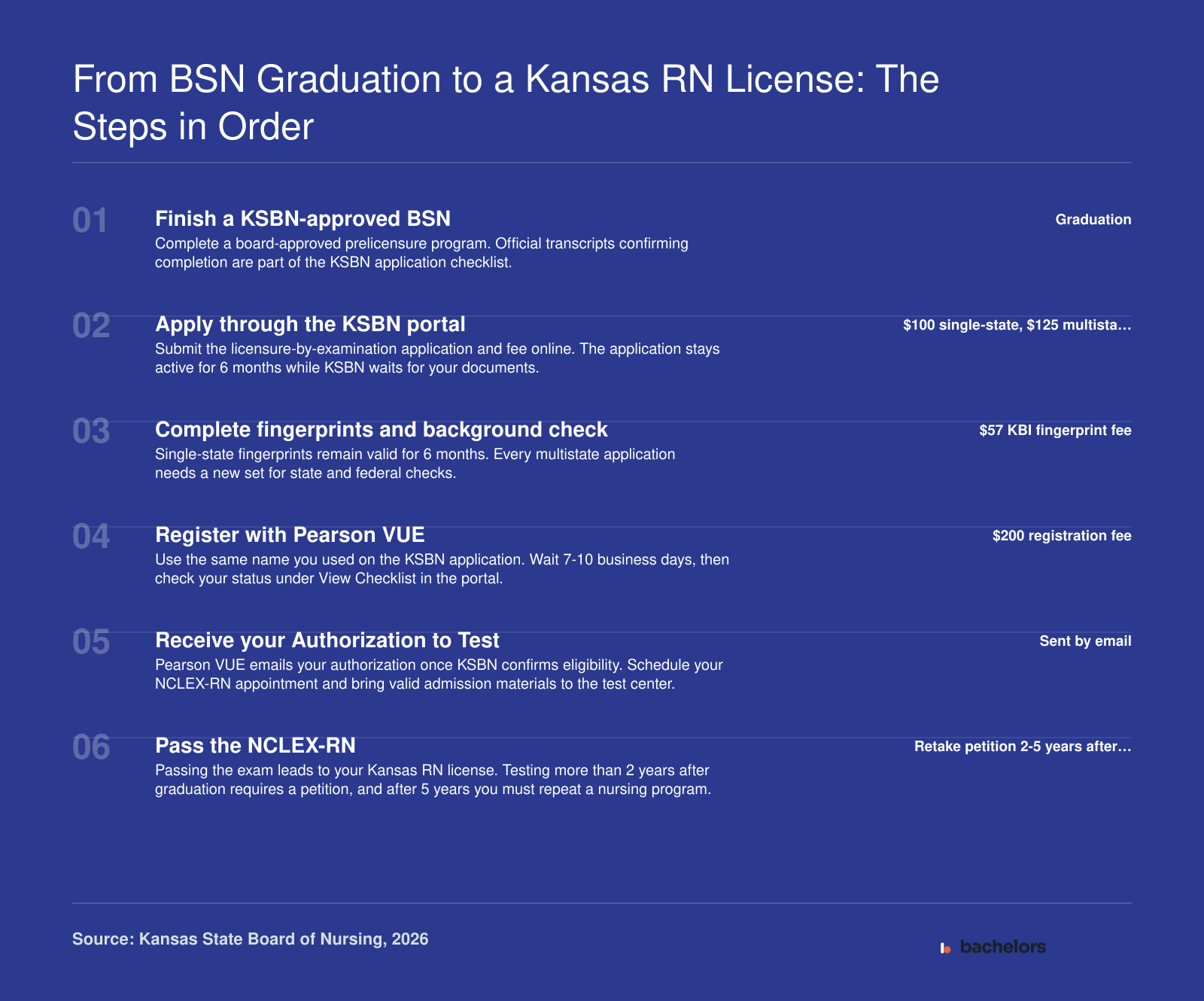
The path runs in one direction: finish a board-approved BSN, apply for licensure with the Kansas Board of Nursing, and pass the NCLEX-RN. The graphic below sets out the sequence.
From BSN Graduation to a Kansas RN License: The Steps in Order
After graduation, a new BSN holder moves through a fixed sequence with the Kansas State Board of Nursing (KSBN) and Pearson VUE. Minimum direct costs come to about $357 for a single-state license or $382 for a multistate license. Kansas is a Nurse Licensure Compact state, so residents who meet the uniform requirements can apply for a multistate RN license.
Compare Bachelor of Science in Nursing (BSN) programs on the data that matters
Explore more Nursing majors or browse every field of study.
All Nursing programs Browse every field of study