Best Accelerated BSN (ABSN) Programs in Kansas
Compare 7 accredited Accelerated BSN (ABSN) programs in Kansas, with net price after aid, graduation rates, earnings and debt from IPEDS and the U.S. College Scorecard.
An accelerated BSN compresses a nursing degree into 12 to 18 months of full-time study, which leaves little room for a job or a long commute. If you already hold a bachelor's degree in another field, the trade is usually worth it: general education is behind you, and nursing coursework starts right away. Lectures may be partly online, but clinicals are always in person, so the location of the program and its hospital partners matters as much as the tuition.
Geography complicates the choice. Some Kansas City-area options sit on the Missouri side of the state line, and a Missouri-approved program is not the same as a Kansas-approved one when you apply for a Kansas RN license.
Key Points
- Ottawa University-Ottawa lists $29,940 total tuition for its 16-month, 60-credit program.
- Kansas Board of Nursing approval, not accreditation, unlocks RN licensure eligibility.
- A Kansas multistate RN license costs $125; single-state costs $100.
Ranked: The Top Accelerated BSN Schools for Kansas Career Changers
Six Kansas schools returned an accelerated nursing option for this list, and the gap between first and sixth comes down to price and format rather than prestige. Pittsburg State pairs the lowest published in-state tuition in the group with fully online coursework, while the private Kansas City-area campuses that follow charge more and compete on 12- to 16-month pre-licensure timelines and hospital clinical placements. Each card profiles the school rather than a single track, so read the program bullets to see whether the accelerated route is open to career changers or reserved for licensed nurses.
Pittsburg State University
#1Pittsburg, KS · $16,000/yr (est. net price)
Best for: Working RNs finishing a bachelor's online
Pittsburg State University is a public university in southeast Kansas, and the accelerated BSN option in this list is its online RN-to-BSN track, a degree-completion path for licensed registered nurses rather than a pre-licensure second degree. Students take upper-division nursing courses over three semesters with part-time pacing available, and an ADN jumpstart option lets associate-degree students begin BSN coursework early. Instruction is fully online and the program is CCNE accredited. Career changers without an RN license should look at the university's separate pre-licensure BSN instead.
- Online RN-to-BSN track for licensed registered nurses
- Three semesters of upper-division nursing courses, about 12 months
- Part-time pacing for nurses who keep working
- Jumpstart option lets ADN students begin BSN courses early
- Upper-division focus on leadership, critical thinking and evidence-based care
- CCNE accredited
Wichita State University
#2Wichita, KS · ~$13,000/yr (est.)
Best for: Wichita-area applicants weighing nearby nursing routes
Wichita State University is a public research university in Kansas's largest city, and its School of Nursing houses an accelerated BSN track alongside traditional BSN and RN-to-BSN routes. The accelerated option is not currently enrolling new students, so the school directs interested applicants toward its other nursing programs while staff answer questions about curriculum and admission from the program office on the Wichita campus. The nursing programs are CCNE accredited. For readers comparing Kansas accelerated BSNs, Wichita State is a name to check back on rather than a program to apply to today.
- Accelerated BSN track inside the Wichita State School of Nursing
- Not currently enrolling new students
- Traditional BSN and RN-to-BSN remain open as alternatives
- Program office located on the Wichita campus
- CCNE accredited
Baker University
#3Baldwin City, KS · ~$25,000/yr (est.)
Best for: Career changers who need online didactics
Baker University is a private university based in Baldwin City, and its accelerated BSN is one of the more flexible formats on this list: didactic courses run online while clinicals happen in long weekend blocks at a Magnet-designated hospital. The 14.5-month program covers 62 nursing credit hours, from mental health and pediatrics to critical care and community health, with NCLEX preparation and leadership coursework built in. Cohorts stay small, and each student works with a faculty advisor and a student success coach. Baker also maintains a Topeka nursing location tied to Stormont Vail Health.
- 14.5-month program with 62 nursing credit hours
- Didactic courses delivered 100% online
- Clinicals in long weekend blocks at a Magnet-designated Topeka hospital
- Cohorts of about 30 students with faculty advisors and success coaches
- Curriculum spans mental health, pediatrics, critical care and community health
- NCLEX prep, leadership and evidence-based practice built into coursework
- School reports a 95% licensure pass rate
- CCNE accredited
MidAmerica Nazarene University
#4Olathe, KS · ~$32,000/yr (est.)
MidAmerica Nazarene University is a private university in Olathe, positioned squarely in the Johnson County and Kansas City market. Its accelerated BSN is a 12-month, cohort-based program taught on campus with modern labs and clinical placements through regional hospital partners. The track was built with LPNs, paramedics and students holding prior college credit in mind, and applicants apply directly to the university rather than through Nursing CAS. Financial aid, scholarships and military benefits are available, and the program is CCNE accredited.
- 12-month, cohort-based accelerated BSN
- On-campus instruction in Olathe with lab and simulation work
- Designed for LPNs, paramedics and students with prior college credit
- Clinical partnerships with regional hospitals
- School reports a 94% licensure pass rate
- Apply directly to MNU; no Nursing CAS application required
- Monthly information sessions for prospective students
- Military benefits, scholarships and financial aid accepted
University of Saint Mary
#5Leavenworth, KS · ~$23,000/yr (est.)
The University of Saint Mary is a private university in Leavenworth, sponsored by the Sisters of Charity of Leavenworth, and its 12-month accelerated BSN draws clinical placements from the Kansas City metro. Coursework is hybrid: online classes paired with on-campus residencies and 714 hours of clinical rotation at Kansas City-area facilities. Classes run in seven- or eight-week terms with a summer start, and faculty are certified in online teaching. The program is CCNE accredited and designed for career changers and second-degree students.
- 12-month program, 60 total credit hours
- Hybrid format: online classes plus on-campus residencies
- 714 hours of clinical rotations at Kansas City-area facilities
- Seven- or eight-week course terms with a summer start
- TEAS entrance exam and a 3.0 GPA minimum
- Built for career changers and second-degree students
- Faculty certified in online teaching
- CCNE accredited
Ottawa University-Ottawa
#6Ottawa, KS · ~$28,000/yr (est.)
Ottawa University is a private university whose pre-licensure BSN runs at its Overland Park campus rather than in the city of Ottawa, placing students in the Kansas City, Kansas market. The program takes 16 months across eight terms, with three start dates a year and clinical sites on both sides of the state line. A 120-hour capstone pairs each student with a nurse preceptor, and admission runs on prerequisite credits, a 2.5 GPA and TEAS scores. It is the longest of the accelerated routes on this list.
- 16-month pre-licensure BSN at the Overland Park campus
- Three start dates a year: January, May and August
- 60 nursing credits across eight terms
- 60 clinical hours per course, with sites in Kansas and Missouri
- 120-hour capstone under a nurse preceptor
- 2.5 GPA minimum and 60 prerequisite credits
- TEAS scores from 58.7% to 77.3% required for admission
- $499 per credit hour, about $29,940 in program tuition
Cost & outcomes by school
Federal data for the highest-earning Accelerated BSN (ABSN) programs, independent of the ranking above. Earnings are this field's bachelor's graduates four years after completing where the Scorecard reports them, else the school's undergraduate median.
| School | Net price / yr | Grad rate | Earnings | Debt | Grads/yr | Format |
|---|---|---|---|---|---|---|
| Baker University KS | $25,301 | 58% | $63,855 | $25,000 | 516 | Online |
| MidAmerica Nazarene University KS | $32,165 | 54% | $62,972 | $15,000 | 618 | Campus |
| University of Saint Mary KS | $22,519 | 48% | $59,483 | $22,018 | 434 | Campus |
| Ottawa University-Kansas City KS | — | — | $55,552 | $21,500 | 170 | Campus |
| Ottawa University-Ottawa KS | $27,963 | 28% | $55,552 | $21,500 | 384 | Campus |
| Wichita State University KS | $13,194 | 51% | $51,532 | $20,500 | 4,710 | Campus |
| Pittsburg State University KS | $15,784 | 57% | $50,579 | $18,969 | 1,990 | Online |
Sources: U.S. Department of Education. Net price, graduation rate, earnings and debt: College Scorecard (earnings and debt for this field's bachelor's graduates where reported, else school-wide); graduates: IPEDS. A dash means no figure is reported.
Cost, debt & payoff
Median earnings of this field's bachelor's graduates (4 yrs after completing, else the school's undergraduate median) vs. their median federal loan debt · U.S. College Scorecard
Across these programs the median graduate earns about $55,552 and finishes with roughly $21,500 in debt — a ratio that clears a common rule of thumb (keep debt below first-year salary). Net price and debt vary widely school to school, so check the per-school figures in the table above before you shortlist.
Behind the List: What Moved a Kansas ABSN up or Down
Which Kansas accelerated BSN programs give a career changer with a bachelor's in another field the strongest mix of cost, access and outcomes? Those three factors decide the order below, and each one is something you can verify yourself.
The Factors That Shape the Order
- Published tuition: The sticker price a school lists before any financial aid is applied.
- Average net price: What students typically pay after grants and scholarships. This figure is often a better guide to your real bill than the listed rate.
- Graduation rate: This covers the whole institution, not the ABSN cohort alone. It shows how well a campus supports students overall, but an accelerated nursing cohort can perform quite differently.
- Delivery format: Whether coursework runs on campus, hybrid or partly online. Labs and clinical hours stay in person regardless.
Where the Programs Sit
Every school on this list operates from a Kansas campus, from Wichita and Pittsburg to Baldwin City, Olathe, Leavenworth and Ottawa, so their nursing programs answer to the Kansas State Board of Nursing. If you also look across the state line at Kansas City, Missouri schools, those programs are approved by Missouri's board. Graduating from one can still lead to a Kansas RN license, since Kansas accepts graduates of other states' approved programs who pass the NCLEX-RN.
What You Still Need to Verify
The list does not measure clinical placement quality, cohort size, faculty-to-student ratios or how competitive admission is. Ask each school where rotations take place, how many students start per cohort and how many apply for those seats. Confirm the track itself, too: Pittsburg State University's listed nursing program is an RN to BSN option, so check whether a second-degree route fits your background before you apply.
Related Articles
ABSN Pace and Price in Kansas: 12 to 18 Months of Full-Time Study
Ottawa University-Ottawa lists $29,940 in total program tuition, at $499 per credit across 60 credit hours and 16 months. Among the Kansas programs here, it is the clearest published price, and it shows how pace and cost connect.
How Fast the Programs Run
The schools here run year-round with no summer break, and most advise against holding a job. MidAmerica Nazarene University and University of Saint Mary both list 12-month tracks. Saint Mary's runs 57 credit hours in 7- or 8-week terms and includes 714 clinical hours. MidAmerica Nazarene lists 60 to 63 credits. Ottawa stretches 60 credits over 16 months, and Baker University lists 15 months. Baker also shows 120 total credit hours, so its credit count is not directly comparable to the others.
What Tuition Looks Like
MidAmerica Nazarene charged $575 per credit for 2025-26. Multiplying that across its credit range gives a rough tuition figure of about $34,500 to $36,200, but the school says total cost is worked out individually, so treat that as a ballpark. Saint Mary's and Baker publish estimates, and it is not always clear whether lab, clinical, technology and testing fees are included. Ask each admissions office for an itemized fee schedule.
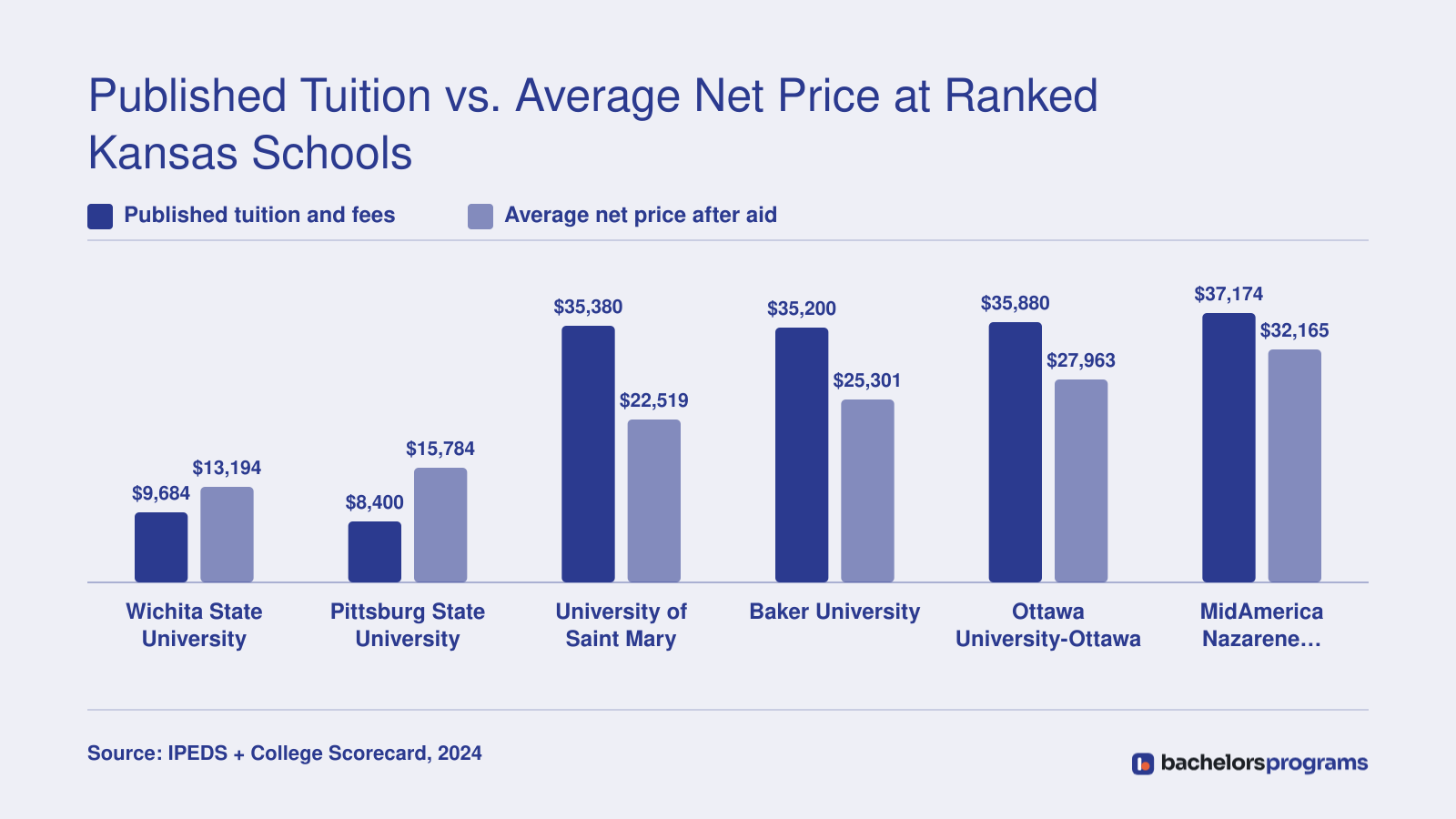
Private pricing runs well above public rates. Institution-wide, published in-state tuition is $9,684 at Wichita State University and $8,400 at Pittsburg State University. The private schools here sit between $35,300 and $37,174. Average net price (what students pay after grants) is $13,194 at Wichita State and $15,784 at Pittsburg State, versus $22,519 to $32,165 at the private schools. These are campus-wide figures for standard undergraduates. ABSN pricing often differs, so use them as context, not a quote.
Costs Readers Forget
The tuition line is not the whole bill. Budget for:
- Screening: Ottawa requires a criminal background check and a 12-panel drug screen.
- Health and gear: Immunization records or boosters, uniforms and clinical supplies.
- Course materials: Textbooks and ATI or HESI testing packages, where the school does not bundle them.
- Licensure: NCLEX-RN registration fees after graduation.
- Leftover prerequisites: Any science courses still missing before the cohort starts, which are billed separately from the nursing credits.
Published Tuition vs. Average Net Price at Ranked Kansas Schools
Both figures are institution-level undergraduate numbers from federal data. They describe each school overall, not an ABSN price quote, so confirm program tuition with each nursing department. The widest gap between sticker price and net price is at the University of Saint Mary: published tuition and fees of $35,380 against an average net price of $22,519, a difference of $12,861. Baker University, Ottawa University-Ottawa and MidAmerica Nazarene University also show average net prices below their published tuition. At Wichita State University and Pittsburg State University, the average net price is higher than published tuition. Net price counts the full cost of attendance, including housing and books, minus grant aid, while the tuition figure covers tuition and fees alone.
Paying for an Accelerated BSN in Kansas: Aid, Scholarships and Hospital Tuition Deals
Grant money gets scarce once you hold a bachelor's degree, so financing an ABSN usually comes down to a tradeoff: borrow now, or commit your first years as an RN to an employer or the state in exchange for help.
Federal Aid for Second-Degree Students
Pell Grants are generally off the table for students who already have a bachelor's. An ABSN is an undergraduate program, so Grad PLUS loans do not apply. Your main federal option is undergraduate Direct Loans, which carry annual and lifetime caps. Loans from your first degree count toward that lifetime limit. Ask each school's aid office how much eligibility you have left before you budget around a loan.
Kansas and School Scholarships
The Kansas Nursing Service Scholarship works through sponsors. A Kansas-licensed employer of LPNs or RNs agrees to hire you after licensure. Sponsors in certain counties are excluded, and mental-health centers and treatment facilities get priority. You owe one year of Kansas nursing practice for each year of support. The 2026-2027 deadline is June 1. Confirm directly with the program whether accelerated second-degree students qualify and what the award covers.
At the University of Saint Mary, the Brisley Scholarship Program offers up to $4,000 per year to incoming ABSN students. Saint Mary's ABSN runs 12 months, so treat that as roughly one award unless the school says otherwise.
Hospital Tuition Partnerships
Where hospital deals exist, they typically pair tuition help with guaranteed employment and a multi-year work commitment, sometimes three years. Before signing, ask what happens if you leave early and whether payments are taxable.
- Practical tip: Find out whether the ABSN is billed at a flat program rate or per credit hour. The answer changes how loans and scholarships are applied each term.
Kansas Board of Nursing Approval, Accreditation and the NCLEX-RN
Does an ABSN need national accreditation for you to become a Kansas RN? No. It needs approval from the Kansas State Board of Nursing (KSBN). The board's 2026 prelicensure list covers programs whose graduates can qualify for licensure, and national nursing accreditation is not required for that approval.
Approval vs. Accreditation
Board approval and accreditation do different jobs. KSBN approval decides whether you can sit for the licensing exam. Accreditation from CCNE or ACEN is a separate peer review of program quality. It matters later, because many graduate nursing programs and some employers look for it. Check both before you commit.
Status at the Ranked Schools
- Baker University: KSBN-approved. Its accelerated BSN, which began in 2024 and runs four semesters within 15 months, sits under a CCNE-accredited baccalaureate.2 The accreditation runs through 2031, with the next on-site evaluation in Spring 2031.1
- University of Saint Mary: KSBN-approved and CCNE-accredited at the prelicensure baccalaureate level.1 Its 12-month hybrid accelerated program is built on that degree, though the source does not describe a separate accreditation decision for the accelerated track.
Neither school is described as conditional or under a pending accreditation review. For Wichita State University, MidAmerica Nazarene University and Ottawa University-Ottawa, confirm current approval on the board's 2026 prelicensure list and on each school's nursing page before you apply.
NCLEX-RN Pass Rates
Pass rates for these specific programs are not reported here. KSBN publishes NCLEX-RN pass rates by program each year. When you compare schools, use the same reporting year for each one. Cohorts are small, so one year can swing a percentage a lot.
After Graduation
- Apply for licensure: You file with the board, and your school confirms you completed the program.
- Receive authorization to test: Once the board finds you eligible, you can schedule the NCLEX-RN.
- Pass the exam: The NCLEX-RN is the national licensing test for registered nurses.
- License issued: After a passing result, the board issues your Kansas RN license.
Getting Licensed as a Kansas RN After an ABSN
Questions to Ask Yourself
Can you step away from paid work for a year or more?
Are your science prerequisites recent enough?
Would you commute to a Kansas City, Missouri campus?
Would a hospital tuition-forgiveness offer tie you down?
Three Fast Answers for Second-Degree Nursing Students in Kansas
These answers cover the questions career changers ask most about timing, delivery and prerequisites. Always confirm current details on each school's admissions page before you apply.
Can I finish a nursing degree in about 12 months in Kansas if I already hold a bachelor's degree?
Do any Kansas accelerated nursing programs let me complete coursework online?
Do I need every science prerequisite finished before I apply to a Kansas ABSN?
Compare Accelerated BSN (ABSN) programs on the data that matters
Explore more Nursing majors or browse every field of study.
All Nursing programs Browse every field of study