Best BSN Programs in Massachusetts
Compare 31 accredited Bachelor of Science in Nursing (BSN) programs in Massachusetts at 28 colleges, with net price after aid, graduation rates, earnings and debt from IPEDS and the U.S. College Scorecard.

A BSN does not let anyone work as a registered nurse in Massachusetts; passing the NCLEX-RN does. That makes first-attempt exam results the most practical measure for anyone choosing a traditional pre-licensure BSN here.
The main list is ordered by first-time NCLEX-RN pass rate, with completion and accreditation breaking ties. Cost, earnings, admissions, state grants, and Board of Registration in Nursing licensure all change the final calculation.
Price complicates the choice. Private colleges post sticker prices several times higher than public universities such as Worcester State, yet strong exam outcomes show up at both.
Key Points
- Simmons University reports the highest median first-year earnings among ranked BSN schools.
- Community colleges post the lowest net prices but offer associate nursing degrees.
- The Board of Registration in Nursing approves programs under 244 CMR 6.00.
Top NCLEX-RN Outcomes: 10 BSN Schools in Massachusetts Ranked
This ranking starts with the NCLEX-RN. Each Massachusetts BSN program below is ordered by its first-time pass rate on the national licensure exam, which supplies about three quarters of the score using the state board's most recent three years of results, weighted by how many candidates sat for the test. Accreditation and a small amount of completion and retention data settle close calls.
Emmanuel College
#1Boston, MA · ~$27,000/yr (est.) · NCLEX-RN pass rate 100%
Best for: Boston-area students wanting hospital placements
A private Catholic college in Boston where nursing has been taught for more than four decades. The CCNE-accredited BSN runs on campus and pairs coursework with clinical placements at Boston hospitals and a capstone mentored by a practicing nurse. The university admits about 76% of applicants and graduates about 68% of students overall, with an average net price near $26,700 after aid.
- CCNE accredited and approved by the Massachusetts board
- Capstone clinical mentored by a professional nurse
- Clinical rotations in mental health, maternity, pediatrics, community health
- 40+ years of nursing education in Boston
Westfield State University
#2Westfield, MA · $15,000 – $20,000/yr (est.) · NCLEX-RN pass rate 98.4% (3-yr weighted avg)
Best for: Cost-conscious students in western Massachusetts
A public university in western Massachusetts and one of the stronger values in the state for a traditional BSN. Clinical work begins in the first semester of sophomore year, supported by a simulation lab and a senior capstone preceptorship, and admission requires no entrance exam. The university admits about 81% of applicants and graduates about 54% of students overall; average net price after aid comes in near $16,700.
- CCNE accredited; no entrance exam and test-optional admission
- Clinicals begin in the first semester of sophomore year
- State-of-the-art simulation lab
- Senior capstone preceptorship with full internship placement
- 2.5 GPA minimum for the nursing major
Endicott College
#3Beverly, MA · $40,000 – $45,000/yr (est.) · NCLEX-RN pass rate 98.2% (3-yr weighted avg)
Best for: Students eyeing a fifth-year master's option
A private college on Boston's North Shore whose nursing students start clinicals in sophomore year with a 1:6 faculty-to-student ratio in practice settings. Placements include Beverly Hospital and Boston's major teaching hospitals, and the 126-credit curriculum closes with a senior capstone. The university admits about 71% of applicants, graduates about 76% of students overall, and averages roughly $40,700 in net price after aid.
- 126-credit BSN with clinicals from sophomore year
- 1:6 faculty-to-student ratio in clinical settings
- Internships at Boston's top hospitals
- Fifth Year Master's pathway available
- 3.0 GPA minimum and prerequisite courses required
- Full-time enrollment required
Boston College
#4Chestnut Hill, MA · ~$42,000/yr (est.) · NCLEX-RN pass rate 96.5% (3-yr weighted avg)
The most selective campus on this list, admitting about 16% of applicants, and its Chestnut Hill location draws clinical placements from Brigham and Women's and Boston Children's. The CCNE-accredited BSN includes a Seacole Scholars living-learning community, undergraduate research fellowships, and a junior year abroad taken by roughly a third of students. The university graduates about 91% of students overall and averages near $41,700 in net price after aid.
- Seacole Scholars living-learning community
- Undergraduate Research Fellows program
- Study abroad junior year, chosen by about a third of students
- Clinical placements at Brigham and Women's and Boston Children's
- 448 undergraduate nursing students
Assumption University
#5Worcester, MA · ~$29,000/yr (est.) · NCLEX-RN pass rate 96%
A private Catholic university in Worcester whose Froelich School of Nursing admits first-years directly into the BSN. The 127-credit program pairs high-fidelity simulation with clinical rotations at UMass Memorial and Saint Vincent's Hospital, and a 41,000-square-foot health sciences building supports the work. The university admits about 83% of applicants, graduates about 75% of students overall, and averages near $29,500 in net price after aid.
- Direct admission to the nursing program for first-years
- 127 credit hours, including 56 credits of nursing coursework
- High-fidelity simulation mannequins in skills labs
- Clinicals at UMass Memorial and Saint Vincent's Hospital
- 3.2 GPA minimum; prerequisite courses required
- Annual hands blessing ceremony before clinical practice
Worcester State University
#6Worcester, MA · ~$13,000/yr (est.) · NCLEX-RN pass rate 95.4% (3-yr weighted avg)
The lowest average net price after aid among the ranked public campuses, roughly $13,400, which makes it the cost-conscious pick in central Massachusetts. Clinical placements run through UMass Memorial Health and community health centers, and the CCNE-accredited curriculum covers medical-surgical, pediatric, mental health, and community nursing. The university admits about 88% of applicants and graduates about 61% of students overall.
- CCNE accredited and approved by the state board
- Clinical placements at UMass Memorial Health and community health centers
- Simulation labs with hands-on practice
- Student chapter of the National Student Nurses' Association
- Sigma Theta Tau honor society chapter
Fitchburg State University
#7Fitchburg, MA · $14,000/yr (est. net price) · NCLEX-RN pass rate 94.6% (3-yr weighted avg)
The first public state university in Massachusetts to offer nursing, and still one of the most affordable routes to the credential. Students log a 17-hour-per-week capstone clinical and train in a simulation lab with code blue scenarios, with faculty-led study abroad available. Average net price after aid is about $14,300, and the university admits roughly 87% of applicants and graduates about 55% of students overall.
- First public state university in Massachusetts to offer nursing
- 17-hour-per-week capstone clinical experience
- Simulation lab with code blue training
- Faculty-led study abroad trips
- Small class sizes with collaborative learning
Curry College
#8Milton, MA · $29,000/yr (est. net price) · NCLEX-RN pass rate 94.7% (3-yr weighted avg)
A private college just south of Boston where nursing students complete six semesters of clinical work at Boston hospitals with a maximum 6:1 student-to-faculty ratio. Simulation labs and virtual clinical applications supplement placements, and study abroad in France or Ireland is an option. The university admits about 88% of applicants, graduates about 51% of students overall, and averages near $29,200 in net price after aid. A separate accelerated track serves second-degree students.
- Six semesters of clinical experience at Boston hospitals
- Maximum 6:1 student-to-faculty ratio
- High-fidelity simulation plus virtual clinical applications
- Study abroad in France or Ireland
- Student Nurses Association and Sigma Theta Tau chapter
- Alumni work at Massachusetts General Hospital
University of Massachusetts-Lowell
#9Lowell, MA · ~$17,000/yr (est.) · NCLEX-RN pass rate 93.5% (3-yr weighted avg)
The largest public option in the ranking, with more than 250 clinical agency partners and a senior-year immersion in a specialty the student chooses. Interprofessional coursework puts nursing students alongside dietetics, physical therapy, and pharmacy peers, and a fast track to a master's or DNP is open to high achievers. In-state students see an average net price after aid near $17,200, and the university graduates about 65% of students overall.
- 120 credits with full-time and part-time options
- 250+ clinical agency partnerships
- Senior-year immersion in a nursing specialty
- Interprofessional education with dietetics, PT, and pharmacy students
- B.S. to M.S. or DNP fast track for high achievers
- Simulation labs with observation rooms
Simmons University
#10Boston, MA · $25,000 – $30,000/yr (est.) · NCLEX-RN pass rate 92.9% (3-yr weighted avg)
One of the first university-based nursing programs in the country, and its Boston campus comes with an 11,000-square-foot simulation center and rotations at Massachusetts General and Boston Children's. The Dotson Bridge and Mentoring Program supports students from groups underrepresented in nursing, and a capstone practicum closes the eight-semester sequence. The university admits about 70% of applicants, graduates about 72% of students overall, and averages roughly $25,300 in net price after aid.
- 11,000-square-foot simulation center
- 850+ clinical training sites, including Mass General and Boston Children's
- Capstone practicum in the traditional four-year sequence
- Dotson Bridge and Mentoring Program for diverse students
- One of the nation's first university-based nursing programs
Cost & outcomes by school
Federal data for the highest-earning Bachelor of Science in Nursing (BSN) programs, independent of the ranking above. Earnings are this field's bachelor's graduates four years after completing where the Scorecard reports them, else the school's undergraduate median.
| School | Net price / yr | Grad rate | Earnings | Debt | Grads/yr | Format |
|---|---|---|---|---|---|---|
| Massachusetts College of Pharmacy and Health Sciences MA | $39,545 | 62% | $125,557 | $25,000 | 1,676 | Campus |
| Boston College MA | $41,704 | 91% | $103,937 | $19,000 | 6,686 | Campus |
| Northeastern University MA | $30,915 | 91% | $92,538 | $24,250 | 12,086 | Campus |
| Northeastern University MA | — | — | $92,538 | $24,250 | 1,084 | Campus |
| MGH Institute of Health Professions MA | — | — | $87,130 | $24,961 | 324 | Campus |
| Merrimack College MA | $37,927 | 70% | $75,584 | $27,000 | 1,916 | Campus |
| Assumption University MA | $29,498 | 75% | $74,895 | $27,000 | 868 | Campus |
| University of Massachusetts-Amherst MA | $22,383 | 83% | $71,631 | $22,763 | 13,682 | Campus |
| University of Massachusetts-Dartmouth MA | $20,927 | 52% | $68,804 | $25,000 | 2,260 | Campus |
| Emmanuel College MA | $26,706 | 68% | $68,245 | $27,000 | 940 | Campus |
| Wheaton College (Massachusetts) MA | $29,822 | 73% | $67,725 | $26,000 | 946 | Campus |
| University of Massachusetts-Boston MA | $17,707 | 49% | $65,865 | $21,974 | 5,042 | Campus |
Sources: U.S. Department of Education. Net price, graduation rate, earnings and debt: College Scorecard (earnings and debt for this field's bachelor's graduates where reported, else school-wide); graduates: IPEDS. A dash means no figure is reported.
Cost, debt & payoff
Median earnings of this field's bachelor's graduates (4 yrs after completing, else the school's undergraduate median) vs. their median federal loan debt · U.S. College Scorecard
Across these programs the median graduate earns about $64,184 and finishes with roughly $25,000 in debt — a ratio that clears a common rule of thumb (keep debt below first-year salary). Net price and debt vary widely school to school, so check the per-school figures in the table above before you shortlist.
Inside the Scoring: Why First-Time NCLEX-RN Results Carry the Most Weight
A ranking of Massachusetts BSN programs starts with exam results rather than tuition or campus life. A nursing degree is only as useful as the license it leads to, and the NCLEX-RN is the gate to that license.
How the Weighting Works
First-time NCLEX-RN pass rate makes up roughly 75% of each school's score. The figure is a three-year average, weighted so that large cohorts count more than small ones, which keeps a single unusually strong or weak year at a small program from swinging the list. Accreditation status and completion and retention fill in the remaining quarter.
Why the Method Is Open
Some rankings cite outside lists without saying how they were built. Here every input is public: state board exam results, accreditation status, and federal IPEDS and College Scorecard data. Anyone can check the underlying numbers.
Limits to Keep in Mind
- Graduation rates: These are institution-wide, so they describe the whole college, not only its nursing students.
- Net price: This is an average after aid, so your own cost will depend on your aid package and household income.
- Scope: Only traditional pre-licensure BSN programs are ranked. Associate degree, hospital diploma, RN to BSN, and accelerated tracks follow different routes and are not scored against them.
Use the ranking as a starting point, then confirm each school's admissions policy and board approval status before you apply.
Cheapest BSN Programs in Massachusetts by Net Price After Aid
Net price is the average amount full-time students actually paid after grants and scholarships. The tuition column is the published in-state sticker price before any aid, from federal College Scorecard data. Bay Path University, a private school, shows the gap between the two: its $38,302 sticker price falls to an average net price of $14,271, close to the public state universities here. For comparison, UMass campuses list 2025-26 in-state tuition and mandatory fees from $16,232 at Dartmouth to $18,488 at Amherst, and nursing charges come on top of that, such as Amherst's $1,000 per-semester program fee or Salem State's $1,000 yearly nursing fee. These net prices are averages across each school's aided undergraduates, not nursing students alone, so your own cost depends on your financial aid package.
| School | Sector | Format | Average Net Price After Aid | Published In-State Tuition and Fees (Before Aid) | Graduation Rate (Institution-Wide) |
|---|---|---|---|---|---|
| Worcester State University | Public | On campus | $13,381 | $11,786 | 61% |
| Fitchburg State University | Public | On campus | $14,262 | $11,346 | 55% |
| Bay Path University | Private nonprofit | Online | $14,271 | $38,302 | 44% |
| Salem State University | Public | On campus | $15,996 | $12,338 | 50% |
| Massachusetts College of Liberal Arts | Public | On campus | $16,068 | $12,436 | 56% |
Related Articles
Getting Into a Massachusetts BSN: Prerequisites, GPA, Testing, and Direct-Entry Policies
Some Massachusetts BSN programs place you in the nursing major on day one, while others ask you to earn a seat after a year or two of prerequisite coursework. Knowing which model a school uses matters more than almost any other detail when you apply.
Direct Admission vs Upper-Division Entry
Northeastern University and Assumption University describe a direct route. Northeastern admits freshmen into the Boston BSN through the standard undergraduate application, with no separate nursing supplement.1 Assumption's program information lists direct admit to nursing.
Westfield State University notes clinical work beginning in the first semester of sophomore year, which signals an early, structured sequence. For Boston College, Emmanuel College, Worcester State University, and Fitchburg State University, the pages reviewed do not clearly establish whether freshmen enter nursing directly or through a pre-nursing stage. Confirm that on each school's admissions page before you apply.
Prerequisites and GPA
Expect a science-heavy foundation: biology, chemistry, and algebra, plus anatomy and physiology for students moving into nursing from another major. Published minimums vary by school and can change from year to year:
- Westfield State: a 2.5 GPA minimum is listed.
- Endicott College: a 3.0 GPA minimum and required prerequisite courses are listed.
- Assumption University: a 3.2 GPA minimum, one recommendation letter, and prerequisite courses are listed.
- Worcester State: prerequisite courses are listed, but no minimum GPA appears in the data reviewed.
Treat these as starting points, since competitive applicants often exceed them.
Test Policy and Transfer Routes
Westfield State and Endicott both describe themselves as test-optional with no entrance exam. Boston College is test-optional for transfer applicants, though it encourages scores from those who took the tests.2 Whether Northeastern's freshman nursing applicants are test-optional in 2026 is not established, so check its current admissions page.
No TEAS or HESI requirement turned up for Northeastern's or Boston College's routes. Northeastern lets current students change majors into the BSN, but no minimum GPA or prerequisite list is established for that move.1 It is not accepting external transfers into the Boston undergraduate BSN. Boston College is likewise not accepting transfer applications to its Connell School of Nursing right now. Transfer entrants there normally begin as first-semester sophomores and complete six semesters.2 Applicants who come in with a bachelor's degree are directed to accelerated second-degree options, which carry their own admission rules.
A Practical Tip
Before you enroll in a pre-nursing track or plan to switch majors later, ask how many internal-transfer seats exist and what GPA recent admits had. A school with limited seats can turn a nursing plan into a different degree, and direct admission removes most of that risk.
Paying for a BSN in Massachusetts: Sticker Price, Net Price, and State Grants
The price on a school's website and the price you pay are rarely the same number, and the gap can run in either direction. Private colleges tend to post high tuition and then discount it with institutional aid. Public campuses start lower but usually discount less.
Sticker Price vs. Net Price
Worcester State University shows how a public campus looks in the data: in-state tuition and fees of $11,786, and an average net price of $13,381. Net price counts the full cost of attending (housing, food, books) minus grant aid, so it can land above tuition alone. Private schools such as Boston College, Simmons University, or Merrimack College post higher tuition, but their net price depends heavily on your family's finances. Compare net prices, not sticker prices.
State Aid From the Department of Higher Education
The Massachusetts Department of Higher Education, through its Office of Student Financial Assistance, runs the state's main undergraduate aid programs.
- MASSGrant: A need-based grant usable at public, independent, and nursing schools. For 2026-2027, you need a FAFSA or MASFA on file by June 30, 2026, one year of Massachusetts residency, 12 credits per term, and no prior bachelor's degree.
- MASSGrant Plus: Tuition-free assistance at public four-year institutions for eligible students. The 2025-2026 guidelines required at least 6 credits per term for families under $85,000 and 12 credits for those at $85,000 to $100,000. An expansion reached non-Pell-eligible students with a student aid index of $15,000 or less.
- Commonwealth Commitment, MassTransfer, and Gilbert Matching Student Grant: These programs serve community college transfers and students at independent colleges. Current terms and award amounts were not confirmed in the sources reviewed, so verify them with the Department of Higher Education and each school's financial aid office before counting on them.
No scholarship or loan-repayment program specific to nursing in Massachusetts turned up in the sources reviewed. Ask the Office of Student Financial Assistance and each nursing department about program-specific awards.
Your Next Step
File the FAFSA (or MASFA, if you cannot complete it) as soon as it opens for your enrollment year. June 30 is MASSGrant's program deadline, not a universal priority date, and many schools set earlier institutional deadlines, so confirm each date. Then run the net price calculator on every school's website with your own family numbers. That comparison will tell you more than any tuition table.
First-Year Pay for Massachusetts BSN Graduates
Among the schools ranked here, Simmons University reports the highest median first-year earnings for BSN completers.
Board of Registration in Nursing Approval, Accreditation, and Your RN License
State approval is the legal permission a nursing program needs to operate in Massachusetts. The Board of Registration in Nursing (BORN) grants it under 244 CMR 6.00, and it comes in three designations: initial, continued, and conditional. Graduating from a Board-approved program is the eligibility gate for the NCLEX-RN, and enrolling in a program without the required approval can leave graduates ineligible to test. Check any school's status on the Board's approved-program list (current as of March 12, 2026) before you commit.
Approval vs. Accreditation
Approval and accreditation are separate things. Accreditation from the Commission on Collegiate Nursing Education (CCNE) or the Accreditation Commission for Education in Nursing (ACEN) is voluntary and national. It matters when you apply to graduate nursing programs, when you rely on federal financial aid, and when employers screen candidates. Confirm both credentials for each school you consider.
The Licensure Steps
Massachusetts licenses graduates as Registered Nurses by examination. The general sequence:
- Apply to BORN: The application fee is $230, unless waived under M.G.L. c. 112, § 1B. Applicants need a valid Social Security number and must meet the good moral character standard. The state materials do not say whether exam, background-check, or vendor charges are included in that fee, so budget for them separately.
- Register with Pearson VUE: Registration for the NCLEX-RN follows your Massachusetts application and the Board's eligibility determination.
- Receive your Authorization to Test: You cannot schedule the exam without it. Confirm the current Pearson VUE fee and scheduling rules directly with the vendor.
- Pass the NCLEX-RN: A passing score, together with graduation from an approved program, completes the core requirements.
Moving Your License to Another State
Massachusetts enacted the Nurse Licensure Compact in November 2024 but has not implemented it. A Massachusetts RN license should not be treated as multistate, and it carries no compact privileges elsewhere. Once a state is in the compact, the multistate license comes from your primary state of residence.
For now, moving means endorsement: you apply to the destination state, which issues a new license after you meet its requirements. Coming the other way, out-of-state RNs applying in Massachusetts pay a $275 endorsement fee plus a $30 license verification fee through Nursys.
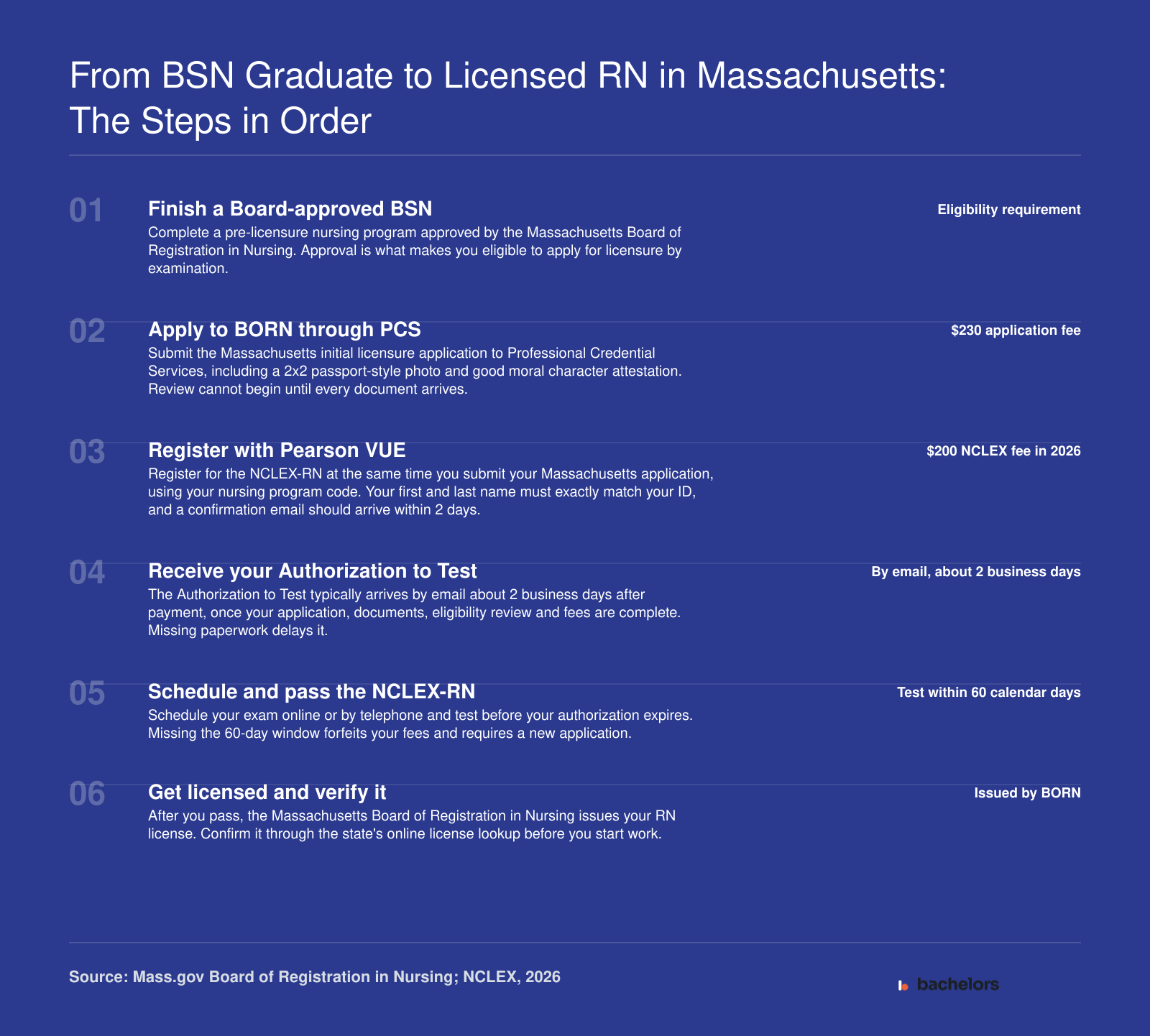
From BSN Graduate to Licensed RN in Massachusetts: The Steps in Order
Massachusetts first-time RN licensure runs through the Board of Registration in Nursing. Professional Credential Services processes the applications and Pearson VUE delivers the NCLEX-RN, so the order below matters: your Authorization to Test is released only after your state application, fee, documents and Pearson VUE registration are all complete. Budget $230 for the Massachusetts application and $200 for NCLEX-RN registration in 2026 (the U.S. exam fee is scheduled to rise to $350 on February 1, 2027), and plan to sit for the exam within 60 calendar days of receiving authorization. This sequence covers first-time licensure by examination only. If you later move to another state with a Massachusetts license, or arrive in Massachusetts already licensed elsewhere, licensure by endorsement is a separate path with its own application.
Massachusetts RN Licensing Authority at a Glance
Compare Bachelor of Science in Nursing (BSN) programs on the data that matters
Explore more Nursing majors or browse every field of study.
All Nursing programs Browse every field of study