Best BSN Programs in Missouri
Compare 51 accredited Bachelor of Science in Nursing (BSN) programs in Missouri at 38 colleges, with net price after aid, graduation rates, earnings and debt from IPEDS and the U.S. College Scorecard.
A cheaper Missouri BSN saves money only if its graduates pass the NCLEX-RN, because the Missouri State Board of Nursing issues no RN license without that exam. Tuition and location matter, but they come second to first-attempt results.
First-time NCLEX-RN performance drives the ranking, with shorter lists of the most affordable schools and those whose graduates earn the most following it. Licensed RNs and second-degree students belong in RN-to-BSN and accelerated BSN programs, which have their own pages.
A failed first attempt means another $200 Pearson VUE registration and a mandatory wait before retesting. The new graduate spends that time unable to work as an RN.
Key Points
- First-time NCLEX-RN pass rates drive roughly three quarters of each school's score.
- College of the Ozarks anchors the low-cost BSN options in Missouri.
- Even Maryville University graduates, the most indebted here, owe a median $26,000.
Top 10 Missouri BSN Programs Ranked by NCLEX-RN Outcomes
These ten programs are ordered by nursing exam performance: how many graduates pass the NCLEX-RN on the first attempt, counted across the three most recent years the state board reports. Each entry pairs that pass rate with what students actually pay after aid, how selective the university is, and how many of its students finish a degree. Pass rates appear exactly as the state board publishes them, and a small graduating class can move a school several places.
William Jewell College
#1Liberty, MO · ~$18,000/yr (est.) · NCLEX-RN pass rate 100% (3-yr weighted avg)
Best for: First-year students wanting direct admission
William Jewell College is a private liberal arts college in Liberty, just north of Kansas City, where nursing students start clinical work in sophomore year and log more than 650 clinical, lab, and simulation hours before graduation. Its simulation center was the first in Missouri and Kansas to earn international endorsement, and placements run through Kansas City hospitals in pediatrics, critical care, oncology, and emergency care. First-time NCLEX-RN pass rates stand at 100% across the state board's latest three-year window, the strongest showing in this ranking. The university graduates 68% of its students overall, admits about 38% of applicants, and reports an average net price after aid of about $24,498.
- CCNE accredited
- Clinicals begin in sophomore year
- More than 650 clinical, lab, and simulation hours
- 6:1 student-faculty ratio
- Direct admission for eligible first-year students
- 2.8 GPA minimum with ACT required
- Senior-year NCLEX live review and success coordinator
- Clinical placements at Kansas City hospitals
University of Missouri-Kansas City
#2Kansas City, MO · $13,000 – $30,000/yr (est.) · NCLEX-RN pass rate 99.4% (3-yr weighted avg)
Best for: Kansas City residents staying close to home
The University of Missouri-Kansas City is a public research university whose nursing programs sit in the city's health sciences district, with clinical work woven into the traditional pre-licensure track from the first fall. A Direct Admit option lets qualified high school students lock in a seat, and a separate accelerated track serves second-degree students. The first-time NCLEX-RN pass rate is 99.4% across 196 test-takers, the second-largest cohort in this ranking. The university graduates 55% of its students overall, admits about 72% of applicants, and reports an average net price after aid of roughly $13,310.
- CCNE accredited
- Traditional four- to five-year pre-licensure track
- Direct Admit option for qualified high school students
- Clinical experiences begin in the fall
- January supplemental application deadline
- Two concentration options
- Five semesters, completed in under two years
- 1,050 clinical hours plus a 300-hour capstone internship
- 2.8 GPA minimum, 3.5 prerequisite GPA recommended
- 30 hours of direct patient interaction required
- Clinical rotations across seven specialties
- Daytime classes only
- 100% online, no campus visits required
- Synchronous and asynchronous course options
- 2.5 GPA minimum
- Team-directed practice experiences
- BSN-PhD bridge option available
- In-state tuition for eligible states
Missouri Southern State University
#3Joplin, MO · $12,000/yr (est. net price) · NCLEX-RN pass rate 99% (3-yr weighted avg)
Best for: Budget-minded students seeking small clinical groups
Missouri Southern State University is a public regional university in Joplin, in the southwest corner of the state, and its BSN is a campus-based pre-licensure program accredited by the Accreditation Commission for Education in Nursing. Recent state funding has kept class sizes small while clinical judgment and patient care skills are built across the curriculum. The first-time NCLEX-RN pass rate is 99% across 57 test-takers. The university admits about 97% of applicants, graduates 42% of its students overall, and reports an average net price after aid of about $12,007.
- ACEN accredited
- State funding supports smaller class sizes
- Accelerated nursing degree pathway available
- Prepares students for NCLEX-RN licensure
- Faculty mentorship paired with small classes
Missouri Western State University
#4Saint Joseph, MO · $13,000/yr (est. net price) · NCLEX-RN pass rate 97.9% (3-yr weighted avg)
Missouri Western State University is a public university in St. Joseph, roughly an hour north of Kansas City, and its traditional BSN runs clinical groups at a 10:1 student-to-instructor ratio with high-tech patient simulators in the lab. A senior capstone course is built as a reality-based transition into the RN role, and placements stretch from St. Joseph into the greater Kansas City region. The first-time NCLEX-RN pass rate is 97.9% on the largest test-taking cohort in this ranking, 228 candidates. The university graduates 39% of its students overall and reports an average net price after aid of about $13,251.
- CCNE accredited
- 10:1 clinical student-to-instructor ratio
- High-tech patient simulators in the simulation lab
- Senior Capstone course for the transition to practice
- Research opportunities with nursing faculty
- Clinical sites across St. Joseph and greater Kansas City
Southeast Missouri Hospital College of Nursing and Health Sciences
#5Cape Girardeau, MO · $15,000 – $20,000/yr (est.) · NCLEX-RN pass rate 95.7% (3-yr weighted avg)
Southeast Missouri Hospital College of Nursing and Health Sciences is a small private college in Cape Girardeau tied to Southeast Hospital, and its BSN is a completion track for licensed RNs who already hold an associate degree. Coursework runs online and blended, with didactic classes meeting one day a week plus a clinical component, and students can transfer up to 34 general education credits and 38 nursing credits. The first-time NCLEX-RN pass rate is 95.7% across 109 test-takers. The college graduates 75% of its students overall and reports an average net price after aid of about $19,390.
- CCNE accredited
- Courses online and blended, didactic class one day weekly
- Up to 34 general education credits transfer
- Up to 38 nursing credits transfer
- 2.5 GPA minimum and an unencumbered RN license
- Part-time and accelerated tracks available
- Clinical component included
- Prepares students to advance toward an MSN
College of the Ozarks
#6Point Lookout, MO · $5,000 – $10,000/yr (est.) · NCLEX-RN pass rate 95.5% (3-yr weighted avg)
College of the Ozarks is a private Christian work college in Point Lookout, near Branson, and its pre-licensure BSN follows a six-semester nursing course plan that ends in a one-on-one preceptorship with a registered nurse. Clinical placements run through healthcare settings across the Ozarks, and the curriculum is taught from a Christ-centered perspective. The first-time NCLEX-RN pass rate is 95.5% across 53 test-takers. The university admits about 12% of applicants, graduates 64% of its students overall, and reports an average net price after aid of about $6,100, the lowest figure in this ranking.
- CCNE accredited
- Six-semester nursing course plan
- One-on-one preceptorship with a registered nurse
- Clinical settings across the Ozarks
- Christ-centered curriculum
- Prerequisite courses required before the nursing sequence
Park University
#7Parkville, MO · $20,000 – $25,000/yr (est.) · NCLEX-RN pass rate 96.2% (3-yr weighted avg)
Park University is a private university in Parkville, just northeast of Kansas City, and its pre-licensure BSN is a 124-credit, cohort-based program with fall and spring start dates. Licensed practical nurses can earn prior learning credit, and clinical experiences take place in Parkville. The first-time NCLEX-RN pass rate is 96.2% across 70 test-takers. The university graduates 38% of its students overall and reports an average net price after aid of about $21,032.
- CCNE accredited and Missouri State Board of Nursing approved
- 124 total credit hours
- Fall and spring start dates
- Cohort-based progression
- Prior learning credit for licensed practical nurses
- ATI admissions test and NursingCAS application
- 2.8 nursing GPA required
- Clinical experiences in Parkville
Southeast Missouri State University
#8Cape Girardeau, MO · $16,000/yr (est. net price) · NCLEX-RN pass rate 95.6% (3-yr weighted avg)
Southeast Missouri State University is a public university in Cape Girardeau whose on-campus BSN pairs classroom instruction with clinical rotations in hospitals, clinics, and community health agencies. The simulation labs hold 12 high-fidelity mannequins, the final term includes eight weeks of focused NCLEX-RN preparation, and about 70% of faculty hold doctoral degrees. The first-time NCLEX-RN pass rate is 95.6% across 172 test-takers. The university admits about 74% of applicants, graduates 58% of its students overall, and reports an average net price after aid of about $15,882.
- CCNE accredited
- HESI entrance exam required
- 12 high-fidelity mannequins in the simulation labs
- Eight weeks of NCLEX-RN preparation in the final term
- Clinical practice in every specialty area
- 70% of faculty hold doctoral degrees
- Fast Track grant eligible for Missouri residents
- 2.8 GPA minimum
Truman State University
#9Kirksville, MO · ~$13,000/yr (est.) · NCLEX-RN pass rate 95% (3-yr weighted avg)
Truman State University is a public liberal arts university in Kirksville that admits roughly 60 nursing students each fall, with direct entry beginning in the first year rather than after a separate upper-division application. Students practice in the Nursing Simulation Center and complete rotations at sites including Northeast Regional Medical Center, and an Army Nursing Program option is available. The first-time NCLEX-RN pass rate is 95% across 156 test-takers. The university admits about 84% of applicants, graduates 69% of its students overall, and reports an average net price after aid of about $12,780.
- CCNE accredited
- Direct entry beginning in the first year
- About 60 students admitted each fall
- Practice in the Nursing Simulation Center
- Clinical rotations at Northeast Regional Medical Center and other sites
- Army Nursing Program option
- ACT required for admission
- 2.8 GPA minimum
Missouri State University
#10Springfield, MO · $18,000/yr (est. net price) · NCLEX-RN pass rate 94% (3-yr weighted avg)
Missouri State University is a public university in Springfield with the largest test-taking cohort in this ranking, 489 candidates sitting the NCLEX-RN in the latest three-year window. The traditional four-year BSN leans on interprofessional education, with nursing students learning alongside anesthesia, therapy, and social care students, and the university is a founding partner of the Alliance for Healthcare Education. Skills labs cover IV insertions and patient assessments in preparation for clinical placement. The first-time NCLEX-RN pass rate is 94% across that cohort, the university graduates 58% of its students overall, admits about 91% of applicants, and reports an average net price after aid of about $17,613.
- CCNE accredited
- Four-year traditional track
- Interprofessional education with anesthesia, therapy, and social care students
- Founding partner of the Alliance for Healthcare Education
- Skills labs for IV insertions and patient assessments
- Accelerated 15-month BSN and one-year RN to BSN also offered
Cost & outcomes by school
Federal data for the highest-earning Bachelor of Science in Nursing (BSN) programs, independent of the ranking above. Earnings are this field's bachelor's graduates four years after completing where the Scorecard reports them, else the school's undergraduate median.
| School | Net price / yr | Grad rate | Earnings | Debt | Grads/yr | Format |
|---|---|---|---|---|---|---|
| Chamberlain University-Missouri MO | $30,716 | 100% | $92,405 | $20,919 | 130 | Hybrid |
| Research College of Nursing MO | — | — | $85,910 | $13,930 | 246 | Campus |
| Barnes-Jewish College Goldfarb School of Nursing MO | — | — | $84,393 | $16,750 | 550 | Campus |
| Saint Louis University MO | $24,398 | 80% | $70,783 | $25,000 | 3,528 | Campus |
| Rockhurst University MO | $25,884 | 75% | $67,102 | $18,250 | 1,072 | Campus |
| University of Missouri MO | $20,268 | 75% | $63,403 | $20,500 | 12,116 | Campus |
| Maryville University MO | $22,066 | 66% | $62,105 | $22,000 | 2,178 | Campus |
| Southeast Missouri Hospital College of Nursing and Health Sciences MO | $19,390 | 75% | $60,918 | $11,500 | 32 | Hybrid |
| University of Missouri-Kansas City MO | $13,310 | 56% | $59,637 | $18,750 | 3,382 | Campus |
| William Jewell College MO | $17,562 | 68% | $59,268 | $24,498 | 498 | Campus |
| Cox College MO | — | 100% | $56,867 | $20,000 | 192 | Campus |
| Park University MO | $21,032 | 38% | $56,309 | $21,685 | 2,238 | Campus |
Sources: U.S. Department of Education. Net price, graduation rate, earnings and debt: College Scorecard (earnings and debt for this field's bachelor's graduates where reported, else school-wide); graduates: IPEDS. A dash means no figure is reported.
Cost, debt & payoff
Median earnings of this field's bachelor's graduates (4 yrs after completing, else the school's undergraduate median) vs. their median federal loan debt · U.S. College Scorecard
Across these programs the median graduate earns about $51,825 and finishes with roughly $20,710 in debt — a ratio that clears a common rule of thumb (keep debt below first-year salary). Net price and debt vary widely school to school, so check the per-school figures in the table above before you shortlist.
Most Affordable Missouri BSN Programs
These schools from the ranking above show the lowest average annual net price, meaning what students actually pay after grants and scholarships, according to 2024 IPEDS and College Scorecard data. College of the Ozarks stands out with a net price far below its sticker tuition, while the public universities that follow sit within a few hundred dollars of each other. Every program listed is a campus-based traditional BSN.
| School | City | Average Annual Net Price | In-State Tuition and Fees | Program Format |
|---|---|---|---|---|
| College of the Ozarks | Point Lookout | $6,100 | $22,320 | On campus |
| Missouri Southern State University | Joplin | $12,007 | $8,960 | On campus |
| Truman State University | Kirksville | $12,780 | $9,838 | On campus |
| Missouri Western State University | Saint Joseph | $13,251 | $10,306 | On campus |
| University of Missouri-Kansas City | Kansas City | $13,310 | $12,587 | On campus |
What Drives These Rankings: First-Time NCLEX-RN Pass Rates Weighted by Test-Takers
One exam carries roughly three quarters of each school's score: the NCLEX-RN that graduates sit within weeks of commencement. Whether graduates clear that licensing hurdle is the real test of a BSN, which is why it carries the most weight.
How the Score Is Built
The core measure is the first-time NCLEX-RN pass rate over the latest three reported years. Each year's result counts in proportion to how many graduates sat the exam, so a 20-person cohort cannot outrank a 200-person one on a single good year. Accreditation status, plus completion and retention, fill the remaining quarter or so.
Where the Numbers Come From
- NCLEX-RN results: the state board's published pass rates for each program.
- Tuition: IPEDS.
- Net price, graduation rate, retention, admission rate, earnings and debt: College Scorecard, including program-level earnings and debt where reported.
What the Data Cannot Tell You
Graduation rate and net price are institution-wide averages. They blend nursing students with every other major on campus, so a school's figure may not match what a nursing cohort experiences. Nothing in the data measures clinical placement quality or faculty strength, either.
Treat the order as a starting point for comparison, not a verdict. Use it to build a shortlist, then ask each school about clinical sites, faculty and cohort size before you apply.
Missouri BSN Graduates With the Highest Earnings
These schools are ordered by the median earnings of their BSN graduates five years after finishing, drawn from program-level U.S. Debt stays modest next to pay: at Maryville University, the highest debt here, graduates owe a median $26,000 with a $276 monthly payment against $76,236 in median earnings five years after finishing, while Research College of Nursing pairs the lowest debt ($13,500, or $143 a month) with the top five-year figure of $81,458. For every program below, the annual cost of that 10-year payment stays under 5 percent of median earnings five years after finishing, a strong return for a pre-licensure BSN.
| School | City | Median earnings 1 year after finishing | Median earnings 5 years after finishing | Median debt (BSN program) | Median monthly payment (10-year plan) |
|---|---|---|---|---|---|
| Research College of Nursing | Kansas City | $75,705 | $81,458 | $13,500 | $143 |
| Saint Louis University | Saint Louis | $70,226 | $80,449 | $22,002 | $233 |
| University of Central Missouri | Warrensburg | $70,840 | $79,346 | $18,268 | $194 |
| University of Missouri-Kansas City | Kansas City | $71,150 | $77,420 | $22,900 | $243 |
| Maryville University | Saint Louis | $69,116 | $76,236 | $26,000 | $276 |
BSN Cost in Missouri: Sticker Tuition, Net Price, and Access Missouri Grants
The tuition a Missouri nursing school publishes is the starting point of your bill, not the amount most students end up paying.
Sticker Price vs. Net Price
Published tuition is the rate charged before any aid. Net price is what remains after grants and scholarships are subtracted from tuition, fees, housing and books. It is the better number for comparing schools.
At UMKC, resident full-time undergraduates were charged $14,038 in tuition and fees for 30 credit hours in fiscal 2026, according to the University of Missouri System's budget facts.3 That works out to roughly $468 per credit, though the system publishes the annual figure rather than a flat per-credit charge.
Private schools here, including Saint Louis University, Maryville University, William Jewell College and Park University, generally post higher sticker tuition than public universities. Institutional scholarships can narrow that gap, so compare the net price figures in the affordability table above rather than published rates alone.
Fees Beyond Base Tuition
Base tuition rarely covers everything. Public campuses add required per-semester fees, and individual colleges can layer on program-specific charges.4 Before you compare offers, ask each nursing program for its full list of costs tied to clinical courses, lab supplies, uniforms and background checks.
Missouri Grants and Loans
- Access Missouri: For 2026-27, you must be a Missouri resident and a U.S. citizen or permanent resident, enroll full time as an undergraduate at a participating Missouri school, have a FAFSA on file and show a Student Aid Index of $12,000 or less. Any A+ Scholarship tuition reimbursement you receive reduces your Access Missouri award, so plan for that if you use A+ funding.
- Missouri Professional and Practical Nursing Student Loan: This program is open to Missouri residents enrolled full time in a State Board of Nursing-approved program. Students already enrolled need at least a 2.5 GPA. Priority goes to underrepresented minority students, residents of underserved areas and prior recipients. The published award is $2,500 for practical nursing students, so confirm the BSN amount and any repayment terms before counting on it.
File the FAFSA Early
The state lists December 1, 2026 as the deadline for first-time Access Missouri applicants and February 1, 2027 for continuing and transfer students. Submit your FAFSA well ahead of both dates, and check whether your school sets an earlier campus aid deadline of its own.
Related Articles
BSN Admissions in Missouri: Prerequisites, GPA, and Direct vs. Upper-Division Entry
Do you apply to a Missouri BSN as a high school senior, or only after two years of prerequisites? The answer depends on the campus, and it decides when your grades start counting.
Two entry models
Southeast Missouri State University runs the upper-division version. You complete at least 45 of the 59 first- and second-year prerequisite credit hours, keep the rest on schedule, and then submit a separate application to the nursing program.1 Admission to the university is not admission to nursing, and the program is capped by the state board's student limit. Its handbook adds a timing rule: required courses must be complete or in progress when you apply, and planned summer or winter courses are not counted.2 Other schools on this list admit students to the nursing major earlier, often at the freshman application, and move them into clinical courses in the junior year. If a school lists neither a minimum GPA nor an entrance exam, treat that as a gap in what it publishes, not an open door.
The prerequisites that repeat
Anatomy and physiology I and II, microbiology, chemistry, and statistics appear on nearly every list. Southeast Missouri State requires a C or better in each required course and names anatomy and physiology I and II, chemistry, microbiology, growth and development across the lifespan, nutrition for health, rhetorical and critical thinking, and statistical reasoning.2
GPA and entrance exam
Southeast Missouri State sets a 2.80 minimum cumulative GPA and requires the HESI A-2 with Critical Thinking during the application semester.1 Selection weights 60% of the HESI composite, 25% cumulative GPA, and 15% Critical Thinking.2 The 2.80 clears the screen; it does not win a seat, because GPA is scored rather than used as a cutoff. Some schools on this list require no entrance exam at all.
What actually decides it
In an upper-division program, your science grades matter more than your ACT. A strong ACT gets you into the university. A's in anatomy and microbiology get you into nursing.
Questions to Ask Yourself
Would you rather lock in a nursing seat as a freshman, or risk a competitive upper-division application for a stronger NCLEX-RN record?
Does a private college's higher sticker price still beat a public university once you compare net price and Access Missouri eligibility?
Are you willing to commute to clinical rotations in St. Louis or Kansas City hospitals, or do you need a program near home?
Is a high pass rate from a small cohort as convincing to you as a slightly lower rate from a large one?
Already an RN or Holding a Bachelor's? Your Missouri Routes
If you already hold a nursing license or a bachelor's degree in another field, your route to a BSN differs from a first-time student's. The traditional pre-licensure programs ranked on this page assume you are starting college-level nursing coursework from scratch, with no prior license and no prior degree.
Two other routes exist for readers who do not fit that profile:
- RN-to-BSN: built for licensed RNs who hold an associate degree or diploma in nursing and want to complete the bachelor's credential, often while working. That route has its own page.
- Accelerated BSN: built for career changers who already hold a non-nursing bachelor's degree and want to move into nursing without repeating general education requirements. It also has a separate page.
Neither route is ranked or evaluated here. Use this page to compare traditional BSN programs, then follow the matching page if your starting point is a license or a completed degree in another field.
Missouri RN Licensure at a Glance
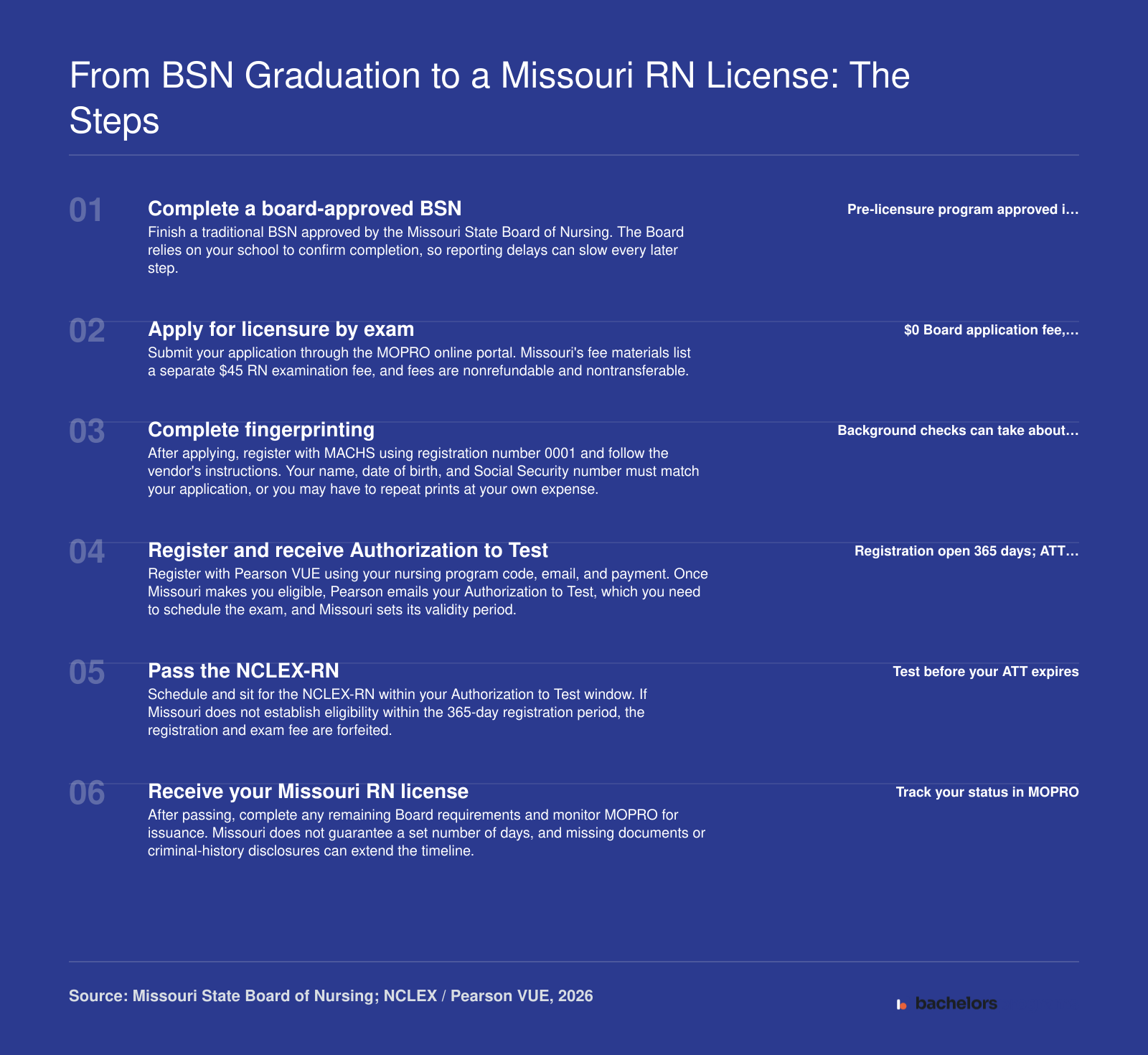
From BSN Graduation to a Missouri RN License: The Steps
Once you finish your BSN, Missouri's path to a license follows a fixed order: apply, get fingerprinted, register with Pearson VUE, receive your Authorization to Test, pass the NCLEX-RN, and wait for the Missouri State Board of Nursing to issue your license. The background check alone can take about two months, so your first attempt at the exam carries real weight, because a second attempt adds another round of registration, fees, and waiting before your first RN paycheck. That is why the first-time NCLEX-RN pass rates behind the ranking above matter: a program that consistently prepares graduates to pass on the first try shortens the gap between graduation and earning a registered nurse's salary.
Missouri BSN Questions Students Ask Before Applying
These answers cover the three questions applicants raise most often: program length, community college transfer, and what happens after an unsuccessful NCLEX-RN attempt. Details vary by school, so confirm specifics with the program you are considering.
How many years does a traditional BSN take at a Missouri university?
Can prerequisite credits from a Missouri community college transfer into a BSN program?
What happens if a Missouri BSN graduate fails the NCLEX-RN on the first attempt?
Compare Bachelor of Science in Nursing (BSN) programs on the data that matters
Explore more Nursing majors or browse every field of study.
All Nursing programs Browse every field of study