Best Accelerated BSN (ABSN) Programs in Missouri
Compare 15 accredited Accelerated BSN (ABSN) programs in Missouri, with net price after aid, graduation rates, earnings and debt from IPEDS and the U.S. College Scorecard.
A bachelor's degree in another field can become an RN license in as little as 12 months in Missouri. Saint Louis University and the University of Missouri-St Louis both run 12-month accelerated tracks.
Most programs here run 12 to 18 months of full-time study, a pace that makes outside work impractical. Clinicals happen in person, so no ABSN is fully online, even a hybrid one like Rockhurst University's.
Speed comes with a price gap: the University of Missouri lists $35,684 in total program tuition, while Saint Louis University lists $51,940.
Key Points
- Most Missouri ABSN programs run 12 to 18 months of full-time study.
- Research College of Nursing reports the highest first-year earnings among schools here.
- Missouri State Board of Nursing approval, not accreditation alone, gates RN licensure.
Best Accelerated BSN (ABSN) Schools in Missouri, Ranked
Each school below earned its spot by how well it balances what a second-degree student pays against how reliably students there finish and how hard it is to get in. Missouri runs a small, well-defined set of accelerated BSN options, and most sit in St. Louis, Kansas City, Columbia or Springfield. Tuition figures are the in-state rate, paired with an approximate average net price after aid, so a public research campus and a private college can be compared on the same footing.
University of Missouri
#1Columbia, MO · ~$20,000/yr (est.)
Best for: Missouri residents seeking a public research campus
The University of Missouri runs its accelerated BSN through the Sinclair School of Nursing on the Columbia campus, which puts second-degree students inside a large public research university with its own academic health system close at hand. In-state tuition is about $14,837 a year and the average net price after aid comes to roughly $20,268, with about 78% of applicants admitted. Schools offering this program graduate 75% of students institution-wide.
- CCNE accredited; 17-month, 61-credit curriculum across four semesters
- Two start dates per year, in January and August
- 3.0 GPA minimum plus prerequisite courses from any accredited college
- $35,684 total program tuition
- $15,000 MU Health scholarship in exchange for a two-year work commitment
- Clinical curriculum updated in fall 2025
- Built for students who already hold a non-nursing bachelor's degree
Saint Louis University
#2Saint Louis, MO · $24,000/yr (est. net price)
Best for: Career changers drawn to a hybrid format
Saint Louis University has been running an accelerated BSN longer than anyone in the country, and its 12-month hybrid sequence is one of the shortest full pathways on this list. Online coursework is paired with on-campus labs and clinicals in St. Louis, so the flexible parts are the lectures, not the hands-on training. Tuition is the same for residents and non-residents at about $55,760, the average net price after aid falls to roughly $24,398, and about 75% of applicants are admitted. Schools offering this program graduate 80% of students institution-wide.
- CCNE accredited; 12-month, 120-credit hybrid program
- $51,940 total program tuition, or $1,060 per credit
- Online classes combined with on-campus labs and clinical placements
- Rolling admissions with fall and spring start dates
- 3.0 GPA minimum and prerequisite coursework required
- Described as the first accelerated BSN program in the United States
- Holistic review process and a low student-to-faculty ratio
- Full-time pace; the program advises against working while enrolled
Rockhurst University
#3Kansas City, MO · ~$26,000/yr (est.)
Best for: Working adults needing flexible start dates
Rockhurst University in Kansas City delivers most of its ABSN online with a short on-campus residency, which suits students who cannot relocate for a year of study. The clinical side is fully in person around Kansas City, and the program offers three start dates a year with small cohorts. In-state tuition runs about $44,966 and the average net price after aid is near $25,884, with roughly 70% of applicants admitted. Schools offering this program graduate 75% of students institution-wide.
- CCNE accredited; 16-month, 60-credit hybrid program
- $785 per credit with synchronous and asynchronous course options
- 100% online coursework plus a 10-day on-campus residency
- More than 583 clinical hours, with placement services included
- 1:1 NCLEX coaching and a dedicated success advisor
- 2.7 GPA minimum with prerequisite courses required
- Cohort sizes of about 25 students
- Three start dates per year across spring, summer and fall
Maryville University
#4Saint Louis, MO · ~$22,000/yr (est.)
Maryville University in St. Louis offers its Fast Track BSN as one of two pre-licensure tracks in the nursing major, and it begins at the junior level once general education and nursing core requirements are finished. The pace is two years of full-time study rather than a compressed 12-month sprint, which leaves room for a capstone and clinical rotations arranged by the student. Tuition runs about $27,166 and the average net price after aid is near $22,066, and admission is close to open at roughly 95% of applicants. Schools offering this program graduate 66% of students institution-wide.
- Fast Track BSN track begins at junior level as a two-year full-time degree
- 57 credits of general education and nursing core must be completed first
- Fall and spring start dates
- 36-credit MCORE plus 86 credits of major requirements
- Capstone course required before graduation
- Approved by the Missouri State Board of Nursing and CCNE accredited
- Students arrange their own transportation to clinical sites
- University One Fee covers materials, standardized testing, liability insurance and lab supplies
University of Missouri-Kansas City
#5Kansas City, MO · $13,000 – $30,000/yr (est.)
UMKC runs a five-semester ABSN on a dedicated health sciences campus shared with dental, medical and pharmacy students, and it assigns more clinical hours than any other program in the region. A 300-hour capstone internship in the student's chosen specialty closes out the sequence. Missouri residents pay about $12,587 in tuition, the average net price after aid comes to roughly $13,310, and about 72% of applicants are admitted. Schools offering this program graduate 55% of students institution-wide.
- CCNE accredited; five-semester cohort completed in under two years
- More than 1,050 clinical hours, the most in the region
- 300-hour capstone internship in a chosen specialty
- 2.8 GPA minimum; single fall start
- In-state tuition extended to Kansas residents, plus a Heartland Rate for 15 states
- Interprofessional campus shared with dental, medical and pharmacy students
- Daytime classes with simulation and skills laboratories on site
William Jewell College
#6Liberty, MO · ~$18,000/yr (est.)
William Jewell College in Liberty is a small private liberal arts college, and its ABSN is the most selective on paper in this group at roughly 38% of applicants admitted. The program runs two tracks, a traditional in-person format and a hybrid with evening synchronous classes and weekend clinicals, both completed in 12 months. Tuition is about $20,610 and the average net price after aid lands near $17,562. Schools offering this program graduate 68% of students institution-wide.
- CCNE accredited; 12-month accelerated program
- No entrance exam required; test optional admissions
- Two tracks: fully in person or hybrid with evening classes and weekend clinicals
- 2.8 GPA minimum plus prerequisite courses
- Clinical placements at 8 to 10 Kansas City hospitals and specialty facilities
- NCLEX Success Coordinator provides individualized support
- Liberty Hospital partnership and an internationally endorsed simulation center
- Faculty are practicing nurses
Barnes-Jewish College Goldfarb School of Nursing
#7Saint Louis, MO
Barnes-Jewish College Goldfarb School of Nursing is a hospital-based college in St. Louis, so clinical exposure comes with the institution rather than through scattered affiliate agreements. Its one-year ABSN packs 58 credits into three full-time terms with three start dates a year, and it expects 30 to 40 hours a week of class, lab and clinical time. The 27 prerequisite credit hours and a 3.0 GPA minimum are the main gates, and the college sits inside a major academic medical center.
- CCNE accredited; one-year, 58-credit program
- Three full-time terms rather than a traditional semester sequence
- Three start dates per year across spring, summer and fall
- 27 credit hours of prerequisites and a 3.0 GPA minimum
- Expect 30 to 40 hours per week of study and clinical time
- Fall application deadline July 31; spring deadline November 30
- Hospital-based college in St. Louis with clinical partnerships built in
University of Missouri-St Louis
#8Saint Louis, MO · $15,000 – $20,000/yr (est.)
UMSL runs a 12-month cohort ABSN with clinical placements across more than 100 regional partners, including BJC, Mercy, SSM and St. Luke's, and it leans on a longstanding reputation for affordability among Missouri publics. Students train in a simulation lab before moving to live clinical settings. In-state tuition is about $14,112, the average net price after aid comes to roughly $15,071, and about 63% of applicants are admitted. Schools offering this program graduate 57% of students institution-wide.
- CCNE accredited; 12-month, cohort-based on-campus program
- Clinical placements with more than 100 regional partners
- Prerequisites in statistics and human growth and development
- Simulation lab training before live clinical rotations
- Financial aid and scholarships available to eligible students
- Honors College certificate option
- Nursing alumni network of more than 5,000 graduates
Missouri State University
#9Springfield, MO · $18,000/yr (est. net price)
Missouri State in Springfield admits one fall cohort a year through NursingCAS, which keeps the application calendar simple but makes the seat count tight for a second-degree applicant. The program leans on prior coursework to move quickly through prerequisites and clinical training in 15 months. In-state tuition is about $9,502, the lowest on this list, though the average net price after aid settles near $17,613, and roughly 91% of applicants are admitted. Schools offering this program graduate 58% of students institution-wide.
- CCNE accredited; 15-month cohort program
- One fall start date per year
- Requires a prior bachelor's degree; competitive admission
- Applications submitted through NursingCAS
- Accelerated format builds on previous college coursework
Cox College
#10Springfield, MO · ~$15,000/yr (est.)
Cox College in Springfield is in teach-out: new enrollment stopped in spring 2025 and the college is slated to close after May 2027, so it is not a live option for a new ABSN applicant. The 16-month, 120-credit program is still listed with a spring start and a September 1 deadline, and CoxHealth is shifting its education partnerships to the Alliance for Healthcare Education with Missouri State and other partners. Applicants who want to train in the Springfield market should apply to Missouri State instead.
- 16-month, 120-credit full-time program across three semesters and a summer
- Cohort-based structure with a required capstone
- Spring start with a September 1 application deadline
- Prior bachelor's degree required
- Prepares graduates to sit for the NCLEX-RN
Cost & outcomes by school
Federal data for the highest-earning Accelerated BSN (ABSN) programs, independent of the ranking above. Earnings are this field's bachelor's graduates four years after completing where the Scorecard reports them, else the school's undergraduate median.
| School | Net price / yr | Grad rate | Earnings | Debt | Grads/yr | Format |
|---|---|---|---|---|---|---|
| Research College of Nursing MO | — | — | $85,910 | $13,930 | 246 | Campus |
| Barnes-Jewish College Goldfarb School of Nursing MO | — | — | $84,393 | $16,750 | 550 | Campus |
| Saint Louis University MO | $24,398 | 80% | $70,783 | $25,000 | 3,528 | Hybrid |
| Rockhurst University MO | $25,884 | 75% | $67,102 | $18,250 | 1,072 | Hybrid |
| University of Missouri MO | $20,268 | 75% | $63,403 | $20,500 | 12,116 | Campus |
| Maryville University MO | $22,066 | 66% | $62,105 | $22,000 | 2,178 | Campus |
| University of Missouri-Kansas City MO | $13,310 | 56% | $59,637 | $18,750 | 3,382 | Campus |
| William Jewell College MO | $17,562 | 68% | $59,268 | $24,498 | 498 | Campus |
| Cox College MO | — | 100% | $56,867 | $20,000 | 192 | Campus |
| University of Missouri-St Louis MO | $15,071 | 57% | $53,037 | $20,000 | 2,882 | Campus |
| Avila University MO | $16,053 | 52% | $52,773 | $25,000 | 510 | Online |
| Missouri State University MO | $17,613 | 58% | $49,827 | $21,992 | 6,214 | Campus |
Sources: U.S. Department of Education. Net price, graduation rate, earnings and debt: College Scorecard (earnings and debt for this field's bachelor's graduates where reported, else school-wide); graduates: IPEDS. A dash means no figure is reported.
Cost, debt & payoff
Median earnings of this field's bachelor's graduates (4 yrs after completing, else the school's undergraduate median) vs. their median federal loan debt · U.S. College Scorecard
Across these programs the median graduate earns about $59,268 and finishes with roughly $20,000 in debt — a ratio that clears a common rule of thumb (keep debt below first-year salary). Net price and debt vary widely school to school, so check the per-school figures in the table above before you shortlist.
Cheapest Accelerated BSN Schools in Missouri
These figures are each school's institution-wide average annual net price after grants and scholarships, drawn from 2024 U.S. Department of Education data. Treat them as a guide to overall affordability, not an exact ABSN quote. Public universities such as University of Missouri-Kansas City and University of Missouri-St Louis tend to land at the low end, with private colleges like Central Methodist University-College of Graduate and Extended Studies, Avila University and William Jewell College close behind. Accelerated BSN programs often bill by the credit hour at rates that can differ from these school-wide averages, so check the pace and cost section below for program-level tuition before you compare final costs.
| School | City | Sector | Average Annual Net Price After Aid (School-Wide) | ABSN Program Length |
|---|---|---|---|---|
| University of Missouri-Kansas City | Kansas City | Public | $13,310 | 5 semesters (under 2 years) |
| Central Methodist University-College of Graduate and Extended Studies | Fayette | Private nonprofit | $14,601 | 14 months |
| University of Missouri-St Louis | Saint Louis | Public | $15,071 | 12 months |
| Avila University | Kansas City | Private nonprofit | $16,053 | N/A |
| William Jewell College | Liberty | Private nonprofit | $17,562 | 12 months |
ABSN Admissions: Prior Bachelor's, Prerequisites, GPA, and Test Policy
Can you apply to a Missouri accelerated BSN before your bachelor's degree is finished?
Sometimes yes, and Saint Louis University is the clearest case. Most ABSN programs here assume you already hold a bachelor's in another field, but SLU also runs a junior-entry accelerated route open to current undergraduates who have completed at least 71 credits, so a finished degree is not required for that pathway. Elsewhere the timeline tightens: the University of Missouri accepts applications with prerequisites still in progress as long as the bachelor's is complete before the Accelerated BSN begins, and UMKC expects your bachelor's finished by July 1 of the application year.1
Prerequisites and the grades they expect
- Saint Louis University: microbiology, chemistry, inferential and descriptive statistics, human growth and development, human anatomy, human physiology, and written composition, each at C or higher from a regionally accredited institution.
- University of Missouri: chemistry (2 credits, no lab), statistics, nutrition, microbiology and anatomy and physiology with labs, plus pathophysiology, all at C or better.2
- UMKC: a B- or better in every admission prerequisite, with a below-B- course allowed to be repeated.1
GPA minimums and test policy
The University of Missouri requires a 3.0 cumulative GPA on a 4.0 scale for its Accelerated BSN.2 SLU's published requirements do not list a minimum GPA. On entrance exams, none of the admissions pages reviewed for the programs below names a TEAS or HESI test; where a school's page is silent on testing, treat that as unanswered rather than waived and confirm directly with an admissions counselor.
One sequencing move that protects your start date
Work backward from the deadline. MU's 2026 application closes September 15, 2026, so anatomy, physiology, and microbiology with their labs need to be finished, or nearly finished, well before then. Take the lab sciences two at a time instead of four, score above the posted minimum so a stray B- does not disqualify you at a stricter program, and verify with each school that your lab credits and course ages satisfy its requirement before you register.
Related Articles
ABSN Pace and Cost: Program Length, Tuition, and Financial Aid
An accelerated BSN compresses a nursing degree into a full-time, year-round schedule for second-degree students. Most Missouri programs run 12 to 18 months, and the workload is heavy enough that holding a job during the program is very difficult. Plan your finances before you enroll, not after.
How Long Each Program Takes
UMSL's Fall 2026 entry can finish in 12 months once prerequisites are done (53 credits, in-person blended).1 Rockhurst takes 16 months over four semesters and 60 credits. Mizzou runs 17 months on campus, with 61 credits over four semesters.
Missouri State is reported two ways: 14 or 15 months. The current program page, based on the 2025-26 catalog, says 15 months, and your own timeline can shift with prior coursework.
"Hybrid" means the lecture-style coursework is online while labs, simulation, and clinical rotations happen in person. No Missouri ABSN is fully online. Rockhurst's hybrid track, for example, pairs online classes with a 10-day Kansas City residency and 583.5 clinical hours.
Public and Private Tuition
Mizzou, the public option, publishes an in-state estimate of $35,684 for the whole program. That figure is illustrative, since your actual cost depends on residency, transfer hours, and course choices. Rockhurst, a private school, charges $783 per credit, which works out to about $46,980 across 60 credits before fees. Private tuition runs noticeably higher than public in-state pricing, so confirm current rates with each school.
Aid Worth Pursuing
- FAFSA: Second-degree students can file, but federal loan and grant eligibility depends on how the program is classified and on how much aggregate aid you have left. Ask each financial aid office.
- Missouri nursing student loan: The state's professional nursing loan program awards up to $5,000 (2027-2028).2 You must be a Missouri resident enrolled full time in a Board-approved program, with a 2.5 GPA. The application deadline is February 1, 2027.
- Hospital tuition partnerships: Some health systems help fund nursing students in exchange for a work commitment. Ask the school's aid office and local employers which agreements cover second-degree students.
How Many Months Does Each Missouri ABSN Take?
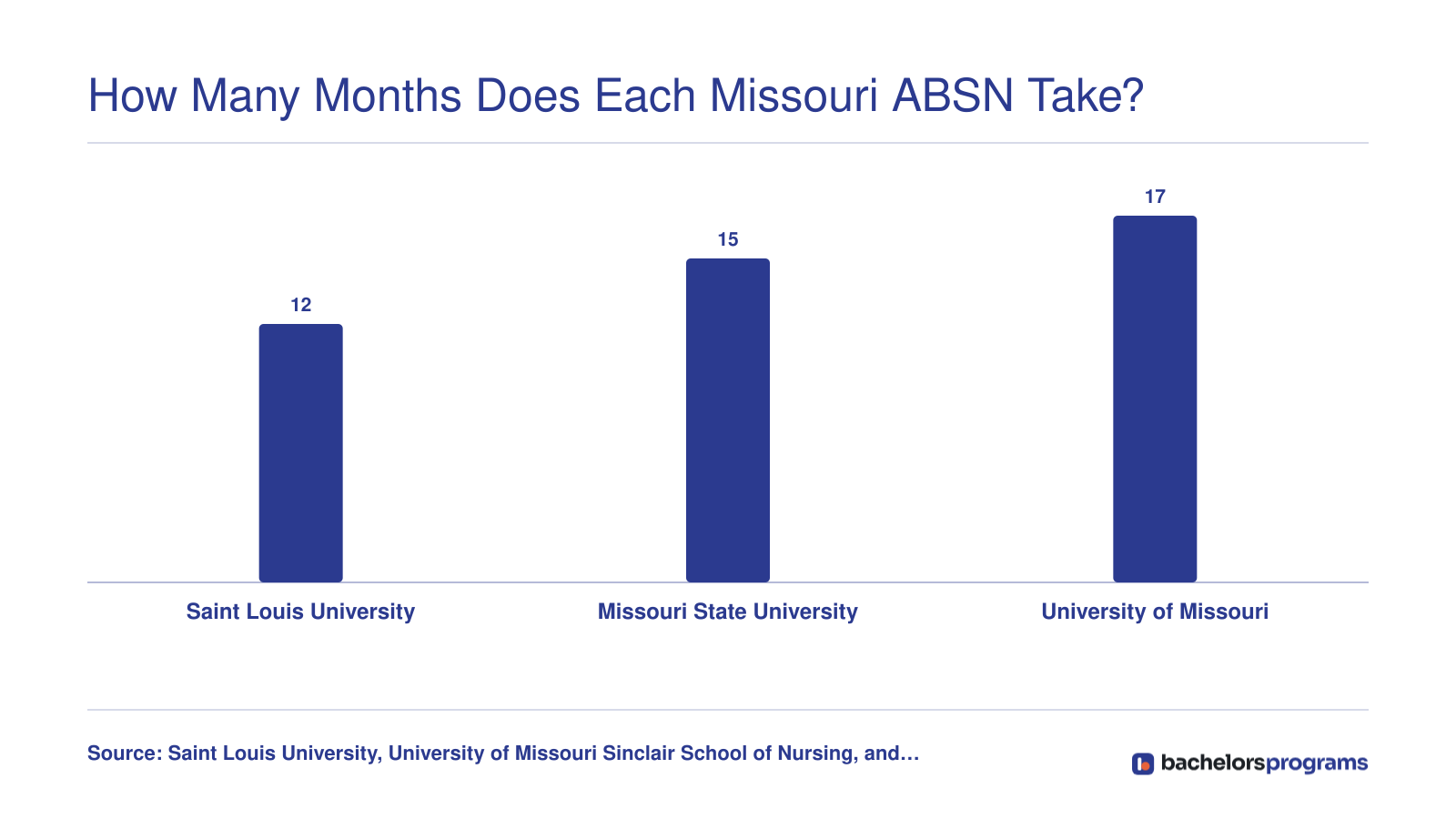
Each bar shows a school's published full-time length for the accelerated nursing sequence, which starts only after your prior bachelor's and prerequisite science courses are complete. The University of Missouri runs its program on campus over four semesters with January and August starts, and Saint Louis University fits three semesters, including a summer session, into 12 months. Missouri State's cohort begins each fall: its program page lists 15 months, and the actual schedule may vary with courses you have already completed, while a separate school page describes an online format with on-campus components at 14 months. UMKC publishes its clinical program as five semesters rather than a month count, so it is not shown in the chart.
First-Year Pay After a Missouri Accelerated BSN
Research College of Nursing in Kansas City reports the highest first-year earnings among the schools on this page.
Missouri Board of Nursing Approval and NCLEX-RN Licensure
Does Missouri require an accelerated BSN program to hold state approval, or is national accreditation enough?
State approval is what gates your license. The Missouri State Board of Nursing approves prelicensure RN programs after reviewing them against minimum standards, weighing an on-site survey report, and then monitoring continuing compliance.1 CCNE or ACEN accreditation is a separate, national peer review. Neither substitutes for the other, and Missouri does not accept accreditation in place of Board approval.1 Accreditation still matters for graduate school, employer tuition benefits, and some federal aid, so look for both.
Verifying a Program Before You Apply
Check the Board's published list of approved prelicensure RN programs and confirm your exact school, campus, and track appear. Approval attaches to a specific program at a specific location, so a green light for one campus or one degree track says nothing about another. Confirm the accelerated BSN itself is listed before you commit a deposit.
The Licensure Path, Step by Step
- Apply to the Board. First-time applicants pay no Missouri application fee.2 Use a personal email address, not a school account, and apply roughly three months before graduation.6 Supporting documents are generally mailed in; fingerprint registration runs online through MOPRO.3
- Fingerprints and background check. Missouri requires a criminal-history check through the Highway Patrol and FBI.3 Apply for the license first, then register with the state's fingerprint vendor using registration number 0001.4 Your name, date of birth, and Social Security number must match the Board's records exactly, or you repeat the process at your own cost. Prior fingerprint results cannot be reused.4 You pay the vendor fee.5
- Submit your final transcript showing the degree awarded and the graduation date, plus proof of citizenship or lawful presence.2
- Register for the NCLEX-RN separately through NCSBN and pass it.2
Pass rates for the programs ranked here appear in the ranking data above; treat any single year's number as a snapshot rather than a guarantee.
Missouri RN Licensure at a Glance
Picking Your Missouri ABSN: Location, Clinicals, Start Dates, and Budget
Choosing a Missouri ABSN comes down to four practical filters: where you'll do clinical rotations, which cohort you can still make, what the full program costs, and how hard it is to get in.
Location and Clinical Sites
St. Louis has the densest hospital market. Saint Louis University, Maryville University, University of Missouri-St Louis and Barnes-Jewish College Goldfarb School of Nursing are all in the metro. Kansas City options include Rockhurst University, UMKC, Research College of Nursing, Avila University and William Jewell College in nearby Liberty. Springfield has Cox College and Missouri State University, and Columbia has the University of Missouri.
Ask each school whether it arranges clinical placements or expects you to line them up yourself. Rockhurst lists placement services as included, and Maryville students provide their own transportation to clinical sites.
Deadlines for 2027 Cohorts
- Goldfarb: Rolling admission with spring, summer and fall starts. The spring deadline is November 30, and seats can fill sooner.
- University of Missouri: Fall 2027 applications are due January 31, 2027, and spring 2028 applications by September 15, 2027.
- UMKC: The fall 2027 window runs November 1, 2026 through January 31, 2027.
- Missouri State: Fall-only, with a February 1, 2027 deadline listed for fall 2027. Admission decisions are reported by April 1.
- Saint Louis University: No official deadline, but space is limited.
- Research College: The January 2027 deadline has passed, so ask about its May entry.
Budget and Selectivity
Use the cheapest-schools and earnings tables above, and compare total program cost rather than per-credit rates. MU lists $35,684 in total program tuition and SLU lists $51,940. Rockhurst quotes $783 per credit across 60 credits.
Schoolwide admission rates give a rough selectivity signal. William Jewell admits about 38 percent of applicants, SLU about 75 percent and Missouri State about 91 percent. Missouri State still describes its ABSN admission as competitive. Applying to two or three programs protects you if one cohort fills.
Your next step: find the earliest upcoming deadline on your shortlist and request information from that school this week.
Quick Answers for Second-Degree Nursing Students in Missouri
These are the questions career changers ask most often before applying. Confirm details with each school's admissions office, since policies can change from one cycle to the next.
Can you complete a Missouri accelerated BSN entirely online, or are clinicals always in person?
Can I apply to a Missouri ABSN before my first bachelor's degree is conferred?
Will an RN license earned in Missouri let me practice in other states?
Compare Accelerated BSN (ABSN) programs on the data that matters
Explore more Nursing majors or browse every field of study.
All Nursing programs Browse every field of study