Best BSN Programs in North Carolina
Compare 50 accredited Bachelor of Science in Nursing (BSN) programs in North Carolina at 38 colleges, with net price after aid, graduation rates, earnings and debt from IPEDS and the U.S. College Scorecard.
Approval from the North Carolina Board of Nursing is the minimum every prelicensure program must clear, so it says little about how one school compares with another. A program's first-time NCLEX-RN pass rate says far more about whether its graduates actually get licensed.
Only traditional four-year prelicensure BSN programs are ranked here. RN-to-BSN and accelerated second-degree routes serve different students and sit outside the ranking.
Seats, more than tuition, are often the real constraint. Many programs admit a limited cohort each year, so a strong pass rate matters little without an offer.
Key Points
- Every ranked program posts first-time NCLEX-RN pass rates from 98.2% to 100%.
- University of North Carolina Wilmington BSN graduates post the strongest early earnings.
- North Carolina licensure costs $75 to the Board plus $200 for NCLEX-RN.
10 North Carolina BSN Programs With the Best NCLEX-RN Outcomes
Programs below are ordered by first-time NCLEX-RN pass rate, with accreditation status and completion outcomes used to settle ties. Each card pairs that pass rate with in-state tuition, average net price after aid, admission rate, and institution-wide graduation rate, so exam performance sits beside cost and selectivity. The last two entries, UNC Charlotte and Carolinas College of Health Sciences, list second-degree and RN completion routes in the data we track rather than a traditional prelicensure pathway.
Appalachian State University
#1Boone, NC · $8,000 – $25,000/yr (est.) · NCLEX-RN pass rate 99.1% (3-yr weighted avg)
Best for: CNA-certified students avoiding entrance exams
Appalachian State University admits roughly 75 juniors and seniors a year to its CCNE-accredited prelicensure BSN, a 63-credit upper-division sequence that does not require the TEAS, though CNA certification is required. Clinicals reach up to 90 miles from Boone and a capstone closes the final semester. First-time NCLEX-RN pass rate is 99.1 percent; in-state tuition and fees are $7,579, average net price after aid is $16,836, the admission rate is 90 percent, and the institution-wide graduation rate is 75 percent.
- CCNE accredited, 63-credit upper-division program
- Two years of full-time study after prerequisites
- CNA certification required for admission
- No TEAS or other entrance exam required
- Science prerequisites require a B- or better
- Clinical placements up to 90 miles from Boone
- About 75 students admitted each year
- Capstone required in the final semester
University of North Carolina at Chapel Hill
#2Chapel Hill, NC · ~$12,000/yr (est.) · NCLEX-RN pass rate 98.4% (2-yr weighted avg)
Best for: North Carolina residents wanting assured admission
UNC Chapel Hill pairs a small, CCNE-accredited BSN with the clinical depth of a major academic health system, and selected North Carolina first-year students can lock in upper-division admission with a 3.0 GPA and 32 service hours. The school also runs accelerated and military pathways. First-time NCLEX-RN pass rate is 98.4 percent; in-state tuition and fees are $8,994, average net price after aid is $11,655, the admission rate is 15 percent, and the institution-wide graduation rate is 91 percent.
- CCNE accredited, on-campus program starting each fall
- Assured upper-division admission for selected NC first-year students
- Requires a 3.0 GPA and 32 service hours to keep the seat
- Up to 15 ROTC assured-admission seats planned from 2027-28
- Prepares for hospital, public health, research, and military careers
- Four-semester option for students who already hold a bachelor's degree
- On-campus format with a fall start
- Designed for military and veteran students
- Starts fall on campus
- Financial aid and scholarships available
Western Carolina University
#3Cullowhee, NC · ~$13,000/yr (est.) · NCLEX-RN pass rate 98.2% (3-yr weighted avg)
Best for: Cost-focused students in western North Carolina
Western Carolina University teaches a 120-credit, four-year BSN in Cullowhee with clinicals spread across western North Carolina hospitals, schools, and community agencies. Cohorts start in fall and spring, an entrance exam is required, and NC Promise pricing holds in-state costs down. First-time NCLEX-RN pass rate is 98.2 percent; in-state tuition and fees are $4,630, average net price after aid is $13,315, the admission rate is 82 percent, and the institution-wide graduation rate is 60 percent.
- CCNE accredited, 120-credit four-year program
- 3.0 GPA minimum plus ACT or TEAS entrance exam
- Cohort structure with fall and spring starts
- Clinicals across western North Carolina
- NC Promise keeps in-state tuition at a reduced rate
- Small classes with one-on-one faculty attention
- Graduate-level courses available as an undergraduate
- Apply online through NursingCAS
Barton College
#4Wilson, NC · $24,000/yr (est. net price) · NCLEX-RN pass rate 97.9% (3-yr weighted avg)
Barton College is a private liberal arts campus in Wilson where the 120-credit BSN is taught entirely in person and seniors finish with a preceptorship. The Nursing Direct Pathway gives freshmen early acceptance, and the Wilson Medical Center Fellows Program adds tuition support. First-time NCLEX-RN pass rate is 97.9 percent; tuition and fees are $37,250, average net price after aid is $23,626, the admission rate is 94 percent, and the institution-wide graduation rate is 46 percent.
- CCNE accredited, 120-credit in-person program
- Nursing Direct Pathway offers early acceptance for freshmen
- Clinical rotations that include Duke Health and WakeMed
- Wilson Medical Center Fellows Program adds tuition support
- Senior-year preceptorship
- Study abroad options
- Sigma Theta Tau honor society chapter
- Annual Nursing Career Day
Lenoir-Rhyne University
#5Hickory, NC · $21,000/yr (est. net price) · NCLEX-RN pass rate 97.4% (3-yr weighted avg)
Lenoir-Rhyne University in Hickory runs one of the oldest nursing programs in North Carolina, with a 120-credit prelicensure BSN plus RN-to-BSN and RIBN options. The campus route requires a 2.9 GPA, a TEAS score of 65, and CNA I certification. First-time NCLEX-RN pass rate is 97.4 percent; tuition and fees are $31,900, average net price after aid is $20,689, the admission rate is 85 percent, and the institution-wide graduation rate is 48 percent.
- CCNE accredited, 120-credit four-year program
- 2.9 GPA minimum and ATI TEAS score of 65
- CNA I certification required
- Direct entry through the Bear Bound program
- One of the oldest nursing programs in North Carolina
- Honors society membership and community service projects
- Alumni tuition discount toward the DNP
- Fully online, completable in three or four semesters
- Work as an RN while enrolled
- Financial aid and scholarships available
- Four-year concurrent enrollment with a community college partner
- Work as an RN during the final year
- Courses delivered online while at the community college
- RIBN student success advocate assigned
East Carolina University
#6Greenville, NC · ~$16,000/yr (est.) · NCLEX-RN pass rate 97.3% (3-yr weighted avg)
East Carolina University's campus BSN in Greenville graduates Pirate Nurses and leans on community and public health, leadership, and research coursework. Career paths run from hospital practice to school, occupational, and military health. First-time NCLEX-RN pass rate is 97.3 percent; in-state tuition and fees are $7,361, average net price after aid is $15,739, the admission rate is 89 percent, and the institution-wide graduation rate is 63 percent.
- CCNE accredited, campus-based program in Greenville
- Graduates are known as Pirate Nurses
- Leadership and research threaded through the curriculum
- Career paths in hospital, community, school, and occupational health
- Prepares for licensure in North Carolina and beyond
University of North Carolina Wilmington
#7Wilmington, NC · $7,000 – $24,000/yr (est.) · NCLEX-RN pass rate 95.7% (2-yr weighted avg)
UNC Wilmington splits nursing into a prelicensure BSN admitting about 120 students a year, an accelerated BSN for degree holders, and an online RN-to-BSN. The prelicensure track starts in fall and spring, requires a 2.7 GPA and the TEAS, and builds on evidence-based practice and interprofessional work. First-time NCLEX-RN pass rate is 95.7 percent; in-state tuition and fees are $7,277, average net price after aid is $20,109, the admission rate is 64 percent, and the institution-wide graduation rate is 71 percent.
- Prelicensure track admits about 120 students each year
- Fall and spring starts
- 2.7 GPA minimum and TEAS exam required
- CCNE accredited
- Career paths include hospice, travel, forensic, and clinical research nursing
- 12-month online option for licensed RNs
- Rolling admissions with six start dates a year
- Nursing honor society available
- Four-semester fast track for bachelor's degree holders
- Campus-based in Wilmington
Elon University
#8Elon, NC · ~$42,000/yr (est.) · NCLEX-RN pass rate 95.3% (3-yr weighted avg)
Elon University admits students directly into a four-year BSN rather than through a second application, and the curriculum is built on a value-based model of care with clinical experiences that include international sites. A minimum SAT of 1100 or ACT of 22 is required, and nursing courses demand a B- or better. First-time NCLEX-RN pass rate is 95.3 percent; tuition and fees are $46,958, average net price after aid is $41,555, the admission rate is 66 percent, and the institution-wide graduation rate is 84 percent.
- Four-year direct-entry prelicensure program
- Minimum SAT of 1100 or ACT of 22 for admission
- B- or better required in nursing courses
- Clinical experiences that include international settings
- Value-based model of care across the lifespan
- Prerequisite courses required before the nursing sequence
University of North Carolina at Charlotte
#9Charlotte, NC · $15,000 – $20,000/yr (est.) · NCLEX-RN pass rate 97.2% (2-yr weighted avg)
UNC Charlotte's nursing school sits in the state's largest metro, and the pathway tracked here is an accelerated BSN for students who already hold a bachelor's degree. Four consecutive semesters include high-fidelity simulation and assigned success tutors, with a B or better in prerequisite sciences and CNA I certification required before enrollment. First-time NCLEX-RN pass rate is 97.2 percent; in-state tuition and fees are $7,239, average net price after aid is $15,435, the admission rate is 80 percent, and the institution-wide graduation rate is 69 percent.
- Four semesters: fall, spring, summer, fall
- For students who already hold a bachelor's degree
- CNA I certification required before enrollment
- Prerequisite sciences require a B or above
- High-fidelity simulation in a learning resource center
- Dedicated student success tutors
- Automatic eligibility for a competitive scholarship
Carolinas College of Health Sciences
#10Charlotte, NC · ~$19,000/yr (est.) · NCLEX-RN pass rate 99.7% (3-yr weighted avg)
Carolinas College of Health Sciences is a small Charlotte health-sciences college tied to Atrium Health, and its nursing offering in our data is an online RN-to-BSN for licensed nurses rather than a prelicensure track. Students finish in 12 to 18 months across August, January, and May starts, with transfer credit accepted without date limits. First-time NCLEX-RN pass rate is 99.7 percent; tuition and fees are $18,882 and the admission rate is 60 percent.
- Online completion track for licensed registered nurses
- Finish in as few as 12 to 18 months
- 2.25 cumulative college GPA required
- Current, unencumbered RN license required
- Transfer credit accepted with no date limits
- Fair Transfer Promise with North Carolina community colleges
- Starts in August, January, and May
- Atrium Health teammates may receive course reimbursement
Cost & outcomes by school
Federal data for the highest-earning Bachelor of Science in Nursing (BSN) programs, independent of the ranking above. Earnings are this field's bachelor's graduates four years after completing where the Scorecard reports them, else the school's undergraduate median.
| School | Net price / yr | Grad rate | Earnings | Debt | Grads/yr | Format |
|---|---|---|---|---|---|---|
| Duke University NC | $29,612 | 97% | $97,800 | $13,000 | 5,506 | Campus |
| Chamberlain University-North Carolina NC | $38,436 | — | $92,405 | $20,919 | 86 | Campus |
| Elon University NC | $41,555 | 84% | $74,545 | $20,500 | 3,416 | Campus |
| University of North Carolina at Chapel Hill NC | $11,655 | 91% | $72,200 | $14,000 | 14,766 | Campus |
| Carolinas College of Health Sciences NC | — | 100% | $64,624 | $15,337 | 60 | Online |
| High Point University NC | $38,707 | 74% | $61,389 | $24,575 | 2,276 | Campus |
| Cabarrus College of Health Sciences NC | $17,618 | 71% | $58,708 | $16,000 | 260 | Campus |
| Queens University of Charlotte NC | $30,857 | 61% | $57,673 | $25,000 | 604 | Campus |
| University of North Carolina at Charlotte NC | $15,435 | 69% | $57,289 | $21,500 | 12,800 | Campus |
| East Carolina University NC | $15,739 | 63% | $55,146 | $22,750 | 9,648 | Campus |
| University of North Carolina Wilmington NC | $20,109 | 71% | $54,967 | $19,500 | 7,880 | Online |
| Campbell University NC | $24,516 | 61% | $54,886 | $22,500 | 1,392 | Campus |
Sources: U.S. Department of Education. Net price, graduation rate, earnings and debt: College Scorecard (earnings and debt for this field's bachelor's graduates where reported, else school-wide); graduates: IPEDS. A dash means no figure is reported.
Cost, debt & payoff
Median earnings of this field's bachelor's graduates (4 yrs after completing, else the school's undergraduate median) vs. their median federal loan debt · U.S. College Scorecard
Across these programs the median graduate earns about $48,160 and finishes with roughly $24,788 in debt — a ratio that clears a common rule of thumb (keep debt below first-year salary). Net price and debt vary widely school to school, so check the per-school figures in the table above before you shortlist.
What Puts a North Carolina BSN Program at the Top of Our List
The North Carolina Board of Nursing's annual NCLEX-RN report is the closest thing the state has to a public scoreboard for nursing programs, and it is where this list begins. The Board publishes first-time pass rates for each approved prelicensure program, reporting BSN and ADN results separately, and the 2025 edition is the most recent completed year.
Pass Rates Carry Most of the Weight
First-time NCLEX-RN pass rates make up roughly three quarters of each program's composite score. We average the Board's three most recent years and weight each year by the number of first-time test takers, so a year with 120 candidates counts for more than a year with 12. Averaging three cycles keeps one rough cohort or one standout cohort from defining a program.
Tie-Breakers and Federal Figures
Accreditation acts as both gate and tie-breaker, and a small completion and retention measure factors in. Cost and outcome numbers come from College Scorecard and IPEDS: in-state tuition, net price after aid, graduation rate, graduate earnings, and typical debt. Those graduation rates describe the whole institution rather than the nursing cohort, so read them as context, not as a nursing statistic.
What the Score Cannot See
Clinical placement quality, faculty-to-student ratios in the skills lab, and whether a campus feels right never appear in a federal dataset. Judge those in person: ask where students complete clinical rotations, sit in on a simulation session, and talk with second-year students about scheduling and support.
A strong pass rate tells you graduates clear the licensure exam. A campus visit tells you whether you will get there.
Cheapest BSN Programs in North Carolina by Net Price
Public institutions hold every spot here. Surry Community College's RIBN partnership with Western Carolina University leads, followed by UNC System campuses that include the HBCUs Fayetteville State University and North Carolina A & T State University, while no private school on this page posts a lower average net price. Figures are each school's average net price after aid across all undergraduates, drawn from 2024 IPEDS and College Scorecard data, so your own cost will depend on the grants and scholarships you qualify for.
| School | City | Type | Average Net Price After Aid | NCLEX-RN Pass Rate |
|---|---|---|---|---|
| Surry Community College | Dobson | Public community college (RIBN with Western Carolina University) | $4,961 | 95.2% |
| Fayetteville State University | Fayetteville | Public, UNC System, HBCU | $7,892 | 88.7% |
| University of North Carolina at Pembroke | Pembroke | Public, UNC System | $10,260 | 95.2% |
| North Carolina A & T State University | Greensboro | Public, UNC System, HBCU | $10,846 | 90.1% |
| University of North Carolina at Greensboro | Greensboro | Public, UNC System | $10,965 | 92.8% |
What a BSN Costs in North Carolina: Tuition, Net Price, and State Aid
Public and private BSN schools in North Carolina price themselves very differently, but the gap on the sticker is not always the gap on your bill.
Public Tuition vs. Private Sticker Prices
UNC-Chapel Hill's nursing school estimates in-state costs for 2025-26 at $4,599.50 per semester, or $9,199 across two semesters. That includes $3,509.50 in tuition, $1,060.50 in student fees, a $5.50 clinical-compliance fee, and a $24 BSN orientation and graduation fee. Treat these as estimates and check the current bill. Private schools, such as Carolinas College of Health Sciences, publish higher sticker prices, and a verified side-by-side figure was not available for this page. Many private schools discount heavily with institutional grants, so net price (cost after grants and scholarships) can land far below the listed tuition. Compare net prices, not sticker prices.
NC Promise
NC Promise sets resident undergraduate tuition at $500 per semester ($1,000 a year) at four UNC System campuses: Elizabeth City State, Fayetteville State, UNC Pembroke, and Western Carolina.1 That figure covers tuition only, not mandatory fees. Chapel Hill, Appalachian State, and UNC Wilmington are not part of the plan, so their in-state rates follow the regular UNC System schedule.1 Confirm with each campus whether a prelicensure BSN is offered before building a budget around the cap.
State Aid to Look For
Award amounts and income cutoffs change by year, so verify current figures through the College Foundation of North Carolina (CFNC) before you count on any of them.
- Next NC Scholarship: Aimed at lower-income residents, it is designed to cover remaining tuition and fees at UNC System campuses and community colleges after other grants.
- NC Need-Based Scholarship: Aimed at residents with demonstrated financial need, with award size set by need and the type of school.
- Education Lottery Scholarship: Aimed at residents with need, with amounts that vary by sector and enrollment.
For nursing specifically, ask the state's financial aid agency (NCSEAA) about Forgivable Education Loans for Service. It has supported nursing students in exchange for working in a qualifying North Carolina role after graduation, but the current status, award amount, and length of the service obligation should be confirmed.
Your Next Step
File the FAFSA first, since the state programs above depend on it. Then run each school's net price calculator and compare the results side by side before weighing any offer.
Related Articles
Top First-Year Paycheck Among NC BSN Graduates
Of the BSN programs ranked here, University of North Carolina Wilmington posts the strongest early earnings.
BSN Admissions in North Carolina: Prerequisites, GPA, and Entrance Tests
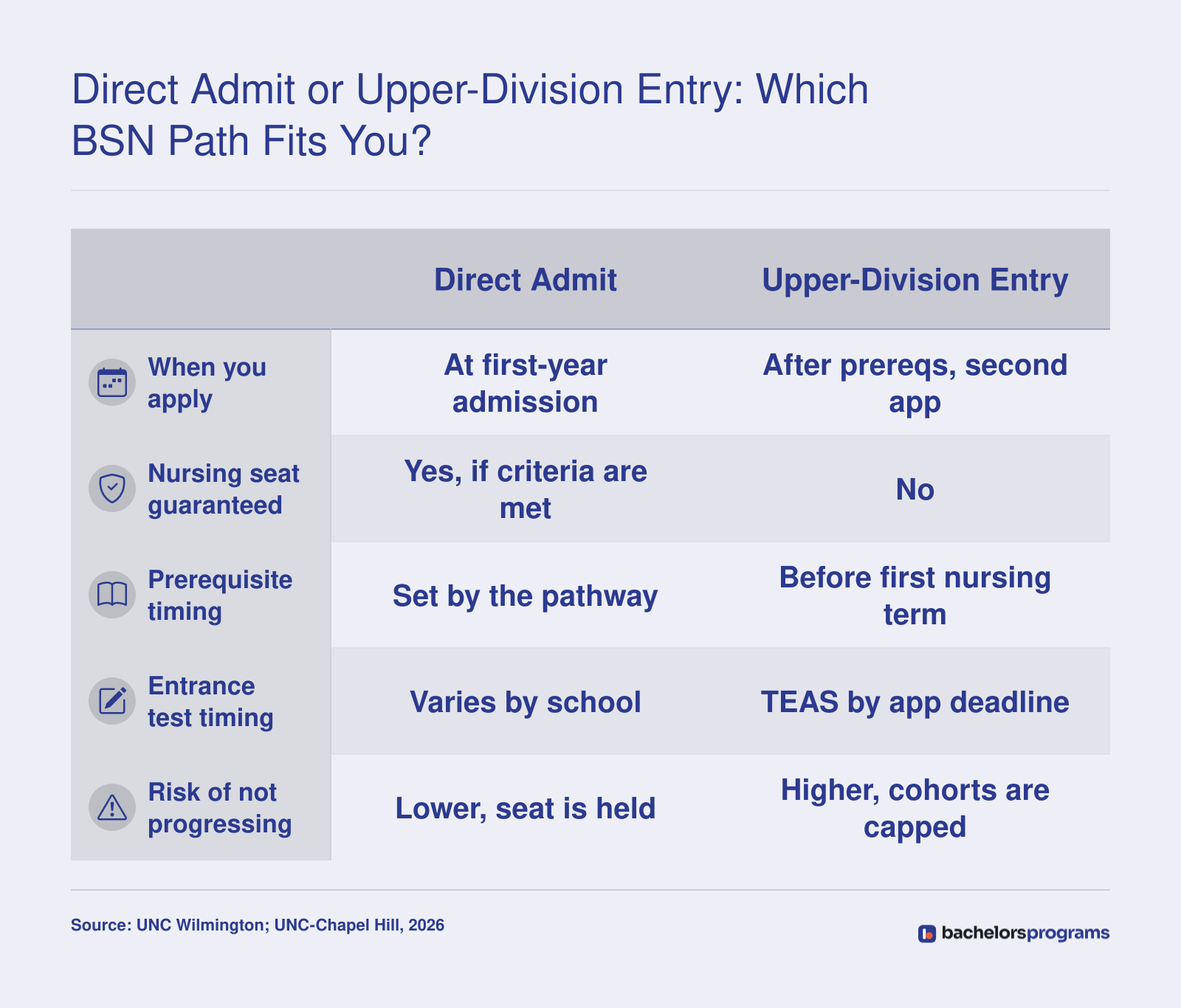
The real fork in a North Carolina BSN application is timing, not prestige: enter a nursing major as a freshman, or spend a year or two proving yourself in prerequisite courses and apply to the major later. The model a school uses shapes when you apply, what you must have finished, and how much room you have to change your mind.
Two Entry Models, One Application Calendar
UNC-Chapel Hill's BSN admissions pages describe both patterns. First-year North Carolina residents can pursue its direct-admit route, which reserves a BSN seat conditionally: students must maintain a 3.0 GPA and complete 32 service hours during their first two years.1 Other first-degree students follow the five-semester BSN and apply after prerequisites; they need a 2.8 cumulative and science GPA, a B- in Anatomy and Physiology I, Anatomy and Physiology II, and Microbiology with lab, and a C in General Psychology and Statistics. UNC Wilmington publishes a 2.7 minimum GPA and weights the TEAS at 25% of the admission decision; Appalachian State does not spell out a minimum GPA or entrance-test cutoff in its public BSN admissions information, so confirm both with the department.
The practical difference is risk. Direct admit removes the second application, but it ties your seat to freshman-year performance. Upper-division entry gives you a longer runway to raise your GPA, yet it adds a competitive application at the point when many students are already deep into college.
Prerequisites and the GPA Floor
Typical prerequisites include anatomy and physiology, microbiology, chemistry, statistics, and psychology. Published minimums are floors, not targets. At UNC-Chapel Hill, A&P I is due at application, at least three science prerequisites must be complete by then, and A&P II may remain outstanding only if finished by the end of the spring before entry. Students without an associate degree need at least 60 transferable credits before starting. A 2.8 meets the stated minimum but will not make an applicant competitive, since the science courses matter most, they are the ones the nursing major builds on.
Tests and Deadlines
UNC-Chapel Hill requires no GRE, MAT, TEAS, HESI, or NLN PAX. Other programs on this list are not uniform: some may ask for the ATI TEAS, others the HESI A2, and some neither. Do not assume either test is universal, and register only after the nursing department confirms its current requirement in writing. Upper-division windows are often annual. Missing one can push your start, and your graduation, back a full year, which is why the calendar matters as much as the GPA.
Direct Admit or Upper-Division Entry: Which BSN Path Fits You?
Direct admit suits students who know they want nursing from day one and qualify for a guaranteed pathway, such as the Assured Admissions to Nursing option UNC-Chapel Hill announced for selected first-year students starting in fall 2026. Upper-division entry, the model UNC Wilmington uses, suits students who want time to build their grades first, but it requires a competitive secondary application. Under either model, declaring pre-nursing does not by itself secure a nursing seat.
North Carolina Board of Nursing Approval, Accreditation, and the NCLEX-RN
State approval decides whether you can get licensed here, while national accreditation shapes what you can do after licensure. A BSN student has to check both, and they are not the same thing.
Board Approval vs. National Accreditation
The North Carolina Board of Nursing (NCBON) approves prelicensure nursing programs located in the state. The Board's stated route to the NCLEX-RN is graduation from an approved associate, baccalaureate, or diploma program. Programs outside North Carolina are not covered by that approval. To keep full approval, a program must meet Board rules, pass an on-site survey in the final term of curriculum implementation, and keep NCLEX results above the Board's benchmark.
CCNE and ACEN accreditation, by contrast, is voluntary and handled by separate bodies. NCBON's list shows which accreditor each BSN program holds. Accreditation can matter when you apply to graduate school or when an employer screens candidates, so confirm it on the program's own page.
The Path to Licensure
In broad strokes, the steps are:
- Graduate: Finish an NCBON-approved prelicensure program.
- Apply: Submit the Board's application for licensure by examination and pay the statutory fee.
- Background check: Complete the required criminal background check.
- Register: Sign up with Pearson VUE, the exam vendor, and make sure the Board receives confirmation.
- Test: Receive your Authorization to Test, then take and pass the NCLEX-RN.
Current fees and the exact order of steps are set out in NCBON and NCSBN instructions, so follow those instead of a checklist from a school.
The Nurse Licensure Compact
North Carolina belongs to the Nurse Licensure Compact. A multistate license lets you work in any other compact state without applying for another license. It is tied to your primary state of residence, and a North Carolina license is not automatically multistate, so confirm your eligibility when you apply. This is useful if you plan to work near a state line or take travel assignments.
Reading Pass Rates Wisely
One year of results can mislead, especially when a cohort is small and a couple of failures move the percentage. Look at first-time pass rates across several years and at how many graduates tested. The ranking above gives each school's figure, so use it as your starting point.
North Carolina RN Licensure at a Glance
Quick Answers for Future North Carolina BSN Students
Do you need the TEAS to get into nursing school in North Carolina?
How many years does a traditional BSN take in North Carolina?
Can community college students transfer into a North Carolina BSN program?
Compare Bachelor of Science in Nursing (BSN) programs on the data that matters
Explore more Nursing majors or browse every field of study.
All Nursing programs Browse every field of study