Best Accelerated BSN (ABSN) Programs in North Carolina
Compare 17 accredited Accelerated BSN (ABSN) programs in North Carolina, with net price after aid, graduation rates, earnings and debt from IPEDS and the U.S. College Scorecard.
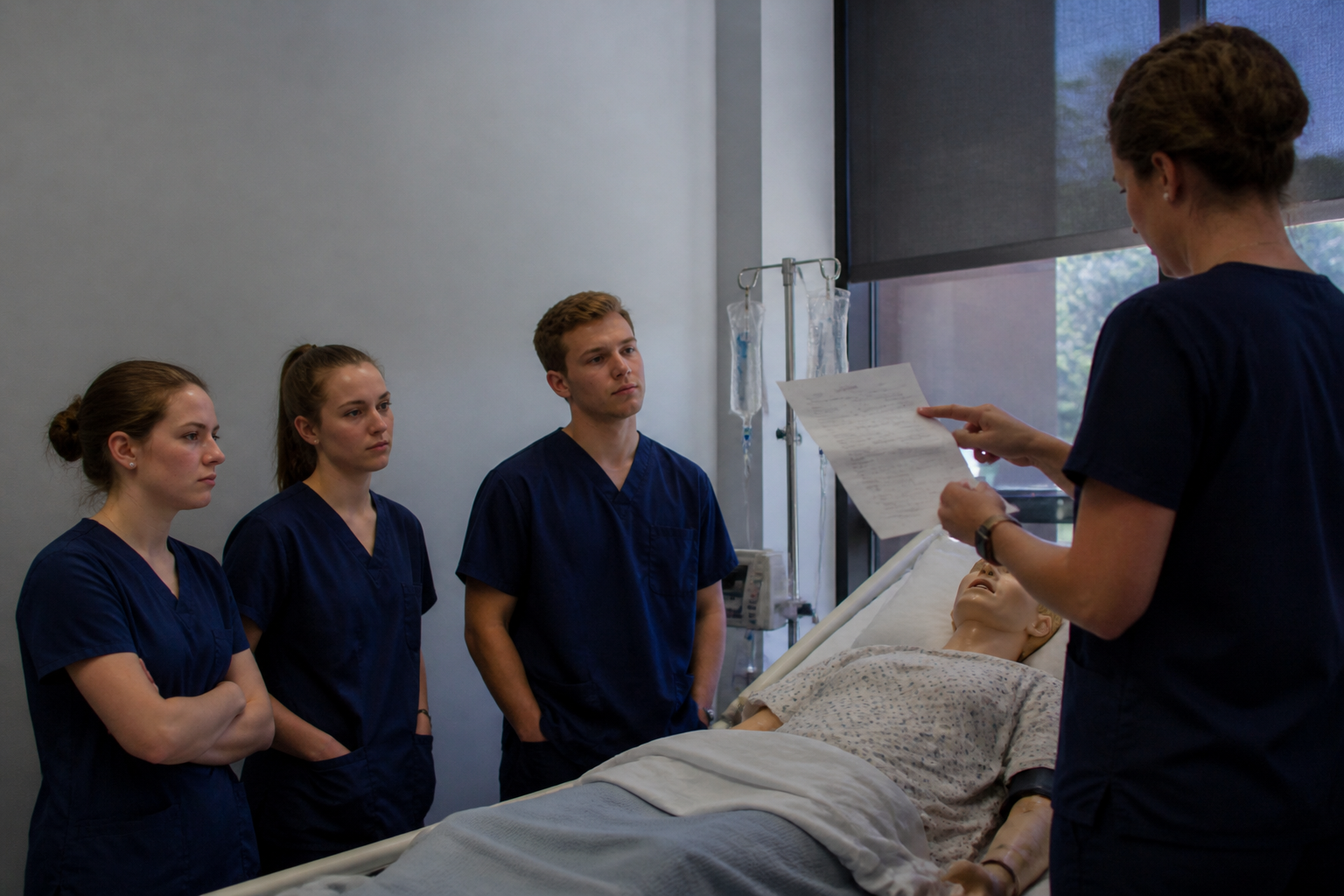
Acceleration in a second-degree BSN comes from subtraction, not speed. Your non-nursing bachelor's already covers the general education requirements, so a North Carolina accelerated BSN keeps the nursing courses and clinical hours, runs year-round without a summer break, and finishes in roughly 12 to 16 months of full-time study.
The cost of that compression is scheduling. Prerequisite sciences have to be finished before day one, clinicals run on hospital time, and there is little slack for a failed course or a part-time job.
With most cohorts admitting once a year, a missed prerequisite deadline can push your first nursing course back a full twelve months.
Key Points
- Fayetteville State posts the lowest average net price listed: $7,892 (2024).
- Expect 12 to 18 months of full-time, year-round classes and clinicals.
- NC licensure costs $75 through Nurse Gateway plus $200 for NCLEX-RN.
Best Accelerated BSN (ABSN) Schools in North Carolina
Think of this list as a scorecard that weighs what you pay, how often students finish, and how hard it is to get in. Every entry below is an accelerated second-degree BSN in North Carolina, so each one assumes you already hold a bachelor's in something else. The figures describe the whole institution, not the ABSN cohort alone, which makes them a fair way to compare campuses side by side.
University of North Carolina at Chapel Hill
#1Chapel Hill, NC · ~$12,000/yr (est.)
Best for: Research-minded career changers
UNC Chapel Hill is the state's flagship public university and the most selective campus on this list, with an overall graduation rate above 90 percent. Its accelerated BSN runs four semesters on campus and leans on interprofessional education and undergraduate research. Carolina nurses are trained as team-oriented, patient-centered clinicians, and the School of Nursing carries a national reputation that travels well beyond North Carolina.
- Four-semester, on-campus accelerated BSN for second-degree students
- Starts in summer with financial aid and scholarships available
- Interprofessional education and student research built into the curriculum
- Prepares for roles in hospital administration, public health, and research
Duke University
#2Durham, NC · ~$30,000/yr (est.)
Best for: High-achievers eyeing graduate study
Duke University pairs a highly selective undergraduate and graduate profile with one of the country's best-known schools of nursing. The accelerated BSN packs 58 credit hours into 16 months, with 56 clinical hours per credit and elective options that carry graduate credit. A bridge pathway exists for Duke undergraduates, and the surrounding health system gives students an unusually deep clinical environment in Durham.
- 16-month program totaling 58 credit hours
- 56 clinical hours per credit hour
- Graduate credit elective option and Trinity College Bridge pathway
- Coursework spans pharmacology, lifespan care, and complex care
- Leadership, collaboration, and evidence-based practice threads
Cabarrus College of Health Sciences
#3Concord, NC · $15,000 – $20,000/yr (est.)
Best for: Hands-on learners near Charlotte
Cabarrus College of Health Sciences is a small, hospital-based institution in Concord, north of Charlotte, operating on an Atrium Health campus. The accelerated BSN takes as little as four semesters, and clinicals can begin in the first semester in high-tech simulation labs. Small classes and preferred access to Atrium Health clinical sites make this the most clinically immersive option on the list.
- Accelerated BSN for holders of a bachelor's in any field
- As little as four semesters to finish
- Clinicals start as early as the first semester
- Hospital-based campus with high-tech simulation labs
- Individualized instruction in small classes
- Preferred access to Atrium Health clinical sites
- Prepares graduates to sit for the NCLEX-RN
University of North Carolina Wilmington
#4Wilmington, NC · $7,000 – $24,000/yr (est.)
UNC Wilmington is a coastal public university with a large, well-established nursing school and a strong simulation program. Its accelerated BSN is cohort-based and finishes in four semesters, blending lab work with off-campus clinical placements. Financial aid and scholarships are available, and the in-state tuition rate here is among the lowest for a public ABSN in the state.
- Four-semester accelerated BSN, cohort-based structure
- Simulation labs plus off-campus clinical practice
- Financial aid and scholarships available to eligible students
- Student organizations and a nursing honor society
- Prepares graduates to sit for the NCLEX-RN
University of North Carolina at Charlotte
#5Charlotte, NC · $15,000 – $20,000/yr (est.)
UNC Charlotte is the largest public university in the Charlotte metro, and its ABSN admits once a year in the fall. The program runs four semesters with high-fidelity simulation in a dedicated learning resource center, plus dedicated student success tutors and automatic scholarship eligibility for admitted students. Applicants need a prior degree, CNA I certification, and science prerequisites completed with a B or higher.
- Four-semester accelerated BSN, one fall start per year
- High-fidelity simulation in a dedicated learning resource center
- Dedicated student success tutors and automatic scholarship eligibility
- Prerequisite sciences require a B grade or higher
- CNA I certification required before entry
- Two-step application process
Elon University
#6Elon, NC · ~$42,000/yr (est.)
Elon University is a private institution in the Piedmont known for engaged, residency-style learning, and it sits on this list with the highest admissions rate and graduation rate among the private options. Its accelerated BSN runs 16 months and 67 credit hours with 540 clinical hours at area hospitals and clinics. Community-driven service learning and resiliency training set the curriculum apart.
- 16-month program totaling 67 credit hours
- 540 clinical hours at area hospitals and clinics
- Simulation with high-fidelity manikins and standardized patients
- 3.0 GPA minimum and TEAS entrance exam required
- Community-driven service learning partnerships
- Resiliency and self-care training for providers
- One fall start per year
East Carolina University
#7Greenville, NC · ~$16,000/yr (est.)
East Carolina University is a public university in Greenville with a long-standing health sciences focus and a large nursing school. Its accelerated second-degree BSN is a 12-month, full-time, in-person program, the shortest timeline on this list. The program covers nursing theory and clinical practice and prepares graduates for RN licensure.
- 12-month accelerated format for second-degree students
- Full-time, in-person classes
- Prepares graduates to sit for the NCLEX-RN
- Eligible for RN licensure on completion
Western Carolina University
#8Cullowhee, NC · ~$13,000/yr (est.)
Western Carolina University is a public university in Cullowhee that delivers its ABSN at the Asheville Biltmore Park instructional site. The 16-month program runs four consecutive semesters with clinical rotations across Buncombe County and western North Carolina. State-of-the-art classrooms and labs pair with hands-on clinical partnerships, and applications go through NursingCAS.
- 16-month, four-semester accelerated BSN
- Classes held at the Asheville Biltmore Park site
- Clinical rotations in Buncombe County and western North Carolina
- Two-step admissions process through NursingCAS
- Monthly virtual open houses and on-site events
North Carolina A & T State University
#9Greensboro, NC · ~$11,000/yr (est.)
North Carolina A&T State University is a land-grant HBCU in Greensboro with a strong health sciences tradition. Its accelerated BSN is a 12-month program covering 64 semester hours in a block format, with a full-time schedule that includes days, evenings, and weekends. Admission requires a 3.0 GPA, TEAS scores at or above the national mean, and CNA I listing.
- 12-month accelerated BSN, 64 semester hours in block format
- Second-degree entry option for prior bachelor's holders
- 3.0 GPA minimum and TEAS entrance exam required
- CNA I listing required before entry
- Full-time schedule with nights and weekends
- Prerequisites include microbiology, nutrition, chemistry, and statistics
- Interview and writing sample as part of admission
Winston-Salem State University
#10Winston-Salem, NC · $10,000 – $15,000/yr (est.)
Winston-Salem State University is a public HBCU with a supportive, cohort-style culture and a reputation for social mobility. Its accelerated BSN runs 15 months full-time and covers pediatrics, mental health, public health, and maternal-newborn care. The program is structured so students can focus entirely on their studies, and applicants apply by September 1 for a spring start.
- 15-month full-time accelerated BSN
- Spring start with a September 1 application deadline
- Requires a prior bachelor's degree and prerequisite courses
- Coursework spans pediatrics, mental health, public health, and maternal-newborn care
- Interprofessional clinical collaborations
- Students are encouraged not to work during the program
Cost & outcomes by school
Federal data for the highest-earning Accelerated BSN (ABSN) programs, independent of the ranking above. Earnings are this field's bachelor's graduates four years after completing where the Scorecard reports them, else the school's undergraduate median.
| School | Net price / yr | Grad rate | Earnings | Debt | Grads/yr | Format |
|---|---|---|---|---|---|---|
| Duke University NC | $29,612 | 97% | $97,800 | $13,000 | 5,506 | Campus |
| Elon University NC | $41,555 | 84% | $74,545 | $20,500 | 3,416 | Campus |
| University of North Carolina at Chapel Hill NC | $11,655 | 91% | $72,200 | $14,000 | 14,766 | Campus |
| Cabarrus College of Health Sciences NC | $17,618 | 71% | $58,708 | $16,000 | 260 | Campus |
| Queens University of Charlotte NC | $30,857 | 61% | $57,673 | $25,000 | 604 | Campus |
| University of North Carolina at Charlotte NC | $15,435 | 69% | $57,289 | $21,500 | 12,800 | Campus |
| East Carolina University NC | $15,739 | 63% | $55,146 | $22,750 | 9,648 | Campus |
| University of North Carolina Wilmington NC | $20,109 | 71% | $54,967 | $19,500 | 7,880 | Campus |
| Western Carolina University NC | $13,315 | 60% | $49,458 | $21,868 | 5,136 | Campus |
| Gardner-Webb University NC | $17,674 | 55% | $48,039 | $24,222 | 922 | Campus |
| University of Mount Olive NC | $18,853 | 52% | $47,139 | $27,209 | 854 | Campus |
| Winston-Salem State University NC | $13,479 | 47% | $45,344 | $25,000 | 1,840 | Campus |
Sources: U.S. Department of Education. Net price, graduation rate, earnings and debt: College Scorecard (earnings and debt for this field's bachelor's graduates where reported, else school-wide); graduates: IPEDS. A dash means no figure is reported.
Cost, debt & payoff
Median earnings of this field's bachelor's graduates (4 yrs after completing, else the school's undergraduate median) vs. their median federal loan debt · U.S. College Scorecard
Across these programs the median graduate earns about $49,458 and finishes with roughly $22,750 in debt — a ratio that clears a common rule of thumb (keep debt below first-year salary). Net price and debt vary widely school to school, so check the per-school figures in the table above before you shortlist.
Second Degree Nursing Programs in North Carolina: Who the ABSN Route Fits
A traditional BSN spends four years building from scratch; an accelerated BSN assumes you already hold a bachelor's degree in something else. That prior degree is the entry ticket. Biology, business, psychology, any major outside nursing qualifies you for the ABSN route.
How It Differs From a Traditional BSN or ADN
An ADN is a two-year associate path to RN licensure through a community college. A traditional BSN spreads general education and nursing coursework across four years. An ABSN skips the general education entirely, because you already earned those credits. What is left is nursing-only: pathophysiology, pharmacology, adult health, maternal-newborn, mental health, and clinical rotations, delivered back to back with few breaks.
The Trade-Off
You reach RN licensure far faster, but you pay for it in intensity. Most programs run full-time, and clinical hours are scheduled by the hospital, not by you. Part-time work is difficult and sometimes discouraged outright.
Where the Programs Are
Options cluster in a few regions. Charlotte and nearby Concord anchor the southwest, the Triangle covers Durham and Chapel Hill, and regional hubs stretch from Wilmington and Greenville to Greensboro, Winston-Salem, Fayetteville, Elon, and the mountains at Cullowhee.
Most Affordable Accelerated BSN Schools in North Carolina
Every school in this lowest-cost group is a public UNC System campus. Average net price after aid runs from $7,892 at Fayetteville State University to $13,479 at Winston-Salem State University, based on 2024 federal IPEDS and College Scorecard data. Net price is an institution-wide average for undergraduates after grants and scholarships, while published in-state tuition and fees is the sticker price before any aid. Neither figure is the full cost of an ABSN program, so check each nursing school's fee schedule for program-specific charges. No private school, including Duke University or Elon University, appears here. Private campuses do not offer state-subsidized in-state rates, which is the main reason UNC System schools hold the lowest prices on this page.
| School | City | Sector | Average Net Price After Aid (institution-wide) | Published In-State Tuition and Fees (before aid) | Median Graduate Debt (institution-wide) |
|---|---|---|---|---|---|
| Fayetteville State University | Fayetteville | Public (UNC System) | $7,892 | $4,353 | $22,987 |
| North Carolina A & T State University | Greensboro | Public (UNC System) | $10,846 | $6,813 | $27,000 |
| University of North Carolina at Chapel Hill | Chapel Hill | Public (UNC System) | $11,655 | $8,994 | $14,000 |
| Western Carolina University | Cullowhee | Public (UNC System) | $13,315 | $4,630 | $21,868 |
| Winston-Salem State University | Winston-Salem | Public (UNC System) | $13,479 | $6,126 | $25,000 |
ABSN Admissions: Prior Bachelor's, Prerequisites, GPA, and Entrance Tests
Admission rules vary by school, so read each program's admissions page before you plan your prerequisites. These examples come from UNC Chapel Hill, UNC Charlotte, and North Carolina A&T.
- Prior degreeMost ABSN applicants hold a bachelor's in another field. UNC Charlotte also accepts an Associate in Arts or Associate in Science. Ask each school when your degree must be conferred relative to the start date.
- Prerequisite coursesUNC Chapel Hill requires Anatomy and Physiology I and II, Microbiology with lab, General Psychology, and Statistics. UNC Charlotte lists writing, college algebra, introductory statistics, general psychology, anatomy and physiology with lab, nutrition, and growth and development.
- GPA and minimum gradesUNC Chapel Hill sets a 2.8 minimum for both cumulative and science GPA. It requires a B- in A&P and Microbiology and a C in Psychology and Statistics. UNC Charlotte requires a B in its biology, nutrition, and growth courses and a C in the others. It reviews prerequisite GPA without publishing a numeric floor. North Carolina A&T sets a 3.0 cumulative minimum and wants C or better in prerequisites, preferably on the first attempt.
- Entrance examsUNC Chapel Hill requires no TEAS, HESI, GRE, MAT, or NLN PAX. North Carolina A&T requires a TEAS score at or above the national mean.
- Course recency and timingAt UNC Chapel Hill, A&P and Microbiology must fall within 5 years of the deadline, and Psychology and Statistics within 10. Three of five key sciences, including A&P I, must be done by the deadline. The rest must be finished by the end of spring before entry.
- CNA and clinical clearancesUNC Charlotte and North Carolina A&T require Nurse Aide I listing on the North Carolina registry. Confirm background check, drug screen, and immunization deadlines with each school.
Related Articles
Pace and Cost: 12 to 18 Months, In-State Tuition, and Fees Beyond Tuition
Accelerated BSN pricing in North Carolina has pulled apart over the last few cycles, with public residents paying a fraction of what private programs charge for the same license. The calendar, though, is nearly identical everywhere: full-time, year-round, no part-time option.
Length and Credit Load
The published schedules sit squarely in the 12-to-16-month window:
- UNC Chapel Hill: 60 credits over four semesters, 15 months, with no part-time track available.
- North Carolina A&T State University: 12 months.
- Elon University: 16 months, 67 credits, including 540 required clinical hours.
- Duke University: 16 months.
Those credit totals matter more than the month count. Sixty-plus nursing credits compressed into roughly a year means carrying 15 to 18 credits a semester alongside clinical rotations, summers included.
In-State Public Pricing vs. Private Tuition
The gap is stark. UNC Chapel Hill lists in-state tuition of $3,615 per semester against $23,736 for out-of-state students, with a total program cost around $26,002. Elon's accelerated BSN runs about $46,958 in tuition and fees. Duke charges $27,397 per semester, roughly $109,588 across the program. Residency status alone can swing your bill by more than $80,000 at the extremes.
The Line Items Applicants Forget
Tuition is the headline, not the total. Budget separately for:
- Mandatory student fees: UNC Chapel Hill adds $1,060.50 per semester, plus a $24 nursing program fee and a $5.50 clinical compliance charge each term.
- Books, supplies, and equipment: scrubs, a stethoscope, and course materials are real money.
- Clinical clearance: background checks, drug screens, immunization records, and CPR certification.
- Licensure: NCLEX-RN registration and the North Carolina Board of Nursing application fee come at the end, when savings are thinnest.
Lost Wages Are Part of the Price
Programs this dense rarely leave room for a job. Clinical rotations are scheduled around hospital shifts, not yours, and night or weekend placements are common. If you are walking away from a $45,000 salary for 15 months, that foregone income exceeds the tuition at several public options here. Plan financing for living expenses, not just the bursar's bill.
North Carolina Board of Nursing Approval, CCNE Accreditation, and NCLEX-RN Eligibility
A nursing program can carry two different stamps of approval, and they do different jobs.
Board Approval Comes First
The North Carolina Board of Nursing approves prelicensure programs that lead to initial RN licensure. That approval is the one tied to your eligibility to sit for the NCLEX-RN and apply for a license. The Board's scope covers prelicensure nursing programs, not RN-to-BSN completion tracks or graduate nursing degrees. Before you enroll, confirm the program appears on the Board's current approved-programs list.
Accreditation Is a Separate Signal
CCNE or ACEN accreditation is voluntary and reviews the program itself. It is not the same as state approval, but it matters when you apply to graduate school, when employers screen applicants, and when you seek certain types of financial aid. Among the programs ranked here, the ABSN programs at UNC-Chapel Hill, Duke, UNC Charlotte, and Winston-Salem State hold CCNE accreditation. Accreditation can vary by track and change over time, so verify the specific ABSN entry on the CCNE directory and cross-check the school's admissions page. If a program's page does not state its status plainly, ask the program director in writing before you deposit.
Pass Rates and License Portability
For current NCLEX-RN pass rates, check the North Carolina Board of Nursing's published program reports rather than a number that dates quickly. North Carolina is also a Nurse Licensure Compact state, so a multistate RN license issued here can carry to other compact states, provided you follow each state's practice rules. Keep both the Board's approved-programs list and the CCNE directory bookmarked as you compare schools. They answer different questions, and you need both.
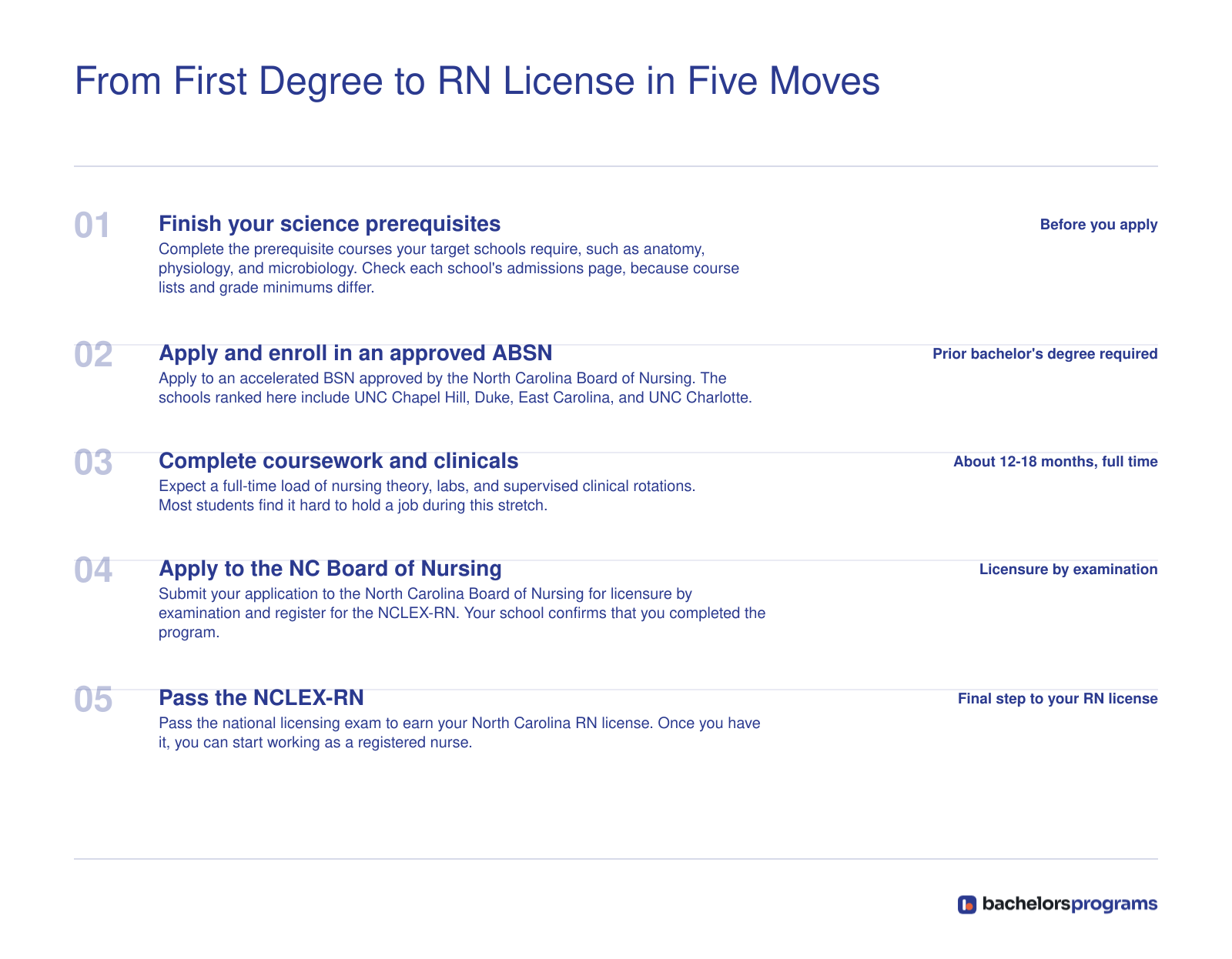
From First Degree to RN License in Five Moves
The accelerated BSN route follows a fixed order, and each step depends on the one before it. Use this sequence to plan your timeline from your first prerequisite course to your first nursing shift.
NC RN Licensure by Examination at a Glance
Accelerated BSN in North Carolina: Quick Questions Answered
Do second-degree nursing students in North Carolina qualify for federal financial aid?
Which accelerated nursing programs in North Carolina start in January or spring?
Are there accelerated nursing programs in Charlotte, NC?
Compare Accelerated BSN (ABSN) programs on the data that matters
Explore more Nursing majors or browse every field of study.
All Nursing programs Browse every field of study