Best BSN Programs in Oregon
Compare 15 accredited Bachelor of Science in Nursing (BSN) programs in Oregon at 14 colleges, with net price after aid, graduation rates, earnings and debt from IPEDS and the U.S. College Scorecard.
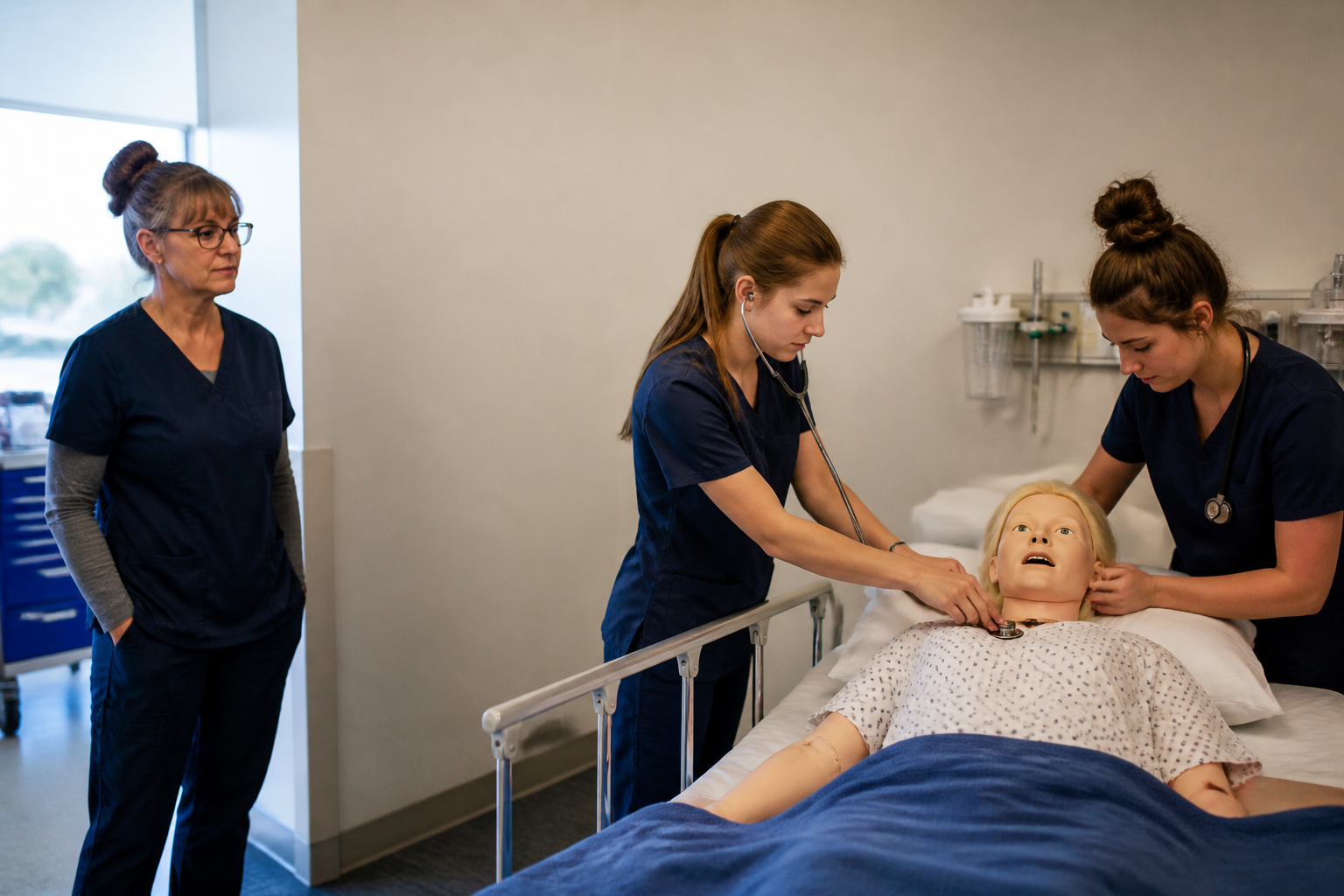
Which Oregon BSN program gives a new graduate the best odds of passing the NCLEX-RN on the first try? The ranking below answers it, ordering the state's traditional pre-licensure programs by NCLEX-RN results.
Cost pulls the other way. A private university BSN and a community college route can differ by tens of thousands of dollars, and net price after aid reshuffles the order. Admissions narrows the field too: prerequisite sequences, TEAS scores, and upper-division entry that can fill a cohort a year ahead of clinicals.
Licensed RNs and second-degree students have their own RN-to-BSN and accelerated tracks. For everyone else, several community colleges admit by lottery with in-district priority.
Key Points
- First-time NCLEX-RN pass rates drive about 75 percent of each school's score.
- University-wide admission rates: George Fox near 94 percent, Bushnell near 67.
- Oregon graduates must sit for the NCLEX-RN within three years of finishing.
Oregon BSN Schools Ranked by NCLEX-RN Pass Rate
First-time NCLEX-RN results drive this list, with completion and accreditation used to separate close calls. Every school below runs a traditional pre-licensure BSN in Oregon, where students enter as undergraduates and leave eligible for RN licensure. RN-to-BSN completion tracks and accelerated second-degree options are covered separately.
Bushnell University
#1Eugene, OR · ~$21,000/yr (est.) · NCLEX-RN pass rate 100% (3-yr weighted avg)
Best for: Students seeking a faith-integrated campus BSN
Bushnell is a private Christian university in Eugene whose on-campus BSN pairs acute care and community clinical placements with coursework in ethics, evidence-based practice and holistic care. Its graduates posted a 100 percent first-time NCLEX-RN pass rate across the three years reported, on 89 test takers. The school-wide graduation rate is 56 percent and the admission rate is 67 percent, with about two thirds of undergraduates receiving Pell Grants, so need-based aid matters here. Classes are small and faculty bring practice experience into the room.
- On-campus pre-licensure BSN with acute care and community clinicals
- CCNE accredited and approved for veteran's benefits
- Curriculum integrates a Christian worldview and social justice
- Prepares for RN licensure, leadership and direct patient care
- Faculty bring real-world clinical experience to the classroom
George Fox University
#2Newberg, OR · $30,000 – $35,000/yr (est.) · NCLEX-RN pass rate 92.5% (3-yr weighted avg)
Best for: Nursing students wanting patient-actor simulation practice
George Fox is a private university in Newberg, in the Willamette Valley, with a BSN that mixes acute care hospital and community clinic placements with a simulation clinic staffed by trained patient actors. First-time NCLEX-RN results sit at 92.5 percent over the three years reported, across 292 test takers. The school-wide graduation rate is 72 percent against a 94 percent admission rate, and roughly 48 percent of undergraduates receive Pell Grants. George Fox reports that its graduates are eligible for licensure in all 50 states.
- CCNE and OSBN accredited, accredited since 2008
- Simulation clinic staffed with trained patient actors
- Clinical placements in acute care hospitals and community clinics
- Graduates eligible for licensure in all 50 states
- Prepares students for graduate nursing education
Sumner College
#3Portland, OR · $25,000 – $30,000/yr (est.) · NCLEX-RN pass rate 90.1% (3-yr weighted avg)
Best for: Adults starting nursing without prerequisite coursework
Sumner College is a private, for-profit college in Portland that admits students with no prerequisite coursework, then runs a hybrid schedule of online classes, on-campus skills labs and clinical rotations. The curriculum spans 12 terms over about 32 months, and the TEAS is required for entry. Its first-time NCLEX-RN pass rate is 90.1 percent over three years on 217 test takers. The school-wide graduation rate is 83 percent, the admission rate is 89 percent, and about 61 percent of students receive Pell Grants, which fits its role as a practical, access-oriented option.
- No prerequisite coursework required for admission
- Hybrid format: online classes, campus skills labs, clinicals
- TEAS entrance exam required
- Rolling admissions with new cohorts every 10 weeks
- 32-month, 12-term curriculum
- $510 per credit, with scholarships available
- Transfer up to 25 percent of prior college credits
- Small class sizes in a cohort-based structure
Oregon Health & Science University
#4Portland, OR · NCLEX-RN pass rate 90.3% (3-yr weighted avg)
OHSU is Oregon's only academic health center, and its three-year BSN runs across five campuses: Portland, Ashland, Klamath Falls, La Grande and Monmouth. Students complete 180 credits with clinical placements arranged by the university, so the state's academic health system effectively sets up the practice side of the degree. The first-time NCLEX-RN pass rate is 90.3 percent over the three years reported, on 852 test takers, the largest testing pool among the schools listed here. About 33 percent of undergraduates receive Pell Grants, and regional campus students can qualify for scholarships of up to $6,000.
- Three-year, 180-credit BSN at Oregon's only academic health center
- Five campus locations: Portland, Ashland, Klamath Falls, La Grande, Monmouth
- Clinical placements arranged by the university
- 3.0 GPA minimum and about 28 quarter credits of prerequisites
- Scholarships up to $6,000 for regional campus students
- Nursing simulation labs and a low student-faculty ratio
- $442 per credit
- CCNE accredited
Linfield University
#5McMinnville, OR · $25,000 – $30,000/yr (est.) · NCLEX-RN pass rate 89.5% (3-yr weighted avg)
Linfield is a private university in McMinnville with a four-semester BSN that runs in 15-week terms and admits students in both fall and spring. Simulation and virtual reality labs anchor the practice side, and faculty mentors are assigned from the first day. The first-time NCLEX-RN pass rate is 89.5 percent over three years on 638 test takers, one of the larger pools in Oregon. The school-wide graduation rate is 70 percent, the admission rate is 85 percent, and about 40 percent of undergraduates receive Pell Grants.
- Four-semester BSN with 15-week terms
- Two start dates per year, fall and spring
- Simulation and virtual reality labs in dedicated facilities
- Faculty mentors assigned from the first day
- Coursework emphasizes social justice and care for underserved populations
- Prepares students for national licensure and RN practice
University of Portland
#6Portland, OR · $28,000/yr (est. net price) · NCLEX-RN pass rate 86.1% (3-yr weighted avg)
The University of Portland runs a concept-based BSN organized around population health, leadership, evidence-based practice and social justice, with a Simulated Health Center that uses trained actors and high-fidelity manikins. Clinical work runs through Dedicated Education Units and community-based sites. First-time NCLEX-RN results are 86.1 percent over the three years reported, on 692 test takers, one of the largest pools on this list. The school-wide graduation rate is 80 percent, the admission rate is 89 percent, and about 33 percent of undergraduates receive Pell Grants.
- Concept-based curriculum covering population health and leadership
- Simulated Health Center with trained actors and high-fidelity manikins
- Clinical partnerships through Dedicated Education Units
- Community-based clinical placements
- Emphasis on evidence-based practice and social justice
- CCNE accredited
- Prepares graduates for holistic generalist nursing practice
Warner Pacific University
#7Portland, OR · $25,000 – $30,000/yr (est.) · NCLEX-RN pass rate 75.8% (3-yr weighted avg)
Warner Pacific is a small private university in Portland whose pre-licensure BSN is a four-semester, in-person program built for traditional undergraduates, with a 2.5 GPA threshold and two required recommendations. Coursework covers medical-surgical, maternal-neonatal, child, community and mental health nursing, ending in a leadership capstone with clinical hours. The first-time NCLEX-RN pass rate is 75.8 percent over the three years reported, on 166 test takers, the smallest pool here. The school-wide graduation rate is 49 percent, the admission rate is 71 percent, and about 70 percent of undergraduates receive Pell Grants, the highest share among the schools listed.
- Four-semester, in-person pre-licensure BSN
- 2.5 GPA minimum plus prerequisite sciences
- Two letters of recommendation required
- Application essay on diversity in health care
- Leadership capstone that includes clinical hours
- Coursework spans medical-surgical, maternal-neonatal, child, community and mental health
- CCNE accredited
Chemeketa Community College
#8Salem, OR · ~$8,000/yr (est.) · NCLEX-RN pass rate 99.4% (3-yr weighted avg)
Klamath Community College
#9Klamath Falls, OR · $5,000 – $8,000/yr (est.) · NCLEX-RN pass rate 92.1% (3-yr weighted avg)
Lane Community College
#10Eugene, OR · ~$9,000/yr (est.) · NCLEX-RN pass rate 91.5% (3-yr weighted avg)
Cost & outcomes by school
Federal data for the highest-earning Bachelor of Science in Nursing (BSN) programs, independent of the ranking above. Earnings are this field's bachelor's graduates four years after completing where the Scorecard reports them, else the school's undergraduate median.
| School | Net price / yr | Grad rate | Earnings | Debt | Grads/yr | Format |
|---|---|---|---|---|---|---|
| Oregon Health & Science University OR | — | — | $101,028 | $16,625 | 864 | Campus |
| University of Portland OR | $28,210 | 80% | $82,804 | $21,370 | 1,716 | Campus |
| Linfield University OR | $26,536 | 71% | $78,638 | $25,000 | 988 | Campus |
| George Fox University OR | $31,679 | 72% | $59,761 | $24,250 | 1,370 | Campus |
| Warner Pacific University OR | $25,629 | 49% | $55,204 | $25,000 | 212 | Campus |
| Warner Pacific University Professional and Graduate Studies OR | — | — | $55,204 | $25,000 | 82 | Campus |
| Bushnell University OR | $20,789 | 56% | $53,623 | $23,500 | 340 | Campus |
| Eastern Oregon University OR | $17,148 | 43% | $50,112 | $20,500 | 1,280 | Campus |
| Southern Oregon University OR | $16,732 | 43% | $49,175 | $20,332 | 1,186 | Hybrid |
| Corban University OR | $28,035 | 61% | $48,917 | $22,625 | 398 | Campus |
| Sumner College OR | $29,411 | 83% | $46,639 | $16,500 | 40 | Hybrid |
| Chemeketa Community College OR | $8,200 | 21% | $40,968 | $12,822 | 42 | Hybrid |
Sources: U.S. Department of Education. Net price, graduation rate, earnings and debt: College Scorecard (earnings and debt for this field's bachelor's graduates where reported, else school-wide); graduates: IPEDS. A dash means no figure is reported.
Cost, debt & payoff
Median earnings of this field's bachelor's graduates (4 yrs after completing, else the school's undergraduate median) vs. their median federal loan debt · U.S. College Scorecard
Across these programs the median graduate earns about $53,623 and finishes with roughly $21,370 in debt — a ratio that clears a common rule of thumb (keep debt below first-year salary). Net price and debt vary widely school to school, so check the per-school figures in the table above before you shortlist.
Behind the Ranking: Exam Results First, Then Completion and Accreditation
Roughly 75 percent of each school's score comes from one number: the first-time NCLEX-RN pass rate reported by the Oregon State Board of Nursing. The rate is a three-year average weighted by the number of test-takers, so one unusually small or unusually strong cohort cannot push a school up or down the list.
Why the Exam Leads
A BSN diploma does not let you work as a nurse in Oregon. Passing the NCLEX-RN does, because it is the gate to an RN license. Many "top nursing school" lists hand out #1, #2 and #3 without saying what the order rests on. Here the exam carries the most weight because it is the outcome every student needs.
Tie-Breakers
When schools land close together, three factors settle the order: accreditation status, completion, and retention. Graduation and retention figures describe the whole institution, not just the nursing department. Treat them as a general signal of how well a school keeps students enrolled, not as a nursing completion rate.
What the Ranking Leaves Out
The order cannot tell you how good the clinical placements are, how large each cohort is, or whether a campus suits your life. Those decisions belong to you. Cost, earnings and admissions each get their own section, so weigh them alongside the ranking.
Scope
Only traditional pre-licensure BSN programs make the list. RN-to-BSN and accelerated tracks are left out, so those programs do not compete with the schools above.
Five Oregon BSN Schools With the Lowest Net Price
Net price below is an institution-wide average from IPEDS and College Scorecard (2024) data, showing what first-time, full-time aid recipients paid across each campus, so treat it as a benchmark rather than a personal quote for a nursing program. Every school in this lowest-price group is public, so no private school's aid package closes the gap at this level. Median debt and graduation rate also describe each whole institution, including two-year students at the community colleges, not BSN cohorts alone. The three community college options here serve nurses who already hold an RN license, while Southern Oregon University and Eastern Oregon University offer pre-licensure BSN paths linked to Oregon Health & Science University. For tuition details and Oregon state grant programs, see the cost section below.
| School | City | Sector | BSN Entry Route | Average Net Price After Aid (Institution-Wide) | Median Graduate Debt (Institution-Wide) | Graduation Rate (Institution-Wide) |
|---|---|---|---|---|---|---|
| Klamath Community College | Klamath Falls | Public | For RNs with an associate degree (statewide consortium) | $7,050 | $17,480 | 42.8% |
| Chemeketa Community College | Salem | Public | For licensed RNs with an associate degree (statewide consortium) | $8,200 | $12,822 | 21.3% |
| Lane Community College | Eugene | Public | RN to BSN for licensed nurses | $9,123 | $14,761 | 20.4% |
| Southern Oregon University | Ashland | Public | Pre-licensure BSN, partnership with OHSU | $16,732 | $20,332 | 42.5% |
| Eastern Oregon University | La Grande | Public | Pre-licensure BSN, dual enrollment with OHSU | $17,148 | $20,500 | 43.0% |
Paying for a BSN in Oregon: In-State Tuition, Net Price and State Grants
Nursing education in Oregon costs less than many families expect, especially if you start at a public campus and claim the state aid you qualify for.
Published In-State Tuition
Annual in-state tuition and fees at the public colleges ranked here run from $4,965 at Klamath Community College to $7,192 at Southwestern Oregon Community College. Clatsop Community College ($5,110), Portland Community College ($5,220) and Mt Hood Community College ($5,247) also sit near the low end. These are general tuition and fee figures. Nursing programs can add lab, clinical, uniform and testing costs on top, so check each school's nursing fee schedule before you build a budget.
Net Price After Aid
Net price is what students pay once grants and scholarships are subtracted from the full cost of attendance, including books and living expenses. That is why it can exceed tuition. Among the schools ranked here, average annual net price ranges from $7,050 at Klamath Community College to $10,548 at Clatsop Community College. Public colleges generally post lower net prices than private universities, which explains why community colleges dominate the affordable end of the list.
The Oregon Opportunity Grant
Oregon's main need-based state grant is not nursing-specific, but it applies to nursing students. Maximum awards for 2025-26:
- Community college: $4,272
- Applied bachelor's at a community college: $5,964
- Four-year college: $7,8001
The maximum requires full-time, full-year enrollment of at least 12 credits per term; part-time or part-year study is prorated.1 Your actual award depends on your Student Aid Index. To qualify, you must:
- Residency: Live in Oregon for at least 12 months before enrolling, with limited exceptions.
- Status: Be a U.S. citizen or eligible noncitizen with no prior bachelor's degree.
- Enrollment: Attend at least half time (6 credits per term) at a participating Oregon public or private nonprofit school.
- Need: Show financial need through the FAFSA or the Oregon Student Aid Application (ORSAA).
The grant covers up to the equivalent of four full-time years.1
File Early
Submit the FAFSA, or the ORSAA if you cannot file the FAFSA, as soon as the application opens. Oregon awards the grant until funds run out, so a qualified student who files late can still miss out.1
Related Articles
Questions to Ask Yourself
Are you entering straight from high school, or do you already have prerequisites finished?
Would you accept a slightly lower NCLEX-RN pass rate for a public school's lower net price?
Can you relocate to the campus city where clinical rotations happen?
Does the BSN hold CCNE or ACEN accreditation if you may pursue graduate nursing study later?
Getting Into an Oregon BSN: Prerequisites, GPA, TEAS and Entry Models
George Fox University reports an institution-wide admission rate of about 94 percent, and Bushnell University about 67 percent. Those figures cover every applicant to each university, not only nursing applicants, so treat them as a rough signal. Nursing seats are capped by clinical placements, and the bar for the major is usually higher than the campus-wide rate.
Direct Entry vs. Upper-Division Entry
Oregon BSN programs generally follow one of two models.
- Direct entry: You are admitted to nursing, or to a pre-nursing track, as a freshman.
- Upper-division entry: You complete one to two years of general education and science prerequisites first. Then you apply to the nursing program for the final two or three years.
Bushnell and George Fox are four-year universities, so both enroll students straight from high school. Each school's nursing admissions page sets whether you enter the nursing major when you enroll or after prerequisites. Confirm that detail before you commit, because it determines how secure your spot is.
You can start as a freshman at Bushnell University or George Fox University and finish your prerequisites on campus.
If you would rather begin at a community college, the common path has three steps:
- Earn an associate degree in nursing at a school such as Linn-Benton, Central Oregon, Rogue, Umpqua or Treasure Valley Community College.
- Pass the licensure exam and become an RN.
- Complete a BSN completion program.
Chemeketa Community College and Klamath Community College run consortium BSN programs built for that last step. Both require an associate degree in nursing and an unencumbered RN license. Both fill seats by lottery and give in-district residents priority.
Prerequisites, GPA and Entrance Tests
Pre-licensure nursing programs commonly expect these courses:
- Anatomy and physiology
- Microbiology with lab
- Chemistry
- Nutrition
- Human development
- English composition
- College-level math
Programs often set a minimum grade in each course and limit how old your science credits can be. Chemeketa's consortium program lists microbiology as a required prerequisite. Competitive GPAs tend to sit at 3.0 or higher, and many programs require an entrance exam such as the ATI TEAS or HESI A2.
Requirements can shift between application cycles. Before you plan your schedule, pull the current GPA floor, prerequisite list and test policy from each school's nursing admissions page.
If you already hold a degree in a different field, look at the accelerated BSN route instead. Bushnell University offers one, and that path is covered on its own page.
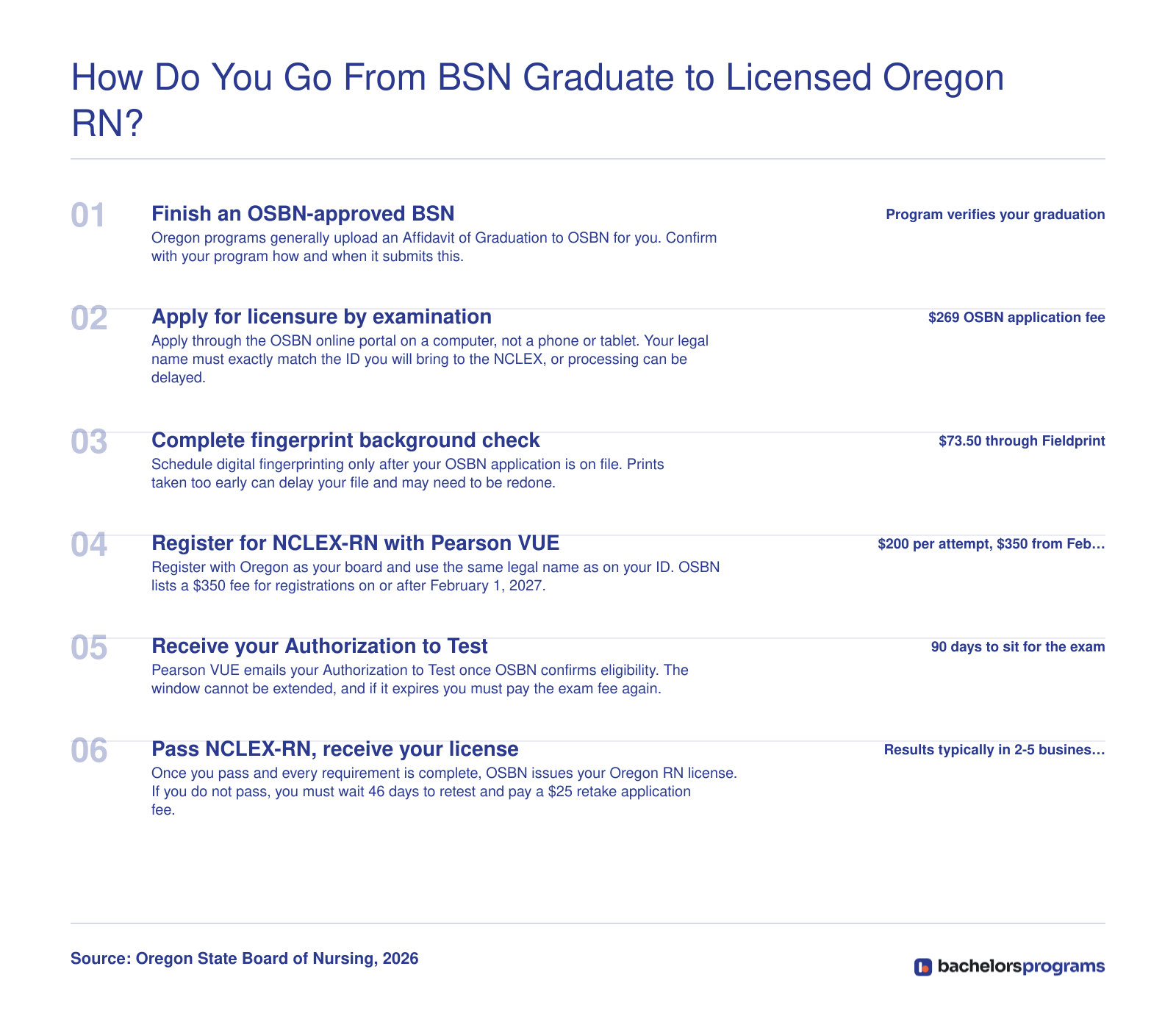
How Do You Go From BSN Graduate to Licensed Oregon RN?
New BSN graduates who have never held a nursing license elsewhere earn the Oregon RN license by examination through the Oregon State Board of Nursing (OSBN). You must test within three years of finishing your program, and you get up to four NCLEX-RN attempts. Fees below are current as of November 2026.
OSBN Approval, CCNE and ACEN Accreditation: What Each Seal Means
A state seal and a national seal answer different questions. Oregon State Board of Nursing approval asks whether a program may prepare you for the NCLEX-RN in Oregon. CCNE or ACEN accreditation asks whether a national nursing accreditor has reviewed the program against its standards. You need the first to test for a license. The second can matter later, for graduate school, some employers and certain aid or transfer decisions.
The approval that leads to licensure
OSBN approval is the first requirement. Oregon requires graduation from an approved program before you can take the NCLEX-RN. The board publishes an approved-program list by degree type, including baccalaureate programs, and posts annual NCLEX-RN pass rates for Oregon RN programs. The board calculates those rates once a year from the prior calendar year and rounds to the nearest percentage. Reports pair first-time pass rates with candidate counts, so you can see whether a percentage rests on a small cohort.
What national accreditation adds
CCNE and ACEN are voluntary national accreditors, separate from OSBN. A program can hold state approval without holding one of these seals. National accreditation can matter for graduate admission, some employer preferences, and certain federal aid or transfer decisions. Check a school's status directly in the CCNE or ACEN directory rather than trusting a general claim or a third-party list. Every program in the ranking is OSBN-approved; confirm national accreditation school by school.
Reading pass rates without overreading them
Look at first-time rates across several years, not one graduating class. Small cohorts swing widely: one or two candidates can move a program from the low 80s to 100%. The pass rate shown for a program here is a first-time rate, so it does not include repeat test takers. Oregon's rules also set minimum first-time and total pass-rate standards, and the board allows four NCLEX attempts. If a recent rate sits near a state floor, ask what remediation and repeat-taker support the program provides.
Oregon RN Licensure at a Glance
Already an RN or Holding Another Degree? Other Oregon BSN Routes
A traditional BSN started from scratch takes time you may not need to spend if you already hold a license or a degree. The programs ranked here are pre-licensure tracks for students earning their first nursing credential, so two groups should look elsewhere.
Licensed RNs with an associate degree in nursing belong on the dedicated RN-to-BSN page. That route is built around a license you already hold, so the focus is on completing the bachelor's-level coursework.
Students who already hold a bachelor's in a different subject should head to the accelerated BSN page. That route starts from a prior degree, which lets you move into nursing coursework faster.
If neither describes you, the decision is straightforward. Pick two or three schools from the NCLEX-RN pass rate ranking. Compare net price rather than sticker tuition, then confirm admissions deadlines and prerequisite timelines on each school's own admissions page before you apply.
Compare Bachelor of Science in Nursing (BSN) programs on the data that matters
Explore more Nursing majors or browse every field of study.
All Nursing programs Browse every field of study