Best Accelerated BSN (ABSN) Programs in Oregon
Compare 3 accredited Accelerated BSN (ABSN) programs in Oregon, with net price after aid, graduation rates, earnings and debt from IPEDS and the U.S. College Scorecard.
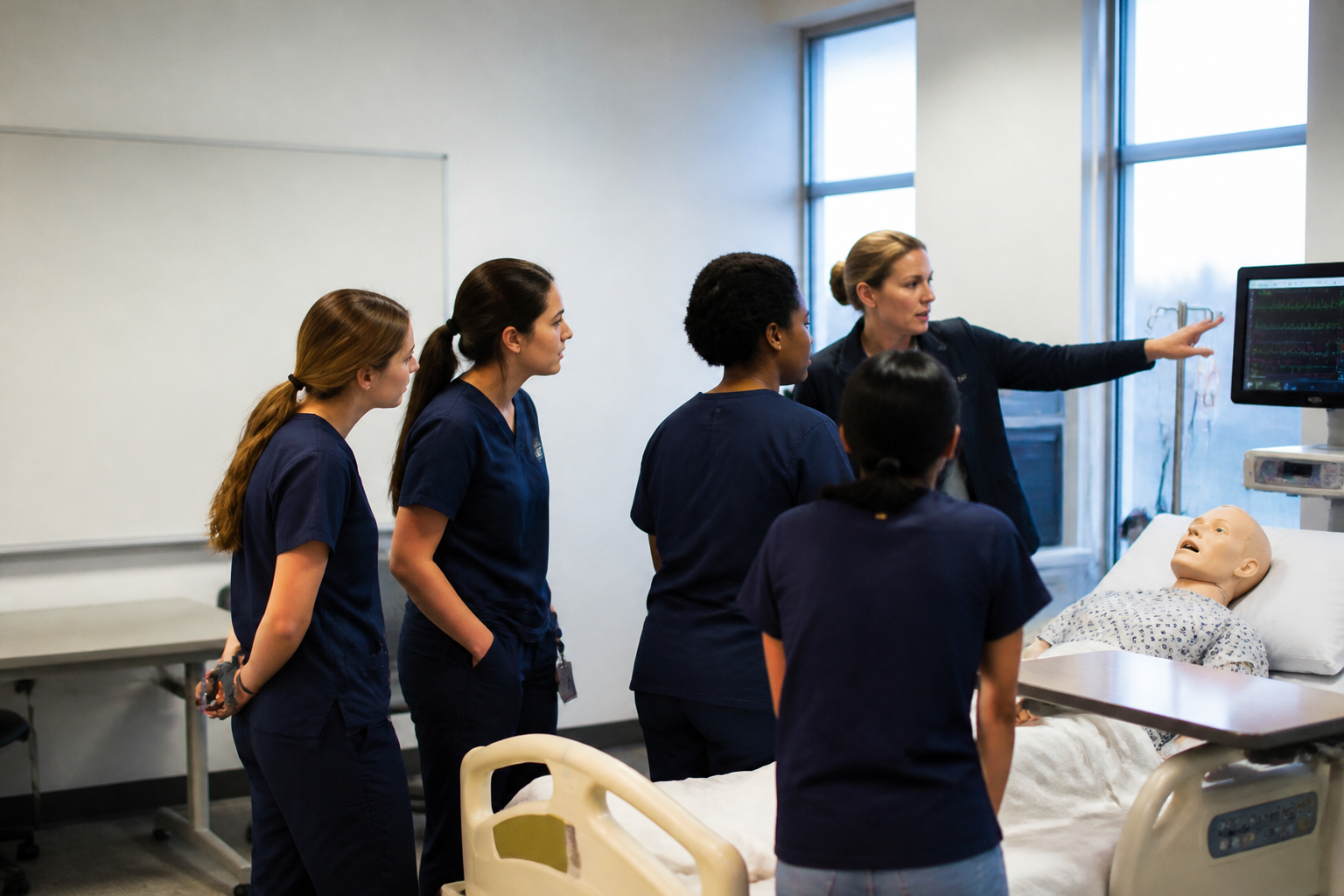
Oregon licenses registered nurses through a single exam, the NCLEX-RN, and no accelerated pathway skips it. An ABSN takes a bachelor's degree earned in another field and adds a compressed nursing sequence on top, usually 12 to 15 months of full-time study.
The bottleneck is seat count and prerequisite timing, not ambition. Science coursework has to be finished before a cohort begins, and each campus runs a fixed intake with its own deadline.
Oregon's accelerated BSN field is small and campus-based, so the choice usually comes down to geography, tuition, and how quickly a program gets you to the exam.
Key Points
- Oregon ABSN tuition and program charges run roughly $57,000 to $75,000.
- OHSU anchors Portland, while Linfield and Bushnell offer smaller Willamette Valley cohorts.
- Oregon licensure by exam starts with a $269 OSBN application fee.
Oregon's Top Accelerated BSN Programs for Second-Degree Students
Three Oregon schools currently enroll second-degree students in an accelerated BSN, and they differ sharply in size, setting, and price. Two sit in smaller Willamette Valley cities with small cohorts; the third is the state's academic health center in Portland, with the largest cohort and the strongest clinical footprint. Each entry below is a single, stand-alone accelerated BSN, so the choice comes down to setting and cost rather than sorting through multiple tracks.
Linfield University
#1McMinnville, OR · $25,000 – $30,000/yr (est.)
Best for: Small-cohort applicants near Portland
Linfield University is a private liberal arts institution in McMinnville, about an hour southwest of Portland, and its ABSN runs on the McMinnville campus with clinical placements across the greater Portland area. The program is deliberately small and selective, and it draws on simulation labs plus an unusual offering of healthcare-themed study abroad coursework. For a second-degree applicant who wants a tight cohort and a suburban small-town base within reach of Portland hospitals, this is the most direct fit in the state.
- 12-month ABSN built for holders of a prior bachelor's degree
- Four 10-week semesters spanning summer, fall, winter, and spring
- Summer start with a competitive, selective admission process
- Simulation lab coursework plus clinical placements in greater Portland
- Healthcare-themed international study opportunities
- Applications submitted through NursingCAS
Bushnell University
#2Eugene, OR · ~$21,000/yr (est.)
Best for: Working CNAs and LPNs in Eugene
Bushnell University is a private Christian institution in Eugene, and its ABSN is a 12-month, on-campus pathway that pairs a faith-based learning environment with clinical rotations across acute care, clinics, and community settings, including a PeaceHealth partnership. The program is CCNE accredited and runs small cohorts with close faculty mentorship. It is also one of the few Oregon options that admits students with a current CNA certification or LPN license alongside the prior bachelor's degree, which suits applicants already working in health care.
- 12-month ABSN with fall and spring start dates
- 44 total credit hours at $1,225 per credit
- CCNE accredited program
- Prior bachelor's holders need a 2.75 cumulative GPA
- Current unencumbered CNA certification or LPN license required for second-degree applicants
- Prerequisites completed with B- or higher before the program begins
- Clinical rotations include a partnership with PeaceHealth
- Small cohorts with personalized faculty mentorship
Oregon Health & Science University
#3Portland, OR
Best for: Portland residents eyeing advanced practice
Oregon Health & Science University in Portland is the state's only academic health center, and its accelerated B.S. in nursing is a 15-month, full-time cohort program that covers the same curriculum as the traditional track. Students train in advanced simulation labs and take clinical placements arranged by OHSU at local health care sites, with a low student-faculty ratio and access to dual admission pathways into D.N.P. or Ph.D. study. It enrolls the largest accelerated cohort in Oregon and carries the lowest comparable tuition among the state's accelerated options.
- 15-month accelerated B.S. in nursing for prior bachelor's holders
- 180 total credit hours, full-time cohort enrollment
- CCNE accredited
- 3.0 GPA minimum plus prerequisite coursework
- Advanced training in nursing simulation labs
- Clinical placements arranged by OHSU at local sites
- Dual admission pathways to D.N.P. or Ph.D. programs
- Scholarships available, including $6,000 for Ashland students
Cost & outcomes by school
Federal data for the highest-earning Accelerated BSN (ABSN) programs, independent of the ranking above. Earnings are this field's bachelor's graduates four years after completing where the Scorecard reports them, else the school's undergraduate median.
| School | Net price / yr | Grad rate | Earnings | Debt | Grads/yr | Format |
|---|---|---|---|---|---|---|
| Oregon Health & Science University OR | — | — | $101,028 | $16,625 | 864 | Campus |
| Linfield University OR | $26,536 | 71% | $78,638 | $25,000 | 988 | Campus |
| Bushnell University OR | $20,789 | 56% | $53,623 | $23,500 | 340 | Campus |
Sources: U.S. Department of Education. Net price, graduation rate, earnings and debt: College Scorecard (earnings and debt for this field's bachelor's graduates where reported, else school-wide); graduates: IPEDS. A dash means no figure is reported.
Cost, debt & payoff
Median earnings of this field's bachelor's graduates (4 yrs after completing, else the school's undergraduate median) vs. their median federal loan debt · U.S. College Scorecard
Across these programs the median graduate earns about $78,638 and finishes with roughly $23,500 in debt — a ratio that clears a common rule of thumb (keep debt below first-year salary). Net price and debt vary widely school to school, so check the per-school figures in the table above before you shortlist.
What Put These Oregon ABSN Schools in Order
Two numbers can describe the same Oregon ABSN: the price a school publishes and the price a student actually pays after grants and scholarships. The gap between them, along with admission difficulty and completion, is part of what separates the entries below.
What the Ordering Reflects
A second-degree student usually cares about three things first: what the program costs after aid, how selective the school is, and how many students actually finish. The order you see reflects those signals. Linfield University, Bushnell University and Oregon Health & Science University each publish their own admission requirements and program details, and the figures behind each entry come from federal education data.
How to Read the Institutional Numbers
One caution before you compare schools side by side. Net price is an institution-wide average after aid across all undergraduates, not a tuition quote for the accelerated BSN. Graduation rate covers the entire school, including students who never enter nursing. Neither is an ABSN-specific figure, so read both as a signal of how a school prices and supports its students overall, then confirm program costs and cohort outcomes directly with the school.
NCLEX-RN pass rates appear only where the ranking data supplies them. Where the data does not supply a rate, the figure is left out rather than estimated.
Earnings Snapshot for Oregon Nursing Graduates
Federal data on nursing bachelor's graduates from the schools on this page show strong pay soon after licensure.
ABSN Admissions in Oregon: Prior Bachelor's, Science Prerequisites, and GPA
Oregon's accelerated BSN programs are built for applicants who already hold a degree in another field. The basic requirements are similar, but grade floors, course lists, and certification rules differ by school. Use this checklist, then confirm details on each school's admissions page, including Linfield University's.
- A completed non-nursing bachelor's degreeOHSU requires a non-nursing bachelor's. You may apply while finishing it, but it must be conferred before the program starts. Bushnell University requires a non-nursing bachelor's from a regionally accredited institution.
- Science and support prerequisites, within recency limitsOHSU lists anatomy and physiology with lab (12 credits), microbiology with lab (4), nutrition (3), human development (3), genetics (3), and statistics (3). All except human development must be completed within seven years of your intended start. Bushnell's prerequisite checklist includes general biology, microbiology, and anatomy and physiology. Its March 2026 prerequisite document sets a seven-year window, extended to 10 years for nutrition and human growth and development.
- Minimum grades and GPAOHSU requires a 3.0 cumulative GPA, a 3.0 prerequisite GPA, and a B- or higher in each prerequisite. Bushnell sets a 2.75 cumulative GPA for applicants with a prior bachelor's and, per its 2026-27 catalog, a 2.75 in required prerequisite science courses. Its program page also calls for a B- or higher in each prerequisite.
- Entrance exam policyNeither OHSU's nor Bushnell's admissions materials list the TEAS or HESI. Check this again with each school before you apply.
- CNA or LPN credentialBushnell requires a current, unencumbered CNA certification or LPN license. OHSU's admissions pages do not list this requirement.
- Background check and immunizationsConfirm background check and immunization requirements, and when they are due, directly with each school's admissions office.
Oregon ABSN Start Dates, Deadlines, and Cohort Sizes by School
Use this table to plan backward from your target start term, especially if you still have science prerequisites to finish. These dates come from the schools' own admissions pages as reviewed in October 2026, and deadlines and start terms shift from one admission cycle to the next, so confirm current dates with each school before you schedule prerequisite courses or submit an application. Oregon Health & Science University sets earlier winter deadlines for a summer or later start, while Bushnell University runs two admission cycles a year. Linfield University's dates were not part of this review, so contact its nursing admissions office directly for its current cohort calendar.
| School | Start Term(s) | Application Deadline or Window | Cohort Size | Prerequisites Due By |
|---|---|---|---|---|
| Oregon Health & Science University (Portland campus) | Summer 2027, Fall 2027 or Winter 2028 | January 5, 2027 | Not published | Not published |
| Oregon Health & Science University (Ashland campus) | Summer or Fall 2027 | Priority: January 5, 2027; Final: February 1, 2027 | Not published | Not published |
| Oregon Health & Science University (Bend campus) | Summer 2027 | January 5, 2027 | Not published | Not published |
| Bushnell University (Eugene) | January and August | Fall admission: April 1; Spring admission: September 1 | Not published | All prerequisite courses completed with a grade of B- or higher before the program begins |
Related Articles
ABSN Pace and Cost in Oregon: Program Length, Tuition, and Financial Aid
An Oregon ABSN costs roughly $57,000 to $75,000 in tuition and program charges, and the sticker price depends more on residency and fees than on program length. Most programs here run 12 to 15 months of full-time study, and the schools below sit at the faster end.
Length and Credits
OHSU runs 15 months and 72 credits. Bushnell University is 12 months and 44 credits, full-time and in person. Linfield University runs its ABSN across four 10-week semesters, summer, fall, winter, and spring, and its credit total was not in the material reviewed, so confirm it with the school.
Published Cost by School
OHSU is the public option, with 2026-2027 rates of $623 per credit for Oregon residents and $832 for nonresidents. Approximate totals by campus:
- Portland: $59,939 resident, $74,987 nonresident.
- Bend: $58,754 resident, $73,802 nonresident.
- Ashland: $56,924 resident, $71,972 nonresident.
Those totals exclude campus-specific fees. Bushnell is private and priced flat at $1,250 per credit. With a $3,505 program fee, about $1,500 in textbooks, and $300 to $600 in other expenses, the all-in range is $60,305 to $60,605. Technology and clinical-site transportation are not priced in that figure. Linfield's program-level tuition in our data is about $51,736.
Federal net price figures are lower than these totals. They show average cost after aid across each school's undergraduates: about $20,789 at Bushnell and $26,536 at Linfield. Treat them as a loose benchmark, since they are not specific to second-degree nursing students.
Why Per-Credit Price Misleads
A low per-credit rate can still produce a larger bill. Program fees, lab and clinical fees, uniforms, equipment, and travel to clinical sites all change the total. Compare the full cost of attendance for your campus, not the headline rate.
Aid for Second-Degree Students
Federal loans are generally available to second-degree students. Pell grants usually are not. Bushnell ABSN students do not qualify for the institutional grants given to traditional undergraduates, but two nursing awards exist: the Helen Stafford Walsh Scholarship ($500, with a 3.00 cumulative GPA requirement) and the Freeman Scholarship for Nursing ($5,000, for Spring 2027, with preference to ABSN students). Employee tuition-benefit recipients are excluded from both. OHSU lists a $6,000 Ashland ABSN scholarship, but it applies to summer or fall 2027 starts and is disbursed in 2027-28. Check OHSU's scholarship pages for other awards.
The Hidden Timeline Cost
Missing science prerequisites can add one or two terms before you start, and that delay carries its own tuition and living costs. Once enrolled, plan on little or no paid work. A full-time ABSN combines class, lab, simulation, and clinical shifts, so budget for living expenses across the entire program.
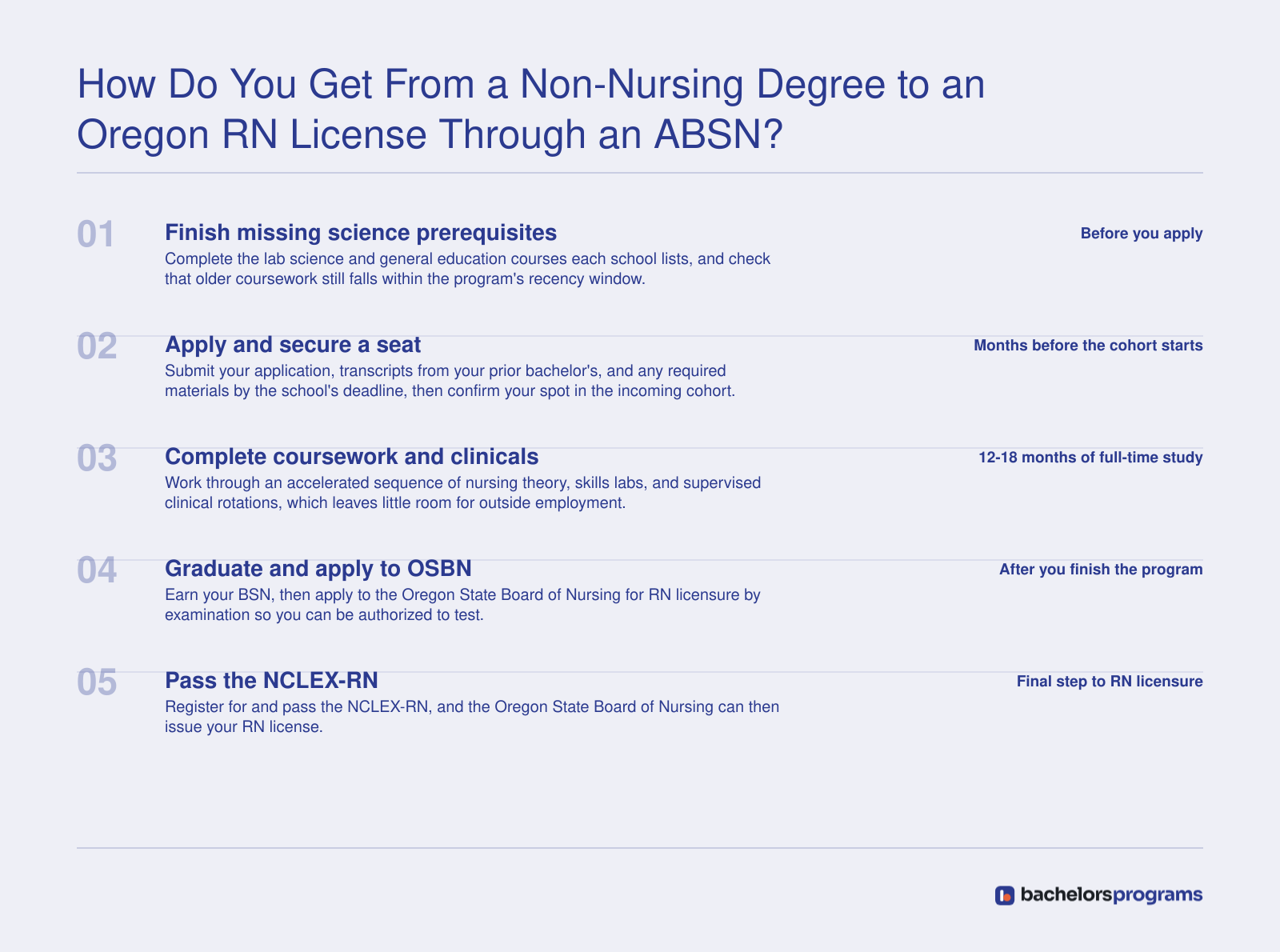
How Do You Get From a Non-Nursing Degree to an Oregon RN License Through an ABSN?
The accelerated BSN path at Linfield University, Bushnell University, and Oregon Health & Science University follows the same basic order: prerequisites, admission, an intensive full-time program, then licensure through the Oregon State Board of Nursing and the NCLEX-RN. Applicants most often lose time before the program starts, because science prerequisites can expire if they were completed too long ago, and retaking anatomy, physiology, or microbiology can push an application back a full term. The second common delay is the start calendar, since a program that admits only one cohort a year turns a missed deadline or an incomplete prerequisite into a twelve-month wait, so confirm each school's recency rule and start dates on its admissions page before you plan your timeline.
Oregon State Board of Nursing Approval, Accreditation, and NCLEX-RN Results for ABSN Programs
Why Board Approval Matters
In Oregon, only graduates of Oregon State Board of Nursing-approved pre-licensure programs, or an equivalent program, can sit for the NCLEX-RN. A degree from an unapproved program can leave you with a diploma and no path to an RN license. Approval and accreditation are separate things. Approval comes from the state board, while accreditation comes from a national body.
The board's NCLEX report lists Bushnell University in Eugene as an Oregon RN program. OHSU also appears in that report, though by campus location. Confirm the current approval wording for each accelerated track directly with the board.
Accreditation and Pass Rates
Bushnell's ABSN and OHSU's School of Nursing are both accredited by the Commission on Collegiate Nursing Education (CCNE). Neither is flagged as newly or provisionally accredited in the material reviewed, but check each school's current status on the accreditor's site.
The board publishes first-time NCLEX-RN pass rates by program for 2021 through 2025:
- Bushnell University: 100% in each year from 2022 through 2025, with no figure shown for 2021.
- OHSU (Ashland location, accelerated program): 93% in 2021, 100% in 2022, 93% in 2023 and 2024, and 92% in 2025.
- OHSU (Klamath Falls location): 70% in 2021, 68% in 2022, 96% in 2023, 77% in 2024, and 68% in 2025.
OHSU is reported by location, so these figures do not add up to one statewide OHSU accelerated rate. The board's report does not break out the Portland campus separately in the material reviewed. Small cohorts also make a single year swing widely, so look at several years rather than one. Linfield's results should come from the board's report as well, since no figures were confirmed here.
Verify in Two Steps
- Step one: Check the Oregon State Board of Nursing's list of approved programs and its "RN/LPN Education Program NCLEX Pass Rates" page for the program and campus you plan to attend.
- Step two: Look up the school in the CCNE or ACEN directory to confirm accreditation is current.
Run both checks for Linfield, Bushnell, and OHSU before you apply, since status and pass rates are updated each year.
Oregon RN Licensure by Exam at a Glance
Choosing an Oregon ABSN by Location, Format, and Clinical Travel
Every accelerated BSN in Oregon is campus-based, so students must live within reach of labs and clinical sites rather than log in from anywhere.
Where the campuses sit
Oregon Health & Science University anchors its ABSN in Portland, with additional sites in Ashland and Bend. Bushnell University runs its 12-month ABSN in Eugene. Linfield University's accelerated program is based in McMinnville and lists clinical sites in the greater Portland area. None of the three is a fully online program: OHSU is campus-based, Bushnell is in person, and Linfield is listed as a campus format. Plan for didactic work, skills labs, simulation, and clinical preparation at a physical site.
Labs and relocation
At Bushnell, theory and lab courses are in person, so out-of-area students should expect to relocate to Eugene for the 12-month sprint. OHSU's classes, labs, simulation, and clinical preparation run through the designated campus, meaning students admitted to Ashland or Bend should build their lives around that site, not Portland. Linfield's McMinnville base keeps students in the Willamette Valley, with a commute or short move to Portland-area clinical placements.
Clinical travel
Bushnell arranges rotations across acute and specialty hospitals, clinics, behavioral health, schools, community, correctional, and veteran settings, including the Eugene VA. Sites may be up to 75 miles away, and students provide transportation; the final semester includes a 192-hour one-on-one preceptor immersion. OHSU arranges local clinical placements for its students. Linfield points to greater Portland clinical sites. Ask each school for its current placement map before you commit, because a 75-mile radius can mean a daily drive over a mountain pass.
The decision rule
Pick the campus where you can realistically live for the 12 to 15 months your program runs and still reach labs and clinical sites without a punishing commute. Then compare tuition and aid. Location is the constraint that shapes everything else.
Compare Accelerated BSN (ABSN) programs on the data that matters
Explore more Nursing majors or browse every field of study.
All Nursing programs Browse every field of study