Best BSN Programs in Tennessee
Compare 42 accredited Bachelor of Science in Nursing (BSN) programs in Tennessee at 31 colleges, with net price after aid, graduation rates, earnings and debt from IPEDS and the U.S. College Scorecard.
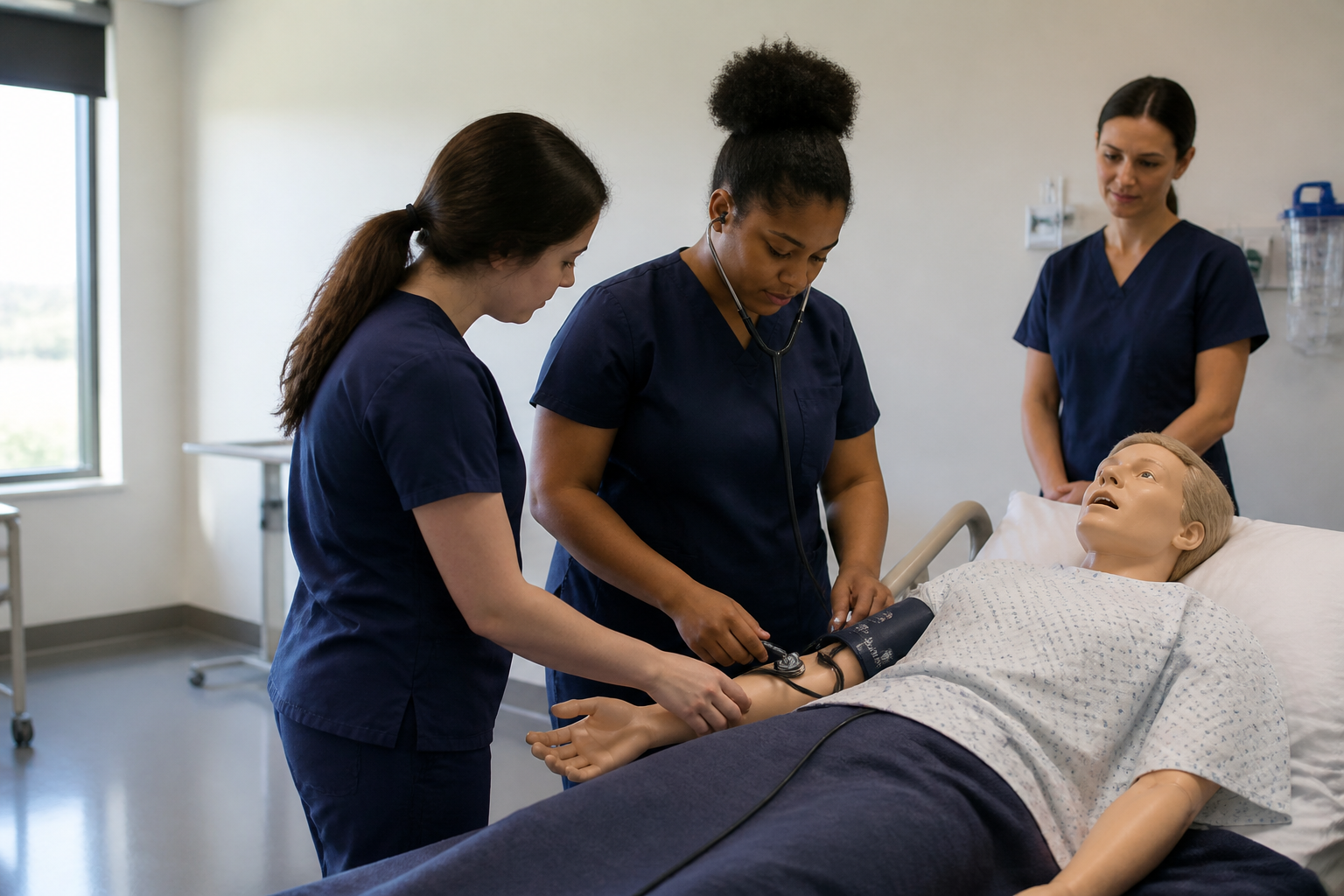
A BSN is a four-year nursing degree that qualifies graduates to sit for the NCLEX-RN, the licensing exam every Tennessee nurse must pass. Among the top schools here, pass rates run from 97% to 100%, so the choice rarely comes down to reputation. It comes down to results, cost, and how a program admits students.
The ranking covers traditional pre-licensure BSN programs only; affordability, graduate earnings, admissions, state aid, and Board of Nursing licensure follow.
Admission is often the tighter constraint: several schools here limit nursing seats or admit only after prerequisites are finished.
Key Points
- Top Tennessee BSN programs all cleared 97% first-time NCLEX-RN pass rates.
- Public university in-state tuition runs roughly $10,400 to $11,400 yearly.
- Tennessee RN applicants need TBI and FBI fingerprint background checks.
Tennessee BSN Schools Ranked by NCLEX-RN Results: 10 Top Programs
Tennessee's strongest first-time NCLEX-RN outcomes belong to the traditional BSN programs below, listed from the highest pass rate to the lowest. Each profile covers what the school is known for, what its nursing program asks of applicants, and the setting where students train.
The University of Tennessee Southern
#1Pulaski, TN · ~$13,000/yr (est.) · NCLEX-RN pass rate 100% (3-yr weighted avg)
Best for: Small-town students seeking close faculty mentoring
A small public university in Pulaski, UT Southern runs a four-year, 120-credit BSN that pairs science coursework with simulation labs and supervised clinical placements. The program holds CCNE accreditation and full Tennessee Board of Nursing approval, and small classes keep faculty accessible. Eligible students can also pursue a partnership enrollment pathway into the University of Tennessee Health Science Center's nursing programs. The school's graduation rate is 37%.
- Four-year, 120-credit BSN with CCNE accreditation and state approval
- First-time NCLEX-RN pass rate of 100% across 26 candidates
- High faculty-to-student ratio and personalized attention
- Institutional aid can cover tuition for qualifying Tennessee residents
- Health Sciences Association club for nursing students
- Reported career placement rate of 100%
Lee University
#2Cleveland, TN · ~$19,000/yr (est.) · NCLEX-RN pass rate 99.1% (3-yr weighted avg)
Best for: Transfer students entering as pre-nursing
A private university in Cleveland, Lee admits nursing students from three pools: first-time freshmen, current Lee students, and transfer students. Everyone begins as pre-nursing, completes prerequisites, and starts nursing coursework in the fall, and seats are limited. The traditional track is CCNE accredited and draws a large applicant pool for its size. The school's graduation rate is 63%.
- Traditional campus track admits freshmen, current Lee students, and transfers
- Students enter as pre-nursing and complete prerequisites first
- All nursing majors begin coursework in the fall semester
- First-time NCLEX-RN pass rate of 99.1% across 208 candidates
- University admission required before the nursing application
- Limited seats make nursing admission competitive
- CCNE accredited
Cumberland University
#3Lebanon, TN · ~$19,000/yr (est.) · NCLEX-RN pass rate 98.5% (3-yr weighted avg)
Best for: Students wanting global health clinical experience
A private university in Lebanon, Cumberland builds its BSN around hands-on practice, with 1,080 clinical hours, human patient simulators, and community health fairs across Middle Tennessee. Nursing students can also join transcultural trips abroad, and an 11:1 student-to-faculty ratio keeps instruction personal. Endowed scholarships and tuition reimbursement from area health systems help offset cost. The school's graduation rate is 46%.
- 1,080 clinical hours built into the curriculum
- First-time NCLEX-RN pass rate of 98.5% across 186 candidates
- Human patient simulators used throughout coursework
- Transcultural nursing trips abroad and Middle Tennessee health fairs
- 11:1 student-to-faculty ratio
- Multiple endowed scholarships; employer tuition reimbursement accepted
- CCNE accredited
Galen Health Institutes-Nashville Campus
#4Nashville, TN · ~$27,000/yr (est.) · NCLEX-RN pass rate 97.5% (2-yr weighted avg)
Galen's Nashville campus is a dedicated nursing site rather than a full university, and its three-year BSN runs year round so students can enter practice sooner. There are no prerequisite courses to complete before applying, but applicants take the TEAS entrance assessment, and classes start four times a year. Simulation labs and academic support sit alongside clinical experiences in Nashville-area care settings.
- Three-year BSN with year-round study
- Four start dates per year; next term begins January 4, 2027
- TEAS entrance assessment required; no prerequisite courses
- $0 application fee and a roughly 10-minute application
- First-time NCLEX-RN pass rate of 97.5% across 137 candidates
- Simulation labs and personalized academic resources
- No essays required for admission
Tennessee Tech
#5Cookeville, TN · $10,000 – $15,000/yr (est.) · NCLEX-RN pass rate 97% (3-yr weighted avg)
A public university in Cookeville, Tennessee Tech's Whitson-Hester School of Nursing pairs four years of coursework with a five-semester clinical sequence and weekly placements across Middle and East Tennessee. Admission to the upper division is competitive, and new freshmen who meet the Presidential Scholarship benchmarks are guaranteed a clinical seat. Prerequisites can be completed at community colleges before transferring in. The school's graduation rate is 58%.
- Four-year BSN with a five-semester clinical sequence
- First-time NCLEX-RN pass rate of 97% across 382 candidates
- Presidential Scholarship recipients (3.4 GPA, 23 ACT) get guaranteed clinical admission
- HESI A2 required before applying to the clinical portion
- Clinical admission runs twice a year with separate fall and spring cycles
- Community college prerequisites accepted from transfer applicants
- Weekly clinical placements across Middle and East Tennessee
The University of Tennessee-Chattanooga
#6Chattanooga, TN · ~$14,000/yr (est.) · NCLEX-RN pass rate 97.2% (3-yr weighted avg)
A public university in Chattanooga, UTC runs a four-year CCNE-accredited BSN with small clinical groups and rotations across a range of care settings. Faculty emphasize critical thinking and evidence-based practice, and the degree doubles as preparation for graduate nursing study. The school's graduation rate is 50%.
- First-time NCLEX-RN pass rate of 97.2% across 226 candidates
- Small clinical groups with individualized faculty attention
- Four-year BSN accredited by CCNE
- Clinical rotations across a variety of care settings
- Scholarships available to nursing students
- Strong foundation for graduate nursing study
The University of Tennessee-Martin
#7Martin, TN · $11,000/yr (est. net price) · NCLEX-RN pass rate 97% (3-yr weighted avg)
A public university in Martin, UT Martin offers its pre-licensure BSN on the main campus and at the Parsons Center, with clinical rotations at Baptist Memorial Hospitals and West Tennessee Healthcare. Students train in simulation and off-campus labs, and class sizes stay small. Transfer applicants from other nursing programs must supply a letter of good standing, and science prerequisites older than seven years are not accepted. The school's graduation rate is 53%.
- Pre-licensure BSN offered at the Martin campus and Parsons Center
- First-time NCLEX-RN pass rate of 97% across 117 candidates
- 2.75 cumulative GPA plus 21 ACT composite or 20 ACT Reading to apply
- TEAS entrance exam required
- Clinical rotations with Baptist Memorial Hospitals and West Tennessee Healthcare
- Transfer students from other nursing programs need a letter of good standing
- Science prerequisites older than seven years are not transferable
Middle Tennessee State University
#8Murfreesboro, TN · ~$13,000/yr (est.) · NCLEX-RN pass rate 96.9% (3-yr weighted avg)
A public university in Murfreesboro, MTSU's BSN is a 120-credit, on-ground program with 200 hours in simulation labs and more than 500 clinical hours with community partners such as Vanderbilt and Ascension Saint Thomas. Coursework is organized around communication, critical thinking, leadership, the nursing process, and professional relationships. The school's graduation rate is 54%.
- 200 simulation lab hours plus 500+ clinical hours
- First-time NCLEX-RN pass rate of 96.9% across 253 candidates
- Clinical partners include Vanderbilt and Ascension Saint Thomas
- 120-credit, four-year on-ground format
- CCNE accredited
- Prepares for roles in cardiac care, emergency nursing, and research
The University of Tennessee-Knoxville
#9Knoxville, TN · ~$19,000/yr (est.) · NCLEX-RN pass rate 95.6% (3-yr weighted avg)
A public university in Knoxville, UTK is the largest of the state's public nursing schools and admits freshmen directly into the nursing major. Students may join a nursing living-learning community, train in a simulation lab, and complete clinicals at regional hospitals, community clinics, and health departments. Army and Air Force ROTC pathways are available for students considering military nursing. The school's graduation rate is 74%.
- Direct freshman admission to the nursing major
- Freshman Nursing Living and Learning Community
- First-time NCLEX-RN pass rate of 95.6% across 607 candidates
- 3.2 GPA minimum for transfer applicants
- Clinical placements at regional hospitals, clinics, and health departments
- Army and Air Force ROTC pathways available
- CCNE accredited with technology-enhanced classrooms and a simulation lab
King University
#10Bristol, TN · ~$22,000/yr (est.) · NCLEX-RN pass rate 96.4% (3-yr weighted avg)
A private university in Bristol, King runs a small on-campus BSN with rolling admissions and fall or spring start dates. Students complete clinicals at area hospitals and free clinics, can join international mission trips, and may pursue research with faculty who still practice. The program is CCNE accredited and approved by the Tennessee Board of Nursing, and it guarantees a pathway into King's MSN. The school's graduation rate is 48%.
- Rolling admissions with fall and spring starts
- First-time NCLEX-RN pass rate of 96.4% across 48 candidates
- 3.0 GPA minimum plus TEAS entrance exam
- Guaranteed admission pathway to the MSN program
- International mission trips and service-learning in free clinics
- Small classes with faculty who practice clinically
- Approved by the Tennessee Board of Nursing and CCNE accredited
Cost & outcomes by school
Federal data for the highest-earning Bachelor of Science in Nursing (BSN) programs, independent of the ranking above. Earnings are this field's bachelor's graduates four years after completing where the Scorecard reports them, else the school's undergraduate median.
| School | Net price / yr | Grad rate | Earnings | Debt | Grads/yr | Format |
|---|---|---|---|---|---|---|
| Baptist Health Sciences University TN | $11,212 | 40% | $72,529 | $29,500 | 324 | Campus |
| The University of Tennessee Health Science Center TN | — | — | $66,318 | $12,500 | 730 | Campus |
| Galen Health Institutes-Nashville Campus TN | $27,267 | — | $61,480 | $24,166 | 74 | Campus |
| The University of Tennessee-Knoxville TN | $18,976 | 74% | $60,249 | $20,500 | 13,976 | Campus |
| King University TN | $22,347 | 48% | $59,831 | $22,750 | 530 | Campus |
| Cumberland University TN | $18,759 | 46% | $57,687 | $17,952 | 644 | Campus |
| Christian Brothers University TN | $9,854 | 55% | $57,478 | $27,000 | 568 | Campus |
| Belmont University TN | $33,147 | 71% | $55,930 | $20,500 | 3,904 | Campus |
| Lipscomb University TN | $24,739 | 72% | $55,541 | $19,500 | 1,462 | Campus |
| Bryan College-Dayton TN | $20,614 | 50% | $54,434 | $23,000 | 396 | Hybrid |
| Union University TN | $27,171 | 66% | $53,990 | $20,714 | 898 | Campus |
| Southern Adventist University TN | $24,345 | 49% | $53,723 | $24,500 | 908 | Online |
Sources: U.S. Department of Education. Net price, graduation rate, earnings and debt: College Scorecard (earnings and debt for this field's bachelor's graduates where reported, else school-wide); graduates: IPEDS. A dash means no figure is reported.
Cost, debt & payoff
Median earnings of this field's bachelor's graduates (4 yrs after completing, else the school's undergraduate median) vs. their median federal loan debt · U.S. College Scorecard
Across these programs the median graduate earns about $48,960 and finishes with roughly $20,500 in debt — a ratio that clears a common rule of thumb (keep debt below first-year salary). Net price and debt vary widely school to school, so check the per-school figures in the table above before you shortlist.
How We Ranked Tennessee BSN Schools
Reputation surveys ask deans and administrators to rate one another's schools. The NCLEX-RN asks graduates to prove, question by question, that they are safe to practice. We built this ranking on the second approach, because licensure is the one outcome every pre-licensure BSN student in Tennessee has to reach.
What carries the weight
- First-time NCLEX-RN pass rate (about three quarters of the score): Drawn from the state board's most recent three years of program-level reporting and weighted by cohort size, so one lucky year in a small program cannot outrank a large program's steady record.
- Accreditation and completion: Nursing accreditation plus a small graduation and retention component serve as tie-breakers when pass rates sit close together.
Only traditional pre-licensure BSN programs are eligible. RN to BSN tracks, which serve nurses who already hold a license, and accelerated second-degree options are covered on their own pages rather than scored here.
Where the numbers have limits
Graduation and retention figures are reported for the institution as a whole, not for the nursing school specifically, so treat them as context rather than a verdict on a cohort of nursing majors. Net price is a campus-wide average after grants and scholarships, not a quote for your family's situation. And NCLEX-RN results appear exactly as the ranking data reports them, with no adjustment, estimate, or rounding on our part.
Most Affordable BSN Schools in Tennessee
Ranked by average net price after grants and scholarships (U.S. Department of Education IPEDS and College Scorecard data, 2024), Austin Peay State University, UT Martin and the University of Memphis are the lowest-cost public options for the cheapest BSN programs in Tennessee, while private Baptist Health Sciences University and Bethel University land close behind because institutional aid cuts well into their sticker tuition (Bethel's $18,712 in tuition and fees drops to a $12,595 average net price). Debt figures are the median federal loan balance at completion for each school's nursing bachelor's graduates, and the monthly payment assumes a standard 10-year repayment plan. Net price is an institution-wide average across aided undergraduates, so your own aid package may come in higher or lower.
| School | City | Sector | Average Net Price (after grants and scholarships) | In-State Tuition and Fees | Median Federal Debt at Completion (nursing bachelor's graduates) | Monthly Payment (10-year standard plan) | NCLEX-RN Pass Rate |
|---|---|---|---|---|---|---|---|
| Austin Peay State University | Clarksville | Public | $9,735 | $9,006 | $23,365 | $248 | 95.9% |
| The University of Tennessee-Martin | Martin | Public | $10,701 | $10,560 | $23,362 | $248 | 97% |
| Baptist Health Sciences University | Memphis | Private nonprofit | $11,212 | $13,796 | $34,895 | $370 | 90.5% |
| University of Memphis | Memphis | Public | $12,397 | $10,728 | $23,963 | $254 | 84% |
| Bethel University | McKenzie | Private nonprofit | $12,595 | $18,712 | $22,500 | $239 | 93% |
Related Articles
BSN Admission Requirements in Tennessee: Prerequisites, GPA, and Entry Routes
Direct Admit vs. Upper-Division Entry
Tennessee's traditional BSN programs generally fall into two models. Direct admit places freshmen in the nursing major from day one. Upper-division entry has students finish prerequisites first, then compete for a seat around sophomore year.
The University of Tennessee-Knoxville uses upper-division entry.1 Students complete the freshman and sophomore curriculum and apply by January 20 of sophomore year.1 Incoming first-years can instead pursue a Freshman Direct Admit place. Selection is competitive, and a 3.20 cumulative GPA at the end of the lower-division work is a minimum, not a guarantee. Tennessee Tech's program page also describes competitive upper-division admission, with prerequisites often completed at community colleges. Lee University admits students to the university first and places them in a pre-nursing category, with limited space in the nursing major.
Belmont University's available admissions information does not state which model it uses. We could not confirm a 2026 entry model for MTSU, UT Chattanooga, or Union University, so check each nursing admissions page directly.
Prerequisites and GPA
Expect anatomy and physiology, microbiology, chemistry, statistics, and lifespan development. UT Knoxville names anatomy, physiology, human development, and microbiology, and requires a C or better in every required course. UT Martin lists a 2.75 cumulative college GPA minimum and required prerequisites. UT Southern requires a separate nursing application, with a posted deadline of July 18, 2026.
For first-year applicants who apply without ACT or SAT scores, Belmont looks for a 3.5 high-school GPA and a 3.5 in math and science.2 Transfer applicants typically need a 3.25 college GPA and 3.25 prerequisite GPA, though lower numbers can still be considered when the rest of the application is strong.
Entrance Tests
Belmont is test-optional.2 UT Martin and Galen Health Institutes-Nashville list the TEAS as an entrance exam, though minimum scores are not given here. UT Knoxville's traditional selection leans on high-school record, ACT/SAT results, and demonstrated interest in nursing. For other schools here, no TEAS or HESI A2 policy is confirmed, so do not assume one.
Clinical Clearance
Nearly every program requires a background check, drug screen, and immunization records before clinical placement. Budget time for these, since a failed screen can block progression.
BSN Cost in Tennessee: Tuition, Net Price, and State Aid
The price gap between Tennessee's public universities and its private colleges is wide enough to shape where a BSN student can realistically enroll.
Public vs. Private Tuition
Published in-state tuition and fees run roughly $10,400 to $11,400 a year at The University of Tennessee-Chattanooga ($10,448), The University of Tennessee-Martin ($10,560), The University of Tennessee Southern ($10,924), and Tennessee Tech ($11,376). Private options cost more: Galen Health Institutes-Nashville Campus lists $17,048, Lee University $23,790, and Cumberland University $27,840. Rates change every year, so confirm the current figure on each school's bursar page.
Costs Beyond Tuition
Nursing adds expenses that tuition does not cover:
- Program fees: clinical or nursing course fees, which vary by school.
- Supplies: uniforms, a stethoscope and other equipment.
- Testing: standardized testing packages and entrance exam fees.
- Compliance: background checks, drug screens and immunization records.
- Licensure: NCLEX-RN registration and Tennessee licensure fees after graduation.
Net Price After Aid
Net price shows what students actually pay once grants and scholarships are subtracted. The averages here are about $10,701 at UT Martin, $12,798 at UT Southern, $14,246 at Tennessee Tech, $14,265 at UT Chattanooga, $18,759 at Cumberland, $18,878 at Lee, and $27,267 at Galen. Each is an institution-wide average across all majors, not a nursing-specific figure, so your own cost will differ.
Tennessee Aid Programs
- HOPE Scholarship: a merit award for Tennessee residents at eligible in-state schools. It has generally required a minimum high school GPA or ACT score, and amounts are set each year, so check current figures with the Tennessee Student Assistance Corporation (TSAC).
- Tennessee Student Assistance Award: a need-based grant for Tennessee-resident undergraduates, awarded on FAFSA data while state funds last.
- Tennessee Promise and Tennessee Reconnect: these cover community college and associate degree study, so they matter mainly for students who start at a community college and transfer into a BSN.
- Nursing-specific aid: ask each school's nursing department about endowed scholarships. UT Southern and Cumberland both list scholarships for nursing students.
File the FAFSA as early as possible. State grant funds are limited, and late applicants can miss out.
Tennessee RN Licensure at a Glance
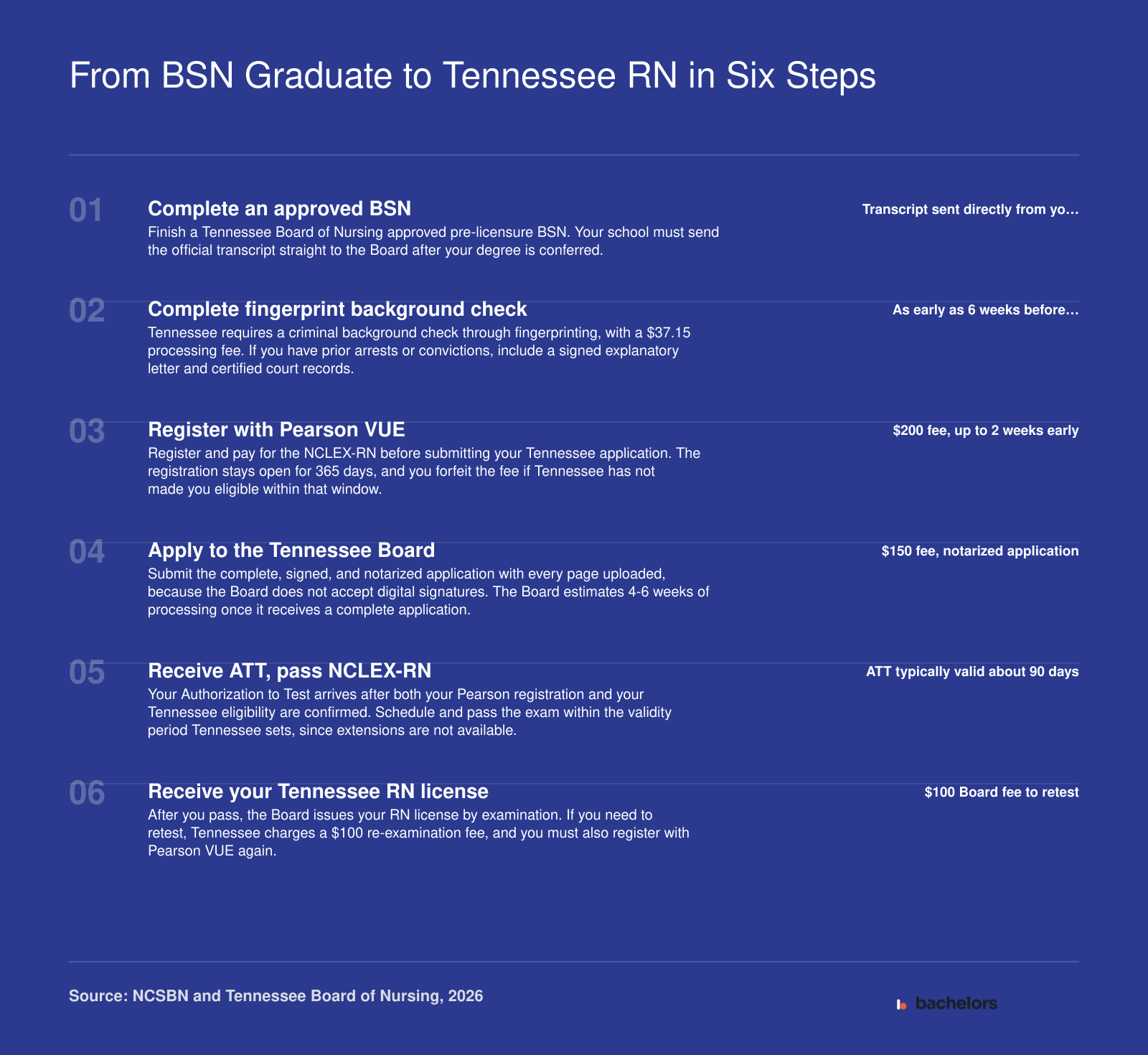
From BSN Graduate to Tennessee RN in Six Steps
Several licensure tasks can start before graduation, so plan the sequence during your final semester. Tennessee asks for your Pearson VUE registration and payment before you submit the Board application, which is why registration comes first below. Expect about $350 in core exam and licensure fees: $200 for the NCLEX-RN and $150 for the Tennessee license.
Questions to Ask Yourself
Would you rather have a guaranteed nursing seat as a freshman, or compete for upper-division entry?
Can you keep the GPA needed to renew the HOPE Scholarship while carrying a heavy science load?
Can you reach clinical sites in the Memphis, Nashville, Knoxville, or Chattanooga health systems without a long commute?
Does a private school's net price after aid actually beat in-state public tuition for you?
Tennessee BSN Programs: Your Questions Answered
These answers cover the questions Tennessee BSN applicants ask most often. Policies differ by school and change over time, so confirm details on each program's official pages before you apply.
What is the best BSN program in Tennessee?
Which Tennessee BSN schools post the highest first-time NCLEX-RN pass rates?
How much does a BSN program cost in Tennessee?
What do I need to apply to a BSN program in Tennessee?
Are there accelerated or online BSN programs in Tennessee?
Do Tennessee BSN programs require the TEAS or HESI A2?
Can the Tennessee HOPE Scholarship be used toward a BSN?
Does a Tennessee RN license qualify for multistate practice under the Nurse Licensure Compact?
Compare Bachelor of Science in Nursing (BSN) programs on the data that matters
Explore more Nursing majors or browse every field of study.
All Nursing programs Browse every field of study