Best BSN Programs in Washington
Compare 25 accredited Bachelor of Science in Nursing (BSN) programs in Washington at 22 colleges, with net price after aid, graduation rates, earnings and debt from IPEDS and the U.S. College Scorecard.
Washington BSN applicants weigh three numbers that rarely point the same way: first-time NCLEX-RN pass rate, net price after grants and scholarships, and admission odds. Walla Walla University's net price of $23,329 sits well under its $34,227 sticker price, while Gonzaga University admits roughly 82% of applicants and lists tuition and fees at $55,480.
The exam result is usually the tiebreaker. A failed first attempt delays the license, and the license is what employers hire on, so a program's pass rate tells you more than its marketing does. Cost and selectivity decide whether the seat is reachable at all.
Key Points
- Washington State University lists $13,391 in-state tuition and fees; Gonzaga lists $55,480.
- Olympic College graduates lead early earnings at $110,085 after four years.
- First-time NCLEX-RN pass rates drive about three quarters of each ranking score.
Top NCLEX-RN Pass Rates: 10 Washington BSN Schools Ranked
The schools below are ordered by how consistently their graduates clear the NCLEX-RN on the first try. Each card shows the pass rate recorded for the school alongside the city, delivery format, in-state tuition, average net price after aid, and admission rate, so you can weigh exam performance against cost and access. Graduation rates on these cards describe the whole institution, not the nursing program.
Gonzaga University
#1Spokane, WA · ~$35,000/yr (est.) · NCLEX-RN pass rate 97% (3-yr weighted avg)
Best for: Spokane students drawn to Jesuit nursing
Gonzaga University is a private Jesuit institution in Spokane with an 86% graduation rate and an 82% acceptance rate, so a solid record earns a real look but admission is not automatic. The BSN is a pre-licensure campus program that pairs liberal arts and behavioral science coursework with a nursing curriculum grounded in ethics, reflection, and social justice. Students train across Spokane's hospital systems and take on acute and chronic illness care, community health, and servant leadership work rather than a purely technical sequence. In-state tuition and fees run about $55,480 before aid, and the average net price after grants lands near $35,119, with a student-faculty ratio around 12 to 1.
- Pre-licensure BSN on the Spokane campus
- CCNE accredited
- Jesuit tradition woven into ethics and liberal arts coursework
- Servant leadership and social justice thread through the curriculum
- Clinical work covering acute and chronic illness
- Community and population health emphasis
Green River College
#2Auburn, WA · $4,700 – $5,000/yr (est.) · NCLEX-RN pass rate 95.2% (2-yr weighted avg)
Best for: Working LPNs in South King County
Green River College is a public college in Auburn where in-state tuition runs about $4,711, by far the lowest sticker price in this group, and the average net price after aid sits near $13,803. The nursing department runs an LPN to BSN pathway that blends online coursework with two in-person instruction days each week, with a full-time two-year plan and a part-time three-year option. Because it builds on practical nursing experience, the pace suits licensed LPNs who want the registered nurse credential without leaving the workforce. Cohorts are small at roughly 32 students, admissions are selective, and prerequisite coursework plus an active Washington practical nurse license are required before entry.
- LPN to BSN pathway for licensed practical nurses
- Hybrid format: online coursework plus two in-person days weekly
- Full-time two-year or part-time three-year plan
- Cohort size of about 32 students
- Two start dates per year, fall and winter
- Prerequisite coursework and an active WA practical nurse license
- Accredited by NLN CNEA
Walla Walla University
#3College Place, WA · $20,000 – $25,000/yr (est.) · NCLEX-RN pass rate 94.2% (3-yr weighted avg)
Best for: Hands-on learners who prefer small cohorts
Walla Walla University is a private institution in College Place that combines a 60% graduation rate with an average net price near $23,329 after aid against roughly $34,227 in tuition and fees. The BSN is campus-based and competency-focused, with modernized simulation labs on two campuses and clinical work that spans hospitals, community health, schools, and home health. The department reports job placement near 98% within 12 months of graduation, a sign of how its graduates fare in the regional hiring market. A student-faculty ratio around 14 to 1 and a residential campus culture keep the experience personal rather than anonymous.
- Campus-based BSN with CCNE accreditation
- Competency-based curriculum covering care across the lifespan
- Modernized simulation labs at two campus locations
- Clinical settings include hospitals, schools, and home health
- Holistic care emphasis
Washington State University
#4Pullman, WA · ~$15,000/yr (est.) · NCLEX-RN pass rate 93.7% (3-yr weighted avg)
Washington State University is the state's land-grant research university, and its Pullman campus anchors a nursing program with a 61% graduation rate, an 87% acceptance rate, and in-state tuition near $13,391. Admission is holistic with a 3.0 GPA floor and the TEAS entrance exam, and about 85% of admitted students come from Washington. A Rural Nursing Pathway and clinical placements up to 50 miles from campus let students train in the communities where many of them will eventually practice, and the program awards more than $200,000 in scholarships each year. The BSN runs four years, split between two years of prerequisites and two years of nursing coursework.
- Four-year pre-licensure BSN: two years of prerequisites plus two years of nursing
- 3.0 GPA minimum and TEAS entrance exam
- Holistic admissions; about 85% of admits are Washington residents
- Rural Nursing Pathway for community-based training
- Clinical placements up to 50 miles from campus
- More than $200,000 in annual scholarship aid
- Two start dates per year, fall and spring
Northwest University
#5Kirkland, WA · ~$22,000/yr (est.) · NCLEX-RN pass rate 92.1% (3-yr weighted avg)
Northwest University is a private, faith-based school in Kirkland with a 71% graduation rate and an 83% acceptance rate, and its average net price of about $22,288 after aid sits well below its $36,035 tuition and fees. The BSN is a two-year, campus-based program that adds a faith-integrated perspective to medical-surgical, psychiatric, maternity, and community nursing coursework. A simulation lab with virtual reality and clinical rotations at Pacific Northwest hospitals such as Seattle Children's and UW Medical Center give students exposure to high-acuity pediatric and adult care. A cross-cultural study abroad component rounds out the degree and gives graduates a wider view of how health systems work.
- Two-year campus program with CCNE accreditation
- Faith-integrated nursing curriculum
- Simulation lab with virtual reality integration
- Clinical rotations at Seattle Children's and UW Medical Center
- Cross-cultural study abroad component
- Coursework in medical-surgical, psychiatric, maternity, and community nursing
Bellevue College
#6Bellevue, WA · $11,000/yr (est. net price) · NCLEX-RN pass rate 91.2% (3-yr weighted avg)
Bellevue College is a public college in the Seattle metro where in-state tuition runs near $4,436 and the average net price after aid is about $11,430, making it one of the least expensive routes to a BSN in the region. Its nursing bachelor's is an RN to BSN completion program, built for students who already hold an associate degree or diploma in nursing and want to add the four-year credential. Coursework covers evidence-based practice, community and public health, leadership, health information technology, and policy, with full-time and part-time schedules and a mix of online and in-person classes. Students complete 90 to 95 credits on top of roughly 90 general education and prerequisite credits.
- RN to BSN completion program for nurses with an associate degree or diploma
- 90 to 95 credits beyond roughly 90 prerequisite and general education credits
- Full-time and part-time schedules available
- Classes offered online and in person
- Coursework in evidence-based practice, community health, and health policy
- CCNE accredited and approved by the state nursing commission
Olympic College
#7Bremerton, WA · $7,000/yr (est. net price) · NCLEX-RN pass rate 90.5% (3-yr weighted avg)
Olympic College is a public college in Bremerton with in-state tuition near $4,197 and an average net price of roughly $7,172 after aid, the lowest net price on this list. Its nursing bachelor's is built for people who already hold a nursing license, combining an RN to BSN completion track with a separate Veterans and Licensed Practical Nurses track that carries LPN and military medic experience into the degree. The department offers one-, two-, and three-year completion plans, rolling admissions, and starts in fall, winter, spring, and summer. Clinical experiences happen at partner healthcare facilities around the Kitsap Peninsula, and dedicated healthcare student success coaches support students through to graduation.
- RN to BSN completion route for licensed registered nurses
- Rolling admissions with fall, winter, spring, and summer starts
- One-, two-, or three-year completion plans
- Prerequisite coursework and one year of clinical experience required
- Portfolio required for graduation
- Priority fall deadline of March 31
- Track for licensed practical nurses and military medics
- No entrance exam required
- Hybrid format with online and in-person courses
- 2.0 GPA minimum plus three letters of recommendation
- 83% job placement rate reported for graduates
- $53 application fee
Wenatchee Valley College
#8Wenatchee, WA · ~$10,000/yr (est.) · NCLEX-RN pass rate 90.1% (3-yr weighted avg)
Wenatchee Valley College is a public college in north-central Washington with in-state tuition near $5,267 and an average net price of about $9,722 after aid. Its nursing bachelor's is an RN to BSN completion program delivered mostly online with roughly one day a week on campus, letting working nurses finish in a year of full-time study. A cohort of about 25 students, a community health practicum, and a capstone project keep the experience applied rather than abstract. Admission requires an active RN license and prerequisite coursework, and a part-time option exists for nurses who need a slower pace.
- RN to BSN completion program for nurses with an ADN and an active license
- 80% online, 20% face-to-face
- Full-time completion in one year; part-time option available
- Cohort of about 25 students admitted each year
- Community health practicum and capstone project
- 2.0 GPA minimum and $50 application fee
University of Washington-Seattle Campus
#9Seattle, WA · ~$14,000/yr (est.) · NCLEX-RN pass rate 89.1% (3-yr weighted avg)
The University of Washington's Seattle campus is the flagship public research university in the state, with a 39% acceptance rate, an 85% graduation rate, and in-state tuition near $12,973. The BSN is a two-year, full-time upper-division program that admits students after prerequisite work and runs 91 credits of nursing coursework, with applications due in mid-January. Students train in a dedicated simulation center and complete supervised clinical placements across medical-surgical, pediatric, family, psychosocial mental health, and community nursing. Honors options, research internships, and service learning give undergraduates a path into graduate study and specialty practice.
- Two-year, full-time upper-division BSN totaling 91 credits
- 2.0 GPA minimum and one letter of recommendation
- Simulation center plus supervised direct patient care
- Clinical placements in medical-surgical, pediatric, family, mental health, and community nursing
- Honors options and research internships available
- Scholarships available through the School of Nursing
Saint Martin's University
#10Lacey, WA · ~$28,000/yr (est.) · NCLEX-RN pass rate 88.2% (3-yr weighted avg)
Saint Martin's University is a private Catholic institution in Lacey with a 52% graduation rate and a 90% acceptance rate, and its average net price of about $28,119 after aid is far below its $45,510 tuition and fees. The BSN blends a liberal arts foundation with rigorous nursing coursework and clinical placements at Providence St. Peter's and community sites, and it comes with a four-year graduation guarantee. A separate LPN to BSN track lets licensed practical nurses finish in two years with 15 credits awarded for their experience. Small cohorts, a simulation lab, and a dedicated nursing study lounge keep the program personal, and the location puts students within reach of Olympia and Joint Base Lewis-McChord.
- Four-year campus BSN with CCNE accreditation
- 3.0 GPA minimum and two letters of recommendation
- Fall and spring start dates
- Capstone required for graduation
- Four-year graduation guarantee
- Clinical experiences at Providence St. Peter's and community sites
- State-of-the-art simulation lab and dedicated nursing study lounge
- Two-year LPN to BSN track totaling 120 credits
- 15 credits awarded for LPN experience
- Hybrid: class one day a week plus a clinical practicum day
- Cohort-based structure with small class sizes
- Approved by the Washington State Board of Nursing
- 3.0 GPA minimum and prerequisite coursework required
Cost & outcomes by school
Federal data for the highest-earning Bachelor of Science in Nursing (BSN) programs, independent of the ranking above. Earnings are this field's bachelor's graduates four years after completing where the Scorecard reports them, else the school's undergraduate median.
| School | Net price / yr | Grad rate | Earnings | Debt | Grads/yr | Format |
|---|---|---|---|---|---|---|
| Gonzaga University WA | $35,119 | 86% | $78,892 | $24,454 | 2,908 | Campus |
| University of Washington-Seattle Campus WA | $14,091 | 85% | $78,466 | $14,615 | 19,444 | Campus |
| University of Washington-Bothell Campus WA | $12,319 | 65% | $78,466 | $14,615 | 3,000 | Hybrid |
| University of Washington-Tacoma Campus WA | $10,163 | 63% | $78,466 | $14,615 | 2,728 | Hybrid |
| Seattle University WA | $34,662 | 76% | $75,272 | $19,883 | 2,378 | Campus |
| Washington State University WA | $14,971 | 61% | $68,905 | $19,500 | 10,356 | Campus |
| Pacific Lutheran University WA | $19,589 | 69% | $66,990 | $22,578 | 1,608 | Campus |
| Seattle Pacific University WA | $24,488 | 62% | $64,506 | $24,000 | 1,134 | Campus |
| Western Washington University WA | $21,193 | 65% | $62,569 | $18,500 | 6,124 | Hybrid |
| Saint Martin's University WA | $28,119 | 52% | $62,092 | $22,500 | 620 | Campus |
| Walla Walla University WA | $23,329 | 60% | $61,885 | $26,842 | 444 | Campus |
| Whitworth University WA | $26,534 | 71% | $58,561 | $25,000 | 986 | Campus |
Sources: U.S. Department of Education. Net price, graduation rate, earnings and debt: College Scorecard (earnings and debt for this field's bachelor's graduates where reported, else school-wide); graduates: IPEDS. A dash means no figure is reported.
Cost, debt & payoff
Median earnings of this field's bachelor's graduates (4 yrs after completing, else the school's undergraduate median) vs. their median federal loan debt · U.S. College Scorecard
Across these programs the median graduate earns about $61,885 and finishes with roughly $19,500 in debt — a ratio that clears a common rule of thumb (keep debt below first-year salary). Net price and debt vary widely school to school, so check the per-school figures in the table above before you shortlist.
How to Get Into a Washington BSN Program: Prerequisites, GPA and Entry Routes
Washington BSN programs take students at two points: as incoming first-years, or after two years of college science coursework. Both routes exist in this state, and the answer changes which schools you should be targeting right now.
Direct Admit vs. Upper-Division Entry
Gonzaga University admits students directly into the nursing program as undergraduates. Students spend their first two years on prerequisite coursework at Gonzaga and must hold a C or better in every prerequisite nursing course and a 3.0 cumulative GPA before moving into the nursing major.1
The University of Washington, Washington State University and Seattle Pacific University all use upper-division entry: you complete prerequisites first, then submit a separate application to the nursing major. UW and SPU both expect roughly 90 quarter credits by the time the program starts, so freshman admission to the major is not an option at either.
Prerequisites, GPA Minimums and Entrance Exams
The prerequisite list looks similar across schools: anatomy and physiology, microbiology, chemistry, statistics, lifespan development and psychology. UW asks for natural sciences, lifespan growth and development, and statistics, plus 100 hours of hands-on healthcare experience. SPU's list runs through chemistry, biology, psychology, nutrition and math, with at least four prerequisites (two of them sciences) finished at application.2
GPA and testing policies diverge sharply:
- University of Washington: 2.0 minimum, but admitted students have ranged from 2.4 to 4.0. No entrance exam identified.
- Washington State University: 3.0 prerequisite GPA and 3.0 cumulative, no more than three prerequisites in progress, TEAS score of 70 or higher.
- Seattle Pacific University: 2.85 prerequisite GPA for SPU coursework, 3.5 for transfer prerequisites; no entrance exam. The autumn 2026/winter 2027 admitted cohort averaged 3.31.3
- Gonzaga University: 3.0 cumulative with C grades in prerequisites; no entrance exam identified.
Pacific Lutheran University does not publish current traditional BSN prerequisite, GPA or testing requirements in a form we could verify, so contact the school directly.
Is It Hard to Get In, and How Long Does It Take?
Minimums are not targets. UW's published 2.0 floor sits well below what admitted students actually bring, and SPU's cohort average is a better planning number than its stated minimum. Institution-wide acceptance rates shown elsewhere on this page describe the university, not the nursing major, which runs its own, much narrower admission cycle.
Plan on four years total. Upper-division students typically spend about two years in prerequisites and two in the nursing major. Licensed RNs should see our RN to BSN page; students who already hold a bachelor's in another field should see our accelerated BSN page.
Cheapest BSN Programs in Washington by Net Price
Every school with the lowest average net price on this page is public. In-state tuition at these schools runs from $4,472 to $13,168, and average net price after aid runs from $7,172 to $10,163, based on 2024 data from the U.S. Department of Education's IPEDS and College Scorecard. Net price is an approximate institution-wide average of what students pay for tuition, fees, housing and books after grant aid, which is why it can run higher than tuition alone. Private schools generally start from higher sticker prices, but institutional aid can bring some of them close to public net prices, so compare net price rather than tuition. Several of these programs are built for nurses who already hold an RN license, so confirm the entry route on each school's site before comparing costs.
| School | City | Sector | In-State Tuition | Average Net Price After Aid (approx., institution-wide) |
|---|---|---|---|---|
| Olympic College | Bremerton | Public | $4,472 | $7,172 |
| Lower Columbia College | Longview | Public | $4,626 | $7,630 |
| Columbia Basin College | Pasco | Public | $6,555 | $8,317 |
| Wenatchee Valley College | Wenatchee | Public | $4,552 | $9,722 |
| University of Washington-Tacoma Campus | Tacoma | Public | $13,168 | $10,163 |
Related Articles
Washington BSN Tuition and Fees, Net Price and State Grants
Public and private Washington BSN programs sit at very different sticker prices, but the gap shrinks once aid is counted. Washington State University lists in-state tuition and fees of $13,391 in our ranking data, against $55,480 at Gonzaga University and $34,227 at Walla Walla University. The University of Washington lists resident tuition of $13,406 and annual student fees of $1,676 for 2026-27.
Why Net Price Matters More
Sticker price is what a school bills. Net price is the approximate average a student pays after grants and scholarships. By that measure, WSU averages about $14,971, Walla Walla University about $23,329 and Gonzaga about $35,119. Private schools often discount heavily, so compare net price first and sticker price second. Treat these averages as estimates, because your own aid depends on income and academic profile.
Washington College Grant
The Washington College Grant is the state's main need-based aid.1 Eligibility requires:
- Residency: You must be a Washington resident with a high school diploma, GED or equivalent.
- No prior degree: You cannot already hold a bachelor's degree.
- Eligible school: You must attend an eligible Washington college, which includes participating private schools.
For 2026-27, a family of four qualifies for a full award at $83,500 or less in income and a partial award up to $139,500.2 Limits for other family sizes differ, so confirm them with the Washington Student Achievement Council. Maximum awards are set school by school, and at several public universities they run roughly $8,000 to $8,800.1
Opportunity Scholarship and Other Aid
The Washington State Opportunity Scholarship supports students in STEM and health care majors, including bachelor's-level transfers and completers.4 Its Career & Technical track lists nursing programs, among them Spokane Community College's Nursing DTA/MRP.5 WSOS also offers up to $25,000 to graduate nurse practitioner students at five Washington nursing schools, with a two-year commitment to practice in an underserved area.3 That is a later-career option, not an undergraduate award. Our research found no nursing-specific undergraduate state grant. State health-professional loan repayment programs exist, but confirm current availability and terms with the Student Achievement Council before counting on one.
One Practical Tip
File the FAFSA, or the WASFA, if you are not eligible for federal aid, as soon as the application opens. Some Washington state aid is awarded first-come, so a late filing can cost you money.
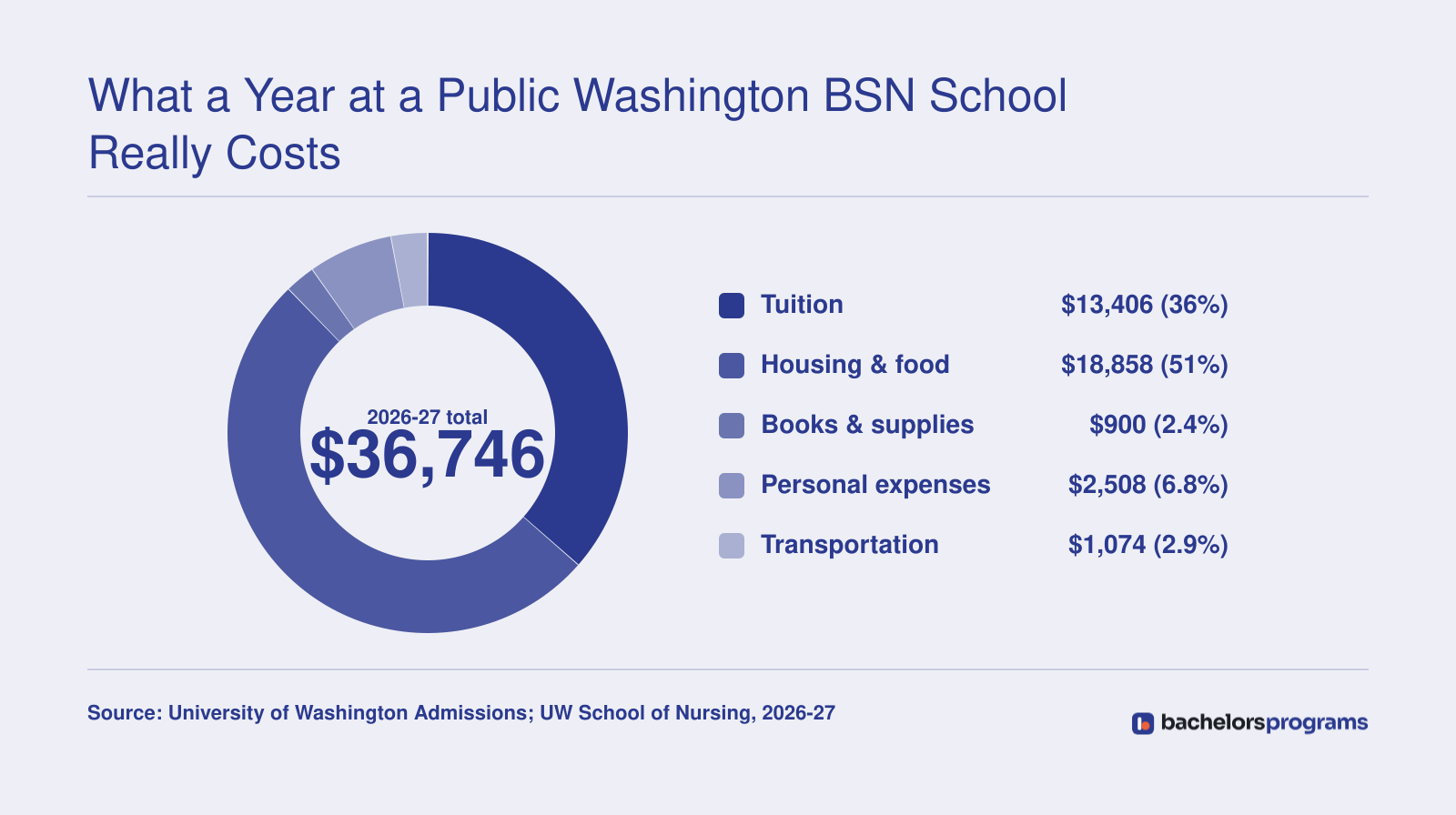
What a Year at a Public Washington BSN School Really Costs
The University of Washington Seattle budgets $36,746 for a Washington resident's 2026-27 academic year, covering the nine months from fall through spring. Housing and food make up the largest share, ahead of tuition. The UW School of Nursing lists BSN resident tuition at $4,625 per quarter. UW also notes that course fees vary by discipline and that student insurance fees may apply on top of this budget, so confirm program charges with the School of Nursing. This is the published sticker figure before aid. Grants such as the Washington College Grant lower what eligible residents actually pay, so compare this total with the net price figures in the cheapest-programs table above.
Washington BSN Graduates With the Highest Early Earnings
These figures come from the U.S. Olympic College leads at $110,085 four years after finishing, while the University of Washington-Seattle Campus pairs $99,042 at five years with the lowest median federal debt here, $12,500, or about $133 a month on a 10-year repayment plan.
| School | Location | Median Earnings | Time Window | Median Federal Debt at Graduation | Median Monthly Payment (10-Year Plan) |
|---|---|---|---|---|---|
| Olympic College | Bremerton, WA | $110,085 | Four years after finishing | N/A | N/A |
| University of Washington-Seattle Campus | Seattle, WA | $99,042 | Five years after finishing | $12,500 | $133 |
| Gonzaga University | Spokane, WA | $96,703 | Five years after finishing | $27,000 | $286 |
| Seattle Pacific University | Seattle, WA | $96,041 | Five years after finishing | $26,986 | $286 |
| Saint Martin's University | Lacey, WA | $95,489 | Five years after finishing | N/A | N/A |
First-Year Pay for Washington BSN Graduates
Bellevue College posts the highest early earnings among the Washington BSN programs ranked here. Its bachelor's is an RN to BSN pathway for nurses who already hold a license.
Washington State Board of Nursing Approved Programs and NCLEX-RN Licensure
Does it matter whether a Washington BSN is approved by the state board, accredited nationally, or both? Yes, and for different reasons. One decides whether you can become a licensed nurse. The other shapes what you can do afterward.
What WABON Approval Means
The Washington State Board of Nursing (WABON) is the regulator that approves pre-licensure RN programs. It reviews them against state rules (WAC 246-840-511 through 246-840-556), national accrediting standards, and NCSBN quality indicators. A brand-new program starts with "Initial Approval of Program" status, which lets it enroll students. Full approval can last up to 10 years when requirements are met.
This matters because RN licensure by examination in Washington requires you to graduate from, or be eligible to graduate from, a Board-approved pre-licensure program. You must then pass the NCLEX-RN and meet the remaining application requirements. Before you commit to a school, check its status on WABON's approved program list.
Accreditation Is a Separate Check
CCNE and ACEN are national nursing accreditors, and WABON's list shows their status separately from state approval. A new Washington program must earn national accreditation within four years of full Board approval, and WABON can act under WAC 246-840-557 if a program does not maintain it. For you, accreditation matters most when you plan to apply to graduate nursing programs, and some employers look for it too. It does not replace state approval.
Reading the Pass Rates
A first-time NCLEX-RN pass rate shows how well a program prepares its graduates for the licensing exam. Use the figures in the ranking above, and compare schools on that basis instead of relying on one number alone. Pair the rate with approval and accreditation status on WABON's list.
Washington and the Nurse Licensure Compact
Washington's Nurse Licensure Compact is operational in 2026. WABON has procedures for applying for or upgrading to a multistate license, and nurses holding active multistate licenses from other compact states can practice in Washington. Employers of those nurses must complete a WABON compliance form. Rulemaking this year also addresses a pathway for nurses whose primary residence is Washington. As a new graduate, confirm current multistate eligibility with WABON before you apply.
Inside Our NCLEX-RN Scoring Method
Licensing outcomes count for far more here than campus statistics, because first-time NCLEX-RN success is the clearest signal of whether a program turns students into licensed nurses.
Weights
The first-time pass rate makes up about three quarters of each score. It draws on the state board's latest three years of results and is weighted by the number of test takers, so a large cohort moves a school's figure more than a small one. Accreditation and a small completion and retention component make up the rest.
Sources and scope
- State board results: NCLEX-RN pass data reported for each nursing program.
- College Scorecard: U.S. Department of Education institution data, 2024 release.
The ranking covers traditional pre-licensure BSN programs only. RN-to-BSN and accelerated BSN programs serve licensed nurses and second-degree students, so their first-time licensure results are not comparable.
Caveats to keep in mind
- Net price is an approximate institution-wide average. Your own cost depends on your aid package and living situation.
- Graduation and admission rates describe the whole school, not the nursing major. Entry into nursing is often more selective than entry into the college.
Use the ranking as a starting point, then confirm current admission requirements and costs on each school's own nursing page.
Compare Bachelor of Science in Nursing (BSN) programs on the data that matters
Explore more Nursing majors or browse every field of study.
All Nursing programs Browse every field of study