Best Accelerated BSN (ABSN) Programs in Washington
Compare 3 accredited Accelerated BSN (ABSN) programs in Washington, with net price after aid, graduation rates, earnings and debt from IPEDS and the U.S. College Scorecard.
Career changers who already hold a bachelor's degree outside nursing don't have to start over on a four-year degree to become RNs in Washington. The accelerated BSN builds on that first degree and compresses nursing study into a little over a year.
The ABSN programs ranked here are in Seattle (University of Washington-Seattle Campus), Spokane (Gonzaga University), and Tacoma (Pacific Lutheran University). UW runs four back-to-back quarters. Gonzaga (15 months) and PLU (16 months) pair online coursework with in-person clinicals.
Price is the sharpest split. UW lists in-state tuition and fees of $12,973, against $55,480 at Gonzaga. Every applicant still clears prerequisite science courses first, and licensure depends on approval from the Washington State Board of Nursing plus a passing NCLEX-RN result.
Key Points
- UW Seattle, Gonzaga, and Pacific Lutheran offer accelerated BSNs for degree holders.
- Programs run 12 to 18 months full time, never fully online.
- Washington RN licenses cost $138 single-state or $203 multistate.
Ranked: Washington's Accelerated BSN Programs for Second-Degree Students
Washington's accelerated BSN options are few enough that most second-degree applicants end up comparing the same three schools: one in Seattle, one in Spokane, and one based in Lynnwood, north of Seattle. Each takes a different approach to scheduling, clinical placement, and where students spend their time.
University of Washington-Seattle Campus
#1Seattle, WA · ~$14,000/yr (est.)
Best for: Seattle-based career changers wanting a research university
Washington's flagship public research university, based in Seattle, houses an accelerated BSN inside a School of Nursing with an international reputation for teaching and research. Accelerated students study full time on campus and train in the school's Simulation Center before supervised patient care placements in hospitals and community settings around the Seattle area. The ABSN is billed on a fee-based model rather than the state-subsidized rate, so Washington residency does not lower the price the way it does for UW's other undergraduate programs. Institution-wide, about 85% of students at this school graduate, a campus-wide figure rather than an ABSN completion rate.
- CCNE accredited
- 79 total credit hours
- Two start dates per year, fall and spring
- Designed for second-career students
- Simulation Center clinical practice
- Supervised direct patient care in hospitals and community sites
- Honors options available
- Financial aid and scholarships available
Gonzaga University
#2Spokane, WA · ~$35,000/yr (est.)
Best for: Eastern Washington residents balancing online coursework
A private Jesuit university in Spokane, Gonzaga is the only school in Eastern Washington offering an accelerated BSN, and its clinical education connects to Spokane-area health systems that hire locally. The program is built for students who cannot be on campus five days a week: coursework runs asynchronously online, while labs and clinical rotations happen in person in Spokane. Gonzaga's simulation facilities are endorsed by INACSL, and the university reports an institution-wide graduation rate of about 86%.
- CCNE accredited
- 64 total credit hours
- Asynchronous online classes with in-person labs
- Cohort-based structure
- INACSL-endorsed simulation facilities
- Clinicals at Spokane-area health systems
- Rotations in med-surg, pediatrics, obstetrics, mental health
- Only accelerated BSN based in Eastern Washington
Pacific Lutheran University
#3Tacoma, WA · ~$20,000/yr (est.)
Best for: Puget Sound commuters wanting flexible entry points
A private Lutheran university in Tacoma, Pacific Lutheran runs its accelerated BSN at a Lynnwood site about 16 miles north of Seattle, which puts clinical placements within reach of the Puget Sound metro rather than the South Sound. Students move between online coursework, hands-on nursing labs, and in-person rotations, with coursework emphasizing safe patient care, interprofessional collaboration, and ethical leadership. The program accepts three cohorts a year, and the university reports an institution-wide graduation rate of about 69%.
- Accredited by ACEN
- Three start dates per year: February, June, September
- Hybrid format: online coursework, hands-on labs, clinicals
- Lynnwood campus, 16 miles north of Seattle
- In-person clinical rotations across care settings
- Emphasis on ethical leadership and patient care technology
- Team-based, interprofessional practice focus
Cost & outcomes by school
Federal data for the highest-earning Accelerated BSN (ABSN) programs, independent of the ranking above. Earnings are this field's bachelor's graduates four years after completing where the Scorecard reports them, else the school's undergraduate median.
| School | Net price / yr | Grad rate | Earnings | Debt | Grads/yr | Format |
|---|---|---|---|---|---|---|
| Gonzaga University WA | $35,119 | 86% | $78,892 | $24,454 | 2,908 | Hybrid |
| University of Washington-Seattle Campus WA | $14,091 | 85% | $78,466 | $14,615 | 19,444 | Campus |
| Pacific Lutheran University WA | $19,589 | 69% | $66,990 | $22,578 | 1,608 | Hybrid |
Sources: U.S. Department of Education. Net price, graduation rate, earnings and debt: College Scorecard (earnings and debt for this field's bachelor's graduates where reported, else school-wide); graduates: IPEDS. A dash means no figure is reported.
Cost, debt & payoff
Median earnings of this field's bachelor's graduates (4 yrs after completing, else the school's undergraduate median) vs. their median federal loan debt · U.S. College Scorecard
Across these programs the median graduate earns about $78,466 and finishes with roughly $22,578 in debt — a ratio that clears a common rule of thumb (keep debt below first-year salary). Net price and debt vary widely school to school, so check the per-school figures in the table above before you shortlist.
Washington ABSN Admissions: Prior Bachelor's, Prerequisites, and GPA
Each school sets its own admission rules. Here is what each ABSN admissions page asks of second-degree applicants. Confirm every item with the school before you apply.
- Prior degree or creditsUniversity of Washington-Seattle Campus requires a non-nursing bachelor's degree, finished before the program begins. Gonzaga University requires a bachelor's from an institution accredited by an agency the U.S. Department of Education recognizes. Pacific Lutheran University is the exception: it accepts either a non-nursing bachelor's or at least 60 non-nursing college credits.
- Prerequisite courses and gradesEach school publishes its own list of prerequisite courses. Pacific Lutheran requires at least a B- in every ABSN prerequisite. Gonzaga accepts a C or better in each course but expects a 3.0 average across them.
- Minimum grade point averageThe cumulative minimums are 2.5 at Gonzaga, 2.8 at the Seattle campus (across all college-level coursework) and 3.0 on a 4.0 scale at Pacific Lutheran.
- Entrance examThe Seattle campus states that the TEAS is not required. Pacific Lutheran's and Gonzaga's requirement pages list no TEAS or HESI requirement.
- Healthcare experienceThe Seattle campus requires at least 100 hours of hands-on healthcare experience. The hours must come from one setting, within a three-month span, during the 12 months before you apply. Nursing-assistant work is common among applicants but not required. Pacific Lutheran requires no prior healthcare experience.
Prerequisite Courses by School: Minimum Grades, Science Recency, and Test Policy
The table below draws only on each school's published admissions and catalog pages for its accelerated BSN, so a cell marked "Not listed" means that figure was not published in the sources reviewed. Applicants most often stumble over two rules: Pacific Lutheran University's six-year recency window for science courses, which can force a career changer with an older anatomy or chemistry credit to retake it, and the grade floors at the University of Washington (a 3.0, or B, in every prerequisite) and Pacific Lutheran (a B- in each nursing prerequisite), both stricter than Gonzaga's C or better. If you plan to complete prerequisites at a Washington community college, confirm with each school's admissions office that every course transfers as a direct equivalent before you enroll. Pacific Lutheran lists specific courses such as BIOL 201, 205 and 206, and the University of Washington counts natural science work in quarter credits.
| School | Required Prerequisites | Minimum Course Grade | Science Recency Rule | Minimum GPA | Entrance Exam |
|---|---|---|---|---|---|
| University of Washington-Seattle Campus | Six natural science courses (28 quarter credits on the prerequisite worksheet), Lifespan Growth and Development, Statistics | 3.0 (B) in each ABSN prerequisite course | No expiration date | 2.8 cumulative across all completed college-level coursework | TEAS not required |
| Gonzaga University | General Chemistry with Lab; Human Anatomy and Physiology I with Lab; Human Anatomy and Physiology II with Lab; Microbiology with Lab; Introductory Statistics; Lifespan Growth and Development; Nutrition | C or better | Not listed | 3.0 cumulative in prerequisite courses | Not listed |
| Pacific Lutheran University | BIOL 201, BIOL 205, BIOL 206, CHEM 105, STAT 231, PSYC 320 (Development Across the Lifespan), Nutrition (NURA/NURT 120 or equivalent) | B- (2.5) in each nursing prerequisite and co-requisite course | 6 years | Not listed | Not listed |
Washington Board of Nursing Approval and NCLEX-RN Licensure for ABSN Graduates
A program can look affordable and convenient and still leave you ineligible for the licensing exam, which makes approval and accreditation worth checking alongside tuition.
State Approval Is the License Gate
The Washington State Board of Nursing, formerly the Nursing Care Quality Assurance Commission, approves prelicensure RN programs. Graduating from an approved program is what makes you eligible to sit for the NCLEX-RN. UW, Gonzaga, and PLU all appear on the board's approved in-state list for 2026. Gonzaga's listing specifies both BSN and ABSN options, so the accelerated track sits inside that approval.
Accreditation: Ask for the Letter
State approval and national accreditation are different stamps. Accreditation affects federal student aid eligibility and whether graduate programs will accept your degree. The University of Washington's baccalaureate program holds CCNE accreditation. Gonzaga and PLU should be asked directly for their current accreditation letter and confirmation that it covers the ABSN track. Get that in writing before you deposit.
First-Time NCLEX-RN Results
Washington reports first-time pass rates, and the most recent available 2025 figures show Gonzaga at 98.67% with 75 candidates and PLU at 86.04% with 222 candidates. The statewide rate was 85.7% across 35 programs that reported at least 30 candidates. Gonzaga's figure points to strong first-attempt preparation; PLU's lands close to the state mark. One year is a snapshot, so ask each school for a multi-year trend.
From Exam to License
Passing the NCLEX-RN is the last academic hurdle before you apply for a Washington RN license. All three matter: approval lets you test, accreditation protects your options, and a strong pass rate shows how well the program prepares students for the exam.
Washington RN Licensure at a Glance
Working, Paying, and Applying: Straight Answers on Washington ABSN Life
A Washington ABSN compresses the nursing portion of a degree into roughly a year to a year and a half of full-time study, and that pace changes the answer to almost every practical question about jobs, credits, and money.
Working and Transferring Credits
- Can you work during a Washington ABSN? None of these schools publishes an outright ban on outside employment, but the calendars leave little room: UW runs four back-to-back quarters, Gonzaga runs 15 months, and PLU runs 16 months with labs and clinical rotations that can land on evenings or weekends. UW does list employment among the resources available to nursing students, and UW employees at 50 percent FTE or more may qualify for a tuition exemption, subject to application and active-status conditions.
- Will your old degree's credits transfer? Your completed bachelor's is the entry ticket itself, which is why the nursing coursework is comparatively short (79 credits at UW, 64 at Gonzaga). What actually transfers is prerequisite science credit, evaluated course by course.
Paying for a Second Bachelor's
- Does federal aid apply? Pell Grants generally do not reach second bachelor's students, but federal loans, including Direct Unsubsidized, and Federal Work-Study may still be available.1 File the FAFSA or WASFA either way; PLU requires renewal every year.2
- Are there nursing scholarships in Washington? UW's School of Nursing scholarship includes ABSN students alongside BSN, MS, DNP, and PhD candidates. It is open to U.S. citizens, permanent residents, undocumented, and international applicants, requires the FAFSA or WASFA, and carried a second-round priority deadline of October 30, 2026. PLU states that institutional gift aid is not available for its ABSN and points students toward payment plans, private loans, and outside scholarships.2 Ask directly about state loan repayment through the Washington Health Corps and tuition support from hospital employers, since terms shift year to year.
Odds and Timing
- How competitive are they? Institution-wide admit rates (roughly 39 percent at UW, 82 percent at Gonzaga, 78 percent at PLU) describe the university, not the nursing cohort, which is smaller and tighter.
- When should you apply? Gonzaga lists a February 1, 2027 deadline for a summer start; UW admits twice a year, PLU three times. Begin prerequisites nine to twelve months out.
- Can you study online? Hybrid is as close as it gets here: Gonzaga offers asynchronous online classes and PLU online coursework, both with in-person clinicals.
Related Articles
In-Person, Hybrid, or Online: ABSN Formats and Locations Across Washington
Online coursework can loosen your weekly schedule, but it cannot move you out of the hospital. No Washington ABSN is fully online. Where a program is hybrid, the lectures may be asynchronous, while labs, simulation, and clinical rotations stay in person.
Formats and Locations
- University of Washington (Seattle): Fully in person and full-time across four consecutive quarters, with classroom work, Simulation Center time, and 600+ direct-care hours.
- Pacific Lutheran University (Lynnwood): Hybrid, with online coursework plus required skills and simulation labs at PLU's satellite site, about 16 miles north of Seattle. The university is based in Tacoma, but the ABSN is delivered from Lynnwood, and the program is designed to take as few as 16 months.
- Gonzaga University (Spokane): Hybrid, with asynchronous online classes plus hands-on clinical and simulation learning in Spokane. The 15-month, four-semester program begins Summer 2027.
Program type is a starting point. Confirm delivery details on each school's page before you plan a move or a commute.
Clinical Placements
UW arranges all clinical placements. Its published network includes Harborview, UW Medical Center, Overlake, Providence Everett, Seattle Children's, and Swedish.
PLU begins arranging placements in the first semester, and students complete 600 clinical hours at Seattle-area facilities. PLU names a broader Seattle network that includes UW Medical Center, Virginia Mason, Swedish, and Seattle Children's. That is not a promise of a specific site, so plan on living within driving distance of Lynnwood and commuting for rotations.
Gonzaga describes rotations in medical-surgical, mental health, pediatrics, obstetrics, and population health settings with Spokane organizations. Specific hospital partners are not named in its current materials, so ask the admissions office.
For every school, ask about shift times and travel distance, since clinical schedules may not follow a standard workday.
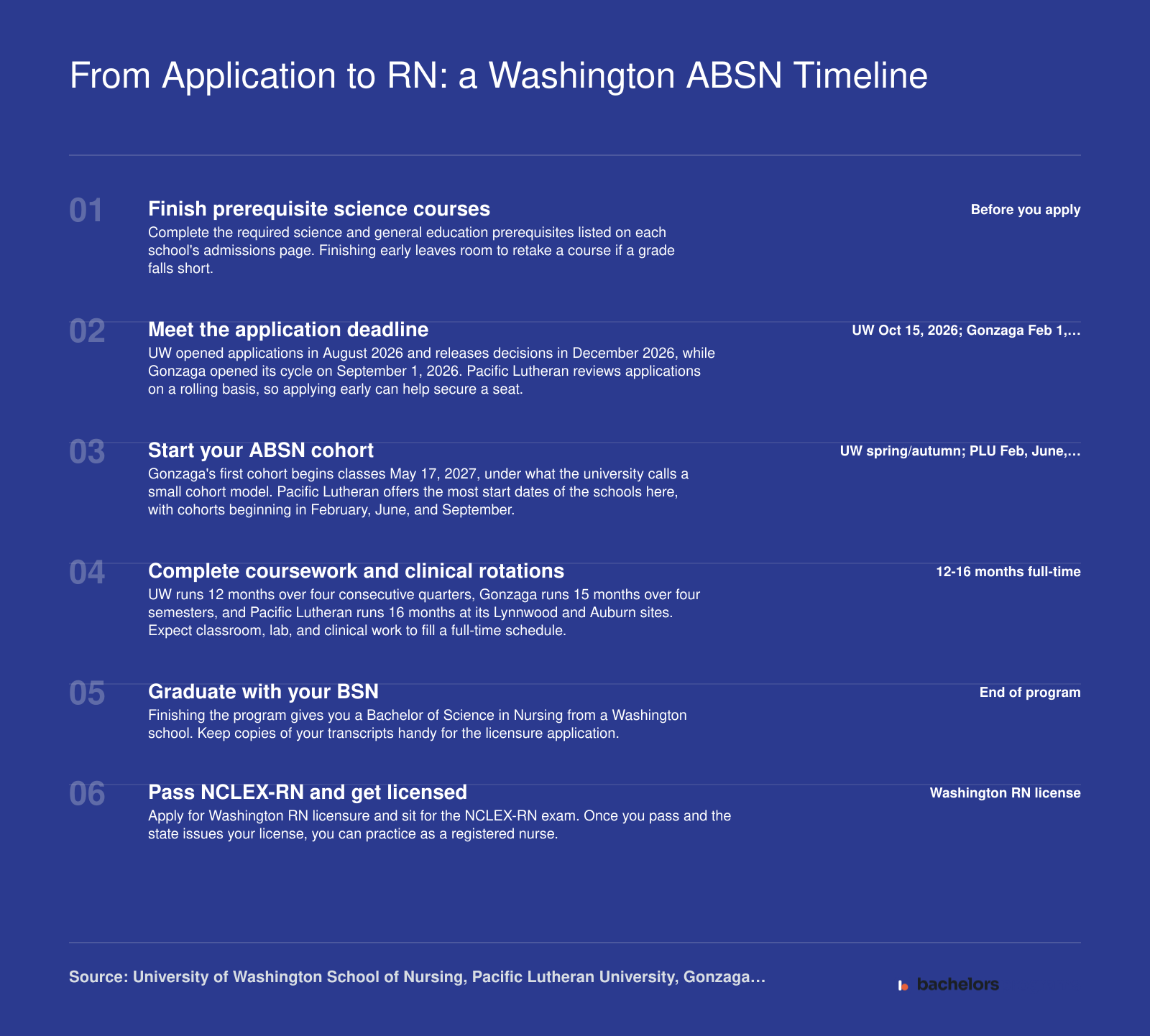
From Application to RN: a Washington ABSN Timeline
Plan on starting roughly 9-12 months before your target cohort begins. Washington ABSN deadlines can fall many months ahead of the first day of class: Gonzaga opened applications in September 2026 for a May 2027 start, and UW's October 2026 deadline came with decisions in December. Use the stages below to map your own calendar.
Questions to Ask Yourself
Can you step away from full-time work for 12 to 18 months of intensive coursework and clinical shifts?
Are your anatomy, physiology, and microbiology credits still inside each school's recency window?
Is a private-university sticker price worth an earlier start date compared with the public option?
Would you relocate to Spokane or Tacoma, or do you need a Seattle-area clinical footprint?
How to Choose the Right Washington ABSN School
Choosing a Washington ABSN school means matching a fast, fixed-schedule nursing program to your prerequisite progress, budget, and home base. Rank your decision factors in this order.
- Prerequisites and start date: Finished science courses and a realistic start window decide which cohorts you can enter. University of Washington-Seattle Campus starts fall and spring, Pacific Lutheran University offers three starts a year, and Gonzaga University starts in summer with a February 1, 2027 application deadline.
- Total cost after aid: Compare what you will actually pay, not the sticker price.
- Location and clinical travel: Clinicals are in person even in hybrid formats, so consider your commute to hospitals in Seattle, Tacoma, or Spokane.
- Selectivity and backups: Pick one reach school and one school where your GPA and experience sit comfortably.
Public vs. Private Trade-Offs
The University of Washington lists in-state tuition of $12,973 for its program, and the average net price after aid at the university is $14,091. Gonzaga lists in-state tuition of $55,480, with an average net price of $35,119 after aid. Pacific Lutheran lists $50,916, with an average net price of $19,589. Net price averages the whole institution rather than the ABSN alone, so treat it as a guide and ask each school for a program-specific estimate.
The public option is cheapest on paper, but it also requires 100 hours of healthcare experience and a 2.8 GPA minimum. The private schools cost more up front, and their aid can narrow the gap.
Apply to at Least Two
Cohorts are small and competitive, so apply to at least two programs. One denial or a missed prerequisite should not cost you a year.
Your Next Step
Request information from your top two schools, attend an info session, and get a transcript evaluation before the next deadline. The evaluation shows exactly which prerequisites remain, and that tells you which start date is realistic.
Compare Accelerated BSN (ABSN) programs on the data that matters
Explore more Nursing majors or browse every field of study.
All Nursing programs Browse every field of study