Best Accelerated BSN (ABSN) Programs in Alabama
Compare 5 accredited Accelerated BSN (ABSN) programs in Alabama, with net price after aid, graduation rates, earnings and debt from IPEDS and the U.S. College Scorecard.
Can a non-nursing bachelor's shorten the path to an Alabama RN license? It can, through an accelerated BSN. These programs credit your prior degree, so you complete only the nursing major: 60 credits at the University of North Alabama, 62 at the University of South Alabama.
The University of Alabama in Huntsville compresses its program into three semesters with a 20-student cohort, leaving little room for a job. Formats range from campus cohorts in Huntsville, Mobile, and Birmingham to North Alabama's low-residency model with online coursework.
Online lectures do not move the hospital, though: North Alabama's clinicals still meet on weekends in Northwest Alabama, so geography still matters.
Key Points
- University of Alabama in Huntsville's ABSN runs three semesters with 20-student cohorts.
- Missing a once-a-year ABSN deadline usually delays your start 12 months.
- Alabama RN licensure by exam costs $225 multistate or $125 single-state.
Ranked: Alabama Accelerated BSN Programs Worth Your Second Degree
Five Alabama universities currently enroll second-degree students in an accelerated BSN, and they differ sharply in format, price, and the kind of employer connection they offer. The notes below focus on who each program fits, from a small employer-partnered cohort in Huntsville to a low-residency hybrid in Florence.
University of Alabama in Huntsville
#1Huntsville, AL · $19,000/yr (est. net price)
Best for: Career changers wanting small clinical cohorts
UAH runs its accelerated BSN as a formal academic practice partnership, so much of the clinical learning happens alongside working nurses at partner health systems around Huntsville. The cohort is deliberately small and the sequence runs three semesters, with employer partners able to cover leftover tuition and pay students for clinical hours. The university has a graduation rate of 64%. It suits career changers who want an employer-connected route into a first nursing job rather than a generalist campus program.
- Three-semester cohort capped at about 20 students
- Employer partners can cover remaining tuition after other aid
- Paid clinical hours alongside a practicing nurse mentor
- Guaranteed job placement with partner employers
- Prior bachelor's degree, 3.0 GPA, and in-person TEAS required
- UAH-only prerequisite: Health Promotions for Nursing Majors (NUR 220)
- Applications open March 1
- CCNE accredited
University of North Alabama
#2Florence, AL · $12,000 – $22,000/yr (est.)
Best for: Working adults needing weekend clinicals
The University of North Alabama runs its accelerated BSN as a low-residency hybrid, with didactic coursework online and weekend clinical rotations across Northwest Alabama. The 15-month, 60-credit sequence includes a student nurse apprenticeship that pays for clinical hours and can help cover tuition, and the university has a graduation rate of 55%. It fits people who need to keep living and working in the region while they retrain, since attendance at designated clinical facilities is a firm requirement.
- 15-month, 60-credit low-residency hybrid format
- Online didactic courses paired with weekend clinicals in Northwest Alabama
- $340 per credit hour for in-state students, $680 for out-of-state
- Student Nurse Apprenticeship offers paid clinical hours and tuition support
- Starts in summer; applications due March 1
- 3.0 GPA minimum plus required prerequisite coursework
- Admission index weighs assessment scores, GPA, and UNA coursework
- ACEN accredited
University of South Alabama
#3Mobile, AL · $18,000/yr (est. net price)
Best for: Second-degree students wanting two yearly starts
South Alabama's accelerated pathway is a full-time, campus-based program in Mobile that moves 62 credits through three semesters with January and July entry points. Admission is competitive and every prerequisite must be finished before the cohort begins, so most applicants plan a semester or two of science coursework first. The university has a graduation rate of 53%. It is the strongest fit for someone who can commit to weekday and weekend clinical rotations and wants a large, established college of nursing behind them.
- 62 credits across three semesters
- Two start dates each year, January and July
- 26 prerequisite credits in sciences and math completed before entry
- 3.0 GPA minimum with at least a C in every prerequisite
- Clinical rotations scheduled on weekdays and weekends
- On-campus housing available
- $50 application fee
- CCNE accredited
University of Mobile
#4Mobile, AL · ~$22,000/yr (est.)
Mobile is a private Christian university whose campus-based accelerated BSN combines coursework with clinical placements in hospitals and psychiatric centers around the city. Faculty are described as bringing more than a century of combined clinical experience, and the simulation labs use augmented reality scenarios for practice. The university has a graduation rate of 57%. It suits readers who want a faith-informed, fully in-person program with heavy hands-on simulation rather than an online format.
- Campus-based format with clinicals in hospitals and psychiatric centers
- Simulation labs using augmented reality scenarios
- Program reports a 100% licensure pass rate
- Faculty with more than 100 years of combined clinical experience
- Christian approach to patient care and healing
- CCNE accredited
Herzing University-Birmingham
#5Birmingham, AL · $15,000 – $20,000/yr (est.)
Herzing's Birmingham campus offers the accelerated BSN option with several start dates through the year, which shortens the gap between finishing prerequisites and starting nursing coursework. Classes are campus-based with hands-on clinical placements and faculty support, and the enrollment fee is currently waived. The university has a graduation rate of 13%. It is worth a look for applicants who need a rolling start date and a metro Birmingham location more than a traditional campus experience.
- Multiple start dates through the year on the Birmingham campus
- Hands-on clinical placements with faculty support
- Prepares graduates for the NCLEX-RN exam
- Enrollment fee currently waived
- Campus-based accelerated BSN option
Cost & outcomes by school
Federal data for the highest-earning Accelerated BSN (ABSN) programs, independent of the ranking above. Earnings are this field's bachelor's graduates four years after completing where the Scorecard reports them, else the school's undergraduate median.
| School | Net price / yr | Grad rate | Earnings | Debt | Grads/yr | Format |
|---|---|---|---|---|---|---|
| University of Alabama in Huntsville AL | $18,796 | 64% | $61,767 | $20,705 | 3,082 | Campus |
| University of South Alabama AL | $17,648 | 53% | $49,379 | $24,929 | 3,668 | Campus |
| University of North Alabama AL | $12,170 | 55% | $45,415 | $22,077 | 2,488 | Hybrid |
| University of Mobile AL | $22,382 | 57% | $43,611 | $26,500 | 492 | Campus |
| Herzing University-Birmingham AL | $19,651 | 13% | $36,909 | $21,500 | 38 | Campus |
Sources: U.S. Department of Education. Net price, graduation rate, earnings and debt: College Scorecard (earnings and debt for this field's bachelor's graduates where reported, else school-wide); graduates: IPEDS. A dash means no figure is reported.
Cost, debt & payoff
Median earnings of this field's bachelor's graduates (4 yrs after completing, else the school's undergraduate median) vs. their median federal loan debt · U.S. College Scorecard
Across these programs the median graduate earns about $45,415 and finishes with roughly $22,077 in debt — a ratio that clears a common rule of thumb (keep debt below first-year salary). Net price and debt vary widely school to school, so check the per-school figures in the table above before you shortlist.
Getting Into an Alabama ABSN: Prior Degree, Science Prerequisites, GPA, and Entrance Exams
Accelerated BSN admissions in Alabama follow a similar pattern, but the details differ by school. Use this checklist against each program's own admissions page, and read every rule as specific to the school named.
- A completed bachelor's degree in another fieldThe University of Alabama in Huntsville accepts a bachelor's or higher in a field other than nursing. The University of South Alabama requires the bachelor's degree to be posted to your official transcript.
- Science and math prerequisitesUAH lists Anatomy and Physiology I and II with labs, microbiology with lab, and a three-credit statistics course. South Alabama requires 26 prerequisite credits from a regionally accredited school, complete or in progress by the deadline and finished before your admission semester. If your courses are several years old, ask admissions whether they still count.
- Minimum GPA and course gradesBoth UAH and South Alabama set a 3.0 minimum. UAH applies it to your cumulative GPA on all prior coursework. South Alabama applies it to your final prerequisite GPA. Each school requires a C or better in every prerequisite.
- Entrance exam and interviewUAH requires a competitive ATI TEAS score with your application. You must take the exam in person at a testing center because remote scores are not accepted. An ABSN Admission Committee interview decides final acceptance at UAH.
- Clinical clearance and other schoolsBefore clinical placements, confirm background check, drug screen, and immunization rules directly with your school. The University of North Alabama, University of Mobile, and Herzing University-Birmingham set their own requirements, so check each school's admissions page.
Alabama ABSN Application Windows and Start Dates by School
Most accelerated BSN programs in Alabama enroll one cohort a year, so a missed deadline usually costs you 12 months. Published dates come from each school's current admissions page and shift between cycles, so confirm before you submit.
Start Terms and Windows
- University of Alabama in Huntsville: the three-semester accelerated BSN runs in spring, summer, and fall. Applications open March 1 and close August 1 the year before the program starts.
- University of South Alabama: admits twice a year in Mobile. The spring cohort closes June 15 and begins the first week of January; the fall cohort closes March 15 and begins mid-July. Attendance on the first day is required.
- University of North Alabama, University of Mobile, and Herzing University-Birmingham: check each school's site for the current cycle's open and close dates.
GPA and Test Policy
Minimum GPA cutoffs and entrance exam requirements are set by each program and can change from one cycle to the next, so pull the current figure from the admissions page rather than an older catalog.
Work Backward From the Close Date
List every outstanding prerequisite, confirm which term the school offers it, and register two terms before your deadline. A single spring-only science sequence can otherwise push your file past the window and into the next cycle.
How Fast and How Much: Accelerated BSN Length, Tuition, and Aid in Alabama
An Alabama ABSN costs more in lost income than in tuition: these programs compress a full nursing major into roughly a year of nonstop study.
Program Length and Credits
The University of Alabama in Huntsville and the University of South Alabama both run their accelerated BSN in three semesters. South Alabama requires 62 credits and offers January and July starts. Among programs with published lengths, the University of North Alabama runs longest at 15 months.
Program-Level Tuition
The ranking cards show institution-wide tuition. The figures here are specific to each ABSN program.
- South Alabama: $435 per credit for 2026-27, or $26,970 for 62 credits before additional mandatory and program-specific fees.
- North Alabama: $340 per credit plus additional fees. Ask for a full credit count to build a total.
- UAH: A reported in-state range of $15,561 to $18,561, with no stated credits, fees or year. Confirm it directly with the school.
Aid for Second-Degree Students
A prior bachelor's degree generally ends Pell Grant eligibility. Because an ABSN is an undergraduate degree, Grad PLUS loans do not apply. You borrow under undergraduate unsubsidized limits, and federal loans you used for your first degree count toward the lifetime cap. Private loans often fill the gap.
Some program-linked aid comes with conditions. UAH's Academic Practice Partnership is open to second-degree students and pairs paid clinical hours with one-on-one clinical mentoring. Participants may receive an employer-paid "Last Dollar" scholarship, but it is an opportunity rather than a guarantee for every admitted student. The partnership also carries a two-year job guarantee. Get the hiring employer, the required length of service and any repayment terms in writing before you sign. UNA's New Start Scholarship waives the application fee and covers a first course when you enroll in two or more. Apprenticeship aid at UNA reportedly covers tuition, books, paid clinical hours and a first NCLEX attempt, so verify who qualifies.
Budget for No Paycheck
Plan rent, food and transportation for the entire program as if you will earn nothing. Clinical schedules rarely leave room for steady work.
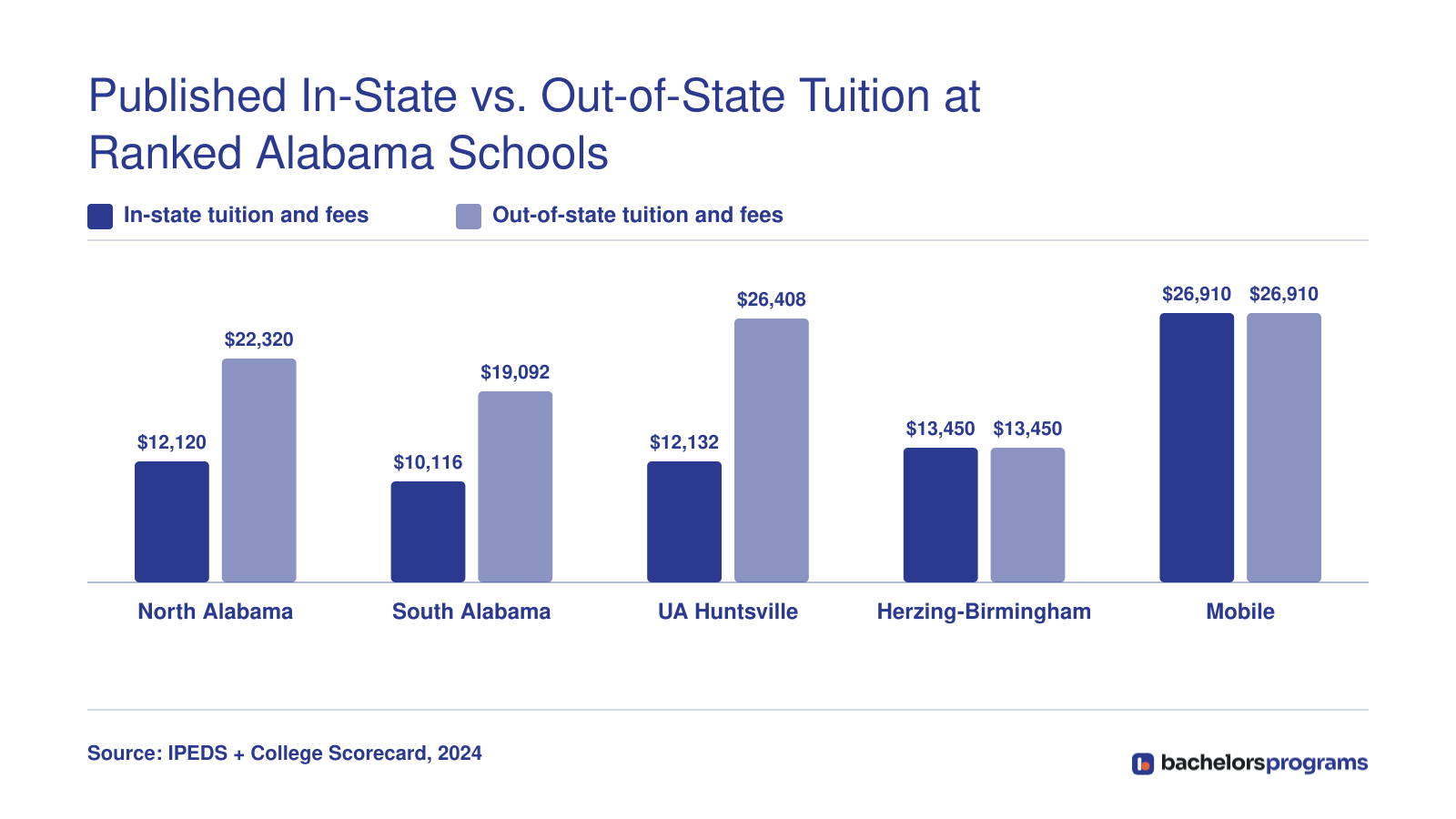
Published In-State vs. Out-of-State Tuition at Ranked Alabama Schools
These bars show each school's institution-wide published tuition and fees for one year of undergraduate study, before grants or scholarships. They are not the price of the accelerated BSN program itself, which may be billed per credit or carry its own fees. The University of Alabama in Huntsville has the widest residency gap: $12,132 in-state versus $26,408 out-of-state, a difference of $14,276. Private schools such as the University of Mobile and Herzing University-Birmingham typically charge one rate, so your residency does not change their published price.
Related Articles
Quick Answers for Alabama Second-Degree Nursing Applicants
- Which program ranks first: The University of Alabama in Huntsville. Its accelerated BSN runs three semesters with a 20-student cohort, and applications open March 1.
- How long the program takes: Most accelerated tracks run 12 to 18 months of full-time study. University of North Alabama lists 15 months, starting in summer.
- Whether a non-nursing bachelor's qualifies: Yes. A prior bachelor's in any field is the entry point, plus prerequisite science courses. University of South Alabama also lists a 3.0 GPA minimum.
- What it costs: University of Alabama in Huntsville reports an in-state tuition range of $15,561 to $18,561. North Alabama lists $340 per credit across 60 credit hours. Fees and living costs are extra.
- Community college or online prerequisites: Often acceptable if the credits are regionally accredited and match the school's course list. South Alabama requires 26 prerequisite credits, so confirm each course with admissions first.
- Reapplying after a rejection: Generally you can apply again next cycle. South Alabama describes admission as selective and competitive, so use the gap to raise your science grades and update your application.
- Multistate licensure: Alabama participates in the Nurse Licensure Compact. If Alabama is your primary state of residence, your RN license carries multistate privileges, whichever approved ABSN you attended.
Campus, Hybrid, and Low-Residency Accelerated BSN Formats in Alabama
Alabama's accelerated nursing options fall into two formats: full-time campus cohorts and a newer low-residency model that moves coursework online. None of the programs here is fully online, because skills labs and clinical rotations must be done in person.
Fully On-Campus Programs
The University of South Alabama is campus-based and full-time, running at least three semesters. Clinical days can exceed 20 hours per week and fall on weekdays or weekends, alongside skill and simulation labs. Approved clinical sites may be outside Mobile, and placement is not guaranteed.
The University of Mobile and Herzing University-Birmingham are also listed as campus programs. Mobile places students in hospitals and psychiatric centers.
The University of Alabama in Huntsville runs three semesters (spring, summer, fall) through an employer partnership. Students get one-on-one mentoring from a practicing nurse, paid clinical hours, and guaranteed job placement. Its program page does not spell out a hybrid or low-residency design, so plan on campus attendance.
The Hybrid, Low-Residency Option
The University of North Alabama is the clearest low-residency fit. Its 15-month program delivers coursework online, with weekend clinicals in Northwest Alabama and a Student Nurse Apprenticeship that includes paid clinical hours. Ask the school for its exact total clinical hours and on-campus lab dates before you apply.
Which Format Suits You
- Relocating or living near campus: South Alabama, Mobile, or Herzing suit students who can commit to a full-time schedule.
- Employer-backed career changers: Huntsville fits students who want paid clinical time and a job lined up.
- Staying put in North Alabama: UNA suits those who can travel for weekend clinicals but need flexible coursework.
Questions to Ask Yourself
Are your anatomy, physiology, and microbiology credits recent enough to clear each school's recency window?
Could you relocate or travel for lab immersions if the program near you is hybrid?
Would you accept an employer-funded seat that requires a post-graduation work commitment?
Do you have the savings, loans, or family support to cover 12 to 18 months without a full paycheck?
Alabama Board of Nursing Approval and CCNE or ACEN Accreditation for ABSN Programs
Two Separate Checks
State approval and national accreditation answer different questions. Alabama Board of Nursing approval is what qualifies a graduate to sit for the NCLEX-RN and apply for an Alabama RN license. Without it, the degree does not lead to licensure here. Accreditation by the Commission on Collegiate Nursing Education (CCNE) or the Accreditation Commission for Education in Nursing (ACEN) is voluntary, but it matters later. Many MSN and DNP programs expect an accredited BSN, some employers screen for it, and it can affect eligibility for certain federal aid and programs.
What the Records Show
The board's CY2025 list of approved nursing programs includes University of South Alabama and University of Alabama in Huntsville among approved baccalaureate programs. The board approves the BSN program as a whole and does not list accelerated or second-degree tracks separately, so an ABSN generally operates under its parent program's approval. University of South Alabama also appears in CCNE's Alabama directory.1 Directory entries typically do not break out the accelerated track, so ask admissions to confirm in writing that accreditation covers the ABSN. Request the same confirmation, including the accrediting body's name, from University of North Alabama, University of Mobile, Herzing University-Birmingham and UAH.
Verify It Yourself
- State approval: Search the Alabama Board of Nursing's approved nursing programs list by degree type.
- Accreditation: Look up the school in the CCNE accredited-programs directory or the ACEN program search.
- Pass rates: The board publishes annual NCLEX-RN pass rates for each approved program. These reflect the full BSN program, not the accelerated cohort alone.
NCLEX-RN Licensure Through the Alabama Board of Nursing
Compare Accelerated BSN (ABSN) programs on the data that matters
Explore more Nursing majors or browse every field of study.
All Nursing programs Browse every field of study