Best BSN Programs in Alabama
Compare 24 accredited Bachelor of Science in Nursing (BSN) programs in Alabama at 18 colleges, with net price after aid, graduation rates, earnings and debt from IPEDS and the U.S. College Scorecard.
The NCLEX-RN, not the diploma, puts a nursing license in your hands, and Alabama schools differ in how many graduates pass it on the first try. A retake can cost months of RN pay.
That is why the programs here are ordered by exam results rather than reputation. The scope is traditional pre-licensure BSN programs approved in Alabama, the route for students entering nursing for the first time.
Strong exam records and low prices do not always belong to the same school, so the order of your priorities matters.
Key Points
- Auburn University and Samford University lead on first-time NCLEX-RN results.
- Expect two entry models: direct freshman admission or competitive upper-division entry.
- An Alabama RN license costs $125 single-state or $225 multistate.
Top NCLEX-RN Pass Rates: 10 Alabama BSN Schools Ranked
Alabama's strongest traditional BSN programs separate themselves at licensure time, and these ten schools carry the highest first-time NCLEX-RN pass rates in the state board data behind this list. Every entry is a campus-based, pre-licensure BSN for students who do not yet hold a nursing license. Alongside each program you will see the school's institution-wide graduation rate, so exam results and completion can be weighed together.
Auburn University
#1Auburn, AL · $13,000 – $35,000/yr (est.) · NCLEX-RN pass rate 100% (2-yr weighted avg)
Best for: Public university students wanting a traditional campus
Auburn University runs its CCNE-accredited baccalaureate nursing program on a traditional residential campus, with simulation labs and clinical placements at partner hospitals. Graduates posted a 100% first-time NCLEX-RN pass rate in the ranking data, and the school graduates 82% of students. Coursework threads evidence-based practice and interprofessional learning across all four years, and faculty mentors stay with students from the lab through clinical rotations.
- CCNE accredited baccalaureate program for pre-licensure students
- Simulation labs plus clinical placements at leading hospitals
- Coursework in evidence-based practice and interprofessional learning
- Preparation for hospitals, community clinics, leadership and policy
- Faculty mentors guide students through labs and clinical rotations
Samford University
#2Birmingham, AL · $30,000 – $35,000/yr (est.) · NCLEX-RN pass rate 100% (2-yr weighted avg)
Best for: First-year students starting clinical work immediately
Samford University is a private campus in Birmingham where nursing students log more than 900 clinical hours in the city's hospitals and health systems before they graduate. Its first-time NCLEX-RN pass rate sits at 100% in the ranking data, and the school graduates 77% of students. The CCNE-accredited program admits first-time freshmen directly and layers pharmacology, pathophysiology, and health assessment onto clinical work that starts in the first year.
- More than 900 clinical hours in Birmingham hospitals and health systems
- CCNE accredited four-year track for first-time freshmen
- Freshman entry requires a 3.0 GPA plus ACT or SAT scores
- Two units of lab science with a grade of C or better required
- Freshman applications close May 1; transfer applications June 1
- Coursework in pharmacology, pathophysiology and health assessment
- Clinical experience starts in the first year
The University of Alabama
#3Tuscaloosa, AL · ~$22,000/yr (est.) · NCLEX-RN pass rate 99.6% (2-yr weighted avg)
Best for: Students drawn to an expanding nursing college
The University of Alabama's Capstone College of Nursing is CCNE accredited and enrolls freshmen, transfer students, and second-degree students on its Tuscaloosa campus. First-time NCLEX-RN pass rates land at 99.6% in the ranking data, and the school graduates 73% of students. The college is planning an $80.75 million expansion meant to more than double on-campus enrollment and push annual graduates past 550, developed with the UAB Health System.
- CCNE accredited BSN at the Capstone College of Nursing
- Simulation centers plus clinical placements in hospitals and agencies
- Admits freshmen, transfer students and second-degree students
- RN to BSN option for licensed registered nurses
- Lower- and upper-division coursework with leadership training
- Faculty mentoring and individualized instruction in labs
University of Alabama in Huntsville
#4Huntsville, AL · $19,000/yr (est. net price) · NCLEX-RN pass rate 98.9% (2-yr weighted avg)
The University of Alabama in Huntsville offers a pre-licensure BSN concentration built for students without a prior nursing degree, delivered across four upper-division semesters on a research campus. First-time NCLEX-RN pass rates reach 98.9% in the ranking data, and the school graduates 64% of students.
- Pre-licensure concentration across four upper-division semesters
- Practice in the Simulation and Learning Innovation Center
- Priority consideration for applicants with 30 or more UAH hours
- Transfer students welcome into the BSN concentration
- Association of Nursing Students chapter on campus
- Sigma Theta Tau Honor Society affiliation
- ACT scores required with the application
University of North Alabama
#5Florence, AL · $12,000 – $22,000/yr (est.) · NCLEX-RN pass rate 96.9% (2-yr weighted avg)
The University of North Alabama has taught nursing since 1973 and runs its traditional BSN on the Florence campus with fall and spring starts. First-time NCLEX-RN pass rates come in at 96.9% in the ranking data, and the school graduates 55% of students. The first two years cover biological, physical, and behavioral sciences plus humanities, then clinical and professional nursing courses take over, with nine courses carrying a clinical component.
- 125 total credit hours, including 60 in the nursing major
- Two start dates each year, fall and spring
- Minimum 2.8 GPA plus prerequisite courses for admission
- Nine courses include a clinical component
- Early admission option for high school seniors
- Criminal background check required before clinical placements
- Nursing education offered at UNA since 1973
University of Mobile
#6Mobile, AL · ~$22,000/yr (est.) · NCLEX-RN pass rate 95.5% (2-yr weighted avg)
The University of Mobile is a private, faith-based campus in Mobile where the traditional BSN blends classroom theory with clinical simulation and personal faculty mentoring. First-time NCLEX-RN pass rates reach 95.5% in the ranking data, and the school graduates 57% of students. The CCNE-accredited curriculum spans adult health, psychiatric-mental health, community, and child health nursing, and graduates leave prepared for critical care, emergency, and pediatric roles.
- Traditional BSN with adult health, psychiatric, community and child health
- State-of-the-art clinical simulations alongside classroom theory
- Faculty mentors with practicing healthcare backgrounds
- Admission requires a minimum GPA plus ACT or SAT scores
- Foundation for master's and doctoral study in nursing
- Faith-based approach to nursing education
University of Alabama at Birmingham
#7Birmingham, AL · $19,000/yr (est. net price) · NCLEX-RN pass rate 95% (2-yr weighted avg)
UAB's School of Nursing sits inside a major academic medical center with Level 1 trauma care, so BSN students get on-campus clinical and research experience without leaving Birmingham. First-time NCLEX-RN pass rates land at 95% in the ranking data, and the school graduates 64% of students. The CCNE-accredited pathway runs a five-semester upper-division sequence with a preceptorship, plus a Dean's Scholars Program for high school seniors and an honors track built around research.
- Five-semester upper-division sequence with a preceptorship
- Three admission cycles per year, starting fall, spring or summer
- Minimum 2.8 GPA plus prerequisite coursework
- Clinicals at a Level 1 trauma academic medical center
- Dean's Scholars Program for high-achieving high school seniors
- Nursing Honors Program with research opportunities
- Student Nurse Internship Program with Children's of Alabama
- RN to BSN pathway for licensed registered nurses
Troy University
#8Troy, AL · $15,000 – $20,000/yr (est.) · NCLEX-RN pass rate 94.5% (2-yr weighted avg)
Troy University runs its BSN at campuses in Troy and Dothan, pairing simulation and clinical rotations with a paid student apprenticeship at partner hospitals. First-time NCLEX-RN pass rates come in at 94.5% in the ranking data, and the school graduates 50% of students. The program holds continuing accreditation from ACEN, takes about 4.5 years, and offers fall and spring starts plus an early acceptance track for high school seniors.
- ACEN continuing accreditation
- Available at the Troy and Dothan campuses
- Complete in approximately 4.5 years
- Nursing student apprenticeship lets students earn while learning
- Early acceptance program for high school seniors
- Two start dates each year, fall and spring
- Rotations in adult health, psychiatric, public and child health nursing
University of South Alabama
#9Mobile, AL · $18,000/yr (est. net price) · NCLEX-RN pass rate 94.4% (2-yr weighted avg)
The University of South Alabama delivers its CCNE-accredited BSN on a Mobile campus with simulation labs, team-based learning, and clinical placements across the region. First-time NCLEX-RN pass rates reach 94.4% in the ranking data, and the school graduates 53% of students. Students take sciences and humanities first, move into nursing coursework in the final two years, and can apply for early admission as high achievers or enter through the RN to BSN route as licensed nurses.
- CCNE accredited four-year BSN on the Mobile campus
- Skill and simulation labs with team-based learning
- Early admission option for high-achieving students
- RN to BSN pathway for associate-degree nurses
- Last two years focus on nursing coursework and clinicals
- Graduates prepared for NCLEX-RN and graduate study
Spring Hill College
#10Mobile, AL · $20,000/yr (est. net price) · NCLEX-RN pass rate 92.3% (2-yr weighted avg)
Spring Hill College is a small private campus in Mobile where nursing classes average 13 students and clinical work runs through Gulf Coast hospitals and clinics. First-time NCLEX-RN pass rates reach 92.3% in the ranking data, and the school graduates 52% of students. The CCNE-accredited BSN splits into a pre-professional phase and a professional phase, and admissions are test-optional for applicants.
- CCNE accredited four-year on-campus BSN
- Average class size of 13 students
- Test-optional admissions for applicants
- Pre-professional and professional phases of coursework
- Sigma Theta Tau honor society membership
- Kelley Powell Scholarship for nursing students
- Clinical experiences across Gulf Coast hospitals and clinics
Cost & outcomes by school
Federal data for the highest-earning Bachelor of Science in Nursing (BSN) programs, independent of the ranking above. Earnings are this field's bachelor's graduates four years after completing where the Scorecard reports them, else the school's undergraduate median.
| School | Net price / yr | Grad rate | Earnings | Debt | Grads/yr | Format |
|---|---|---|---|---|---|---|
| Auburn University AL | $24,323 | 82% | $65,337 | $21,000 | 12,396 | Campus |
| University of Alabama in Huntsville AL | $18,796 | 64% | $61,767 | $20,705 | 3,082 | Campus |
| The University of Alabama AL | $22,420 | 73% | $59,221 | $22,750 | 15,056 | Campus |
| Samford University AL | $32,622 | 77% | $58,469 | $19,500 | 1,938 | Campus |
| University of Alabama at Birmingham AL | $18,749 | 64% | $54,501 | $22,300 | 5,760 | Campus |
| Spring Hill College AL | $20,449 | 52% | $51,500 | $27,000 | 452 | Campus |
| Athens State University AL | — | — | $50,273 | $18,051 | 1,650 | Online |
| Tuskegee University AL | $35,013 | 55% | $49,641 | $27,000 | 888 | Campus |
| University of South Alabama AL | $17,648 | 53% | $49,379 | $24,929 | 3,668 | Campus |
| University of North Alabama AL | $12,170 | 55% | $45,415 | $22,077 | 2,488 | Campus |
| Jacksonville State University AL | $14,279 | 55% | $45,235 | $22,189 | 2,788 | Campus |
| Auburn University at Montgomery AL | $13,224 | 33% | $44,391 | $25,000 | 1,208 | Campus |
Sources: U.S. Department of Education. Net price, graduation rate, earnings and debt: College Scorecard (earnings and debt for this field's bachelor's graduates where reported, else school-wide); graduates: IPEDS. A dash means no figure is reported.
Cost, debt & payoff
Median earnings of this field's bachelor's graduates (4 yrs after completing, else the school's undergraduate median) vs. their median federal loan debt · U.S. College Scorecard
Across these programs the median graduate earns about $49,379 and finishes with roughly $22,875 in debt — a ratio that clears a common rule of thumb (keep debt below first-year salary). Net price and debt vary widely school to school, so check the per-school figures in the table above before you shortlist.
What Drives Our Alabama BSN Order: Exam Results First, Then Accreditation and Completion
A polished campus tour and a strong first-attempt NCLEX-RN pass rate both say something about a nursing school. Only one of them says whether its graduates actually get licensed.
What decides whether a BSN pays off is how many graduates pass the NCLEX-RN on their first attempt, and that figure carries most of the weight here.
How the Score Breaks Down
First-attempt pass rate supplies roughly 75% of each program's score, drawn from three years of state board results and scaled to how many graduates sat the exam, so one strong year from a small cohort cannot leapfrog a large program with a steady record. Accreditation and completion and retention fill in the rest. Sources are state board NCLEX-RN reports, the College Scorecard for net price, earnings and debt, and IPEDS for tuition. This list is independent; it does not repackage U.S. News or any other publisher's ranking.
What the Numbers Cannot Tell You
Graduation and retention rates describe the whole university, not the BSN cohort alone. Net price averages what students pay after aid across the whole school; it is not a quote for your situation.
The two lists that follow turn those measures into decisions: where net price lands lowest, and where graduates report the strongest earnings.
Cheapest BSN Schools in Alabama by Net Price After Aid
These are the lowest-cost schools on this page, ordered by average net price after aid, based on U.S. Department of Education IPEDS and College Scorecard data (2024). Net price is the institution-wide average a full-time undergraduate pays after grants and scholarships, not a BSN-specific bill. In-state tuition and fees is the published rate before any aid. A low price does not guarantee strong exam results: the University of North Alabama pairs the lowest net price here with a 96.9% NCLEX-RN pass rate, while Jacksonville State University comes in at 80.6%, so check each school's NCLEX-RN results in the ranking above before letting cost decide.
| School | Location | Average Net Price After Aid (institution-wide) | Published In-State Tuition and Fees (before aid) | NCLEX-RN Pass Rate |
|---|---|---|---|---|
| University of North Alabama | Florence, AL | $12,170 | $12,120 | 96.9% |
| University of West Alabama | Livingston, AL | $12,684 | $10,990 | 85.7% |
| Auburn University at Montgomery | Montgomery, AL | $13,224 | $9,700 | 92.3% |
| Jacksonville State University | Jacksonville, AL | $14,279 | $12,894 | 80.6% |
| Troy University | Troy, AL | $16,527 | $10,176 | 94.5% |
Related Articles
Getting Into an Alabama BSN: Prerequisites, GPA, TEAS, and Direct vs. Upper-Division Entry
Can you start in the nursing major as a freshman, or do you have to finish prerequisites and then compete for a seat? Alabama schools do both, and the entry model shapes everything else about your application.
Two Entry Models
Direct admit means you enter the nursing major on day one and move through the professional sequence with your cohort. Samford University follows this pattern with a traditional track for first-time freshmen. Its listing shows a 3.0 GPA minimum, ACT or SAT scores, two units of high school lab science, and a freshman application deadline of May 1 (transfer deadline June 1).
Upper-division entry means you spend roughly two years on prerequisites, then apply competitively to the professional phase. The University of Alabama in Huntsville runs a four-semester upper-division concentration and gives priority consideration to students with 30 or more UAH hours. The University of North Alabama also admits to nursing at the upper-division stage, and its program states that university admission does not assure a nursing seat.1
GPA and Test Policy
- University of North Alabama: 2.75 in the required BSN courses and a C or higher in each prerequisite.1 An admission assessment exam feeds into a cumulative ranking index, but the published page does not say whether that exam is the TEAS, the ACT, or another test.
- University of Alabama in Huntsville: ACT is the listed exam. Check its nursing page for the current GPA floor.
- Samford University: 3.0 GPA minimum, with ACT or SAT as the entrance exam.
- Auburn University and The University of Alabama: Neither program's GPA floor or test policy is detailed here, so check each nursing admissions page before you plan around either.
Common Prerequisite Courses
Lower-division sequences at Alabama BSN programs typically include:
- Anatomy and physiology (usually two semesters with labs)
- Microbiology
- Chemistry
- Statistics
- English composition
Exact lists differ by school, as do the rules on retaking courses. The grade rule that does show up in published criteria is a C or higher in every prerequisite. Treat that as the floor, not the target.
A Practical Tip
Meeting a published minimum rarely guarantees a seat in an upper-division program. Seats are limited, and schools rank applicants on prerequisite grades, assessment results, and sometimes other criteria. Before you commit to a campus, find its application deadline, learn how it ranks applicants, and look at how strong your science grades need to be to stand out. If you have a choice, aim well above the minimum, and keep a second school in mind in case the first is full.
Alabama BSN Tuition Comparison: In-State Rates, Net Price, and State Grant Programs
Alabama BSN tuition comes in two numbers that rarely match: the sticker rate a school publishes and the average net price students actually pay once grants and scholarships are applied. Comparing both, with state aid added on top, gets you to a realistic four-year figure.
Sticker Rate vs. Net Price
- Auburn University: $12,890 in-state tuition against a $24,323 average net price, the widest gap among the four-year BSN schools here.
- The University of Alabama: $12,180 tuition, $22,420 net.
- University of Alabama in Huntsville: $12,132 tuition, $18,796 net.
- University of North Alabama: $12,120 tuition, $12,170 net, the narrowest gap of the group.
- Samford University: $40,150 tuition, $32,622 net, the private option and the only school where average aid pulls net price below the published rate.
Gaps run wide at public universities because net price bundles housing, food, and books with tuition before subtracting aid. A wide gap is not automatically bad news; it usually reflects a larger total cost of attendance, not a weaker award package.
What the Average Hides
That net figure is a school-wide average across undergraduates receiving aid. Your own offer depends on your FAFSA results, merit scholarships, and residency status. Run each school's net price calculator, which federal rules require them to provide, before you rule a program in or out.
Alabama Aid That Reduces the Bill
- Alabama Student Grant Program: up to $3,000 a year, not need-based, for Alabama residents at eligible private nonprofit Alabama institutions. About 5,435 students shared roughly $9.6 million in 2026, so confirm the current eligible-school list with the Alabama Commission on Higher Education.1
- Alabama Student Assistance Program: $300 to $5,000 a year based on need2, ACHE-administered and usable at public and private institutions. About 11,790 students received awards totaling roughly $9.7 million in 2026.1
- Alabama Board of Nursing programs: the Graduate Nursing Scholarship (up to $10,000, with a 24-month Alabama practice obligation) funds graduate study, while the Nursing Education Loan Repayment and Advanced Practice Nursing Loan Repayment programs (up to $15,000 each) target nurse educators and CRNP, CNM, or CRNA roles. Treat these as post-BSN options.
If You Are Moving In
Out-of-state tuition runs $34,922 at Auburn, $34,172 at Alabama, $26,408 at UAH, and $22,320 at UNA. Samford charges the same $40,150 regardless of residency. State grants generally require Alabama residency, so settle domicile questions before you enroll.
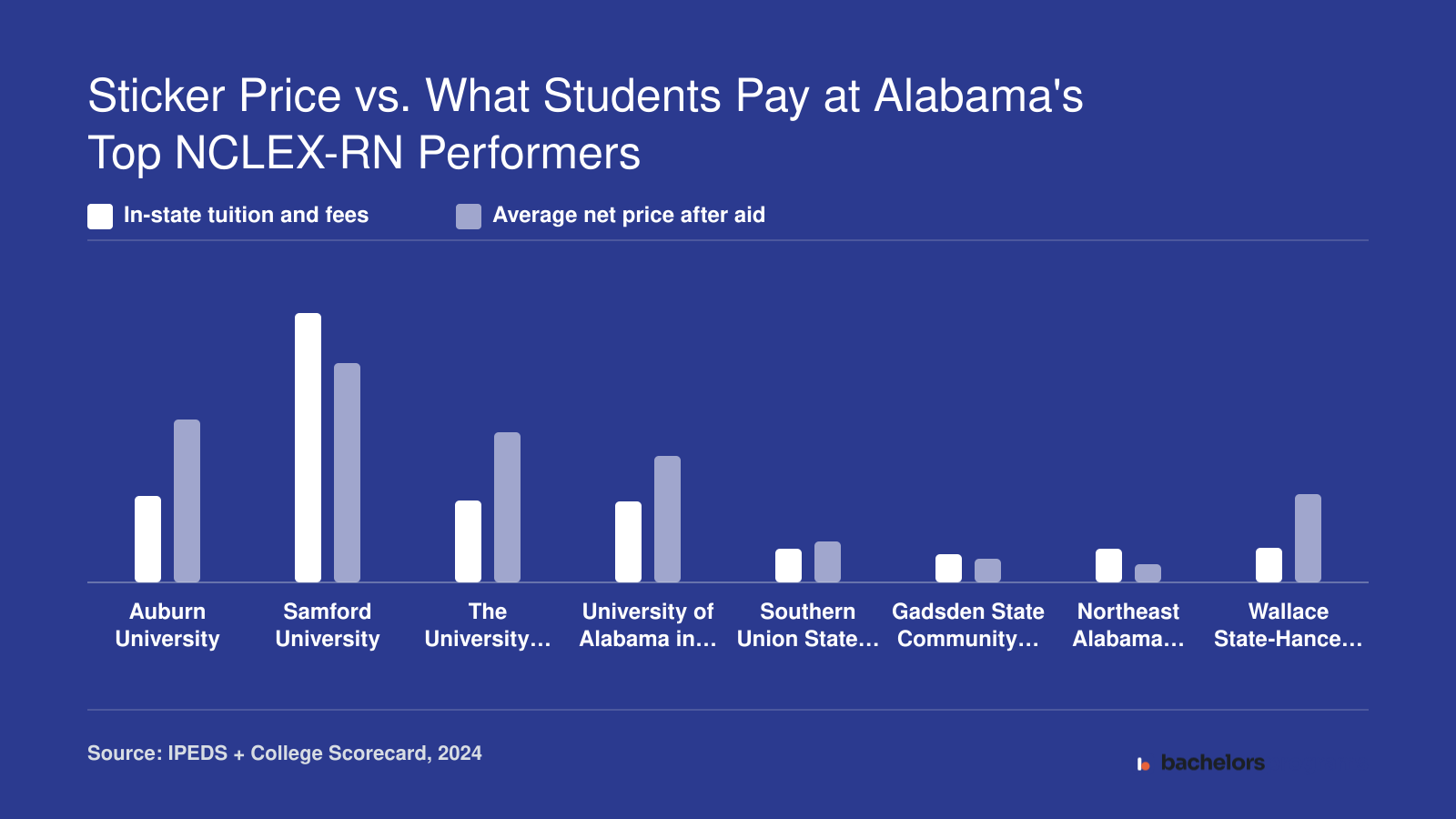
Sticker Price vs. What Students Pay at Alabama's Top NCLEX-RN Performers
Each school below shows its published in-state tuition and fees next to its average annual net price after grants and scholarships. Net price is an institution-wide average for aided students, not a nursing-only figure. It also covers housing, books and other living costs, so at several public schools it lands above tuition alone. Samford University shows the biggest drop from sticker price: its $40,150 tuition falls to an average net price of $32,622, about $7,500 less once aid is applied. Northeast Alabama Community College and Gadsden State Community College also come in below their tuition, at $2,756 and $3,515. At Auburn University and The University of Alabama, the full cost of attendance after aid runs roughly $10,000 above tuition, so plan for living expenses as well as the tuition bill.
Alabama Board of Nursing Approval, CCNE/ACEN Accreditation, and NCLEX-RN Eligibility
State approval decides whether you can become a nurse. National accreditation decides how far your degree travels afterward. The two are separate checks, and a BSN program needs both.
Why Board Approval Comes First
Only graduates of Alabama Board of Nursing (ABN) approved pre-licensure programs, or out-of-state programs the home board has approved and that meet Alabama's criteria, can apply for RN licensure by examination. Approval attaches to the specific program and location. A school's general accreditation, a federal-aid listing, or a marketing claim does not establish it.
What CCNE and ACEN Add
CCNE and ACEN are the national nursing accreditors. Alabama requires approved programs to earn recognized national nursing accreditation within five years of ABN approval. Accreditation matters for graduate school admission, and some employers and military pathways expect it. It also affects how your program fits into federal financial aid rules. It does not replace ABN approval.
How to Verify a Program
- ABN: Find the program on the Board's website listing. Match the exact program name, campus, and degree type.
- CCNE or ACEN: Search the accreditor's public directory for the same program.
- Status flags: Anything short of full approval, such as conditional or probationary standing, signals the Board has concerns. Confirm the details with the ABN before you enroll.
From Graduation to Authorization to Test
- Apply after graduating: The ABN will not consider an exam application until you have graduated. Your school sends an official transcript in a sealed envelope.
- Choose your license type: Single-state costs $125 and multistate costs $225, plus a $3.50 transaction fee. Multistate applicants also submit a PSOR form and a Citizenship Checklist.
- Complete the background check: Fingerprinting is required, and your application must be on file first.
- Register with Pearson VUE: Do this at the same time as your ABN application. Once the ABN confirms eligibility, Pearson VUE issues your Authorization to Test.
The multistate option ties to the Nurse Licensure Compact, which can let you practice in other compact states without a new license. Confirm the residency rules with the ABN before you choose it.
From BSN Graduate to Licensed Alabama RN
Already an RN or Changing Careers? Other Routes to a BSN
The shortest route to a BSN depends on what you already hold, not on where a school sits in a ranking. Licensed RNs with an associate degree or hospital diploma can build on their clinical experience and current license through an RN-to-BSN pathway instead of repeating a traditional pre-licensure sequence. A separate RN-to-BSN page covers format, clinical expectations, and how prior coursework is treated.
Students who already hold a bachelor's degree in another field have a different option: an accelerated BSN. These programs compress the nursing sequence into an intense full-time schedule, on the assumption that general education and upper-division coursework are already complete. The dedicated page explains what these programs expect and how they differ from a traditional four-year track.
Which Ranking Applies to You
The schools ranked here were judged on their traditional pre-licensure BSN, the route for students who do not yet hold an RN license or a prior bachelor's degree. The order therefore does not answer which program is best for an RN returning to school or for a career changer. Use the dedicated RN-to-BSN and accelerated pages for those choices, and compare them on schedule, clinical placement, and total cost.
Matching an Alabama BSN School to Your Situation
Which Alabama BSN school fits you best? Work through the factors in this order, because each one narrows the field before the next matters.
A Priority Order for Your Shortlist
- First-time NCLEX-RN results: Auburn University and Samford University both sit at 100 percent in the ranking, with The University of Alabama at 99.6 percent. Start with the top of the list.
- Board approval and accreditation: Confirm each program is approved by the Alabama Board of Nursing and holds CCNE or ACEN accreditation.
- Net price after aid: Compare what students actually pay, not the sticker price.
- Entry type and selectivity: Admission rates give context, not a verdict. Auburn admits about 46 percent of applicants and Samford about 82 percent, but the nursing major has its own entry rules.
- Clinical access and location: Ask where students rotate and how far you would commute.
Guided Picks by Student Profile
Budget-first students should begin with the cheapest-five list, then see where each of those schools lands in the ranking. Look at the program type too, since several of the lowest-cost schools here list an associate degree in nursing, which is a different credential from a BSN.
If certainty about reaching the nursing major matters most, favor schools that publish a freshman-entry track. Samford describes a traditional track for first-time freshmen, and the University of North Alabama lists early admission for high school seniors. The University of Alabama in Huntsville uses an upper-division concentration, so you complete prerequisites first and then compete for a seat.
If exam results drive your decision, shortlist the first few schools in the ranking and compare their entry requirements.
Support Signals for Working and First-Generation Students
School-wide retention and Pell share can hint at how well a campus supports students balancing work and family. Auburn, for example, retains about 94 percent of full-time first-year students, and roughly 44 percent of its undergraduates receive Pell grants. These are campus-wide figures, not nursing-specific ones, so treat them as context only.
Ready to narrow your list? Request information from the ranked Alabama BSN programs on bachelorsprograms.com, or compare them side by side to see which one fits your budget, schedule, and goals.
Compare Bachelor of Science in Nursing (BSN) programs on the data that matters
Explore more Nursing majors or browse every field of study.
All Nursing programs Browse every field of study