Best RN to BSN Programs in Alabama
Compare 17 accredited RN to BSN programs in Alabama at 15 colleges, with net price after aid, graduation rates, earnings and debt from IPEDS and the U.S. College Scorecard.

Alabama's RN to BSN programs award block credit for the associate work you already finished: 40 hours at The University of Alabama, 36 at UAB, 35 at Jacksonville State. That is why a completion degree runs 27 to 30 upper-division credits rather than four fresh years.
The ranking here covers fully online completion programs for licensed RNs; hybrid formats requiring campus time are left out. The real tension is pace against price. Troy advertises as few as 18 weeks, UAB spreads 30 credits across three to five semesters, and Samford's private tuition sits well above the public in-state rates.
For nurses working full shifts, the deciding factor is usually how much of the old transcript a school agrees to count.
Key Points
- Average net price runs from $12,684 (West Alabama) to $16,527 (Troy).
- At UAB Hospital, Alabama's only Magnet hospital, leadership roles expect a BSN.
- Alabama's 54,340 registered nurses earn a median of $37.06 per hour.
Best Fully Online RN to BSN Programs in Alabama, Ranked
The programs that score highest here share a few practical traits: a curriculum built for licensed RNs rather than generic nursing students, a stated policy for turning the associate degree into college credit, and online delivery that does not require rearranging a hospital schedule. Each card below names the school's nursing program, its delivery format, the school's average net price after aid and its overall graduation rate.
Auburn University
#1Auburn, AL · $13,000 – $35,000/yr (est.)
Best for: Nurses wanting a three-semester completion track
Auburn's School of Nursing gives licensed RNs two routes: a three-semester RN to BSN track of 27 upper-division nursing credits, and a concurrent option developed with community colleges so students can earn the ADN and BSN in sequence. Coursework centers on leadership, evidence-based practice, population health and clinical prevention, with supervised practice folded into two courses. As one of Alabama's largest public universities, Auburn offers the widest catalog of support services on this list.
- CCNE accredited
- 27 upper-division nursing credit hours
- Designed to finish in three semesters
- 38 credit competency escrow available
- 2.5 GPA minimum and active RN license
- Fall, spring and summer start terms
- Statistics prerequisite required
- Clinical practice built into two courses
The University of Alabama
#2Tuscaloosa, AL · ~$22,000/yr (est.)
Best for: Working nurses seeking credit for prior experience
The Capstone College of Nursing runs one of the state's larger online RN to BSN enrollments, with rolling admission and three start terms a year. Nurses who want to keep moving can stack the bachelor's into an accelerated RN to BSN/MSN Nurse Executive track that awards the BSN in the fourth semester. Faculty who teach on campus also teach online, and prior RN experience is formally recognized at admission rather than case by case.
- CCNE accredited
- 30 credit hours of nursing coursework
- 40 credit hours awarded for prior RN experience
- Rolling admissions with three start terms a year
- No ACT or SAT scores required
- $399 per credit
- Practicum required
- Sciences and liberal arts prerequisites
- 53 to 59 total credit hours
- Nurse Executive concentration
- BSN awarded in the fourth semester
- 3.0 GPA admission requirement
- No campus attendance required
- Bachelor courses $399 per hour, master $480 per hour
- Practicum components included
- Early graduate school admission possible
University of Alabama at Birmingham
#3Birmingham, AL · $19,000/yr (est. net price)
Best for: Nurses planning an eventual graduate degree
UAB's School of Nursing sits inside a major academic health center in Birmingham, which shapes a curriculum heavy on evidence-based practice, quality and patient safety, applied pathophysiology and transitional care. RNs choose a three-, four- or five-semester plan, so the pace can flex around shifts and family obligations. An optional Nursing Honors Program gives research-minded nurses a running start on graduate study.
- CCNE accredited
- 30 upper-division nursing credit hours across 9 courses
- 36 block credits for prior nursing coursework
- Three-, four- or five-semester plans
- Part-time option available
- BSN totals at least 125 credit hours
- 2.5 GPA minimum
- No entrance exam required
University of Alabama in Huntsville
#4Huntsville, AL · $19,000/yr (est. net price)
UAH's College of Nursing in Huntsville teaches its online RN to BSN with the same faculty who teach on campus, and the track can be finished in as few as 12 months while students keep working. Admission is comparatively open, built around a 2.0 GPA minimum and an unencumbered license rather than a competitive cut. Residency rules require 12 of the final 18 credits at UAH, so plan the last stretch accordingly.
- CCNE accredited
- 2.0 GPA minimum
- Unencumbered RN license required
- ADN or diploma from an accredited nursing program
- Transfer credit from regionally accredited institutions
- 12 of the last 18 credits must be earned at UAH
- Minimum grade of C in nursing courses
Jacksonville State University
#5Jacksonville, AL · $10,000 – $15,000/yr (est.)
Jacksonville State's STEP program is built for working nurses who want a compressed route: one calendar year, no waiting list, and up to 35 credits banked for prior nursing education. Three start dates a year plus full- and part-time options let nurses fit school around hospital schedules instead of the other way around. The curriculum pushes into leadership, community health and evidence-based practice rather than repeating clinical fundamentals.
- CCNE accredited
- 100% online format
- Completes in one calendar year
- Full-time and part-time options
- Up to 35 transfer credits for prior nursing education
- Three start dates a year
- No waiting list
- Designed for working RNs
University of South Alabama
#6Mobile, AL · $18,000/yr (est. net price)
South Alabama's College of Nursing in Mobile frames its pathway as a bridge from the ADN to broader roles in management, education and specialized clinical practice. Coursework blends sciences and humanities with a professional nursing component covering community health, leadership, health policy and evidence-based practice. The whole pathway is delivered online, which matters for nurses in Mobile, Baldwin County and beyond who cannot add a commute to a 12-hour shift.
- CCNE accredited
- Online pathway for ADN and diploma nurses
- Sciences and humanities plus a professional nursing component
- Community health, leadership and health policy content
- Evidence-based practice threaded through the curriculum
Samford University
#7Birmingham, AL · $30,000 – $35,000/yr (est.)
Samford is the private option on this list, a Birmingham university whose online BSN completion program keeps a firm 120-credit graduation requirement and a specific prerequisite set in anatomy, physiology and microbiology. Admission runs twice a year and asks for short essays and a resume, so applicants should start planning earlier than they would for a rolling-admission program. Transfer credit, CLEP scores of 50 or higher and military credit are all considered.
- CCNE accredited
- 120 total credit hours to graduate
- 2.5 GPA minimum and unencumbered license
- Admits AS or AAS nursing graduates
- Anatomy, physiology and microbiology prerequisites
- Statistics may be taken in the first semester
- Two start dates a year
- CLEP credit for scores of 50 or higher
Troy University
#8Troy, AL · $15,000 – $20,000/yr (est.)
Troy has educated nurses for more than 50 years and organizes its online RN Mobility option around asynchronous classes and five terms a year. Students choose where to complete the preceptorship, which matters for nurses working in smaller Alabama towns far from a campus. The School of Nursing also takes part in a state apprenticeship initiative with the Alabama Board of Nursing, though the apprenticeship is separate from this degree track.
- ACEN accredited
- Complete in as few as 18 weeks
- Asynchronous online classes
- Five terms a year
- Full-time and part-time options
- Choose your preceptorship location
- Fall and spring starts
- 50+ years educating nurses
Athens State University
#9Athens, AL
Athens State is a small upper-division university in north Alabama built for transfer students who arrive with an associate degree already in hand. Its nursing program leans on leadership, complex clinical care management and community health improvement, and the school reports learning partnerships with Huntsville Hospital Health System, Crestwood Medical Center and other regional employers. That makes it a natural fit for nurses already working in the north Alabama hospital corridor.
- CCNE accredited
- 2.0 GPA minimum
- Current RN license required
- 36 transferable semester hours required
- Leadership and community health focus
- Experiential learning opportunities
- Online program format
University of Mobile
#10Mobile, AL · ~$22,000/yr (est.)
The University of Mobile runs an asynchronous online RN to BSN from a small private campus near Mobile, which suits nurses who want a self-paced class schedule. Applicants face a long prerequisite list plus a background check, drug screen, immunization record and BLS certification, so gathering documents takes real lead time. Graduates of UM's own associate degree in nursing receive dedicated scholarship support.
- CCNE accredited
- Asynchronous online classes
- $375 per credit
- 61 credit hours of prerequisites
- Unencumbered RN license required
- Scholarships for UM ADN graduates
- Background check and BLS certification required
- Prepares students for master's and doctoral study
Cost & outcomes by school
Federal data for the highest-earning RN to BSN programs, independent of the ranking above. Earnings are this field's bachelor's graduates four years after completing where the Scorecard reports them, else the school's undergraduate median.
| School | Net price / yr | Grad rate | Earnings | Debt | Grads/yr | Format |
|---|---|---|---|---|---|---|
| Auburn University AL | $24,323 | 82% | $65,337 | $21,000 | 12,396 | Online |
| Columbia Southern University AL | $14,580 | 33% | $63,534 | $21,339 | 8,506 | Online |
| University of Alabama in Huntsville AL | $18,796 | 64% | $61,767 | $20,705 | 3,082 | Online |
| The University of Alabama AL | $22,420 | 73% | $59,221 | $22,750 | 15,056 | Online |
| Samford University AL | $32,622 | 77% | $58,469 | $19,500 | 1,938 | Online |
| University of Alabama at Birmingham AL | $18,749 | 64% | $54,501 | $22,300 | 5,760 | Online |
| Athens State University AL | — | — | $50,273 | $18,051 | 1,650 | Online |
| University of South Alabama AL | $17,648 | 53% | $49,379 | $24,929 | 3,668 | Online |
| University of North Alabama AL | $12,170 | 55% | $45,415 | $22,077 | 2,488 | Hybrid |
| Jacksonville State University AL | $14,279 | 55% | $45,235 | $22,189 | 2,788 | Online |
| Auburn University at Montgomery AL | $13,224 | 33% | $44,391 | $25,000 | 1,208 | Hybrid |
| University of West Alabama AL | $12,684 | 35% | $44,232 | $24,944 | 912 | Online |
Sources: U.S. Department of Education. Net price, graduation rate, earnings and debt: College Scorecard (earnings and debt for this field's bachelor's graduates where reported, else school-wide); graduates: IPEDS. A dash means no figure is reported.
Cost, debt & payoff
Median earnings of this field's bachelor's graduates (4 yrs after completing, else the school's undergraduate median) vs. their median federal loan debt · U.S. College Scorecard
Across these programs the median graduate earns about $50,273 and finishes with roughly $22,300 in debt — a ratio that clears a common rule of thumb (keep debt below first-year salary). Net price and debt vary widely school to school, so check the per-school figures in the table above before you shortlist.
Cheapest Online RN to BSN Programs in Alabama: Five Lowest-Cost Picks
These online RN to BSN options are ordered by average net price after aid, from $12,684 at the University of West Alabama to $16,527 at Troy University. Net price is a school-wide average from federal College Scorecard data, so treat it as an approximate guide rather than a quote for your own bill. Columbia Southern University, the only private (for-profit) school in the table, has the lowest published tuition and fees yet lands mid-range at $14,580, a reminder that sticker price and net price can rank schools differently. For working RNs, the per-credit rate often matters more than annual figures. The University of West Alabama lists $325 per credit, and Columbia Southern lists $278 per credit plus a $35 per course fee. Many Alabama online programs also charge one rate regardless of residency: the University of South Alabama charges $328 per credit for all students, The University of Alabama charges $399 per credit plus a $10 per credit nursing fee, and UAB lists $573 per semester hour for residents and nonresidents in 2026-2027.
| Rank | School | Sector | Format | Average net price after aid | Published tuition and fees (in-state / out-of-state, annual) | RN to BSN per-credit rate (program page) | Median graduate debt (program-level) |
|---|---|---|---|---|---|---|---|
| 1 | University of West Alabama (Livingston) | Public | Online | $12,684 | $10,990 / $20,090 | $325 per credit | N/A |
| 2 | Auburn University at Montgomery (Montgomery) | Public | Fully online or hybrid | $13,224 | $9,700 / $20,668 | N/A | $17,245 |
| 3 | Jacksonville State University (Jacksonville) | Public | 100% online | $14,279 | $12,894 / $23,334 | N/A | $15,330 |
| 4 | Columbia Southern University (Orange Beach) | Private (for-profit) | Online | $14,580 | $6,760 / $6,760 | $278 per credit hour plus $35 per course fee | N/A |
| 5 | Troy University (Troy) | Public | Online, asynchronous | $16,527 | $10,176 / $20,352 | N/A | $21,625 |
Related Articles
RN to BSN Admission Requirements in Alabama: Your Checklist
Admission rules differ from campus to campus, so check each school's own program page before you apply. Here is what Alabama RN to BSN programs commonly ask for, with examples from the schools that publish their requirements.
- Active, unencumbered RN licenseThe University of Alabama requires an unencumbered U.S. RN license, and applicants licensed outside Alabama should confirm that state's rules. The University of South Alabama requires a license with no restriction and treats participation in a voluntary discipline program as a restriction. The University of West Alabama requires an unencumbered license in the state where you complete clinical hours.
- Accredited ADN or diplomaThe University of Alabama accepts graduates of ACEN- or CNEA-accredited associate degree or diploma programs. The University of South Alabama and UAB also accept either an ADN or a diploma, and the University of West Alabama asks for graduation from an accredited nursing school.
- Prerequisite and general education creditsExpect courses such as anatomy and physiology I and II, microbiology, English composition I and II, math, psychology, history, humanities and a lab science. The University of South Alabama requires 59 general education credits beyond nursing coursework. At the University of Alabama, you apply for upper-division standing after you finish the lower-division prerequisites.
- Minimum GPAThe University of Alabama, the University of South Alabama and the University of West Alabama each set a 2.5 minimum. South Alabama applies the 2.5 to prerequisite courses, requires a C or better in each one and sets a 2.0 minimum for the overall university GPA.
- Deadlines and start termsThe University of Alabama offers fall, spring and summer starts, with deadlines of July 15, November 1 and April 15. South Alabama also has three entry points per year. Troy University lists August 1 and January 1 deadlines. Confirm current dates for the 2026 cycle with each school before you apply.
Alabama RN Licensure Rules for RN to BSN Students
RN to BSN Transfer Credits, Part-Time Pace and Tuition Help in Alabama
How Your ADN Credits Transfer
An RN to BSN completion program builds on the credit you already earned in nursing school and adds the upper-division nursing and general education courses a bachelor's degree requires. How much of your earlier work counts shapes both your timeline and your bill, and Alabama schools handle it differently.
- University of West Alabama: Accepts up to 96 transfer credits, including up to 40 from ACEN-accredited associate degree nursing programs.
- University of South Alabama: Allows up to 59 semester hours from an accredited institution to transfer, with the Registrar evaluating your full academic history after admission.
- The University of Alabama: Lists 30 credit hours for the online RN to BSN program component. A third-party listing reports ADN holders transferring up to 40 credits, with 52 to 58 lower-division credits and 25 core nursing credits. Confirm these figures against the current catalog.
- University of Alabama at Birmingham: Offers a 30-credit online RN to BSN for licensed diploma or ADN nurses.
Most bachelor's degrees total roughly 120 credits, so request a written transcript evaluation before you enroll. Also ask whether a minimum number of credits must be earned at that school, since residency rules can limit how much transfer credit applies.
Advertised Timelines vs. a Working Nurse's Schedule
Program pages often promise completion in about a year. That pace usually assumes your general education prerequisites are already finished and that you can carry a full course load. A nurse working three 12-hour shifts a week, with rotating weekends, often does better carrying one or two courses at a time, which can stretch the program well past a year. Map any missing prerequisites first, because they can add a semester before nursing courses begin.
What You'll Actually Pay
Many Alabama online programs charge a flat per-credit rate, and some charge the same rate regardless of where you live. Tuition is only part of the bill. Look for technology or distance-learning fees, nursing course fees, background check and drug screen costs, and a graduation application fee. Multiply the full per-credit cost by the credits you still need, not by a headline credit total.
Tapping Employer Tuition Help
Hospital tuition benefits can cover a meaningful share of an RN to BSN, but terms vary by employer and change often. Before enrolling, ask your HR office about:
- Annual cap: How much the benefit pays each year. Federal tax law lets employers provide up to $5,250 a year in educational assistance tax-free.
- Payment method: Reimbursement after you pass a course, or direct billing to the school.
- Service commitment: How long you must stay after receiving funds, and what you repay if you leave early.
- Eligible schools: Whether your employer partners with specific programs or offers a discount.
Get the answers in writing, since policies can shift mid-program.
How an Alabama ADN Adds up to a 120-Credit BSN
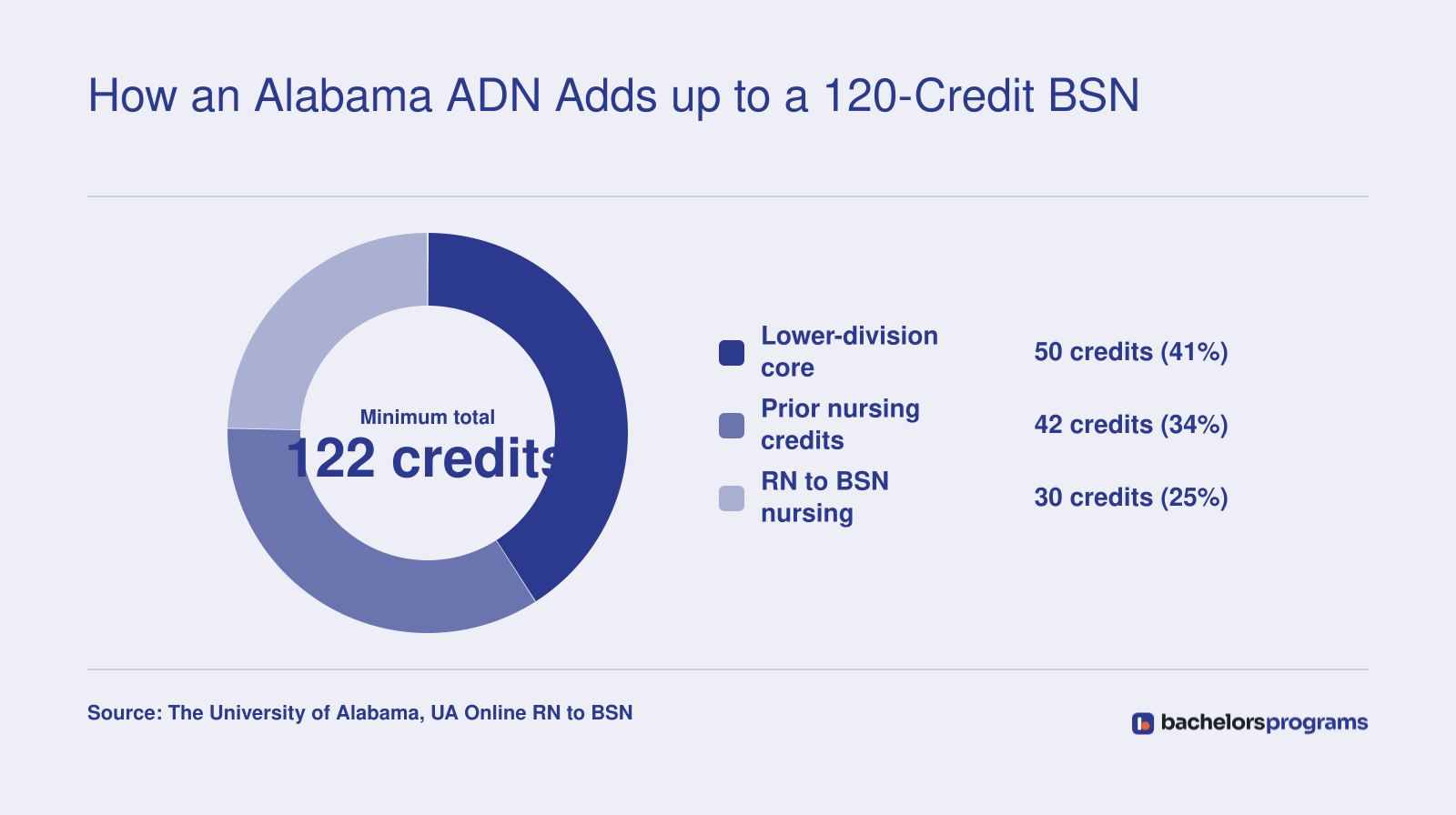
At The University of Alabama, the online RN to BSN totals at least 122 credits, built from three blocks. The first is a minimum of 50 lower-division semester hours, which include the core and general education courses. The second is 42 credits awarded upon admission for prior nursing coursework, so the nursing training behind your RN license counts without being retaken. That leaves 30 upper-division RN to BSN nursing hours as the heart of the program. Because the prior nursing credits and any completed lower-division hours already cover most of the degree, an RN who arrives with core courses finished mainly faces those 30 nursing hours rather than a full four-year course load. Other Alabama schools count prior nursing work differently, so ask each program for its own transcript review before you apply.
Why an RN to BSN Matters for Alabama Nurses
Hospitals chasing Magnet recognition have turned the BSN from a résumé bonus into a leadership prerequisite, and Alabama nurses feel that shift most in Birmingham.
Magnet Hiring in Alabama
UAB Hospital is the state's only Magnet-designated hospital. It first earned the designation in 2002 and has been redesignated five times since, most recently in 2024, with that recognition running through 2029.1 UAB's Magnet scope also covers UAB Hospital-Highlands.2
The American Nurses Credentialing Center (ANCC) does not require every staff RN to hold a BSN. It does require that 100 percent of nurse managers hold a BSN or graduate nursing degree, and the same for nurse leaders.3 The chief nursing officer needs at least a master's.3 One nursing-education source reports that roughly half of direct-care RNs hired by Magnet institutions hold a BSN, though that is a trend and not a hiring rule.4 UAB's published employment material does not set a BSN requirement for every RN applicant.
Roles That Open Up
A BSN matters most when you want to move beyond the bedside. Employers commonly require or prefer it for:
- Charge nurse and nurse manager: Unit leadership is where degree expectations tend to be firmest.
- Case management: Care coordination roles often list a bachelor's degree.
- Public health nursing: Community and health department positions commonly favor a BSN.
- Clinical educator: Teaching and staff development roles typically call for one.
Policies vary by employer, so check postings at the hospitals you are targeting.
The Graduate Pathway
A BSN is the entry point to graduate nursing study, including MSN and DNP programs. That covers nurse practitioner and nurse educator tracks. Some schools here, such as The University of Alabama, offer an RN to BSN/MSN Nurse Executive option that folds the next step into one plan.
A Candid Note on Payoff
Do not expect an automatic raise the day you graduate. Many employers pay staff nurses on the same scale with or without a BSN. The real return is access: the leadership, specialty and graduate-study paths that stay closed without the degree.
What Alabama Registered Nurses Earn
Alabama employs 54,340 registered nurses, and the typical RN in the state earns a median of $37.06 per hour.
Our Scoring Method for Alabama's Online RN to BSN Programs
The score answers one question: among fully online RN to BSN programs, which gives a working Alabama nurse the strongest mix of value and outcomes?
What Counts as Eligible
A program earns a place only when its delivery data shows the RN to BSN coursework runs online. Hybrid arrangements and programs that pull nurses to campus for regular class sessions fall outside the list, since they solve a different problem than most working RNs have.
What the Score Weighs
Each eligible program sits on a composite of three things:
- Affordability: average net price, the figure after typical grant and scholarship aid, not the sticker tuition rate.
- Completion: institution-wide graduation and retention rates, which speak to whether students who start actually finish.
- Outcomes: program-level earnings and median debt from College Scorecard, used where they are published.
A program that looks strong on price but weak on completion does not score as well as one that holds up across all three.
Where the Numbers Stop
Both the graduation rate and the net price describe the whole school, not the nursing department, so read them as context for the institution rather than a promise about any one cohort. Some programs have no published earnings figures for their graduates, and those entries lean on the other two pieces instead of guessing. Figures come from IPEDS and College Scorecard, latest available year, and they shift as federal reporting updates.
Quick Answers for Alabama RNs Weighing an Online RN to BSN
These answers cover the questions working Alabama nurses ask most before enrolling. Details vary by school, so confirm specifics with each admissions office.
Can I complete RN to BSN clinical hours near my home in Alabama?
How many credits transfer into an RN to BSN program in Alabama?
Is an online RN to BSN worth it for a nurse already working in Alabama?
Compare RN to BSN programs on the data that matters
Explore more Nursing majors or browse every field of study.
All Nursing programs Browse every field of study