Best Accelerated BSN (ABSN) Programs in Louisiana
Compare 10 accredited Accelerated BSN (ABSN) programs in Louisiana at 9 colleges, with net price after aid, graduation rates, earnings and debt from IPEDS and the U.S. College Scorecard.
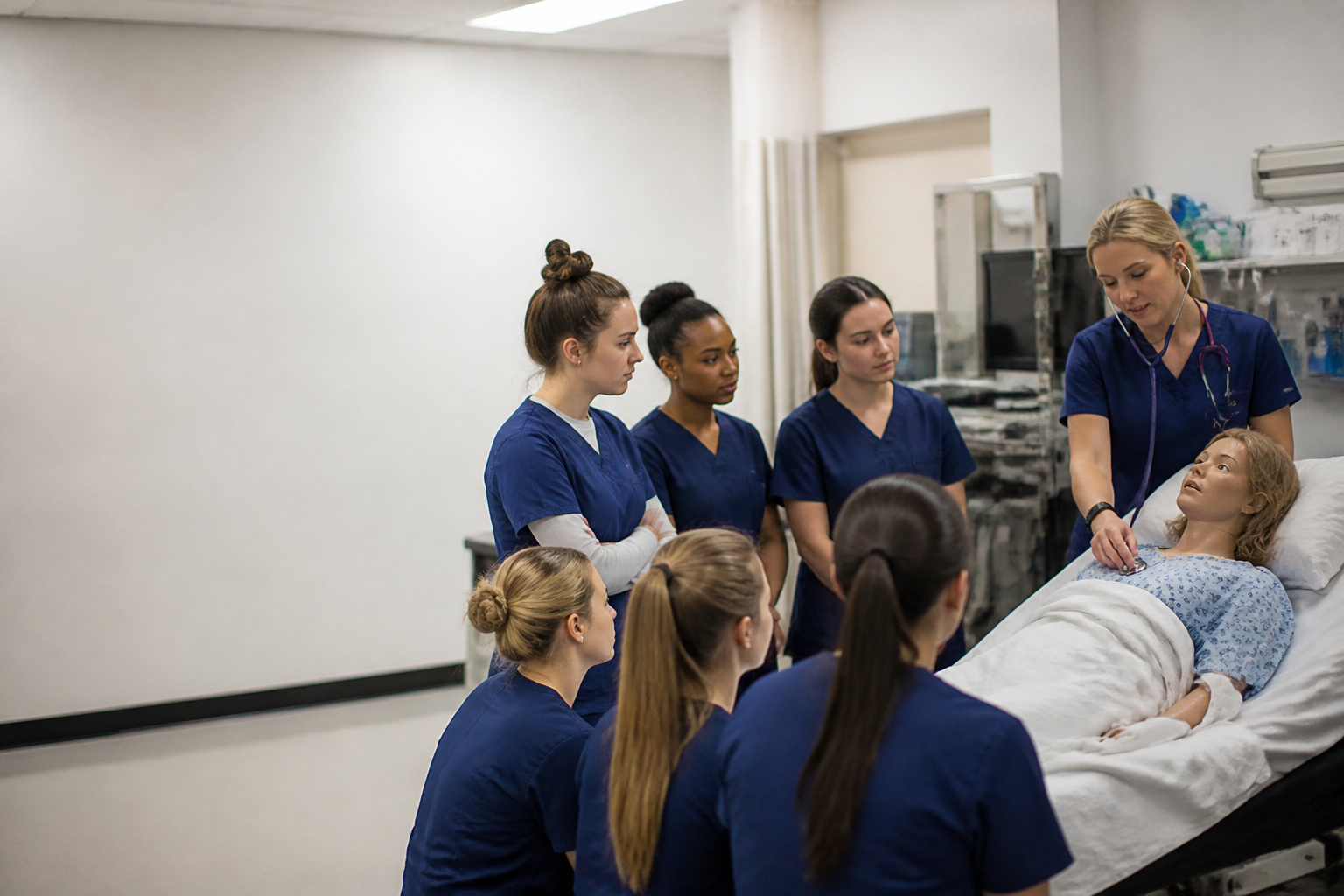
Becoming an RN in Louisiana does not require starting a second four-year degree. A bachelor's in another field plus 15 to 24 months of full-time accelerated BSN coursework qualifies you to take the NCLEX-RN, the exam every registered nurse in the state must pass.
Admissions, not ambition, is the real filter: science prerequisites, a prior degree, and a seat that opens on a fixed calendar. Cost spreads widely, and the cheapest route can carry a work commitment.
Applications for 2027 cohorts open while prerequisites are still in progress.
Key Points
- Louisiana public ABSN tuition runs roughly $14,500 to $30,000 in-state.
- Ochsner pays UL Lafayette nursing-phase tuition for a three-year work commitment.
- Louisiana Board of Nursing approval, not accreditation alone, unlocks the NCLEX-RN.
Louisiana Accelerated BSN Programs Ranked for Second-Degree Students
Nine Louisiana schools and ten accelerated BSN listings made this ranking, from a 15-month partnership track in Lafayette to hybrid programs in New Orleans. Each entry gives you the city, format, in-state tuition, average net price and the school's graduation rate so second-degree applicants can compare like with like.
University of Louisiana at Lafayette
#1Lafayette, LA · $10,000 – $15,000/yr (est.)
Best for: Acadiana residents eyeing hospital employment
UL Lafayette runs its ABSN with Ochsner Health, which covers nursing-course tuition in exchange for a post-graduation employment commitment. In-state tuition is about $10,418, the average net price lands near $13,530, and the school's graduation rate is 53 percent. At 15 months it is the shortest route on this list, with clinicals at Ochsner Lafayette General and simulation labs accredited by the Society for Simulation in Health Care.
- 15-month, full-time cohort totaling 120 credit hours
- 3.0 GPA minimum plus prerequisite coursework
- Nursing-course tuition covered through the Ochsner partnership
- Clinical rotations at Ochsner Lafayette General
- Simulation labs accredited by the Society for Simulation in Health Care
- Guaranteed job with the Ochsner system after graduation
- Community health experience through the Wellness Wednesday clinic
Southeastern Louisiana University
#2Hammond, LA · ~$13,000/yr (est.)
Best for: Baton Rouge and Northshore commuter students
Southeastern is the lowest-priced public option in this ranking at roughly $8,373 in in-state tuition, with an average net price near $13,154 and a school graduation rate of 45 percent. Its 18-month ABSN runs in two places: coursework on the Hammond campus with clinicals at the Baton Rouge Center, and a separate Northshore cohort in Covington tied to St. Tammany Health System.
- 18-month, cohort-based program for second-degree students
- Coursework on the Hammond campus, clinicals at the Baton Rouge Center
- Prepares students for medical-surgical, pediatric and cardiac nursing
- NCLEX preparation built into the curriculum
Loyola University New Orleans
#3New Orleans, LA · ~$24,000/yr (est.)
Best for: Working adults needing hybrid course delivery
Loyola's ABSN is the hybrid option in New Orleans: 17 months of synchronous online classes plus in-person simulation and clinicals, priced at $950 per credit across 54 credits. Sticker tuition is $49,440, though the average net price falls near $23,696, and the school's graduation rate is 59 percent. Rolling admissions and guaranteed clinical placements make it the most forgiving entry timeline in the state.
- 17 months, 54 credit hours, $950 per credit
- Synchronous online classes plus in-person clinicals and simulation
- Rolling admissions with prerequisite courses required
- Guaranteed clinical placements with partners including Ochsner
- 1:10 faculty-to-student ratio during clinicals
- Simulation lab available from the first semester
- Clinical rotations across six specialty areas
Northwestern State University of Louisiana
#4Natchitoches, LA · $10,000 – $15,000/yr (est.)
Northwestern State delivers its 16-month ABSN in Shreveport and Alexandria rather than only on the Natchitoches campus, and it is a true second-degree track open to a bachelor's in any field, kept separate from the school's LPN-to-BSN and RN-to-BSN routes. In-state tuition is about $8,864 with an average net price near $13,606, and the school's graduation rate is 43 percent.
- 16 months across four consecutive semesters, starting each summer
- Bachelor's degree in any field with a 3.0 GPA (2026)
- 66 nursing credit hours
- Taught at Shreveport and Alexandria, not only Natchitoches
- Preferred deadline Oct 15, final deadline Jan 15
- Separate from NSU's LPN-to-BSN and RN-to-BSN tracks
Louisiana Christian University
#5Pineville, LA · ~$13,000/yr (est.)
Louisiana Christian in Pineville teaches a 16-month, concept-based ABSN built around Next Gen NCLEX content, and it does not require the TEAS or any other entrance exam. Tuition is about $20,266, the average net price sits near $13,113, and the school's graduation rate is 44 percent. Small classes come with an assigned success specialist and Cabrini Scholarships for accepted students.
- 16-month concept-based curriculum built around Next Gen NCLEX
- No TEAS or other entrance exam required
- 2.6 GPA minimum plus prerequisite courses
- Cabrini Scholarships and financial aid available
- Small classes with an assigned success specialist
- Christian perspective on holistic patient care
Louisiana State University Health Sciences Center-New Orleans
#6New Orleans, LA
LSU Health Sciences Center New Orleans admits second-degree students through its CARE concentration, a career-changer route that runs under two years rather than the 12-to-18-month ABSN timeline; it is a genuine second-degree pathway, just a longer one. In-state tuition is about $7,020, the lowest here, and the same concentration is taught at a Shreveport site that admits in both fall and spring.
- CARE concentration for career changers with a bachelor's in any field
- 43 prerequisite hours and a 3.0 GPA on prerequisites
- Provisional admission with up to 12 outstanding hours
- 120 semester hours; program runs under two years
- Fall start in New Orleans; Shreveport site admits fall and spring
- Methodist Health System scholarship available
Franciscan Missionaries of Our Lady University
#7Baton Rouge, LA · ~$19,000/yr (est.)
Franciscan Missionaries of Our Lady University runs a campus-based 16-month ABSN in Baton Rouge with two start dates a year, on-campus simulation in the Simulated Environment Teaching Hospital, and clinical rotations with Our Lady of the Lake Health System. Tuition is about $18,310, the average net price sits near $18,552, and the school's graduation rate is 45 percent. A TEAS or HESI exam and a 3.0 GPA gate admission.
- 16 months with fall and spring start dates
- TEAS or HESI entrance exam plus a 3.0 GPA
- Simulated Environment Teaching Hospital on campus
- Clinical partnerships with Our Lady of the Lake Health System
- Program reports a 100% licensure pass rate
- Faculty drawn from diverse clinical specialties
Herzing University-New Orleans
#8Metairie, LA · $20,000 – $25,000/yr (est.)
Herzing's New Orleans-area campus in Metairie accepts non-nursing bachelor's and master's holders into a 20-month ABSN, or 24 months with science prerequisites, and folds 12 graduate dual-credit hours into the degree. Tuition is about $13,450 against an average net price near $21,269, and the school's graduation rate is 15 percent. Rolling admissions, a waived enrollment fee and transfer of up to 90 credits make it the most open entry point.
- 20 months, or 24 with science prerequisites
- 120 credits, including 54 nursing and 12 graduate dual-credit hours
- 2.5 GPA minimum and a TEAS score required
- 630 clinical hours plus a practicum
- Rolling admissions with no application deadline
- Transfer up to 90 approved credits
- High-fidelity simulation training
- Enrollment fee waived
Tulane University of Louisiana
#9New Orleans, LA · ~$40,000/yr (est.)
Tulane's ABSN is a hybrid four-semester program, about 16 months and 60 credits, with 720 clinical hours across New Orleans hospitals, clinics and outreach sites. Tuition is $68,678, the highest on this list, though the average net price is near $39,949, and the school's graduation rate is 86 percent. Prerequisites total 25 credit hours at a 3.0 GPA, plus a video submission and a letter of good academic standing.
- Four consecutive semesters, 60 credit hours
- 720 clinical hours in New Orleans hospitals, clinics and outreach
- 25 prerequisite credit hours with a 3.0 GPA
- Online coursework plus in-person simulation and clinicals
- Video submission and letter of good academic standing required
- Simulations run alongside medical students
- Prepares for ER, surgical, pediatric and community health roles
Cost & outcomes by school
Federal data for the highest-earning Accelerated BSN (ABSN) programs, independent of the ranking above. Earnings are this field's bachelor's graduates four years after completing where the Scorecard reports them, else the school's undergraduate median.
| School | Net price / yr | Grad rate | Earnings | Debt | Grads/yr | Format |
|---|---|---|---|---|---|---|
| Louisiana State University Health Sciences Center-New Orleans LA | — | — | $78,495 | $19,500 | 614 | Campus |
| Tulane University of Louisiana LA | $39,949 | 86% | $63,268 | $20,500 | 5,872 | Hybrid |
| Franciscan Missionaries of Our Lady University LA | $18,552 | 46% | $59,419 | $27,672 | 282 | Campus |
| Loyola University New Orleans LA | $23,696 | 59% | $52,927 | $26,000 | 1,390 | Hybrid |
| Louisiana Christian University LA | $13,113 | 44% | $51,700 | $21,875 | 310 | Campus |
| University of Louisiana at Lafayette LA | $13,530 | 53% | $47,089 | $22,902 | 4,372 | Campus |
| Northwestern State University of Louisiana LA | $13,606 | 43% | $47,021 | $25,000 | 2,260 | Campus |
| Southeastern Louisiana University LA | $13,154 | 45% | $46,482 | $22,113 | 3,410 | Campus |
| Herzing University-New Orleans LA | $21,269 | 15% | $36,909 | $21,500 | 126 | Campus |
Sources: U.S. Department of Education. Net price, graduation rate, earnings and debt: College Scorecard (earnings and debt for this field's bachelor's graduates where reported, else school-wide); graduates: IPEDS. A dash means no figure is reported.
Cost, debt & payoff
Median earnings of this field's bachelor's graduates (4 yrs after completing, else the school's undergraduate median) vs. their median federal loan debt · U.S. College Scorecard
Across these programs the median graduate earns about $49,395 and finishes with roughly $22,113 in debt — a ratio that clears a common rule of thumb (keep debt below first-year salary). Net price and debt vary widely school to school, so check the per-school figures in the table above before you shortlist.
How We Scored Louisiana ABSN Schools Before Ranking Them
Cost, speed and access rarely line up neatly, and in Louisiana the spread between the least and most expensive second-degree nursing path is wide enough to change where you apply. Each ranked entry answers one question: which accelerated BSN options give a career changer the best mix of cost, outcomes and access?
What Goes Into Each Entry
- Cost: in-state tuition and fees, plus the average price students actually pay once aid is applied.
- Outcomes: institution-wide graduation rate, and program-level earnings and debt where the federal data publishes them.
- Format: campus or hybrid delivery, since that shapes commuting and work schedules.
What the Numbers Do and Do Not Cover
Graduation rates cover the whole institution, not the ABSN cohort alone, and the net price is an approximate average that shifts with each student's aid package. Where earnings are published, they reflect graduates who finished, not the offer you will field in a Louisiana hospital.
The list also does not measure NCLEX pass rates or clinical site quality, so confirm both with each nursing department before you apply. Treat the tuition and aid figures as a starting filter rather than a final answer.
Lowest-Cost Accelerated Nursing Programs in Louisiana
These schools are ordered by average annual net price after grant aid, drawn from 2024 U.S. Department of Education data (IPEDS and College Scorecard). Published in-state tuition and fees appear alongside for comparison, and net price can exceed sticker tuition because it reflects the full cost of attendance minus grants. Louisiana Christian University has the lowest net price at $13,113. Southeastern, UL Lafayette and Northwestern State all fall within $493 of it. Franciscan Missionaries of Our Lady University runs $5,439 higher at $18,552. All of these are school-wide figures, not ABSN-specific prices, so clinical, lab, simulation, uniform and exam-prep fees may add to what an accelerated nursing student actually pays.
| School | City | Sector | Average Net Price After Aid (per year) | Published In-State Tuition and Fees (per year) | ABSN Length |
|---|---|---|---|---|---|
| Louisiana Christian University | Pineville | Private | $13,113 | $20,266 | 16 months |
| Southeastern Louisiana University | Hammond | Public | $13,154 | $8,373 | 18 months |
| University of Louisiana at Lafayette | Lafayette | Public | $13,530 | $10,418 | 15 months |
| Northwestern State University of Louisiana | Natchitoches | Public | $13,606 | $8,864 | 16 months |
| Franciscan Missionaries of Our Lady University | Baton Rouge | Private | $18,552 | $18,310 | 16 months |
ABSN Pace and Cost: 12 to 18 Months, In-State Tuition and Aid
How much does an accelerated BSN cost in Louisiana? For in-state students at public schools, tuition alone lands roughly between $14,500 and $30,000, before fees, books and prerequisite courses. Private programs can cost considerably more, so confirm current schedules with each school.
The Pace
Most programs here run about 15 to 18 months of full-time study: UL Lafayette at 15 months, Franciscan Missionaries of Our Lady University and Tulane at 16, Southeastern at 18. LSU Health New Orleans lists two years. Terms run year-round with no summer break, and classroom work is combined with simulation labs and clinical rotations. Tulane's program includes 720 clinical hours.
Published Tuition
- LSU Health New Orleans: $14,793 per year in-state and $25,983 out-of-state for 2026-27, about $29,586 in resident tuition over the program.
- Southeastern Louisiana University: $4,855 per semester in-state and $11,094 out-of-state, which works out to about $14,565 to $19,420 in-state depending on how many full-time semesters are billed.
- Franciscan Missionaries of Our Lady University: $638.66 per credit for preclinical courses and $669.86 for clinical courses. As a private school, it does not discount for residency.
- Tulane: about $884 in one-time nursing fees plus roughly $300 per semester for books. Confirm tuition with the school.
- UL Lafayette: a comparison figure near $28,000, though the Ochsner partnership may cover nursing-course tuition.
Loyola's published figures conflict, so request its current schedule directly. Prerequisites, uniforms, background checks and exam fees are usually extra.
Aid You Can Use
Federal unsubsidized loans are open to most second-degree students. Beyond that, look at school ABSN scholarships and hospital-backed deals. UL Lafayette's Ochsner option asks for a three-year work commitment, and Tulane's LCMC benefit requires finishing in 16 months plus two years of RN work at a matched facility. I could not confirm a Louisiana state grant aimed at accelerated second-degree students; your financial aid office can tell you which nursing scholarships you qualify for.
The Ochsner and UL Lafayette Tuition Deal: Who Qualifies
The cheapest route into a UL Lafayette accelerated BSN can also be the least flexible: the Ochsner-sponsored track covers tuition for the nursing half of the degree, and in exchange you owe Ochsner Lafayette General three years of work.
What the sponsorship covers
Ochsner Lafayette General pays tuition for the 70 nursing-course credit hours. The remaining 50 prerequisite and general-education hours come out of your pocket, and official program materials do not spell out fees, books, equipment, or living costs. No stipend is attached; this is tuition coverage, not a salary.
The commitment
Graduates contract to work for Ochsner Lafayette General for three years after finishing. Program FAQs state there are no exceptions and no option to buy out the commitment by repaying the tuition yourself.
Who gets in
You need a bachelor's in a field other than nursing from a regionally accredited school, at least a 2.6 overall undergraduate GPA as of the 2026 program page, the 50 prerequisite hours, U.S. citizenship, and a Social Security number. Admission to UL Lafayette comes first, then an in-person interview with the College of Nursing & Health Sciences. Nursing coursework runs about 15 months, and admissions materials describe eligibility screening and the interview but not a ranked formula or a published cohort size.
Related Articles
Louisiana Board of Nursing Approval and NCLEX-RN Licensure for ABSN Graduates
The Louisiana State Board of Nursing (LSBN) must approve a pre-licensure nursing program before its graduates can take the NCLEX-RN; that approval is distinct from the CCNE or ACEN accreditation a school advertises.
Approval and accreditation are separate stamps
Accreditation answers to a national body; approval answers to the state board. Herzing University New Orleans and Louisiana Christian University each list CCNE accreditation for the accelerated BSN, and LSU Health Sciences Center New Orleans holds full CCNE accreditation as of 2026. Southeastern Louisiana University's accelerated options have appeared under both ACEN and CCNE in published sources, so confirm the current body with the department. Where a program's state approval category is not spelled out on its admissions page, ask for it in writing and cross-check LSBN's own school list before you deposit.
Accreditation matters past licensure: graduate nursing programs generally expect a bachelor's from an accredited institution, and some hospital systems and federal employers screen on it.
From diploma to license
- Apply online through the Louisiana Nurse Portal and upload a government-issued photo ID.
- Complete the criminal background check through the Louisiana State Police and the FBI, as required under La. R.S. 37:920.1.
- Register for the NCLEX-RN with Pearson VUE, then wait for your Authorization to Test before scheduling.
- Pass within four attempts and within four years of graduation.
A prior criminal record is reviewed case by case, so bring a dated narrative plus court, arrest, or diversion records to the application rather than waiting to be asked.
Where pass rates actually live
LSBN publishes NCLEX-RN pass-rate reports by program. Start there rather than with a recruiter's brochure, and read the numbers for your specific campus.
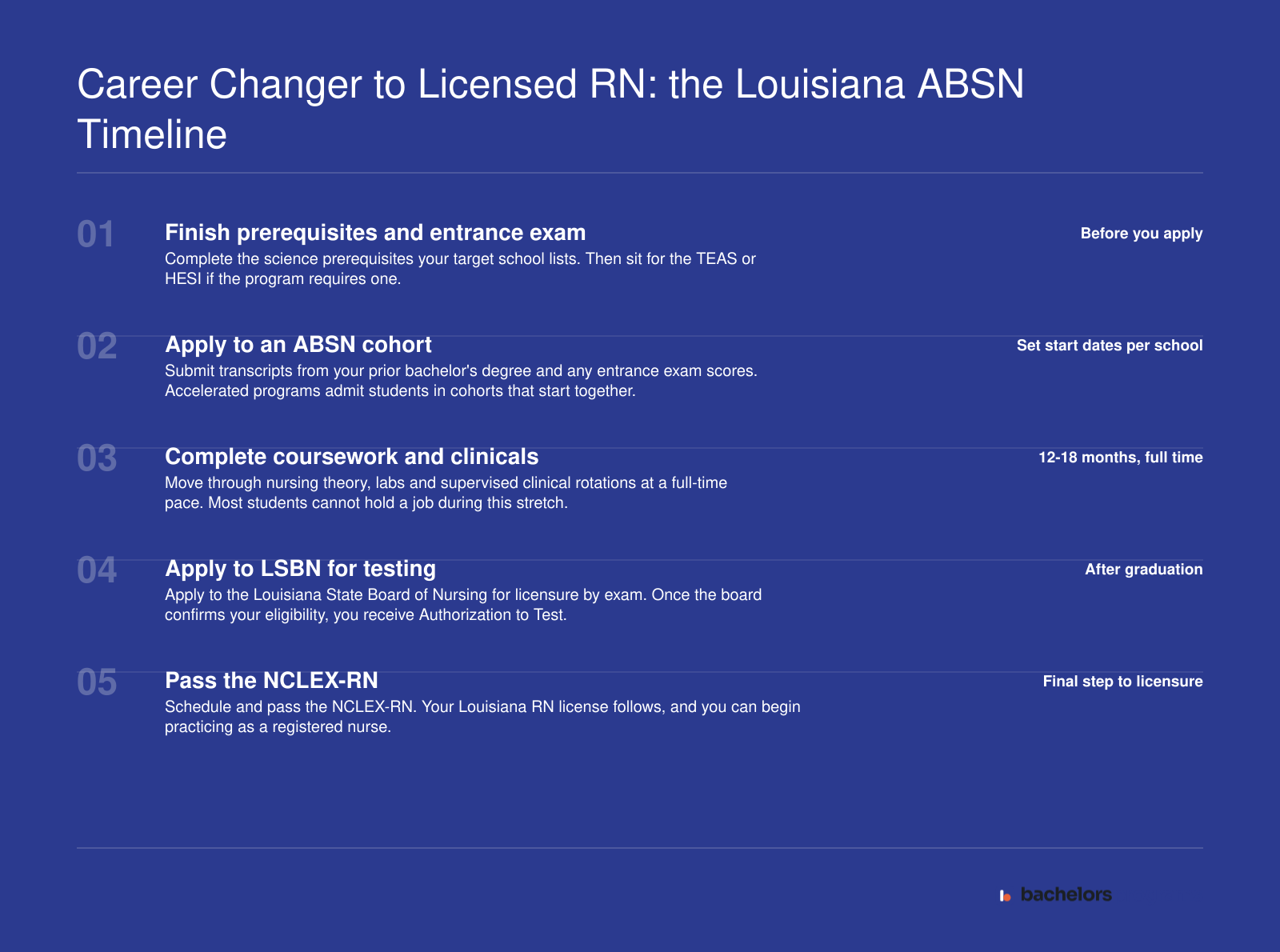
Career Changer to Licensed RN: the Louisiana ABSN Timeline
An accelerated BSN compresses nursing school, but the path to a Louisiana RN license still runs in a fixed order. Each step below depends on finishing the one before it, so plan your calendar around the full sequence, not just the coursework.
Questions to Ask Yourself
Can you cover 12 to 18 months of living costs without a paycheck, or do you need a sponsored seat?
Are your science prerequisites recent enough and graded high enough to meet the GPA cutoffs?
Would a hybrid format with on-site clinicals suit you better than a fully on-campus cohort?
Are you willing to relocate to New Orleans, Baton Rouge or Lafayette if no program runs near you?
Matching an ABSN to Where You Live: New Orleans, Baton Rouge, Lafayette, the Northshore and Shreveport
Hybrid delivery has loosened where you can sit for lectures, but it has not changed where you must show up for hands-on training. Every program here requires in-person labs and clinicals, so location still decides your daily routine.
New Orleans and Metairie
New Orleans offers the most options. Anyone looking at an accelerated BSN in New Orleans can choose Loyola University New Orleans or Tulane University of Louisiana, both hybrid with in-person clinical components. Louisiana State University Health Sciences Center-New Orleans (CARE) and Herzing University-New Orleans in Metairie are fully on campus.
Baton Rouge, the Northshore and Lafayette
For an accelerated BSN in Baton Rouge, Franciscan Missionaries of Our Lady University runs an on-campus program, and Southeastern Louisiana University holds courses in both Hammond and Baton Rouge. Southeastern also offers a Northshore accelerated nursing program, which suits students in the Hammond corridor. An accelerated BSN in Lafayette means the UL Lafayette and Ochsner program, which is on campus and full-time.
Central and North Louisiana
Options thin out here. Louisiana Christian University in Pineville serves the Alexandria area, Northwestern State University of Louisiana runs its accelerated BSN in Alexandria and Shreveport, and LSUHSC-New Orleans teaches its CARE program at a Shreveport site. Students in Monroe, Lake Charles or Houma should expect a real commute or a temporary move. For a program of 15 to 18 months, renting near campus often beats a long daily drive during clinical rotations.
Compare Accelerated BSN (ABSN) programs on the data that matters
Explore more Nursing majors or browse every field of study.
All Nursing programs Browse every field of study