Best Accelerated BSN (ABSN) Programs in Maine
Compare 5 accredited Accelerated BSN (ABSN) programs in Maine, with net price after aid, graduation rates, earnings and debt from IPEDS and the U.S. College Scorecard.
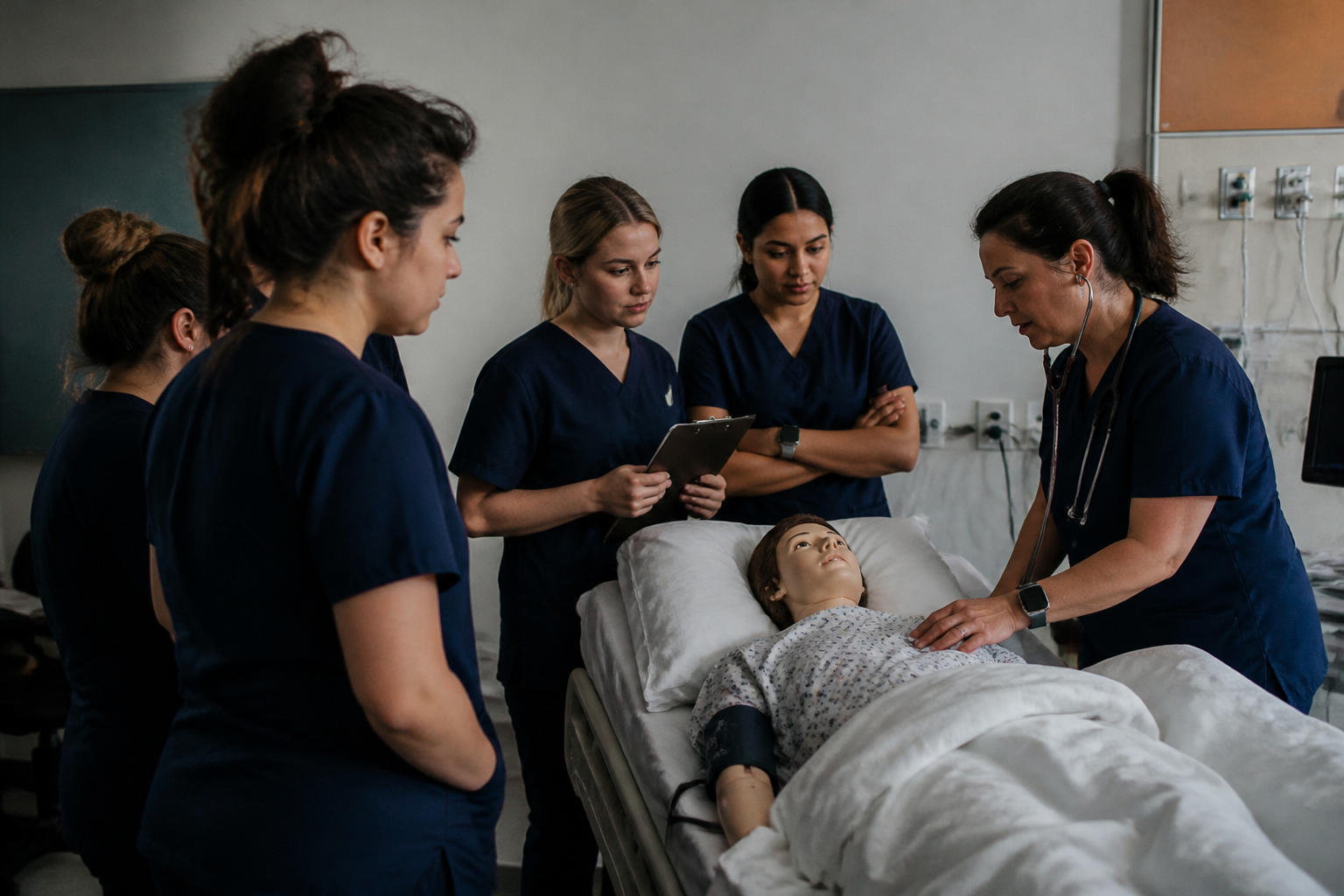
Starting a four-year BSN from scratch means repeating general education coursework you already completed. An accelerated BSN assumes the reverse: your first bachelor's covers the core, and 12 to 18 months of full-time nursing study stand between you and NCLEX-RN eligibility.
In Maine that choice narrows fast. Only a short list of programs enroll second-degree students, and they diverge on price, length and clinical format. Delivery varies as much as cost: one track runs 12 months, another 15, and several start in summer. Admission turns on science prerequisites and a GPA floor, not nursing experience. For most applicants, tuition and start dates decide the choice.
Key Points
- Lowest average net price: University of Maine at Fort Kent, $7,482.
- University of Southern Maine's ABSN starts in May, deadline October 1.
- Maine RN licensure requires a Board-approved program and a $75 application fee.
Top Accelerated BSN Schools in Maine for Second-Degree Students
Each school below earned its spot on what a career changer actually pays, how reliably students finish, and how the program is delivered. Five Maine institutions currently enroll second-degree students in an accelerated BSN, and they differ sharply in price and in format. Every dollar figure here is a published rate or an average after aid, not a quote.
University of Maine at Fort Kent
#1Fort Kent, ME · $9,000 – $15,000/yr (est.)
Best for: Rural health-minded career changers
Fort Kent sits at the top of Aroostook County, and the University of Maine at Fort Kent is the small public campus that anchors nursing education there. The accelerated BSN is delivered on campus, with in-state tuition of $9,420 a year and an average net price after aid of about $7,482, the lowest of any program on this list. Admission is close to open at a 98% acceptance rate, and the school graduates 39% of its students overall. Students train in high-tech simulation labs and complete clinical placements at Northern Maine Medical Center.
- CCNE accredited and approved by the Maine State Board of Nursing
- Clinical placements at Northern Maine Medical Center
- High-tech simulation labs for hands-on practice
- Coursework spans adult health, critical care, mental health and pediatrics
- Built for career changers who already hold a bachelor's degree
- Patient-centered, holistic care threaded through the curriculum
Saint Joseph's College of Maine
#2Standish, ME · $25,000 – $30,000/yr (est.)
Best for: Working adults needing hybrid flexibility
Saint Joseph's College of Maine in Standish runs its accelerated BSN in a hybrid format, pairing online coursework with two required on-campus immersions at a lakeside campus outside Portland. In-state tuition is $44,420, while the average net price after aid comes to about $27,555, a gap that matters for second-degree students paying their own way. The college admits about 84% of applicants and graduates 66% of its students overall. Clinical placement support is included at no added cost, and each student works with a dedicated success advisor.
- CCNE accredited hybrid ABSN for non-nursing bachelor's graduates
- Two on-campus clinical immersions alongside online coursework
- 600 clinical hours across varied care settings
- Clinical placement support included at no added cost
- Dedicated student success advisor for each student
- Synchronous and asynchronous class options
- Two start dates per year
University of Southern Maine
#3Portland, ME · $11,000 – $28,000/yr (est.)
Best for: Portland residents seeking campus-based training
The University of Southern Maine bases its accelerated BSN at the Portland campus, combining in-person classes with simulation work and clinical practice around the state's largest city. In-state tuition is $11,284 and the average net price after aid is about $13,596, which keeps a public option within reach for Maine residents. USM admits roughly 79% of applicants and graduates 40% of its students overall. The program leans on a simulation center with hospital rooms, home settings and virtual reality, plus a 168-hour practicum with a preceptor.
- CCNE accredited and approved by the Maine State Board of Nursing
- 168-hour practicum with a preceptor in acute care, hospice or school nursing
- Simulation center with virtual reality and hospital-room setups
- ATI software integrated to track NCLEX readiness
- Eligible for CNA certification partway through the program
- INACSL Simulation Standards Endorsement
- NEBHE Tuition Break for New England residents
- Merit scholarships available
University of New England
#4Biddeford, ME · $38,000/yr (est. net price)
The University of New England is a private university in Biddeford whose accelerated nursing program is taught on its Portland campus, in a cohort that moves through the curriculum together. Tuition is $44,210 and the average net price after aid is about $38,107. UNE admits about 92% of applicants and graduates 68% of its students overall, the strongest completion figure among the ranked schools. Students learn in a hospital-like simulation lab and take interprofessional coursework alongside other health professions students, with service learning placements in vulnerable communities.
- No entrance exam required; rolling admissions
- Cohort-based structure with one summer start per year
- Hospital-like simulation lab on the Portland campus
- Interprofessional coursework with other health professions students
- Service learning placements with vulnerable populations
- Student Nurses Association club for networking
- No campus housing available in Portland
Beal University
#5Bangor, ME · $40,000/yr (est. net price)
Beal University in Bangor delivers its prelicensure BSN in a hybrid format, with online coursework supported by on-campus labs and year-round clinical rotations. The average net price after aid is about $40,109. The school graduates 36% of its students overall. Clinical groups stay small, at roughly eight students per instructor, and classes run on a modular calendar that finishes each course in half a semester.
- Hybrid format combining online coursework, campus labs and clinicals
- 8:1 student-to-instructor ratio in clinical placements
- Year-round clinical rotations
- Modular classes completed in half a semester
- Small class sizes across the program
- Holds pre-accreditation status from the NLN Commission for Nursing Education Accreditation
- November start date each year
Cost & outcomes by school
Federal data for the highest-earning Accelerated BSN (ABSN) programs, independent of the ranking above. Earnings are this field's bachelor's graduates four years after completing where the Scorecard reports them, else the school's undergraduate median.
| School | Net price / yr | Grad rate | Earnings | Debt | Grads/yr | Format |
|---|---|---|---|---|---|---|
| Saint Joseph's College of Maine ME | $27,555 | 66% | $59,045 | $27,000 | 508 | Hybrid |
| University of New England ME | $38,107 | 68% | $55,921 | $25,250 | 976 | Campus |
| University of Maine at Fort Kent ME | $7,482 | 39% | $51,077 | $20,160 | 352 | Campus |
| University of Southern Maine ME | $13,596 | 40% | $49,958 | $19,060 | 2,090 | Campus |
| Beal University ME | $40,109 | 36% | $35,639 | $19,500 | 28 | Hybrid |
Sources: U.S. Department of Education. Net price, graduation rate, earnings and debt: College Scorecard (earnings and debt for this field's bachelor's graduates where reported, else school-wide); graduates: IPEDS. A dash means no figure is reported.
Cost, debt & payoff
Median earnings of this field's bachelor's graduates (4 yrs after completing, else the school's undergraduate median) vs. their median federal loan debt · U.S. College Scorecard
Across these programs the median graduate earns about $51,077 and finishes with roughly $20,160 in debt — a ratio that clears a common rule of thumb (keep debt below first-year salary). Net price and debt vary widely school to school, so check the per-school figures in the table above before you shortlist.
Prelicensure ABSN vs. RN-to-BSN: Decoding Maine Program Labels
An accelerated BSN is a prelicensure track: you arrive with a bachelor's degree in a field other than nursing, and roughly 12 to 18 months of full-time study later you are eligible for the NCLEX-RN. You are not a nurse when you start. That is the whole point of the degree.
The Two Labels That Get Confused
RN-to-BSN is a different program. It is a completion program for licensed RNs who want the bachelor's credential, usually part time and often online. It does not prepare you for initial licensure because you already have it. Search results and school pages routinely fold both formats under "accelerated," "degree completion," or "online nursing," so the label alone tells you very little.
What "Online" Actually Means Here
When a Maine accelerated BSN is described as hybrid or online, read that as online lectures and coursework paired with required in-person lab sessions and clinical rotations at partner facilities. No accelerated BSN leads to RN licensure without supervised clinical hours. If a page promises a fully remote path to the license, it is describing an RN-to-BSN, not an ABSN.
How to Check a Listing in Two Minutes
- Look for the qualifying words: "second degree," "prelicensure," or "accelerated BSN" should appear near the program title.
- Find the licensure sentence: a prelicensure program states that graduates are eligible for the NCLEX-RN. Absence of that statement is your signal to keep reading.
- Confirm the credential: a BSN, not an MSN, is the outcome you want from a second-degree entry track.
Sort programs by label first; the cost and length comparisons that follow get easier.
Maine ABSN Schools Side by Side: Cost, Format, Selectivity and Debt
University of Maine at Fort Kent is the most affordable option here, with a $7,482 average net price and $9,420 in-state tuition. University of Southern Maine is the most selective, admitting 79.2% of applicants, though every school below admits most of the students who apply. Tuition columns show each school's undergraduate tuition and fees, not ABSN pricing: some accelerated tracks charge their own rates (Saint Joseph's College lists $54,000 total program tuition), which the cost section covers. Saint Joseph's College has a placement coordinator who secures clinical sites near each student's home in Maine at no added cost, with two on-campus immersions in Standish. University of New England does not guarantee placement alongside classmates and expects students to arrange their own transportation to clinical sites. Beal University (Bangor, hybrid) reports a $40,109 average net price but no tuition, admission rate or debt figures, so it is left out of the grid.
| School | City | Format | In-State Tuition and Fees | Out-of-State Tuition and Fees | Average Net Price | Admission Rate | Median Debt (Nursing Bachelor's) |
|---|---|---|---|---|---|---|---|
| University of Maine at Fort Kent | Fort Kent | Campus | $9,420 | $14,880 | $7,482 | 97.9% | $21,125 |
| University of Southern Maine | Portland | Campus-based | $11,284 | $27,944 | $13,596 | 79.2% | $20,017 |
| Saint Joseph's College of Maine | Standish | Hybrid (online coursework, in-person clinicals) | $44,420 | $44,420 | $27,555 | 83.5% | $27,000 |
| University of New England | Biddeford | In-person | $44,210 | $44,210 | $38,107 | 91.6% | $26,000 |
Accelerated BSN Prerequisites and Admission Requirements in Maine
Maine's accelerated BSN programs share one core requirement, a prior bachelor's degree, but each school sets its own rules for prerequisites, GPA and timing. The University of Southern Maine publishes the most detailed criteria, so its figures appear below. For the other schools, confirm current requirements directly with admissions before you apply.
- A completed bachelor's degree in another fieldThe University of Southern Maine requires a bachelor's degree or higher from a regionally accredited institution, earned before the program starts. Saint Joseph's College of Maine accepts a bachelor's in any field and requires no prior nursing experience. The University of Maine at Fort Kent and the University of New England also build their accelerated tracks for students who already hold a bachelor's degree.
- Prerequisite science and math coursesThe University of Southern Maine requires Statistics, Anatomy and Physiology I and II, and Microbiology with lab, each with a C or better before the May start. Pathophysiology and Human Nutrition are not required, but they strengthen an application. Many nursing programs limit how old science credits can be, so ask each school about any recency window.
- Minimum GPAThe University of Southern Maine sets a 3.0 minimum, applied to your most recently earned degree. Get each other school's current GPA standard from its admissions office.
- Testing, experience and essaysThe University of Southern Maine does not require healthcare experience, and Saint Joseph's College of Maine welcomes applicants with no nursing background. Ask each school whether it uses an entrance exam such as the TEAS or HESI A2, an interview or a personal statement.
- Deadlines and clinical clearanceThe University of Southern Maine opens applications in June and closes them October 1 for a competitive May start. Admitted students must clear a background check and meet clinical health requirements before May.
Related Articles
Accelerated BSN Pace, Tuition and Financial Aid in Maine
Accelerated BSN study in Maine is a full-time commitment first and a financial decision second. Tracks compress the clinical hours and science coursework of a traditional BSN into roughly 12 to 18 months, with short or no breaks between terms. Cohorts move as a unit, and one missed course can mean waiting for the next cycle to start. Holding a job beyond occasional per diem shifts is difficult, so budget for living costs across the whole program, not just tuition.
Reading the published tuition numbers
The University of Southern Maine lists undergraduate e-tuition of $355 per credit for 2025-26, alongside graduate rates of $475, $503 or $532 per credit for Maine residents and $1,435, $1,522 or $1,608 for nonresidents, depending on program tier. Which rate an accelerated second-degree nursing student actually pays is a question for the program office, because ABSN cohorts are sometimes billed at undergraduate rates and sometimes at a nursing-specific one. Ask each school for its current per-credit rate, the total credit count, and the fees added on top: lab, clinical placement, technology, and NCLEX-RN review. Get those numbers in writing before you compare offers.
Federal aid after a first bachelor's degree
A prior bachelor's degree generally ends Pell Grant eligibility, and the 2026-27 maximum award of $7,395 does not change that.1 Federal Direct Unsubsidized Loans remain available at undergraduate limits: $3,500, $4,500 and $5,500 in successive years, with an independent undergraduate aggregate of $57,500 (no more than $23,000 of it subsidized)2 and a $257,500 lifetime cap across subsidized and unsubsidized borrowing3. Existing undergraduate loans count toward the aggregate, so your remaining room can be smaller than those ceilings suggest.2
Maine loan repayment targets a different borrower
Maine's Nursing Education Loan Repayment Program awards up to $40,000 over three years, but it is built for nurse educators enrolled in or completing a master's or doctoral nursing program, and undergraduate loans cannot be counted toward it. The 2026 cycle closed March 31, 2026. An ABSN graduate carrying only program debt does not fit the published criteria, so plan on federal loans and institutional aid rather than state repayment.
Why sticker price and average net price diverge
Average net price, the institution-level figure that appears in comparison tables, is calculated for first-time, full-time undergraduates who receive federal aid. A second-degree ABSN student is neither first-time nor usually grant-eligible, so the program's published tuition sits closer to the real bill. Read net price as context for a school's overall cost profile, not as a forecast of what your ABSN year will cost.
From Application to First Nursing Shift: The Maine ABSN Timeline
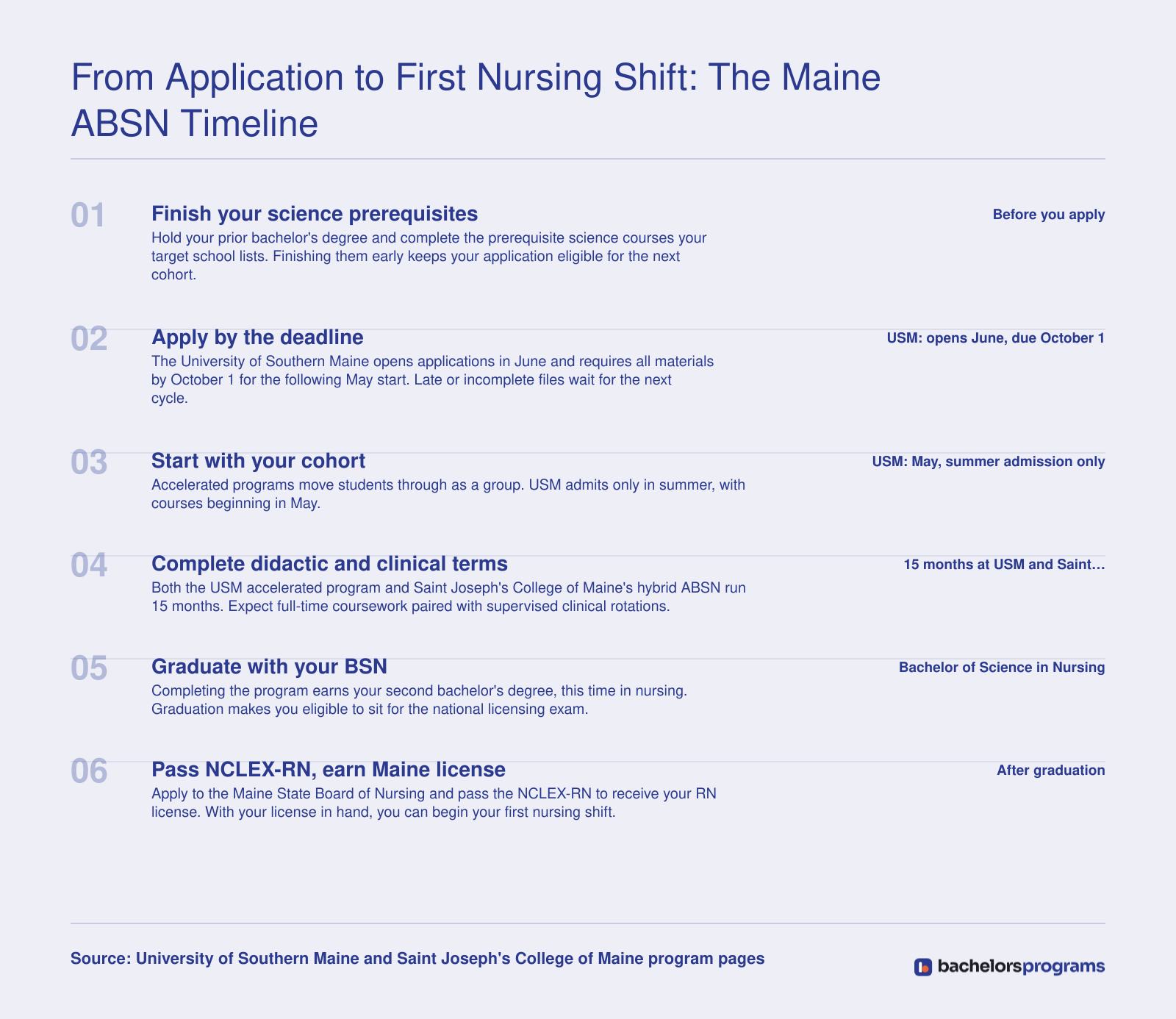
An accelerated BSN moves fast once you start, but the calendar around it is fixed. At the University of Southern Maine, admission happens once a year for a May start, so missing the October 1 deadline can push your first day back by a full year. Confirm each school's current deadline and start date on its admissions page before you plan your prerequisites.
First-Year Earnings for Maine BSN Completers
Among the schools ranked here, the University of New England posts the highest first-year median earnings for its nursing graduates.
Maine State Board of Nursing Approval and NCLEX-RN Licensure for ABSN Graduates
Licensure, not the diploma, is the final step in an accelerated BSN, and in Maine the State Board of Nursing makes that call.
Why Board Approval Comes First
In Maine, only graduates of a Board-approved prelicensure nursing program are eligible for the NCLEX-RN. An ABSN is a prelicensure program, so its approval status determines whether your coursework leads to an exam seat. Confirm with admissions that the accelerated track itself, not only the traditional BSN, falls under the school's Board approval.
Accreditation Is a Separate Check
Board approval lets you test. National accreditation, CCNE or ACEN, signals that a program meets standards graduate nursing schools and many hospital employers look for. If you plan to pursue an MSN or DNP later, or you want to work for a health system that prefers accredited programs, look up each school in the CCNE or ACEN online directory before you commit. Confirm that the listing covers the baccalaureate program that houses the accelerated option.
First-Time NCLEX-RN Pass Rates
The Maine State Board of Nursing's latest published report lists 2025 first-time results and 2023 to 2025 averages. These figures cover each school's BSN graduates overall, not accelerated students alone.
- University of New England: 94.44% in 2025, 96.91% three-year average
- University of Southern Maine: 91.87% in 2025, 90.75% three-year average
- University of Maine at Fort Kent: 89.80% in 2025, 85.15% three-year average
- Saint Joseph's College of Maine: 77.03% in 2025, 82.61% three-year average
Maine BSN programs as a group posted 87.72% in 2025 and 88.34% across the three years. Beal University is not among the BSN programs in that report, so request its most recent first-time pass rate directly from the nursing department or the Board. At any school, ask whether it tracks ABSN cohorts separately.
Licensure Steps After Graduation
- Apply to the Board: Submit your RN licensure-by-examination application to the Maine State Board of Nursing.
- Complete the background check: Maine requires fingerprinting for a criminal history record check.
- Register with Pearson VUE: Register for the NCLEX-RN through Pearson VUE, then schedule your exam once the Board confirms your eligibility and you receive your Authorization to Test.
Maine RN Licensure at a Glance
Accelerated BSN Questions Maine Applicants Ask
These answers cover the questions second-degree applicants raise most often when comparing ABSN options in Maine. Details can change by intake, so confirm specifics on each school's admissions page before you apply.
Is there an accelerated BSN in Maine for people whose bachelor's is in a non-nursing field?
How many months does a Maine accelerated BSN take from the first day to the NCLEX?
Which science prerequisites do Maine ABSN programs expect, and do old credits expire?
Can I complete a Maine accelerated BSN mostly online?
What does a Maine accelerated BSN cost before financial aid?
Can second-degree nursing students in Maine still qualify for federal grants or loans?
Compare Accelerated BSN (ABSN) programs on the data that matters
Explore more Nursing majors or browse every field of study.
All Nursing programs Browse every field of study