Best Accelerated BSN (ABSN) Programs in Michigan
Compare 11 accredited Accelerated BSN (ABSN) programs in Michigan at 10 colleges, with net price after aid, graduation rates, earnings and debt from IPEDS and the U.S. College Scorecard.
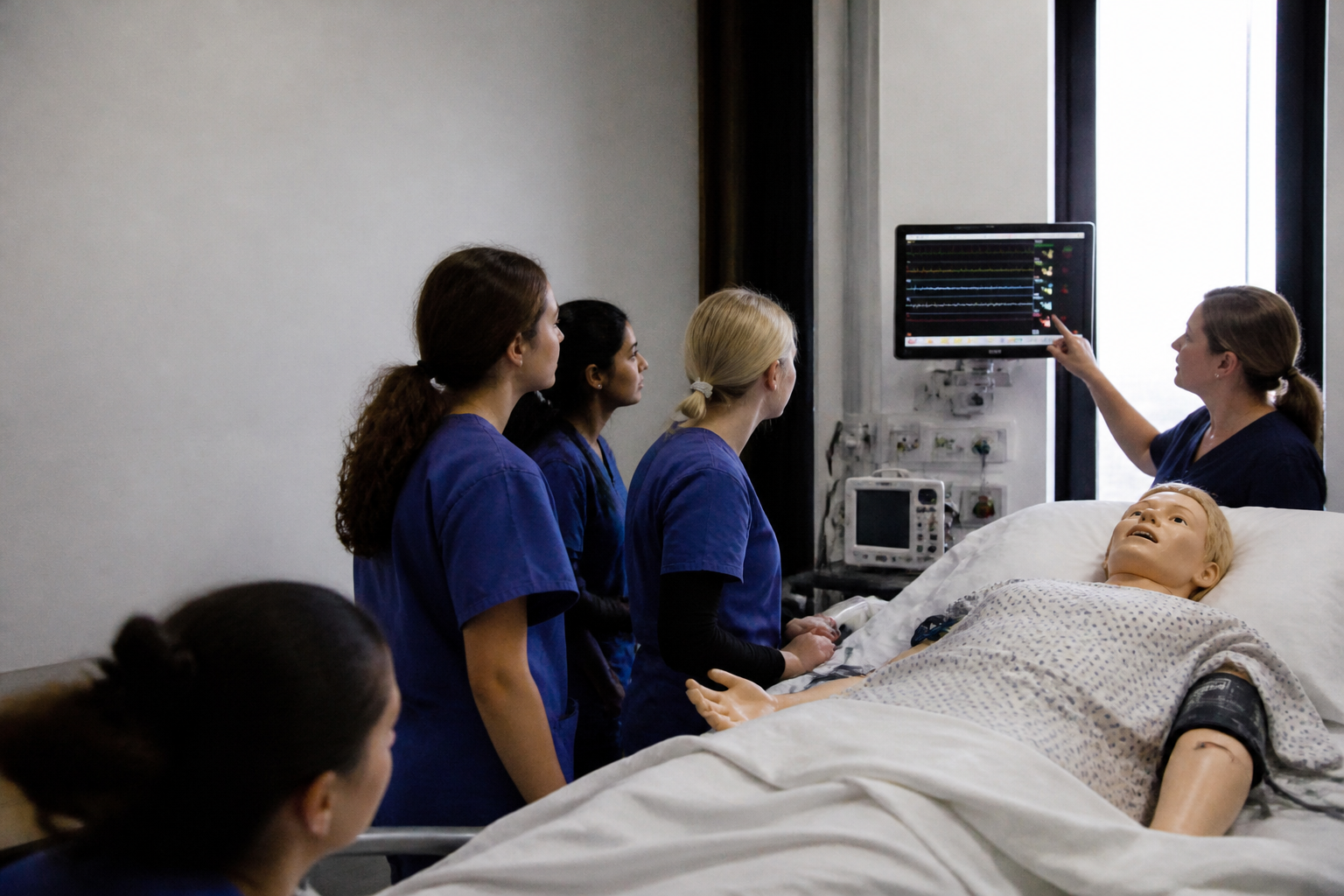
A traditional four-year BSN and an accelerated second-degree track end at the same credential; the difference is about two and a half years of full-time enrollment.
Accelerated programs compress the nursing major into 12 to 18 months of year-round study. The science prerequisites, anatomy, physiology, microbiology, chemistry, statistics, must be finished first, and those grades carry the most weight in admission.
Michigan options run from 15-month cohorts to 20-month schedules, on campus and hybrid, across Detroit, Flint, Ypsilanti, and West Michigan. The binding constraint is sequencing: a start date that fits the year you can step away from work.
Key Points
- Admission hinges on a prior non-nursing bachelor's plus completed science prerequisites.
- University of Michigan-Flint posts the lowest average net price: $7,007 a year.
- After graduating, expect a $212.90 Michigan RN application fee and the NCLEX-RN.
Best Accelerated BSN Schools in Michigan: The Full Ranked List
Ten Michigan universities currently enroll second-degree students into an accelerated BSN, and they differ sharply on length, delivery, and setting. Five finish in 16 months or less, three lean on online or hybrid coursework, and several sit within a short drive of downtown Detroit. Here is the full list, from East Lansing to Ypsilanti.
Michigan State University
#1East Lansing, MI · $16,000 – $44,000/yr (est.)
Best for: Second-degree students wanting two campus options
Michigan State runs its 16-month accelerated second degree BSN from two locations, East Lansing and Detroit, with a fall start and four full-time semesters. Coursework layers nursing science onto the biological, physical, and behavioral sciences students already studied, and recent graduates posted a 92% first-time NCLEX-RN pass rate in early 2025. The university graduates 81% of its students, and the Detroit site puts clinical work inside the state's largest hospital market.
- 16 months across four full-time semesters
- Fall start only
- Two campus locations: East Lansing and Detroit
- 92% first-time NCLEX-RN pass rate reported for early 2025
- Builds on prior learning in the sciences and humanities
- CCNE accredited
- Prepares students for NCLEX-RN licensure
University of Detroit Mercy
#2Detroit, MI · ~$15,000/yr (est.)
Best for: Detroit-area career changers needing hybrid classes
University of Detroit Mercy delivers its Second Degree Option BSN in a hybrid format across seven-week terms, finishing in 16 months with a cohort that moves through the program together. Admission asks for a letter of intent, a resume, and one recommendation, and the program holds monthly virtual information sessions for career changers weighing the move. The university graduates 67% of its students, and its Detroit campus sits in the middle of the metro hospital corridor.
- 16 months delivered in seven-week terms
- Hybrid format built on a cohort model
- Admission requires a letter of intent, resume, one recommendation
- Prerequisite coursework in sciences and liberal arts
- Monthly virtual information sessions
- Financial aid available
- CCNE accredited
Spring Arbor University
#3Spring Arbor, MI · ~$19,000/yr (est.)
Best for: Faith-motivated learners who need fully online study
Spring Arbor offers a 125-credit accelerated BSN in an online format, with a dedicated NCLEX review course built in and Christian faith integrated throughout the curriculum. Admission requires a 2.67 GPA and B-minus grades in the key sciences, which places the bar between the state's most and least selective programs. The university graduates 64% of its students overall. It appeals most to applicants who want the classroom portion at a distance.
- 125 total credit hours
- Accelerated online format for second bachelor's students
- 2.67 GPA minimum; B-minus required in key sciences
- Dedicated NCLEX review course included
- Christian faith integrated throughout the curriculum
- CCNE accredited
- International applicants must submit TOEFL scores
Wayne State University
#4Detroit, MI · ~$13,000/yr (est.)
Wayne State's second-career BSN is a campus-based, 20-month program of 65 credits with guaranteed clinical placement every semester and one start date a year in spring or summer. Clinicals run across Detroit's hospital systems, and a separate admission category supports veterans entering nursing. The university graduates 58% of its students and retains 83% into the second year.
- 20 months, 65 total credit hours
- One start date per year, spring or summer
- Guaranteed clinical placement each semester
- Clinical experiences across Detroit-area health systems
- 2.0 GPA minimum; bachelor's in another discipline required
- A grade below C blocks progression through the nursing sequence
- Separate admission category for veteran students
- Same campus-based accelerated BSN curriculum and clinicals
- CCNE accredited
Grand Valley State University
#5Allendale, MI · $15,000 – $20,000/yr (est.)
Grand Valley's accelerated second degree BSN is a face-to-face, 33-credit track based in Grand Rapids with three start dates a year, small cohorts, and academic advising built in. Applicants must already be admitted to GVSU as degree-seeking undergraduates before the track begins. The university graduates 67% of its students, and the program reports a 79% job placement rate for graduates.
- 33 nursing credits; completable in about 16 months
- Three start dates a year
- Face-to-face instruction with clinical practicums
- 2.7 GPA minimum; three prerequisites may be repeated, once each
- Merit-based scholarships available
- 79% job placement rate reported
- CCNE accredited
Oakland University
#6Rochester Hills, MI · $9,000/yr (est. net price)
Oakland University runs a four-semester accelerated BSN with three start dates a year at its main campus and West Center, and admission is holistic, weighing pre-nursing GPA, an essay, professional references, and a character assessment. A 3.0 GPA minimum keeps it among the more selective options in the state. The university graduates 58% of its students overall.
- Four-semester full-time track
- Three start dates a year: fall, winter, summer
- 3.0 GPA minimum
- Holistic review includes essay, references, character assessment
- Classes at the main campus and West Center
- Clinical experiences across Southeastern Michigan
- Scholarships available
Madonna University
#7Livonia, MI · $15,000 – $20,000/yr (est.)
Madonna's 16-month ABSN is hybrid, pairing online coursework with on-campus simulation labs and clinical rotations at metro Detroit healthcare facilities, with three start dates a year and no waitlist. It is designed for career changers and transfer students and is taught within a Catholic and Franciscan framework. The university graduates 60% of its students, and dedicated admissions representatives walk applicants through each step.
- 16 months, hybrid online and on-campus format
- Three start dates: January, May, August
- No waitlist for admitted students
- On-campus simulation labs plus clinical rotations
- Designed for career changers and transfer students
- Catholic and Franciscan values
- Dedicated admissions representative
University of Michigan-Flint
#8Flint, MI · $15,000 – $28,000/yr (est.)
The University of Michigan-Flint packs its accelerated second degree BSN into 16 months with a fall start and caps each cohort at 56 students, so admission is competitive. Students train in a dedicated nursing simulation center and complete clinical placements at local hospitals that often turn into job offers. The program reports a 95% first-time NCLEX-RN pass rate, and the university graduates 40% of its students overall.
- 16 months, fall start, cohort based
- Cohort capped at 56 students
- 95% first-time NCLEX-RN pass rate reported
- Nursing Simulation Center on campus
- Clinical placements at local hospitals
- Transfer scholarship for applicants with a 3.0 GPA or higher
- Automatic Go Blue Guarantee consideration for eligible Michigan residents
- CCNE accredited
Eastern Michigan University
#9Ypsilanti, MI · $15,000 – $20,000/yr (est.)
Eastern Michigan's second degree BSN runs 20 months across five semesters and 60 credits, entirely on campus, with clinical placements spread across a range of care settings. Prerequisites must be completed at 2.0 or better, which makes the academic bar one of the more accessible in the state. The university graduates 46% of its students overall, and graduates can continue into graduate study for nurse practitioner or administrative roles.
- 20 months across five semesters
- 60 total credit hours, on-campus delivery
- Prerequisite courses completed at 2.0 or better
- Clinical experience in varied care settings
- Scholarships and loans available
- Path to nurse practitioner and nurse executive roles
- CCNE accredited
Baker College
#10Owosso, MI · ~$13,000/yr (est.)
Baker College runs its accelerated BSN over about 15 months and 62 nursing credits at the Muskegon and Royal Oak campuses, each with high-fidelity simulation labs and dedicated nursing suites. Cohorts of 20 to 30 students complete acute, community, maternal-child, and mental health rotations plus a leadership practicum and capstone clinical. The university graduates 36% of its students overall. Admission requires a 2.0 cumulative GPA and B-minus grades in the science prerequisites.
- About 15 months, 62 nursing credits, full time
- Classes at the Muskegon and Royal Oak campuses
- High-fidelity simulation labs and nursing suites
- 2.0 cumulative GPA minimum; B-minus in science prerequisites
- Cohorts of 20 to 30 students
- Community health and leadership practicums plus capstone clinical
- All 62 nursing credits completed at Baker
- CCNE accredited
Cost & outcomes by school
Federal data for the highest-earning Accelerated BSN (ABSN) programs, independent of the ranking above. Earnings are this field's bachelor's graduates four years after completing where the Scorecard reports them, else the school's undergraduate median.
| School | Net price / yr | Grad rate | Earnings | Debt | Grads/yr | Format |
|---|---|---|---|---|---|---|
| University of Detroit Mercy MI | $15,232 | 67% | $71,030 | $23,250 | 2,162 | Hybrid |
| Michigan State University MI | $19,680 | 81% | $67,253 | $23,250 | 19,242 | Campus |
| Madonna University MI | $17,755 | 60% | $59,058 | $23,000 | 878 | Hybrid |
| Oakland University MI | $9,120 | 58% | $58,612 | $22,750 | 5,984 | Campus |
| Grand Valley State University MI | $16,317 | 67% | $56,118 | $24,500 | 9,312 | Campus |
| Wayne State University MI | $12,766 | 58% | $53,493 | $21,250 | 7,780 | Campus |
| University of Michigan-Flint MI | $7,007 | 40% | $53,230 | $25,000 | 1,998 | Campus |
| Eastern Michigan University MI | $15,407 | 46% | $51,793 | $25,000 | 5,086 | Campus |
| Spring Arbor University MI | $19,353 | 64% | $51,732 | $26,375 | 644 | Online |
| Baker College MI | $13,157 | 36% | $35,833 | $25,000 | 1,146 | Campus |
Sources: U.S. Department of Education. Net price, graduation rate, earnings and debt: College Scorecard (earnings and debt for this field's bachelor's graduates where reported, else school-wide); graduates: IPEDS. A dash means no figure is reported.
Cost, debt & payoff
Median earnings of this field's bachelor's graduates (4 yrs after completing, else the school's undergraduate median) vs. their median federal loan debt · U.S. College Scorecard
Across these programs the median graduate earns about $53,493 and finishes with roughly $23,250 in debt — a ratio that clears a common rule of thumb (keep debt below first-year salary). Net price and debt vary widely school to school, so check the per-school figures in the table above before you shortlist.
What Put These Programs on the List: Our ABSN Scoring Approach
Accelerated BSN admissions in Michigan have tightened as career changers crowd into nursing, which makes it worth knowing exactly what a program comparison rests on before you commit a year of tuition to one.
Only Second-Degree Programs Qualify
The starting filter is eligibility. A program earns a place on this list only if it is a genuine second-degree BSN, a route built for students who already hold a bachelor's in another field. Traditional four-year prelicensure BSNs, RN-to-BSN completion tracks, and graduate-entry pathways were set aside, even where they sit inside the same nursing school. That is why Spring Arbor's accelerated prelicensure track appears alongside Michigan State's 16-month cohort, and why several entries state plainly that a non-nursing bachelor's is required for admission. Each one has a verified program page describing the second-degree path.
Where the Numbers Come From
Net price, graduation rate, program-level earnings, and median debt come from federal College Scorecard and IPEDS reporting. Delivery format, meaning campus, hybrid, or online coursework, comes from each school's own nursing program page.
Read the Figures With Care
- Net price: an institution-wide average after aid, not a nursing-only figure.
- Graduation rate: describes the whole university, not the ABSN cohort.
- Earnings: windows vary by school, so a one-year figure and a four-year figure are not directly comparable.
Confirm current tuition, seat availability, and start dates directly with each nursing school before applying. Published figures lag the term you would actually enter.
Lowest-Cost Accelerated BSN Programs in Michigan
Ranked by average net price after aid in U.S. Department of Education IPEDS and College Scorecard data (2024), the most affordable accelerated BSN programs here start at $7,007 a year at University of Michigan-Flint, with Pell share showing how many undergraduates at each school receive Pell Grants. Net price is an institution-wide average for aided undergraduates, not a quote for an individual ABSN student. Nursing program fees, clinical placement costs, uniforms, and NCLEX-RN preparation can add to the total, so confirm current figures with each school's nursing office.
| School | City | Format | Program Length | Average Net Price After Aid | Pell Share |
|---|---|---|---|---|---|
| University of Michigan-Flint | Flint | On campus | 16 months | $7,007 | 66% |
| Oakland University | Rochester Hills | On campus | 4 semesters | $9,120 | 56% |
| Wayne State University | Detroit | On campus | 20 months | $12,766 | 68% |
| Baker College | Owosso | On campus | 15 months | $13,157 | 77% |
| University of Detroit Mercy | Detroit | Hybrid | 16 months | $15,232 | 49% |
Related Articles
What Michigan Accelerated BSN Programs Expect From Applicants
Michigan's accelerated BSN programs judge second-degree applicants on two things above all: a completed bachelor's in another field and the science courses you bring with it. Everything else is a tiebreaker.
The Degree and the GPA Floor
A regionally accredited bachelor's outside nursing is the entry ticket. Michigan State requires the degree finished by the end of the spring term before the program starts, with final transcripts due May 15, 2026 for a fall 2026 start. Madonna accepts either a full bachelor's degree, with a 2.8 minimum GPA, or 60 undergraduate credits at a 3.01. Michigan State sets a 2.75 cumulative GPA across every institution you have attended, and each prerequisite must land at 2.0 or better; up to 12 credits of prerequisite or general education coursework can be used to lift a weak GPA before you apply.
Other programs sit at different points on that scale. Grand Valley State lists 2.7, Oakland asks for 3.0, and Baker College sets 2.0 overall while requiring a B- or better in nursing courses. Spring Arbor also expects a B- in the sciences.
Science Prerequisites and Recency
Expect anatomy and physiology I and II, microbiology, chemistry, statistics, and a human development or nutrition course. UM-Flint names microbiology, anatomy, physiology, developmental psychology, and essential nutrition, and may require up to two semesters of pre-nursing work depending on your background. Science coursework usually has a shelf life, so ask each program what window it enforces; a course taken eight years ago may need to be retaken. Michigan State wants any coursework taken elsewhere approved for transfer before you apply.
Tests, Extras, and Courses Still in Progress
Entrance exam policy is set program by program, so confirm directly whether TEAS or HESI A2 applies to you rather than assuming. Madonna adds a writing assessment and a letter of intent1; University of Detroit Mercy asks for a letter of intent and a resume; Oakland reviews applicants holistically. UM-Flint admits by January 15 for its fall cohort and starts students as pre-nursing before a direct application to the nursing major, which gives you room to finish a prerequisite or two on campus.
Map Before You Register
Pull the prerequisite lists for two or three target programs side by side and check your transcript course by course before you enroll in anything new. The gap you find decides what you take next, and it may save you from repeating chemistry twice.
What Registered Nurses Earn in Michigan
This is the statewide wage for working RNs across all employers and experience levels. It is not what graduates of any one program earn.
3 to 18 Months Full Time: Accelerated BSN Tuition, Fees, and Aid in Michigan
An accelerated BSN in Michigan is a full-time job you pay tuition to hold, and the calendar is the single biggest cost most applicants underestimate.
The Pace: Back-to-Back Semesters, Summer Included
Most of these programs cluster around 16 months. Michigan State's Accelerated Second Degree BSN runs 16 months of full-time study, University of Michigan-Flint's covers 16 months across four semesters, and Detroit Mercy and Madonna both describe 16-month tracks. Baker College lists 15 months, and Oakland University uses a four-semester sequence. At the longer end, Wayne State's BSN Second Career/Degree and Eastern Michigan's Second Degree BSN are both described as roughly 20 months. Semesters run consecutively with no summer off, and clinical blocks are scheduled around hospital needs rather than yours. Nursing faculty routinely discourage outside employment during these programs, and that lost income belongs in your budget alongside tuition.
Sorting Out Which Price Tag Is Which
Three different numbers get thrown around, and they are not interchangeable. The first is program tuition: Michigan State publishes $898 per credit for residents across 61 credits, which works out near $54,800 in tuition alone, before fees and taxes. Madonna has been quoted around $1,112 per semester hour, roughly $58,936 in total, though what that figure includes is not fully spelled out. UM-Flint has carried a published program figure of $27,108, but the official material does not make clear whether that covers tuition only or tuition plus fees, so treat it as indicative.
The second number is the annual published undergraduate rate shown in the ranking, which measures something else entirely: $14,236 in-state at UM-Flint, $16,159 at Wayne State, $13,000 at Baker College, and $28,440 at Madonna, a private university with a single rate. The third is average net price after aid across all undergraduates, from about $7,007 at UM-Flint to $19,680 at Michigan State. None of these capture clinical and lab fees, simulation charges, uniforms, background checks, immunizations, liability insurance, parking, or NCLEX review materials. Budget for those separately.
Aid When You Already Hold a Degree
Federal Pell grants are generally off the table once you have a bachelor's degree, which reshapes the whole plan. Federal Direct unsubsidized borrowing at undergraduate limits usually remains available, with PLUS or private loans covering gaps. School awards still apply: UM-Flint gives admitted students automatic consideration for the Go Blue Guarantee and offers a $5,000 transfer scholarship at a 3.0 GPA, though you should confirm how a prior degree affects eligibility. The federal Nurse Corps Scholarship covers tuition, fees, and other educational costs for full-time BSN students who commit to two years at a critical shortage facility, while Nurse Corps Loan Repayment works the same way after graduation. Michigan's State Loan Repayment Program offers up to $300,000 tax-free, spread over as many as 10 years, for selected clinicians at qualifying sites; verify current eligibility rules. The NURSES Grant that funded rural clinical travel ended in 2026 with no confirmed successor.
From Prerequisites to RN License: The Michigan ABSN Timeline
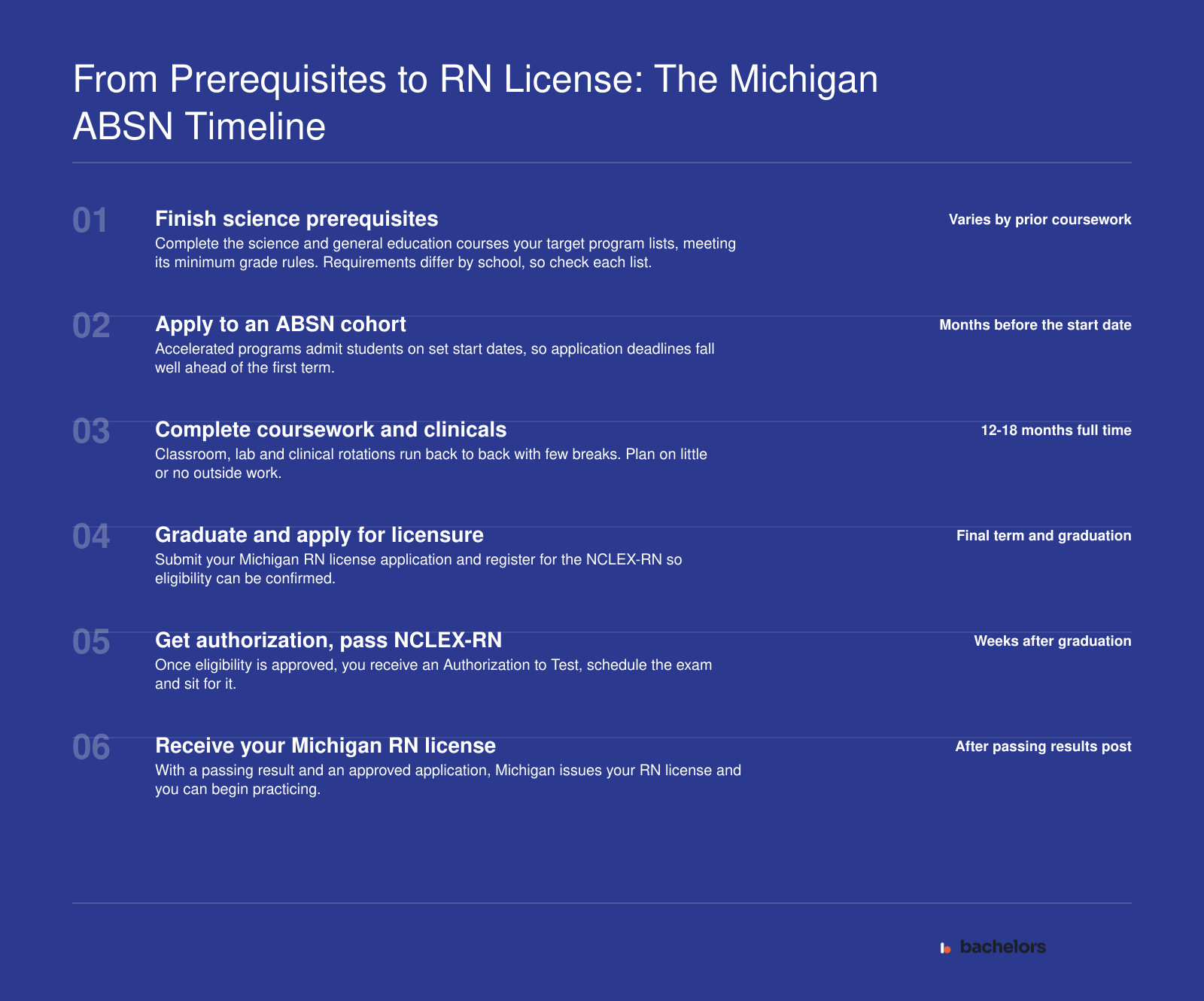
Most of the time from application to an RN license goes to the accelerated BSN itself: 12 to 18 months of full-time study, followed by a shorter licensing stretch after graduation. Prerequisites and the admissions cycle add time up front, depending on how much science coursework your first bachelor's already covers.
Michigan Board of Nursing Approval and the NCLEX-RN Path for ABSN Graduates
The Michigan RN application fee is $212.90, and paying it only helps if your degree comes from a program the state recognizes. For graduates of Michigan schools, that means a program approved by the Michigan Board of Nursing, which operates under the Department of Licensing and Regulatory Affairs (LARA). The Board approves programs under the Public Health Code and the Nursing General Rules, and LARA publishes a list of approved education programs. Check that any ABSN you are considering appears on it.
Board Approval vs. National Accreditation
Accreditation from CCNE or ACEN is a separate credential from state approval, and it does not stand in for Board approval. Treat the two as complementary checks. Approval governs your path to licensure. National accreditation is an independent quality review that employers and graduate schools often look for. Michigan's licensing rule also recognizes CASN-accredited programs as an eligibility route, so confirm the details with LARA if your situation is unusual.
Licensure Steps as the State Publishes Them
- Apply through MiPLUS: Submit the LARA application and fee after your program confirms you qualify.
- Social Security number: One is required on the application.
- Fingerprint background check: This applies to initial licensure.
- Required training: Human-trafficking and implicit-bias training are both required. Confirm current hours and approved formats with LARA.
- Verification of prior licenses: If you have held a nursing license in another state or country, arrange for it to be verified directly to the Board.
- NCLEX-RN registration: This is separate from your state application. You register with Pearson VUE and must receive an Authorization to Test before you can schedule the exam.
Reading NCLEX-RN Pass Rates
Ranking data for these schools does not include NCLEX-RN pass rates, so use the Board's own report instead. Its 2025 NCLEX Program Summaries, last updated January 14, 2026, report first-time takers, repeaters, and pass rates by program. Look at the number of test-takers behind each rate, since small cohorts swing widely. Board minutes refer to an 80% benchmark in the NCLEX Improvement Plan process, but that is a review trigger for programs, not a requirement for you to be admitted, graduate, or get licensed.
Working Outside Michigan
Michigan is not currently a Nurse Licensure Compact member. House Bill 4246 passed the House in June 2025 and was pending in the Senate in 2026. Until it becomes law, a Michigan RN license does not carry multistate privileges. If you plan to practice elsewhere, expect to apply for licensure in that state.
Michigan RN Licensure at a Glance
Accelerated BSN in Michigan: Answers Before You Dig Deeper
These answers cover the questions career changers ask most when comparing Michigan second-degree nursing options. Deadlines and start terms change by cycle, so confirm final dates on each school's official ABSN page before you plan.
How long does an accelerated BSN take to finish in Michigan?
What do Michigan accelerated BSN programs require for admission?
How much does an accelerated BSN cost in Michigan?
Can I earn an accelerated BSN in Michigan mostly online?
Which Michigan accelerated BSN programs report the highest NCLEX-RN pass rates?
When do Michigan ABSN cohorts start, and how far ahead should I apply?
How is an accelerated BSN different from other second-degree nursing routes in Michigan?
Are there accelerated BSN options near Detroit?
Compare Accelerated BSN (ABSN) programs on the data that matters
Explore more Nursing majors or browse every field of study.
All Nursing programs Browse every field of study