Best BSN Programs in Michigan
Compare 42 accredited Bachelor of Science in Nursing (BSN) programs in Michigan at 32 colleges, with net price after aid, graduation rates, earnings and debt from IPEDS and the U.S. College Scorecard.

A Michigan BSN is a four-year nursing degree, but the degree alone does not let anyone work as a nurse. Graduates must pass the NCLEX-RN and hold a state license before a hospital can hire them as a registered nurse, so exam results come first. The schools ranked here run traditional pre-licensure BSN programs.
Strong pass rates, affordable tuition and easy admission rarely line up at one school. Hope College, for example, limits its nursing cohort to 45 students a year, so a strong exam record can still come with a narrow door.
Key Points
- University of Michigan-Flint BSN graduates report the highest first-year earnings here.
- Filing the FAFSA unlocks Michigan Achievement Scholarship aid for nursing students.
- Graduates apply for RN licensure by examination through LARA's MiPLUS portal.
Michigan BSN Schools Ranked by NCLEX-RN Outcomes: Our Top 10
The order below follows one question: how often a school's BSN graduates pass the NCLEX-RN on their first attempt. Recent state board results carry the most weight, with test-taker volume, accreditation and completion rates settling close calls. Each card also gives you net price after aid and the institution-wide graduation rate, so you can weigh exam results against what the degree is likely to cost.
University of Michigan
#1Ann Arbor, MI · $18,000 – $61,000/yr (est.) · NCLEX-RN pass rate 95.8% (3-yr weighted avg)
Best for: Academic high-achievers eyeing research hospitals
The University of Michigan in Ann Arbor runs one of the state's most selective pre-licensure BSN routes, with a four-year track for first-year applicants and a three-year path for sophomore transfers, plus about 1,000 clinical hours that begin in the sophomore year. Net price after aid is about $13,138, and the school has a graduation rate of 93%. Nursing is CCNE accredited, and the first-time NCLEX-RN pass rate is 95.8% across 541 test takers in the latest three-year window.
- Four-year track for first-year applicants, three-year for sophomore transfers
- About 1,000 supervised clinical hours
- Clinical rotations begin in the sophomore year
- Honors program and global study abroad options
- CCNE accredited
Hope College
#2Holland, MI · $27,000/yr (est. net price) · NCLEX-RN pass rate 94.8% (3-yr weighted avg)
Best for: Small-cohort learners wanting close faculty mentorship
Hope College is a private liberal arts college in Holland that caps its BSN cohort at roughly 45 students a year, which keeps clinical groups and advising small. Net price after aid is about $27,182, and the school has a graduation rate of 80%. The nursing program is CCNE accredited, and the first-time NCLEX-RN pass rate is 94.8% among 131 test takers.
- Cohort limited to about 45 students per year
- 3.2 GPA minimum plus prerequisite science courses
- At least 500 clinical hours in diverse settings
- Two application deadlines: February 1 and October 1
- Double majors and minors in psychology or languages
Saginaw Valley State University
#3University Center, MI · $10,000 – $15,000/yr (est.) · NCLEX-RN pass rate 95% (3-yr weighted avg)
Best for: In-state students seeking a low net price
Saginaw Valley State University in University Center graduates one of the larger BSN cohorts on this list, with 378 first-time NCLEX-RN test takers in the latest three-year window. Net price after aid is about $10,775, the lowest among the public universities ranked here, and the school has a graduation rate of 48%. The program is CCNE accredited with a first-time pass rate of 95%.
- 124 total credit hours
- Two start dates per year, fall and winter
- 3.0 GPA minimum plus prerequisite courses
- Freshman direct admission option available
- Simulation labs and clinical placements at regional medical centers
Calvin University
#4Grand Rapids, MI · $23,000/yr (est. net price) · NCLEX-RN pass rate 93% (3-yr weighted avg)
Calvin University is a private Christian college in Grand Rapids whose nursing students complete clinical work at area hospitals including Helen DeVos Children's Hospital and Trinity Health. Net price after aid is about $22,992, and the school has a graduation rate of 74%. Nursing is CCNE accredited, and the first-time NCLEX-RN pass rate is 93% among 208 test takers.
- Clinical placements at Grand Rapids hospitals and community sites
- Early admission option for incoming students
- Study abroad and underserved-population perspectives
- Tuition assistance through a Pine Rest partnership
- CCNE accredited
Lake Superior State University
#5Sault Ste Marie, MI · ~$13,000/yr (est.) · NCLEX-RN pass rate 91.8% (3-yr weighted avg)
Lake Superior State University in Sault Ste. Marie starts students in a pre-nursing foundation year before they move into the clinical nursing sequence, so admission to the major comes after the first year. Net price after aid is about $12,822, and the school has a graduation rate of 51%. Nursing is CCNE accredited, and the first-time NCLEX-RN pass rate is 91.8% among 110 test takers.
- Pre-nursing track before the clinical sequence
- Clinical admission required after the first year
- TEAS testing resources available to applicants
- BSN student handbook documents progression rules
- CCNE accredited
Jackson College
#6Jackson, MI · $8,000/yr (est. net price) · NCLEX-RN pass rate 91.8% (3-yr weighted avg)
Jackson College in Jackson appears on state board approval records as a BSN program and posts the lowest published net price in this group at about $7,761. The school has a graduation rate of 16%, a figure measured across all of its credentials rather than the nursing bachelor's alone. Its first-time NCLEX-RN pass rate is 91.8% among 162 test takers, the same rate as several larger universities here.
- Listed on state board approval records as a BSN program
- Lowest published net price among the ten schools ranked here
Northern Michigan University
#7Marquette, MI · $14,000 – $20,000/yr (est.) · NCLEX-RN pass rate 91.3% (3-yr weighted avg)
Northern Michigan University in Marquette admits students into a 121-credit BSN that takes roughly two and a half years once the nursing sequence starts, with a simulation lab and small classes. Net price after aid is about $14,085, and the school has a graduation rate of 52%. Nursing is CCNE accredited, and the first-time NCLEX-RN pass rate is 91.3% among 234 test takers.
- 121 total credit hours
- About two and one-half years in the nursing sequence
- 2.8 GPA minimum plus prerequisite courses
- Two start terms, fall and winter
- Simulated learning lab and small clinical groups
Ferris State University
#8Big Rapids, MI · ~$9,000/yr (est.) · NCLEX-RN pass rate 90.7% (3-yr weighted avg)
Ferris State University in Big Rapids structures its pre-licensure BSN as a five-semester professional sequence that begins after prerequisite coursework, with small cohort sizes and clinicians as instructors. Net price after aid is about $8,624, and the school has a graduation rate of 47%. Nursing is CCNE accredited, and the first-time NCLEX-RN pass rate is 90.7% among 184 test takers.
- Five-semester professional sequence after prerequisites
- Coursework covers medical-surgical, obstetric, pediatric and critical care
- Small cohort sizes with clinician instructors
- Graduates eligible to sit for the NCLEX-RN
- CCNE accredited
Grand Valley State University
#9Allendale, MI · $15,000 – $20,000/yr (est.) · NCLEX-RN pass rate 90.4% (3-yr weighted avg)
Grand Valley State University in Allendale produces the largest testing pool in this ranking, with 735 first-time NCLEX-RN candidates over the latest three years, and places clinical rotations on Grand Rapids' Medical Mile. Net price after aid is about $16,317, and the school has a graduation rate of 67%. Nursing is CCNE accredited, and the first-time pass rate is 90.4%.
- 136 total credit hours
- Five semesters of clinical rotations
- Cohort-based structure with two start dates per year
- 3.0 GPA minimum plus prerequisite courses
- Clinical sites on Grand Rapids' Medical Mile
University of Michigan-Flint
#10Flint, MI · $15,000 – $28,000/yr (est.) · NCLEX-RN pass rate 90.3% (3-yr weighted avg)
The University of Michigan-Flint offers a traditional BSN with a direct admit option for high school seniors, a simulation center, and clinical placements across the Flint area. Net price after aid is about $7,007, the lowest of the four-year universities ranked here, and the school has a graduation rate of 40%. Nursing is CCNE accredited, and the first-time NCLEX-RN pass rate is 90.3% among 357 test takers.
- Direct admit option for high school seniors
- Two start dates per year, fall and winter
- 3.0 GPA minimum plus prerequisites
- Simulation center and area clinical placements
- NCLEX-RN preparation built into the curriculum
Cost & outcomes by school
Federal data for the highest-earning Bachelor of Science in Nursing (BSN) programs, independent of the ranking above. Earnings are this field's bachelor's graduates four years after completing where the Scorecard reports them, else the school's undergraduate median.
| School | Net price / yr | Grad rate | Earnings | Debt | Grads/yr | Format |
|---|---|---|---|---|---|---|
| Chamberlain University-Michigan MI | $28,045 | 100% | $92,405 | $20,919 | 278 | Hybrid |
| University of Michigan MI | $13,138 | 93% | $83,648 | $19,500 | 20,096 | Campus |
| Michigan Technological University MI | $14,182 | 68% | $78,198 | $24,990 | 2,674 | Campus |
| University of Detroit Mercy MI | $15,232 | 67% | $71,030 | $23,250 | 2,162 | Campus |
| Lawrence Technological University MI | $32,918 | 61% | $69,151 | $27,000 | 742 | Campus |
| Michigan State University MI | $19,680 | 81% | $67,253 | $23,250 | 19,242 | Campus |
| Madonna University MI | $17,755 | 60% | $59,058 | $23,000 | 878 | Campus |
| Oakland University MI | $9,120 | 58% | $58,612 | $22,750 | 5,984 | Campus |
| Hope College MI | $27,182 | 80% | $58,427 | $26,800 | 1,846 | Campus |
| Calvin University MI | $22,992 | 74% | $58,375 | $23,250 | 1,714 | Campus |
| Siena Heights University MI | $17,124 | 39% | $57,529 | $18,750 | 930 | Campus |
| Grand Valley State University MI | $16,317 | 67% | $56,118 | $24,500 | 9,312 | Campus |
Sources: U.S. Department of Education. Net price, graduation rate, earnings and debt: College Scorecard (earnings and debt for this field's bachelor's graduates where reported, else school-wide); graduates: IPEDS. A dash means no figure is reported.
Cost, debt & payoff
Median earnings of this field's bachelor's graduates (4 yrs after completing, else the school's undergraduate median) vs. their median federal loan debt · U.S. College Scorecard
Across these programs the median graduate earns about $53,528 and finishes with roughly $24,745 in debt — a ratio that clears a common rule of thumb (keep debt below first-year salary). Net price and debt vary widely school to school, so check the per-school figures in the table above before you shortlist.
What This Michigan BSN List Covers: Pre-Licensure Programs Only
A BSN for a student with no nursing license looks nothing like a BSN for a nurse who already holds one.
What Counts as a Traditional Pre-Licensure BSN
A traditional pre-licensure BSN is a four-year bachelor's for students who hold no RN license. Coursework and supervised clinical hours prepare you for the NCLEX-RN and for a Michigan license application.
Two other routes sit outside this list. RN-to-BSN programs serve nurses who already hold a license; accelerated BSN programs serve students who already have a bachelor's in another field. Both have their own pages on bachelorsprograms.com, and neither is ranked here.
Why First-Time NCLEX-RN Results Matter
The first-time pass rate shows how often a program's graduates cleared the licensing exam on their first attempt. It is the closest public signal that a program's curriculum and clinical hours lead to a license and a job, which is why the ranking above leans on it.
On-Campus Delivery
Every school ranked here delivers its bachelor's in nursing on campus in Michigan. The University of Michigan lists a campus program with clinical rotations beginning in the sophomore year, while Gogebic Community College lists a hybrid format that blends in-person and online instruction.
Most Affordable BSN Programs in Michigan by Net Price
Average net price is the institution-wide figure the U.S. Department of Education reports in its 2024 IPEDS and College Scorecard data for what students pay after grants and scholarships, so treat it as an approximate benchmark rather than a quote for your own bill. Comparing it with each school's published in-state tuition shows how much aid typically closes the gap. At the University of Michigan-Flint, for example, $14,236 in tuition drops to an average net price of $7,007. Saginaw Valley State University is the standout value among these lower-cost options because it pairs a $10,775 average net price with a 95% NCLEX-RN pass rate, while UM-Flint and Jackson College combine the lowest costs here with pass rates above 90%.
| School | City | Average Net Price After Aid (Institution-Wide) | Published In-State Tuition | NCLEX-RN Pass Rate |
|---|---|---|---|---|
| University of Michigan-Flint | Flint | $7,007 | $14,236 | 90.3% |
| Jackson College | Jackson | $7,761 | $8,310 | 91.8% |
| Ferris State University | Big Rapids | $8,624 | $14,778 | 90.7% |
| Oakland University | Rochester Hills | $9,120 | $17,167 | 85.3% |
| Saginaw Valley State University | University Center | $10,775 | $12,930 | 95% |
Related Articles
How Much Does a BSN Cost in Michigan?
Sticker price is one of the least reliable numbers in comparing Michigan nursing programs, because almost no one pays it. Published in-state tuition and fees at the public universities ranked here run from roughly $7,350 at Jackson College to about $17,736 at the University of Michigan, with most of the regional publics clustered between $12,900 and $15,500. The private colleges on this list post far higher numbers: Hope College and Calvin University both list tuition near $39,000 to $42,000 per year.
Why Net Price Tells a Truer Story
Net price is what students actually pay on average after grants and scholarships are subtracted, and it changes which schools look affordable. The University of Michigan's average net price is around $13,138, below its published tuition. Ferris State averages roughly $8,624 and University of Michigan-Flint about $7,007, both well under their listed rates. On the private side, Calvin's average net price falls to roughly $22,992 and Hope's to about $27,182, which narrows the public-private gap considerably even though it does not erase it. Institutional aid does most of the work at the private colleges; federal and state grants do more at the publics with high Pell enrollment.
Nursing-Specific Costs the Averages Miss
Net price figures cover tuition, fees, housing and books. They do not isolate what nursing majors pay once they enter the clinical sequence. Oakland University, for example, charges $713.25 per upper-division nursing credit and $608.00 for lower-division coursework, and tells students that travel to clinical sites is their own responsibility. Wayne State lists a $50 application fee for its BSN.1 Budget separately for:
- Clinical and lab fees: simulation center charges and course fees tied to the professional sequence.
- Uniforms and equipment: scrubs, stethoscope, shoes.
- Compliance costs: background checks, drug screens, immunization records, CPR certification.
- Licensure prep: NCLEX review materials, plus the exam and licensure application fees.
Check each school's bursar and nursing department cost pages, since these line items are published separately from general tuition.
One Practical Step
Run the net price calculator on each school's financial aid site before you rule anything out. A published average describes last year's freshman class as a whole, not your family's income, your residency status or your scholarship offer. The calculator gets you closer to a real number.
Which Michigan State Aid Programs Can Lower Your BSN Bill?
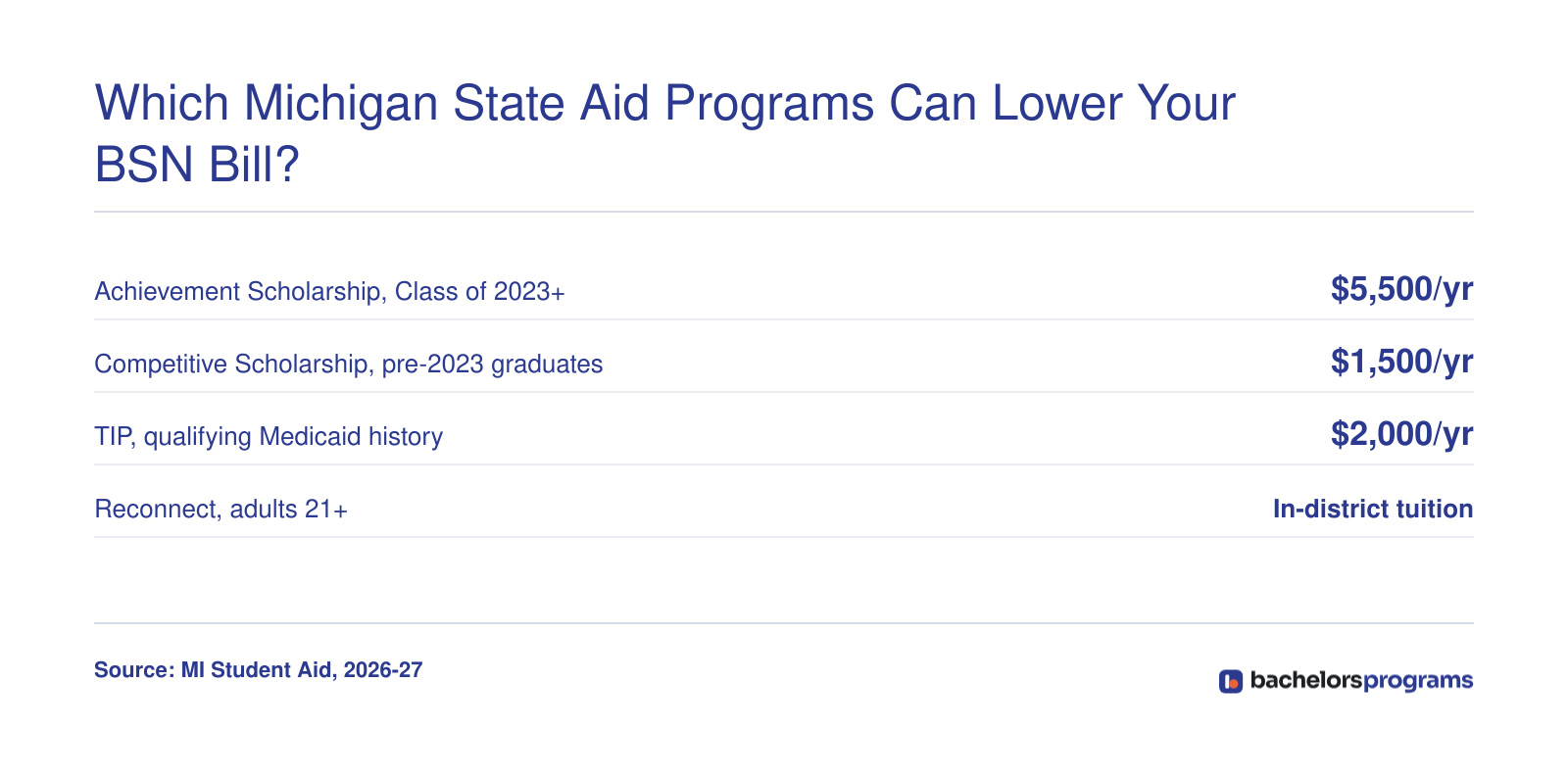
File the FAFSA first: it is the gateway to every Michigan state aid program below, according to MI Student Aid. The Achievement Scholarship serves Class of 2023 and later graduates with a Student Aid Index of 30,000 or less, paying up to $27,500 total over five years. The Competitive Scholarship now serves only earlier graduates with an SAT score of 1200 or higher, TIP serves students with qualifying Medicaid history, and Reconnect pays community college tuition for adults 21 and older who want to finish nursing prerequisites before transferring into a BSN.
First-Year Pay for Michigan BSN Graduates
Among the schools ranked here, University of Michigan-Flint's traditional BSN graduates report the highest first-year earnings.
Michigan Board of Nursing Approval and NCLEX-RN Licensure
What State Approval Means
LARA's September 3, 2026 list of approved nursing programs sorts Michigan RN programs into four credential types: BSN, ADN, diploma and PN-to-RN. That list matters: the Michigan Board of Nursing, which operates under the Department of Licensing and Regulatory Affairs (LARA), licenses only graduates of approved programs. Finishing an approved program is what qualifies you for the NCLEX-RN, the national exam from NCSBN that the Board adopts.1
Approval is not a one-time stamp. New programs can seek full approval after their second graduating cohort and must do so by the fourth, with NCLEX results that meet the standard in Michigan rule R 338.10310.1 After that, the Board reviews enrollment, completion and NCLEX data. It can require improvement plans when results slip, must approve major changes (sometimes with a site visit), and can remove programs from the list. Before you enroll, confirm your school appears on LARA's current list.
Approval vs. Accreditation
State approval and national accreditation are separate. Accreditation comes from a national body, either the Commission on Collegiate Nursing Education (CCNE) or the Accreditation Commission for Education in Nursing (ACEN). Approval lets you test for a Michigan license. Accreditation is what many graduate nursing programs, and some employers, look for. If a master's or doctorate might be in your future, check both before you commit.
Reading NCLEX-RN Pass Rates
The pass rates in the ranking above count first-time test-takers only, averaged over three years and weighted by how many graduates tested each year. That smooths out a single unusually good or bad year, but cohort size still matters. When a small group tests, a handful of results can move the rate several points from one year to the next, while a large program's figure tends to hold steadier. Read each rate alongside program size rather than as a standalone score.
Michigan Application Details
When you apply for your license, LARA expects:
- Recent education: a three-year education recency requirement applies, so plan to test and apply soon after graduation.
- Transcripts: sent directly from your nursing school.
- Certification form: a nursing school certification form, when applicable.
Michigan RN Licensure at a Glance
How to Choose a Michigan BSN School That Fits Your Priorities
The right Michigan BSN program is the one that matches your top priority, and each priority leads somewhere different.
If NCLEX-RN Results Come First
Shortlist the schools at the top of the ranking, then look at how steady each school's results have been rather than relying on a single figure. A program that holds a strong pass rate from one cohort to the next tells you more than one that spiked once.
If Cost Comes First
Start with the affordable sub-list, then confirm what nursing adds on top of tuition: program fees, uniforms, clinical supplies, and testing charges. Next, check whether you qualify for Michigan state aid, since eligibility rules can change what you owe at a given school.
If Admission Odds Matter
Separate direct-admit schools from upper-division programs. Direct admit can secure your nursing seat as a first-year student, while upper-division entry means competing for places after prerequisites. Compare your GPA against each school's published minimum, and treat a minimum as a floor, not a promise. Where a school publishes no clear policy, plan on contacting the admissions office.
Location and Clinical Partners
Commute and hospital access shape daily life for four years. A program in Ann Arbor, Holland, Flint, or Ironwood puts you in very different clinical settings, from large academic medical centers to small regional hospitals. Think about where you want to be placed for rotations and whether you could live comfortably within reach of those sites.
Your Next Step
Request a net price estimate from two or three schools you are seriously considering, then visit each one. Ask to see the simulation labs, meet current students, and learn how clinical placements are assigned. Comparing real cost and real campus feel will narrow the field faster than any list can.
Michigan BSN Programs: Your Questions Answered
These answers cover the questions Michigan nursing applicants ask most often, from NCLEX-RN results to admissions and transfer credit. Admission rules vary by school, so confirm current details on each program's admissions page before you apply.
Which Michigan school is the strongest choice for a BSN based on NCLEX-RN results?
Which Michigan BSN programs post the highest NCLEX-RN pass rates?
What GPA do competitive Michigan BSN programs expect?
Can you start a BSN in Michigan without finishing prerequisites first?
Do Michigan BSN programs require the TEAS or HESI exam?
Is an upper-division BSN harder to get into than a direct-admit program in Michigan?
Do Michigan community college credits transfer into a four-year BSN?
What happens if a Michigan BSN graduate fails the NCLEX-RN on the first try?
Compare Bachelor of Science in Nursing (BSN) programs on the data that matters
Explore more Nursing majors or browse every field of study.
All Nursing programs Browse every field of study