Best RN to BSN Programs in Michigan
Compare 19 accredited RN to BSN programs in Michigan, with net price after aid, graduation rates, earnings and debt from IPEDS and the U.S. College Scorecard.

Can a Michigan nurse with an ADN or diploma and an active RN license finish a BSN without cutting back shifts? At every school ranked here, yes: each program is delivered fully online, and hybrid formats are excluded.
Cost is where the programs diverge. Average net prices after aid run from under $9,000 at Ferris State University to more than $28,000 at Chamberlain University-Michigan. The credits a school awards for your license and associate coursework push the final bill further still.
Employers increasingly list the BSN as a requirement or preference for leadership, education and Magnet-track roles, so the degree now shapes who gets considered.
Key Points
- University of Michigan-Flint is cheapest here, at $7,007 net after aid.
- Michigan State University grants licensed RNs 30 credits on entry.
- After ADN credits transfer, most Michigan programs leave 30 to 40 credits.
The 10 Best Fully Online RN to BSN Schools in Michigan
A working nurse comparing RN to BSN programs in Michigan usually weighs the same few things: whether the coursework fits around three 12-hour shifts a week, how many credits the school hands back for an associate degree and an active license, and what the bill looks like after employer tuition help. Every program below is delivered fully online, with no hybrid or on-campus coursework required, and each card reflects a mix of cost, completion, and program fit rather than a single metric.
Chamberlain University-Michigan
#1Troy, MI · ~$28,000/yr (est.)
Best for: Experienced nurses seeking credit for licensure
Chamberlain University-Michigan in Troy is a nursing-focused institution, and its RN to BSN is built around the Chamberlain College Articulation Plan, which converts an active RN license into as many as 77 proficiency credits. Coursework is fully online with experiential learning activities, and year-round full-time enrollment can finish the 122-credit degree in as few as three semesters. A leadership foundations certificate is open to graduates who want to keep building credentials.
- 122 total credit hours, including up to 77 proficiency credits
- Active U.S. RN licensure converts to 37 general education and 40 nursing credits
- Year-round full-time enrollment can finish in as few as 3 semesters
- All coursework is 100 percent online with experiential learning activities
- Capstone course plus practicum evaluated by preceptors and faculty
- Leadership foundations certificate available to BSN graduates
Michigan State University
#2East Lansing, MI · $16,000 – $44,000/yr (est.)
Best for: Community college transfers wanting a defined pathway
Michigan State University is a large research campus in East Lansing, and the school has a graduation rate of 81%. Its CCNE-accredited RN to BSN grants 30 credits for an active RN license and holds transfer partnerships with six Michigan community colleges, including Henry Ford, Lansing, Macomb, Muskegon, Oakland, and St. Clair County. Students can start summer coursework while finishing an associate degree, then complete a scholarly project and a leadership immersion experience.
- CCNE accredited
- Active RN license grants 30 credits toward the BSN
- Transfer partnerships with six Michigan community colleges
- Summer enrollment lets students start before the ADN is finished
- Scholarly Project Seminar and Leadership Immersion required
- Two start dates per year, fall and spring
- Background check and drug screen required
Andrews University
#3Berrien Springs, MI · $10,000 – $15,000/yr (est.)
Best for: Nurses who want a faith-integrated nursing curriculum
Andrews University in Berrien Springs is a Seventh-day Adventist institution that threads a faith-based perspective through its nursing curriculum, and the school has a graduation rate of 72%. Its RN to BSN accepts up to 92 transfer credits, so licensed nurses may need as few as 32 new credits, and three start terms a year keep admission flexible. Coursework is fully asynchronous, and Southwestern Michigan College ADN graduates have a defined pathway into the program.
- Up to 92 transfer credits toward a 120-credit BSN
- As few as 32 new credits after an associate degree in nursing
- Tuition of $490 per credit plus a $165 distance degree fee per semester
- Three start terms a year: August, January, and May
- Fully asynchronous online classes with no entrance exam
- College transfers into Andrews' online BSN after earning the ADN
- Prepares graduates for graduate-level nursing study
Oakland University
#4Rochester Hills, MI · $9,000/yr (est. net price)
Oakland University in Rochester Hills runs a CCNE-accredited RN to BSN with one flat program tuition of $9,995 and no fees, and the school has a graduation rate of 58%. The 32-credit sequence is delivered 100% online and can be finished in as few as 12 months of full-time study. Admission runs once a year in fall with a limited cohort, so the June 1 priority deadline matters.
- CCNE accredited
- $9,995 total program tuition with no fees
- 32 credit hours, completable in as few as 12 months
- 100% online delivery in a full-time cohort
- Admits once a year in fall, limited to about 70 seats
- Priority application deadline of June 1
- Valid RN license and 2.5 GPA required
Grand Valley State University
#5Allendale, MI · $15,000 – $20,000/yr (est.)
Grand Valley State University in Allendale takes a competency-based approach, and the school has a graduation rate of 67%. Its Kirkhof College of Nursing RN to B.S.N. runs part-time and fully online, awards up to 32 prior learning credits for an unencumbered license, and requires 120 total semester hours with the last 30 at GVSU. Concurrent enrollment agreements with Jackson College, Kirtland, Muskegon, and Northwestern Michigan colleges let ADN students begin BSN coursework early.
- CCNE accredited
- Competency-based curriculum delivered part-time and fully online
- Up to 32 prior learning credits for an unencumbered RN license
- 120 total credits, with the final 30 completed at GVSU
- Senior nursing sequence spans three semesters with a capstone
- Concurrent enrollment agreements with four Michigan community colleges
- Background check, fingerprinting, and drug screen required
Western Michigan University
#6Kalamazoo, MI · $15,000 – $20,000/yr (est.)
Western Michigan University's Bronson School of Nursing in Kalamazoo offers an online RN to BSN with both part-time and full-time tracks, and the school has a graduation rate of 58%. The curriculum covers leadership, health informatics, evidence-based research, and population health, with small classes and one-on-one instructor access. Clinical partnerships with hospitals in Michigan and other states let students complete hands-on work close to home, and courses can start any semester.
- CCNE accredited
- Part-time and full-time tracks with starts in any semester
- Small classes and one-on-one interaction with instructors
- Clinical partnerships with local hospitals in Michigan and other states
- Coursework in leadership, informatics, evidence-based research and population health
- Scholarships and financial aid available
Ferris State University
#7Big Rapids, MI · ~$9,000/yr (est.)
Ferris State University in Big Rapids runs a CCNE-accredited RN to BSN completion program, and the school has a graduation rate of 47%. Registered nurses with an associate degree or diploma can apply up to 40 credits from prior nursing education, then finish in as few as three semesters full-time or seven semesters part-time. The fully online curriculum emphasizes evidence-based practice, population health, and leadership, ending in a capstone leadership practicum.
- CCNE accredited
- Up to 40 credits accepted from an RN license or ADN
- Three semesters full-time or seven semesters part-time
- 120 total credit hours with a capstone leadership practicum
- Courses in population-based health promotion, community nursing and leadership
- Online classes with no commuting required
- 2.5 GPA minimum and active RN license
Spring Arbor University
#8Spring Arbor, MI · ~$19,000/yr (est.)
Spring Arbor University, a Christian institution in Spring Arbor, delivers its RN to BSN online in seven-week courses with no mandatory log-in times, and the school has a graduation rate of 64%. The 38-credit program takes about 20 months and can be entered four times a year, with clinical hours embedded in classroom courses rather than scheduled separately. A dedicated student success coach supports each enrolled nurse.
- CCNE accredited
- 38 credit hours completed in about 20 months
- Seven-week courses with no mandatory log-in times
- Four start dates per year
- Clinical hours embedded within classroom courses
- Dedicated student success coach for enrolled nurses
- Military benefits accepted
Lake Superior State University
#9Sault Ste Marie, MI · ~$13,000/yr (est.)
Lake Superior State University in Sault Ste. Marie keeps its CCNE-accredited RN to BSN lean, and the school has a graduation rate of 51%. Nurses with an associate degree or diploma complete eight courses, combining 30 LSSU credits with up to 31 transfer credits toward a 125-credit BSN. Classes are asynchronous, and the schedule is built for nurses working 30 or more hours a week, with full-time and part-time options.
- CCNE accredited
- Eight courses, combining 30 LSSU credits with up to 31 transfer credits
- 125 total credits required for the BSN
- Two semesters full-time or four semesters part-time
- Asynchronous online classes built for nurses working 30+ hours a week
- Coursework in multicultural health, research, population health and leadership
Central Michigan University
#10Mount Pleasant, MI · $18,000/yr (est. net price)
Central Michigan University in Mount Pleasant offers a CCNE-accredited RN-to-BSN aligned with the AACN Essentials, and the school has a graduation rate of 59%. Up to 90 of the 120 required credits can transfer in, and the program can be completed in less than 12 months, with spring and fall admission and small classes backed by dedicated advising. A start-to-finish pathway with Mid Michigan College gives ADN students guaranteed seats and transferable credits.
- CCNE accredited and aligned with AACN Essentials
- Transfer up to 90 credits toward a 120-credit BSN
- Complete in less than 12 months
- Spring and fall admission with 2.5 GPA minimum
- Provisional admission available without an RN license
- Guaranteed-seat ADN pathway developed with Mid Michigan College
- Small class sizes with dedicated advising
Cost & outcomes by school
Federal data for the highest-earning RN to BSN programs, independent of the ranking above. Earnings are this field's bachelor's graduates four years after completing where the Scorecard reports them, else the school's undergraduate median.
| School | Net price / yr | Grad rate | Earnings | Debt | Grads/yr | Format |
|---|---|---|---|---|---|---|
| Chamberlain University-Michigan MI | $28,045 | 100% | $92,405 | $20,919 | 278 | Online |
| University of Detroit Mercy MI | $15,232 | 67% | $71,030 | $23,250 | 2,162 | Hybrid |
| Michigan State University MI | $19,680 | 81% | $67,253 | $23,250 | 19,242 | Online |
| Madonna University MI | $17,755 | 60% | $59,058 | $23,000 | 878 | Hybrid |
| Oakland University MI | $9,120 | 58% | $58,612 | $22,750 | 5,984 | Online |
| Grand Valley State University MI | $16,317 | 67% | $56,118 | $24,500 | 9,312 | Online |
| Central Michigan University MI | $17,597 | 59% | $55,874 | $27,000 | 4,826 | Online |
| Ferris State University MI | $8,624 | 47% | $54,735 | $21,000 | 3,072 | Online |
| Western Michigan University MI | $15,273 | 58% | $53,562 | $26,188 | 6,216 | Online |
| Wayne State University MI | $12,766 | 58% | $53,493 | $21,250 | 7,780 | Campus |
| University of Michigan-Flint MI | $7,007 | 40% | $53,230 | $25,000 | 1,998 | Online |
| Andrews University MI | $12,547 | 72% | $53,187 | $26,000 | 604 | Online |
Sources: U.S. Department of Education. Net price, graduation rate, earnings and debt: College Scorecard (earnings and debt for this field's bachelor's graduates where reported, else school-wide); graduates: IPEDS. A dash means no figure is reported.
Cost, debt & payoff
Median earnings of this field's bachelor's graduates (4 yrs after completing, else the school's undergraduate median) vs. their median federal loan debt · U.S. College Scorecard
Across these programs the median graduate earns about $53,493 and finishes with roughly $25,000 in debt — a ratio that clears a common rule of thumb (keep debt below first-year salary). Net price and debt vary widely school to school, so check the per-school figures in the table above before you shortlist.
How an RN to BSN Completion Program Works in Michigan
The real question in a Michigan RN to BSN is not which courses you will take, but how much of your ADN already counts. These are degree-completion programs, not four-year degrees from scratch: your associate degree or diploma and your active RN license count toward the 120-credit BSN, so you enter at the upper division and finish the remainder.
What You'll Actually Study
The upper-division nursing coursework looks much the same from school to school: community and public health, nursing leadership and management, evidence-based practice, and research. Any general-education gaps, such as a statistics or writing requirement, fold into the same plan. That is why your transfer credit total at entry matters more than the course list itself.
Screen for Accreditation First
Before comparing tuition or transfer policies, confirm the program holds CCNE or ACEN accreditation. Make it the first filter, because a degree from an unaccredited program can complicate later MSN admission and employer tuition reimbursement.
What "Online" Means Here
Online describes how coursework is delivered, not how the entire program runs. Some programs still require practice experiences with a Michigan provider, a point worth checking before you commit to a start date.
5 Most Affordable 100% Online RN to BSN Picks in Michigan
Based on the latest IPEDS and College Scorecard data from the U.S. Department of Education, the University of Michigan-Flint is the cheapest online RN to BSN option here, with an average net price of $7,007 after aid, followed by Ferris State University at $8,624 and Oakland University at $9,120. Net price is an institution-wide average for undergraduates after grants and scholarships, not a quote for the RN to BSN itself, so your real cost depends on each school's per-credit tuition and how many credits you still need after your ADN or diploma transfers in (the time-and-cost section below breaks this down). Median federal debt is also institution-wide and is shown as reported for each school.
| School | Location | Sector | Average Net Price After Aid | In-State Tuition and Fees | Median Federal Debt | RN to BSN Cost or Credit Note |
|---|---|---|---|---|---|---|
| University of Michigan-Flint | Flint, MI | Public | $7,007 | $14,704 | $25,000 | Up to 30 credits for RN license |
| Ferris State University | Big Rapids, MI | Public | $8,624 | $14,778 | $21,000 | Up to 40 credits from RN license or ADN |
| Oakland University | Rochester Hills, MI | Public | $9,120 | $15,262 | $22,750 | $9,995 total program tuition, 32 credit hours |
| Andrews University | Berrien Springs, MI | Private nonprofit | $12,547 | $35,056 | $26,000 | $490 per credit, up to 92 transferable credits |
| Lake Superior State University | Sault Ste Marie, MI | Public | $12,822 | $14,890 | $23,250 | 31 transfer credits from ADN |
Related Articles
Michigan RN to BSN Admission Requirements: License, Degree, and GPA
Most RN to BSN programs in Michigan screen applicants on four things: your license, your nursing credential, your prior coursework, and your GPA. Use this checklist to see where you stand before you apply.
- Active, unencumbered RN licenseFerris State requires an RN license for admission. Grand Valley State requires a license in your state of residency before the senior nursing sequence, and it must stay unencumbered while you are enrolled. Recent ADN graduates still awaiting licensure should ask each school whether early coursework can begin before the license is issued.
- Associate degree in nursing (ADN) or diplomaFerris State lists an ADN as the entry credential. If you trained in a hospital diploma program, confirm eligibility and how your nursing credits will transfer with admissions before you apply.
- Prerequisite courseworkGrand Valley State requires at least a C (2.0) in prerequisite courses. Request transcript evaluations early so missing science or statistics credits don't delay your start.
- Minimum GPAExpect a floor of roughly 2.5 to 3.0. Ferris State sets 2.50, calculated across all colleges attended for transfer students. Grand Valley State asks for 3.0 overall or 3.0 in your last 15 credits.
- Application steps and start datesAt Grand Valley State, you first apply as a degree-seeking student, complete transfer advising and registration, declare nursing, then submit a separate RN to BSN application. Confirm current deadlines and start terms directly with each program.
RN to BSN Time and Cost in Michigan: Pace, Tuition, and Employer Help
Most of the cost question comes down to one number: how many credits you still pay for once your ADN and RN license are applied. At Michigan completion programs, that usually leaves 30 to 40 credits, so the per-credit rate matters far more than a four-year sticker price.
What the Per-Credit Rate Buys
Michigan State University charges $742.50 per credit for Michigan residents and $770.25 for nonresidents in 2025-26, and its 30-credit completion sequence totals $22,275 for residents before separately billed fees.1 University of Michigan-Flint's Practice Partner option prices the same 30 credits at $15,828, then adds a $374 registration fee each semester and a one-time $50 orientation fee. Residency rules differ by school: MSU separates resident and nonresident rates, while several online completion programs charge one flat rate to every student regardless of where they live. Confirm which model applies before you compare totals.
Run Your Own Estimate
Multiply the per-credit rate by your remaining credits. At 35 credits and MSU's resident rate, 35 x $742.50 comes to roughly $25,990. That figure assumes the ADN and license clear everything else, excludes books and fees, and takes no employer or partner discount into account. Then rerun it with your own transcript evaluation and per-credit rate.
Full-Time or Part-Time Pace
A nurse working three 12-hour shifts a week can finish 30 credits in about 12 months by carrying two courses in most terms. Move to one course at a time and the same program stretches to roughly 18 to 24 months. The part-time route is the common one for nurses who cannot rearrange their shifts.
Where Employer Help Shows Up
Corewell Health, Trinity Health Michigan, and Henry Ford Health all offer tuition assistance to nurses, but published amounts, annual caps, and eligibility terms shift from year to year and often vary by hospital or bargaining unit. Get your site's current policy in writing from HR before you enroll, and ask whether reimbursement is paid up front or after the course ends. Some schools fold the benefit into the program instead: UM-Flint's Practice Partner track includes a $2,500 award for eligible candidates affiliated with partner sites. Ask admissions whether your employer is a listed partner and whether that award can be combined with reimbursement.
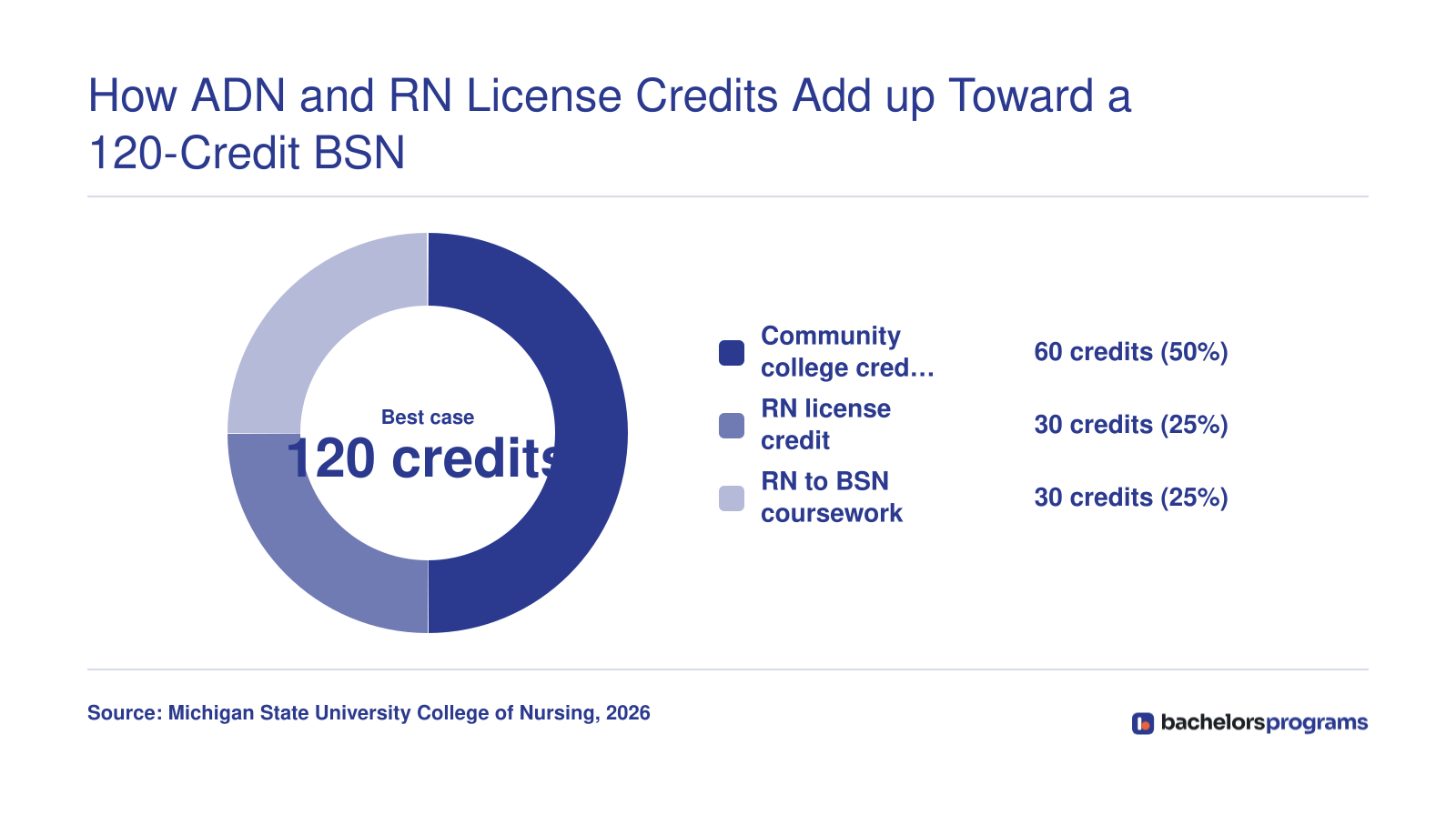
How ADN and RN License Credits Add up Toward a 120-Credit BSN
How many credits transfer? At Michigan State University, nurses who passed the NCLEX receive 30 credits on entry, up to 60 more can transfer from a community college after MSU review, and the RN to BSN curriculum itself is 30 credits, so a nurse with full transfer approval could reach the 120-credit total shown here. The Michigan Transfer Agreement (MTA) covers much of that general education block: MSU strongly encourages finishing the MTA before enrolling and lists partnership agreements with Michigan community colleges. Treat this as a best-case model, because prerequisites and other university requirements can add credits and the split varies by school. University of Michigan-Flint, for example, awards up to 30 credits for an unencumbered RN license.
RN to BSN Earnings Snapshot
Program-level federal data shows what RN to BSN graduates in Michigan earn soon after finishing the degree.
Questions to Ask Yourself
Does your employer offer tuition assistance tied to specific partner schools?
Can you handle 6-9 credits per term on top of 12-hour shifts, or do you need one course at a time?
Will the school place you for practice experiences, or must you find your own preceptor?
Do you plan to continue into graduate nursing study, and does the program offer a bridge?
Compare RN to BSN programs on the data that matters
Explore more Nursing majors or browse every field of study.
All Nursing programs Browse every field of study