Best Accelerated BSN (ABSN) Programs in Minnesota
Compare 10 accredited Accelerated BSN (ABSN) programs in Minnesota, with net price after aid, graduation rates, earnings and debt from IPEDS and the U.S. College Scorecard.
An accelerated BSN turns a degree you already hold into Minnesota RN eligibility in 12 to 18 months of full-time study, with no second four-year degree. The programs ranked below fold the same nursing coursework and clinical hours into a shorter calendar; a few stretch past 20 months to accommodate students who keep working.
The hard part is the prerequisites. The science sequence, labs included, has to be finished before nursing coursework starts, and cohorts begin on fixed terms rather than monthly, so one late transcript can push an applicant back a full intake.
Minnesota hospital systems hire new graduates year-round. Program seats do not open year-round.
Key Points
- Most accelerated BSN programs take 12 to 18 months of full-time study.
- Saint Cloud State University posts the lowest average net price here.
- Minnesota's RN exam application costs $105 plus a $35 background check.
Best Accelerated BSN Programs in Minnesota: Our School-by-School Rankings
Ten Minnesota schools appear below, ordered around what a second-degree student actually pays, how reliably each school's students finish, and how the program is delivered. A program that fits your budget and your weekly schedule will do more for your nursing career than a familiar name will. One entry, Saint Cloud State, is an RN-to-BSN rather than a prelicensure ABSN, and its description says so.
Rasmussen University-Minnesota
#1St. Cloud, MN · ~$18,000/yr (est.)
Best for: Career changers needing frequent start dates
Rasmussen runs its accelerated second-degree BSN across Minnesota campuses, blending online coursework with on-campus labs and clinicals. No prerequisite courses are required and there are eight start dates a year, which makes it the most schedule-friendly entry on this list for someone who wants to begin quickly. It is CCNE accredited, qualified students receive a laptop, and an accelerated master's pathway lets students bank two MSN courses early.
- CCNE accredited
- Eight start dates per year
- No prerequisite courses required
- 2.3 GPA minimum
- 180 total credit hours
- Entrance exam required: HESI, TEAS, ACT or SAT
- Finish in as few as 18 months
- Online coursework with campus labs and clinicals
Bethel University
#2Saint Paul, MN · $29,000/yr (est. net price)
Best for: Faith-driven learners wanting small cohorts
Bethel's post-baccalaureate nursing program is a hybrid path built on a faith-based, holistic-care model, and it leans on more than 230 clinical partner organizations for placements. Small cohorts and faculty mentors give career changers a tight support structure, and the 15-to-20-month window leaves room for people balancing other commitments. It is CCNE accredited and charges $891 per credit, with scholarships available.
- Hybrid: online coursework plus in-person skills labs
- Clinical placements at more than 230 organizations
- Completes in 15 to 20 months
- 2.9 GPA minimum
- $891 per credit
- Prerequisite courses required
- CCNE accredited
- Faith-based holistic care focus
The College of Saint Scholastica
#3Duluth, MN · $28,000/yr (est. net price)
Best for: Duluth-area students preferring in-person labs
The College of Saint Scholastica is the most compressed program here: 12 months across three consecutive semesters, with online nursing coursework plus in-person labs and clinicals in Duluth and St. Cloud. Admission is more prescriptive than most, requiring a 3.0 GPA and active CNA or NA-R registration before entry. The college secures all clinical placements, including sites such as Essentia St. Mary's, and the program is CCNE accredited and approved by the Minnesota Board of Nursing.
- 12 months over three consecutive semesters
- 45 credits of theory, lab, and clinical coursework
- 3.0 cumulative GPA required
- Current CNA or NA-R registration required at admission
- Prerequisites include anatomy, microbiology, chemistry, and nutrition
- Labs and clinicals in Duluth and St. Cloud
- CCNE accredited and Minnesota Board of Nursing approved
- Rolling admissions with priority deadlines
University of Northwestern-St Paul
#4Saint Paul, MN · ~$28,000/yr (est.)
Northwestern's accelerated BSN runs four back-to-back semesters on campus and places students with Twin Cities health systems including M Health Fairview, Children's Minnesota, and Mayo Clinic. The curriculum is Christ-centered and weaves servant leadership through 125 credits and 476.5 clinical hours. It is CCNE accredited, with a fall start and individual faculty mentoring for a comparatively small cohort.
- Four back-to-back semesters
- 125 credits, including 476.5 clinical hours
- Clinical partners include M Health Fairview, Children's Minnesota, and Mayo Clinic
- Christ-centered curriculum with a servant leadership focus
- Prerequisite courses required
- Single fall start each year
- CCNE accredited
St Catherine University
#5Saint Paul, MN · $15,000 – $20,000/yr (est.)
St. Catherine has taught nursing for more than a century and offers its accelerated BSN through the College for Adults, with synchronous evening classes online and one evening a week of lab and simulation on the St. Paul campus. The 21-month option is longer than most here but built for working adults, and clinicals run at regional hospitals. Graduates can also pursue Public Health Nursing and Holistic Nurse certification, and the Bridge To Care scholarship adds another source of aid.
- 21-month accelerated option
- 50 nursing credits
- Synchronous online evening classes
- Weekly lab and simulation on the St. Paul campus
- Clinicals at regional hospitals
- $525 per credit for 2025-26
- Two start dates per year, fall and spring
- Public Health Nursing and Holistic Nurse certification eligible
Concordia College at Moorhead
#6Moorhead, MN · ~$25,000/yr (est.)
Concordia College runs a 12-month, 54-credit accelerated BSN as a campus program with 20-student cohorts, faculty-arranged clinical placements, and 500 hours of hands-on practice. The program has 17 years of accelerated nursing experience behind it and meets Minnesota's public health nurse registration requirements. It is CCNE accredited, and the small cohort model means close faculty advising from start to finish.
- 12 months, 54 credits
- 500 clinical hours arranged by faculty
- 20-student cohorts with dedicated advising
- Meets Minnesota public health nurse registration requirements
- CCNE accredited
- 17 years of accelerated nursing experience
Concordia University-Saint Paul
#7Saint Paul, MN · ~$18,000/yr (est.)
Concordia University St. Paul delivers its ABSN in a hybrid format, with online coursework, on-campus skills labs, and clinical rotations, and it accepts applicants who hold a non-nursing bachelor's or at least 54 college credits. Three start dates a year and small classes make it one of the more accessible entries on this list. It is CCNE accredited, and its average net price after aid, about $18,460, is among the lower figures here.
- 16 months to completion
- Three start dates per year
- Online courses with on-campus skills labs and clinical rotations
- Open to a non-nursing bachelor's or at least 54 college credits
- Prerequisite courses required
- Small class sizes
- CCNE accredited
Herzing University-Minneapolis
#8St. Louis Park, MN · $15,000 – $20,000/yr (est.)
Herzing's Minneapolis ABSN is a campus-based program in St. Louis Park that mixes on-campus nursing courses with online work and 630 clinical hours at community partners. Rolling admissions, waived enrollment fees, and transfer of up to 90 approved credits make it unusually flexible for career changers, and a dual-credit arrangement lets students start on an MSN while enrolled. It is CCNE accredited, and at about $16,670 in average net price after aid it carries the lowest price tag among the second-degree ABSN programs in this ranking.
- As few as 20 months; 24 months if science prerequisites are needed
- 120 credits, including 630 clinical hours
- TEAS entrance exam required
- Transfer up to 90 approved credits
- Dual credit toward an MSN
- Rolling admissions with waived enrollment fee
- On-campus core nursing classes plus online coursework
- CCNE accredited
Saint Cloud State University
#9Saint Cloud, MN · ~$14,000/yr (est.)
Saint Cloud State's entry is different in kind: it is an accelerated online RN-to-BSN for licensed registered nurses, not a prelicensure program for career changers. Thirty nursing credits run in 7-week courses over as few as 10 months, with up to 90 transfer credits accepted and five start dates a year. Its average net price after aid, about $13,530, is the lowest number on this page, and it is CCNE accredited. Readers who do not yet hold an RN license should focus on the prelicensure programs listed before it.
- Online RN to BSN for licensed registered nurses
- 30 nursing credits in as few as 10 months
- 7-week accelerated courses
- $350 per credit
- Five start dates per year
- Up to 90 transfer credits accepted
- 2.5 GPA minimum
- CCNE accredited
Capella University
#10Minneapolis, MN · $15,000 – $20,000/yr (est.)
Capella's prelicensure BSN includes an ABSN pathway for students who already hold a bachelor's degree, delivered mostly online with two in-person skills labs and 550 supervised clinical hours. A 2.5 GPA waives the ATI TEAS requirement, and 10-week courses with NCLEX preparation built in suit students who want to move at their own pace. It enrolls residents of 13 states, including Minnesota, and posts the highest first-year earnings among the nursing graduates reported here, about $85,400 one year after finishing, though that figure spans its national nursing cohort rather than Minnesota ABSN students alone. Its overall graduation rate is low, around 20 percent, so ask about ABSN completion and licensure outcomes directly.
- ABSN pathway for students who already hold a bachelor's degree
- 180 quarter credits, including 550 clinical hours
- Two in-person skills labs
- 2.5 GPA waives the ATI TEAS requirement
- 10-week courses with NCLEX prep built in
- Up to 84 transfer credits accepted
- $0 application fee
- Available to residents of 13 states, including Minnesota
Cost & outcomes by school
Federal data for the highest-earning Accelerated BSN (ABSN) programs, independent of the ranking above. Earnings are this field's bachelor's graduates four years after completing where the Scorecard reports them, else the school's undergraduate median.
| School | Net price / yr | Grad rate | Earnings | Debt | Grads/yr | Format |
|---|---|---|---|---|---|---|
| The College of Saint Scholastica MN | $27,846 | 71% | $65,934 | $20,000 | 1,196 | Hybrid |
| Bethel University MN | $28,556 | 71% | $63,764 | $21,500 | 1,244 | Hybrid |
| Concordia University-Saint Paul MN | $18,462 | 46% | $59,871 | $17,832 | 1,832 | Hybrid |
| Concordia College at Moorhead MN | $24,902 | 61% | $59,317 | $26,847 | 1,064 | Campus |
| St Catherine University MN | $19,764 | 61% | $59,282 | $24,181 | 1,070 | Hybrid |
| Saint Cloud State University MN | $13,529 | 40% | $55,813 | $21,058 | 2,232 | Online |
| University of Northwestern-St Paul MN | $27,705 | 68% | $50,755 | $21,325 | 942 | Campus |
| Capella University MN | $17,956 | 20% | $42,189 | $14,968 | 24,112 | Hybrid |
| Rasmussen University-Minnesota MN | $17,962 | 54% | $39,080 | $20,899 | 1,312 | Campus |
| Herzing University-Minneapolis MN | $16,670 | 47% | $36,909 | $21,500 | 304 | Campus |
Sources: U.S. Department of Education. Net price, graduation rate, earnings and debt: College Scorecard (earnings and debt for this field's bachelor's graduates where reported, else school-wide); graduates: IPEDS. A dash means no figure is reported.
Cost, debt & payoff
Median earnings of this field's bachelor's graduates (4 yrs after completing, else the school's undergraduate median) vs. their median federal loan debt · U.S. College Scorecard
Across these programs the median graduate earns about $57,548 and finishes with roughly $21,192 in debt — a ratio that clears a common rule of thumb (keep debt below first-year salary). Net price and debt vary widely school to school, so check the per-school figures in the table above before you shortlist.
Most Affordable Accelerated BSN Programs in Minnesota by Net Price
Saint Cloud State University, a public university, posts the lowest average net price below, and the rest of this group is made up of private nonprofit and for-profit schools, according to 2024 federal IPEDS and College Scorecard data. Net price is an institution-wide average of what students pay after grants and scholarships, and it mostly reflects traditional first-time undergraduates. Second-degree nursing students often receive less grant aid than those students, so treat these figures as a starting point rather than a quote. For program-specific tuition, including per-credit rates and total program costs, see the pace-and-cost section of this guide.
| School | City | Sector | Program | Format | Average Net Price | In-State Tuition and Fees |
|---|---|---|---|---|---|---|
| Saint Cloud State University | Saint Cloud | Public | Accelerated RN to BSN | Online | $13,529 | $10,245 |
| Herzing University-Minneapolis | St. Louis Park | Private nonprofit | Accelerated Bachelor of Science in Nursing (ABSN) | On campus | $16,670 | $13,450 |
| Capella University | Minneapolis | Private for-profit | Accelerated BSN (ABSN) pathway | Hybrid | $17,956 | $14,400 |
| Rasmussen University-Minnesota | St. Cloud | Private for-profit | Bachelor of Science in Nursing (BSN) program | On campus | $17,962 | $11,490 |
| Concordia University-Saint Paul | Saint Paul | Private nonprofit | Accelerated Bachelor of Science in Nursing (ABSN) | Hybrid | $18,462 | $25,600 |
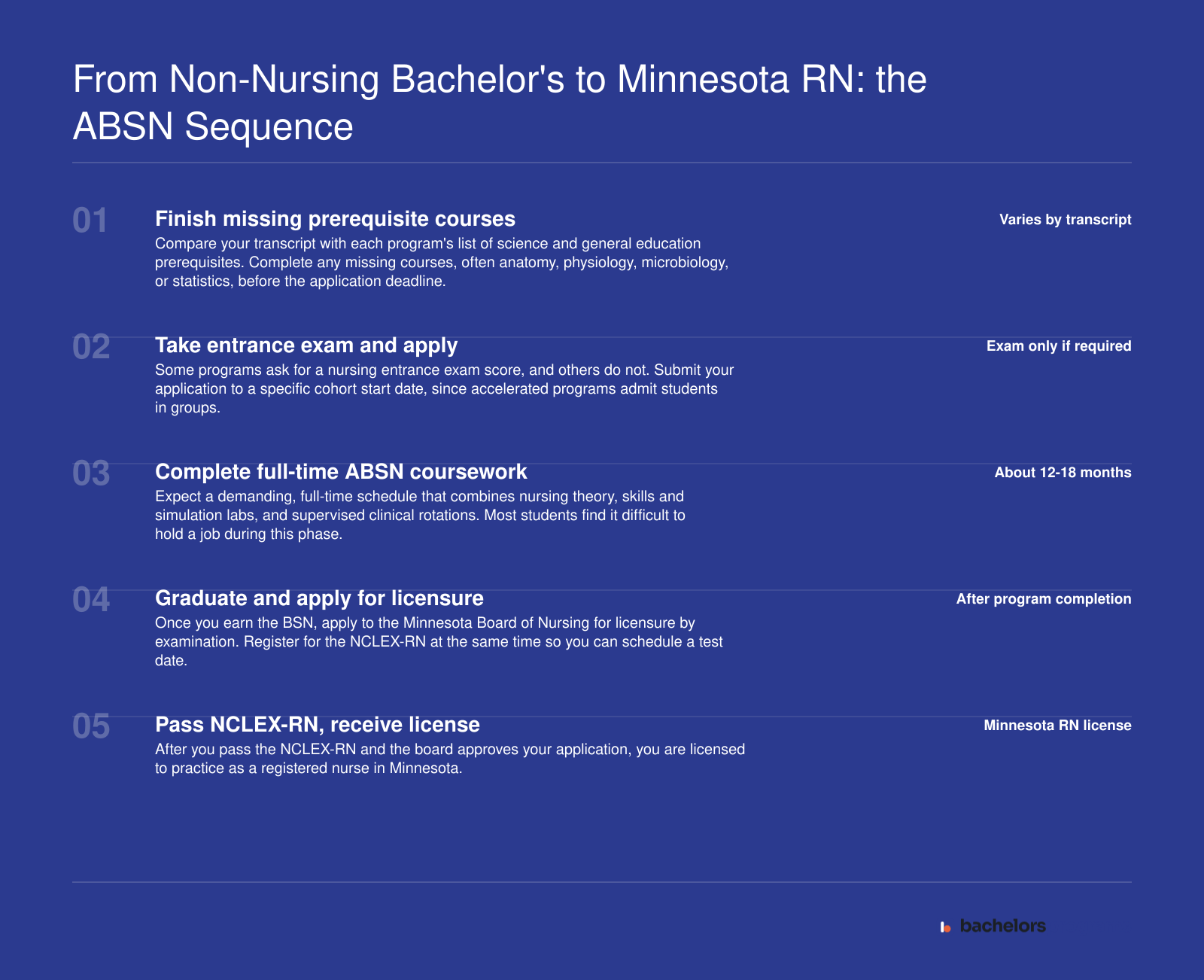
From Non-Nursing Bachelor's to Minnesota RN: the ABSN Sequence
An accelerated BSN builds on the bachelor's you already hold, but the order of steps matters. The prerequisite phase is where most applicants lose time, so map it against each school's requirements before you apply. Program-specific timelines follow in the next section.
First-Year Earnings After a Minnesota Nursing Degree
Early earnings show how quickly a nursing bachelor's can repay its cost.
Related Articles
Minnesota Board of Nursing Approval, Accreditation, and NCLEX-RN Licensure for ABSN Grads
Board approval and programmatic accreditation are two separate credentials, and only one of them decides whether you can take the NCLEX-RN at all.
Approval Is the Gate, Accreditation Is the Signal
Minnesota Board of Nursing approval authorizes a school to operate a professional nursing program in the state. Under Minnesota's licensure-by-examination statute, you must show completion of a Board-approved program (or an equivalent U.S. or Canadian program) that prepared you for the credential you are seeking, submit an application, provide evidence of no disqualifying conduct, and pass the exam. Without that approval, nothing else in the process can start.
Accreditation from the Commission on Collegiate Nursing Education (CCNE) or the Accreditation Commission for Education in Nursing (ACEN) is a separate, voluntary peer review. It carries weight later: graduate nursing admissions, tuition reimbursement plans, and some hospital and federal employers screen for it. Bethel University's nursing program is both Board-approved and CCNE-accredited, and Rasmussen University's Minnesota locations appear on the Board's 2026 approved list. For any other program on your shortlist, verify the accreditor, term, and expiration directly in the CCNE or ACEN directory, which is what the Board itself advises.
The Licensure Sequence
- Apply to the Board: Submit the application with the $105 nonrefundable fee plus a $35 criminal background check fee.
- Fingerprints: After you apply, the program office emails your fingerprint packet, typically the next business day.
- Program completion: A Minnesota school official can confirm completion online; paper forms go from the program directly to the Board.
- Register with Pearson VUE: Pay the exam registration separately from your Board application.
- Authorization to Test: The ATT arrives by email and is valid 90 days. Schedule and test inside that window or the registration becomes invalid.
Two timing rules catch career changers off guard. If you do not test within one year of the Board receiving your application, the application is nullified. If five years pass since program completion, a review course is required. Retakes are permitted after a failed attempt.
Checking Program Performance
The Minnesota Board of Nursing publishes pass-rate reports by program. Pull the current report for the schools you are considering rather than relying on marketing copy.
Minnesota RN Licensure by Examination at a Glance
Online, Hybrid, or On-Campus: How Minnesota ABSN Programs Are Delivered
No accelerated BSN in Minnesota is fully online. Hybrid programs move theory courses online, but skills labs, simulation, and clinical rotations always happen in person. Bethel University, St Catherine University, Concordia University-Saint Paul, and The College of Saint Scholastica all use some form of online coursework paired with required on-campus or site-based work. Compare them below, then check each school's current schedule before you apply.
| School | Coursework delivery | Labs and simulation | Clinical placements | Location | Pace and intensity |
|---|---|---|---|---|---|
| Bethel University | Blended format with more than half of coursework online | Face-to-face sessions plus skills and simulation intensives | In-person clinical experiences built into the program | St. Paul campus | Hybrid structure with periodic on-campus intensives |
| St Catherine University | Fully online courses in the accelerated option | Weekly lab, one evening per week, in the university's simulation facility | In-person clinical learning alongside the weekly lab | St. Paul campus | 21-month accelerated option with a steady weekly on-campus commitment |
| Concordia University-Saint Paul | Online coursework combined with on-campus components | In-person skills labs required at the ABSN learning center | On-campus clinical learning experiences | ABSN learning center, St. Paul | 16-month curriculum, the shortest timeline among the hybrid options described here |
| The College of Saint Scholastica | Online coursework and synchronous webinars | In-person labs | 600 to 800+ supervised hours in hospitals, clinics, and community settings; placements may be in Minneapolis-Saint Paul or rural regions through statewide partnerships | Duluth, with clinical sites across Minnesota | Live webinar sessions plus a heavy clinical load, so travel for placements is possible |
| Minnesota hybrid ABSNs overall | Online theory courses | On-campus labs, with simulation intensives at some programs | Clinical rotations are always in person | Campus plus partner health sites | Online flexibility never replaces required in-person hours |
Accelerated BSN vs. RN-to-BSN and Other Second-Degree Nursing Paths
Who a True ABSN Is For
An accelerated BSN is built for people who hold a non-nursing bachelor's degree and have never been licensed as nurses. You finish the science prerequisites, then complete nursing coursework and clinicals in a compressed block, and graduate eligible to take the NCLEX-RN. Bethel University, The College of Saint Scholastica, and Concordia University-Saint Paul all run programs of this kind.
RN-to-BSN and RN-to-MSN programs work differently. They require an active RN license before you start, so they are not shortcuts for career changers. Saint Cloud State University's accelerated RN to BSN, for example, serves nurses who are already licensed, not newcomers to the field.
The Entry-Level Master's Route
Some universities offer entry-level master's programs for non-nurses with a prior bachelor's. Expect a longer timeline and a higher total cost than an ABSN. Graduates still take the NCLEX-RN and earn the same RN license, with a graduate degree added on top. It makes sense mainly if you already know you want advanced practice.
The ADN-Then-Bridge Alternative
A slower, cheaper option is to earn an associate degree in nursing, pass the NCLEX-RN, start working, and complete a bachelor's through an RN-to-BSN bridge later. Some Minnesota career changers choose this to spread out costs or keep earning along the way. The tradeoff is more total time before you hold the BSN.
A Quick Rule of Thumb
- Speed: Choose an ABSN if you want the fastest route to an RN license with a bachelor's degree.
- Cost: Consider the ADN-then-bridge path if lowering up-front spending matters more than time.
- Advanced practice: Consider an entry-level master's if nurse practitioner or leadership roles are your long-term goal.
Minnesota ABSN FAQs
Cohort sizes, acceptance rates, and entrance exam rules change from one intake to the next, so the school itself is the only reliable source. These answers show where to look and how to compare programs using confirmed information.
Where can I find cohort size, acceptance rate, and applicant-to-seat ratio for Minnesota ABSN programs?
Do Minnesota ABSN programs require the TEAS or HESI?
Which outside sources should I use for context on nursing careers and program approval?
What is a simple checklist for comparing Minnesota ABSN programs?
How long does an accelerated BSN take in Minnesota?
Compare Accelerated BSN (ABSN) programs on the data that matters
Explore more Nursing majors or browse every field of study.
All Nursing programs Browse every field of study