Best RN to BSN Programs in Minnesota
Compare 15 accredited RN to BSN programs in Minnesota, with net price after aid, graduation rates, earnings and debt from IPEDS and the U.S. College Scorecard.

A Minnesota RN with an associate degree typically starts a BSN with half or more of the 120 required credits already earned. What remains is upper-division work in leadership, community health and evidence-based practice, finished around shifts rather than instead of them.
Every ranked program is delivered fully online, and hybrid tracks were excluded. Average net price after aid runs from $13,529 at Saint Cloud State University to $19,764 at St Catherine University. The ranked list comes first, then the cheapest picks, top graduate earnings, admissions, and time and cost.
Transfer policy is usually the deciding variable: the ADN credits a school accepts set both the tuition bill and the finish date.
Key Points
- Saint Cloud State University is cheapest, averaging $13,529 net per year.
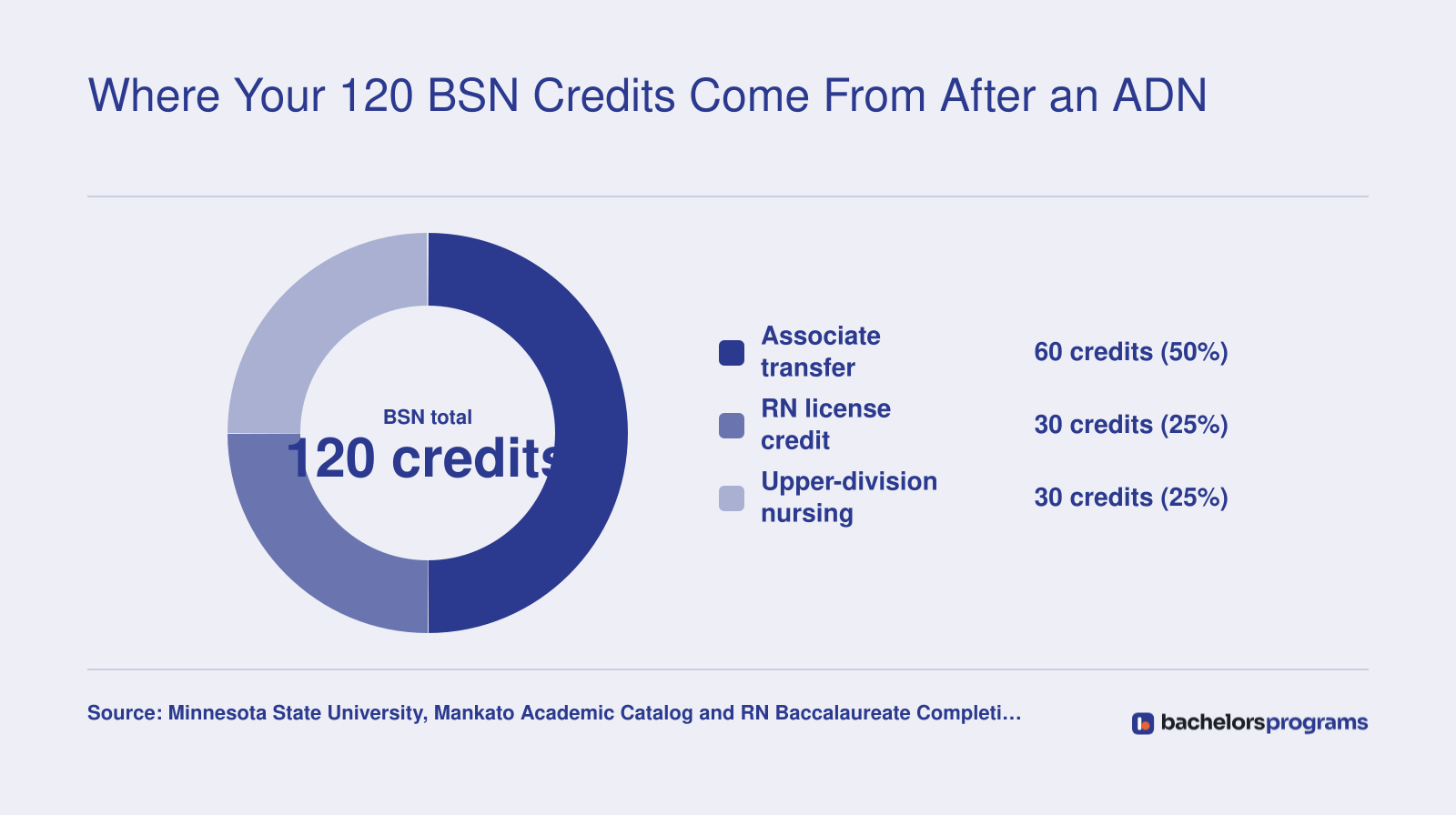
- Minnesota State Mankato grants 60 transfer plus 30 prior-learning BSN credits.
- Because Minnesota is outside the Nurse Licensure Compact, multistate licenses don't automatically apply.
Top 100% Online RN to BSN Programs in Minnesota, School by School
Every program below is delivered fully online, with no required in-person sessions, so a nurse working nights in Duluth, Rochester or the Twin Cities can finish the degree without rebuilding a schedule around campus visits. Hybrid tracks were left out entirely. The list is ordered by a composite quality score, and each entry notes the campus city, in-state tuition, average net price after aid, and the share of students the school graduates overall.
Rasmussen University-Minnesota
#1St. Cloud, MN · ~$18,000/yr (est.)
Best for: Working RNs needing frequent start dates
Rasmussen University-Minnesota is a career-focused institution serving working adults across several Minnesota sites, with nursing among its larger program areas. Its RN to BSN track is priced per credit and softened by named grants, so the total bill is visible before a nurse enrolls. Support runs through assigned faculty advisors and round-the-clock technical help, and there is a documented accelerated route into graduate study for nurses who want to keep going.
- 70 credit hours across 17 courses
- $345 per credit, about $24,650 total tuition
- Finish in 12 to 18 months
- Eight start dates per year
- Transfer up to 134 credits
- CCNE-accredited program
- Accelerated master's pathway included
- Get Started Grant can lower the total to $14,690
Winona State University
#2Winona, MN · ~$18,000/yr (est.)
Best for: RNs aiming at public health certification
Winona State University is a public regional university in southeastern Minnesota with a long-established nursing department and clinical ties across the region, including Mayo Clinic. Its RN to BSN work is built around community and population health, with experiential hours spent alongside vulnerable populations. The university reports a 96% job placement rate for nursing graduates and distributes more than $75,000 in scholarships each year.
- 40 total credit hours
- Asynchronous online classes
- Fall and spring start terms
- 60 hours of experiential learning
- Clinical partnerships include Mayo Clinic
- Prepares for Public Health Nurse certification
- Also prepares for School Nurse licensure
- CCNE accredited
Minnesota State University Moorhead
#3Moorhead, MN · ~$18,000/yr (est.)
Best for: ADN students planning early through dual acceptance
Minnesota State University Moorhead has taught nursing for more than 50 years and sits in the Red River Valley, within reach of both Fargo-Moorhead employers and North Dakota border students. The department runs dual acceptance agreements with a long roster of Minnesota community colleges, letting students lock in a bachelor's seat before they finish an associate degree. Small classes, military-friendly policies and study abroad options round out the offer.
- Dual Acceptance Program with partner colleges
- CCNE accredited with NLN CNEA pre-accreditation
- 100% job placement rate reported
- Military benefits accepted
- More than 50 years of nursing education
- Study abroad opportunities available
- Open to licensed RNs with an associate degree or diploma
Minnesota State University-Mankato
#4Mankato, MN · $10,000 – $19,000/yr (est.)
Minnesota State University-Mankato is a comprehensive public university in southern Minnesota with a dedicated college of allied health and nursing. The RN completion track runs on rolling admissions with several entry points, which helps nurses who need to start soon rather than wait for one annual cohort. Coursework leans on leadership, community health and evidence-based practice, and advising is arranged around individual pacing.
- 100% online coursework
- Rolling admissions
- Multiple start dates each year
- Individualized and flexible pacing
- CCNE accredited
- Focus on leadership and community health
- Prepares graduates for management, education or specialized practice
Bemidji State University
#5Bemidji, MN · ~$15,000/yr (est.)
Bemidji State University is a small public university in northern Minnesota where nursing is one of the signature professional programs. Class sizes stay small, tuition is banded for full-time students, and the university awards more than $41,000 in scholarships each year. Its RN to BSN track grants upper-level credit for the RN license itself, which shortens the runway for nurses who already hold one.
- Finish in as little as one year
- Three-semester program
- Five start dates per year
- 2.3 GPA minimum and a $0 application fee
- 100% online coursework with no required campus visits
- RN Advantage awards 15 upper-level credits for your license
- Banded tuition for full-time students
- More than $41,000 in scholarships awarded annually
Metropolitan State University
#6Saint Paul, MN · ~$17,000/yr (est.)
Metropolitan State University is the Twin Cities' urban public university, built around adult and transfer students, and its nursing department leans hard into community and public health. The curriculum is competency-based and cohort-structured, with an explicit focus on health equity and anti-racism. Graduates leave eligible for public health nursing registration in Minnesota and prepared for holistic nursing certification.
- 31 total credit hours
- Five-semester cohort progression
- Part-time option with three start dates a year
- 2.5 GPA minimum
- 45 clinical hours plus a capstone
- Qualifies graduates for Minnesota public health nurse registration
- Endorsed by AHNCC for holistic nursing certification
- Coursework centered on health equity and anti-racism
Southwest Minnesota State University
#7Marshall, MN · ~$15,000/yr (est.)
Southwest Minnesota State University is a public university in Marshall serving a largely rural region, and its nursing program threads rural practice through the coursework rather than treating it as a sidebar. Prior learning credit is awarded for nursing experience, and graduates can register as a Public Health Nurse in Minnesota. The department is small enough that pacing is faculty-supported rather than locked to a fixed calendar.
- Courses completely online
- Fall and spring starts
- 2.3 GPA minimum and no entrance exam
- Prior learning credits awarded for nursing experience
- Rural nursing practice woven through the curriculum
- Eligible for Public Health Nurse registration in Minnesota
- 120 total credit hours
Herzing University-Minneapolis
#8St. Louis Park, MN · $15,000 – $20,000/yr (est.)
Herzing University-Minneapolis is a private, career-oriented institution in St. Louis Park whose nursing program is designed around practicing adults. Each course carries continuing education hours that count toward license renewal, an unusual convenience for nurses already logging CE. Transfer policy is generous for anyone arriving with an associate degree or diploma in nursing.
- 120 semester credits, 26 of them in nursing
- Transfer up to 70 nursing credits, 90 overall
- 45-hour community project in place of traditional clinicals
- Capstone course required
- Up to 9 graduate credits may replace undergraduate courses
- Each course includes continuing education for license renewal
- CCNE accredited
Saint Cloud State University
#9Saint Cloud, MN · ~$14,000/yr (est.)
Saint Cloud State University is a mid-sized public university in central Minnesota with an established nursing department and Minnesota Board of Nursing approval. Its completion option is organized into seven-week courses with rolling admissions, so nurses can enter several times a year instead of waiting for fall. The department also prepares graduates for public health certification, and advising is geared to part-time students working full shifts.
- 30 total credit hours
- Courses start every seven weeks
- Complete in as little as one calendar year
- Rolling admissions with three start dates
- 2.5 GPA minimum
- Entirely online coursework
- Eligibility for public health certification
- CCNE accredited and Minnesota Board of Nursing approved
St Catherine University
#10Saint Paul, MN · $15,000 – $20,000/yr (est.)
St. Catherine University is a private university in Saint Paul with one of the state's longer-running nursing traditions and the strongest overall graduation record on this list. Nursing students move through population-based practice and leadership coursework, and the university offers a public health certification alongside the degree. Scholarship support and a graduate credit pathway make it a common bridge toward an MSN or DNP.
- Practicum experience built into two courses
- Public Health Certification option
- 2.5 GPA minimum and an unencumbered RN license
- CPR certification required
- Earn 12 graduate credits toward an MSN or DNP
- Corporate partner scholarships available
- Scholarships let most students finish under $10,000 in tuition
Cost & outcomes by school
Federal data for the highest-earning RN to BSN programs, independent of the ranking above. Earnings are this field's bachelor's graduates four years after completing where the Scorecard reports them, else the school's undergraduate median.
| School | Net price / yr | Grad rate | Earnings | Debt | Grads/yr | Format |
|---|---|---|---|---|---|---|
| The College of Saint Scholastica MN | $27,846 | 71% | $65,934 | $20,000 | 1,196 | Campus |
| Metropolitan State University MN | $16,863 | 44% | $64,705 | $17,100 | 2,800 | Online |
| Concordia University-Saint Paul MN | $18,462 | 46% | $59,871 | $17,832 | 1,832 | Hybrid |
| St Catherine University MN | $19,764 | 61% | $59,282 | $24,181 | 1,070 | Online |
| Augsburg University MN | $23,873 | 52% | $58,829 | $25,347 | 980 | Online |
| Winona State University MN | $17,503 | 57% | $58,532 | $21,500 | 2,450 | Online |
| Minnesota State University-Mankato MN | $19,139 | 54% | $56,922 | $21,106 | 5,230 | Online |
| Saint Cloud State University MN | $13,529 | 40% | $55,813 | $21,058 | 2,232 | Online |
| Bemidji State University MN | $15,261 | 48% | $53,755 | $19,750 | 1,802 | Online |
| Southwest Minnesota State University MN | $15,291 | 45% | $51,342 | $20,500 | 980 | Online |
| Minnesota State University Moorhead MN | $17,997 | 57% | $50,527 | $20,000 | 1,582 | Hybrid |
| Walden University MN | $33,817 | — | $42,810 | $20,834 | 3,348 | Online |
Sources: U.S. Department of Education. Net price, graduation rate, earnings and debt: College Scorecard (earnings and debt for this field's bachelor's graduates where reported, else school-wide); graduates: IPEDS. A dash means no figure is reported.
Cost, debt & payoff
Median earnings of this field's bachelor's graduates (4 yrs after completing, else the school's undergraduate median) vs. their median federal loan debt · U.S. College Scorecard
Across these programs the median graduate earns about $55,813 and finishes with roughly $20,834 in debt — a ratio that clears a common rule of thumb (keep debt below first-year salary). Net price and debt vary widely school to school, so check the per-school figures in the table above before you shortlist.
Inside the Scoring: Why Only Fully Online Programs Made the Cut
Flexibility Comes First
For a working RN, the real tradeoff is a program built around twelve-hour shifts versus one that expects you on campus at fixed times. This ranking settles that up front. Programs with required on-campus sessions or hybrid class meetings were excluded, so coursework at every school here can be finished from anywhere in Minnesota, whether you work in Duluth, Rochester or Worthington. Ask each program how any practicum hours are arranged before you apply.
What Feeds the Score
- Completion: Institution-wide graduation and retention rates from IPEDS.
- Cost: Average net price after aid, also from IPEDS.
- Outcomes: Program-level earnings and debt from the College Scorecard, where the Scorecard publishes them.
Read the Numbers Carefully
Net price is a school-wide average after grants and scholarships. It is not a quote for RN to BSN students, who often pay by the credit and may also receive employer tuition help. Graduation rates likewise describe the whole institution, including first-time freshmen, rather than licensed nurses finishing a bachelor's degree. Treat both as signals of a school's overall health and affordability, then check the program's own tuition sheet for your actual cost.
Schools cannot pay for placement, and self-reported "best" claims on school websites played no part in the scores.
Cheapest Online RN to BSN Programs in Minnesota
Saint Cloud State University is the cheapest online RN to BSN option ranked here, with an average net price after aid of $13,529 per year. Net price is an institution-wide figure from federal College Scorecard data, so treat it as an approximation: your own aid package, transfer credits, and enrollment pace will change what you actually pay, and Metropolitan State University posts the lowest published tuition and fees even though its net price ranks fifth. Southwest Minnesota State University's 2026-27 rate is shown with its general student fees; SMSU does not confirm whether every one of those fees applies to online RN to BSN students, so check with the school for an exact bill.
| School | City | Average net price after aid (annual, institution-wide) | Published in-state tuition and fees (annual) | RN to BSN credits or length | Researched per-credit tuition and fees (2026-27) |
|---|---|---|---|---|---|
| Saint Cloud State University | Saint Cloud | $13,529 | $10,245 | 30 credit hours | N/A |
| Bemidji State University | Bemidji | $15,261 | $10,237 | Three-semester program | N/A |
| Southwest Minnesota State University | Marshall | $15,291 | $10,361 | 120-credit degree, prior learning credits awarded | $349.62 tuition plus $56.63 off-campus fees, $406.25 total |
| Herzing University-Minneapolis | St. Louis Park | $16,670 | $13,450 | 120-credit degree, up to 90 transfer credits | N/A |
| Metropolitan State University | Saint Paul | $16,863 | $9,840 | 31 credit hours | N/A |
Related Articles
RN to BSN Admission Requirements in Minnesota: Your Application Checklist
Admission standards at Minnesota's RN to BSN programs are similar from school to school. Before you apply, check these items against each program's own admission page.
- Active, unencumbered RN licenseMinnesota State University, Mankato requires an active, unrestricted RN license before you begin the program. Metropolitan State University asks for an active, unencumbered Minnesota RN license. St. Cloud State University accepts a current, unencumbered license from at least one state, as long as you are eligible for Minnesota licensure. Recent ADN graduates who are still waiting to take the NCLEX may also apply there.
- Nursing degree and minimum GPAMetropolitan State requires an associate degree in nursing. Mankato, Metropolitan State and St. Cloud State all set a 2.5 minimum GPA. St. Cloud State measures that GPA in your prior RN program. At Metropolitan State, applicants with a 2.3 to 2.49 GPA may petition for conditional admission, but approval is not automatic.
- Course grades and prior creditsMankato and Metropolitan State require a C or better in earlier nursing courses. Mankato also expects at least 30 college credits and no longer requires statistics.
- TranscriptsMetropolitan State needs official transcripts from all other undergraduate and graduate work by your application date. Your ADN coursework always counts toward your GPA.
- Start termsMankato admits students in fall, spring and summer. Confirm current deadlines with each school directly.
- Out-of-state RNsMetropolitan State reviews out-of-state applicants case by case. Contact the school before applying to confirm it is authorized to enroll students in your state.
Minnesota RN Licensure Rules That Affect Online Enrollment
How Long and How Much: RN to BSN Time, Credits, and Cost
Speed and cost pull in the same direction in a Minnesota RN to BSN program: every credit that transfers is one you never pay tuition for and never spend a term completing. The tradeoff runs the other way: the faster route usually means carrying more courses at once while you are still working shifts. The schools ranked here handle that balance differently, and their published credit policies show it most clearly.
How Many Credits You Still Need
At Minnesota State Mankato, the RN Baccalaureate Completion program requires 120 credits and accepts 60 or more associate-level credits where they apply.1 Under the statewide nursing articulation the program cites, that block splits into 30 nursing credits and 30 non-nursing credits. Nurses who arrive with fewer than 60 credits complete additional coursework to reach the 120-credit minimum, so the ADN alone does not close the gap.
Winona State University sets its program at 40 credits inside a 120-credit degree3 and counts up to 80 transferable credits from accredited two- and four-year institutions, including Minnesota State community colleges.4 How much of that 80 you actually receive depends on a transfer evaluation, not the ceiling, and finishing Minnesota Transfer Curriculum goal-area courses before the nursing sequence can change what remains. Neither school publishes a blanket waiver of general education for holding an RN license.
How Fast You Can Finish
Neither Mankato nor Winona publishes a fixed completion time for full-time or part-time students, so your calendar follows from credits remaining and courses per term. Mankato's 2026-27 catalog lists fall, spring and summer starts, and its 2026 application page lists five start dates a year2; Winona runs fall and spring starts. Year-round terms are what keep a part-time student moving.
What It Costs and Who Pays
Coursework at Mankato is fully online, which is what makes a working schedule possible. Two courses per term is a sustainable load alongside full-time nursing work; three is a full-time pace. Ask your employer about tuition assistance before you enroll, because fewer remaining credits means a lower total bill and a shorter reimbursement window.
Where Your 120 BSN Credits Come From After an ADN
Minnesota State University, Mankato's online RN Baccalaureate Completion program shows how a 120-credit BSN is assembled: at least 60 credits transfer from your associate degree, 30 upper-division prior-learning credits are awarded once you have passed the NCLEX-RN and been admitted, and you complete the remaining 30 upper-division nursing credits at Mankato, which also covers the school's 30-credit residency rule. Minnesota Transfer Curriculum general education is folded into the total, with required nursing courses filling the writing-intensive and Diverse Cultures requirements. Totals vary by school and by transcript: students with fewer than 60 prior semester credits take extra coursework to reach 120, and other programs on this list structure their transfer and RN credit awards differently.
Fastest Early Payoff Among Ranked RN to BSN Programs
Early earnings show how quickly a BSN can pay off for working nurses.
Compare RN to BSN programs on the data that matters
Explore more Nursing majors or browse every field of study.
All Nursing programs Browse every field of study