Best BSN Programs in Minnesota
Compare 31 accredited Bachelor of Science in Nursing (BSN) programs in Minnesota at 28 colleges, with net price after aid, graduation rates, earnings and debt from IPEDS and the U.S. College Scorecard.
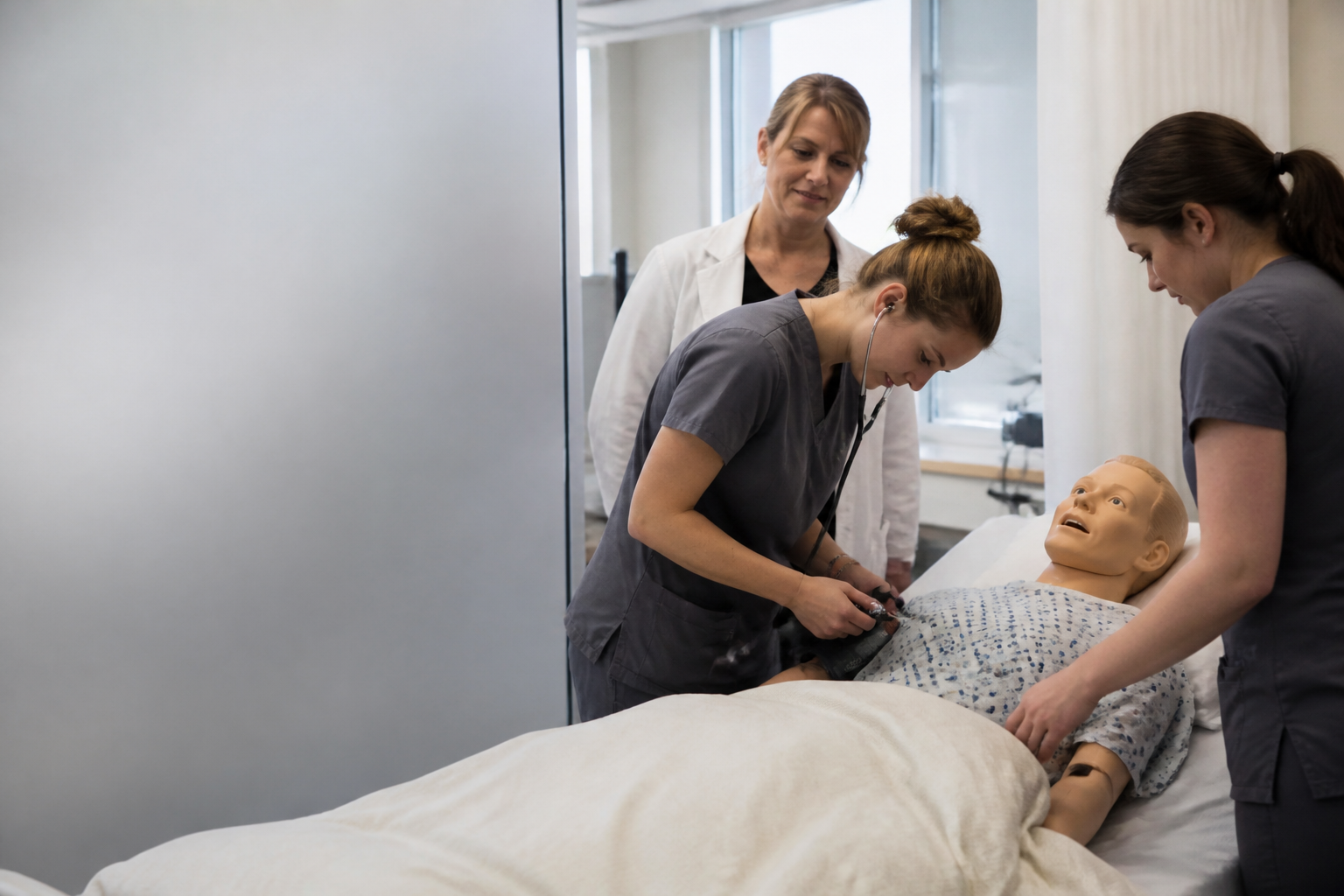
Minnesota employers hire RNs by license, not by diploma, so the BSN question starts at the NCLEX-RN testing center rather than the campus tour. First-time pass rates among the prelicensure programs ranked here run from 92.3% to 100%, a spread wide enough to change where a tuition dollar goes.
The ranking favors those results, using completion and accreditation as tie-breakers. Cost cuts the other way: public two-year net prices sit far below private BSN tuition, which is why the cheapest first step for many students is an associate degree, then an RN-to-BSN completion.
Key Points
- Saint Mary's University of Minnesota posts the strongest early-career pay here.
- Board of Nursing approval, not accreditation, unlocks NCLEX-RN eligibility in Minnesota.
- Minnesota RN applicants pay a $105 Board fee plus $35 fingerprinting.
Best NCLEX-RN Outcomes: 10 Top BSN Programs in Minnesota
Minnesota's bachelor's nursing programs separate most clearly on how their graduates perform on the NCLEX-RN, so first-time pass rates set the order below. Completion outcomes and accreditation break ties when two programs land within a point of each other. Every school listed here enrolls traditional pre-licensure BSN students; RN-to-BSN and accelerated second-degree tracks are covered separately because they serve licensed nurses and people who already hold a degree.
Saint Mary's University of Minnesota
#1Winona, MN · $12,000/yr (est. net price) · NCLEX-RN pass rate 100%
Best for: Students who want nursing from the first semester
Saint Mary's University of Minnesota runs a direct-admit BSN on its Winona campus, so nursing coursework begins in the first semester instead of after a separate upper-division application. Cohorts stay near 50 students, and clinical placements reach across Minnesota and western Wisconsin. The state's NCLEX-RN data show a 100 percent first-time pass rate for the 11 candidates reported, and the school graduates 66% of students overall.
- CCNE accredited
- Direct admission to nursing from the first semester
- Cohort of about 50 students
- 3.0 GPA minimum plus prerequisite courses
- 500 clinical hours with partners in Minnesota and Wisconsin
- Simulation suite with high-fidelity manikins and skills labs
- Rolling admissions
- 19 minors available alongside nursing
Bethel University
#2Saint Paul, MN · $29,000/yr (est. net price) · NCLEX-RN pass rate 95% (3-yr weighted avg)
Best for: Faith-centered learners seeking urban clinical placements
Bethel University pairs a CCNE-accredited BSN with a Christ-centered general education core on its Saint Paul campus. Nursing students rotate through more than 30 clinical partner agencies across the Twin Cities and rehearse high-stakes scenarios in simulation labs before they meet them in a hospital. Bethel also offers a separate post-baccalaureate nursing track for students who already hold a bachelor's degree. The school graduates 71% of students overall, and the NCLEX-RN first-time pass rate in the state data is 95 percent.
- CCNE-accredited four-year BSN
- 2.8 GPA minimum plus prerequisite courses
- Clinical rotations at more than 30 partner agencies in the Twin Cities
- Simulation labs for high-stakes scenarios
- Research with faculty mentors
- Career coaching starting in year one
- Study abroad options
- Christ-centered curriculum
Concordia College at Moorhead
#3Moorhead, MN · ~$25,000/yr (est.) · NCLEX-RN pass rate 93.9% (3-yr weighted avg)
Best for: Liberal arts students who want campus life
Concordia College at Moorhead builds its traditional BSN on a liberal arts foundation, with a Lutheran lens on caring for the whole person. The four-year program starts each fall and keeps nursing majors woven into campus life through music, athletics and theatre. The school graduates 61% of students overall, and the NCLEX-RN first-time pass rate is 93.9 percent.
- CCNE-accredited four-year traditional BSN
- Fall start each year
- Apply through the college portal or the Common App
- Nursing science built on a liberal arts core
- Nursing majors can join music, athletics and theatre
Crown College
#4Saint Bonifacius, MN · ~$27,000/yr (est.) · NCLEX-RN pass rate 94.2% (3-yr weighted avg)
Crown College is a small Christian college west of the Twin Cities where nursing cohorts run 15 to 24 students, so faculty practitioners know students by name. Clinical work spans urban, suburban and rural sites, and courses are taught from a biblical worldview. High school students can be admitted directly to the program. The school graduates 45% of students overall, and its NCLEX-RN first-time pass rate is 94.2 percent.
- CCNE accredited
- Direct admission from high school
- Cohorts of 15 to 24 students
- Clinical experience in urban, suburban and rural settings
- Courses taught from a biblical worldview
- Faculty who are practicing nurses
- Preparation for advanced nursing degrees
Bemidji State University
#5Bemidji, MN · ~$15,000/yr (est.) · NCLEX-RN pass rate 93.3% (3-yr weighted avg)
Bemidji State University is the public option for northern Minnesota, with a pre-licensure BSN that runs five semesters and opens a cohort every spring. An 8,000-square-foot simulation lab holds six hospital bays with high-fidelity manikins, and clinical rotations stay in the Bemidji area. A TEAS entrance exam and a CNA course sit on the admission path. The school graduates 48% of students overall, and the NCLEX-RN first-time pass rate is 93.3 percent.
- CCNE-accredited pre-licensure track
- Five-semester, cohort-based program starting each spring
- TEAS entrance exam required
- 2.8 GPA minimum and two letters of recommendation
- CNA course required before the program starts
- 8,000-square-foot simulation lab with six hospital bays
- Clinical rotations in the Bemidji area
- Differential tuition of $36.20 per credit for nursing courses
University of Northwestern-St Paul
#6Saint Paul, MN · ~$28,000/yr (est.) · NCLEX-RN pass rate 93% (3-yr weighted avg)
University of Northwestern in Saint Paul delivers a 125-credit BSN in a connected format that blends in-person and online instruction. Clinical partners include M Health Fairview and Mayo Clinic, and students pick between a standard four-year path with summers off and a quicker completion option. The school graduates 68% of students overall, and the NCLEX-RN first-time pass rate is 93 percent.
- CCNE accredited, 125-credit BSN
- Standard four-year path or an accelerated completion option
- Synchronous and asynchronous connected learning
- Clinical partnerships with M Health Fairview and Mayo Clinic
- 476 clinical hours
- Servant leadership threaded through the curriculum
- Individual faculty mentoring
- PSEO and early college options
College of Saint Benedict
#7Saint Joseph, MN · $27,000/yr (est. net price) · NCLEX-RN pass rate 92.3% (3-yr weighted avg)
The College of Saint Benedict, working with Saint John's University, offers a CCNE-accredited BSN on a liberal arts campus in Saint Joseph. Qualified first-year students can be admitted directly, and the curriculum adds a capstone plus a cultural immersion trip; past destinations include Belize and Zambia. A 4+1 option carries students into graduate study. The school graduates 77% of students overall, and the NCLEX-RN first-time pass rate is 92.3 percent.
- CCNE accredited
- Capstone experience required
- Direct admission available for qualified first-year students
- Cultural immersion experience
- 4+1 accelerated path to graduate study
- Sigma nursing honor society chapter
- Liberal arts core combined with nursing science
Minnesota State University-Mankato
#8Mankato, MN · $10,000 – $19,000/yr (est.) · NCLEX-RN pass rate 92.1% (3-yr weighted avg)
Minnesota State University, Mankato is the largest public campus on this list, and its pre-licensure BSN supplies hospitals and clinics across southern Minnesota. Students train in the Maverick Family Nursing Simulation Center and can add a nursing internship course for additional clinical hours. The School of Nursing puts weight on diversity, equity and inclusion, and the Student Nurses Association gives majors a professional network. The school graduates 54% of students overall, and the NCLEX-RN first-time pass rate is 92.1 percent across 333 candidates.
- CCNE-accredited pre-licensure BSN
- Maverick Family Nursing Simulation Center on campus
- Optional nursing internship course for extra clinical hours
- Student Nurses Association for networking
- School of Nursing emphasizes diversity, equity and inclusion
- Prepares students for RN licensure
University of Minnesota-Twin Cities
#9Minneapolis, MN · ~$17,000/yr (est.) · NCLEX-RN pass rate 91.1% (3-yr weighted avg)
The University of Minnesota Twin Cities is the flagship campus here, combining Big Ten scale with a small-college nursing community. Freshmen enter on the Twin Cities campus while transfer students complete the BSN in Rochester, and clinical experiences extend to Tribal Colleges and Universities. The school graduates 85% of students overall, and its 91.1 percent NCLEX-RN first-time pass rate comes from the largest candidate pool in the state data, 738 test takers.
- CCNE accredited
- Freshmen enter on the Twin Cities campus
- Transfer students complete the BSN in Rochester
- Clinical experiences include Tribal Colleges and Universities
University of St Thomas
#10Saint Paul, MN · ~$29,000/yr (est.) · NCLEX-RN pass rate 91.4% (2-yr weighted avg)
The University of St. Thomas frames its BSN around whole-person wellness and health equity, with 131 credits and a fall start in Saint Paul. A clinical placement specialist arranges rotations in pediatrics, obstetrics and public health, and students receive an iPad and Apple Pencil for coursework. Qualified high school seniors can be admitted directly. The school graduates 76% of students overall, and the NCLEX-RN first-time pass rate is 91.4 percent.
- CCNE accredited, 131-credit BSN
- Fall start with prerequisite coursework required
- Direct admission for qualified high school seniors
- Clinical placements in pediatrics, obstetrics and public health
- Dedicated clinical placement specialist coordinates rotations
- iPad and Apple Pencil provided
- One-time nursing fees total $998
- Biology, psychology and anatomy alongside nursing courses
Cost & outcomes by school
Federal data for the highest-earning Bachelor of Science in Nursing (BSN) programs, independent of the ranking above. Earnings are this field's bachelor's graduates four years after completing where the Scorecard reports them, else the school's undergraduate median.
| School | Net price / yr | Grad rate | Earnings | Debt | Grads/yr | Format |
|---|---|---|---|---|---|---|
| Saint Johns University MN | $25,672 | 75% | $76,786 | $27,000 | 704 | Campus |
| University of St Thomas MN | $29,155 | 76% | $73,739 | $23,250 | 2,860 | Campus |
| University of Minnesota-Twin Cities MN | $16,778 | 85% | $69,020 | $19,500 | 16,680 | Campus |
| The College of Saint Scholastica MN | $27,846 | 71% | $65,934 | $20,000 | 1,196 | Campus |
| Gustavus Adolphus College MN | $22,900 | 77% | $65,607 | $26,774 | 1,320 | Campus |
| St Olaf College MN | $23,874 | 84% | $65,543 | $26,000 | 1,910 | Campus |
| Metropolitan State University MN | $16,863 | 44% | $64,705 | $17,100 | 2,800 | Campus |
| Bethel University MN | $28,556 | 71% | $63,764 | $21,500 | 1,244 | Campus |
| College of Saint Benedict MN | $26,640 | 77% | $63,260 | $26,944 | 732 | Campus |
| Concordia University-Saint Paul MN | $18,462 | 46% | $59,871 | $17,832 | 1,832 | Campus |
| Concordia College at Moorhead MN | $24,902 | 61% | $59,317 | $26,847 | 1,064 | Campus |
| St Catherine University MN | $19,764 | 61% | $59,282 | $24,181 | 1,070 | Hybrid |
Sources: U.S. Department of Education. Net price, graduation rate, earnings and debt: College Scorecard (earnings and debt for this field's bachelor's graduates where reported, else school-wide); graduates: IPEDS. A dash means no figure is reported.
Cost, debt & payoff
Median earnings of this field's bachelor's graduates (4 yrs after completing, else the school's undergraduate median) vs. their median federal loan debt · U.S. College Scorecard
Across these programs the median graduate earns about $58,532 and finishes with roughly $21,500 in debt — a ratio that clears a common rule of thumb (keep debt below first-year salary). Net price and debt vary widely school to school, so check the per-school figures in the table above before you shortlist.
Behind the List: Pass Rates First, Completion and Accreditation as Tie-Breakers
A list sorted by prestige or sticker price tells you which schools are famous or cheap. A list sorted by licensing results tells you whose graduates pass the exam that lets them work as nurses. This ranking takes the second approach, because a BSN that does not lead to an RN license is a weak career credential.
NCLEX-RN Results Carry Most of the Weight
About three quarters of the weight goes to first-time NCLEX-RN pass rates reported by the state nursing board. The ranking uses the latest three years and weights them by how many graduates sat for the exam. That weighting keeps one strong year by a small cohort from lifting a school past programs with steadier records across larger groups of test takers. The pass rate on each ranking card above is the figure behind this part of the score.
What Breaks a Tie
When exam results land close together, nursing accreditation and a smaller completion and retention measure separate the schools. Accreditation signals that a program meets national standards, which can matter for graduate study and for some employers. Completion and retention show whether students who start a program tend to finish it.
What the List Leaves Out
Several factors that shape your daily experience are not scored here, so weigh them on your own:
- Clinical placements: where you train, how far you travel and which specialties you can sample.
- Cohort size: smaller groups can mean more faculty attention, while larger ones may offer more scheduling options.
- Campus fit: location, cost of living, faith affiliation and student support services.
Net price and graduation rate figures come from the College Scorecard, and they describe each school as a whole. They give useful context about the institution, but they are not results for the nursing program alone.
Cheapest BSN Programs in Minnesota After Financial Aid
The figures below are each school's average net price after aid from 2024 federal IPEDS and College Scorecard data, not the tuition on the school's price sheet. At public Minnesota State campuses such as St. Cloud State and Bemidji State, published tuition and fees sit near $10,200 and the net price lands higher, because net price also counts housing, books and other living costs after grants. Private colleges work the other way: Saint Mary's University of Minnesota lists $45,080 in tuition and fees, yet its average net price of $11,704 is the lowest here. Net price is an average across all aided students at a school, so request a personalized aid offer before comparing your real cost.
| School | City | Sector | Average net price after aid | Published tuition and fees (in-state) | NCLEX-RN pass rate |
|---|---|---|---|---|---|
| Saint Mary's University of Minnesota | Winona | Private nonprofit | $11,704 | $45,080 | 100% |
| North Hennepin Community College (MANE BSN with Metropolitan State University) | Brooklyn Park | Public | $12,186 | $5,061 | 86.8% |
| Saint Cloud State University | Saint Cloud | Public | $13,529 | $10,245 | 87% |
| Bemidji State University | Bemidji | Public | $15,261 | $10,237 | 93.3% |
What a Minnesota BSN Costs: Tuition, Net Price and State Grant Money
A private-college sticker price can look three or four times higher than a public one, yet the gap often shrinks once aid is applied. The bill you see is rarely the bill you pay.
Sticker Price vs. Net Price
Published in-state tuition and fees for the schools below come from federal data. Net price is what aided students pay on average once grants and scholarships are counted, and it covers the whole institution, not just nursing majors. It also folds in housing and books, so for public schools it can land above tuition alone.
- Saint Mary's University of Minnesota: $45,080 in tuition and fees, against an average net price of $11,704.
- College of Saint Benedict: $55,756 in tuition and fees, against $26,640.
- Bethel University: $44,226, against $28,556.
- Concordia College at Moorhead: $31,170, against $24,902.
- Bemidji State University: $10,237, against $15,261, which includes living costs.
Nursing programs can add their own charges. Bemidji State lists differential tuition of $36.20 per credit and about $1,850 in extra first-semester costs. The University of Minnesota School of Nursing posts a collegiate fee of $288.50 per term for Fall 2026 and Spring 2027, and a $700 clinical fee per term. Check how often each is billed. St. Catherine University lists its traditional BSN at $525 per credit for 2025-26, so confirm what fees sit on top.
Minnesota State Grant
The Minnesota State Grant is need-based aid for Minnesota residents attending eligible in-state schools, public or private. The award is generally built from a cost-of-attendance figure, minus what your family is expected to contribute and federal grants such as Pell. The legislature sets the award limits, and they change. Check the Minnesota Office of Higher Education for this year's maximum before you budget around it.
Other Programs for Nursing Students and New RNs
North Star Promise is designed to cover remaining tuition and fees at Minnesota public colleges and universities for residents whose family income falls under a set threshold, reported at $80,000 when it launched. It applies to public schools such as Bemidji State, not private ones. Confirm the current rules with the state.
For loans, federal Public Service Loan Forgiveness can cancel the remaining Direct Loan balance after 120 qualifying payments while working full-time for an eligible public-service or nonprofit employer. Nurses in qualifying settings can meet that test. Minnesota has also offered state-run loan forgiveness for nurses in specific roles or underserved areas. Terms, awards and deadlines change, so read each program's current requirements before counting on it.
One Practical Tip
File the FAFSA as soon as it opens, or the Minnesota Dream Act application if that is your route. State grant funds are limited, and early filers are better positioned for them.
Minnesota BSN Admission Requirements: Prerequisites, GPA and TEAS/HESI Policies
Do Minnesota BSN programs require the TEAS? At most of the programs here it is required, usually alongside a prerequisite GPA cut-off that matters more than the overall GPA on your transcript.
Two entry models, two very different timelines
St. Catherine University admits first-year students directly into nursing under a guaranteed pathway, provided the prerequisite GPA is at least 3.25 and the TEAS score is proficient or higher.1 Transfer applicants face a selective review at a 3.0 prerequisite GPA.
Minnesota State Mankato runs the opposite model. You finish the prerequisites first, then apply for upper-division admission, where a 3.0 cumulative GPA is the minimum and the TEAS plus an interview feed into the decision.2
Bethel University sits in between. You are admitted to the university first, then apply separately to the nursing major, which asks for a 2.75 cumulative GPA and a 2.75 GPA across science prerequisites.3
What you'll have finished before you apply
Anatomy and physiology, microbiology, chemistry, statistics, psychology and English composition show up repeatedly. Mankato publishes its own numbered course list.2 St. Catherine requires math and science prerequisites to be no more than five years old at first enrollment, and Bethel requires a C or better in every prerequisite.
TEAS, HESI or neither
- St. Catherine: TEAS at proficient or higher; HESI not required.
- Mankato: TEAS, plus an interview.
- Bethel: ATI TEAS at proficient or higher, two attempts maximum, at least two weeks apart.3
- Bemidji State: lists the TEAS as its entrance exam.
HESI does not appear as a requirement at these programs. Where a school describes its process without publishing a numbered GPA or test policy, treat prerequisite grades and the interview as the real gate rather than assuming no standard exists.
Minimums are floors, not targets
A published 3.0 or 2.75 keeps your application eligible; it does not make it competitive. St. Catherine's 3.25 for guaranteed first-year entry shows where the bar actually sits.
The extras that trip up applicants
Bemidji State requires a CNA course before you start and asks for at least two letters of recommendation. Clinical placements bring background checks and immunization records, which take weeks to clear.
Minnesota RN Licensure at a Glance
Related Articles
Minnesota Board of Nursing Approval and the Road to NCLEX-RN Eligibility
Minnesota's licensure pathway turns on a distinction many applicants miss: state program approval, not national accreditation, is what makes a BSN graduate eligible to take the NCLEX-RN.
Approval Is the Legal Gate
Under Minnesota Statutes section 148.251 and Minnesota Rules chapter 6301, a Minnesota program that prepares students for RN licensure must hold Board approval; the detailed approval requirements are in Minnesota Rules 6301.2360, subpart 5. Approval is what allows a program's graduates to meet the education requirement for RN licensure and NCLEX-RN eligibility in Minnesota. The Board tracks programs through annual nursing-education reports that cover approval status, education trends, NCLEX data and the work of its Education Committee.
The Board publishes its "Approved Professional Nursing Programs" list on its Education webpage, alongside a separate practical-nursing list. The professional list includes associate, baccalaureate, and entry-level master's programs, so a BSN should appear there. Check the Board's current list rather than relying on a college's marketing page.
National Accreditation Is a Different Seal
CCNE and ACEN accreditation is voluntary, but it matters for graduate school admission and for employers that prefer accredited degrees. Board approval is the legal requirement; accreditation is a quality marker layered on top. A program can hold one without the other, so verify both if either matters to your plans.
Reading NCLEX-RN Pass Rates
The Board's statistical tables report candidate counts and first-time success rates, with the current table covering 2022 through 2025. Look at first-time candidates specifically, since repeat takers are reported differently and can move a headline rate. Small cohorts can swing sharply from one year to the next, so a multi-year average is a steadier signal than a single class. The ranking above lists each school's NCLEX-RN outcome from that reporting.
When Results Fall Below the Standard
The Board states that programs below the minimum standard for first-time candidate success on the NCLEX are subject to corrective action. It also may revoke approval and remove a program from the approved list. A fall below the line is therefore a serious warning sign, not an automatic closure.
First-Year Pay for a Minnesota BSN Graduate
Saint Mary's University of Minnesota posts the strongest early-career pay among the BSN programs ranked here.
Already an RN or Holding Another Degree? Other BSN Routes
The ranked programs on this page are traditional prelicensure BSN paths, built for students heading toward a first RN license. Two other groups of students have routes of their own.
Licensed RNs With an ADN
If you already hold an RN license through an associate degree in nursing, the RN-to-BSN route is the one to explore. It builds on your existing license and clinical experience rather than starting from the beginning. Our dedicated RN-to-BSN page covers those options in detail.
Career Changers With a Bachelor's Degree
If your bachelor's degree is in a different field, an accelerated BSN is built for you. It credits your earlier coursework and compresses the nursing content into a faster timeline. You can compare those options on our dedicated accelerated BSN page.
Why These Routes Are Not Ranked Here
Neither pathway is ranked on this page. Their student populations, program structures and outcomes differ from those of traditional prelicensure programs, so placing them in the same list would not give you a fair comparison.
First-Time Nursing Students
If you are new to nursing and do not yet hold a degree or an RN license, the traditional BSN is your path. Go back to the ranked list to compare NCLEX-RN results school by school, then read the admissions section for prerequisites, GPA expectations and entry timing before you apply.
Compare Bachelor of Science in Nursing (BSN) programs on the data that matters
Explore more Nursing majors or browse every field of study.
All Nursing programs Browse every field of study