
Missouri State University Bachelor's Degrees
Missouri State University-Springfield is not a hard door to walk through, and the numbers say so plainly. The public four-year campus in southwest Missouri enrolled 13,313 undergraduates and awarded 2,987 bachelor's degrees in 2025, according to IPEDS / U.S. Department of Education College Scorecard data. It admitted 90.5% of applicants in the 2024 cycle.
The tension sits in the second half of the equation: 57.9% of students finish within 150% of normal time. Getting in is close to automatic; finishing is not.
That gap shapes what a prospective student should weigh: how quickly credits accumulate in the first year, and the program-level gates that decide whether a major stays open.
Key Points
- Missouri State awarded 2,987 bachelor's degrees in 2025, 51% of all credentials.
- Acceptance sits near 90.5%, but 57.9% finish within 150% of time.
- Net price averages $17,613 after aid; median earnings reach $49,827.
Bachelor's degree programs at Missouri State University
Arts & Design All programs in this field →
Business & Management All programs in this field →
Communications & Media All programs in this field →
Computers & IT All programs in this field →
Healthcare All programs in this field →
Liberal Arts & Humanities All programs in this field →
Nursing All programs in this field →
Psychology All programs in this field →
Religion & Theology All programs in this field →
Science & Engineering All programs in this field →
Social Work & Social Sciences All programs in this field →
In the 2025 IPEDS completions data, Missouri State University awarded 2,987 bachelor's degrees across 83 fields of study in 24 subject areas. Business & Management accounts for the most, 674 (23%), led by Marketing/Marketing Management, General with 157. 63% of graduates were women and 4% were international students. That is down 3% from 3,093 in 2023.
Business & Management 674 degrees · 23%
- Marketing/Marketing Management, General 15753% women
- Finance, General 10832% women
- Accounting 9250% women
- Business/Commerce, General 7646% women
- Business Administration and Management, General 6535% women
- Construction Management, General 4511% women
- Hospitality Administration/Management, General 3177% women
- Business Administration, Management and Operations, Other 2871% women
- Human Resources Management/Personnel Administration, General 2264% women
- Logistics, Materials, and Supply Chain Management 2040% women
- Entrepreneurship/Entrepreneurial Studies 1242% women
- Insurance 1250% women
- International Business/Trade/Commerce 617% women
Education 353 degrees · 12%
- Elementary Education and Teaching 11994% women
- Secondary Education and Teaching 9769% women
- Special Education and Teaching, General 5688% women
- Early Childhood Education and Teaching 43100% women
- Junior High/Intermediate/Middle School Education and Teaching 2365% women
- Music Teacher Education 1540% women
Health Professions 334 degrees · 11%
- Registered Nursing/Registered Nurse 17785% women
- Audiology/Audiologist and Speech-Language Pathology/Pathologist 5696% women
- Health Services/Allied Health/Health Sciences, General 3589% women
- Athletic Training/Trainer 2665% women
- Dietetics/Dietitian 1989% women
- Radiologic Technology/Science - Radiographer 1385% women
- Clinical Laboratory Science/Medical Technology/Technologist 6100% women
- Respiratory Care Therapy/Therapist 250% women
Psychology 251 degrees · 8%
- Psychology, General 25176% women
Visual & Performing Arts 189 degrees · 6%
- Design and Visual Communications, General 4281% women
- Cinematography and Film/Video Production 3842% women
- Drama and Dramatics/Theatre Arts, General 3577% women
- Art/Art Studies, General 2770% women
- Intermedia/Multimedia 1850% women
- Visual and Performing Arts, General 1580% women
- Music Performance, General 956% women
- Music, General 540% women
- Also reported, no graduates in 2025: Art History, Criticism and Conservation
Social Sciences 169 degrees · 6%
- Criminology 9063% women
- Political Science and Government, General 2650% women
- Sociology, General 1753% women
- Econometrics and Quantitative Economics 1638% women
- Anthropology, General 1471% women
- Geography 667% women
Computer & Information Sciences 164 degrees · 5%
- Information Technology 7414% women
- Computer Science 6916% women
- Computer Systems Analysis/Analyst 2133% women
Biological & Biomedical Sciences 159 degrees · 5%
- Biology/Biological Sciences, General 10365% women
- Biomedical Sciences, General 3275% women
- Cell/Cellular and Molecular Biology 2446% women
Parks, Recreation & Fitness 115 degrees · 4%
- Exercise Science and Kinesiology 10350% women
- Parks, Recreation, and Leisure Studies 1225% women
Communication & Journalism 111 degrees · 4%
- Speech Communication and Rhetoric 7860% women
- Journalism 1650% women
- Public Relations/Image Management 1182% women
- Mass Communication/Media Studies 560% women
- Political Communication 10% women
- Also reported, no graduates in 2025: International and Intercultural Communication; Organizational Communication, General
Agriculture 94 degrees · 3%
- Horticultural Science 3352% women
- Animal Sciences, General 2588% women
- Agriculture, General 1553% women
- Agronomy and Crop Science 1050% women
- Agribusiness/Agricultural Business Operations 956% women
- Horse Husbandry/Equine Science and Management 250% women
Family & Consumer Sciences 80 degrees · 3%
- Human Development and Family Studies, General 3497% women
- Housing and Human Environments, General 2896% women
- Apparel and Textiles, General 18100% women
English 59 degrees · 2%
- English Language and Literature, General 4569% women
- Professional, Technical, Business, and Scientific Writing 1479% women
Liberal Arts & Humanities 59 degrees · 2%
- Liberal Arts and Sciences/Liberal Studies 5961% women
Public Administration & Social Work 52 degrees · 2%
- Social Work 5296% women
Physical Sciences 38 degrees · 1%
- Chemistry, General 1861% women
- Geology/Earth Science, General 1020% women
- Physics, General 1040% women
Natural Resources & Conservation 23 degrees · 1%
- Wildlife, Fish and Wildlands Science and Management 2335% women
Languages & Linguistics 14 degrees · 0%
- Foreign Languages and Literatures, General 1471% women
History 12 degrees · 0%
- History, General 1250% women
Engineering Technology 9 degrees · 0%
- Mechanical/Mechanical Engineering Technology/Technician 825% women
- Industrial Production Technologies/Technicians, Other 10% women
Interdisciplinary Studies 9 degrees · 0%
- International/Globalization Studies 4100% women
- Cultural Studies/Critical Theory and Analysis 333% women
- Gerontology 2100% women
Philosophy & Religious Studies 8 degrees · 0%
- Religion/Religious Studies 5100% women
- Philosophy 367% women
Mathematics & Statistics 7 degrees · 0%
- Mathematics, General 757% women
Architecture & Planning 4 degrees · 0%
- City/Urban, Community, and Regional Planning 475% women
Source: U.S. Department of Education, IPEDS completions 2025, bachelor's degrees, first majors, by the field the school reports (CIP code). Programs we have verified and profiled are under Popular programs.
Cost, admissions and enrollment at Missouri State University
| Average net price after grants and scholarships, per year | $17,613 |
|---|---|
| Published tuition and fees, in-state | $9,502 |
| Published tuition and fees, out-of-state | $18,770 |
| Acceptance rate | 91% |
| First-year retention rate | 78% |
| Six-year graduation rate | 58% |
| Undergraduates receiving a Pell Grant | 57% |
| Student-faculty ratio | 21 : 1 |
| Undergraduates (12-month enrollment) | 21,763 |
| Studying fully online | 11% |
| Taking some online courses | 47% |
| Bachelor's degrees awarded (2025) | 2,987 |
| Share of all degrees and certificates the school awards | 51% |
Source: U.S. Department of Education, College Scorecard 2024 and IPEDS 2024. Net price is what first-time, full-time undergraduates paid on average after aid; your own price depends on family income (use the school's net price calculator). Tuition is the published rate before aid.
Outcomes by field
Bachelor's degrees Missouri State University awards each year by field, with the median earnings of its graduates four years after completing and their median federal debt, where the Scorecard reports them.
| Field | Degrees / yr | Median earnings | Median debt |
|---|---|---|---|
| General Psychology | 251 | $43,956 | $22,000 |
|
Accelerated BSN (ABSN), Bachelor of Science in Nursing, Nursing (RN to BSN) Figures for the whole field: Registered Nursing, Nursing Administration, Nursing Research and Clinical Nursing |
177 | $79,615 | $26,020 |
| Marketing | 157 | $66,333 | $23,250 |
|
Applied Business & Technology, Logistics & Supply Chain Management, Management Figures for the whole field: Business Administration, Management and Operations |
113 | $60,247 | $24,500 |
| Finance | 108 | $72,227 | $22,500 |
| Accounting | 92 | $70,614 | $22,772 |
| Communications | 83 | $50,065 | $22,563 |
| Computer Science | 69 | $93,094 | $21,500 |
|
Communication Disorders, Speech Pathology Figures for the whole field: Communication Disorders Sciences and Services |
56 | $50,774 | $21,000 |
| Social Work | 52 | $46,403 | $22,974 |
| Construction Management | 45 | $98,563 | $22,500 |
| Interior Design | 42 | $50,814 | $25,750 |
|
Food Industry Management, Hospitality Management Figures for the whole field: Hospitality Administration/Management |
31 | $53,789 | $24,728 |
| Political Science, Government | 26 | $58,014 | $19,160 |
| Human Resource Management | 22 | — | — |
Source: U.S. Department of Education — IPEDS completions (bachelor's level) and College Scorecard field-of-study data.
Accreditation
Missouri State University is institutionally accredited by the Higher Learning Commission.
- Didactic Program in Dietetics — Academy of Nutrition and Dietetics, Accreditation Council for Education in Nutrition and Dietetics
- Dietetics (DIETI) - Dietetic Internship — Academy of Nutrition and Dietetics, Accreditation Council for Education in Nutrition and Dietetics
- Occupational Therapy (OTM) - Programs leading to a Master's Degree — American Occupational Therapy Association, Accreditation Council for Occupational Therapy Education
- Physical Therapy (PT) - Professional programs for the physical therapist — American Physical Therapy Association, Commission on Accreditation in Physical Therapy Education
- Clinical doctoral program in Audiology — American Speech-Language-Hearing Association, Council on Academic Accreditation in Audiology and Speech-Language Pathology
- Speech-Language Pathology (SLP) - Graduate degree programs — American Speech-Language-Hearing Association, Council on Academic Accreditation in Audiology and Speech-Language Pathology
- Nursing (CNDNP) - Nursing education programs at the doctorate degree levels — Commission on Collegiate Nursing Education
- Nursing (CNURED) - Nursing education programs at the baccalaureate degree levels — Commission on Collegiate Nursing Education
- Nursing (CNURED) - Nursing education programs at the graduate degree levels — Commission on Collegiate Nursing Education
- Nurse Anesthesia (ANEST) - Institutions and programs at the master's degree, post master's certificate or doctoral degree levels — Council on Accreditation of Nurse Anesthesia Educational Programs
- Public Health Programs (PHPG) - Graduate level program offered outside a school of public health — Council on Education for Public Health
- Institutional Accreditation — Higher Learning Commission
- Baccalaureate Degree Nursing Programs — Missouri State Board of Nursing
- Teacher Education (TED) - Baccalaureate and graduate programs for the preparation of teachers and other professional personnel for elementary and secondary schools — National Council for Accreditation of Teacher Education
What Bachelor's Degrees Does Missouri State University Offer?
Missouri State University awarded 2,987 bachelor's degrees in 2025, which works out to 51% of the 5,904 degrees and certificates of every level the university conferred that year, according to IPEDS / U.S. Department of Education College Scorecard data. That split tells you something useful up front: the bachelor's credential is the core of what this school does, and most students who finish here finish with one.
One Number, Several Ways of Counting
There is no single official program total: the published counts do not match each other. That is not a scandal. Missouri State counts majors, options, emphases and tracks on different pages, and a department that lists one major with four concentrations can appear as one line or four depending on the document. Rather than chase a number, think about the shape of the catalog: our directory lists roughly 60 distinct bachelor's programs, spread across business, education, health and human services, the arts and sciences, and technical fields such as construction management and information technology.
Where the Degrees Actually Come From
The clearest picture comes from what the university awards, not what it advertises. The largest fields for bachelor's degrees in 2025 were:
- Teacher Education and Professional Development: 282 degrees
- Psychology, General: 251 degrees
- Registered Nursing: 177 degrees
- Marketing: 157 degrees
- Biology, General: 135 degrees
- Business Administration and Management: 113 degrees
- Finance: 108 degrees
- Health and Physical Education/Fitness: 103 degrees
- Accounting: 92 degrees
- Criminology: 90 degrees
Education and psychology lead by volume, while the business disciplines together account for a substantial share of the total.
Finding Your Program and Its Credential
The program directory carries the full list of bachelor's options, including campus, online and hybrid formats, and works better as a working checklist than any prose summary. As you browse, note that Missouri State issues its bachelor's degrees under several abbreviations: BA, BS, BGS, BFA, BMus, BME, BSEd, BSN, BSW and BAS. The letters signal how much of the degree is general education, how much is major coursework, and whether a professional license sits at the end. The next section breaks down what each one means.
BA, BS, BGS, BSN: Decoding Missouri State's Bachelor's Credential Types
At Missouri State, the letters after the major tell you what the degree will actually ask of you. A BA leans on foreign language and breadth, a BS leans on math and science depth, a flexible general-studies route bends around credit you already hold, and a BSN or BSW is built to clear a licensure or field-placement requirement. The practical difference shows up on transfer: a flexible degree can absorb credits from several schools, while a lockstep nursing sequence usually cannot. Every example below comes from the university's own program listings.
| Degree Type | What It Signals | Typical Fit | Missouri State Examples |
|---|---|---|---|
| BA (Bachelor of Arts) | Breadth plus foreign language; a wide liberal arts base around the major | Students who want room for a language, a minor, or study abroad | BA Geography; BA Professional Writing; BA Sociology |
| BS (Bachelor of Science) | More math and science depth inside the major, lighter language requirement | Students heading toward quantitative, technical, or lab-based work | BS Psychology (online); BS Finance (online); BS Communication Studies |
| BA or BS (same field, both shapes) | One major, two routes: you pick the language and breadth path or the math and science path | Students who want the field but not the prescribed math load, or the reverse | Sociology (BA or BS); Professional Writing (BA or BS) |
| BS with a named option or track | A BS core with a defined specialization stacked on top | Students who already know which slice of the field they want | Geography, Environmental and Natural Resources emphasis; Finance, Financial Planning; Supply Chain Analytics |
| BSN (Bachelor of Science in Nursing) | Licensure-ready: clinical hours and a sequenced nursing course load from early on | Students who plan to sit for the NCLEX and practice as an RN | Bachelor of Science in Nursing (campus) |
| Accelerated BSN | A second-degree track that compresses nursing coursework for people who already hold a bachelor's | Career changers with a non-nursing degree already in hand | Accelerated BSN (non-nursing bachelor's required) |
| RN to BSN completion | Credit for prior nursing education and licensure; online and part-time friendly | Working RNs who need the bachelor's for advancement | BSN-Completion (online) |
| BSW (Bachelor of Social Work) | A professional degree with field placement; the entry credential for social work practice | Students who want to practice after graduation or move into an MSW | Bachelor of Social Work (online) |
| BGS (Bachelor of General Studies) | Flexibility: an interdisciplinary route built around credit you already hold | Transfer students and returning adults with credit spread across several schools | N/A |
| Non-comprehensive BS | A BS without the comprehensive major requirement, so a minor or second area fills the space | Students pairing the major with a second field they want on the record | Journalism (Non-Comprehensive), Business Reporting; Political Science (Non-Comprehensive) |
The Fields Where Missouri State Awards the Most Bachelor's Degrees
Missouri State awarded 2,987 bachelor's degrees in 2025, and the outcomes spread wide by field. Teacher education is the largest single field at 282 degrees but posts the lowest median earnings among fields with published figures, while nursing tops the list at $79,615, a gap of more than $41,000 four years after completion. Median federal debt, by contrast, moves across a range of only about $4,500, from $21,500 to $26,020, per IPEDS and College Scorecard data.
| Field | Bachelor's Degrees Awarded (2025) | Median Earnings 4 Years After Completion | Median Federal Debt |
|---|---|---|---|
| Teacher education and professional development, specific levels and methods | 282 | $38,413 | $24,250 |
| Psychology, general | 251 | $43,956 | $22,000 |
| Registered nursing, nursing administration, nursing research and clinical nursing | 177 | $79,615 | $26,020 |
| Marketing | 157 | $66,333 | $23,250 |
| Biology, general | 135 | $51,897 | $21,550 |
| Business administration, management and operations | 113 | $60,247 | $24,500 |
| Finance and financial management services | 108 | $72,227 | $22,500 |
| Health and physical education/fitness | 103 | Not reported | Not reported |
| Accounting and related services | 92 | Not reported | Not reported |
| Criminology | 90 | $49,053 | $21,500 |
| Communication and media studies | 83 | Not reported | Not reported |
| Business/commerce, general | 76 | $56,215 | $22,419 |
Springfield Campus, Online, or Hybrid: Comparing How You'd Take Classes
Missouri State delivers bachelor's degrees in three broad formats: campus-based study in Springfield, fully online study, and a hybrid mix of the two. The format you choose shapes your weekly schedule, your access to campus services, and how often you need to be in Springfield. Most of the bachelor's programs in our verified directory are campus-based, a smaller group is fully online, and some majors offer a hybrid route, but availability can vary by term and program, so confirm the current delivery format with the department before you apply.
| Learning format | How classes typically meet | Bachelor's programs in our directory | Best fit | Confirm before applying |
|---|---|---|---|---|
| Springfield campus | Seated courses, with hybrid seated and online synchronous, hybrid seated and online asynchronous, HyFlex, and BiFlex options. For 2026-27, undergraduate instruction is $317 per credit hour for Missouri residents and $678 for nonresidents. | BSN, Accelerated BSN, Construction Management, Interior Design, Computer Science, Data Analytics, and Communication Sciences and Disorders, among others. | Students who want regular in-person access to faculty, labs, and campus resources. | The course modality for each class in your major and the tuition rate that applies to you. |
| Fully online | 100% online courses developed and taught by full-time faculty, using the same curriculum as on-campus courses. Distance support includes virtual research and writing assistance and one-on-one tutoring in most classes. | BS Accounting; BS Finance plus the Corporate and Investments and Financial Planning options; BS Psychology; Bachelor of Social Work; RN-to-BSN completion; BS Communication Studies in health communication and public relations; Supply Chain, Logistics and Operations Management BS; BA and BS Professional Writing; BA/BS Sociology. | Students who need schedule and location flexibility or who live at a distance from Springfield. | Whether the program admits new students in your target term and whether tutoring is available in every required course. |
| Hybrid | Classroom attendance combined with online components. Missouri State lists hybrid seated and online synchronous, hybrid seated and online asynchronous, and hybrid online synchronous and asynchronous formats. | Marketing is listed as a hybrid bachelor's option in our directory. Some seated courses may also be offered in a blended format with seated and asynchronous online components. | Students who want some on-campus participation without a fully seated weekly schedule. | How much time is required on campus and whether the mix changes by term or course. |
Transfer Credits, AP/IB Credit, and the Fastest Realistic Path to a Degree
Missouri State University places no cap on the number of transfer credits it will accept from a regionally accredited institution, provided the coursework is college-level and appears on an official transcript. Remedial and preparatory courses are excluded. That single rule does more to shorten a degree than any other policy at the school.
How Transfer Credit Actually Works
The real limit on speed is residency, not the transfer cap. Missouri State requires students to satisfy minimum residence and upper-division requirements at the university, and those hours are the ones you cannot outsource to a community college. Confirm the current figure with the registrar before you plan a final semester.
Evaluation happens after admission, not before. Once official transcripts arrive, results post in My Missouri State. Two tools let you plan earlier: the online course equivalency guide, which shows how a specific course from a specific school has transferred before, and BearPACE, a Degree Works self-service estimator open to undergraduates that builds an unofficial audit from self-reported work, including AP, CLEP, and IB exam credit. Courses missing from the guide can be checked by emailing [email protected].
Students who left a community college short of an associate degree should also ask both registrars about reverse transfer, where accumulated Missouri State credit is sent back to finish the two-year credential.
Credit by Exam and Dual Credit
Missouri State awards credit for many AP subjects and recognizes IB exams. Confirm the score thresholds that trigger credit, and any ceiling on how much exam credit can count, with the registrar before you pay for a CLEP sitting. Dual credit is more generous: the university states no limit on dual-credit classes or transfer hours, as long as the courses sit on an official transcript from a regionally accredited college.
The Only Real Shortcuts
Accelerated bachelor's-to-master's pathways, the 4+1 model, exist in some departments and shave time off the graduate credential, not the bachelor's. Eligibility usually runs on GPA and junior or senior standing with a set number of credits completed, so confirm both with the department rather than assuming a university-wide rule.
The Money Question
Transferring does not, by itself, make a degree faster or cheaper. A student who arrives with 60 credits and picks a major with a rigid four-year sequence of prerequisites still takes four years. Speed comes from an early, official credit evaluation plus a program with genuine room for transferred coursework. Marketing, finance, and general business degrees, which Missouri State awards in real volume, tend to absorb transfer credit more easily than tightly sequenced science or nursing tracks.
Admission Requirements, Test Policy, and When to Apply
Missouri State's main campus admits most of the students who apply: 10,487 of 11,584 applicants were admitted in the 2024 cycle, an acceptance rate of 90.5%, according to IPEDS / U.S. Department of Education College Scorecard. That rate has drifted upward over time, from 85% in 2018 to 90.5% in 2024, with the steepest jump between 2020 and 2021. Of the 2,689 first-time students who enrolled, yield works out to roughly one in four admitted students.
What the Requirements List Actually Asks For
The requirements rest mostly on your high school record. A secondary school GPA is required, as is your transcript. Class rank is considered but not required, so a school that does not rank its students will not hold you up. Recommendations and demonstrations of competency are neither required nor recommended, and a college-preparatory program is not required either. International applicants must submit TOEFL.
Test Scores: Optional, but Most Enrollees Send Them
SAT or ACT scores are considered but not required. In practice, most students still submit them: 74% of enrollees supplied an ACT score and 4% supplied an SAT. Among enrolled students in the 2024 cycle, the middle 50% scored 19 to 26 on the ACT composite, 510 to 640 on SAT evidence-based reading and writing, and 510 to 630 on SAT math.
Deadlines and Start Terms
You can begin in fall, spring, or summer, and the published application deadline is July 20. Review is rolling as files are completed,1 so the calendar that matters most is your own.
December 1 is the priority date for admission, and it doubles as the Presidential Scholarship deadline and the priority date for the Hutchens/SGA Centennial Leaders Scholarship. The financial aid priority deadline is February 1 (FAFSA code 002503), and the Missouri State Foundation Scholarship deadline is March 1. The undergraduate application fee is $40 for applicants to Fall 2027 and beyond.1 For that Fall 2027 cycle, first-round decisions are released no later than December 15, 2026. Missouri State confirms completion and review by email, so watch your application-status page rather than waiting for a letter.
Which Missouri State Majors Have a Second Admission Gate
Missouri State admitted 90.5% of applicants in the 2024 cycle, according to IPEDS / U.S. Department of Education College Scorecard data, but that number describes university admission only. Several majors run a separate gate that the acceptance rate says nothing about, and each admits on its own competitive standard.
- Pre-licensure BSN, nursing admissionA 2.5 cumulative college GPA across at least 12 credits is the eligibility floor, not the competitive bar. You also need a C or better in BMS 110, ENG 110, PSY 121 and MTH 130, plus an ATI TEAS score submitted by the application deadline (scores valid five years). Seat offers stay conditional on finishing support courses, a background check and a drug screen.
- Accelerated BSN, degree and deadline gateRequires an accredited bachelor's degree before entry, plus a NursingCAS application. It starts once a year in fall with no spring intake, and admission is explicitly competitive, applying does not guarantee a seat.
- Teacher Education, professional componentCertification candidates must clear a second admission step: 30 credit hours for elementary, early childhood and special education, or 45 for secondary and middle school. Required are a C- or better in COM 115 or GEC 103, passing introductory methods coursework (ART 360 for art, SEC 302 for secondary), a background check and the Dispositions Traits Self-Assessment.
- Teacher Education, content-area GPA gatesSome certification areas layer on their own thresholds: 2.75 overall for speech/theatre, music, physical education and world languages; 2.75 content GPA for history; 3.0 content GPA plus the Piano Proficiency Exam for music. All certification routes still end at a 3.0 content GPA.
- Bachelor of Social Work, BSW program admissionWe found no published secondary GPA, prerequisite list or test requirement for BSW admission. Confirm current criteria with the School of Social Work before you count on the major.
- Interior Design and other portfolio-gated majorsWe could not confirm a published secondary admission standard for interior design. Treat any studio or portfolio requirement as something to verify directly with the department rather than assume.
Missouri State admits about nine of every ten applicants but graduates a little under six in ten, so the acceptance letter is the easy part: finishing is where the real sorting happens.
Tuition, Financial Aid, and the Net Price You'd Actually Pay
Missouri State publishes two very different price tags. One is the sticker rate printed in its catalog; the other is the net price students actually pay once grants and scholarships land. Knowing which number applies to you is the difference between dismissing the school as too expensive and finding it workable.
The Sticker Price, and Where It Has Gone
For 2024, IPEDS / U.S. Department of Education College Scorecard reports tuition and fees of $9,502 for Missouri residents and $18,770 for everyone else. The nonresident figure is roughly double the in-state rate, which is why residency rules matter as much as your intended major. The published rate has also not stood still: it rose from $15,326 in 2018 to $15,898 in 2019, $16,498 in 2021, $17,928 in 2023, and $18,770 in 2024. That is about $3,400 more than six years earlier.
What Students Actually Pay
Average annual net price after aid comes to $17,613. Nearly everyone receives something: 95% get financial aid. Just over half, 52%, hold grants or scholarships averaging $8,161, while 22% receive Pell grants averaging $5,594. Only 29% take federal loans, averaging $6,469 in a given year.
The aid side of the ledger has moved faster than the tuition side. Average grant aid climbed from $5,458 in 2017 to $8,161 in 2024. Aid growth, not a tuition freeze, is what has kept net price in check, and it is the lever you should pull hardest when you apply.
Build your own estimate rather than relying on the average: start with the published rate for your residency, subtract any scholarship you are guaranteed, then add housing, books, and living costs, none of which appear in the tuition line.
Debt Set Against Earnings
Median federal debt at graduation is $21,992. Median earnings ten years after entry are $49,827. Ten-year earnings can make borrowing look safer than it is, so compare the debt to what a first job in your field pays and keep the total near your expected starting salary. The annual loans figure deserves a second look too: borrowing arrives in small increments that accumulate quietly into that graduation total.
Two Practical Moves
- File the FAFSA early: aid packaging depends on it, and some funds are finite.
- Treat $18,770 as the ceiling, not the expected cost: that is the nonresident rate, and in-state residency or a merit award can move your actual bill well below it.
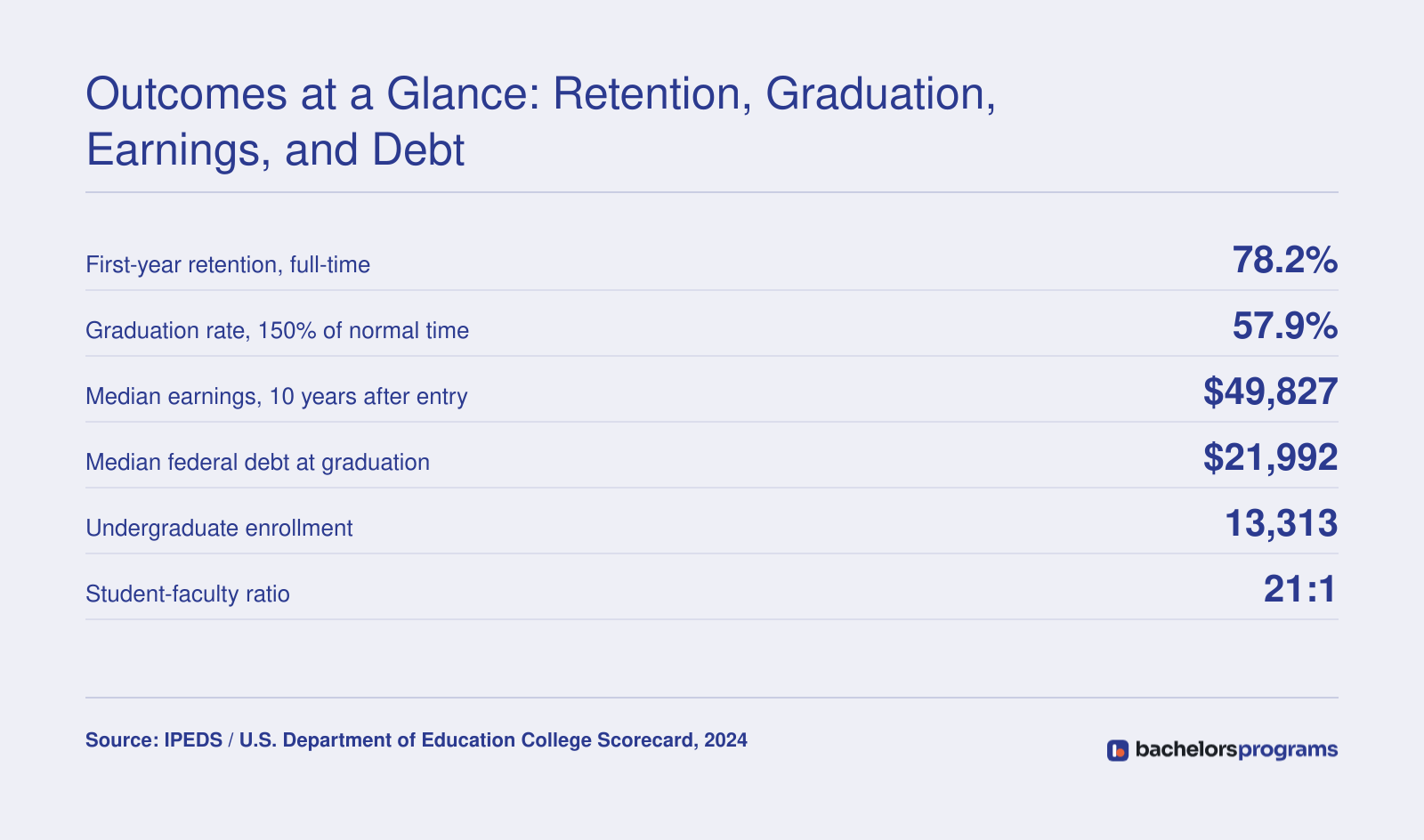
Outcomes at a Glance: Retention, Graduation, Earnings, and Debt
These are the numbers that matter most when you weigh Missouri State against another four-year public: 78.2% of full-time first-years return for a second year, 57.9% finish within 150% of normal time, and graduates report $49,827 in median earnings a decade after entry against $21,992 in median federal debt. The profile underneath is large and commuter-friendly, with 13,313 undergraduates, 13.6% of them studying part-time, and a 21:1 student-faculty ratio. That mix suits cost-conscious students, working adults using the online bachelor's programs, and career-specific majors such as nursing and finance; if you want small classes and a retention rate in the high 80s, a smaller residential campus deserves a harder look.
Accreditation: Institutional Status and Program-Level Credentials
Families now ask about accreditation directly, because licensure boards and graduate admissions offices check it before anyone else does.
The Institutional Stamp: HLC
Missouri State University is accredited by the Higher Learning Commission, continuously since 1915. HLC's comprehensive evaluation ran March 30 and 31, 2026, and on July 7, 2026 the commission reaffirmed accreditation for another decade. Institutional accreditation is what lets the university disburse federal financial aid, and what makes Missouri State credit portable to other universities and the degree recognizable to graduate admissions. HLC accredits the institution as a whole, not individual majors, so program credentials are a separate question.
Where a Program Has Its Own Accreditor
- Nursing: the B.S.N. is accredited by the Commission on Collegiate Nursing Education, current through Dec. 31, 2029, with a site visit scheduled for spring 2029.1 That status is what graduate nursing programs screen for, and it sits alongside the licensure pathway.
- Business: AACSB International covers all undergraduate and master's business programs on a six-year cycle, expiring in fall 2029. It is a voluntary standard layered on top of institutional accreditation.
- Social work: the B.S.W. holds Council on Social Work Education accreditation through Oct. 1, 2033. CSWE status is the eligibility hinge for social work licensure and for advanced-standing MSW admission.
- Computing: ABET's Computing Accreditation Commission accredits the B.S. Computer Science, specifically the Computer Science option, through Sept. 30, 2031, with a site visit that fall.
Two Plain Caveats
Teacher education's operative approval comes from the Missouri Department of Elementary and Secondary Education, which evaluates initial certification programs annually and lists status through 2027. The current listing does not establish a CAEP status, so do not assume one.
No ABET Engineering Accreditation Commission status is established for a Missouri State bachelor's engineering program in the current listing. If engineering is on your list, ask the department directly rather than inferring from the computing accreditation.
Verify It Yourself
Accreditation runs in cycles, and every date here will eventually move. Check the accreditor's own directory, HLC, CCNE, CSWE, AACSB, or ABET, rather than the university's marketing pages, which can trail a review by months.
Missouri State got easier to enter even as finishing stayed roughly as hard. Acceptance rate rose from 85% in 2018 to 90.5% in 2024, while the 150%-time graduation rate moved only from 54.5% to 57.9%, per IPEDS / U.S. Department of Education College Scorecard data. Getting in and getting out are separate questions.
Missouri State Bachelor's Degrees: Common Questions
These are the questions prospective students ask most often when comparing Missouri State with other public four-year options. Each answer is deliberately short; the sections above carry the full detail.
How many credits are required to graduate from Missouri State University?
Can transfer students finish a Missouri State bachelor's degree faster?
Does Missouri State University offer online bachelor's degrees?
What are the bachelor's degree requirements at MSU?
Which Missouri State bachelor's programs are professionally accredited?
Compare Missouri State University against every school in its field
Every ranking scores programs on net price after aid, graduation rate, earnings and debt from IPEDS and the College Scorecard.
Bachelor's degrees in Missouri Browse all fields