Best Accelerated BSN (ABSN) Programs in Montana
Compare 3 accredited Accelerated BSN (ABSN) programs in Montana, with net price after aid, graduation rates, earnings and debt from IPEDS and the U.S. College Scorecard.
An accelerated BSN is the fastest credible route from a non-nursing bachelor's degree to a Montana RN license, and it demands full-time commitment. Carroll College's track runs 15 months with 850 clinical hours. The University of Providence lists 12 months and 54 credits. Montana State University finishes in three semesters.
The ranked programs appear first. Admissions and prerequisites, program length, state approval, accreditation, NCLEX-RN results and clinical formats come next.
The calendar is the hard constraint. Each program admits cohorts on a fixed start term (summer at Carroll, fall at MSU, spring at Providence), so one unfinished science prerequisite can push a career change back by a full year.
Key Points
- Applicants need a prior bachelor's from a regionally accredited institution.
- Expect 12 to 18 months of full-time study with once-yearly admission.
- Montana Board of Nursing charges a nonrefundable $100 RN application fee.
Ranked: Accelerated BSN Programs for Montana Career Changers
Carroll College
#1Helena, MT · ~$24,000/yr (est.)
Best for: Small private-campus career changers
A private Catholic college in Helena with a compact campus and an established accelerated nursing track for people who already hold a degree. The program is CCNE accredited and pairs a simulation center with roughly 850 clinical hours split across hospitals, public health agencies and schools. In-state tuition and fees run $41,484, the institution-wide average net price after aid is $23,960, and the school's overall graduation rate sits near 69 percent, the strongest completion figure among the three Montana schools here. Carroll has also widened eligibility to applicants with an associate degree, which opens the track to career changers who never finished a four-year non-nursing bachelor's.
- CCNE accredited
- Cohort-based structure with a summer start
- About 850 clinical hours in hospitals, public health and schools
- State-of-the-art simulation center
- Commitment to Care loan forgiveness available to graduates
- Yellow Ribbon and military benefits accepted
- Small classes with a low student-to-faculty ratio
- Scholarships and financial aid offered
Montana State University
#2Bozeman, MT · ~$22,000/yr (est.)
Best for: Montana residents wanting public-university value
Montana's land-grant university in Bozeman and the largest nursing operation in the state, with the accelerated track delivered across five Montana campus locations. Because it is a public institution, Montana residents pay $8,460 in tuition and fees, far and away the lowest sticker price in this group. The institution-wide average net price after aid is $22,499 and the school's overall graduation rate is about 57 percent. New simulation laboratories funded through a $101 million investment support the clinical side of the curriculum, and graduates move into acute care, flight, travel, school and military nursing.
- CCNE accredited
- Taught across five Montana campus locations
- One cohort start per year, in fall
- Cohort-based structure
- NursingCAS application required
- Background check and drug screening before clinicals
- New simulation labs from a $101 million investment
- Pathways into acute care, flight, travel, school and military nursing
University of Providence
#3Great Falls, MT · $15,000 – $20,000/yr (est.)
Best for: Working adults choosing hybrid study
An independent Catholic university in Great Falls that runs its accelerated nursing track in a hybrid format, combining online coursework with in-person skill labs and clinical immersions. The institution-wide average net price after aid is $17,649, the lowest of the three, and clinical placements extend across Montana and Alaska. Its overall graduation rate is about 28 percent, so ask hard questions about advising and cohort support before you commit. A Providence Health partnership provides tuition discounts for eligible caregivers and their dependents, and employer tuition reimbursement is accepted.
- CCNE accredited
- Hybrid format: online coursework plus in-person labs
- Clinical immersions in Montana and Alaska
- Eight-week course intensives
- 54 credits of nursing coursework
- Providence Health partnership tuition discount
- Healthcare Professionals Tuition Incentive available
- Small Great Falls cohort of about 20 students
Cost & outcomes by school
Federal data for the highest-earning Accelerated BSN (ABSN) programs, independent of the ranking above. Earnings are this field's bachelor's graduates four years after completing where the Scorecard reports them, else the school's undergraduate median.
| School | Net price / yr | Grad rate | Earnings | Debt | Grads/yr | Format |
|---|---|---|---|---|---|---|
| Carroll College MT | $23,960 | 69% | $61,772 | $25,757 | 566 | Campus |
| Montana State University MT | $22,499 | 57% | $53,263 | $22,500 | 5,732 | Campus |
| University of Providence MT | $17,649 | 28% | $48,296 | $18,750 | 276 | Hybrid |
Sources: U.S. Department of Education. Net price, graduation rate, earnings and debt: College Scorecard (earnings and debt for this field's bachelor's graduates where reported, else school-wide); graduates: IPEDS. A dash means no figure is reported.
Cost, debt & payoff
Median earnings of this field's bachelor's graduates (4 yrs after completing, else the school's undergraduate median) vs. their median federal loan debt · U.S. College Scorecard
Across these programs the median graduate earns about $53,263 and finishes with roughly $22,500 in debt — a ratio that clears a common rule of thumb (keep debt below first-year salary). Net price and debt vary widely school to school, so check the per-school figures in the table above before you shortlist.
Getting Into a Montana ABSN: Prior Degree, GPA and Entrance Exam Policies
An accelerated second-degree BSN compresses nursing training for students who already hold a non-nursing bachelor's degree, and Montana has programs that do exactly that. That earlier degree has to carry regional accreditation. Montana State University requires a non-nursing bachelor's degree in hand before the fall start. University of Providence accepts a bachelor's in any field.
GPA and Entrance Exam Policies
- Montana State University: A 3.0 minimum applies to the required prerequisite courses. Grades must be C- or better, completed within 15 years of the start, with no more than two repeats (a withdrawal counts). At least 3 of the 5 natural-science prerequisites must be done at application, and BIOH 201 must be one of them. Applications go through NursingCAS, and no TEAS or HESI is listed.
- University of Providence: The minimum is 2.75, and applicants below it may be asked for an essay or academic review. No TEAS or HESI is listed.
- Carroll College: The Accelerated Nursing Track lists a 3.0 GPA minimum and required prerequisite courses.
Deadlines, Start Terms and Cohort Size
MSU starts in the fall, with a January 5, 2027 priority deadline for the 2026 cycle. Its pages suggest applications may be accepted until July 15 if slots remain, but confirm whether that applies to your cycle. Providence lists an August 1 application deadline and a Spring 2028 start, with cohorts tied to clinical-site location, including Great Falls. Its prerequisite dates conflict between the current page and the 2025 handbook (A&P I and II are due August 1 on one and June 15 on the other), so plan around the earlier date. Carroll's cohort begins in summer. None of the schools publishes a cohort size or guaranteed seats.
Judging Competitiveness
When a cohort is small relative to its applicant pool, the published minimums are floors, not targets. Because seat counts are not posted, ask each admissions office how many students it enrolls and what GPA the last cohort averaged. Institution-wide admission rates give a rough comparison of selectivity: Providence admits about 50 percent of applicants, Carroll about 71 percent, and Montana State about 82 percent. These rates cover the whole school, not the nursing track, and nursing cohorts usually admit far more selectively. Treat them as a loose signal and aim well above the minimums.
Science and General Education Prerequisites to Finish Before You Apply
Prerequisite lists differ between Montana State University and the University of Providence. Compare each school's requirements with your transcript before you apply.
- Anatomy and Physiology I and II with labsRequired at both schools. MSU lists BIOH 201 and BIOH 211, and BIOH 201 must be completed at application. Providence requires both courses finished by its August 1 application deadline.
- Microbiology with labMSU requires BIOM 250/251. Providence allows Microbiology to be finished by December 15.
- Chemistry (MSU)MSU requires CHMY 121IN/122IN and CHMY 123/124.
- Statistics and mathMSU requires STAT 216Q plus M 140 or M 121Q. Providence requires Statistics by December 15.
- NutritionMSU requires NUTR 221CS. Providence requires Nutrition by December 15.
- Psychology, human development and sociology (MSU)MSU requires HDFS 101IS or PSYX 230, SOCI 101IS or PSYX 100IS, and NRSG 116. These bring its prerequisite total to 37 credits.
- Minimum grades and GPAMSU requires C- or better in each course and a 3.0 prerequisite GPA. Its application page allows two retakes and counts a W as a repeat, but the catalog lists one, so confirm the limit with MSU. Providence requires a C (75%) or higher in each course.
- Recency and courses in progressMSU accepts prerequisites taken within 15 years of program start at a regionally accredited institution. At application, you must have completed 3 of 5 natural sciences and be on track to finish the rest. Providence requires A&P and Microbiology within 10 years and splits its deadlines, so confirm the dates for your cycle.
Related Articles
How Long a Montana Accelerated BSN Really Takes: 12, 15 or 16 Months?
An accelerated BSN sells speed, but the calendar behind that speed has almost no slack. Montana's programs admit once a year on a fixed term, so a missed prerequisite or a single failed course can push graduation back by a full 12 months rather than a single semester.
The Verified Numbers
Montana State University's accelerated BSN runs 12 months across three consecutive semesters, Fall, Spring and Summer, for 56 credits in total. The load is front-loaded: 19 credits in fall, 21 in spring and 16 in summer, with graduation at the end of the summer term. Entry is a Fall start only, and the current cycle points to a Fall 2027 cohort with applications opening in August 2026 and a priority deadline of January 5, 2027.
The University of Providence also finishes in 12 months over three semesters, totaling 54 credits across 18 courses, 18 of them clinical credits. Each semester divides into two eight-week intensives. The standard schedule opens in January and ends in December, though timing follows the clinical site: the Great Falls cohort began in May 2026 as an inaugural summer cohort.
Why You'll See 12, 15 or 16 Months Elsewhere
Third-party pages tend to differ because they count from a different starting month, fold a prerequisite term into the total, or report semesters as if they were months. A January-to-December calendar and a May-to-May calendar both describe 12 months of study but land on different end dates.
What Full-Time Actually Feels Like
There are no breaks. Summer is a full term carrying 16 credits, not a vacation, and 19 to 21 credits in one semester exceeds a standard full-time load before clinical hours begin. At Providence, the eight-week intensive structure means one course block closes and the next opens almost immediately.
Prerequisite coursework is the wildcard. Science and general education requirements must be finished before the clock starts, so a student who still needs microbiology or statistics faces a longer runway than the program length alone suggests.
What a Montana Accelerated BSN Costs: Tuition, Fees and Net Price Side by Side
The first three columns come from 2024 federal College Scorecard data and describe each school's general undergraduate pricing. The net price figure is an institution-wide average for aided undergraduates, not a quote for accelerated BSN students, so use the ABSN pricing column and each school's own published schedule for real budgeting. On aid, federal Pell Grants generally go only to students without a bachelor's degree, so most second-degree nursing students rely on federal Direct Loans, school scholarships and employer or partner discounts like those listed below.
| School | In-state tuition and fees (2024) | Out-of-state tuition and fees (2024) | Average net price after aid (2024, institution-wide) | Published ABSN pricing | Aid and discounts listed by the program |
|---|---|---|---|---|---|
| University of Providence | $30,448 | $30,448 | $17,649 | 2026-2027: 54 credits at $1,126 per credit general rate ($60,804) or $882 per credit healthcare rate ($47,628). Excludes admission and program fees, materials and clinical fees. Textbooks estimated at about $1,500 based on prior cohorts. | Financial aid and scholarships available; Providence Health partnership tuition discount; Healthcare Professionals Tuition Incentive; employer reimbursement supported |
| Montana State University | $8,460 | $33,287 | $22,499 | Summer 2026 schedule: nursing program fee of $5,978 per semester. Listed semester totals of $9,148.55 (8 credits) and $10,478.75 (18 credits) for residents; $17,430.15 and $22,901.15 for nonresidents. Schedule notes some course fees, program fees and health insurance are not in listed totals; tuition is subject to change. | Contact MSU Student Accounts for current amounts and aid options |
| Carroll College | $41,484 | $41,484 | $23,960 | N/A | Financial aid and scholarships available; military benefits accepted; Commitment to Care loan forgiveness |
Montana Board of Nursing Approval, Accreditation and NCLEX-RN Results
Two separate approvals stand behind a Montana accelerated BSN, and they answer different questions. One is the state's permission to run a nursing program and to present its graduates for licensure. The other is national programmatic accreditation, which reviews the curriculum, faculty and clinical experiences themselves.
What Each Credential Does
- Montana Board of Nursing approval: the legal gate. A program must hold it for its graduates to sit the NCLEX-RN and be licensed in Montana.
- Programmatic accreditation (CCNE or ACEN): the academic gate. It matters if you later apply to a master's or doctoral nursing program, and some employers and aid programs look for it.
Both Montana State University and University of Providence hold CCNE accreditation for their baccalaureate nursing programs, including the accelerated track. Neither lists ACEN accreditation for these programs.
Verifying Standing Before You Apply
Open the Montana Board of Nursing's approved nursing education programs list and match the campus and the exact track name, since traditional and accelerated BSN options are often listed separately. Ask admissions for the program's current approval letter. Approval status can change between publication cycles, so confirm it directly rather than relying on any summary, including this one.
NCLEX-RN Results, as Published
Montana State University's accelerated BSN page reports a 90.1% first-time NCLEX-RN pass rate for 2025, following 100% in 2024 and 94.12% in 2023. The University of Providence reports 96.43% for its accelerated nursing program in 2024, up from 80.50% in 2023 and 69.70% in 2022.
Read those with one caveat: schools and the Board do not always separate accelerated graduates from traditional BSN graduates, so a published rate may cover the campus's whole BSN cohort. Ask admissions which graduates a figure describes. The Board's own report gives statewide results by calendar year rather than program-specific rates, and Montana's first-time pass rate was 92.60% in 2024 across 689 first-time candidates.
Getting Your Montana RN License After an Accelerated BSN
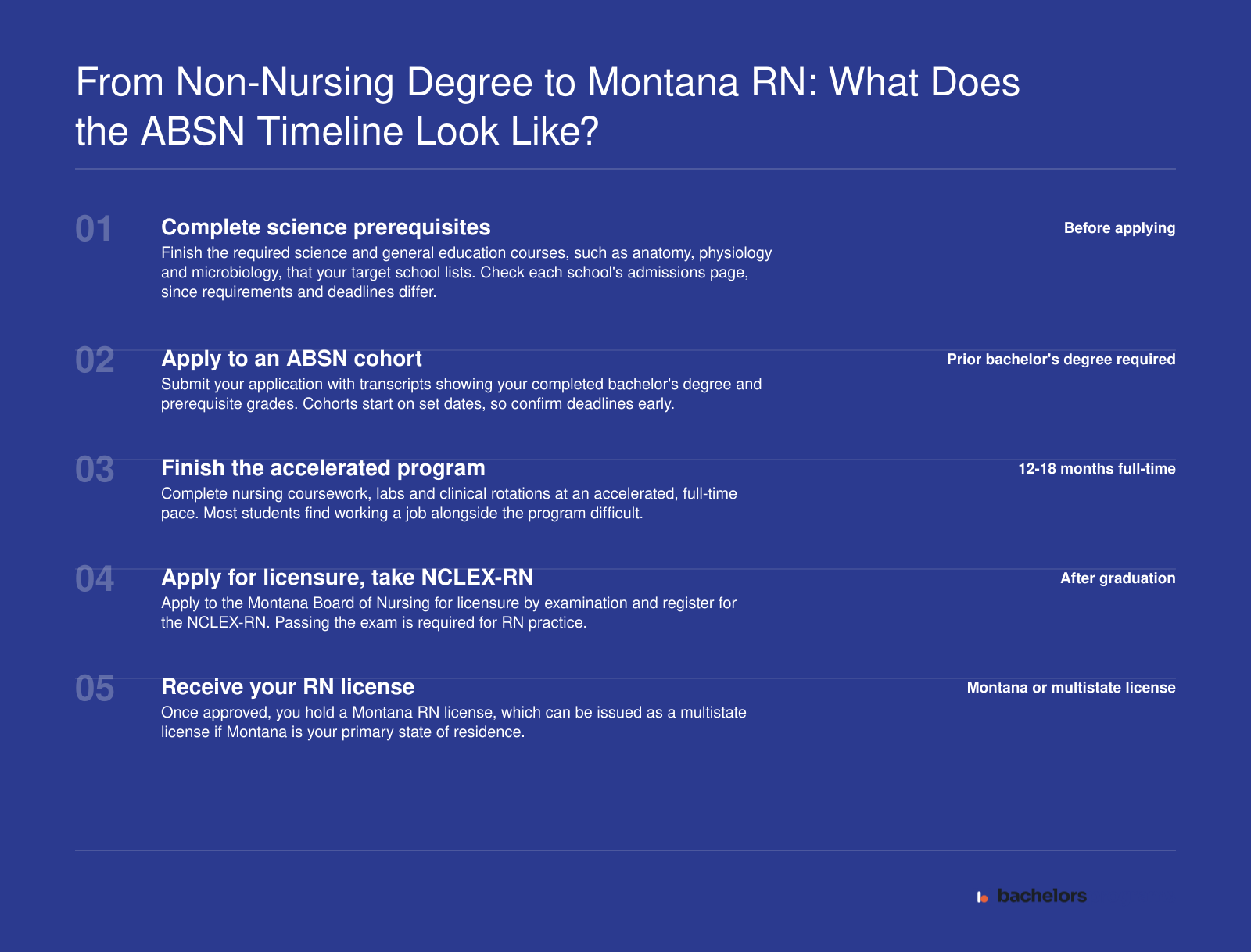
From Non-Nursing Degree to Montana RN: What Does the ABSN Timeline Look Like?
For career changers, an accelerated BSN builds on the bachelor's degree you already hold, so the path to a Montana RN license runs through five ordered steps rather than four years of school. The full-time program sits at the center, typically 12 to 18 months at Carroll College, Montana State University or the University of Providence, but science prerequisites and licensure paperwork add time before and after it. Plan each stage in sequence so the next one is ready when you finish.
Campuses, Clinical Rotations and Delivery Formats Across Montana ABSN Programs
Delivery format in an accelerated BSN comes down to three things: where you attend class, where you practice skills, and where you log clinical hours. In Montana those answers differ sharply by school, so confirm them before you apply.
Campus-Based Programs
Carroll College runs its Accelerated Nursing Track as a campus-based, cohort program in Helena. Its 15-month format includes 850 clinical hours, and the school lists hospitals, public health and schools among its clinical settings.
Montana State University is also campus-based, but it spreads the accelerated BSN across five Montana campuses: Billings, Bozeman, Great Falls, Kalispell and Missoula. Great Falls opened in Fall 2025, Billings and Bozeman are scheduled for Summer 2026, and Kalispell and Missoula for Fall 2026. You rank your campus preferences in NursingCAS, but the program does not guarantee your first choice. MSU does not name its clinical hospital partners publicly, so ask the admissions office. All of its sites are in Montana.
Hybrid Delivery at University of Providence
University of Providence is the hybrid option. Lectures are online, while skill labs and clinical immersions happen in person. For 2026, Montana sites are Lewistown and Great Falls. Anchorage, Alaska is a separate site, and a Juneau, Alaska pilot has been reported but is not confirmed for 2026, so do not plan around it.
Hybrid does not mean location-free. Providence cohorts are tied to a designated clinical-site location, and students are expected to live in or move to that area. Great Falls starts in May 2026, while Lewistown and Anchorage start in January.
How Placements Work
At Providence, placement depends on site capacity and student requests. Coordinators try to honor preferences but cannot promise them. Before you enroll at any school, ask who arranges placements (the school or you), whether rotations ever require travel to another town, and how far those sites may be from where you live.
Choose by Location First
At this pace, nursing school is close to a full-time job, and clinical shifts can be long and set by the placement site. A long daily commute adds up quickly. Start with the campus or clinical site you can realistically live near, then compare programs from there.
Questions to Ask Yourself
Can you stay near campus or the clinical sites for the better part of a year without a full-time job?
Are your anatomy, physiology and microbiology credits recent enough to count?
Would a Montana campus cohort or a hybrid format with travel to clinicals fit your life better?
How will you cover living costs for 12 to 18 months of full-time study?
Compare Accelerated BSN (ABSN) programs on the data that matters
Explore more Nursing majors or browse every field of study.
All Nursing programs Browse every field of study