Best RN to BSN Programs in Montana
Compare 4 accredited RN to BSN programs in Montana, with net price after aid, graduation rates, earnings and debt from IPEDS and the U.S. College Scorecard.

An RN to BSN in Montana is upper-division work, not a second degree. Programs on this list run from 37 to 49 total credit hours, and the ADN or diploma behind your license supplies the rest. Very little repeats.
Coursework is fully online at every school ranked here, so a nurse in Havre, Pablo or Great Falls is not really choosing a campus. Hybrid programs were excluded, which keeps the list short. Transfer credit, pacing and where the clinical project sits are what separate these programs.
Time is the real constraint. Three semesters is the common shape; part-time study stretches it. Montana employers increasingly write the BSN into hiring terms, and an active license alone no longer settles the question.
Key Points
- Every program below runs online, with clinical work completed near home.
- Montana joined the Nurse Licensure Compact in October 2015.
- Magnet hospitals in Montana increasingly write the BSN into hiring terms.
4% Online RN to BSN Programs in Montana, Ranked
Four Montana programs deliver RN to BSN coursework fully online to licensed registered nurses, and only those four qualified for this list. Each one keeps clinical work local and lets a working nurse hold a full-time schedule while finishing the bachelor's degree.
Salish Kootenai College
#1Pablo, MT · ~$8,000/yr (est.)
Best for: Rural nurses wanting asynchronous online study
Salish Kootenai College is a tribal college whose RN to BSN track is built for licensed nurses who cannot step away from a paycheck. Coursework runs fully online and asynchronously with optional synchronous meetings, and students choose part-time completion across six quarters or an accelerated three-quarter route. The school's overall graduation rate is 28%, and median earnings for its nursing bachelor's graduates ten years after entry are about $32,700.
- Fully online asynchronous format with optional synchronous meetings
- Part-time completion in 6 quarters; full-time in as few as 3
- Upper-division entry designed for licensed RNs with an ADN
- Precepted quality improvement capstone project
- Curriculum emphasizes clinical leadership and public health
- Annual federal background check required
- Financial aid and scholarships available
Montana State University-Northern
#2Havre, MT · ~$13,000/yr (est.)
Best for: Nurses stretching coursework over many years
Montana State University-Northern runs its RN to BSN completion program fully online for nurses holding an associate degree, then lets each student pick the pace: three semesters full-time or part-time study stretched across as many as five years. Two clinical credits are finished locally, so no relocation or commute is involved, and the coursework covers nursing leadership, community health, evidence-based practice, and healthcare policy. The program is ACEN accredited and approved by the Montana State Board of Nursing. The school's overall graduation rate is 41%, and nursing bachelor's graduates report median earnings of about $49,500 ten years after entry, with median federal debt of roughly $18,500.
- ACEN accredited and approved by the Montana State Board of Nursing
- Fully online coursework with no commuting required
- Full-time in 3 semesters or part-time over up to 5 years
- Two-credit clinical component completed in the student's local area
- Curriculum covers leadership, community health, and healthcare policy
- Built as a seamless transition for ASN graduates
- Prepares graduates for nurse manager, case manager, and educator roles
- Financial aid and scholarships available
Montana State University Billings
#3Billings, MT · $17,000/yr (est. net price)
Best for: ADN students starting BSN coursework early
Montana State University Billings pairs its RN to BSN completion program with a coordinated 2+1 route that moves ASN students from the university's City College straight into the bachelor's track without starting over. The 49-credit online curriculum runs in eight-week blocks with fall, spring, and summer starts, and clinical hours take the form of faculty-led mentored projects completed in the nurse's own facility or community, so no travel is required. Nurses can even begin concurrent enrollment while still finishing an ADN. The school's overall graduation rate is 30%, and nursing bachelor's graduates report median earnings of about $44,300 ten years after entry.
- CCNE accredited
- 49 total credit hours, including technical writing, statistics, and developmental psychology
- 8-week block scheduling with fall, spring, and summer starts
- Three semesters full-time, with part-time options available
- Faculty-led clinical mentored projects completed in the student's community
- No travel required for clinical hours
- Concurrent enrollment available while still in an ADN program
- At least 30 credits must be earned from MSU Billings
University of Providence
#4Great Falls, MT · $15,000 – $20,000/yr (est.)
The University of Providence offers a 12-month, 37-credit RN to BSN that was developed with Providence St. Joseph Health, one of the region's largest health systems, which gives graduates a familiar name on their resume inside that system's hiring pipeline. Coursework is entirely online and asynchronous in a cohort format, with four classes each semester spread across two eight-week sessions, and graduates move into leadership, specialty roles, or graduate nursing study. Admission requires an active, unencumbered RN license, a 2.75 GPA, and a NursingCAS application, and a nursing diploma is accepted alongside the ADN. The school's overall graduation rate is 28%, and nursing bachelor's graduates report median earnings of about $48,300 ten years after entry.
- CCNE accredited
- 12-month, 37-credit completion program
- 100% online asynchronous coursework in a cohort format
- Three semesters, four classes each, in two 8-week sessions per semester
- Active, unencumbered RN license and 2.75 GPA required
- Nursing diploma accepted alongside the ADN
- NursingCAS application with a fall start and July 9, 2027 deadline
- Healthcare Professionals Tuition Incentive for qualifying students
Cost & outcomes by school
Federal data for the highest-earning RN to BSN programs, independent of the ranking above. Earnings are this field's bachelor's graduates four years after completing where the Scorecard reports them, else the school's undergraduate median.
| School | Net price / yr | Grad rate | Earnings | Debt | Grads/yr | Format |
|---|---|---|---|---|---|---|
| Montana State University-Northern MT | $12,664 | 41% | $49,505 | $18,500 | 254 | Online |
| University of Providence MT | $17,649 | 28% | $48,296 | $18,750 | 276 | Online |
| Montana State University Billings MT | $16,524 | 30% | $44,296 | $18,209 | 720 | Online |
| Salish Kootenai College MT | $7,945 | 28% | $32,725 | $12,923 | 88 | Online |
Sources: U.S. Department of Education. Net price, graduation rate, earnings and debt: College Scorecard (earnings and debt for this field's bachelor's graduates where reported, else school-wide); graduates: IPEDS. A dash means no figure is reported.
Cost, debt & payoff
Median earnings of this field's bachelor's graduates (4 yrs after completing, else the school's undergraduate median) vs. their median federal loan debt · U.S. College Scorecard
Across these programs the median graduate earns about $46,296 and finishes with roughly $18,355 in debt — a ratio that clears a common rule of thumb (keep debt below first-year salary). Net price and debt vary widely school to school, so check the per-school figures in the table above before you shortlist.
How This Fully Online Montana List Was Scored
Plenty of programs advertise flexibility; far fewer are fully online with no campus attendance at all. That is why delivery was the first cut. Only RN to BSN completion programs that require no on-campus attendance stayed in, and hybrid formats were removed before any scoring began.
What the Composite Weighs
The remaining schools were compared on four things:
- Cost: published tuition and average net price.
- Completion: the institution-wide graduation rate.
- Outcomes: College Scorecard earnings and debt, where published.
- Accreditation: CCNE or ACEN status.
Scorecard figures describe the whole institution, not this program alone, so treat them as context rather than a promise.
Accreditation and Coverage
Salish Kootenai College, Montana State University-Northern, Montana State University Billings and University of Providence each run an RN to BSN program. The sources behind this ranking did not give a current accreditor record, term or expiration date for each program. Confirm status in the CCNE and ACEN directories before you apply, and check that the accreditation covers the RN to BSN program itself rather than another nursing degree.
One Montana university with a CCNE-accredited pre-licensure nursing school is not ranked. Its official pages describe the four-year BSN, while its RN to BSN track (current RN licensure plus 48 additional credits) appears only as a proposal, with no clearly active completion cohort. Until that program is confirmed open, it stays off the list.
This ranking reflects data available as of November 2026. Program details change, so verify current terms with each school.
RN to BSN Admission Checklist for Montana Nurses
Admission to an RN to BSN completion program centers on the license and nursing education you already have. Use this checklist to gather your materials, then confirm the details with each school before you apply.
- Active, unencumbered RN licenseUniversity of Providence requires an active, unencumbered RN license to apply. Montana State University-Northern accepts a copy of your Montana RN license with the application.
- Associate degree or diploma in nursingUniversity of Providence admits graduates of an associate nursing program. If you trained through a hospital diploma program, ask each school how it evaluates that coursework.
- Prerequisite and general-education creditsUniversity of Providence's program handbook lists no additional prerequisites, and MSU-Northern's 2025 application lists none either. Remaining general-education courses are typically completed alongside your nursing coursework.
- Minimum GPAMSU-Northern asks for a cumulative GPA of 2.50 or higher. At Salish Kootenai College, Montana State University Billings and University of Providence, confirm the GPA standard with admissions.
- Official transcripts from every college attendedMSU-Northern reviews transcripts from all prior colleges to decide how credits transfer. University of Providence evaluates prior nursing education during admission, so expect a credit review rather than a fixed transfer cap.
- Recent ADN graduates awaiting licensureMSU-Northern accepts an NCLEX-RN exam date in place of a license copy, which may let new graduates apply before they are licensed. Ask how soon you must hold the license after you enroll.
- Background check and immunizationsMany nursing programs require a background check and current immunization records before any practice experience. Ask each school what it requires and when it is due.
Montana RN Licensure and the Nurse Licensure Compact
How Long an RN to BSN Takes in Montana and What It Costs
An RN to BSN in Montana is a credit-and-calendar calculation: you start with an ADN or diploma, transfer the credits a school will accept, and finish the upper-division nursing courses while working. The shortest schedule is not automatically the lowest cost.
Credits come first
University of Providence runs a 37-credit RN to BSN. Its core courses may be completed online at UP or transferred in, and the program manager confirms how much of your ADN work applies. MSU Billings lists 49 total credit hours and a minimum of 30 credits completed from MSU Billings, so transfer credit can shorten the degree but not erase the residency requirement. MSU-Northern and Salish Kootenai College also enroll licensed RNs at the upper-division level; request a written credit evaluation from each before comparing calendars.
Full-time pace versus part-time
At UP, full-time means 12 consecutive months across three semesters, with 12 credits and four classes per semester. That is a heavy load for a nurse working 36-hour weeks, even with asynchronous classes. MSU Billings and MSU-Northern list three-semester plans with full-time and part-time options, and the part-time route may stretch beyond three semesters. SKC lists a three-quarter full-time option and a six-quarter part-time option.1 UP's published application deadline is July 9, 2027 for a fall start; SKC lists June 7, 20271. MSU Billings offers fall, spring, and summer starts.
The published cost
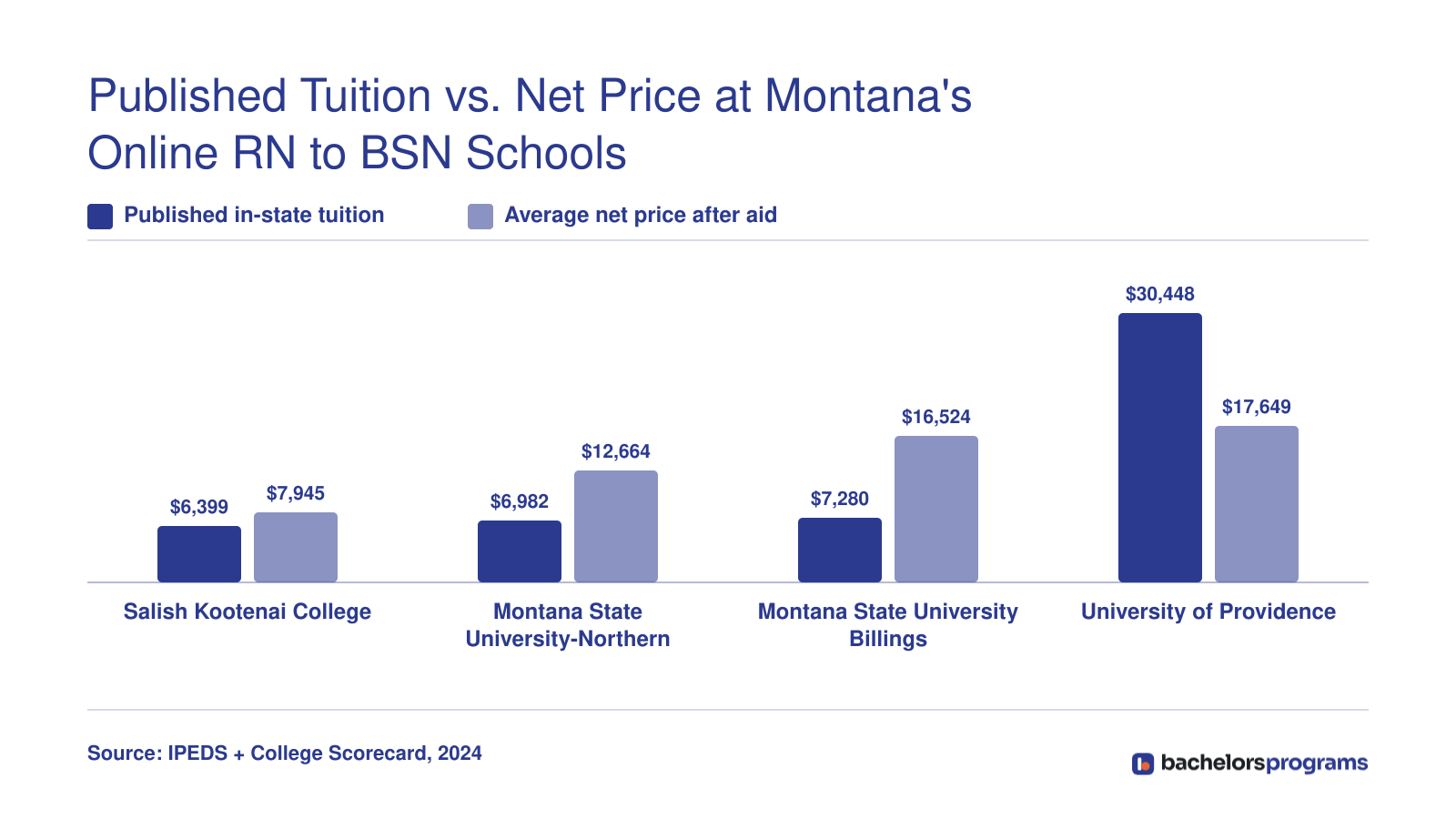
UP's 2026-27 rate is $586 per credit under its healthcare professionals tuition incentive, or $972 at the general rate. At 37 credits, that is $21,682 or $35,964, before admission and program-related fees such as application, textbooks, materials, and clinical fees. Institution-wide published tuition and fees are $4,311 at SKC, $6,982 at MSU-Northern, $7,280 at MSU Billings, and $30,448 at UP; average net prices are $7,945, $12,664, $16,524, and $17,649. Those net prices are institution-wide averages, not a quote for this program. On those institution-wide numbers, SKC is the most affordable option here. For a whole-program total, UP's $21,682 healthcare rate is the clearest figure available.
Employer tuition help
Check your employer benefit before taking loans. UP advertises Providence caregiver tuition discounts and a Healthcare Professionals Tuition Incentive. Nurses at other Montana systems, including Billings Clinic, Benefis Health System, and Logan Health, should ask HR whether RN to BSN credits are reimbursed; the answer depends on the employer and your status.
Published Tuition vs. Net Price at Montana's Online RN to BSN Schools
Published tuition and what students actually pay rarely match. Average net price starts from a school's full cost of attendance, including books and living expenses, then subtracts the grant aid students receive across the whole institution. That is why it lands above tuition at the public schools and well below it at University of Providence. Both figures are campus-wide averages, so a working RN studying part time, possibly with employer tuition help, may pay more or less.
Related Articles
Clinicals in an Online RN to BSN: Three Models Compared
The word "clinical" does not mean the same thing at every Montana RN to BSN program, and that single difference decides how much time you spend away from your unit.
The Three Models
- Coursework-only completion: Study is fully remote with no separate placement to schedule. The Online RN-BSN at University of Providence is delivered 100% online over 12 months for currently practicing RNs who hold an ADN.
- Local practicum credits: You complete a defined block of clinical work near home rather than on campus. The RN-BSN Completion Program at Montana State University-Northern is primarily online for ASN holders, runs three semesters full time, and carries a two-credit clinical component done in your own local area.
- Workplace or preceptor-based hours: Community health and leadership experiences are completed at an approved site, often under a preceptor, with site agreements and documentation. Ask Salish Kootenai College and Montana State University Billings which model their RN to BSN programs use before you assume.
Questions for Admissions and Placement Staff
- Who arranges the preceptor, you or the school?
- Can a preceptor at your current employer be approved?
- What affiliation agreements, site forms, or background checks are required?
- Are exams proctored remotely, or do you need a local testing site?
- Is any orientation, intensive, or campus visit mandatory?
Verify It in Writing
Start on each program's own RN to BSN page and request the clinical or practicum handbook, the course catalog, and accreditation disclosures. Confirm programmatic accreditation through CCNE or ACEN, approval and licensure questions through the Montana Board of Nursing, and scope and workforce context through the Bureau of Labor Statistics Occupational Outlook Handbook. The Montana Nurses Association and the American Nurses Association cover practice standards.
Build a simple matrix using only what you receive in writing. Note whether each requirement is fixed or negotiable, log the staff member's name and the date you spoke, and get written confirmation of clinical, proctoring, and campus visit details before you enroll.
Why an RN to BSN Opens Doors in Montana Hospitals
In Montana, the BSN is no longer a credential nurses pick up eventually; employers now write it into their hiring terms.
Magnet Status and the BSN Push
Billings Clinic describes itself as Montana's first Magnet facility, and in 2026 it announced Magnet recognition for the fifth consecutive time. The designation is not permanent. Hospitals must reapply every four years, and Magnet standards reward organizations that invest in nursing education and build a BSN-prepared workforce. Logan Health is pursuing Magnet status and lists tuition reimbursement among its total rewards for inpatient RNs,4 a sign that other Montana employers are heading the same way.
What Billings Clinic Expects From ADN Nurses
Billings Clinic still hires associate-degree RNs, but its 2026 postings prefer a BSN.1 The terms worth knowing:
- Completion window: Associate or diploma RNs hired into certain positions with less than five years of experience must commit to finishing a BSN within four years of hire.1
- Residency timeline: The nurse residency FAQ cites three years from the start date to complete the BSN, and enrolling right away is up to the nurse. Ask a recruiter which timeline applies to your role.
- Support: The clinic provides financial assistance, and its workforce materials mention paid class time, covered exam fees and supplies.3
New graduates with an ADN can still enter the clinic's 12-month nurse residency, which accepts nurses with less than 12 months of RN experience.2
Advancement and the Path to Graduate Study
Beyond the bedside, charge nurse, nurse manager, public health and case management postings commonly require or prefer a BSN. The degree also matters for what comes next: most MSN programs, including nurse practitioner and nurse educator tracks, expect applicants to hold a BSN. For a working RN, finishing an RN to BSN makes leadership roles available now and graduate study possible later.
Questions to Ask Yourself
Does your employer's tuition benefit require a specific school or a work commitment after graduation?
Can your unit support a community health practicum near your town, or do you need a project-based option?
Will you take one course at a time around 12-hour shifts, or push full time to finish in about a year?
Does your ADN transcript already cover the statistics and general-education prerequisites?
RN to BSN in Montana: Your Questions Answered
These answers cover the questions Montana nurses ask most before choosing a completion program. Where a school's details vary or change by term, confirm them with its admissions office before you apply.
How many months does a Montana RN to BSN usually take?
What does an online RN to BSN cost for a Montana resident?
Can I keep working full time while finishing my RN to BSN in Montana?
Do Montana RN to BSN programs require clinical hours?
Which Montana RN to BSN option costs the least?
How many of my ADN credits will transfer?
When do online RN to BSN cohorts start in Montana, and how early should I apply?
Compare RN to BSN programs on the data that matters
Explore more Nursing majors or browse every field of study.
All Nursing programs Browse every field of study