Best BSN Programs in Montana
Compare 8 accredited Bachelor of Science in Nursing (BSN) programs in Montana, with net price after aid, graduation rates, earnings and debt from IPEDS and the U.S. College Scorecard.

Montana nursing schools increasingly compete on direct admission, and that competition is changing how applicants compare programs.
The outcome spread is wide: first-time NCLEX-RN pass rates at the schools ranked here run from 85.5% to 98.6%, while tuition ranges from roughly $4,000 a year at the public colleges to more than $40,000 at the private ones. Only traditional pre-licensure BSN programs are ranked, ordered by first-time NCLEX-RN pass rate.
Where a school seats you matters as much as its pass rate. Some admit freshmen straight into the nursing major; others hold a competitive upper-division entry after prerequisites, and a lost clinical seat can cost a year.
Key Points
- At $6,399, Salish Kootenai College charges the lowest public in-state tuition here.
- University of Providence BSN graduates report a $121,185 median five years out.
- New Montana RNs pay $100 to apply for licensure by examination.
8 Montana BSN Schools Ranked by NCLEX-RN Performance
First-time NCLEX-RN pass rates anchor this list, with accreditation status and recent completion numbers separating programs that land close together. Each card carries the school's city, delivery format, in-state tuition, average net price after aid, and the institution-wide graduation rate. Across the group, first-time pass rates run from 73.6% to 98.6%.
Montana Technological University
#1Butte, MT · ~$16,000/yr (est.) · NCLEX-RN pass rate 98.6% (3-yr weighted avg)
Best for: High-achieving Montana high school seniors
Montana Technological University in Butte runs its BSN through the Sherry Lesar School of Nursing, where students log close to 1,000 clinical hours across more than 35 partner facilities in southwest Montana. A high-fidelity simulation center and a 3.5 GPA minimum set the academic bar, and the Nursing Scholar's Edge pathway lets strong Montana high school seniors lock in a seat before arriving on campus. Clinical placements reach hospitals, clinics and community settings, giving graduates a wide base for emergency, critical care or school nursing work.
- CCNE accredited BSN through the Sherry Lesar School of Nursing
- Minimum 3.5 GPA for admission
- Nearly 1,000 clinical hours with 35+ partner facilities
- High-fidelity simulation center with Core Four Standards endorsement
- Nursing Scholar's Edge direct entry for Montana high school seniors
- Prepares graduates for NCLEX-RN and advanced practice study
Carroll College
#2Helena, MT · ~$24,000/yr (est.) · NCLEX-RN pass rate 98.1% (3-yr weighted avg)
Best for: Private-college students wanting a liberal arts core
Carroll College is a private Catholic liberal arts college in Helena, and its BSN layers clinical training on a broad liberal arts core rather than a pure health-sciences track. More than 1,600 nurses have graduated from the CCNE-accredited program, and coursework ranges from pathophysiology and pharmacology to nursing leadership and management. A loan forgiveness partnership with Benefis Health System is unusual for a school of this size and is worth asking about before you commit.
- CCNE accredited BSN built on a liberal arts foundation
- More than 1,600 nurses have graduated from the program
- Clinical placements with NCLEX preparation woven through the curriculum
- Loan forgiveness partnership with Benefis Health System
- Coursework in pathophysiology, pharmacology and nursing leadership
- Scholarships and grants available to nursing students
University of Providence
#3Great Falls, MT · $15,000 – $20,000/yr (est.) · NCLEX-RN pass rate 96.2% (3-yr weighted avg)
Best for: Students seeking a Catholic health-sciences setting
The University of Providence, a private Catholic university in Great Falls, offers a four-year traditional BSN of 120 credits with rolling admissions and a 3.3 GPA threshold. Students take roughly 60 credits of biology, chemistry and liberal arts before moving into nursing coursework in ethics, pharmacology and population health, with hands-on work in a skills lab and at local clinical sites. The Boost UP partnership with Benefis Health System provides eligible students up to $30,000 in support plus a hiring pathway after graduation.
- Four-year, 120-credit traditional BSN
- 3.3 GPA minimum plus prerequisite coursework
- Rolling admissions each cycle
- Skills lab plus clinical placements at Great Falls area facilities
- Boost UP partnership offers up to $30,000 in student support
- Catholic liberal arts curriculum in ethics and population health
Montana State University
#4Bozeman, MT · ~$22,000/yr (est.) · NCLEX-RN pass rate 91.3% (3-yr weighted avg)
Montana State University runs the largest BSN in the state through a five-campus, one-college model, with nursing coursework available in Bozeman, Billings, Great Falls, Kalispell and Missoula. Students can finish prerequisites in Bozeman and then apply to complete the upper division at whichever site fits their life. Roughly $101 million in new nursing facilities has come online across the system, and Montana high school graduates have a direct entry route into the college.
- Five-campus, one-college model across Montana
- 3.0 GPA minimum with prerequisite science courses
- Montana Direct Entry for qualifying high school graduates
- New simulation labs funded by a $101M facilities investment
- Application submitted through NursingCAS
- Prerequisite courses must be completed within 15 years
- Clinical settings span acute care, flight nursing and school nursing
Montana State University Billings
#5Billings, MT · $17,000/yr (est. net price) · NCLEX-RN pass rate 86.9% (3-yr weighted avg)
Montana State University Billings is where many of the state's associate-degree nurses go to finish a bachelor's. The BSN here is an RN to BSN degree completion track: 49 credits over three semesters, mostly online, with mentored clinical courses completed in the community where the student already lives and works. Students enrolled in an associate-degree RN program can begin BSN coursework concurrently, and applications roll each semester.
- RN to BSN completion for licensed associate-degree nurses
- 49 credits across three semesters
- Online coursework with mentored community clinical courses
- Rolling admissions each semester
- Concurrent enrollment option for students in an ASN program
- Focus on leadership, health policy, research and management
Salish Kootenai College
#6Pablo, MT · ~$8,000/yr (est.) · NCLEX-RN pass rate 85.5% (2-yr weighted avg)
Salish Kootenai College, a tribal college in Pablo, admits students directly into a four-year BSN from day one, so there is no second application to the nursing major later. Cohorts stay small, faculty-to-student ratios are low, and clinical rotations run through urban and rural Montana hospitals with an eye toward federal nursing careers in the Indian Health Service and Veterans Administration. An entrance exam is required, and the college posts its nursing application and student handbook online.
- Direct admit: students enter the nursing major from day one
- Four-year, cohort-based program
- Entrance exam required for admission
- Small faculty-to-student ratios and high-fidelity simulation
- Clinical rotations at urban and rural Montana hospitals
- Transfer option available for sophomores
- Prepares students for Indian Health Service and VA nursing roles
Montana State University-Northern
#7Havre, MT · ~$13,000/yr (est.) · NCLEX-RN pass rate 73.6% (3-yr weighted avg)
Montana State University-Northern in Havre delivers its BSN online for nurses who already hold an associate degree and a license. Full-time students finish the RN to BSN in three semesters and part-time students can stretch it to five years, with a two-credit clinical component completed in the student's own area. The program is approved by the Montana State Board of Nursing and built around leadership, community health, evidence-based practice and informatics.
- RN to BSN for nurses with an associate degree and active license
- Fully online coursework with a two-credit local clinical component
- Three semesters full time, up to five years part time
- Built around leadership, community health and informatics
- Approved by the Montana State Board of Nursing
- No redundant coursework for associate-degree graduates
Blackfeet Community College
#8Browning, MT · ~$5,000/yr (est.)
Blackfeet Community College in Browning offers a BSN built around entry-level professional nursing care across the lifespan, with an explicit emphasis on culturally competent practice and interprofessional teamwork. The program uses a hybrid format, which matters for students who need to stay close to home while earning a four-year degree. Coursework covers evidence-based frameworks, legal and ethical accountability, and leadership in safe, cost-effective care.
- Hybrid BSN format
- Entry-level nursing care across the lifespan
- Culturally competent care focus
- Evidence-based practice and science-based frameworks
- Leadership in safe, cost-effective nursing care
- Interprofessional team practice
Cost & outcomes by school
Federal data for the highest-earning Bachelor of Science in Nursing (BSN) programs, independent of the ranking above. Earnings are this field's bachelor's graduates four years after completing where the Scorecard reports them, else the school's undergraduate median.
| School | Net price / yr | Grad rate | Earnings | Debt | Grads/yr | Format |
|---|---|---|---|---|---|---|
| Carroll College MT | $23,960 | 69% | $61,772 | $25,757 | 566 | Campus |
| Montana Technological University MT | $16,481 | 58% | $54,329 | $18,750 | 528 | Campus |
| Montana State University MT | $22,499 | 57% | $53,263 | $22,500 | 5,732 | Campus |
| Montana State University-Northern MT | $12,664 | 41% | $49,505 | $18,500 | 254 | Online |
| University of Providence MT | $17,649 | 28% | $48,296 | $18,750 | 276 | Campus |
| Montana State University Billings MT | $16,524 | 30% | $44,296 | $18,209 | 720 | Hybrid |
| Salish Kootenai College MT | $7,945 | 28% | $32,725 | $12,923 | 88 | Campus |
| Blackfeet Community College MT | $5,410 | 62% | $22,953 | — | 6 | Hybrid |
Sources: U.S. Department of Education. Net price, graduation rate, earnings and debt: College Scorecard (earnings and debt for this field's bachelor's graduates where reported, else school-wide); graduates: IPEDS. A dash means no figure is reported.
Cost, debt & payoff
Median earnings of this field's bachelor's graduates (4 yrs after completing, else the school's undergraduate median) vs. their median federal loan debt · U.S. College Scorecard
Across these programs the median graduate earns about $48,901 and finishes with roughly $18,750 in debt — a ratio that clears a common rule of thumb (keep debt below first-year salary). Net price and debt vary widely school to school, so check the per-school figures in the table above before you shortlist.
How This Montana BSN Ranking Was Built
The NCLEX-RN is the one outcome every BSN graduate in Montana shares, so it carries most of the weight in this ranking. A nursing degree only leads to practice once a graduate passes that exam, which makes first-attempt results the clearest signal of how well a program prepares its students.
What Drives the Score
About three quarters of each school's score comes from its first-time NCLEX-RN pass rate, drawn from the Montana Board of Nursing's latest three years of results. Each year is weighted by how many students sat the exam, so one unusually small cohort cannot lift or sink a program on its own. Accreditation and a smaller completion-and-retention measure account for the remaining share. In practice, they work as tie-breakers when pass rates land close together.
How to Read the Supporting Figures
- Graduation and retention: These rates are institution-wide. They count every student at the school, not nursing majors alone.
- Net price: This is an average cost after grants and scholarships, not a quote for every student. Your own price depends on income, residency and the aid package you receive.
- Earnings and debt: These figures come from College Scorecard, and each one on this page is labeled with its measurement window, meaning the point after completion when it was recorded. Where only an institution-wide figure exists, read it as context about the school, never as the nursing program's own result.
What Is Not Ranked Here
This list covers traditional pre-licensure BSN programs only. Licensed RNs finishing a bachelor's degree should look at RN to BSN programs, and students who already hold a bachelor's in another field should look at accelerated BSN programs. Both routes have their own pages on bachelorsprograms.com and are not scored here.
Where Montana BSN Graduates Post the Strongest NCLEX-RN Results
A near-perfect NCLEX-RN pass rate is the best single sign that a program prepares nurses well, but it only counts the students who make it to the exam. Keep that limit in mind when comparing these figures.
- Highest pass rate: Montana Technological University leads the BSN programs here at 98.6 percent. Carroll College follows at 98.1 percent, then University of Providence at 96.2 percent. Great Falls College Montana State University posts a higher 98.3 percent, but its program is an associate degree in nursing, not a BSN.
- Top tier vs. the rest: Montana Tech and Carroll sit within half a point of each other, and Providence is only a couple of points back. Below that the figures step down: Montana State University at 91.3 percent, Montana State University Billings at 86.9 percent, and Salish Kootenai College at 85.5 percent. From first to last that is a gap of about 13 points, which is wide enough to affect your odds of licensure on the first try.
- Why a three-year rate beats a single-year claim: The figures here pool several years of results and weight them by cohort size. A single class of 25 or 30 can swing several points on just a few failures, so one strong year proves little. Pooling smooths that noise. Salish Kootenai's figure rests on 27 test takers over two years, so read it as less settled. Montana State's rests on far more graduates.
- What to ask each program: Request its most recent first-time pass rate and its attrition before NCLEX. A high pass rate can hide students who left the major or were counseled out before graduation. Ask how many students start the nursing sequence in a cohort and how many finish it on schedule. That comparison shows whether a program is strong at teaching or strong at filtering.
Related Articles
BSN Admissions in Montana: Prerequisites, GPA and Direct Admit vs Upper-Division Entry
Getting into a Montana BSN program happens one of two ways. Direct admit means you are accepted into the nursing major as an incoming freshman and hold a clinical seat from day one, as long as you keep your grades up. Upper-division entry means you spend roughly two years finishing pre-nursing coursework first, then submit a separate, competitive application for a limited number of clinical seats. That second model is where most applicants get filtered out, so knowing which model a school uses should shape where you apply.
What Montana Schools Publish
- Montana State University (Bozeman): Upper-division placement, not direct admission. Applicants need a 3.0 calculated prerequisite GPA, a C- or better in each prerequisite, and coursework completed within the last 15 years. At least three of the five natural science prerequisites (two anatomy and physiology courses, microbiology with lab, and two chemistry courses with lab) must be done before you apply. No TEAS or HESI is required. Applications run through NursingCAS, opening August 10, with a January 5 fall priority deadline (seats may be filled through July 15) and an August 1 spring priority deadline (through November 15).
- Salish Kootenai College (Pablo): Direct-admit BSN with a cohort start each fall. An entrance exam is required, with a minimum NEX score of 132. Fall 2026 and 2027 applications are no longer being accepted; the next posted deadline is March 31, 2027. No minimum GPA is published.
- Carroll College, Montana Tech, University of Providence, MSU Billings and MSU-Northern: No published pre-licensure admissions policy covering entry model, GPA floor, prerequisite list, entrance exam and deadline was available at the time of writing. Contact each nursing office directly rather than assuming the MSU requirements apply.
If you already hold a non-nursing bachelor's degree, Montana State's accelerated BSN is the post-baccalaureate route (same 3.0 prerequisite GPA and 15-year recency rule, with a January 5, 2027 priority deadline). Licensed RNs with an associate degree belong in an RN to BSN completion track instead.
Read Admission Rates Carefully
Institution-wide acceptance rates in Montana look generous: Montana Tech admits about 91 percent of applicants and MSU about 82 percent. Those numbers describe the university, not the nursing major. Clinical seats are capped by faculty and hospital placements, so nursing selectivity runs considerably tighter.
One practical move: if you are chasing an upper-division seat, keep a parallel plan. Build your prerequisites so they transfer cleanly, apply to more than one cohort cycle, and treat an associate nursing pathway as a legitimate fallback that still leads to RN licensure.
Pre-Nursing Checklist Before You Apply to a Montana BSN
Requirements differ across Montana BSN schools, so treat Montana State University's published placement rules as a working model and confirm each item on every school's own nursing admissions page.
- Meet the GPA floorMontana State University requires at least a 3.0 GPA calculated across its required prerequisite courses. Other schools set their own minimums, and some measure cumulative rather than prerequisite GPA.
- Finish the lab science sequenceMSU lists five lab sciences: Anatomy and Physiology I and II, Microbiology for Health Sciences, Introduction to General Chemistry, and Introduction to Organic and Biochemistry Principles. At least three must be done with a C- or better to apply. Courses must fall within the last 15 years, no more than two may be retaken, and a W counts as a repeat.
- Check the entrance exam policyMSU's placement requirements do not list a TEAS or HESI exam. Verify each school's test policy before you schedule anything.
- Clear the background check and drug screenMSU applicants must order a Complio package covering a background check and urine drug screen before the deadline. Only Complio reports are accepted.
- Get CPR certified and up to date on immunizationsMSU requires American Heart Association BLS for Healthcare Providers, with compliance items due before the program starts. Get each school's full immunization and TB list directly from the program.
- Track the application windowFor MSU fall entry, the priority date is January 5, with applications accepted through July 15 if seats remain. For spring entry, the priority date is August 1, with applications accepted through November 15.
What a BSN Costs in Montana: Tuition, Net Price and State Aid
Sticker price and what Montana BSN students actually pay are two different numbers, and the gap is widest at the private colleges. In-state tuition at the public programs here runs from $6,399 at Salish Kootenai College to $8,460 at Montana State University, with Montana State University Billings at $7,280 and Montana Technological University at $8,289. The private options sit far higher: $30,448 at the University of Providence and $41,484 at Carroll College.
Out-of-State Tuition
Residency changes the public price sharply. Nonresident tuition runs from $11,583 at Salish Kootenai College to $33,287 at MSU Bozeman, with MSU Billings at $22,897 and Montana Tech at $26,094. Providence and Carroll charge the same rate to everyone.
Tuition vs. Net Price
Net price is the average cost after grants and scholarships, and it is an institution-wide figure, not a nursing quote. Private schools discount heavily: Providence averages $17,649 and Carroll $23,960, well below their published tuition. Public averages include living costs, so they can exceed tuition: Montana Tech averages $16,481, MSU Billings $16,524, MSU $22,499 and Salish Kootenai College $7,945. Your own award depends on income, residency and the aid package you receive.
Program and clinical fees, uniforms and NCLEX registration are separate from these figures. Check each school's nursing page for what it lists.
Montana State Aid
The Montana University System runs its scholarships and grants through the Award Montana portal. Three programs are worth knowing:
- MUS Honor Scholarship: For Montana high school seniors, it waives tuition (not mandatory fees) for up to eight semesters at an eligible MUS campus. It averages about $5,000 a year, roughly $20,000 over four years. Funding is contingent, with up to 200 awards intended each year, and applications are due March 15.
- 2+2 Honor Scholarship: Selected associate-degree graduates of an MUS two-year campus receive a tuition waiver for up to four semesters at a four-year MUS campus. The deadline is June 30.
- Montana Institutional Nursing Incentive Program (MINIP): This is loan repayment, not an undergraduate scholarship. It serves licensed Montana RNs working at Montana State Prison or Montana State Hospital who carry at least $1,000 in eligible nursing-education loans. Applications open March 1 and close May 15.
The Montana STEM Scholarship also lists a March 15 deadline, so confirm on Award Montana whether nursing majors qualify. MINIP is the one nursing-specific state program this research confirms, and it helps working RNs rather than students. Complete the FAFSA early: institutional aid at Carroll and Providence is what brings private-school prices down most.
Montana BSN Schools With the Lowest Net Price After Aid
These are the most affordable Montana BSN schools on this page, ranked by average net price after grants and scholarships, using 2024 IPEDS and College Scorecard figures from the U.S. Department of Education. Low cost does not have to mean weaker licensure results. Montana Technological University posts a 98.6 percent NCLEX-RN pass rate, the strongest figure in the main ranking. Montana State University Billings (86.9 percent) and Salish Kootenai College (85.5 percent) pair below-average net prices with solid exam performance.
| School | City | Published In-State Tuition and Fees | Average Net Price After Aid | Median Debt, BSN Graduates |
|---|---|---|---|---|
| Blackfeet Community College | Browning | $3,610 | $5,410 | |
| Salish Kootenai College | Pablo | $4,311 | $7,945 | |
| Montana State University-Northern | Havre | $6,982 | $12,664 | $31,000 |
| Montana Technological University | Butte | $8,340 | $16,481 | $35,839 |
| Montana State University Billings | Billings | $7,280 | $16,524 | $32,988 |
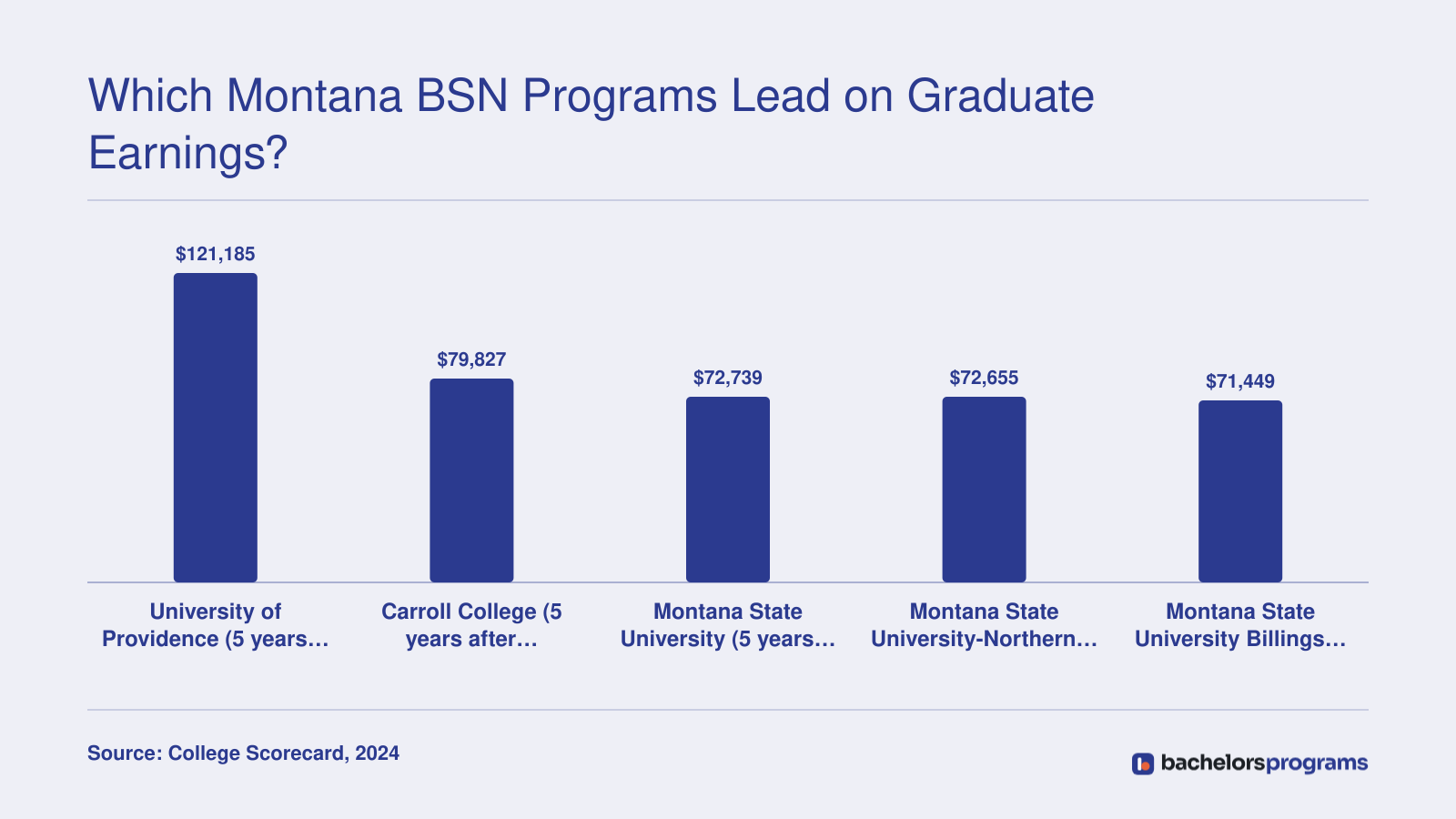
Which Montana BSN Programs Lead on Graduate Earnings?
University of Providence BSN graduates report the highest median earnings here, at $121,185 five years after completion. Each bar shows its measurement window: Montana State University Billings has only a one-year figure, so it is not a direct match for the five-year bars. Early-career RN pay varies by facility, shift and region, so weigh these earnings against each program's median debt before you commit.
Montana RN Licensure by Examination at a Glance
Quick Answers for Montana BSN Applicants
These answers cover the questions Montana nursing applicants ask most often. They draw on this page's ranking data and the admissions and licensing pages of the schools and the Montana Board of Nursing.
Which Montana BSN program has the highest NCLEX pass rate?
Does Montana have direct admit BSN programs?
Do you need Montana Board of Nursing approval to sit for the NCLEX-RN?
How much does a four-year BSN cost at a Montana public university?
Compare Bachelor of Science in Nursing (BSN) programs on the data that matters
Explore more Nursing majors or browse every field of study.
All Nursing programs Browse every field of study