Best Accelerated BSN (ABSN) Programs in South Dakota
Compare 3 accredited Accelerated BSN (ABSN) programs in South Dakota, with net price after aid, graduation rates, earnings and debt from IPEDS and the U.S. College Scorecard.
Someone with a bachelor's in history or business can earn a BSN in roughly 12 to 18 months of full-time study, but South Dakota offers few places to do it. Does South Dakota have accelerated BSN programs? Yes: Augustana University, South Dakota State University and the University of Sioux Falls each run one. Augustana's takes 16 months, and Sioux Falls completes in four semesters.
Other sites disagree about which programs are still open, so each program's status was checked against the school's own pages before anything was ranked.
Cohorts are small and start dates are limited. The University of Sioux Falls starts only in January, so a missed prerequisite or deadline can cost a full year.
Key Points
- South Dakota State charges residents $462 per credit for its 2026-27 ABSN.
- Every ABSN ranked here holds CCNE accreditation and Board of Nursing oversight.
- Registered nurses in South Dakota now earn in the high-$70,000 range.
Best Accelerated BSN Schools in South Dakota Ranked
Three South Dakota schools currently enroll second-degree students in an accelerated BSN: two are private universities in Sioux Falls, and the third is a public university that runs the program in Sioux Falls and Rapid City rather than on its main campus. Each entry below puts the school's overall profile next to the specifics of its accelerated track, so you can see what the program asks of you and what the institution reports about student outcomes. Cohort deadlines shift from cycle to cycle, so confirm the current status with each admissions office before you apply.
Augustana University
#1Sioux Falls, SD · $20,000 – $25,000/yr (est.)
Best for: Career changers wanting a private-college setting
Augustana University is a private university in Sioux Falls whose accelerated nursing track runs 16 months of full-time study, including clinical placements arranged through a Sanford Health partnership. The school graduates 73% of its students, and the ABSN cohort is built for people who already hold a bachelor's degree and are starting over in health care. Scholarship support, including a Sanford Health award, is part of how students fund the year and a half of study.
- Accelerated track for students who already hold a bachelor's degree
- 16-month, 50-credit nursing sequence
- Clinical training arranged through a Sanford Health partnership
- Sanford Health scholarship available to help offset costs
- Nursing program fee of $855 per semester
- Estimated indirect costs of $22,712
- Prerequisite coursework must be finished before entry
- Accredited by ACEN
South Dakota State University
#2Brookings, SD · $15,000 – $20,000/yr (est.)
Best for: South Dakota residents seeking public-university value
South Dakota State University is a public university based in Brookings that delivers its accelerated BSN off the main campus, at sites in Sioux Falls and Rapid City. The school graduates 62% of its students. Accelerated students move through a curriculum that spans hospital and nonhospital care settings and is built to support both direct practice and later graduate study, with student organizations and scholarship support alongside the coursework.
- Accelerated pathway offered at Sioux Falls and Rapid City sites
- Completable in as few as 12 months
- Designed for students who have finished all prerequisites
- Clinical experience in hospital and nonhospital settings
- Builds a foundation for graduate nursing study
- Student Nurses Association and Nurses Christian Fellowship chapters
- Scholarships available for nursing students
- Accredited by CCNE
University of Sioux Falls
#3Sioux Falls, SD · $21,000/yr (est. net price)
Best for: Cohort learners who thrive in structured groups
The University of Sioux Falls is a private university in Sioux Falls that runs its accelerated BSN as a four-semester cohort with a January start. The school graduates 63% of its students. The nursing program reports the highest NCLEX-RN pass rate in the state and a cohort model that keeps the same group together from the first clinical semester onward, with simulation labs supporting the coursework.
- Four-semester cohort that starts each January
- Rolling admissions with one start date per year
- Clinical experience begins in the first semester
- Simulation labs used throughout the curriculum
- At least three letters of recommendation required
- Open to applicants with a prior bachelor's degree or 60 college credits
- Program reports a 97.37% NCLEX pass rate
- Accredited by CCNE
Cost & outcomes by school
Federal data for the highest-earning Accelerated BSN (ABSN) programs, independent of the ranking above. Earnings are this field's bachelor's graduates four years after completing where the Scorecard reports them, else the school's undergraduate median.
| School | Net price / yr | Grad rate | Earnings | Debt | Grads/yr | Format |
|---|---|---|---|---|---|---|
| Augustana University SD | $23,894 | 73% | $59,217 | $25,000 | 1,212 | Campus |
| South Dakota State University SD | $19,841 | 62% | $55,070 | $23,250 | 3,796 | Campus |
| University of Sioux Falls SD | $21,383 | 63% | $54,521 | $23,249 | 784 | Campus |
Sources: U.S. Department of Education. Net price, graduation rate, earnings and debt: College Scorecard (earnings and debt for this field's bachelor's graduates where reported, else school-wide); graduates: IPEDS. A dash means no figure is reported.
Cost, debt & payoff
Median earnings of this field's bachelor's graduates (4 yrs after completing, else the school's undergraduate median) vs. their median federal loan debt · U.S. College Scorecard
Across these programs the median graduate earns about $55,070 and finishes with roughly $23,250 in debt — a ratio that clears a common rule of thumb (keep debt below first-year salary). Net price and debt vary widely school to school, so check the per-school figures in the table above before you shortlist.
Which South Dakota ABSN Programs Are Accepting Applicants Now
Can you still get into an accelerated BSN cohort in South Dakota, or have this year's deadlines already passed? Status changes quickly, so here is what each school's own nursing pages showed when checked in November 2026. Every program here is a second-degree track, built for people whose first bachelor's degree is in another field.
Program Status as of November 2026
- Augustana University: Active and accepting applications, according to its nursing programs page. The accelerated tuition page lists a 2026-27 cohort beginning in Fall 2026, with completion in 16 months. Since that cohort has started, ask admissions which start date is open next.
- South Dakota State University: SDSU Global Campus lists an Accelerated Second BS in Nursing for Spring 2027. The application deadline was September 30, 2026, with transcripts due November 13, 2026 and final transcripts due January 8, 2027.1 This is a separate route from SDSU's nursing transfer program, which the university describes as six semesters rather than accelerated.
- University of Sioux Falls: Its nursing page lists an active Accelerated BSN, and the tuition and costs page shows a January 2026 start. USF is now accepting applications for a Spring 2027 cohort, with a priority deadline of July 1, 2026 and a final deadline of December 1, 2026.
Why Older Listings Can Mislead You
Directories and third-party sites often copy program details once and rarely update them. Cohort dates roll forward, deadlines close and schools restructure tracks, so an older listing may show a start date that no longer exists. Before planning around any program, contact admissions, confirm the next cohort start and deadline in writing, and recheck prerequisites for that intake.
Behind the List: Data Sources and Status Checks for This Ranking
The federal College Scorecard supplies the figures behind each entry: net price, admission rate, completions and graduation rate. Each entry was also checked against the nursing and admissions pages that Augustana University, South Dakota State University and the University of Sioux Falls publish themselves.
What the Federal Numbers Do and Do Not Cover
Net price is an institution-wide average after grant and scholarship aid, not a quote for the ABSN cohort. A second-degree student moving through 12 to 18 months of accelerated coursework may pay something quite different. Graduation rate describes the whole university rather than the nursing program, so treat it as context, not a prediction of whether you will finish.
Status Checks Against School Pages
Third-party directories often lag a semester or more behind reality. Each program's current status was verified against the university's own nursing and admissions pages, and where a directory and a school site disagreed, the school's page won.
What the List Leaves Out
Two things matter to applicants and are not captured here: the quality of clinical sites and the size of each cohort. Both shape the daily experience of an accelerated student. Ask admissions which hospitals and clinics host placements, how many students start each cohort, and whether a clinical seat is guaranteed once you are admitted.
What South Dakota ABSN Programs Require Before You Apply
Accelerated BSN programs at Augustana University, South Dakota State University and the University of Sioux Falls are built for students who already hold a bachelor's degree. Use this checklist to prepare, and confirm every detail on each school's current admissions page before you apply.
- A completed bachelor's degreeAugustana requires a bachelor's degree from an accredited institution. If you are still finishing your first degree, ask South Dakota State and Sioux Falls whether they accept a degree in progress and when it must be conferred.
- Prerequisite science coursesABSN prerequisites typically include anatomy and physiology, microbiology, chemistry, statistics, nutrition and lifespan development, often with labs. Course lists and recency limits vary by school. Augustana requires all prerequisites to be finished by the time your application is reviewed.
- Minimum GPAAugustana sets a cumulative GPA floor of 2.7. Check whether South Dakota State and Sioux Falls also set a separate prerequisite GPA or a minimum grade for each course.
- Entrance exam and deadlinesAugustana's deadline is February 15 for a fall start, and it accepts applications after that date until the program is full. Ask each school whether it requires the TEAS or HESI and which months its cohorts begin.
- Clinical-readiness itemsNursing programs commonly require a background check and current immunizations before clinical rotations. Some also ask for CNA certification or an interview, so confirm the specific list with each admissions office.
Related Articles
ABSN Pace and Cost in South Dakota: 12 to 18 Months, Tuition and Aid
South Dakota State University lists its 2026-27 accelerated BSN at $462 per credit for residents, roughly $28,644 for the curriculum, and $586 per credit (about $36,332) for nonresidents. Residents of several neighboring states, including Iowa, Minnesota, Nebraska and North Dakota, can qualify for the resident rate.
How Long Each Program Runs
SDSU runs about 12 months, though confirm the official length with the school. The University of Sioux Falls runs four semesters, about 57 to 60 credits, with a January start. Augustana University takes 16 months and about 50 nursing credit hours. All three are full-time, cohort-style tracks with clinicals, so working more than a few hours a week is unrealistic. Plan to save or borrow for living costs.
Tuition and Net Price Compared
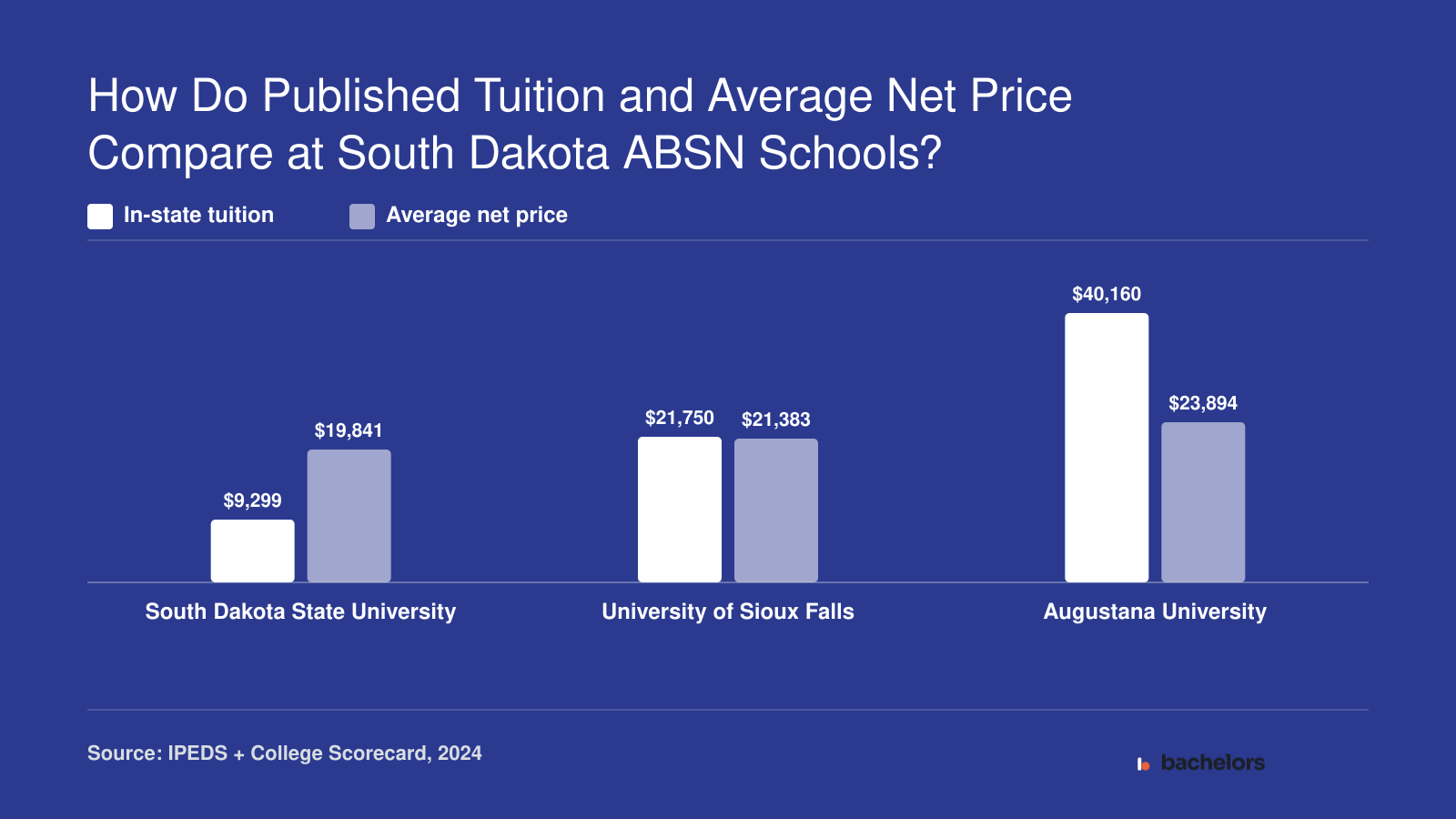
The institution-wide figures show how each school's pricing differs. Annual undergraduate tuition is $9,299 in-state at SDSU, $21,750 at Sioux Falls and $40,160 at Augustana. Average net price after grants is about $19,841, $21,383 and $23,894. Net price narrows the gap, but it reflects traditional undergraduates, not second-degree students.
Program figures are more useful. Sioux Falls charges $450 per credit, with a published range of about $25,650 to $27,000 and fees folded in. Augustana charges $640 per credit, an $855 nursing fee each semester and a university fee of $65 per credit. Its own 2026-27 estimate is about $61,382, while some third-party listings show far lower totals. Ask the school for its current cost sheet.
Costs the Sticker Price Leaves Out
- Prerequisite science courses completed before you apply
- Program and course fees, plus academic resources and ATI testing materials (SDSU lists both)
- Uniforms, stethoscope and other equipment
- Background checks and compliance items such as immunization records
- NCLEX-RN registration and licensure fees
- Living costs, which Augustana estimates at about $22,712 in indirect costs
Aid You Can Actually Use
Pell Grants are usually closed to students who already have a bachelor's degree. Federal Direct Loans are the main option, with repayment starting six months after graduation. SDSU Nursing Loans are subsidized and carry 5% interest at repayment, which begins nine months after graduation. They require unmet financial need and admission to the nursing program. Augustana lists a $10,000 Sanford Health scholarship, so ask about criteria and deadlines. Confirm with each financial aid office how prior federal borrowing affects your eligibility.
How Do Published Tuition and Average Net Price Compare at South Dakota ABSN Schools?
Each school shows its published annual in-state tuition beside its average net price. Net price counts tuition plus housing, books and other costs, minus average grant aid. It is a campus-wide average for first-time, full-time undergraduates who receive aid, so the gap is not a promised ABSN discount: second-degree students usually cannot get Pell Grants, and ABSN tuition is often billed per credit. Augustana University lists $640 per credit and the University of Sioux Falls lists $450, so confirm your own cost with each financial aid office.
South Dakota Board of Nursing Approval, Accreditation and NCLEX-RN Licensure
All three schools here run their accelerated BSN under the oversight of the South Dakota Board of Nursing, and each holds CCNE accreditation. Here is how that breaks down.
Board Approval
Augustana University's 16-month accelerated BSN is Board-approved. South Dakota State University (as little as 12 months) and the University of Sioux Falls (four semesters for second-degree students) both appear among the baccalaureate RN programs in the Board's 2026 Annual Nursing Education Report, which lists six such programs statewide.1 The Board does not label accelerated tracks separately, so confirm with each school that the accelerated cohort falls under its approved BSN before you apply.
Why CCNE Accreditation Matters
Accreditation affects what you can do after graduation. Most MSN and DNP programs expect a degree from an accredited nursing program. Many employers, including hospital systems, prefer or require it. Some state boards also weigh it if you later seek licensure outside South Dakota. Augustana, SDSU and USF are all CCNE-accredited.
NCLEX-RN First-Time Pass Rates
The figures below are 2025 first-time results. They are institution-level baccalaureate RN results, not separate accelerated-cohort rates.
- Augustana University: 95.77% on the school's page. The Board's counts are 65 passes from 68 candidates, about 95.6%.1
- South Dakota State University: 93.27% on the school's page. The Board reports 277 of 297 candidates, about 93.3%.1
- University of Sioux Falls: 38 of 39 candidates, or 97.4%, per the Board.1 That result does not show whether the candidates were accelerated, traditional or a mix.
Small rounding differences between school pages and the Board come from how each reports the same counts. USF's cohort is small, so a single result moves its percentage noticeably.
Same Degree, Same Exam
An accelerated BSN is not a lesser credential. Graduates earn the same Bachelor of Science in Nursing as students in a traditional four-year track and sit for the same NCLEX-RN. Passing that exam, along with meeting the Board's licensure requirements, is what qualifies you to practice as a registered nurse. The compressed schedule changes only how fast you get there.
What Registered Nurses Earn in South Dakota
An ABSN leads to registered nurse jobs, and South Dakota RN pay now sits in the high-$70,000 range.
Multistate RN Licensure for South Dakota ABSN Graduates
Accelerated Nursing Programs in South Dakota: Follow-up Questions
Can a bachelor's in psychology, biology or business get me into a South Dakota ABSN?
Where can I take ABSN prerequisite courses before applying in South Dakota?
Do science prerequisites expire for South Dakota ABSN applicants?
Compare Accelerated BSN (ABSN) programs on the data that matters
Explore more Nursing majors or browse every field of study.
All Nursing programs Browse every field of study