Best RN to BSN Programs in South Dakota
Compare 4 accredited RN to BSN programs in South Dakota, with net price after aid, graduation rates, earnings and debt from IPEDS and the U.S. College Scorecard.
Every RN to BSN completion program ranked here is fully online, so finishing the degree no longer costs a South Dakota nurse a single traded shift. Average annual net price across these schools runs from roughly $19,700 at Dakota Wesleyan University to about $31,000 at National American University-Rapid City, with South Dakota State University and the University of South Dakota clustered near $19,800.
That spread matters more than the delivery format. Online access is now the baseline in this state. What actually separates these programs is how many ADN credits transfer in, how quickly the course terms cycle, and whether supervised clinical hours are still required.
Key Points
- Every RN to BSN program here can be finished fully online.
- Accepted ADN credits largely determine your remaining RN to BSN tuition.
- Online coursework can still require clinical or preceptor hours, so ask first.
Best Fully Online RN to BSN Programs in South Dakota for Working Nurses
Every program on this list is fully online, with no hybrid or in-person attendance requirement, so a working nurse can finish the BSN without rebuilding a shift schedule around campus visits. The four South Dakota institutions appear in the order our review found them strongest overall. Each entry notes what the school offers beyond the degree itself, from start-date frequency to clinical placement help.
South Dakota State University
#1Brookings, SD · $15,000 – $20,000/yr (est.)
Best for: Working RNs juggling full-time schedules
South Dakota State University is the state's land-grant university in Brookings and the largest producer of RN to BSN completions among the schools here. Its CCNE-accredited nursing program is built around fully online coursework, with clinical hours arranged in the student's own community. The school's graduation rate is 62%.
- 100% online coursework; clinical experiences completed near home
- 30 credits of nursing coursework inside a 120-credit bachelor's degree
- 10 courses delivered in 7-week terms
- Six start dates per year across spring, summer, and fall
- Full-time completion in 10 months, part-time in 18 months
- Admission requires a 2.5 GPA and an unencumbered RN license
- RN to Grad option lets students begin graduate coursework early
- CCNE accredited
University of South Dakota
#2Vermillion, SD · ~$20,000/yr (est.)
Best for: Nurses planning a fall cohort start
The University of South Dakota, in Vermillion, runs a CCNE-accredited RN to BSN that moved to eight-week course rotations, letting nurses who already finished general education requirements complete the degree in about 16 months. Clinical placements run through urban and rural hospital partners, and enrolled students can access tuition reimbursement. The school's graduation rate is 60%.
- CCNE-accredited online RN to BSN completion program
- Eight-week course rotations; about 16 months when general education is done
- Fall start followed by four consecutive semesters, summer included
- Clinical partnerships with urban and rural hospitals
- Simulation labs with human patient simulators
- Tuition reimbursement available to enrolled RN to BSN students
- Service-learning opportunities, including trips to Guatemala
Dakota Wesleyan University
#3Mitchell, SD · $15,000 – $20,000/yr (est.)
Best for: Self-directed learners avoiding set login times
Dakota Wesleyan University is a private university in Mitchell whose online RN to BSN enrolled its first cohort in August 2026. The program is fully asynchronous, runs in seven-week terms, and can be finished in 12 months full time or 24 months part time. The school's graduation rate is 48%.
- 100% online with no required login times
- 7-week course terms
- 12-month full-time or 24-month part-time completion
- 28 nursing credits inside a 120-credit degree; transfer credits accepted
- First cohort began August 2026
- CCNE accredited
- Employer tuition reimbursement supported
- $840 clinical fee; background check and CPR card required
National American University-Rapid City
#4Rapid City, SD · ~$31,000/yr (est.)
National American University's Rapid City location offers a CCNE-accredited online RN to BSN with rolling admissions, quarterly start dates, and no application fee. It accepts an active, unencumbered license from any state, which suits nurses who relocate or work across state lines, and it skips an entrance exam entirely.
- Online RN to BSN with rolling admissions and no application fee
- Four quarterly start dates per year
- Active, unencumbered RN license from any U.S. state accepted
- No entrance exam required
- CCNE accredited
- Built for working professionals balancing job and school
Cost & outcomes by school
Federal data for the highest-earning RN to BSN programs, independent of the ranking above. Earnings are this field's bachelor's graduates four years after completing where the Scorecard reports them, else the school's undergraduate median.
| School | Net price / yr | Grad rate | Earnings | Debt | Grads/yr | Format |
|---|---|---|---|---|---|---|
| South Dakota State University SD | $19,841 | 62% | $55,070 | $23,250 | 3,796 | Online |
| Dakota Wesleyan University SD | $19,735 | 48% | $53,728 | $27,000 | 280 | Online |
| University of South Dakota SD | $19,858 | 60% | $51,926 | $23,592 | 2,402 | Online |
| National American University-Rapid City SD | $31,062 | — | $37,325 | $29,020 | 234 | Online |
Sources: U.S. Department of Education. Net price, graduation rate, earnings and debt: College Scorecard (earnings and debt for this field's bachelor's graduates where reported, else school-wide); graduates: IPEDS. A dash means no figure is reported.
Cost, debt & payoff
Median earnings of this field's bachelor's graduates (4 yrs after completing, else the school's undergraduate median) vs. their median federal loan debt · U.S. College Scorecard
Across these programs the median graduate earns about $52,827 and finishes with roughly $25,296 in debt — a ratio that clears a common rule of thumb (keep debt below first-year salary). Net price and debt vary widely school to school, so check the per-school figures in the table above before you shortlist.
What Earned a Spot on This List of Online RN to BSN Programs
Only programs a licensed RN can complete entirely online were eligible here, so no South Dakota nurse has to set foot on campus to finish a BSN.
The Online-Only Filter
Hybrid formats and campus-based completion tracks were set aside. Every program that follows can be finished remotely, which matters when you are working twelve-hour shifts in Sioux Falls, Rapid City, or a rural critical access hospital. The schools ranked here, South Dakota State University, the University of South Dakota, Dakota Wesleyan University, and National American University-Rapid City, all deliver RN to BSN coursework online.
What the Order Reflects, and What It Does Not
The ordering leans on school-wide signals: graduation rates, the average price students pay after aid, and College Scorecard outcomes for graduates. Those figures describe the institution as a whole rather than the RN to BSN track, so treat them as context, not a promise about your own cohort.
The list says nothing about curriculum fit, start-date timing, or how clinical hours get arranged near you. Admission requirements and costs are covered further on.
RN to BSN Admission Requirements in South Dakota
Every RN to BSN program here admits licensed nurses, but the details vary by school. South Dakota State University publishes the most complete checklist, so its rules serve as the benchmark below. Confirm each item with the other schools before you apply.
- Active, unencumbered RN licenseSDSU requires an unencumbered RN license in the state where you practice. If you hold a multistate compact license or work outside South Dakota, ask each school how that applies to any practice experiences.
- ADN or diploma in nursingSDSU accepts an associate degree or a diploma in nursing. Students still finishing an ADN may be conditionally admitted.
- Prerequisites and GPAAt SDSU, you may have no more than three prerequisite courses left when you apply. You need a 2.5 GPA to continue and graduate, plus a C or higher in every course counted toward the degree. Request each school's prerequisite list early.
- Application stepsAt SDSU, apply to the university first and send official transcripts to the Office of Admissions. Then complete the NursingCAS application. Admission opens six times a year, with deadlines of December 1, February 1, April 1, June 1, July 1 and September 1.
- After acceptanceSDSU requires a background check, drug screening, personal liability insurance, current immunizations and CPR certification.
- English proficiencySDSU applicants who meet its non-native English speaker definition need a TOEFL iBT score of 79 with a 26 in speaking, an IELTS score of 6.5 with at least 6.0 on each module, or a Duolingo score of 110.
Related Articles
RN to BSN Time and Cost in South Dakota: Credits, Pace, and Tuition Help
How many of your ADN credits actually count, and what will the remaining coursework cost? Those two answers drive almost everything else about your plan.
How ADN Credits Carry Over
At South Dakota State University, the RN to BSN is built on a 120-credit bachelor's requirement. Published degree details show 46 credits applied from ADN completion and 30 credits that must be earned through SDSU. Treat those numbers as the framework, not a guarantee: official transcripts are evaluated individually, and the credit awarded can shift with course equivalency, grades, and the accreditation of your associate program. Broader guidance on completion pathways suggests roughly 30 to 40 upper-division credits typically remain after an ADN or diploma, which lines up with that structure.
Realistic Pace Around 12-Hour Shifts
SDSU runs seven-week semesters, so you carry fewer courses at once but move through them quickly. The published part-time schedule of six credits per semester finishes in about 18 months. A full-time load of 12 credits per semester compresses that to roughly 10 months, while other SDSU materials cite one to two years, or about 20 months when summer terms are included. The spread exists because you set the pace. Nurses working three 12-hour shifts a week generally find the six-credit rhythm sustainable; doubling it means two concentrated courses running at once in a seven-week window.
Tuition and Employer Assistance
SDSU estimates the 2026-27 curriculum cost at $13,860 for South Dakota residents, with South Dakota Advantage residents paying $462 per credit for the 30 SDSU credits. Nonresidents are estimated at $586 per credit, or about $17,580. Books and fees sit outside those figures. The table below breaks down resident and nonresident per-credit rates side by side.
If you work for Sanford Health, Avera Health, or Monument Health, tuition assistance may be available, but current caps, eligibility windows, and whether RN to BSN coursework qualifies are not consistently published. Ask HR in writing whether reimbursement arrives after grades post or at registration before you commit to a first term.
South Dakota RN to BSN Price Check: Resident vs Nonresident Per-Credit Rates
These rates come from each university's published RN to BSN pricing as checked in fall 2026. Each estimated total multiplies the per-credit rate by the credits you must complete at that school, so it covers tuition only; confirm any online, course, or program fees with the nursing office before you budget. The resident and nonresident gap is widest at South Dakota State University, where out-of-state nurses pay $124 more per credit (about $3,720 more across 30 credits), while the University of South Dakota's flat online rate of $373.80 per credit erases that gap entirely and comes in $88.20 per credit below SDSU's resident rate, a savings of roughly $2,646 over 30 credits.
| School | Resident Per-Credit Rate | Nonresident Per-Credit Rate | Credits Required | Estimated Program Total |
|---|---|---|---|---|
| South Dakota State University | $462 | $586 | 30 credits at SDSU | $13,860 (resident); $17,580 (nonresident) |
| University of South Dakota | $373.80 (flat online rate) | $373.80 (flat online rate) | 30 credits at USD (32 credits at the 300 or 400 level) | $11,214 (resident and nonresident) |
Questions to Ask Yourself
Will your employer's tuition benefit cover the program you choose, and when does the money arrive?
Can you keep pace with 7-week courses during a run of night shifts?
Does your ADN transcript already cover statistics and the general education prerequisites?
Can you complete your practice hours where you already work?
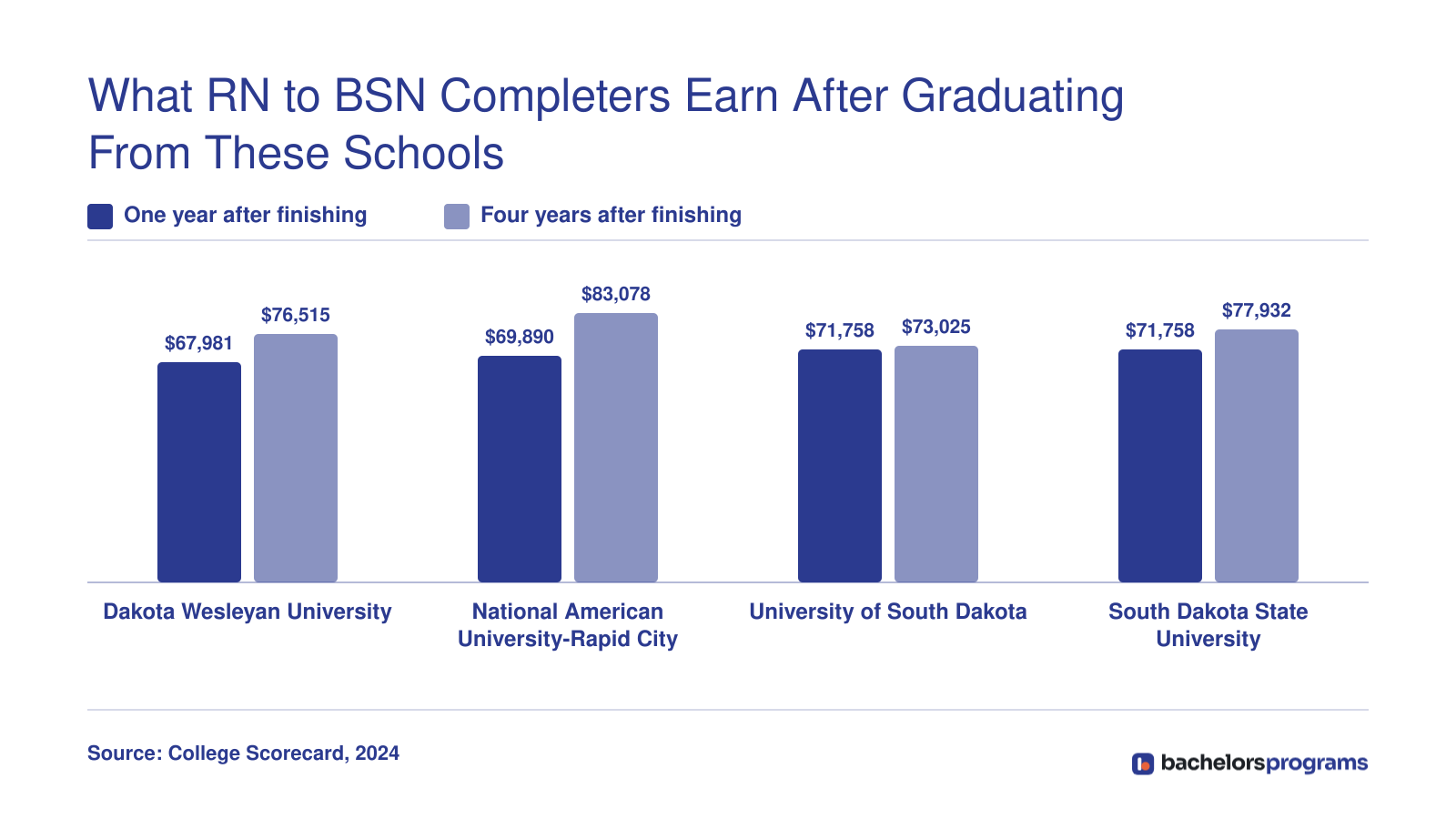
What RN to BSN Completers Earn After Graduating From These Schools
These are College Scorecard median earnings for each school's RN to BSN completers, measured one year and four years after finishing. Because every student enters already licensed, the figures reflect RN earning power built before the BSN, not only the degree itself. Dakota Wesleyan University shows the lowest one-year median at $67,981, while National American University-Rapid City posts the highest four-year median at $83,078. University of South Dakota and South Dakota State University share a one-year figure of $71,758, then diverge to $73,025 and $77,932 by year four.
Compare RN to BSN programs on the data that matters
Explore more Nursing majors or browse every field of study.
All Nursing programs Browse every field of study