Best BSN Programs in South Dakota
Compare 8 accredited Bachelor of Science in Nursing (BSN) programs in South Dakota at 7 colleges, with net price after aid, graduation rates, earnings and debt from IPEDS and the U.S. College Scorecard.
A South Dakota RN license does not require a BSN. Graduates of associate degree programs sit the same NCLEX-RN, and the license looks identical on the other side. What the four-year degree buys is a different hiring track and a shorter path into specialty units and graduate study.
The programs below are the state's traditional pre-licensure BSN tracks, ordered by first-time NCLEX-RN pass rate and the number of candidates behind each result. Annual tuition across them runs from about $9,300 at the public universities to $40,160 at the private ones, a spread that rarely tracks the pass rate.
Key Points
- Augustana University BSN completers earn a $72,237 median one year out.
- South Dakota requires programs to hit a 75% first-time NCLEX-RN pass rate.
- Expect four years, with nursing admission usually coming after prerequisite coursework.
South Dakota BSN Schools With the Best NCLEX-RN Outcomes (2027)
These South Dakota BSN programs are ordered by first-time NCLEX-RN pass rates, using the state board's most recent years of results weighted by how many graduates sat the exam at each school. Accreditation standing and completion outcomes separate schools whose pass rates sit close together. Every entry is a traditional pre-licensure BSN; licensed RNs and second-degree students should follow the RN-to-BSN and accelerated routes covered on their own pages.
University of Sioux Falls
#1Sioux Falls, SD · $21,000/yr (est. net price) · NCLEX-RN pass rate 97.4% (2-yr weighted avg)
Best for: Students wanting faith-integrated nursing training
The University of Sioux Falls pairs a traditional BSN with an accelerated option for second-degree students, and its graduates have posted the strongest first-time NCLEX-RN results in the state across the board's latest reporting window. Clinical work starts early and runs through simulation labs and Sioux Falls-area partners, with coursework framed around Christian values of compassion and service. Cohorts stay small enough that faculty track each student's progress toward licensure.
- CCNE-accredited BSN with clinical placements across Sioux Falls
- Simulation technology used from the start of the clinical sequence
- Coursework framed by Christian values of compassion and service
- Prepares students for NCLEX-RN licensure
- Graduates work in hospitals, clinics, and long-term care settings
- Financial aid and scholarships offered to nursing majors
Augustana University
#2Sioux Falls, SD · $20,000 – $25,000/yr (est.) · NCLEX-RN pass rate 94.7% (2-yr weighted avg)
Best for: Study-abroad minded nursing students
Augustana University runs the only BSN in South Dakota endorsed by the American Holistic Nurses Credentialing Corporation, so caring for the whole person sits at the center of the curriculum. Students log weekly clinical hours inside Sanford and Avera facilities in Sioux Falls, alongside advanced simulation and leadership practicums. Study away options in Costa Rica, Norway, and Greece, a Sigma Theta Tau chapter, and an endowed scholarship for military-affiliated students round out the experience.
- CCNE-accredited BSN program
- Only South Dakota BSN endorsed by the American Holistic Nurses Credentialing Corporation
- Weekly clinical experiences with Sanford and Avera in Sioux Falls
- Advanced simulation center plus leadership practicums
- Study away options in Costa Rica, Norway, and Greece
- Sigma Theta Tau honor society and Nursing Student Association chapters
- Joaquin J. Andujar Endowed Scholarship for military-affiliated students
- Financial aid and scholarships available
South Dakota State University
#3Brookings, SD · $15,000 – $20,000/yr (est.) · NCLEX-RN pass rate 94.1% (2-yr weighted avg)
Best for: Rural-practice focused BSN students
South Dakota State University awards the largest share of BSN degrees in the state and delivers the program at Brookings, Rapid City, and Sioux Falls. A four-year partnership with Avera, funded through HRSA, places students in rural acute-care and long-term-care settings, and a Black Hills State University pathway feeds the Rapid City cohort. Residents of the South Dakota Advantage states pay the same per-credit rate as residents.
- CCNE-accredited BSN offered at Brookings, Rapid City, and Sioux Falls
- RETAIN-RNs partnership with Avera adds rural acute and long-term care hours
- HRSA-funded four-year rural nursing initiative with Avera Health
- Black Hills State University pathway into the Rapid City cohort
- Same per-credit rate for South Dakota Advantage state residents
- Priority deadlines: February 15 for fall entry, September 15 for spring
- Suggested Health Science minor available alongside the BSN
- Student Nurses Association, Nurses Christian Fellowship, and Student Ambassadors
Dakota Wesleyan University
#4Mitchell, SD · $15,000 – $20,000/yr (est.) · NCLEX-RN pass rate 93.5% (2-yr weighted avg)
Dakota Wesleyan University is a small Mitchell campus where nursing students train in four high-tech simulation labs and complete clinicals with hospitals, nursing homes, and rural agencies across the region. Assigned preceptors and the Avera Achieve Sponsorship Program help students manage scheduling and cost. The program closes with a traditional pinning ceremony and reports strong job placement for graduates.
- CCNE-accredited and approved by the South Dakota Board of Nursing
- Four high-tech simulation labs on the Mitchell campus
- Clinical partnerships with hospitals, nursing homes, and rural agencies
- Avera Achieve Sponsorship Program support for nursing students
- Dedicated preceptor assigned for clinical rotations
- Coursework spans pharmacology, health assessment, mental health, and population health
- Pinning ceremony at program completion
- Preparation for roles in hospitals, public health, and nurse management
University of South Dakota
#5Vermillion, SD · ~$20,000/yr (est.) · NCLEX-RN pass rate 93.2% (2-yr weighted avg)
The University of South Dakota offers the BSN in Vermillion and Sioux Falls, mixing urban and rural hospital placements so students work with a wide range of patient populations and communities. A direct-admission route exists for applicants with strong test scores and prerequisite grades, while everyone else enters through the upper-division application. Undergraduate research, service learning in Guatemala, and ROTC scholarships give students options beyond the standard clinical sequence.
- CCNE-accredited BSN on the Vermillion and Sioux Falls campuses
- Direct admission with ACT 27+ and a 3.0 prerequisite GPA
- HESI entrance exam required for upper-division applicants
- Deadlines: September 1 for spring entry, April 1 for fall entry
- Prerequisite spreadsheet submitted with the BSN application
- No application fee
- Clinical placements with urban and rural hospital partners
- Service learning in Guatemala, undergraduate research, and ROTC scholarships
Mount Marty University
#6Yankton, SD · ~$22,000/yr (est.) · NCLEX-RN pass rate 71.5% (2-yr weighted avg)
Mount Marty University in Yankton puts students into clinical settings from the start and covers pediatrics, maternity, medical-surgical, gerontology, mental health, critical care, and community health. The Catholic Benedictine tradition shapes how compassionate, holistic care is taught. Exceptional students can move directly into the university's Doctor of Nurse Anesthesia Practice after the BSN. Its first-time NCLEX-RN results trail the other campuses here, so ask about recent cohorts and the remediation support available.
- CCNE-accredited BSN in Yankton
- Hands-on clinicals from the start of the program
- Specialty rotations in pediatrics, maternity, med-surg, and critical care
- Also covers gerontology, mental health, and community health
- Direct entry path to the Doctor of Nurse Anesthesia Practice
- Catholic Benedictine values shape the curriculum
- Students often receive job offers before graduation
Northern State University
#7Aberdeen, SD · $15,000 – $20,000/yr (est.)
Northern State University in Aberdeen builds the BSN on a liberal arts foundation and sends students to Avera St. Luke's Hospital and Sanford Aberdeen Medical Center for clinical work. A new facility houses simulation labs, and scholarships are widely available to nursing majors. The program carries interim approval from the South Dakota Board of Nursing and does not yet hold nursing accreditation, a detail worth weighing before you enroll.
- Clinical partnerships with Avera St. Luke's and Sanford Aberdeen Medical Center
- New facility with state-of-the-art simulation labs
- Liberal arts foundation built into the nursing curriculum
- Scholarships available to nursing majors
- Prepares students for NCLEX-RN and graduate study
- Holds interim approval from the South Dakota Board of Nursing
Cost & outcomes by school
Federal data for the highest-earning Bachelor of Science in Nursing (BSN) programs, independent of the ranking above. Earnings are this field's bachelor's graduates four years after completing where the Scorecard reports them, else the school's undergraduate median.
| School | Net price / yr | Grad rate | Earnings | Debt | Grads/yr | Format |
|---|---|---|---|---|---|---|
| Augustana University SD | $23,894 | 73% | $59,217 | $25,000 | 1,212 | Campus |
| South Dakota State University SD | $19,841 | 62% | $55,070 | $23,250 | 3,796 | Campus |
| University of Sioux Falls SD | $21,383 | 63% | $54,521 | $23,249 | 784 | Campus |
| Dakota Wesleyan University SD | $19,735 | 48% | $53,728 | $27,000 | 280 | Campus |
| University of South Dakota SD | $19,858 | 60% | $51,926 | $23,592 | 2,402 | Campus |
| Mount Marty University SD | $22,227 | 52% | $48,179 | $26,396 | 322 | Campus |
| Northern State University SD | $15,812 | 49% | $47,618 | $22,320 | 500 | Campus |
Sources: U.S. Department of Education. Net price, graduation rate, earnings and debt: College Scorecard (earnings and debt for this field's bachelor's graduates where reported, else school-wide); graduates: IPEDS. A dash means no figure is reported.
Cost, debt & payoff
Median earnings of this field's bachelor's graduates (4 yrs after completing, else the school's undergraduate median) vs. their median federal loan debt · U.S. College Scorecard
Across these programs the median graduate earns about $54,125 and finishes with roughly $23,421 in debt — a ratio that clears a common rule of thumb (keep debt below first-year salary). Net price and debt vary widely school to school, so check the per-school figures in the table above before you shortlist.
What Puts a School on This List: The NCLEX-RN Scoring Behind It
First-time NCLEX-RN results have become the most closely watched measure of nursing program quality, especially since the exam moved to its Next Generation format in 2023. A school's position here depends mostly on how its graduates performed the first time they sat for the exam.
How the Score Is Built
- NCLEX-RN pass rate: This factor carries about three quarters of the weight: a three-year, first-time pass rate drawn from state board results and weighted by how many candidates sat the exam, so one unusually strong or weak year in a small cohort cannot swing the outcome.
- Accreditation: Programmatic accreditation, verified in accreditor directories, makes up part of the remaining score.
- Completion and retention: A small component reflects how many students stay enrolled and finish, using College Scorecard and IPEDS data.
What the Figures Cover
Only ranked pre-licensure programs appear here. RN-to-BSN completion for licensed nurses and accelerated BSN tracks for second-degree students have their own pages and are not scored on this one.
Graduation, retention and net price figures describe the whole institution rather than the nursing program itself. Nursing students' experience can differ from a university's overall numbers, so read those figures as context and treat the NCLEX-RN result as the program-specific signal.
Getting Into a South Dakota BSN: Prerequisites, GPA and Entry Points
Admission to a South Dakota BSN usually happens in two stages: first to the university, then to the nursing major itself. A few programs collapse those stages for strong high school applicants, but upper-division entry is the norm across this list.
Direct Admit and Upper-Division Entry
South Dakota State University is the clearest example of upper-division entry. Students spend roughly two years on prerequisites, then apply for the professional major, with five semesters of nursing coursework to follow in Brookings, Rapid City or Sioux Falls. The application goes through the university first and then NursingCAS.
Augustana University also admits at the upper-division point. Students apply to nursing courses by Feb. 15 of the year they want to begin, or until seats fill, and need a cumulative GPA of at least 2.7.
The University of South Dakota lists prerequisite coursework and a HESI entrance exam among its requirements, and offers direct admission to applicants with an ACT of 27 or higher.
The Prerequisite Set
Expect anatomy and physiology, microbiology, chemistry, statistics, and psychology, plus composition and human development, on most prerequisite lists. Grades in the science sequence carry real weight, since they predict how students handle pathophysiology and pharmacology later.
Deadlines and Test Policy
SDSU's fall cohort opens the first week of January, with a Feb. 15 priority deadline and space-available review through June 1. Spring entry opens in early August, priority Sept. 15, space-available until Oct. 15. Augustana's single Feb. 15 deadline holds until the class fills.
Where the Policy Isn't Posted
Several schools on this list, among them Dakota Wesleyan, Mount Marty, the University of Sioux Falls, and Northern State, do not post a clear GPA cutoff or entrance exam requirement on their nursing pages. Ask an advisor directly.
Institution-wide acceptance rates at SDSU and USD sit near 100 percent, but that says little about nursing seats, which are typically capped by clinical placements.
Related Articles
Paying for a South Dakota BSN: Tuition, Net Price and State Aid
A student can land at nearly the same out-of-pocket figure paying South Dakota's lowest BSN sticker price or collecting its deepest aid package, so the net price line deserves more weight than the tuition line.
Sticker Price Versus Net Price
Among the public universities, Northern State lists $8,845 in tuition and fees for South Dakota residents, South Dakota State $9,299 and the University of South Dakota $9,432. The private universities run far higher on paper: University of Sioux Falls $21,750, Dakota Wesleyan $33,790, Mount Marty $34,600 and Augustana $40,160. After grant aid the gap narrows sharply. Average net price comes in at $15,812 at Northern State, $19,735 at Dakota Wesleyan, $19,841 at South Dakota State, $19,858 at USD, $21,383 at Sioux Falls, $22,227 at Mount Marty and $23,894 at Augustana. Read those as averages across each school's full undergraduate population, not a promise for your own award letter.
Debt at Graduation
Median federal debt for BSN completers sits in a narrow band: $23,500 at South Dakota State, $24,855 at Dakota Wesleyan, $24,966 at USD, $25,000 at Sioux Falls and Augustana, and $27,000 at Mount Marty. A high sticker price does not automatically become high debt when institutional aid is doing its job.
State Aid Worth Knowing
The South Dakota Opportunity Scholarship pays up to $7,500 across four years: $1,500 in each of the first three years and $3,000 in the fourth.1 It requires South Dakota residency at high school graduation, a 3.0 GPA with no grade below C in the required curriculum, and a 24 ACT or 1180 SAT, with a 28 ACT qualifying without the curriculum conditions.2 You must enroll within five years of graduation and use it within eight semesters. The state also administers a need-based grant and a loan-repayment program for nurses practicing in South Dakota; confirm current terms with each aid office.
Which Cost Profile Fits
- Lowest upfront price: Northern State suits families paying close to full price who want the smallest starting number.
- Strong aid, high sticker: Augustana, Mount Marty and Sioux Falls reward applicants who qualify for institutional grants.
- Scholarship-driven: Chase the Opportunity Scholarship early; it is the largest single state award for a BSN.
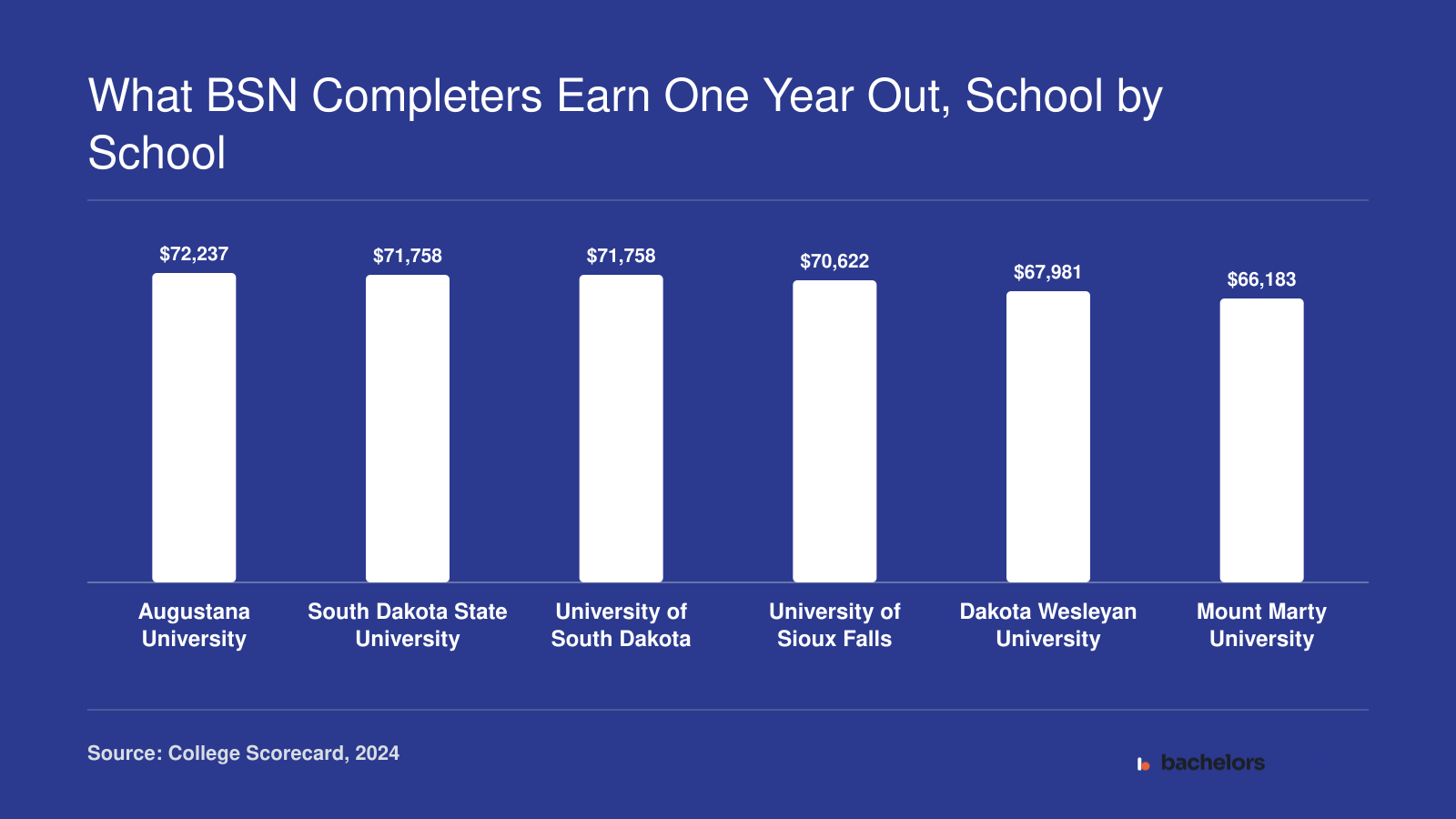
What BSN Completers Earn One Year Out, School by School
College Scorecard data shows what each school's BSN completers earned one year after finishing the program. These are program-level medians for graduates of each school's nursing program, not statewide RN wages. Augustana University leads at $72,237, and South Dakota State University and the University of South Dakota follow closely at $71,758 each.
Board Approval and CCNE Accreditation: Why Both Matter for Your BSN
South Dakota Administrative Rule 20:48:07 sets a 75% first-time NCLEX-RN pass rate as the benchmark a pre-licensure nursing program must meet across two consecutive measuring periods, both to earn initial approval and to keep it.
Two Kinds of Approval, Two Different Jobs
Board approval is the legal gate. A pre-licensure BSN must hold South Dakota Board of Nursing approval before its graduates may take the NCLEX-RN and apply for a South Dakota license. Its 2026 status listing shows the state's BSN programs in full standing except Northern State University, which holds interim status while it works toward full approval. None is on conditional or probationary status.1
Accreditation is national and separate. CCNE and ACEN are the two bodies that matter for nursing: CCNE accredits baccalaureate and graduate programs, while ACEN accredits across degree levels. Among the schools here, Augustana University, Dakota Wesleyan University, Mount Marty University, South Dakota State University, University of Sioux Falls and University of South Dakota hold CCNE accreditation.1 That status affects graduate-school admission, some employer hiring, and federal or military roles.
Reading Pass Rates Honestly
These rates count first-time test takers only, and a small cohort can swing several points on a handful of results. One weak year is not a verdict; watch the trend instead. Before you apply, open the board's approved-program list and confirm the school's current standing yourself.
South Dakota RN License Requirements in Brief
How Long a BSN Takes in South Dakota and Which Route Fits You
A traditional BSN in South Dakota takes four years. Most of the confusion about length comes from counting semesters in the nursing major rather than years to graduation.
The Four-Year Shape
At South Dakota State University, the standard BSN runs four years and 120 credits, split into 58 credits of general and support coursework and 62 credits of nursing theory and clinical work. The nursing major itself covers five semesters, and SDSU delivers that sequence in Brookings, Rapid City and Sioux Falls. The University of South Dakota also lists a four-year, 120-credit program, with 61 credits outside the major and 59 in nursing. Augustana University's breakdown totals 124 credits, 74 general and support plus 50 in nursing, and the University of Sioux Falls comes in at 120 credits, 63 and 57 respectively.
Why You See Five or Six Semesters Online
A program page that says "five semesters" is describing the clinical sequence only, after prerequisites are cleared. Add the first two years of general education and support courses, and the full degree lands at about four years.
Two Other Routes
Licensed South Dakota RNs can find completion study built around their existing credential on the RN-to-BSN page. For those who hold a bachelor's in a different field, the accelerated BSN page explains the faster second-degree option. Neither route is ranked here.
Questions to Ask Yourself
Can you absorb a competitive upper-division application that might not admit you to nursing on the first try?
Are you willing to drive to clinical placements away from campus?
Would a lower net price justify a slightly lower NCLEX-RN pass rate?
Does your situation point toward a traditional BSN at all?
South Dakota BSN Programs: Fast Answers Before You Dig In
These short answers cover the questions South Dakota nursing applicants ask most often. Each one points to the part of this page with the full detail.
How many years does a traditional BSN take in South Dakota?
Which South Dakota BSN schools hold CCNE accreditation?
What NCLEX-RN pass rates do South Dakota BSN programs post?
What does a bachelor of science in nursing cost at South Dakota schools after financial aid?
What GPA do South Dakota BSN programs expect for nursing-major admission?
Do South Dakota BSN programs require the TEAS or HESI entrance exam?
Does a South Dakota RN license let me practice in other Nurse Licensure Compact states?
Do Minnesota or North Dakota residents pay out-of-state tuition at South Dakota BSN schools?
Compare Bachelor of Science in Nursing (BSN) programs on the data that matters
Explore more Nursing majors or browse every field of study.
All Nursing programs Browse every field of study