Best Accelerated BSN (ABSN) Programs in Wisconsin
Compare 12 accredited Accelerated BSN (ABSN) programs in Wisconsin at 11 colleges, with net price after aid, graduation rates, earnings and debt from IPEDS and the U.S. College Scorecard.
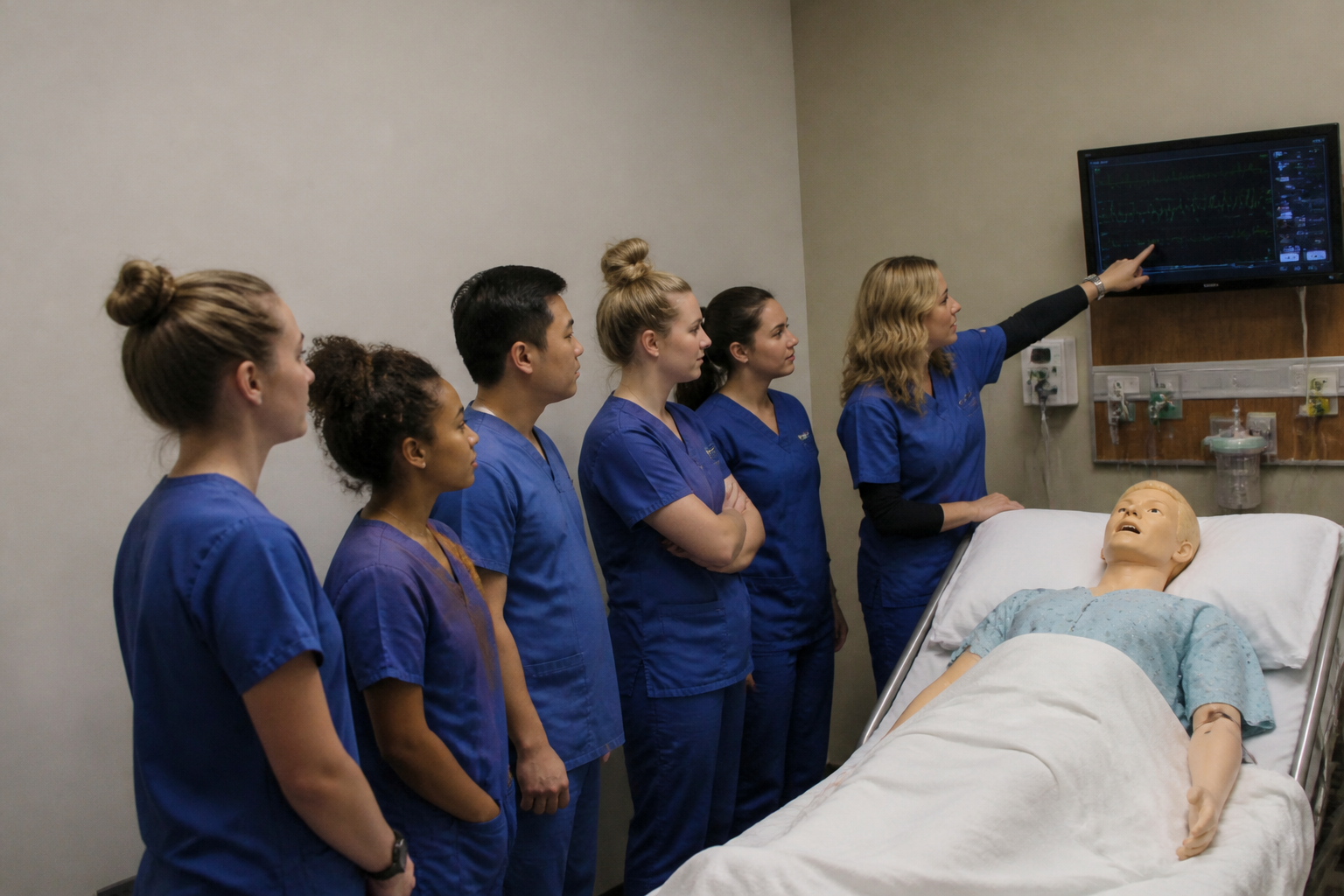
Speed and price pull in opposite directions for a career changer in Wisconsin. The 12-month cohorts at University of Wisconsin-Madison, Edgewood University, and University of Wisconsin-Oshkosh finish fastest, while the Herzing University programs run 20 to 24 months. Either way, a graduate with a non-nursing bachelor's degree reaches RN eligibility in well under the four years a traditional BSN takes.
The schools ranked here deliver accelerated BSN degrees (not master's programs) in campus, hybrid, and online formats.
Compression has a cost, though. Clinical requirements, such as 600 hours at UW-Madison and 630 at Herzing, do not shrink with the calendar, so plan on limited hours for a job.
Key Points
- UW-Oshkosh has the lowest average net price here: $14,305 a year.
- UW-Madison's accelerated BSN requires at least a 2.75 GPA.
- Herzing's Kenosha and Madison campuses, Rasmussen, Concordia, and UW-Oshkosh offer hybrid ABSNs.
Top Wisconsin Accelerated BSN Programs for Career Changers, Ranked
As of 2026, ten Wisconsin schools offer a second-degree route to a BSN, and the options span a 12-month flagship campus cohort to a 20-month hybrid built around transfer credit. Each earned its place by balancing cost after aid, completion, and what graduates go on to earn.
University of Wisconsin-Madison
#1Madison, WI · ~$17,000/yr (est.)
Best for: Career changers seeking a full-time campus cohort
Wisconsin's flagship public university runs the state's most selective accelerated route, a 12-month campus program in Madison for people who already hold a bachelor's in another field. Students enter in mid-May and move through as a cohort, with the school arranging clinical placements in schools, correctional facilities, and rural and urban hospitals and clinics. The school graduates 90% of students.
- 12 months, in person, beginning in mid-May
- Applications through NursingCAS from May 1 to September 15
- Science prerequisites completed within seven years of the start date
- No TEAS exam, no recommendation letters, no CNA license
- Clinical placements in schools, correctional facilities, and hospitals
- Program reports 84% of graduates hired before graduation
- Program reports 99% employed or in graduate school within six months
- Median starting salary of $82,170 reported for graduates
Herzing University-Kenosha
#2Kenosha, WI · ~$23,000/yr (est.)
Best for: Transfer students with prior college credits
Herzing's Kenosha campus sits in the southeastern corner of the state near the Illinois line and runs one of the more flexible second-degree nursing paths in Wisconsin. The program takes about 20 months and can absorb up to 90 approved transfer credits, which shortens the road for students who arrive with substantial prior coursework. The school graduates 72% of students.
- 20 months and 120 credits for non-nursing bachelor's or master's holders
- Nursing classes on campus with some coursework online
- 630 clinical hours with local healthcare partners
- Rolling admissions with a 2.5 GPA minimum
- TEAS entrance exam required
- Transfer up to 90 approved credits
- Dual credit toward an MSN
- CCNE accredited
Rasmussen University-Wisconsin
#3Green Bay, WI
Best for: Degree holders who want year-round start dates
Rasmussen University's Wisconsin campus in Green Bay runs a second-degree BSN built around frequent entry points and a hybrid schedule of online classes plus campus labs. Eight start dates a year and no prerequisite courses make it workable for people who need to begin quickly rather than wait a full cycle. The school graduates 57% of students.
- As few as 18 months and up to 106 credits across 25 courses
- Online classes plus campus labs and in-person clinicals
- Conferred bachelor's required with a 2.25 GPA or higher
- HESI A2, TEAS, ACT, or SAT accepted for admission
- Eight start dates a year and no prerequisite courses
- No application fee and no waitlist at many campuses
- Two MSN courses count toward a master's degree
Milwaukee School of Engineering
#4Milwaukee, WI · ~$22,000/yr (est.)
Milwaukee School of Engineering is a small, engineering-focused private university in downtown Milwaukee whose nursing school runs a compressed 16-month second-degree track. The Ruehlow Nursing Complex gives students a simulation-heavy lab environment, and the year-round calendar means no long summer break between terms. The school graduates 67% of students.
- 16 months, year-round, with a compressed curriculum
- Fall and spring start dates
- 660 clinical hours, 180 lab hours, at least 15 simulations
- Ruehlow Nursing Complex simulation center
- Prerequisite courses required before entry
- Designed for career changers with a prior bachelor's
- CCNE accredited
Concordia University-Wisconsin
#5Mequon, WI · ~$36,000/yr (est.)
Concordia University Wisconsin's Mequon campus sits on the Lake Michigan shoreline about 20 minutes north of Milwaukee. Its second-degree BSN is the shortest on-campus option on this list at 14 months, taught in small cohorts with advanced skills and simulation labs. The school graduates 68% of students.
- 14 months on campus in Mequon
- Advanced skills and simulation labs
- Small class sizes with dedicated faculty
- Military benefits and employer tuition reimbursement accepted
- Payment plans, scholarships, and federal aid available
- CCNE accredited
Edgewood University
#6Madison, WI · $25,000 – $30,000/yr (est.)
Edgewood University is a small liberal arts college in Madison that runs its accelerated BSN in two formats, on campus and online, both built around a 12-month, 58-credit sequence. Clinical work runs through more than 80 partner sites including UW Health, with a 7-to-1 clinical faculty ratio. The school graduates 60% of students.
- 12 months and 58 credits on campus in Madison
- Fall and spring starts with rolling admissions
- 2.8 GPA minimum
- 600 clinical hours across 80+ partner sites including UW Health
- 7-to-1 clinical faculty-to-student ratio
- Earn 3 graduate-level credits toward an Edgewood MSN
- On-campus housing available
- CCNE accredited
- 12 months online with three on-campus lab immersions
- Wisconsin residency required
- Synchronous and asynchronous coursework with three starts a year
- Clinical placements in the Greater Madison area with 1-to-1 preceptors
- 2.8 GPA minimum and rolling admissions
- 58 credits, same total as the on-campus track
- Guaranteed admission to Edgewood's MSN program
- CCNE accredited
University of Wisconsin-Oshkosh
#7Oshkosh, WI · $10,000 – $15,000/yr (est.)
UW-Oshkosh has offered an accelerated nursing option since 2003 and describes it as the first program of its kind in the country. The 12-month hybrid format pairs online theory with clinical rotations near the student's home plus one short on-campus residency. The school graduates 46% of students.
- 12 months, hybrid: online theory plus clinicals near home
- One two-week on-campus residency
- Winter, spring, and fall start dates
- Cohort-based, with an attrition rate under 1%
- Described as the first accelerated nursing program in the U.S.
- More than 1,400 graduates since 2003
- CCNE accredited
Alverno College
#8Milwaukee, WI · $20,000 – $25,000/yr (est.)
Alverno College is a private Catholic liberal arts college in Milwaukee known for an ability-based curriculum and small classes. Its nursing entry is a 2+2 arrangement rather than a true second-degree track: students bring 60 liberal arts and science credits from an accredited institution and complete 60 nursing credits over two years on campus. The school graduates 49% of students.
- 2+2 structure: 60 transfer credits plus 60 nursing credits at Alverno
- Two years of nursing study, starting each August and January
- Transfer credits must come from an accredited institution
- Theory paired with clinical experiences every term
- Concepts build from course to course across the curriculum
- CCNE accredited
Herzing University-Brookfield
#9Brookfield, WI · ~$21,000/yr (est.)
The Brookfield campus of Herzing University serves Milwaukee's western suburbs and runs a 20-month accelerated BSN similar to the one at Herzing's other Wisconsin locations. Classes meet on campus with some online coursework, and the program builds in an NCLEX-RN review course plus a practicum before graduation. The school graduates 42% of students.
- 20 months and 120 credits for non-nursing bachelor's or master's holders
- Classes on campus with some online coursework
- 630 clinical hours plus high-fidelity simulation
- NCLEX-RN exam prep course and practicum included
- Rolling admissions with a 2.5 GPA minimum and TEAS
- Transfer up to 90 approved credits
- Dual credit toward an MSN
- CCNE accredited
Herzing University-Madison
#10Madison, WI · $22,000/yr (est. net price)
Herzing's Madison campus offers a hybrid accelerated BSN that mixes online coursework with on-campus sessions and 630 clinical hours with community healthcare partners. Rolling admissions and a required capstone round out a program designed for people switching fields mid-career. The school graduates 28% of students.
- 20 months and 120 credits, hybrid format
- 630 clinical hours with community healthcare partners
- Capstone required before completion
- Rolling admissions with a 2.5 GPA minimum and TEAS
- High-fidelity simulation training
- Transfer up to 90 credits
- Dual credit toward an MSN
- CCNE accredited
Cost & outcomes by school
Federal data for the highest-earning Accelerated BSN (ABSN) programs, independent of the ranking above. Earnings are this field's bachelor's graduates four years after completing where the Scorecard reports them, else the school's undergraduate median.
| School | Net price / yr | Grad rate | Earnings | Debt | Grads/yr | Format |
|---|---|---|---|---|---|---|
| Milwaukee School of Engineering WI | $22,453 | 67% | $89,070 | $27,000 | 1,114 | Campus |
| University of Wisconsin-Madison WI | $17,354 | 90% | $73,792 | $20,484 | 24,058 | Campus |
| University of Wisconsin-Platteville WI | $16,032 | 56% | $61,760 | $21,977 | 2,434 | Hybrid |
| Edgewood University WI | $26,113 | 60% | $59,728 | $24,424 | 724 | Campus |
| Concordia University-Wisconsin WI | $36,201 | 68% | $56,075 | $25,750 | 1,174 | Hybrid |
| University of Wisconsin-Oshkosh WI | $14,305 | 46% | $55,548 | $21,500 | 3,028 | Hybrid |
| Alverno College WI | $22,540 | 49% | $53,145 | $27,000 | 286 | Campus |
| Rasmussen University-Wisconsin WI | — | 57% | $39,080 | $20,899 | 24 | Hybrid |
| Herzing University-Kenosha WI | $23,066 | 72% | $36,909 | $21,500 | 236 | Hybrid |
| Herzing University-Brookfield WI | $20,514 | 42% | $36,909 | $21,500 | 92 | Campus |
| Herzing University-Madison WI | $22,327 | 28% | $36,909 | $21,500 | 596 | Hybrid |
Sources: U.S. Department of Education. Net price, graduation rate, earnings and debt: College Scorecard (earnings and debt for this field's bachelor's graduates where reported, else school-wide); graduates: IPEDS. A dash means no figure is reported.
Cost, debt & payoff
Median earnings of this field's bachelor's graduates (4 yrs after completing, else the school's undergraduate median) vs. their median federal loan debt · U.S. College Scorecard
Across these programs the median graduate earns about $55,812 and finishes with roughly $21,739 in debt — a ratio that clears a common rule of thumb (keep debt below first-year salary). Net price and debt vary widely school to school, so check the per-school figures in the table above before you shortlist.
Cheapest Accelerated BSN Programs in Wisconsin
Average net price after aid runs from $14,305 a year at University of Wisconsin-Oshkosh to $22,327 at Herzing University-Madison, a gap of $8,022, based on 2024 U.S. Department of Education data from IPEDS and the College Scorecard. Each net price figure is a school-wide annual average after grants and scholarships, not an ABSN-specific quote, and it appears next to published in-state tuition and fees. Your actual ABSN bill depends on the credits you bring in, program fees, and the aid you receive, so see the pace and cost section below for fees, clinical travel, and ABSN-specific aid.
| School | City | Sector | ABSN Format | Program Length (School-Published) | Average Net Price After Aid (Per Year) | Published In-State Tuition and Fees (Per Year) |
|---|---|---|---|---|---|---|
| University of Wisconsin-Oshkosh | Oshkosh | Public | Hybrid | 12 months | $14,305 | $8,532 |
| University of Wisconsin-Platteville | Platteville | Public | Hybrid | 12 months | $16,032 | $8,644 |
| University of Wisconsin-Madison | Madison | Public | On campus | 12 months | $17,354 | $11,603 |
| Herzing University-Brookfield | Brookfield | Private | On campus | 20 months | $20,514 | $13,450 |
| Herzing University-Madison | Madison | Private | Hybrid | 20 months | $22,327 | $13,450 |
Who Gets Into a Wisconsin ABSN: Prior Degree, Science Prerequisites, and GPA
The University of Wisconsin-Madison sets a 2.75 minimum GPA for its accelerated BSN, both cumulative and across prerequisites.1 That bar applies twice: once at application and again by the program's early-May start.
The Prior Degree
UW-Madison and UW-Oshkosh both require a completed non-nursing bachelor's degree. At Madison, the degree must be finished by the start date, along with all seven prerequisites and four general-education requirements. Herzing University, which offers ABSN options at its Kenosha, Brookfield, and Madison campuses, calculates cumulative GPA from the college that awarded your degree.
Science Prerequisites and Deadlines
- UW-Madison: Seven prerequisites, each with a C or higher. All four nursing science courses are due at application and must fall within seven years of the start date.1 At least two of the four general-education requirements are also due then.
- UW-Oshkosh: Six science prerequisites, each with a C (a CD or C- won't count). At least four must be complete at application. The other two can be in progress but must be finished no later than 30 days before the program begins.
Can You Get In Below a 3.0?
Yes, at the schools that publish their thresholds:
- UW-Madison: 2.75 cumulative and 2.75 prerequisite GPA.
- UW-Oshkosh: 2.50 bachelor's GPA, plus a separate 3.0 pre-nursing GPA across College of Nursing prerequisites. Applicants under 2.50 may still qualify with TEAS scores at or above the national BSN program mean.
- Herzing: 2.50 minimum. Applicants between 2.50 and 2.99 take the TEAS and need a composite of at least 66. Those at 3.0 or higher may skip it if they meet the science GPA requirement.
The TEAS is the entrance exam these policies name. UW-Madison's second-degree admissions page does not list a TEAS or HESI requirement.1
A Tip for Weaker Applicants
A low GPA from an older bachelor's degree is not the whole picture. UW-Madison and UW-Oshkosh both set a separate prerequisite GPA, so strong grades in the science courses you take now carry real weight. At Oshkosh and Herzing, a solid TEAS score offers a published route past a GPA that falls short.
Related Articles
ABSN Pace, Cost, and Financial Aid in Wisconsin
An accelerated BSN in Wisconsin compresses a full nursing degree into roughly one to two years of full-time study, and tuition is only the first line on the bill. Comparing published costs is hard: some programs bundle everything into one rate, while others send applicants to an estimator.
How Long the Program Runs
UW-Oshkosh publishes a 12-month, 52-credit accelerated option for 2026. Herzing's Wisconsin ABSN programs list 20 months as the shortest duration and 24 months when science prerequisites remain. Herzing's catalog requires 120 semester credits to graduate, including 35 credits of block transfer from a prior bachelor's and 54 credits of required ABSN coursework. Ask for a month-by-month calendar, because a 12-month plan assumes every prerequisite is finished before day one.
What the Sticker Does Not Show
UW-Oshkosh's published 2026 program tuition is $50,338 for 12 months and is the same for in-state and out-of-state students, subject to UW Board of Regents approval. It includes course software and an NCLEX-RN prep course. A nonrefundable $5,000 deposit is due within 14 days of acceptance, before aid can be awarded. Herzing uses a tuition wizard instead of a published total and notes that students cover travel, lodging, and other intensive expenses, plus tuition to repeat a course or intensive. Budget separately for uniforms, supplies, background checks and drug screens, CPR certification, and clinical travel. Ask whether lab, simulation, and testing fees sit inside the quoted rate.
Paying for It When You Cannot Work
The schedule leaves few open hours for a job, so plan on loans and aid rather than a paycheck. Second-degree students can usually borrow federal Direct Unsubsidized loans, though Pell Grants generally are not available once you hold a bachelor's. Ask each school about ABSN scholarships and payment plans, and ask the hospital systems where you complete clinicals about work-commitment tuition assistance. Wisconsin also runs nursing workforce loan repayment and incentive programs; eligibility and funding change, so confirm current terms with the state before counting on them.
First-Year Pay for Wisconsin Nursing Graduates
Herzing University-Kenosha posts the highest one-year earnings figure among the schools ranked here.
Online vs. Hybrid vs. In-Person ABSN Formats in Wisconsin
Herzing University-Kenosha, Herzing University-Madison, Rasmussen University-Wisconsin, Concordia University-Wisconsin, and University of Wisconsin-Oshkosh list hybrid delivery. University of Wisconsin-Madison, Milwaukee School of Engineering, Edgewood University, Alverno College, and Herzing University-Brookfield are listed as campus-based, though Edgewood also lists an online post-baccalaureate ABSN. "Online" here never means fully remote. Pre-licensure nursing requires in-person labs, simulation, and clinical hours.
What Hybrid Looks Like
- UW-Oshkosh: Its listing describes online theory courses, clinical rotations near home, and one on-campus residency.
- Rasmussen: Online classes are paired with campus labs.
- Herzing Madison: General education runs online, while core nursing courses, high-fidelity simulation, and clinical training happen in Madison. Expect regular campus time.
- Concordia and Herzing Kenosha: Ask admissions for the lab-visit schedule and how often hybrid students travel, since that detail varies by cohort.
Clinical Placements and Travel
Herzing states that placement at a particular site is not guaranteed before enrollment and that site availability can change. Its clinical partners are Wisconsin institutions. Before you apply anywhere, ask whether the school secures every rotation or expects you to find sites, and how far partner hospitals sit from your home. That answer matters most for students living outside the campus city.
Start Dates by Format
- UW-Oshkosh lists three starts a year (winter, spring, fall).
- Rasmussen lists eight start dates a year.
- MSOE, Edgewood, and Alverno list fall and spring starts.
- Herzing uses rolling admissions. Its Madison page shows January 11 as the next start, so confirm the year with an advisor.
Which Format Fits You
If you live far from a campus and can work around a residency and rotations near home, a hybrid option such as UW-Oshkosh fits best. If you live within commuting distance of Madison, Milwaukee, or Mequon, campus-based and hybrid tracks both work, and a campus program gives you the most predictable schedule for labs and simulation.
Wisconsin Board of Nursing Approval and Accreditation Check
From Final Clinical to Licensed RN: NCLEX-RN and Wisconsin Licensure
Wisconsin's path from final clinical to RN license now runs through an online state system, and the part career changers most often miss is that the school, not the graduate, controls when the exam clock starts.
Application, Registration, and Authorization to Test
Your program reports your graduation to the Wisconsin Department of Safety and Professional Services (DSPS), which sets your NCLEX-RN eligibility on that reported date. A school can move it earlier, but only by issuing an early-testing certificate, and no one sits the exam before graduation without that approval.1
From there the steps run in this order:
- DSPS application: file through the LicensE portal, pay the non-refundable application fee set by DSPS (confirm the current amount on the application), and complete the required background check.
- Pearson VUE registration: register separately and pay the $200 NCLEX fee.
- Authorization to Test: typically arrives one to two weeks after eligibility clears, and you must schedule within one year of that eligibility under Wisconsin law.1
- License issuance: follows a passing result once the credentialing team finishes its roughly 10-day review.
Graduation to Test Date
DSPS publishes an 8 to 14 week graduation-to-test window. That breaks into about four to six weeks of DSPS processing depending on volume, then one to two weeks for Pearson VUE to issue your authorization.
What a Multistate License Adds
Wisconsin is a Nurse Licensure Compact state. A single-state license limits you to Wisconsin; a multistate license lets you practice in other compact states as long as Wisconsin stays your primary residence. Eligibility requires a Social Security number, Wisconsin residency, and an active or simultaneous Wisconsin license, plus Form 2687, a passport-style photo, and fingerprinting. Review takes about 10 days, and applicants who already filed single-state can request conversion by written statement.
Where to Find Pass Rates
Program pass rates change every cycle, so check the Board and each program directly. The exam itself is the Next Generation NCLEX, with case-based items rather than the older standalone question format.
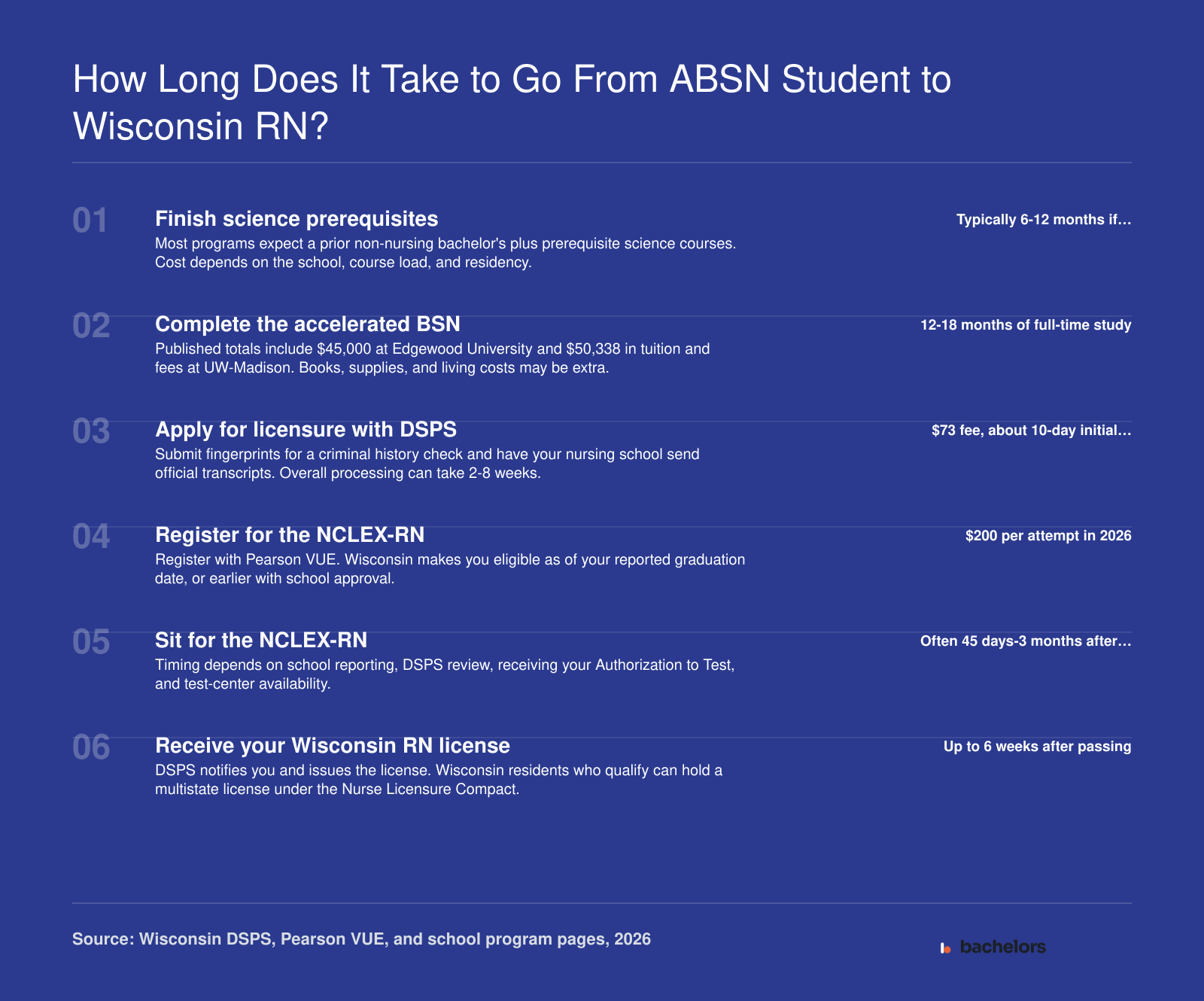
How Long Does It Take to Go From ABSN Student to Wisconsin RN?
Counting prerequisites, the accelerated BSN itself, and licensure, the path from first science class to a Wisconsin RN license typically runs about 2-3 years. Delays from admission cycles, missing documents, or exam scheduling can stretch that, so compare each program's start dates against your own timeline before you apply.
How We Weighed Wisconsin's Accelerated BSN Options
Name recognition does not earn a spot here. The ordering rewards programs that move a career changer from a prior bachelor's degree to the bedside at a reasonable price, with evidence that students who start actually finish and go on to earn well.
What Feeds the Ranking
- Average net price after aid: what students typically pay once grants and scholarships are applied, which separates a sticker-shock private campus from one that discounts heavily.
- Published tuition: the in-state and out-of-state rates a program lists, useful for comparing public options like UW-Madison and UW-Oshkosh against private campuses.
- Graduation and retention rates: the share of students who persist and complete, drawn from federal institutional reporting.
- Program-level earnings and debt: median pay for nursing graduates in the years after completion, weighed against typical borrowing, where federal figures exist for the nursing program itself.
Where the Numbers Stop Short
Graduation rates, retention, and net price are reported for the whole institution, not for the accelerated nursing track alone, so a large university's overall figures can understate or flatter a selective ABSN cohort. NCLEX-RN pass rates and admissions details such as GPA floors, prerequisite lists, and entrance exam policy are described elsewhere on this page but are not part of the scoring.
Sources and Currency
Institutional measures come from IPEDS and the most recent College Scorecard institutional snapshot (2024), with program-level earnings and debt from the 2022 Scorecard outcomes release. This list is current as of November 2026.
Compare Accelerated BSN (ABSN) programs on the data that matters
Explore more Nursing majors or browse every field of study.
All Nursing programs Browse every field of study