Best RN to BSN Programs in Wisconsin
Compare 16 accredited RN to BSN programs in Wisconsin, with net price after aid, graduation rates, earnings and debt from IPEDS and the U.S. College Scorecard.

A Wisconsin technical college ADN carries roughly 60 of the 120 credits a BSN requires under the state's articulation agreements, so the work left is about half a degree, stacked around three 12-hour shifts and, often, an employer's reimbursement cap.
Annual tuition among the online programs here runs from about $8,500 at the public universities to more than $35,000 at the private colleges, and the spread does not reliably predict what graduates earn four years out.
What separates them is narrower: how many nursing credits transfer, what GPA floor applies, and whether the coursework is asynchronous enough to survive a night rotation.
Key Points
- UW BSN@Home courses run asynchronously in 7- or 14-week terms.
- ADN graduates transfer at least 60 credits to University of Wisconsin-Milwaukee.
- Wisconsin has belonged to the Nurse Licensure Compact since 2000.
Best Fully Online RN to BSN Schools in Wisconsin: 10 Ranked Programs
Every program in this list is delivered online, and none requires students to attend hybrid classroom sessions on campus; where clinical or practicum hours appear, they are arranged in the student's own community. The ten are ordered by a composite that rewards fully online delivery first, then the value signals nurses ask about most: what the degree costs after aid and how reliably students finish. Each entry names the program's accreditation and, where the school offers one, the graduate nursing pathway that follows.
Herzing University-Kenosha
#1Kenosha, WI · ~$23,000/yr (est.)
Best for: ADN graduates with years of prior coursework
Herzing University's Kenosha campus is one of two Wisconsin locations for a career-focused institution built around working adults, and its nursing coursework runs fully online. The RN to BSN is the school's clearest fit for licensed nurses: generous credit-transfer rules, a community project in place of traditional clinicals, and graduate-level dual credit that carries into the MSN or DNP. Support services and advising are structured for students balancing a hospital schedule with school.
- 120 semester credits, with 26 in nursing courses
- Up to 70 nursing credits transfer from an ADN or diploma
- 90 credits accepted overall, including general education
- 100% online classes with no traditional clinicals
- 45-hour community project completed with a liaison
- Up to 9 graduate credits can carry into the MSN or DNP
- CCNE accredited
- Continuing education hours built into each course
Rasmussen University-Wisconsin
#2Green Bay, WI
Best for: Nurses needing frequent start dates
Rasmussen University-Wisconsin serves nursing students from a Green Bay base and runs one of the more transfer-friendly RN to BSN programs in the state. The structure favors speed and scheduling flexibility: eight entry points a year, flexible pacing, and room for enough transfer credit to cover roughly three-quarters of the degree. Clinical hours are arranged locally, which lets nurses stay employed full time while finishing.
- Up to 134 transfer credits, nearly 75% of the degree
- 70 credit hours across 17 courses
- Finish in 12 to 18 months
- Eight start dates per year
- Asynchronous online classes with locally arranged clinicals
- $345 per credit, about $24,650 total before grants
- Accelerated master's pathway option
- Program materials describe the RN to BSN as CCNE-accredited
University of Wisconsin-Green Bay
#3Green Bay, WI · $13,000/yr (est. net price)
Best for: Technical college ADN grads near Green Bay
The University of Wisconsin-Green Bay is a public Universities of Wisconsin campus whose RN to BSN shares a common core nursing curriculum with other UW nursing programs. An advisor counts incoming credits course by course and maps what is still needed, so nurses know their finish line before the first class. An employer partnership with Advocate Aurora Health adds enhanced tuition reimbursement for its Wisconsin employees, and graduates can continue into an MSN.
- Transfer up to 90 credits, counted by an advisor
- Required community health practicum
- Advisor guides course registration each semester
- CCNE accredited
- Advocate Aurora Health employees get enhanced tuition reimbursement
- Covered by the Wisconsin Technical College System RN-to-BSN articulation
- Online library services and writing support
- Graduates can continue into an MSN
University of Wisconsin-Milwaukee
#4Milwaukee, WI · $10,000 – $22,000/yr (est.)
The University of Wisconsin-Milwaukee is a large public research university and the center of nursing education in Milwaukee. Its RN to BSN offers two routes, a fully online format and a competency-based UW-FLEX option, and it holds one of the deepest credit-transfer arrangements with Wisconsin technical colleges, with eligible ADN graduates receiving at least 60 credits. A capstone quality improvement project can be completed at the student's own workplace.
- 120 total credit hours, including 60 clinical hours
- Fully online or UW-FLEX competency-based assessments
- Wisconsin technical college ADN graduates receive at least 60 credits
- MATC nursing students can enroll as special students before the ADN
- 2.5 GPA minimum
- Capstone quality improvement project can be done at your workplace
- CCNE accredited
Viterbo University
#5La Crosse, WI · ~$21,000/yr (est.)
Viterbo University is a private Catholic university in La Crosse whose BSN completion program has run for more than 25 years. It is among the most schedule-flexible options here, with seven-week sessions and three published completion tracks ranging from about a year to three years. Clinical placements are arranged near the student's home, application is free, and no additional fees are added on top of tuition.
- 43 total credit hours after transfer
- Complete in about one year, 18 months, or three years
- Transfer up to 70+ credits with a free transcript evaluation
- Seven-week course sessions
- 2.3 GPA minimum and a $0 application fee
- On-site clinical placements arranged near your home
- CCNE accredited
- Online or hybrid delivery options
University of Wisconsin-Oshkosh
#6Oshkosh, WI · $10,000 – $15,000/yr (est.)
The University of Wisconsin-Oshkosh is a public Universities of Wisconsin campus that hosts one of the BSN@Home collaborative's online RN to BSN tracks. Its graduate nursing menu is deeper than most regional campuses, spanning an RN to BSN to MSN nurse educator bridge and BSN to DNP routes. Advising is handled by nurses, and employer tuition reimbursement is explicitly supported.
- BSN@Home collaborative of the Universities of Wisconsin
- Many students finish in 3 semesters
- Transfer up to 90 credits
- Concurrent RN to BSN and ADN enrollment option
- Advisors are professional nurses
- Employer tuition reimbursement supported; scholarships available
- CCNE accredited
- RN to BSN to MSN Nurse Educator bridge available
Bellin College
#7Green Bay, WI · ~$37,000/yr (est.)
Bellin College is a small private health sciences college in Green Bay that focuses almost entirely on nursing and allied health. Its RN to BSN is a straightforward completion program with a single January entry and asynchronous online coursework across a two-year plan. The small enrollment and health-focused mission suit nurses who want a structured, low-distraction finish.
- Online RN to BSN completion program
- Two-year completion plan
- Asynchronous online classes
- Single January entry point each year
- CCNE accredited
Herzing University-Brookfield
#8Brookfield, WI · ~$21,000/yr (est.)
The Brookfield campus is Herzing University's Waukesha County location, serving nurses in Milwaukee's western suburbs with the same fully online RN to BSN offered at Kenosha. It is one of the quicker paths on this list, with a 12-month completion route, six start dates a year, and rolling admissions. A 45-hour community health project stands in for traditional clinicals, and dual credit can be applied toward a Herzing MSN.
- 100% online classes with no traditional clinicals
- Finish in as little as 12 months
- 45-hour community health project replaces clinicals
- Transfer up to 90 semester credits
- Six start dates per year with rolling admissions
- Dual credit toward the MSN
- CCNE accredited
- Full-time and part-time plans of study
Concordia University-Wisconsin
#9Mequon, WI · ~$36,000/yr (est.)
Concordia University Wisconsin is a private Lutheran university in Mequon, just north of Milwaukee, and its nursing programs are built around adult learners. The RN to BSN is test-optional, starts every eight weeks, and accepts up to 84 transfer credits toward the 120-credit degree. Scholarships for adult learners and conditional admission for applicants with lower GPAs make it one of the more accessible entries here.
- 120 total credits, finished in 18 to 24 months
- Transfer up to 84 credits
- Start dates every eight weeks
- Active unencumbered RN license and an ADN required
- ACT and SAT scores not required
- Conditional acceptance available for lower GPAs
- Clinical experiences require current vaccinations
- CCNE accredited
University of Wisconsin-Milwaukee Flex
#10Milwaukee, WI
UW-Milwaukee Flex is the Universities of Wisconsin competency-based arm, and its RN to BSN runs on a subscription model rather than standard semesters. Students pay a flat rate per 12-week period and move as fast as their competency demonstrations allow, with monthly starts and no on-campus requirements. It is a separate enrollment pathway from UWM's traditional online RN to BSN, so it is worth comparing both before applying.
- Competency-based, self-paced format with monthly starts
- 60 credits required beyond the ADN
- Flat-rate All-You-Can-Learn option at $2,250 per 12 weeks
- Single-course option at $1,125
- At least 60 credits granted for ADN or diploma coursework
- Capstone clinical project required
- No on-campus requirements
- Program materials describe it as CCNE-accredited
Cost & outcomes by school
Federal data for the highest-earning RN to BSN programs, independent of the ranking above. Earnings are this field's bachelor's graduates four years after completing where the Scorecard reports them, else the school's undergraduate median.
| School | Net price / yr | Grad rate | Earnings | Debt | Grads/yr | Format |
|---|---|---|---|---|---|---|
| University of Wisconsin-Madison WI | $17,354 | 90% | $73,792 | $20,484 | 24,058 | Hybrid |
| University of Wisconsin-Eau Claire WI | $16,550 | 64% | $58,561 | $20,909 | 4,168 | Hybrid |
| Concordia University-Wisconsin WI | $36,201 | 68% | $56,075 | $25,750 | 1,174 | Online |
| Lakeland University WI | $24,212 | 43% | $55,961 | $25,000 | 438 | Online |
| Viterbo University WI | $21,260 | 68% | $55,660 | $25,000 | 746 | Online |
| Ottawa University-Milwaukee WI | — | — | $55,552 | $21,500 | 44 | Online |
| University of Wisconsin-Oshkosh WI | $14,305 | 46% | $55,548 | $21,500 | 3,028 | Online |
| University of Wisconsin-Milwaukee WI | $15,014 | 49% | $54,990 | $23,000 | 6,786 | Online |
| University of Wisconsin-Milwaukee Flex WI | — | — | $54,990 | $23,000 | 232 | Online |
| Marian University WI | $21,937 | 44% | $53,501 | $25,000 | 458 | Online |
| Alverno College WI | $22,540 | 49% | $53,145 | $27,000 | 286 | Online |
| University of Wisconsin-Green Bay WI | $13,369 | 48% | $52,528 | $18,500 | 2,734 | Online |
Sources: U.S. Department of Education. Net price, graduation rate, earnings and debt: College Scorecard (earnings and debt for this field's bachelor's graduates where reported, else school-wide); graduates: IPEDS. A dash means no figure is reported.
Cost, debt & payoff
Median earnings of this field's bachelor's graduates (4 yrs after completing, else the school's undergraduate median) vs. their median federal loan debt · U.S. College Scorecard
Across these programs the median graduate earns about $54,990 and finishes with roughly $21,500 in debt — a ratio that clears a common rule of thumb (keep debt below first-year salary). Net price and debt vary widely school to school, so check the per-school figures in the table above before you shortlist.
Asynchronous, Cohort, or Self-Paced: How Wisconsin's Online RN to BSN Formats Differ
UW BSN@Home runs its core RN to BSN courses asynchronously in 7- or 14-week terms with fall and spring starts; most students take one or two courses a semester. That structure, not the "online" label, is what separates the formats available in Wisconsin.
Three Delivery Models
- Asynchronous, term-based: BSN@Home campuses such as UW-Green Bay, UW-Milwaukee and UW-Oshkosh post weekly coursework and deadlines but no live class meetings. You choose when in the week to study, not when the term starts.
- Self-paced, competency-based: UW-Milwaukee Flex uses assessments rather than a conventional course schedule, starts new classes monthly and lets you move faster or slower as work allows.
- Cohort model: At private options such as Herzing University-Brookfield, Concordia University-Wisconsin and Viterbo University, ask whether a fixed group starts and finishes together. A cohort trades flexibility for structure and peer accountability.
The Fine Print to Check
Some Wisconsin RN to BSN options marketed as online require scheduled live Zoom sessions. Those live sessions put them outside fully online scope, so confirm the format before applying.
For night-shift and rotating nurses, asynchronous term-based study fits if you can protect a predictable block of study time each week. Self-paced study suits unpredictable schedules but demands self-direction. Pick a cohort if peer accountability matters to you and you can keep to the group's fixed schedule.
Practicum and community health hours are typically arranged with a local site, often your employer, rather than on campus; confirm the hours and preceptor rules with each school.
Cheapest RN to BSN Programs in Wisconsin by Net Price
Net price is each school's institution-wide average cost after grants and scholarships, drawn from federal IPEDS and College Scorecard data. Treat it as an approximate benchmark, not a quote for RN to BSN coursework. Published tuition is the school's annual undergraduate rate, and per-credit figures come from program cost pages where current rates were available. Because most ADN-holding nurses enter with a large block of transfer credit, the clearest comparison is the per-credit rate multiplied by the credits you still need. Herzing's own example of 30 remaining credits at $450 comes to $13,500 before fees, a better guide than annual sticker tuition.
| School | Avg. Net Price After Aid (Institution-Wide, Approx.) | Published Tuition (In-State / Out-of-State) | Per-Credit Tuition (Researched) | Median Program Debt |
|---|---|---|---|---|
| University of Wisconsin-Green Bay | $13,369 | $8,700 / $17,288 | $452 per credit for BSN@Home nursing coursework, same rate across participating UW campuses (no separate residency rate published); no segregated fees, and non-nursing credits are billed separately | $15,221 |
| University of Wisconsin-Oshkosh | $14,305 | $8,532 / $16,446 | $452 per credit for BSN@Home nursing coursework, same rate across participating UW campuses (no separate residency rate published); no segregated fees, and non-nursing credits are billed separately | $23,118 |
| University of Wisconsin-Milwaukee | $15,014 | $10,398 / $22,398 | Confirm the current per-credit rate with UWM nursing before enrolling | $21,500 |
| Herzing University-Brookfield | $20,514 | $13,450 / $13,450 | $450 per credit, flat online rate for all students; $555 learner resource fee per semester; rates effective through Summer 2027 | $27,573 |
| Viterbo University | $21,260 | $34,250 / $34,250 | $480 per credit listed in program materials (may not reflect 2026 pricing); program states no additional fees | $26,983 |
RN to BSN Admissions in Wisconsin: License, ADN, Prerequisites, and GPA
RN to BSN admissions in Wisconsin hinge on four items: your license, your nursing credential, your general education credits, and your GPA. The public options below publish clear rules, and the private schools set their own.
- Active, unencumbered RN licenseBSN@Home, offered through University of Wisconsin-Oshkosh, requires you to live in one of the 50 states and hold a current, unencumbered RN license in that state. You do not need Wisconsin residency or a Wisconsin license. University of Wisconsin-Milwaukee and its Flex option accept a current, unencumbered RN license from any state.
- ADN or nursing diplomaBSN@Home accepts an ADN, an equivalent degree, or a nursing diploma from an accredited program. UW-Milwaukee accepts an ADN or diploma and lets current ADN students begin the process, but you must hold your RN license before admission. Transfer work must come from an accreditor recognized by CHEA.
- Prerequisite and general education creditsBSN@Home asks for at least 24 transferable non-nursing college credits beyond your ADN or diploma coursework. It also requires high school graduation (or GED/HSED), three years of high school math including algebra and geometry, and two years of high school or two semesters of college world language.
- Minimum GPABoth BSN@Home and UW-Milwaukee publish a 2.5 cumulative GPA minimum. ADN students in their final year with a 2.50 GPA may take UW Flexible Option nursing courses as special students.
- Deadlines and start termsBSN@Home accepts applications from August 1 to October 1 for January starts and from December 1 to March 1 for September starts. The application fee is $70, and you must submit all transcripts and one recommendation. For UW-Milwaukee Flex, apply up to five months ahead and no later than the first day of the month before your start.
- Private schoolsViterbo University, Bellin College, Concordia University-Wisconsin, Rasmussen, and Herzing set their own GPA, licensure, and start-date rules. Confirm these directly with each admissions office.
Wisconsin RN Licensure and Out-of-State Enrollment at a Glance
RN to BSN Time and Cost in Wisconsin: Transfer Credits, Part-Time Pace, and Tuition
How many credits transfer from an ADN to a BSN in Wisconsin? Most of a 120-credit degree, usually. At University of Wisconsin-Milwaukee, ADN graduates can transfer at least 60 credits, with up to 30 of those in nursing courses through a statewide technical college agreement. UW Flexible Option, the program behind University of Wisconsin-Milwaukee Flex, breaks the 120 credits into about 60 lower-division, 30 upper-division nursing, and 30 from clinical training and equivalency exams. Upper limits vary by school: up to 90 at University of Wisconsin-Green Bay and University of Wisconsin-Oshkosh, 84 at Concordia University-Wisconsin, and 90 at Herzing, where up to 70 can be nursing credits. Ask for a transcript evaluation before you apply, because transfer rules are not uniform.
How Long Does It Take?
Pace decides the answer, and no single statewide standard exists.
- Fastest: Herzing University-Brookfield advertises 12 months, and Rasmussen University-Wisconsin lists 12 to 18 months.
- Middle: Concordia runs about 18 months, while University of Wisconsin-Milwaukee and Bellin College both describe roughly two years.
- Flexible: University of Wisconsin-Oshkosh says many students finish in three semesters, though the timeline is student-determined.1 Viterbo University offers one year, 18 months, or three years.
Going part-time while working typically stretches the timeline to two to three years. The self-paced University of Wisconsin-Milwaukee Flex option can run shorter or longer depending on how many competencies you complete each term.
In-State vs. Out-of-State Tuition
The public schools price residents far below nonresidents. Annual in-state tuition runs about $8,532 at University of Wisconsin-Oshkosh, $8,700 at University of Wisconsin-Green Bay, and $10,398 at University of Wisconsin-Milwaukee. Out-of-state rates rise to $16,446, $17,288, and $22,398. University of Wisconsin-Milwaukee Flex charges $6,750 regardless of residency, with subscription pricing of $2,250 for All-You-Can-Learn or $1,125 for a single course per 12-week period.
Private schools charge one rate. Rasmussen lists $345 per credit, Concordia $450, and Viterbo $480. Herzing lists a total program cost of $13,500. Bellin College and Viterbo run about $31,000 and $34,000 a year.
Employer Tuition Help
Hospital systems across Wisconsin often help nurses fund a BSN, but caps and service commitments differ by employer. Check with human resources for the current annual limit and any repayment terms before you enroll. University of Wisconsin-Oshkosh notes that employer reimbursement is supported, and Rasmussen mentions corporate alliances that can lower costs. Combine employer money with financial aid and scholarships to shrink what you pay out of pocket.
Related Articles
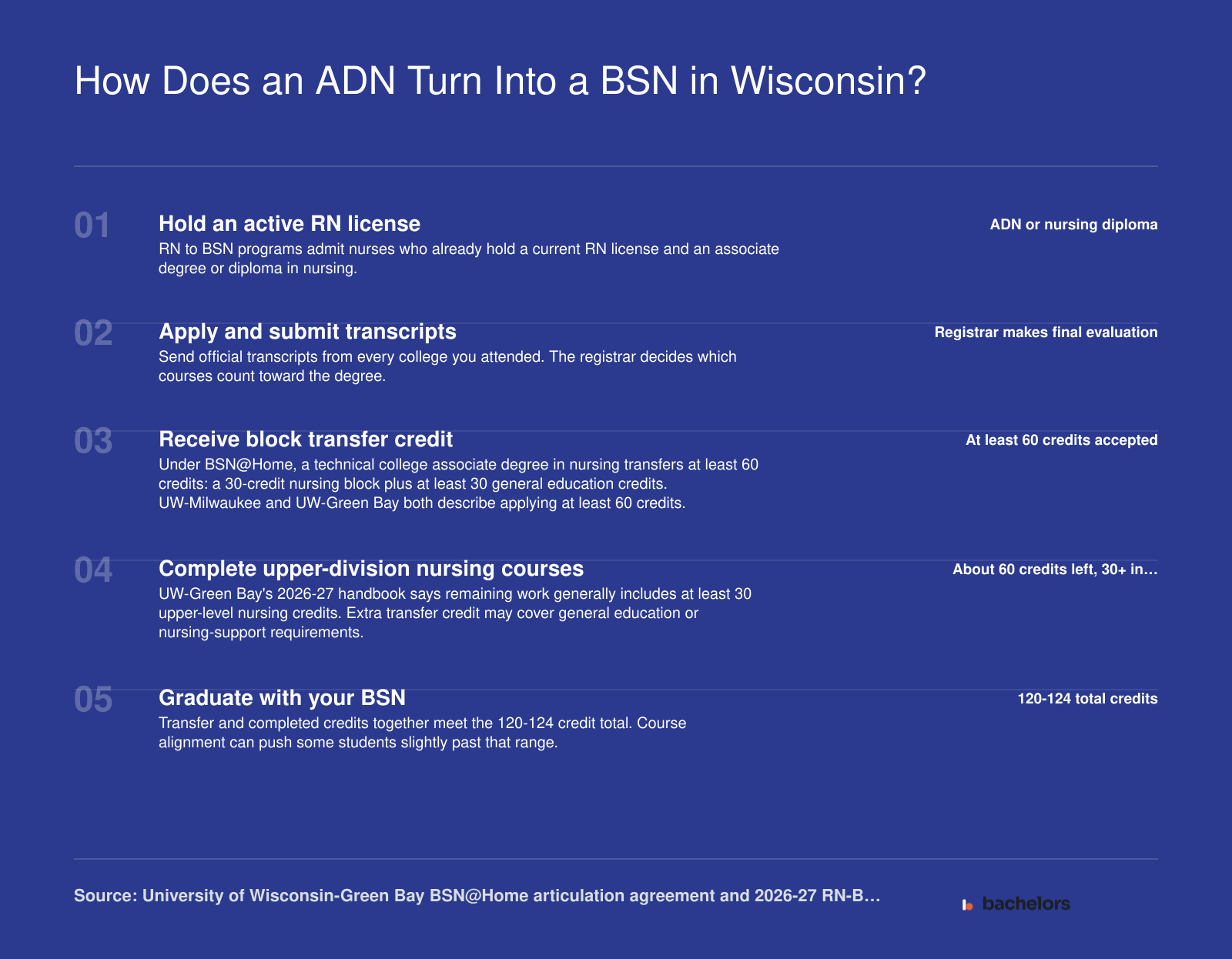
How Does an ADN Turn Into a BSN in Wisconsin?
For graduates of Wisconsin's technical college ADN programs, the statewide BSN@Home articulation with University of Wisconsin campuses turns the associate degree into a large block of transfer credit. That leaves roughly half of a bachelor's degree to finish, mostly upper-level nursing. Exact totals depend on your campus and transcript.
What Registered Nurses Earn in Wisconsin
The latest federal wage survey offers a useful pay benchmark for registered nurses weighing a BSN.
Compare RN to BSN programs on the data that matters
Explore more Nursing majors or browse every field of study.
All Nursing programs Browse every field of study