Best BSN Programs in Wisconsin
Compare 33 accredited Bachelor of Science in Nursing (BSN) programs in Wisconsin at 27 colleges, with net price after aid, graduation rates, earnings and debt from IPEDS and the U.S. College Scorecard.
Two ways to pick a Wisconsin nursing school: by the diploma's name, or by how its graduates do on the licensing exam. Only the second gets a graduate working as a registered nurse.
The NCLEX-RN is pass or fail, and the first attempt is the one that counts. First-time pass rates in state board reports for the schools ranked here run from 97.4 to 100 percent. A miss means weeks of review and a retake.
Only traditional pre-licensure BSN programs are ranked here, ordered chiefly by that pass rate. Cost runs a close second: net price after aid separates campuses that look identical on sticker tuition.
Key Points
- UW-Madison requires 54 college credits before reviewing a nursing application.
- Wisconsin residents pay $11,603 at UW-Madison versus $42,103 for nonresidents.
- The NCLEX-RN costs $200, and graduates apply for licensure through DSPS.
Top 10 Wisconsin BSN Programs by NCLEX-RN Pass Rate (2027)
This list is ordered by first-time NCLEX-RN pass rate, the clearest public signal of how a Wisconsin BSN cohort performs on the licensing exam. Completion and accreditation separate programs whose pass rates sit within a fraction of a point of each other. Pass rates appear exactly as the data reports them, and each card gives the school's average net price after aid, admission rate, and institution-wide graduation rate so you can weigh cost and selectivity against the exam result.
Maranatha Baptist University
#1Watertown, WI · ~$26,000/yr (est.) · NCLEX-RN pass rate 100% (2-yr weighted avg)
Best for: Faith-centered nurses seeking mission-field training
Maranatha Baptist University sits in Watertown, a small city between Madison and Milwaukee, and its nursing cohort is small enough that first-time NCLEX-RN results come from a tight group of test takers. Average net price after aid is $26,005, and the university admits about 72% of applicants and graduates 64% of its students. The BSN pairs more than 1,000 clinical hours with a capstone and an embedded NCLEX review course, and it is taught within a Christian worldview with an optional medical missions trip.
- CCNE accredited Bachelor of Science in Nursing
- More than 1,000 hours of clinical experience
- Capstone practicum required
- NCLEX review course built into the curriculum
- Optional medical missions trip
- Nursing taught within a biblical worldview
- Clinical sites include hospitals and community clinics
University of Wisconsin-Madison
#2Madison, WI · ~$17,000/yr (est.) · NCLEX-RN pass rate 98.2% (2-yr weighted avg)
Best for: Wisconsin residents aiming at a flagship campus
UW-Madison is the state's flagship campus in Madison and reports the largest testing cohort on this list, which makes its NCLEX-RN result a steadier signal than a class of twenty. Average net price after aid is $17,354 for a university that admits about 45% of applicants and graduates 90% of its students. Pre-nursing students spend two years on prerequisites and general education, then apply for the two-year nursing component, with clinical placements running up to 90 miles from campus.
- CCNE accredited, 124 total credit hours
- Two years of prerequisites, then a two-year nursing component
- Sophomore-year application to the nursing major
- 2.8 GPA minimum for the nursing component
- Clinical placements up to 90 miles from campus
- One fall start per year
- School registers students for the NCLEX exam
- BSN Honors in the Major available
- 12-month program for non-nursing bachelor's degree holders
- Cohort-based structure
- No entrance exam required
- Application deadline of October 1
- Clinical rotations in rural and urban hospitals
- Fully online, asynchronous coursework
- $452 per credit
- 31 total credit hours
- Finish in 1.5 to 2.5 years
- Two start dates per year, fall and spring
- 135 clinical hours plus a capstone
- Shared courses across seven UW campuses
Milwaukee School of Engineering
#3Milwaukee, WI · ~$22,000/yr (est.) · NCLEX-RN pass rate 98.1% (2-yr weighted avg)
Best for: Milwaukee learners drawn to simulation-heavy labs
Milwaukee School of Engineering is a small private campus in downtown Milwaukee where first-year students enter the nursing major directly instead of competing for a seat later. Average net price after aid is $22,453, the admission rate is about 59%, and the university graduates 67% of its students. Simulation work happens in the Ruehlow Nursing Complex, and a first-year living learning community plus an anatomy and physiology jump-start program ease the move into clinical coursework.
- CCNE accredited traditional track
- Direct admission into the nursing major
- Guaranteed progression through clinical courses
- Simulation learning in the Ruehlow Nursing Complex
- Nursing Living Learning Community
- Anatomy and Physiology JumpStart Program
- Full-time, campus-based format in downtown Milwaukee
- 16-month track for career changers with a bachelor's degree
- Two start dates per year, fall and spring
- 660 clinical hours
- At least 15 simulation experiences
- Prerequisite coursework required before entry
University of Wisconsin-Eau Claire
#4Eau Claire, WI · ~$17,000/yr (est.) · NCLEX-RN pass rate 98% (2-yr weighted avg)
UW-Eau Claire is a public university in western Wisconsin with an average net price after aid of $16,550, an admission rate near 82%, and an institution-wide graduation rate of 64%. Its nursing footprint includes the statewide BSN@Home collaboration, which lets registered nurses and ADN graduates finish a bachelor's degree through shared online courses while naming a home campus. Licensed RNs take classes in 7- and 14-week sessions, complete a 90-hour clinical project, and apply on a rolling basis.
- Hybrid online completion program for licensed RNs and ADN graduates
- Courses in 7-week and 14-week sessions
- 90-hour clinical project at a community agency
- Rolling admissions
- Part of the statewide BSN@Home collaboration
- Electives in cross-cultural nursing and end-of-life care
- No minor required
Carroll University
#5Waukesha, WI · $15,000 – $20,000/yr (est.) · NCLEX-RN pass rate 97.4% (2-yr weighted avg)
Carroll University occupies a suburban campus in Waukesha, west of Milwaukee, and admits about 67% of applicants while graduating 71% of its students. Average net price after aid is $15,193, among the lower figures for a private BSN on this list. Simulation is INACSL endorsed, clinical sites include Mayo Clinic, the VA, Meriter, and Agrace, and the final semester closes with a 120-hour capstone in an area such as medical-surgical, pediatric, or intensive care.
- CCNE accredited BSN with simulation from the first year
- INACSL endorsed simulation program
- 120-hour capstone in medical-surgical, pediatric, or intensive care
- Clinical placements at Mayo Clinic, VA, Meriter, and Agrace
- Cross-cultural experience requirement
- Pinning and White Coat ceremonies
- Sigma Theta Tau membership available
Bellin College
#6Green Bay, WI · ~$37,000/yr (est.) · NCLEX-RN pass rate 97.5% (2-yr weighted avg)
Bellin College is a health sciences-focused private college in Green Bay, and its size shows in the numbers: an admission rate near 97% and an average net price after aid of $37,408, the highest on this list, against a 63% institution-wide graduation rate. Nursing coursework begins in the first semester rather than after a separate upper-division application. The college runs traditional, transfer, and 15-month accelerated tracks, and general education credits transfer in.
- Nursing courses begin in the first semester
- Three tracks: traditional three-year, transfer, and 15-month accelerated
- CCNE accredited and approved by the Wisconsin Board of Nursing
- 120 total credit hours
- Extensive clinical experience across multiple specialties
- General education credits accepted in transfer
Wisconsin Lutheran College
#7Milwaukee, WI · $20,000 – $25,000/yr (est.) · NCLEX-RN pass rate 97.2% (2-yr weighted avg)
Wisconsin Lutheran College is a small private campus in Milwaukee with an average net price after aid of $23,245, an admission rate around 78%, and a 64% institution-wide graduation rate. Incoming freshmen can be admitted to nursing directly, and the final semester includes a 120-hour preceptorship. Clinical rotations run through Froedtert Hospital and Children's Hospital of Wisconsin, and students complete an immersion experience abroad or with a vulnerable local population.
- Direct admission for incoming freshmen
- 120 clinical hours plus a 120-hour final-semester preceptorship
- Moderate- and high-fidelity patient simulators
- Clinical rotations at Froedtert Hospital and Children's Hospital of Wisconsin
- 2.8 GPA minimum
- Immersion experience abroad or with a local vulnerable population
- CCNE accredited
University of Wisconsin-Oshkosh
#8Oshkosh, WI · $10,000 – $15,000/yr (est.) · NCLEX-RN pass rate 97.2% (2-yr weighted avg)
UW-Oshkosh is a public university on the western shore of Lake Winnebago with the lowest average net price after aid on this list at $14,305. It admits about 87% of applicants and graduates 46% of its students, a completion rate worth weighing against that cost. The traditional BSN runs five semesters with supervised clinical rotations every term, and a year-round option plus a clinical study abroad window add scheduling flexibility for students who need it.
- Five-semester traditional track
- Year-round program option available
- Supervised clinical rotations every semester
- Hybrid and online components mixed with face-to-face classes
- Clinical study abroad during interim periods
- Online RN to BSN and ADN-to-BSN options
- Three-semester completion timeline
- Transfer up to 90 credits
- Faculty advisors who are professional nurses
- 12-month track for prior bachelor's degree holders
- Three start dates per year: spring, summer, and fall
- Online theory with local clinical rotations
- Two-week on-campus residency
Edgewood University
#9Madison, WI · $25,000 – $30,000/yr (est.) · NCLEX-RN pass rate 96.5% (2-yr weighted avg)
Edgewood University is a private Catholic college in Madison with an average net price after aid of $26,113, an admission rate near 76%, and a 60% institution-wide graduation rate. Cohorts are held to roughly 42 students with a 7:1 clinical faculty-to-student ratio, and clinical placements draw on more than 80 partner sites around the city. High-achieving freshmen can lock in a nursing seat through the Guaranteed Admission Program.
- Rolling admissions with fall and spring starts
- Over 80 community clinical partners
- 7:1 clinical faculty-to-student ratio
- Cohorts of 42 students per semester
- Simulation center with high-fidelity mannequins and an Anatomage table
- Guaranteed Admission Program for high-achieving freshmen
- 2.8 GPA minimum
Marquette University
#10Milwaukee, WI · ~$31,000/yr (est.) · NCLEX-RN pass rate 95.9% (2-yr weighted avg)
Marquette University is a private Jesuit campus in Milwaukee that admits nursing students directly as freshmen, so the four-year path is settled before classes begin. Average net price after aid is $31,487, the admission rate is about 81%, and the university graduates 83% of its students, the second-highest completion rate here. Clinical hours are guaranteed, and students can add a Veteran Affairs Nursing Academic Partnership track or an honors capstone.
- Direct admission as a freshman
- Four-year, campus-based BSN
- Guaranteed clinical hours and classes
- Veteran Affairs Nursing Academic Partnership track
- Nursing study abroad opportunities
- Honors program with a capstone project
- CCNE accredited
Cost & outcomes by school
Federal data for the highest-earning Bachelor of Science in Nursing (BSN) programs, independent of the ranking above. Earnings are this field's bachelor's graduates four years after completing where the Scorecard reports them, else the school's undergraduate median.
| School | Net price / yr | Grad rate | Earnings | Debt | Grads/yr | Format |
|---|---|---|---|---|---|---|
| Milwaukee School of Engineering WI | $22,453 | 67% | $89,070 | $27,000 | 1,114 | Campus |
| Marquette University WI | $31,487 | 83% | $78,257 | $23,940 | 4,044 | Campus |
| Bellin College WI | $37,408 | 63% | $76,222 | $18,000 | 244 | Campus |
| University of Wisconsin-Madison WI | $17,354 | 90% | $73,792 | $20,484 | 24,058 | Campus |
| Edgewood University WI | $26,113 | 60% | $59,728 | $24,424 | 724 | Campus |
| University of Wisconsin-Eau Claire WI | $16,550 | 64% | $58,561 | $20,909 | 4,168 | Hybrid |
| Carroll University WI | $15,193 | 71% | $58,009 | $27,000 | 1,172 | Campus |
| Carthage College WI | $26,565 | 64% | $56,950 | $26,000 | 1,340 | Campus |
| Concordia University-Wisconsin WI | $36,201 | 68% | $56,075 | $25,750 | 1,174 | Campus |
| Lakeland University WI | $24,212 | 43% | $55,961 | $25,000 | 438 | Hybrid |
| Viterbo University WI | $21,260 | 68% | $55,660 | $25,000 | 746 | Campus |
| University of Wisconsin-Oshkosh WI | $14,305 | 46% | $55,548 | $21,500 | 3,028 | Hybrid |
Sources: U.S. Department of Education. Net price, graduation rate, earnings and debt: College Scorecard (earnings and debt for this field's bachelor's graduates where reported, else school-wide); graduates: IPEDS. A dash means no figure is reported.
Cost, debt & payoff
Median earnings of this field's bachelor's graduates (4 yrs after completing, else the school's undergraduate median) vs. their median federal loan debt · U.S. College Scorecard
Across these programs the median graduate earns about $55,548 and finishes with roughly $22,275 in debt — a ratio that clears a common rule of thumb (keep debt below first-year salary). Net price and debt vary widely school to school, so check the per-school figures in the table above before you shortlist.
Why First-Time NCLEX-RN Scores Carry This List
A BSN in Wisconsin is only as valuable as the license it leads to. A graduate who passes the NCLEX-RN on the first attempt starts working as a registered nurse within weeks; one who does not waits out a retake. That is why first-time exam results carry about three quarters of each school's score, and why the programs below appear in that order.
What Goes Into the Score
The core input is the first-time NCLEX-RN pass rate across the latest three years of state board data, with each year scaled to its number of candidates, so a large cohort counts for more than a small one. First-time results are also the fairer comparison: they measure a program's own preparation rather than the persistence of a determined retaker. Read each rate alongside the number of test-takers behind it. Accreditation and a modest completion and retention component act as tie-breakers.
What the Numbers Do Not Say
Graduation rates are institution-wide, not nursing-specific. Net price is an average after aid, not a personal quote, so your own figure depends on residency, state grants and transfer credit.
Scope is traditional pre-licensure BSN programs only. Licensed RNs should use the site's RN to BSN page, and second-degree students should use the accelerated BSN page; those routes are not ranked here.
Most Affordable BSN Schools in Wisconsin After Financial Aid
If you are searching for the cheapest BSN programs in Wisconsin, the affordable BSN programs in Wisconsin with the lowest average net price after aid are all public University of Wisconsin System campuses, sorted below from lowest cost using 2024 U.S. Department of Education data (IPEDS and College Scorecard); keep in mind that net price is an institution-wide average for all undergraduates, not a nursing-specific quote, and private schools can still post low figures when institutional grants are large, though none edged out these UW campuses. Value lines up with results at two of these schools: UW-Oshkosh pairs a $14,305 average net price with a 97.2% NCLEX-RN pass rate, and UW-Green Bay pairs $13,369 with a 91.5% pass rate, while you can check where UW-Parkside, UW-Whitewater, and UW-Stevens Point stand in the NCLEX-RN ranking above.
| School | City | Type | Average Net Price After Aid (institution-wide) | In-State Tuition & Fees | Out-of-State Tuition & Fees | Median Graduate Debt (institution-wide) |
|---|---|---|---|---|---|---|
| University of Wisconsin-Parkside | Kenosha | Public (UW System) | $11,772 | $8,270 | $17,429 | $20,492 |
| University of Wisconsin-Green Bay | Green Bay | Public (UW System) | $13,369 | $8,700 | $17,288 | $18,500 |
| University of Wisconsin-Whitewater | Whitewater | Public (UW System) | $14,158 | $8,616 | $18,716 | $23,188 |
| University of Wisconsin-Oshkosh | Oshkosh | Public (UW System) | $14,305 | $8,532 | $16,446 | $21,500 |
| University of Wisconsin-Stevens Point | Stevens Point | Public (UW System) | $14,559 | $9,488 | $18,508 | $21,503 |
Related Articles
Getting Into a Wisconsin BSN: Direct Admit vs. Upper-Division Entry
UW-Madison asks for 54 college-level credits and at least four of seven prerequisites before it will consider a nursing application. That is upper-division entry, and it shows how the two models differ.
Two Ways In
Direct admit gives freshmen a seat in the nursing major from day one, so the main hurdle is the university application. Upper-division entry works differently. You enroll, complete prerequisites, then submit a second, competitive application to the nursing school, usually for sophomore or junior standing.
Milwaukee School of Engineering lists direct admission into its nursing major for its traditional track. UW-Madison and Edgewood University use the upper-division model. The admissions pages for Marquette, UW-Oshkosh, Viterbo and Bellin College did not make the entry model clear, so check each school's nursing page before you apply.
Prerequisites, GPA and Testing
UW-Madison's School of Nursing requires:
- Prerequisites: Chemistry, microbiology, human anatomy, human physiology, psychology, sociology, and human growth and development.
- GPA: A 2.75 cumulative GPA and a 2.75 prerequisite GPA.
- Grades: A C or higher in each prerequisite.
- Testing: ACT and SAT scores are optional for first-year applicants through spring 2028.1 TEAS is not required.
Edgewood's traditional BSN is built around 62 prerequisite credits, which you must finish or be completing in your application semester. It sets the same 2.75 cumulative and prerequisite math and science GPAs, with a C minimum in those courses. Required math and science must fall within eight years of your first nursing course, and you need American Heart Association CPR/BLS certification. Edgewood's page lists higher GPA figures elsewhere without saying which applicants they cover, so confirm yours with an admissions counselor. It publishes no ACT, SAT, TEAS or HESI policy.
How Hard Is It to Get In?
The admission rates in the ranking data are university-wide, not nursing-specific. UW-Madison admits 45.2% of applicants, Milwaukee School of Engineering 58.9%, and Maranatha Baptist University 71.9%. Those figures describe getting into the school, not into the nursing major.
At an upper-division school, the harder gate is the second application. A student admitted to UW-Madison still has to meet the credit, prerequisite and grade thresholds before nursing seats are filled, and the 2.75 GPA is a floor, not a guarantee. I did not find published nursing-major acceptance rates or seat counts for the schools above, so treat the minimums as entry points and aim well above them.
Licensed RNs and anyone who already has a bachelor's degree should follow the RN to BSN and accelerated pages instead; those routes carry different requirements.
What a BSN Costs in Wisconsin, and the State Grants That Cut It
Sticker price is a poor guide to what a Wisconsin nursing degree really costs, because state grants and institutional aid reshape the bill for most students.
Sticker Price vs. Net Price
Public UW System campuses charge far less in published in-state tuition than private colleges such as Marquette University, Carroll University, Viterbo University, or Carthage College. Private schools, however, tend to discount heavily: their average net price, what students pay after grants and scholarships, usually lands well below the posted figure. Always compare net price, not tuition alone.
The ranking data shows how low the floor can go. Average annual net price runs $8,255 at Nicolet Area Technical College, $8,989 at Northwood Technical College, and $9,112 at Milwaukee Area Technical College. These are technical colleges whose nursing program in our data is an associate degree, so treat them as a low-cost benchmark rather than a BSN price. Your own bill depends on family income and enrollment, so treat these figures as averages rather than quotes.
Wisconsin Grant and Talent Incentive Program
The Wisconsin Grant is need-based aid for Wisconsin residents enrolled at least half-time in an undergraduate program at a UW campus, technical college, or private nonprofit college in the state. The Talent Incentive Program (TIP) targets residents with the greatest financial need, and eligibility is tied to a first-time student's circumstances. Both are administered by the Wisconsin Higher Educational Aids Board (HEAB), and you apply by filing the FAFSA. Award amounts change by year, sector, and need, so check HEAB for the current ranges instead of relying on an older figure.
Nursing-Specific Aid
State-level nursing aid, including loan programs and workforce or nurse educator incentives, depends on legislative funding that shifts from year to year. Confirm with HEAB and each school's financial aid office what is currently funded, then ask about eligibility basics such as Wisconsin residency, enrollment status, and any service commitment attached to the money. Many nursing programs also administer their own scholarships, which are worth asking about at admission.
A Practical Tip
File the FAFSA as early as the application opens. State grant dollars are limited, and late filers can miss out even when they qualify on need.
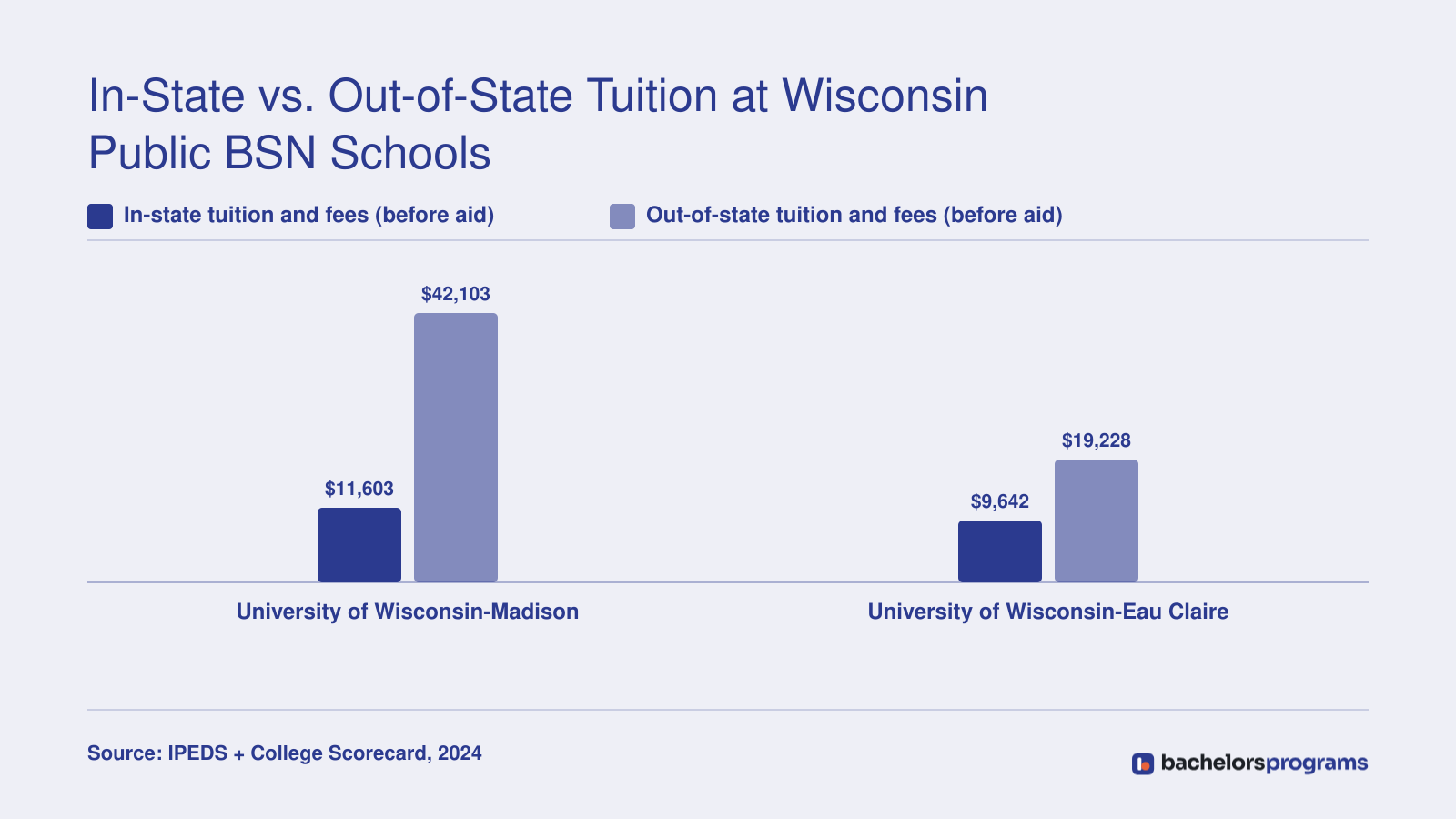
In-State vs. Out-of-State Tuition at Wisconsin Public BSN Schools
These bars show published tuition and fees before aid at the UW campuses in the ranking. The gap is widest at UW-Madison, where nonresidents pay $42,103 against $11,603 for Wisconsin residents. Minnesota residents are the main exception. Under Minnesota-Wisconsin tuition reciprocity, Minnesota undergraduates generally pay the higher of two rates: the UW campus's resident tuition or the comparable Minnesota resident tuition. To use it, apply to the campus first, then file the online reciprocity application, by December 31 for full-year approval. Reciprocity rates are reviewed each spring, so confirm the current figure with the campus. Other out-of-state students qualify for in-state rates under Wisconsin Statute 36.27(2) only after 12 consecutive months as a bona fide Wisconsin resident before enrolling, and the campus makes the initial residency decision.
First-Year Paycheck for Wisconsin BSN Graduates
Among the Wisconsin BSN programs ranked here, University of Wisconsin-Madison graduates post the highest median earnings one year after finishing the degree.
Board Approval and CCNE or ACEN Accreditation: What to Verify First
Board Approval Comes First
A pre-licensure program must be approved by the Wisconsin Board of Nursing, which operates under the Department of Safety and Professional Services (DSPS), before its graduates can sit for the NCLEX-RN. Without that approval, a degree will not lead to a license. DSPS revised its Nursing Program Directory on August 26, 2026, and it flags two statuses worth noticing: "Authorized to Admit Students, Not Yet Board Approved" and "Authorized to Plan, Cannot Admit Students, Not Board Approved." Check the directory for your school before you apply, and look for any probation or conditional approval notes.
Why CCNE or ACEN Accreditation Matters
Programmatic accreditation from CCNE or ACEN is separate from board approval. It affects whether a BSN will be accepted for graduate nursing study, and it matters for federal aid and many employers. DSPS does not report accreditation, so confirm it in the CCNE and ACEN directories.
Program pages for the University of Wisconsin-Madison, Maranatha Baptist University, Milwaukee School of Engineering and the University of Wisconsin-Eau Claire describe CCNE accreditation. We did not find an ACEN-accredited BSN among the schools profiled here. For Marquette University, Viterbo University, Bellin College, Edgewood University and the University of Wisconsin-Oshkosh, look up the current status and date in the directory itself rather than relying on a brochure.
Reading the NCLEX-RN Rates
The rates in the ranking are first-time pass rates, meaning only a graduate's first attempt counts. Cohort size matters. Maranatha Baptist University shows 100 percent on 22 test-takers, so one failed attempt would move that number noticeably. The University of Wisconsin-Madison's 98.2 percent rests on 411 test-takers, which makes it far steadier. The ranking figures combine multiple years of results, which smooths out single-year swings, but a small program can still shift from one cycle to the next.
Your Verification Checklist
- Board status: Find the program in the DSPS directory and confirm it is board approved, not just authorized to admit.
- Accreditation: Confirm CCNE or ACEN status and the most recent review date.
- Cohort size: Weigh a pass rate against the number of test-takers behind it.
Wisconsin RN Licensure at a Glance
Compare Bachelor of Science in Nursing (BSN) programs on the data that matters
Explore more Nursing majors or browse every field of study.
All Nursing programs Browse every field of study