Best BSN Programs in Maryland
Compare 17 accredited Bachelor of Science in Nursing (BSN) programs in Maryland at 14 colleges, with net price after aid, graduation rates, earnings and debt from IPEDS and the U.S. College Scorecard.
A famous nursing school and a strong NCLEX-RN record are not always the same thing, and only the exam decides whether a graduate can work as a registered nurse. Among the bachelor's programs here, pass rates run from 91.9% to 93.5%, too narrow a spread for reputation to break ties.
So which Maryland BSN gives the best shot at passing? The ranked list answers with board pass-rate data, covering traditional pre-licensure programs only. Cost, earnings, admissions, state aid and licensure follow.
Near-identical pass rates still hide very different odds of getting in: Johns Hopkins admits about 6% of applicants, Notre Dame of Maryland about 82%.
Key Points
- Rankings follow first-time NCLEX-RN pass rates from the most recent three years.
- The cheapest options here are community college ADN programs, not BSNs.
- Salisbury University admits nursing students through a separate upper-division application.
Top NCLEX-RN Outcomes: Maryland's 10 Best BSN Programs
These ten traditional BSN programs in Maryland are ordered by first-time NCLEX-RN pass rates, the results that determine whether a graduate can actually practice. Each card pairs the school's most recent published pass rate with what the program looks like day to day, what it costs after aid, and how well the institution keeps students through graduation.
Notre Dame of Maryland University
#1Baltimore, MD · ~$19,000/yr (est.) · NCLEX-RN pass rate 93.5% (3-yr weighted avg)
Best for: Baltimore students wanting hospital clinicals early
Notre Dame of Maryland University is a private Catholic institution in Baltimore with a long history of educating nurses in the city. Its entry-level BSN mixes liberal arts with nursing core coursework, and students begin clinical rotations in junior year at Johns Hopkins Hospital and the University of Maryland Medical Center. Small classes and assigned faculty mentors give the program a personalized feel, and a transformational practice project caps the senior year.
- Traditional four-year entry-level BSN for first-time nursing students
- Clinical placements begin junior year at Johns Hopkins and UMMC
- Coursework includes Holistic Health Assessment and Pathopharmacology
- High-fidelity simulation labs for safe skills practice
- Senior Transformational Practice Project and optional Haiti mission trip
- Small class sizes with assigned faculty mentoring
Towson University
#2Towson, MD · ~$17,000/yr (est.) · NCLEX-RN pass rate 92.7% (3-yr weighted avg)
Best for: Public-university students ready for a competitive screened major
Towson University is Maryland's largest public university and runs one of the state's biggest pre-licensure BSN cohorts, awarding nearly 300 nursing bachelor's degrees in a recent year. Nursing is a screened major: students spend two years on prerequisites and apply for junior-year entry, which keeps the upper division competitive and cohesive. Clinical placements with regional partners and a strong NCLEX preparation record make it a reliable choice for students who want a large-campus public option.
- 120-credit pre-licensure BSN open to new and transfer students
- Screened major: apply during sophomore year for junior entry
- Two years of prerequisite science and core courses first
- Program reports a 91% licensure pass rate
- Clinical placements at partner hospitals and care sites
- Preparation for direct patient care and healthcare administration roles
Salisbury University
#3Salisbury, MD · ~$18,000/yr (est.) · NCLEX-RN pass rate 92% (3-yr weighted avg)
Salisbury University is a public institution on Maryland's Eastern Shore with a cohort-based traditional BSN built on eight prerequisite science courses. Students move through upper-division nursing as a group, with a faculty advisor assigned in sophomore year, which suits learners who want structure and steady guidance. Clinical work is arranged with regional healthcare facilities, and applicants who meet the January 15 priority deadline get first consideration on a space-available basis.
- Traditional first-bachelor's BSN with a cohort model starting each fall
- Eight prerequisite science courses including anatomy, physiology, microbiology and chemistry
- Two-step admissions process through NursingCAS
- January 15 priority deadline with space-available review after
- Faculty advisor assigned in the sophomore year
- Background check and drug testing required before clinicals
Frostburg State University
#4Frostburg, MD · $10,000 – $26,000/yr (est.) · NCLEX-RN pass rate 89.5%
Frostburg State University is a public regional university in western Maryland with a BSN that leans on simulation and local clinical partnerships. The program runs small, supportive classes in a new Education and Health Science Center, and students can join a Living Learning Community in Allen Hall that adds mentoring and shadowing at UPMC Western Maryland. Coursework spans acute, chronic and community-based care, with opportunities to present evidence-based projects at regional conferences.
- High-fidelity simulation and skills lab in a new health science center
- Living Learning Community in Allen Hall with mentoring and shadowing
- Shadowing at UPMC Western Maryland
- Clinical rotations through local health partnerships
- Junior and senior courses taught in active-learning classrooms
- Coursework in acute, chronic and community-based care
Morgan State University
#5Baltimore, MD · $10,000 – $15,000/yr (est.) · NCLEX-RN pass rate 89.5% (3-yr weighted avg)
Morgan State University is a historically Black public university in Baltimore whose nursing department frames the BSN around social justice, diversity and health equity. Students finish pre-professional coursework before moving into upper-division clinical courses placed across Baltimore-area healthcare settings. Admission is more structured than at many Maryland schools, requiring the ATI TEAS entrance exam, at least three letters of reference and a criminal background check.
- Upper-division clinical courses after completing pre-professional coursework
- Curriculum grounded in social justice and health equity
- ATI TEAS entrance exam required for admission
- Minimum of three letters of recommendation
- Criminal background check required
- One fall start per year
Bowie State University
#6Bowie, MD · ~$19,000/yr (est.) · NCLEX-RN pass rate 88.5% (3-yr weighted avg)
Bowie State University is a historically Black public university in Prince George's County offering a four-year traditional BSN for freshman and transfer entrants. The curriculum emphasizes culturally congruent care, research utilization, professional role development and leadership, and it is designed as a generalist program that also prepares graduates for graduate study later. Community partnerships and quality instruction are departmental priorities, and students complete clinical work across diverse care settings.
- Four-year traditional BSN open to freshmen and transfer students
- Emphasis on culturally congruent care and research utilization
- Leadership and professional role development threaded through the curriculum
- Generalist practice foundation that supports later graduate study
- Clinical experience across diverse care settings
- Prepares graduates for the NCLEX-RN licensure exam
Hood College
#7Frederick, MD · ~$21,000/yr (est.) · NCLEX-RN pass rate 87.2% (3-yr weighted avg)
Hood College is a small private liberal arts college in Frederick with a BSN that pairs nursing theory and clinical judgment with a strong leadership and research thread. Simulation labs handle skills practice, while clinical fieldwork with partners such as Frederick Health Hospital puts students in real care settings. The program is accredited by the CCNE and approved by the Maryland Board of Nursing, and a dedicated Nursing Club adds a community-health service outlet.
- CCNE accredited and approved by the Maryland Board of Nursing
- Clinical fieldwork with partners including Frederick Health Hospital
- State-of-the-art simulation labs for controlled skills practice
- Coursework in nursing theory, communication and clinical judgment
- Focus on leadership, research and evidence-based practice
- Nursing Club with community health projects
Stevenson University
#8Owings Mills, MD · ~$27,000/yr (est.) · NCLEX-RN pass rate 85.2% (3-yr weighted avg)
Stevenson University in Owings Mills admits students directly into nursing from day one, so there is no second application to the major after prerequisites. The program has run for more than 30 years and blends ethics, critical thinking and evidence-based practice with clinical placements at Johns Hopkins and MedStar Health starting in the third year. High-fidelity simulation labs and small classes support the hands-on work, and graduates move into med-surg, critical care and pediatric roles.
- Direct admission to the nursing major as an incoming student
- Clinical experiences begin in the third year
- Clinical placements at Johns Hopkins and MedStar Health
- High-fidelity simulation labs with small classes
- Coursework spans anatomy, pharmacology, psychiatric and medical-surgical nursing
- Accepts military benefits and offers scholarships
Washington Adventist University
#9Takoma Park, MD · $15,000 – $20,000/yr (est.) · NCLEX-RN pass rate 85.1% (2-yr weighted avg)
Washington Adventist University is a small private institution in Takoma Park with one of the oldest nursing programs in Maryland. The BSN combines a Christ-centered mission with clinical training at MedStar Washington and Children's National, giving students a Washington, D.C. clinical footprint from a Maryland campus. Paid externships at partner hospitals and nurse residency partnerships give graduates a running start on their first jobs.
- One of the oldest nursing programs in Maryland
- Clinical sites across Washington, D.C. including MedStar Washington and Children's National
- Paid externship program at partner hospitals
- Nurse residency partnerships for new graduates
- Coursework in health assessment, pharmacology, community health and leadership
- Christ-centered curriculum with community service-learning days
University of Maryland-College Park
#10College Park, MD · $16,000/yr (est. net price) · NCLEX-RN pass rate 86.8% (3-yr weighted avg)
The University of Maryland, College Park is the state's flagship public university, and its pre-health office advises students who plan to pursue nursing as a career path. Students should confirm the current enrollment route and program status directly with the university before applying, since the nursing offering referenced for this campus is not a standing four-year BSN cohort.
- Nursing interests advised through the university's pre-health office
Cost & outcomes by school
Federal data for the highest-earning Bachelor of Science in Nursing (BSN) programs, independent of the ranking above. Earnings are this field's bachelor's graduates four years after completing where the Scorecard reports them, else the school's undergraduate median.
| School | Net price / yr | Grad rate | Earnings | Debt | Grads/yr | Format |
|---|---|---|---|---|---|---|
| University of Maryland, Baltimore MD | — | — | $88,174 | $15,000 | 874 | Campus |
| Loyola University Maryland MD | $30,574 | 79% | $82,652 | $27,000 | 1,818 | Campus |
| Notre Dame of Maryland University MD | $19,169 | 50% | $65,344 | $22,666 | 312 | Campus |
| University of Maryland Global Campus MD | $22,063 | 33% | $65,287 | $21,000 | 19,702 | Online |
| Towson University MD | $17,413 | 70% | $64,390 | $18,718 | 7,436 | Campus |
| Washington Adventist University MD | $18,526 | 29% | $64,249 | $30,500 | 168 | Campus |
| Stevenson University MD | $26,505 | 69% | $62,079 | $26,000 | 1,272 | Campus |
| Salisbury University MD | $17,743 | 68% | $61,515 | $21,000 | 2,786 | Campus |
| McDaniel College MD | $21,916 | 63% | $60,663 | $25,000 | 822 | Campus |
| Hood College MD | $20,873 | 57% | $57,089 | $25,000 | 564 | Campus |
| Frostburg State University MD | $16,715 | 50% | $55,493 | $21,105 | 1,498 | Campus |
| Bowie State University MD | $19,298 | 38% | $54,537 | $22,985 | 1,534 | Campus |
Sources: U.S. Department of Education. Net price, graduation rate, earnings and debt: College Scorecard (earnings and debt for this field's bachelor's graduates where reported, else school-wide); graduates: IPEDS. A dash means no figure is reported.
Cost, debt & payoff
Median earnings of this field's bachelor's graduates (4 yrs after completing, else the school's undergraduate median) vs. their median federal loan debt · U.S. College Scorecard
Across these programs the median graduate earns about $61,515 and finishes with roughly $22,985 in debt — a ratio that clears a common rule of thumb (keep debt below first-year salary). Net price and debt vary widely school to school, so check the per-school figures in the table above before you shortlist.
Inside the Ranking: Why NCLEX-RN Results Carry the Most Weight
A BSN exists to produce licensed nurses, so the licensing exam is the fairest yardstick for comparing programs. Graduates cannot work as registered nurses until they pass the NCLEX-RN, and the exam tests the same material no matter which campus they attended.
What Drives the Score
First-time NCLEX-RN pass rates over three years account for roughly three quarters of the score. Results are weighted by cohort size, so one unusually good or bad year in a small program does not swing the standings. Accreditation status, completion and retention make up the rest.
The inputs come from state board NCLEX-RN results, College Scorecard (net price, graduation, and program-level earnings and debt) and IPEDS tuition data.
What Is Left Out
Several factors that often shape other lists carry no weight here:
- Prestige surveys: Reputation among administrators says little about whether graduates pass the exam.
- Research funding: Large grants matter to faculty, not to a first-time test taker.
- Campus amenities: Housing, athletics and facilities do not change licensure outcomes.
- Cost: Price is not part of the score. It has its own section below, so an affordable school is not rewarded or penalized in the ranking itself.
Which Programs Qualify
Only traditional pre-licensure BSN programs are eligible, meaning the four-year route for students preparing for their first RN license. Other BSN formats are covered on separate pages, so they do not compete with these schools here.
Treat the ranking as a starting point. A program with a strong exam record still has to fit your budget, schedule and admission profile.
Cheapest BSN Programs in Maryland by Net Price
Public campuses fill every spot on this list, led by Coppin State University at an average net price of $9,977 a year after grants. A private school with generous aid can sometimes break into a cost ranking like this, but none did in the latest IPEDS and College Scorecard data (2024) from the U.S. Department of Education. Keep in mind that net price is an institution-wide average after grants, not a quote, so your own figure depends on family income and the aid you receive. Towson University pairs the strongest NCLEX-RN pass rate below, 92.7 percent, with a net price under $17,500, and the ranking above shows where each school places on exam results.
| School | City | Sector | Average Net Price After Aid (per year) | In-State Tuition and Fees (per year) | NCLEX-RN Pass Rate |
|---|---|---|---|---|---|
| Coppin State University | Baltimore | Public | $9,977 | $7,100 | 71.6% |
| Morgan State University | Baltimore | Public | $14,985 | $8,229 | 89.5% |
| University of Maryland-College Park | College Park | Public | $15,678 | $11,809 | 86.8% |
| Frostburg State University | Frostburg | Public | $16,715 | $10,220 | 89.5% |
| Towson University | Towson | Public | $17,413 | $11,728 | 92.7% |
BSN Admission Requirements in Maryland: Prerequisites, GPA and Entry Type
At several Maryland universities, getting into the BSN is a second admissions step that comes after you enroll in the school itself.
Direct Admit vs. Upper-Division Entry
Salisbury University is explicit about its model. It uses upper-division secondary admission, with a two-step process, a NursingCAS application and a cohort that starts each fall. Towson University also runs a separate nursing application. The university calls the major highly competitive and screened, and directs students to apply during sophomore year. Notre Dame of Maryland University describes its entry-level BSN as a four-year program with clinicals starting junior year. Its pages do not spell out a formal entry policy, so confirm that directly. Johns Hopkins University, whose nursing major is covered by its own program page, publishes nothing I could verify on entry type, GPA or testing.
Prerequisites, GPA and Testing
Typical prerequisites in Maryland include anatomy and physiology, microbiology, chemistry and statistics. Here is what the schools state:
- Salisbury: The program page lists CHEM 121 and 122, BIOL 215 and 216, BIOL 211, HLSC 255, HLSC 301 and PSYC 200, with a C or better required.3 The catalog lists a slightly different set, including BIOL 217 and BIOL 354, and allows no more than one grade below C.4 Check both before you plan your schedule.
- Salisbury GPA and exam: A 3.0 cumulative GPA is described as typical of more competitive applicants, not a hard cutoff. The Evolve Reach Admission Assessment (A2) is taken at a Prometric testing center.
- Towson: No standard minimum GPA is stated. Applicants between 2.50 and 2.99 may be considered through individual review, and anyone below 2.50 is not eligible under that policy.1 The ATI TEAS 7 is required at the Proficient level, with a total score of 58.7 or higher.2 Towson's full prerequisite list was not available in the sources reviewed.
No SAT or ACT policy for nursing entry is stated at either school. Notre Dame and Johns Hopkins publish no nursing-specific GPA or entrance test policy that I could confirm.
How Hard Is It to Get In?
University-wide admit rates look forgiving: about 82% at Towson, 87% at Salisbury and 82% at Notre Dame of Maryland. Johns Hopkins admits roughly 6%. Those numbers describe the university, not the nursing major. A screened major with a limited cohort is usually tougher than the campus overall, so plan for the nursing application, not the general one.
If you already hold a bachelor's degree in another field, the accelerated BSN page covers that route, and its entry rules differ from the traditional paths above.
Related Articles
First-Year Pay for Maryland BSN Graduates
Among the Maryland BSN programs in the federal earnings data, one school's graduates report the highest median pay one year out.
What a BSN Costs in Maryland: In-State Tuition, Net Price and State Aid
What does a BSN in Maryland actually cost after financial aid, and which state programs reduce the bill?
Tuition vs. Net Price
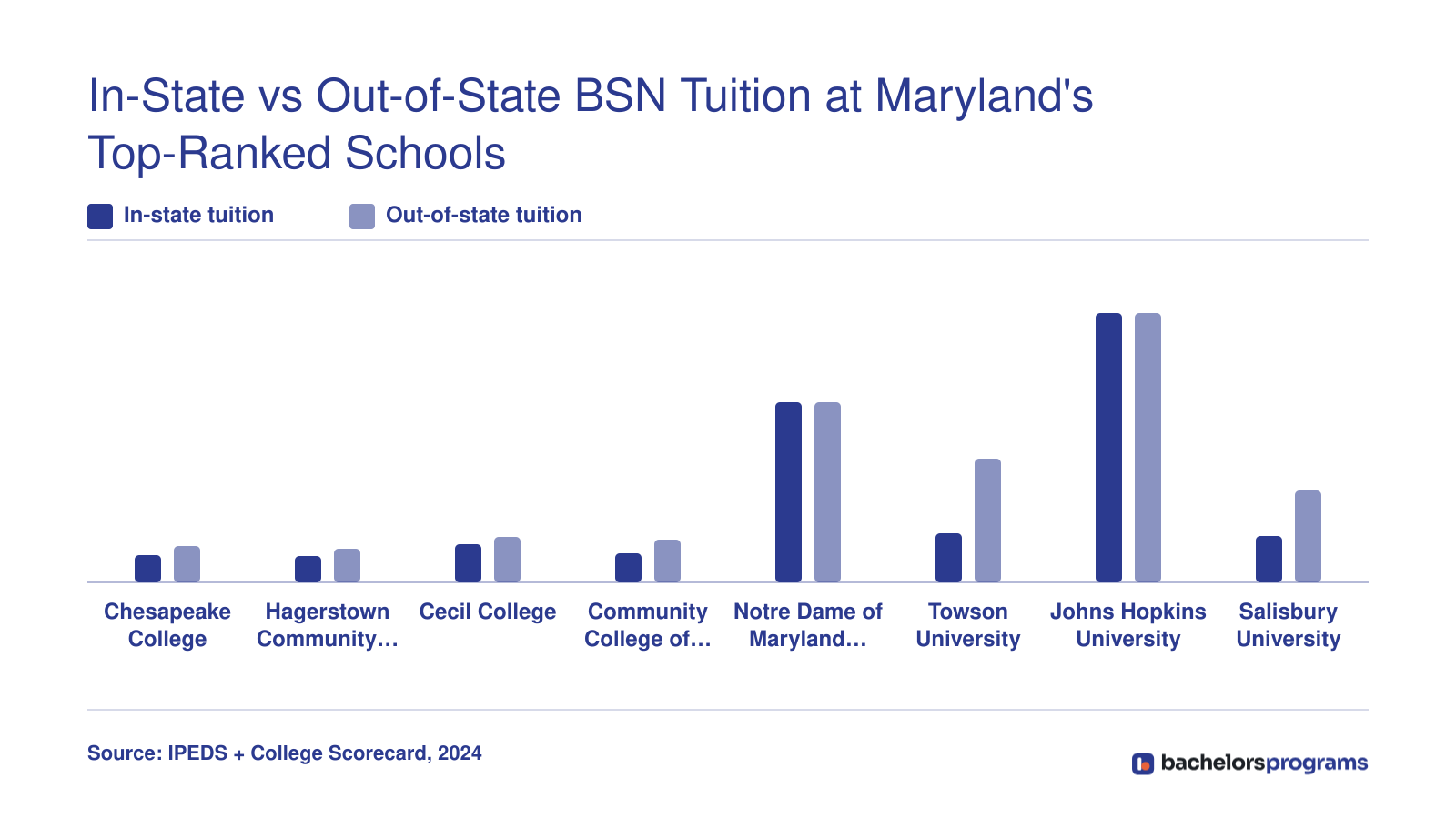
Published tuition and average net price can point in opposite directions. At Towson University, in-state tuition is $11,728, while average net price after grant aid is $17,413. At Salisbury University, the figures are $11,084 and $17,743. Those net prices are full student budgets, not tuition alone, so they include housing, food, books and fees. At private campuses, aid makes a bigger difference. Notre Dame of Maryland University lists tuition of $43,360 but an average net price of $19,169. Johns Hopkins University lists $65,230 against $18,809. Aid narrows the sticker-price gap: both private net prices land within about $2,000 of the public net prices.
Maryland Aid for BSN Students
Nursing status alone does not qualify anyone; a BSN student must meet each program's general eligibility and need rules. File the FAFSA and Maryland's One-App on schedule.
- Guaranteed Access Grant: up to $18,000 for 2026-27 for eligible Maryland residents at Maryland institutions1; apply by March 1, 2026, and submit documentation by Aug. 1, 2026.2
- Educational Assistance Grant: the March 1 deadline covers on-time consideration; eligible filers are reviewed automatically.
- Workforce Shortage Student Assistance Grant: up to $4,000 for 2026-27, with a service requirement; nursing is an eligible shortage field.3 The FAFSA is due June 1, 2026, and the WSSAG application is due July 1, 2026.
- Nurse Support Program II: up to $13,000, but only for full-time graduate students3, so it does not reduce pre-licensure BSN costs.
- Janet L. Hoffman Loan Assistance Repayment Program: up to $10,000 with an Oct. 1, 2026 deadline, but it is not open to undergraduates.
Residency and the Community College Route
At public universities, Maryland residency sets your tuition rate. Towson charges $11,728 for residents and $29,820 for nonresidents; Salisbury charges $11,084 and $22,174. Residency generally depends on domicile and financial independence, and the university makes the final call, so confirm your classification before you enroll. Maryland also offers a tuition reduction for nonresident nursing students accepted into nursing programs at public two- and four-year institutions4; the deadline is rolling, and it changes tuition classification rather than providing cash.
Community college remains the lower-cost entry point. Complete an associate degree in nursing at a Maryland community college, then finish the BSN through a completion program; the RN-to-BSN page covers that route for licensed RNs.
In-State vs Out-of-State BSN Tuition at Maryland's Top-Ranked Schools
The chart compares published undergraduate tuition and fees before financial aid, not net price, so most families will pay less than these sticker figures. Residency matters most at public campuses such as Towson University and Salisbury University, where out-of-state students pay about two to two and a half times the in-state rate. It barely matters at private schools like Johns Hopkins University and Notre Dame of Maryland University, which charge the same rate to every student.
Maryland RN Licensure at a Glance
Choosing a Maryland BSN School: Quick Answers
These answers cover the questions applicants ask most often when weighing cost, selectivity and transfer routes. Use the ranking and the cost table above to check any school against your own situation.
What is the best BSN program in Maryland if cost matters most?
How competitive is getting into a Maryland BSN program?
Can I start at a Maryland community college and transfer into a BSN program?
Compare Bachelor of Science in Nursing (BSN) programs on the data that matters
Explore more Nursing majors or browse every field of study.
All Nursing programs Browse every field of study