Best Accelerated BSN (ABSN) Programs in Maryland
Compare 4 accredited Accelerated BSN (ABSN) programs in Maryland, with net price after aid, graduation rates, earnings and debt from IPEDS and the U.S. College Scorecard.
Twelve months of full-time study is the fast end of a Maryland accelerated BSN; eighteen is the slower one. Either way, the requirement is the same: a completed non-nursing bachelor's degree plus the science prerequisites admissions committees screen for.
Maryland Board of Nursing approval is what decides whether a graduate can sit for the NCLEX-RN, and it carries as much weight as admissions, pace, cost, clinical placement and format. Cohorts are small and clinical slots are assigned rather than chosen, which makes admission timing the binding constraint more often than tuition.
Key Points
- Coppin State lists $7,100 in-state tuition, about half its out-of-state rate.
- Notre Dame of Maryland University graduates post the highest early earnings here.
- Since July 15, 2026, Maryland RN applications run online through MDH CHART.
Best Accelerated BSN (ABSN) Schools in Maryland, Ranked
Maryland's accelerated BSN landscape is smaller than it looks, and the four schools below differ sharply in format: a campus cohort on the Eastern Shore, a two-year entry program in Baltimore, a hybrid ABSN in Elkridge, and a long-running second-degree track at Coppin State. Read the tuition lines first, then check how each format fits your commute and your work schedule before you weigh anything else.
Salisbury University
#1Salisbury, MD · ~$18,000/yr (est.)
Best for: Second-degree students wanting a single-campus cohort
Salisbury University is a public institution on Maryland's Eastern Shore whose nursing school runs a CCNE-accredited accelerated second-degree BSN for people who already hold a bachelor's in another field. The current accelerated route is a 16-month, three-semester full-time sequence with one fall start and a January 15 priority deadline. A shorter 12-month option graduated its first class in August 2023 and was discontinued after August 2025, so applicants should plan around the 16-month timeline. State grant funding has expanded enrollment and simulation capacity in recent years, and clinical placements are arranged across partner healthcare facilities.
- 16-month, three-semester full-time sequence
- One fall start per year; priority deadline January 15
- Minimum 3.0 GPA and two letters of recommendation
- Prerequisites include statistics, microbiology, anatomy and physiology, pathophysiology, and chemistry
- Clinical placements at partner facilities; background checks required
- Fit for Duty technical standards required
- Built for graduates of non-nursing bachelor's programs
- CCNE accredited program
University of Maryland, Baltimore
#2Baltimore, MD
Best for: Full-time students eyeing a two-year entry route
The University of Maryland, Baltimore anchors nursing education in the state's largest city, and its entry-into-nursing BSN is designed for students who are new to the field rather than for those arriving with a prior bachelor's. The program runs about two years of full-time study with 61 credit hours and 720 clinical hours, and it requires the TEAS entrance exam. Classes are offered in Baltimore and Rockville, which shortens the commute for students in the Washington suburbs. Prospective second-degree applicants should confirm with the school which entry pathway is open to them before applying.
- 61 total credit hours over roughly two years of full-time study
- 720 hours of supervised clinical experience
- TEAS entrance exam required
- Minimum 3.0 GPA and one letter of recommendation
- Two Maryland locations: Baltimore and Rockville
- $75 application fee
- Merit scholarships available
Notre Dame of Maryland University
#3Baltimore, MD · ~$19,000/yr (est.)
Best for: Working adults drawn to hybrid scheduling
Notre Dame of Maryland University is a private Catholic institution in Baltimore that has built its ABSN around more than one entry format: a 15-month in-person track on campus, a hybrid version based in Elkridge, and a collaborative on-ground option with Mount St. Mary's University on Charles Street. The ABSN runs 15 months across 56 credits, and Fall 2026 entrants follow a competency-based curriculum rather than the prior catalog sequence. Cohorts are intentionally small, and the hybrid format pairs online theory with on-site skills labs and clinical rotations at Baltimore-area healthcare facilities. The Mount St. Mary's collaboration reserves 10 seats a year for qualified students who complete a BS in Health Science at Mount St. Mary's and then finish the BSN at Notre Dame, a partnership the two schools frame as a response to Maryland's nursing shortage.
- 15 months and 56 credits across four full-time semesters
- Hybrid format offers fall, spring, and summer starts
- Online theory with on-site skills labs and simulation
- Clinical rotations at Baltimore-area facilities
- Competency-based curriculum for Fall 2026 entrants
- Small cohort sizes with dedicated admissions counselors
- Collaborative Charles Street option starts once a year in May
- Designed for students with a non-nursing bachelor's degree
Coppin State University
#4Baltimore, MD · $5,000 – $10,000/yr (est.)
Coppin State University is a public HBCU in Baltimore whose Helene Fuld School of Nursing offers an accelerated second-degree BSN for students who already hold a bachelor's degree. The campus-based track carries 120 total credit hours, from prerequisites through the nursing major, and adds a senior practicum on top of the standard clinical rotations. Admission is selective and personal: the TEAS, a 3.0 GPA, three letters of recommendation, an essay, and an interview are all part of the file, with an early decision deadline of December 1 and a final deadline of March 1. On sticker tuition it is the lowest-priced Maryland option in this list for in-state residents.
- 120 total credit hours including prerequisites and major courses
- TEAS entrance exam required
- Minimum 3.0 GPA and three letters of recommendation
- Personal essay and interview required
- Early decision deadline December 1; final deadline March 1
- Senior practicum plus clinical rotations
- Coursework spans health assessment, pharmacology, maternity, pediatrics, and community health
- Housed in the Helene Fuld School of Nursing
Cost & outcomes by school
Federal data for the highest-earning Accelerated BSN (ABSN) programs, independent of the ranking above. Earnings are this field's bachelor's graduates four years after completing where the Scorecard reports them, else the school's undergraduate median.
| School | Net price / yr | Grad rate | Earnings | Debt | Grads/yr | Format |
|---|---|---|---|---|---|---|
| University of Maryland, Baltimore MD | — | — | $88,174 | $15,000 | 874 | Campus |
| Notre Dame of Maryland University MD | $19,169 | 50% | $65,344 | $22,666 | 312 | Hybrid |
| Salisbury University MD | $17,743 | 68% | $61,515 | $21,000 | 2,786 | Campus |
| Coppin State University MD | $9,977 | 26% | $46,490 | $25,000 | 522 | Campus |
Sources: U.S. Department of Education. Net price, graduation rate, earnings and debt: College Scorecard (earnings and debt for this field's bachelor's graduates where reported, else school-wide); graduates: IPEDS. A dash means no figure is reported.
Cost, debt & payoff
Median earnings of this field's bachelor's graduates (4 yrs after completing, else the school's undergraduate median) vs. their median federal loan debt · U.S. College Scorecard
Across these programs the median graduate earns about $63,430 and finishes with roughly $21,833 in debt — a ratio that clears a common rule of thumb (keep debt below first-year salary). Net price and debt vary widely school to school, so check the per-school figures in the table above before you shortlist.
Behind the List: What Moved a Maryland ABSN up or Down
Few programs are both the cheapest and the most flexible, so the order reflects which tradeoffs each school handled best. Every school here cleared one bar first: a BSN path built for people who already hold a degree.
What Moved a School Up or Down
- Cost: Published tuition and the average net price once grant aid is applied.
- Outcomes: Program-level earnings and debt where College Scorecard reports them, along with completions.
- Selectivity: How competitive admission is for a second-degree applicant.
- Format: How much flexibility a school offers in schedule and delivery, from fully on-campus cohorts to hybrid coursework.
Limits Worth Knowing
Graduation rates and net price are institution-wide, so they describe the whole university rather than the accelerated cohort alone. Scorecard figures also lag by a few years, which means recent tuition changes or newer cohorts may not show up yet. NCLEX-RN pass rates are not part of the data behind the order, so treat a school's position as a view of cost, value and access, not a forecast of exam results. Look up licensure outcomes separately before you commit.
Verify Before You Apply
Accelerated cohorts and pricing change often. Start dates can shift, intake may be limited to certain terms, and per-credit rates or fees can be revised between admission cycles. Confirm the current numbers directly with Salisbury University, University of Maryland, Baltimore, Notre Dame of Maryland University and Coppin State University before you build a budget or plan your prerequisite timeline.
ABSN Admissions in Maryland: Prior Bachelor's, Science Prerequisites, and GPA
Maryland accelerated BSN programs share a common foundation: a finished bachelor's degree, completed science prerequisites, a solid GPA, and an entrance exam. Use this checklist to prepare, then confirm current details with each school, since requirements and calendars can change between cohorts.
- Prior bachelor's degreeNotre Dame of Maryland University's catalog requires a bachelor's degree in a non-nursing field for its Accelerated Second-Degree BSN. Some Notre Dame materials also describe an associate-degree or transfer-credit route, so ask admissions which pathway applies to the accelerated program. At Salisbury University, University of Maryland, Baltimore, and Coppin State University, check the admissions page for the degree rule and any deadline for finishing your degree.
- Science prerequisitesNotre Dame requires 28 credit hours of prerequisites plus any applicable general-education courses. All of them must be completed before you begin nursing coursework. Ask each school for its exact course list, any recency limit on science credits, and the minimum grade it accepts per course.
- Minimum GPANotre Dame and Coppin State both set a 3.0 cumulative GPA minimum.
- Entrance examBoth Notre Dame and Coppin State require the ATI TEAS. Notre Dame's admissions page sets a 65% composite minimum and accepts a score earned within the past year. Its 2025–2026 handbook describes the required result as "Proficient" and says applications are not reviewed without a TEAS score, so confirm which standard applies. Coppin State requires official TEAS scores sent to its College of Health Professions Academic Success Center.
- Deadlines and start termsNotre Dame's 2025–2026 handbook lists July 15 for fall and December 1 for spring. Later applications are considered as space allows. Its admissions page lists January, May, and September starts, so verify the 2026–2027 calendar directly. At the other schools here, confirm the deadline and whether the program admits one cohort or several each year.
ABSN Pace and Cost in Maryland: 12 to 18 Months, Tuition, and Aid
Speed and dollars trade off differently in a Maryland ABSN. Finishing faster trims months of living costs and delayed earnings, while a lower price usually depends on residency or a state award rather than on the calendar.
What 12 to 18 Months Actually Means
Accelerated BSN study is full time and year round, with no summer off and little room for a part-time job. Salisbury University's ABSN runs 16 months for 2026-2027, which sits midrange.1 Faster programs compress toward roughly 12 months; slower ones stretch toward 18. What separates them is usually whether prerequisites are built in, how clinical hours are blocked, and how often a cohort starts. Ask for the cohort calendar, not just a month count.
Resident versus Non-Resident Pricing
Salisbury publishes $11,466 in annual tuition and fees for Maryland residents and $23,590 for nonresidents for 2026-2027, roughly double before you add living expenses.1 A separate $55,620 figure circulates for total ABSN program tuition in Maryland, but read whole-program totals carefully and confirm whether a number is tuition only or tuition plus fees, and which residency it assumes.
Published program tuition is not the same thing as an institution-wide net price. Net price averages grant aid across an entire undergraduate population, and a small second-degree cohort rarely looks like that average. Budget from the program rate.
Aid That Fits Second-Degree Students
- Federal loans: second bachelor's students generally still file the FAFSA and typically borrow through Direct Unsubsidized loans, since Pell Grants generally do not apply to a second bachelor's. Confirm your remaining limits with the aid office.
- Maryland Graduate and Professional Scholarship Program: $1,000 to $5,000 a year for Maryland residents with financial need in eligible fields including nursing, for up to 8 semesters.2 Ask whether your ABSN is classified as an eligible program.
- Non-Resident Nursing Tuition Reduction: brings nonresidents accepted into nursing programs at Maryland public institutions to the resident rate. The 2026-2027 application window runs January 15 to October 15, 2026, awards renew for up to three additional years, and recipients sign a promissory note for four years of full-time Maryland hospital service.3 Private institutions fall outside the program.
Related Articles
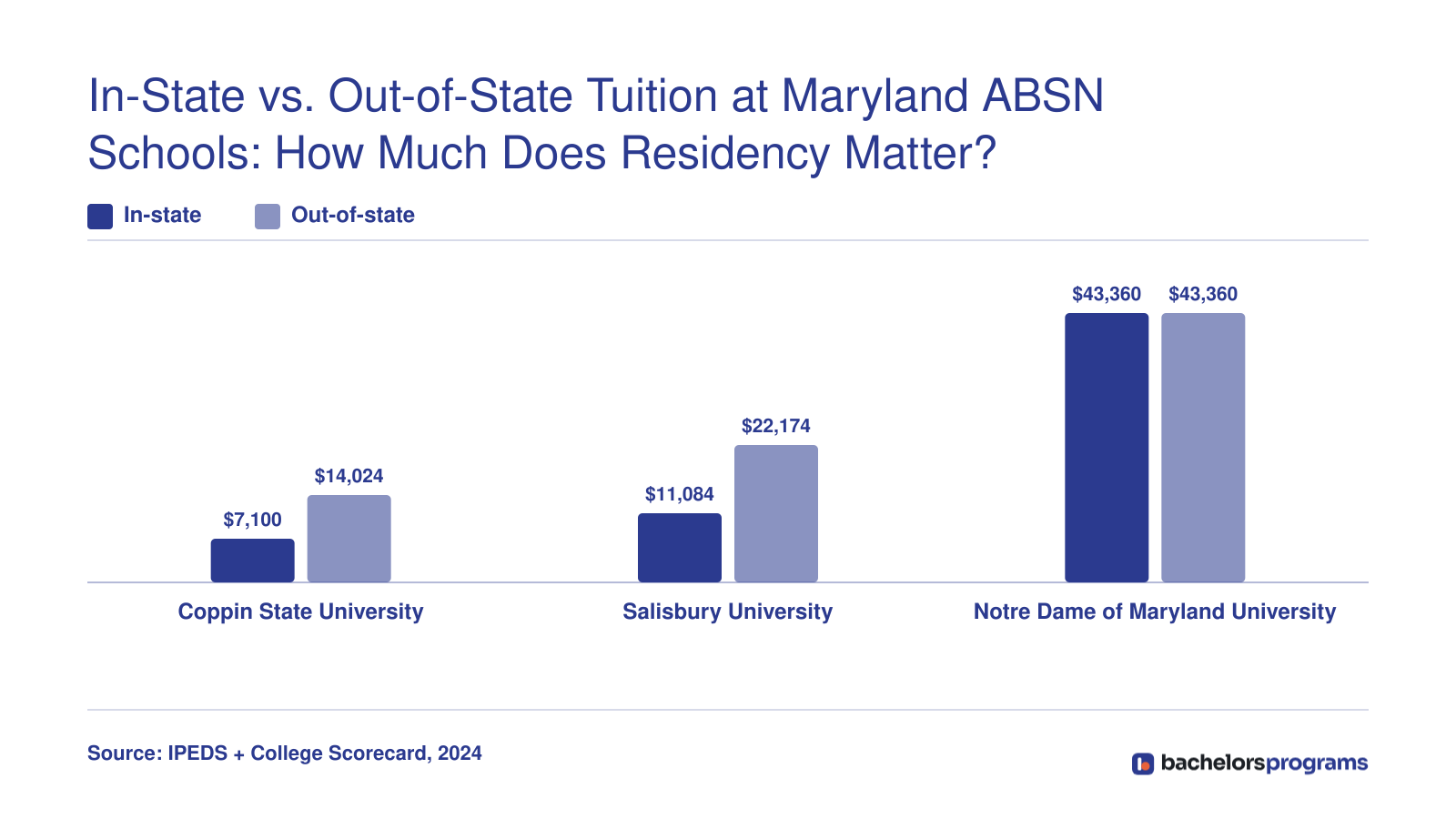
In-State vs. Out-of-State Tuition at Maryland ABSN Schools: How Much Does Residency Matter?
These figures are published annual tuition and fees before any grants, scholarships or other aid. At the public schools, residency roughly doubles the bill: Coppin State University lists $7,100 in-state against $14,024 out-of-state, and Salisbury University lists $11,084 against $22,174. Private Notre Dame of Maryland University charges $43,360 regardless of residency. For net price after aid and how a 12 to 18 month accelerated pace shapes your total cost, see the pace and cost section above.
Hybrid vs. Campus ABSN Formats and Clinical Placements in Maryland
The word hybrid sells convenience, but in a Maryland accelerated BSN it rarely removes the drive to campus. The real choice is how much of your week you can spend in a lab or at a hospital bed, and how far you are willing to travel for it.
What Hybrid Actually Changes
At Notre Dame of Maryland University, the distinction is explicit. The Baltimore campus ABSN, a 15-month program, is fully in person, with theory, skills labs, simulation, and clinical learning delivered on site. The Hybrid ABSN in Elkridge moves course theory online but keeps skills labs, simulation, and clinicals in person. That is the pattern a real hybrid follows: lectures and assignments completed online, hands-on learning at a scheduled location. The University of Maryland, Baltimore lists its BSN as in person and full time.
Clinical Hours and Placement Logistics
The University of Maryland, Baltimore reports 720 total clinical hours. Notre Dame sets clinical hours course by course, and its 2026-2027 handbook says clinical days, hours, and locations vary by course and by available opportunities. Notre Dame's materials describe placements with Baltimore-area hospital systems, but the school's current partner list is the document to request before you commit. Salisbury University and Coppin State University also list accelerated second-degree pathways; ask each directly for its format, clinical-hour total, and site list, because those details change by cohort.
The Commute Is Part of the Curriculum
Clinical rotations in Maryland can be spread across the Baltimore-Washington corridor, and shifts often start early or fall on weekends. A hybrid schedule that saves you two weekday lectures can still cost you an hour each way to a 6:30 a.m. preceptorship. Before enrolling, ask where students in your cohort were placed, how far sites are from the Elkridge or Baltimore campus, and whether you can request a location near home. Add fuel, parking, and unpaid travel time to your budget.
A Practical Way to Choose
Pick the hybrid only if you have reliable transportation, a quiet place to study, and the discipline to complete online coursework without a classroom rhythm. Pick the campus format if you learn best in a structured daily environment and want your labs, peers, and instructors in one place. Either way, judge the program by the clinical placement support it can describe in specifics, not by the convenience promised on the brochure.
What Maryland ABSN-Program Completers Earn One Year Out
Among the schools ranked here, Notre Dame of Maryland University posts the highest early earnings for nursing graduates.
Maryland Board of Nursing Approval and NCLEX-RN Licensure for ABSN Graduates
Does graduating from a Maryland accelerated BSN automatically make you eligible to sit for the NCLEX-RN? No. Eligibility depends on two things: the program must be approved by the Maryland Board of Nursing, and you must clear the state's application steps in the right order.
Approval Is Not the Same as Accreditation
The Board approves RN programs in Maryland, and its nursing program directory lists accelerated options at Coppin State University, Notre Dame of Maryland University, and Salisbury University, plus the entry-to-nursing BSN at University of Maryland, Baltimore. Approval and accreditation are separate records. The Board refers students to CCNE and ACEN, the two nursing accreditors, but its directory does not print a school-by-school accreditation line. Ask each program which body accredits it and confirm that status with the accreditor before you commit.
The Licensure Sequence
- Application: Maryland's RN application is filed online and can be signed before you graduate, but written verification of program completion must reach the Board before you sit for the exam.
- Background check: the Criminal History Record Check and fingerprinting are completed before you submit the application.
- NCLEX registration: after registering you receive an Authorization to Test, which Maryland regulations make valid for six months.1 Miss that window and you re-register and pay the NCLEX fee again.1
- Transcripts: graduates of out-of-state programs need an official final sealed transcript.
Where to Find Pass Rates
The Board publishes annual NCLEX-RN pass-rate reports by program. Read the most recent report, then ask admissions for its latest cohort results and how many graduates tested.
Compact Status Matters Near the District
Maryland has participated in the Enhanced Nurse Licensure Compact since January 19, 2018. A Maryland multistate license requires primary residence in Maryland and meeting multistate requirements. Virginia and Delaware are compact states; the District of Columbia is not, so a DC job needs its own license.
Maryland RN Licensure at a Glance for New ABSN Grads
Deciding Whether a Maryland Accelerated BSN Fits Your Life
An accelerated BSN is a full-time, compressed second-degree program, so the real question is whether you can carry that load for 12 to 18 months. Expect 40 to 60 hours a week of class, skills lab, clinical shifts, and study. Most programs discourage outside employment, and that expectation applies whether you choose Salisbury University, the University of Maryland, Baltimore, Notre Dame of Maryland University, or Coppin State University.
Plan Your Finances First
Because a paycheck is hard to keep, build your funding plan before you apply. Add up savings, any family support, and the federal loans you would be willing to take on, then compare that total against each school's tuition and living costs. Applicants who sort this out early tend to make calmer decisions once the first semester gets heavy.
If Full-Time Doesn't Work
A compressed schedule isn't the only route to a nursing license. Consider these options:
- Part-time BSN routes: Some nursing schools spread coursework over a longer period, which can leave room for work or caregiving. Confirm availability with each school.
- ADN-to-BSN: Maryland community colleges offer associate degree nursing programs, and many graduates complete a bachelor's degree afterward while working as RNs.
- Direct-entry graduate nursing: If your goal is advanced practice, such as nurse practitioner or nurse anesthetist, a direct-entry graduate pathway may suit you better than a BSN first.
Your Next Step
If an accelerated BSN still looks right, act on it this week:
- Shortlist two or three schools from the ranking that match your location and schedule.
- Confirm each school's prerequisite courses, GPA expectations, and application deadlines.
- Request program information from those schools so an admissions advisor can answer questions specific to your background.
Use the request form on bachelorsprograms.com to start that conversation, and bring your transcripts so the advisor can review your prerequisites with you.
Compare Accelerated BSN (ABSN) programs on the data that matters
Explore more Nursing majors or browse every field of study.
All Nursing programs Browse every field of study