Best RN to BSN Programs in Maryland
Compare 9 accredited RN to BSN programs in Maryland, with net price after aid, graduation rates, earnings and debt from IPEDS and the U.S. College Scorecard.
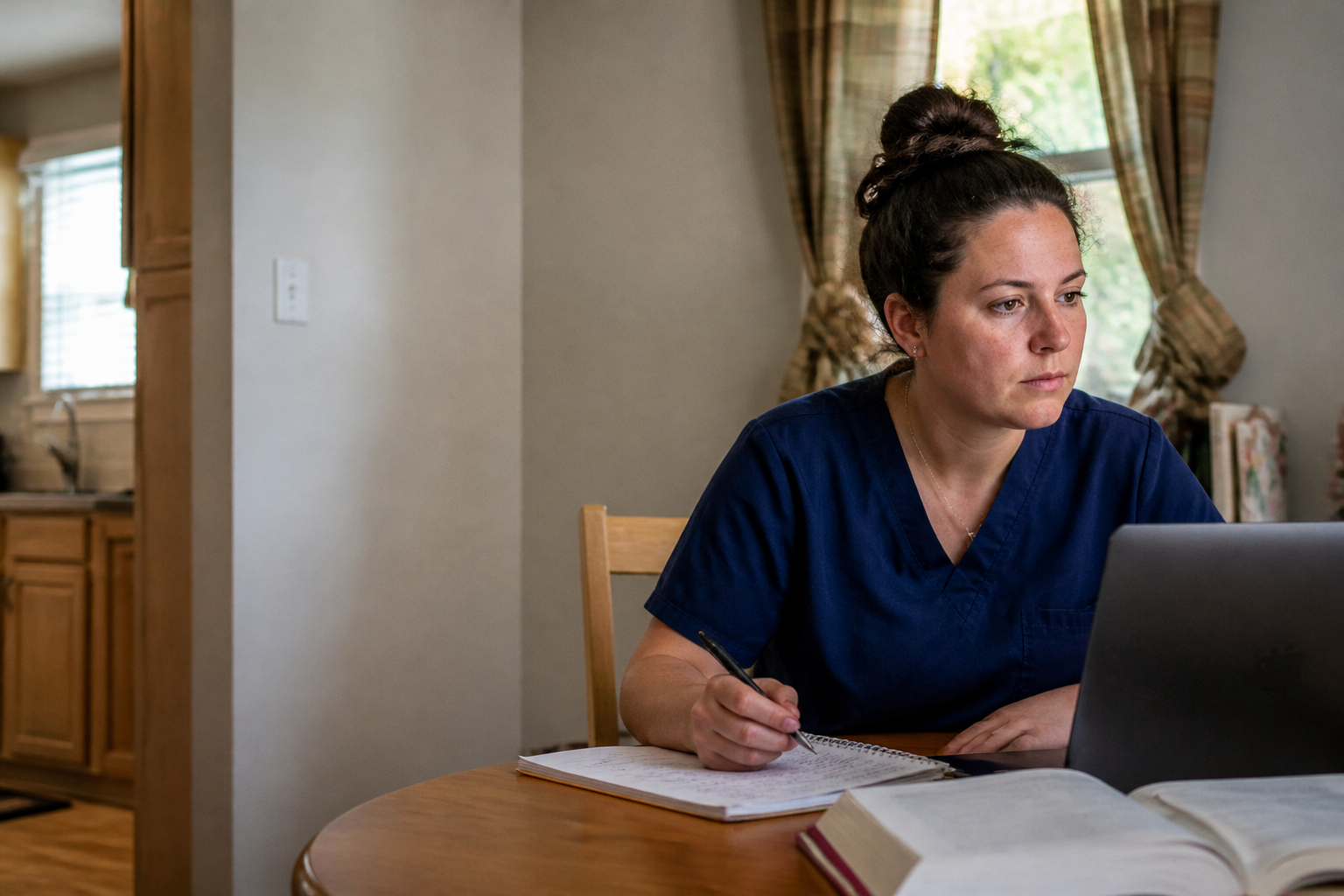
A Maryland RN working twelve-hour hospital shifts rarely has a free weekday for a campus classroom, yet the BSN is increasingly the credential employers ask for. Fully online delivery resolves part of that conflict, since coursework fits around a rotating schedule instead of competing with it.
Every school here offers its RN to BSN fully online, with hybrid formats excluded: University of Maryland, Baltimore; Frostburg State University; Stevenson University; and University of Maryland Global Campus. Because you already hold your RN license, the questions that matter are cost, admissions requirements, how many credits transfer, and how a BSN weighs with Maryland hospital employers.
Programs differ most on pace and credit awards, not on the degree itself.
Key Points
- Maryland's articulation model grants licensed RNs at least 30 upper-division nursing credits.
- Accreditation is nearly uniform (CCNE), so compare per-credit price and transfer policy.
- Coursework runs fully online, with practice hours arranged near home or work.
Top 100% Online RN to BSN Programs for Maryland Nurses
Every program below is delivered fully online, so no hybrid classroom sessions or campus attendance are required to complete the nursing coursework. Where a program asks for practice hours, they are arranged in your own community or at the workplace you already have. Each entry earned its place on a blend of cost, completion, and graduate outcome signals rather than name recognition alone.
University of Maryland, Baltimore
#1Baltimore, MD
Best for: Working RNs from Maryland community colleges
The University of Maryland, Baltimore delivers its RN to BSN through the School of Nursing, which the school ranks among the top 10 BSN programs nationwide and which holds current CCNE accreditation. Dual-admission agreements with all 15 Maryland community colleges that award an ADN let nurses begin BSN coursework before they finish the associate degree, and the school lists academic-hospital partnerships across the state. Licensed RNs receive 30 credits for their license, and the Conway Scholarship can cover half of in-state tuition.
- Fully online coursework with fall and spring start dates
- As few as 2 semesters and 31 program credits
- 30 credits awarded for a valid RN license
- 120 total credits, including 59 prerequisite credits
- Interest area in Care Coordination with Health IT
- Interest area in Substance Use and Addictions
- 90 clinical hours in the public health course
- Conway Scholarship covers 50% of in-state tuition
Frostburg State University
#2Frostburg, MD · $10,000 – $26,000/yr (est.)
Best for: Nurses who prefer one course at a time
Frostburg State University is a public university in western Maryland where about 89% of applicants are admitted, first-year retention runs near 69%, and roughly half of students complete a bachelor's degree. The RN to BSN is built around working nurses: 135 practicum hours are completed in the student's own community, and students can move through in 15 months or take a single class at a time. In-state tuition is $10,220 a year against $25,814 for out-of-state students, and the average net price after aid lands near $16,715. CCNE accreditation is current, with the listed term running through December 2026.
- Finish in 15 months or take one class at a time
- Synchronous and asynchronous online course options
- 135 practicum hours completed in your local community
- Leadership, care coordination, and community health focus
- Prepares graduates for management and graduate study
- Personalized advising and a multistate nurse cohort
Stevenson University
#3Owings Mills, MD · ~$27,000/yr (est.)
Best for: Nurses earning clinical hours on the job
Stevenson University is a private university in Owings Mills, north of Baltimore, that retains about 79% of first-year students and graduates roughly 68% of them. The online RN to BS in Nursing charges $505 per credit, waives the application fee, and offers a free transcript evaluation before you apply, so transfer credits can be priced out up front. Clinical hours can be completed where you already work, and partner employers receive a 20% tuition discount. Published tuition is $37,734 a year, with an average net price after aid of about $26,505.
- $505 per credit with no application fee
- Finish in as little as 15 months
- Clinical hours can be completed on the job
- Free transcript evaluation before you apply
- 20% tuition discount for partner organizations
- 2.5 GPA minimum and prerequisite courses required
- Leadership, community health, research, and informatics courses
University of Maryland Global Campus
#4Adelphi, MD · $22,000/yr (est. net price)
University of Maryland Global Campus is the state's global online institution, built for adults who hold a job while they study, and about a third of its students finish a bachelor's degree within six years. The RN to BSN is fully online but includes an in-person community health practice experience, and the curriculum is mapped to the AACN Essentials with gaming and simulation built into courses. In-state tuition runs $8,136 a year against $12,336 for out-of-state students, and the average net price after aid is roughly $22,063.
- Online courses plus an in-person community health practice
- Curriculum mapped to the AACN Essentials
- Leadership, health equity, advocacy, and evidence-based practice
- Gaming and simulation built into online coursework
- Designed for working adults studying part time
Cost & outcomes by school
Federal data for the highest-earning RN to BSN programs, independent of the ranking above. Earnings are this field's bachelor's graduates four years after completing where the Scorecard reports them, else the school's undergraduate median.
| School | Net price / yr | Grad rate | Earnings | Debt | Grads/yr | Format |
|---|---|---|---|---|---|---|
| University of Maryland, Baltimore MD | — | — | $88,174 | $15,000 | 874 | Online |
| Notre Dame of Maryland University MD | $19,169 | 50% | $65,344 | $22,666 | 312 | Campus |
| University of Maryland Global Campus MD | $22,063 | 33% | $65,287 | $21,000 | 19,702 | Online |
| Towson University MD | $17,413 | 70% | $64,390 | $18,718 | 7,436 | Hybrid |
| Washington Adventist University MD | $18,526 | 29% | $64,249 | $30,500 | 168 | Campus |
| Stevenson University MD | $26,505 | 69% | $62,079 | $26,000 | 1,272 | Online |
| Salisbury University MD | $17,743 | 68% | $61,515 | $21,000 | 2,786 | Campus |
| Frostburg State University MD | $16,715 | 50% | $55,493 | $21,105 | 1,498 | Online |
| Coppin State University MD | $9,977 | 26% | $46,490 | $25,000 | 522 | Campus |
Sources: U.S. Department of Education. Net price, graduation rate, earnings and debt: College Scorecard (earnings and debt for this field's bachelor's graduates where reported, else school-wide); graduates: IPEDS. A dash means no figure is reported.
Cost, debt & payoff
Median earnings of this field's bachelor's graduates (4 yrs after completing, else the school's undergraduate median) vs. their median federal loan debt · U.S. College Scorecard
Across these programs the median graduate earns about $64,249 and finishes with roughly $21,105 in debt — a ratio that clears a common rule of thumb (keep debt below first-year salary). Net price and debt vary widely school to school, so check the per-school figures in the table above before you shortlist.
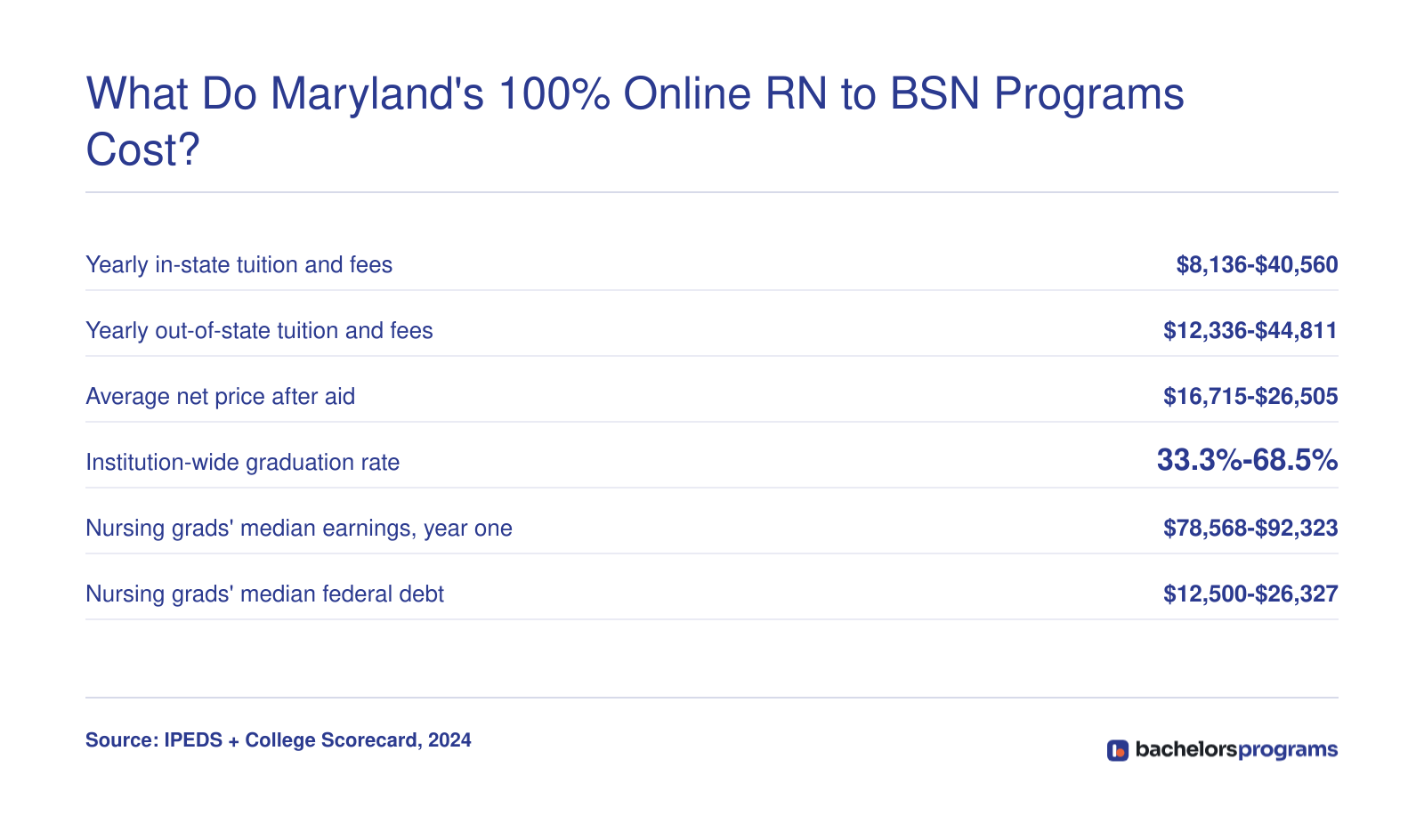
What Do Maryland's 100% Online RN to BSN Programs Cost?
These figures span the lowest and highest values among the online RN to BSN schools ranked below. Graduation rates cover each institution as a whole, not the nursing program alone, and net price is an average paid after grants and scholarships, not a quote for any one student. Use these ranges as a baseline before comparing individual schools in the ranked list.
Most Affordable 100% Online RN to BSN Programs for Maryland Nurses
These programs are listed from lowest to highest average annual net price, the amount students pay after grants and scholarships, according to 2024 IPEDS and College Scorecard data from the U.S. Department of Education. Sticker price and net price do not always line up. University of Maryland Global Campus posts the lowest in-state tuition and fees, but Frostburg State University comes out cheaper once aid is counted. Stevenson University lists a per-credit rate of $505 for its RN to BS in Nursing.
| School | City | Average Annual Net Price | In-State Tuition and Fees | Program Format |
|---|---|---|---|---|
| Frostburg State University | Frostburg | $16,715 | $10,220 | Online, with synchronous and asynchronous options |
| University of Maryland Global Campus | Adelphi | $22,063 | $8,136 | Online, with in-person practice experience |
| Stevenson University | Owings Mills | $26,505 | $40,560 | Online, with clinical hours completed on the job |
Maryland Online RN to BSN Schools Side by Side: Credits, Per-Credit Cost, and Accreditation
Accreditation is close to uniform among Maryland's online RN to BSN options; per-credit price and transfer policy are where the real separation happens.
Where an accreditor is confirmed on this list, it is the Commission on Collegiate Nursing Education (CCNE), the credential graduate nursing programs expect on an MSN application. Credits and cost per credit are the numbers that actually move your budget.
- University of Maryland, Baltimore (RN to BSN): CCNE accredited; 120 credits required for the BSN; up to 59 transfer credits accepted; $459 per credit for Maryland residents, $1,550 per credit for nonresidents.1
- Frostburg State University (RN to BSN): accrediting body, total credits, maximum transfer credits, and resident and nonresident per-credit tuition: Not published.
- Stevenson University (RN to BS in Nursing): accrediting body, total credits, maximum transfer credits, and resident and nonresident per-credit tuition: Not published.
- University of Maryland Global Campus (RN to BSN): accrediting body, total credits, maximum transfer credits, and resident and nonresident per-credit tuition: Not published.
Where the Spreads Sit
The largest confirmed cost gap is the residency split at University of Maryland, Baltimore, where a nonresident pays $1,091 more per credit than a Maryland resident.1 No transfer policy on this list produces a comparable difference.
The confirmed transfer ceiling at University of Maryland, Baltimore, 59 credits, covers just under half of the 120-credit degree, so an ADN graduate still carries a substantial upper-division load. For the other schools, ask for the transfer cap and the per-credit rate in writing before you compare total cost.
Related Articles
What Maryland RN to BSN Programs Require Before You Enroll
Every program here admits nurses who already hold an associate degree or diploma, but the fine print differs. The University of Maryland, Baltimore publishes the most detailed rules, so use it as a benchmark and confirm current requirements with Frostburg State, Stevenson, and University of Maryland Global Campus (UMGC) admissions.
- Active, unencumbered RN licenseUMGC requires an active, unencumbered RN license and residence in an approved state. The University of Maryland, Baltimore lets you apply before licensure, but you must submit valid, unrestricted proof by the end of your first semester, when 30 credits are awarded for the license. If you hold a multistate compact license, confirm that your program accepts it.
- ADN or nursing diplomaUMGC requires an associate degree or diploma from a Maryland Board-approved RN program. Keep official transcripts from your nursing program ready for every application.
- Minimum GPAThe University of Maryland, Baltimore sets a 2.5 overall GPA floor and prefers a 2.75 science GPA. Ask Frostburg State, Stevenson, and UMGC for their current GPA expectations.
- Prerequisite credits and coursesThe University of Maryland, Baltimore requires 59 prerequisite credits before you start. These must include two science lab courses plus one course in human growth and development, statistics, or nutrition. You can have no more than four courses in progress when you apply. Ask each school whether older science credits still count.
- Application deadlines and start termsFor Spring 2027 at the University of Maryland, Baltimore, applications opened February 19, 2026. The priority deadline was July 15 and the regular deadline was September 1, with later applications considered as space allows. Confirm start terms and deadlines directly with the other schools.
- Dual admission for current ADN studentsThe University of Maryland, Baltimore offers dual admission through partner ADN programs. You need one full ADN semester, a 3.0 cumulative GPA, and a 2.75 science GPA, including retakes. The school encourages applying during your first ADN semester. Of the 59 credits above, all transfer, plus 30 more after licensure, and your license is due by the end of your first semester.
Transfer Credits, Part-Time Pacing, and Real RN to BSN Costs in Maryland
How the Maryland Articulation Model Works
Maryland's statewide RN to BSN articulation model awards at least 30 upper-division nursing credits to RNs holding an active, unencumbered Maryland or compact-state license. The catch is that the model does not transfer community college nursing courses. Your license earns the nursing credit. Your non-nursing college coursework (English, psychology, statistics and similar) transfers under the receiving school's own policy.
Two limits apply. Transfer credit cannot exceed half the bachelor's degree, and community college non-nursing work caps at 70 credits. Vocational-technical and non-college general-education coursework generally does not transfer. University of Maryland, Baltimore shows how this plays out: it asks for 59 prerequisite credits plus 30 credits for a valid RN license, and applicants without a prior bachelor's must finish all 59 before enrolling. Frostburg State University, Stevenson University, and University of Maryland Global Campus each run their own transcript review, so request an unofficial evaluation before you commit.
"As Little as 12 Months" Versus a Working Schedule
University of Maryland, Baltimore advertises as little as two semesters, but that assumes full-time study. It also offers part-time enrollment with fall and spring starts, without publishing a part-time length. For RNs working 36-hour weeks, a rough calculation is more useful. Take a typical 120-credit bachelor's. With 30 license credits and a full set of transferred general education, roughly 30 credits may remain. These are illustrative figures, not any school's published numbers:
- Two courses per term: about 6 credits, so roughly five terms.
- One course per term: about 3 credits, so roughly ten terms, or more than three years if you skip summers.
Missing prerequisites add terms before the program even starts.
What Transfer Credits Do to Your Bill
Tuition scales with remaining credits, so every transferred course is a course you don't pay for. Multiply your remaining credits by the in-state per-credit rate from the cost comparison above. A transcript that sends 15 more credits through can cut a year of part-time study. Maryland residents pay in-state rates at the public schools here, so the credit evaluation matters more than a small difference in sticker price.
Employer Help and Aid
Many hospital employers offer tuition assistance for nurses, usually with an annual cap and sometimes a commitment to stay after you finish. Ask HR before you enroll, since some plans reimburse only after you pass each course. Under federal rules, up to $5,250 a year of employer education assistance can be tax-free. Also file the FAFSA and ask each school's financial aid office which Maryland state aid and nursing scholarships apply to part-time RN students.
Questions to Ask Yourself
Will your employer's tuition benefit pay up front or reimburse you?
Can you handle two courses per term alongside rotating 12-hour shifts?
Do you plan to move on to an MSN later?
Is a higher transfer ceiling worth a slightly higher per-credit rate?
Why an RN to BSN Opens Doors at Maryland Hospitals
Maryland hospitals increasingly treat the bachelor's degree as the baseline for a long-term nursing career, and an RN to BSN is the most direct way for an ADN nurse to clear it.
Magnet Standards and BSN Expectations
Magnet designation from the American Nurses Credentialing Center rewards hospitals for a highly educated nursing workforce, which changes how they hire. The state's Magnet roster keeps growing. A Maryland health system reported a second designation in February 2025 and described itself as one of 12 acute-care hospitals in the state with the distinction. Treat that as a snapshot, not a full 2026 list.
Hiring policies vary. A 2019 statewide survey found 54% of Maryland hospitals required new nurses to enroll in a BSN program within 6 to 12 months of starting and finish within three years. Another 21% were developing similar policies, and 25% had none. Those figures are several years old. A 2026 secondary report describes some postings that accept an ADN but ask new hires to enroll within one year and finish within four, without saying which facilities. Check each employer's current posting.
Advancement Beyond the Bedside
A BSN often separates staff nurses from leadership and non-bedside roles. Many employers list it as preferred or required for:
- Charge nurse: Unit leadership and shift coordination.
- Case management: Care coordination across settings.
- Public health nursing: Community and population-focused roles, including positions with health departments.
Employer Tuition Help
Support differs by employer, so ask HR before you enroll. One large Maryland academic medical center advertises up to $10,000 per year toward a graduate degree from the University of Maryland School of Nursing. The source does not say whether that benefit covers undergraduate RN to BSN coursework, who qualifies, or whether it is reimbursement or direct payment. Confirm those terms in writing.
The Path to Advanced Practice
An RN to BSN is also the entry point to graduate study. Most MSN and nurse practitioner programs require a bachelor's degree in nursing, so finishing at a school such as University of Maryland, Baltimore, Frostburg State University, Stevenson University, or University of Maryland Global Campus keeps that option open while you keep working.
Maryland Registered Nurse Pay
The clearest benchmark from the latest federal wage release is the national figure for registered nurses, a useful reference point for Maryland RNs weighing a BSN.
Compare RN to BSN programs on the data that matters
Explore more Nursing majors or browse every field of study.
All Nursing programs Browse every field of study