Best BSN Programs in South Carolina
Compare 23 accredited Bachelor of Science in Nursing (BSN) programs in South Carolina at 19 colleges, with net price after aid, graduation rates, earnings and debt from IPEDS and the U.S. College Scorecard.
Which South Carolina BSN programs best prepare graduates to pass the NCLEX-RN on the first try? Among the schools ranked here, first-time pass rates run from 96.0 percent to 98.9 percent. That band is narrow, so cost, admissions model and location often decide the choice.
The programs below are traditional pre-licensure BSN tracks, ordered mainly by NCLEX-RN results. Quick-reference lists cover lowest net price and highest graduate earnings, and separate sections cover admissions, cost and Board of Nursing licensure. RN-to-BSN and accelerated routes have their own pages.
With exam results this close, admission to the nursing major is often where the real competition sits.
Key Points
- Rankings follow South Carolina Board of Nursing first-time NCLEX-RN pass rates.
- In-state tuition runs from about $4,400 (Tri-County Technical) to $35,000 (Anderson).
- South Carolina's LIFE Scholarship pays up to $5,000 yearly at four-year schools.
South Carolina's Top 10 BSN Programs by NCLEX-RN Pass Rate
These ten traditional pre-licensure BSN programs are ordered by NCLEX-RN first-time pass rate, taken from the South Carolina Board of Nursing's most recent three years of results and weighted by how many graduates sat the exam each year. Accreditation standing and completion outcomes separate programs whose pass rates land within a point of each other. Accelerated BSN and RN-to-BSN routes for second-degree students and licensed nurses are covered on their own pages rather than ranked here.
Anderson University
#1Anderson, SC · ~$24,000/yr (est.) · NCLEX-RN pass rate 98.9% (3-yr weighted avg)
Best for: Applicants who value rolling admissions
Anderson's traditional BSN is a 123-credit, four-year campus program with a rolling admission calendar and fall and spring starts, and students build hands-on hours in a simulation center and a cadaver lab before hospital clinicals. First-time NCLEX-RN pass rate is 98.9% across the latest three years, from 205 test-takers. In-state tuition is $34,970, average net price after aid about $23,544, roughly 55% of applicants are admitted, and the university's overall graduation rate is 66%.
- 123-credit, four-year campus program with fall and spring starts
- Simulation center and cadaver lab for hands-on practice
- Rolling admissions; no previous degree required
- Christ-centered curriculum covering pediatric, adult, surgical and geriatric nursing
- I-20 approved for international students
University of South Carolina
#2Columbia, SC · ~$23,000/yr (est.) · NCLEX-RN pass rate 98.3% (3-yr weighted avg)
Best for: Students wanting a large research nursing college
The University of South Carolina's College of Nursing carries students through pre-nursing sciences and into an upper division built around clinical hours, classroom work and a patient simulation lab, and the faculty hold two NLN Center of Excellence designations. First-time NCLEX-RN pass rate is 98.3% across the latest three years, from 856 test-takers. In-state tuition is $12,688, average net price after aid about $22,811, about 60% of applicants are admitted, and the university's overall graduation rate is 79%.
- Upper-division nursing built on pre-nursing science prerequisites
- State-of-the-art patient simulation lab
- Two NLN Center of Excellence designations
- About $20 million in grant funding over five years
- Research funding ranked No. 28 nationally by the NIH
Bob Jones University
#3Greenville, SC · ~$17,000/yr (est.) · NCLEX-RN pass rate 98.6% (3-yr weighted avg)
Best for: Mission-minded students wanting a faith-based campus
Bob Jones pairs its BSN with six semesters of clinical rotations at local hospitals and a senior capstone practicum, plus a patient simulator lab on campus. A fast-track option compresses the degree into three to three and a half years, and short-term medical mission trips add overseas clinical exposure. First-time NCLEX-RN pass rate is 98.6% across the latest three years, from 124 test-takers. In-state tuition is $24,470, average net price after aid about $16,641, and the university's overall graduation rate is 65%.
- CCNE accredited and approved by the SC Board of Nursing
- Six semesters of clinical rotations plus a capstone practicum
- TEAS entrance exam and a 2.8 GPA minimum
- Fast-track option finishes in 3 to 3.5 years
- SimMan patient simulators and short-term medical mission trips
- Tracks: Public Health Nursing
Lander University
#4Greenwood, SC · $15,000/yr (est. net price) · NCLEX-RN pass rate 98.2% (3-yr weighted avg)
Lander's William Preston Turner School of Nursing runs its BSN on the Greenwood campus, with clinical placements anchored by Self Regional Healthcare and its nursing skills simulation center. The Self Regional Scholars Program awards $10,000 to upper-level junior nursing majors, and a new nursing building opens in 2026. First-time NCLEX-RN pass rate is 98.2% across the latest three years, from 270 test-takers. In-state tuition is $11,700, average net price after aid about $15,363, about 81% of applicants are admitted, and the university's overall graduation rate is 50%.
- CCNE accredited, on-campus program in Greenwood
- Self Regional Scholars awards $10,000 to upper-level juniors
- Clinical partnership with Self Regional Healthcare
- CARE Program pays a stipend for clinical experience
- Nursing honors synthesis ends in a presentation or journal submission
- New nursing building opening in 2026
Clemson University
#5Clemson, SC · $20,000 – $25,000/yr (est.) · NCLEX-RN pass rate 96.4% (3-yr weighted avg)
Clemson's BSN is an eight-semester direct-admit program, so students begin nursing coursework in their first semester instead of applying to an upper division later. Clinicals run at Upstate hospitals and community agencies with an 8:1 clinical student-to-faculty ratio, and the program reports 95 to 100% graduate satisfaction. First-time NCLEX-RN pass rate is 96.4% across the latest three years, from 657 test-takers. In-state tuition is $15,554, average net price after aid about $22,253, about 38% of applicants are admitted, and the university's overall graduation rate is 87%.
- Eight-semester direct admission as a freshman
- 8:1 student-to-faculty ratio in clinicals
- Simulation labs and clinical partnerships with Upstate hospitals
- Honors program and undergraduate research projects
- 95 to 100% graduate satisfaction reported
Medical University of South Carolina
#6Charleston, SC · NCLEX-RN pass rate 96% (3-yr weighted avg)
The Medical University of South Carolina is a Charleston health sciences campus whose nursing college sits alongside a 700-bed academic medical center, so students train inside a working hospital system. Its entry point for new bachelor's students is the accelerated BSN, a four-semester, 61-credit route for people who already hold a degree, while an online RN-to-BSN serves licensed nurses. First-time NCLEX-RN pass rate is 96.0% across the latest three years, from 425 test-takers.
- Four-semester, 61-credit route for career changers with a first degree
- 3.0 GPA minimum with prerequisite coursework and three recommendations
- Clinical rotations at the 700-bed MUSC medical center
- High-fidelity simulation labs
- Priority admission with a 3.5 GPA
- Fully online, asynchronous, 35 credits over three semesters
- $481 per credit with a 2.5 GPA minimum
- 30 credits awarded for RN competency
- In-person clinical practicums in gerontology and community health
- Approved for online study in SARA states
University of South Carolina-Upstate
#7Spartanburg, SC · ~$14,000/yr (est.) · NCLEX-RN pass rate 95.9% (3-yr weighted avg)
USC Upstate's BSN requires 126 credit hours and combines coursework with a simulation center and clinical placements at regional medical centers across the Upstate. Peer-led study groups and faculty mentoring support students through the sequence, and a dual degree in biology plus summer clinical travel abroad are options. First-time NCLEX-RN pass rate is 95.9% across the latest three years, from 404 test-takers. In-state tuition is $11,588, average net price after aid about $13,557, about 67% of applicants are admitted, and the university's overall graduation rate is 43%.
- 126 total credit hours
- Simulation center and clinical placements at regional medical centers
- Peer-led study groups and faculty mentorship
- Dual degree in biology option
- Summer travel abroad clinical opportunities
University of South Carolina Beaufort
#8Bluffton, SC · ~$15,000/yr (est.) · NCLEX-RN pass rate 95.9% (3-yr weighted avg)
USC Beaufort follows prerequisite sciences with five semesters of nursing coursework in patient-centered care, interprofessional teamwork and clinical reasoning. Simulation centers and service learning, including a Lakota Nation Pine Ridge project, sit alongside community clinical placements in the Lowcountry, and an honors program is available. First-time NCLEX-RN pass rate is 95.9% across the latest three years, from 130 test-takers. In-state tuition is $10,730, average net price after aid about $14,656, about 73% of applicants are admitted, and the university's overall graduation rate is 34%.
- Five semesters of nursing courses after prerequisites
- Simulation centers and Lowcountry clinical placements
- Service learning at the Lakota Nation Pine Ridge project
- Honors program available
- Student Nurses Association chapter
University of South Carolina Aiken
#9Aiken, SC · $11,000 – $21,000/yr (est.) · NCLEX-RN pass rate 94.9% (3-yr weighted avg)
USC Aiken's 121-credit BSN caps classes at 20 students and runs labs and clinical groups at an 8-to-1 student-to-faculty ratio, with a curriculum rebuilt on updated accreditation standards to stress critical thinking. The program points to the lowest public nursing tuition in South Carolina and nearly 40 nursing scholarships. First-time NCLEX-RN pass rate is 94.9% across the latest three years, from 253 test-takers. In-state tuition is $10,760, average net price after aid about $11,641, about 79% of applicants are admitted, and the university's overall graduation rate is 40%.
- 121 total credit hours
- Classes capped at 20 students
- 8-to-1 student-to-faculty ratio in labs and clinicals
- Nearly 40 nursing scholarships available
- Critical-thinking curriculum built on updated accreditation standards
- Reports 100% job placement or graduate school within six months
Charleston Southern University
#10Charleston, SC · ~$22,000/yr (est.) · NCLEX-RN pass rate 94.4% (3-yr weighted avg)
Charleston Southern spends the first year of its traditional BSN on 31 prerequisite credits, then three years of nursing coursework and clinical practice using high-fidelity manikins and Lowcountry hospital and community placements. Nursing entry is competitive and separate from university admission, requiring a 2.90 prerequisite GPA, a C or better in each prerequisite and the TEAS exam, with up to two application attempts. The program is ACEN accredited. First-time NCLEX-RN pass rate is 94.4% across the latest three years, from 223 test-takers; in-state tuition is $32,520, average net price after aid about $21,666, and the university's overall graduation rate is 47%.
- Four-year program with fall and spring start dates
- 31 prerequisite credits in the first year
- 2.90 prerequisite GPA, C or better, and TEAS required
- High-fidelity manikin simulators in CSU labs
- Up to two application attempts and two prerequisite retakes
- 18-month, 67-credit route for prior degree holders
- Asynchronous online classes with weekday evening labs on campus
- Weekend clinical rotations and a capstone
- 3.0 GPA minimum; prerequisites within five years
Cost & outcomes by school
Federal data for the highest-earning Bachelor of Science in Nursing (BSN) programs, independent of the ranking above. Earnings are this field's bachelor's graduates four years after completing where the Scorecard reports them, else the school's undergraduate median.
| School | Net price / yr | Grad rate | Earnings | Debt | Grads/yr | Format |
|---|---|---|---|---|---|---|
| Medical University of South Carolina SC | — | — | $88,420 | $15,000 | 336 | Campus |
| Citadel Military College of South Carolina SC | $20,723 | 75% | $72,085 | $21,096 | 1,276 | Campus |
| Clemson University SC | $22,253 | 87% | $71,513 | $21,500 | 12,414 | Campus |
| University of South Carolina SC | $22,811 | 79% | $62,177 | $21,500 | 15,058 | Campus |
| College of Charleston SC | $18,960 | 66% | $56,416 | $23,250 | 5,080 | Online |
| University of South Carolina-Upstate SC | $13,557 | 43% | $48,587 | $22,310 | 1,988 | Hybrid |
| University of South Carolina Beaufort SC | $14,656 | 34% | $48,088 | $24,000 | 816 | Campus |
| Newberry College SC | $21,656 | 45% | $48,040 | $26,805 | 586 | Campus |
| Coastal Carolina University SC | $13,966 | 49% | $47,258 | $23,750 | 4,070 | Campus |
| Charleston Southern University SC | $21,666 | 47% | $45,898 | $26,471 | 1,130 | Campus |
| University of South Carolina Aiken SC | $11,641 | 40% | $45,603 | $24,275 | 1,272 | Campus |
| Bob Jones University SC | $16,641 | 65% | $44,354 | $16,585 | 912 | Campus |
Sources: U.S. Department of Education. Net price, graduation rate, earnings and debt: College Scorecard (earnings and debt for this field's bachelor's graduates where reported, else school-wide); graduates: IPEDS. A dash means no figure is reported.
Cost, debt & payoff
Median earnings of this field's bachelor's graduates (4 yrs after completing, else the school's undergraduate median) vs. their median federal loan debt · U.S. College Scorecard
Across these programs the median graduate earns about $45,898 and finishes with roughly $23,750 in debt — a ratio that clears a common rule of thumb (keep debt below first-year salary). Net price and debt vary widely school to school, so check the per-school figures in the table above before you shortlist.
Behind the Numbers: How These South Carolina BSN Rankings Were Built
NCLEX-RN first-time pass rates from the South Carolina Board of Nursing set the order of the list above; weigh them hardest when comparing schools. A program that consistently gets graduates through the licensure exam on the first attempt is doing the core job of a pre-licensure BSN well.
Read the Supporting Figures With Care
Two other figures deserve a caveat that many guides skip:
- Graduation and retention: These figures describe the whole institution, not the nursing major. A university with strong campus-wide completion can still lose students at the upper-division nursing cut.
- Net price: This average covers all undergraduates, so a nursing student's actual bill, with lab fees, clinical travel and uniforms, may run higher.
How Many BSN Programs Does South Carolina Have?
When a new joint program proposal went to the state's Commission on Higher Education, South Carolina had 15 traditional BSN programs. That count is already changing:
- MUSC joint BSN: MUSC and a Charleston partner college have proposed a four-year traditional BSN with an August 2027 target start. In July 2026, the Board of Nursing still listed it as seeking approval and placed it under a feasibility study. Treat it as a plan, not a current option.
- University of South Carolina: An October 2026 faculty curriculum report proposes generic BSN admission changes for Fall 2027. Under the proposal, students would enter as pre-nursing, lower-division admission would not guarantee upper-division progression, and transferred nursing courses would not count toward the pre-licensure track.
Before committing to a Fall 2027 start, confirm the current admission policy with each school's nursing office.
Cheapest BSN Programs in South Carolina After Financial Aid
The BSN programs below are sorted by average net price, the yearly cost students actually paid after grants and scholarships, according to 2024 U.S. Department of Education data from IPEDS and the College Scorecard. All five lowest-cost options are public universities, and Francis Marion University leads with an average net price of $11,386. Net price covers the full cost of attendance (tuition, housing, books) minus average grant aid, so it can sit above published tuition at a public school. At a private school with a much higher sticker price, large institutional grants can still pull net price into a competitive range, so compare net price rather than tuition alone.
| School | City | In-State Tuition (Before Aid) | Average Net Price (After Aid) | Students Receiving Pell Grants | Median BSN Program Debt |
|---|---|---|---|---|---|
| Francis Marion University | Florence | $11,170 | $11,386 | 73.4% | $25,500 |
| University of South Carolina Aiken | Aiken | $10,760 | $11,641 | 64.1% | $23,667 |
| University of South Carolina-Upstate | Spartanburg | $11,588 | $13,557 | 64.7% | $18,000 |
| Coastal Carolina University | Conway | $11,640 | $13,966 | 52.1% | $16,666 |
| University of South Carolina Beaufort | Bluffton | $10,730 | $14,656 | 64.6% | $27,000 |
Related Articles
BSN Admissions in South Carolina: Prerequisites, GPA, and Direct Admit vs. Upper-Division Entry
For many South Carolina students, acceptance to a university and acceptance to its nursing program are two separate events. The entry model a school uses shapes your first two years, your backup plan, and how much pressure rides on every science grade.
Direct Admit vs. Upper-Division Entry
Direct admit programs enroll you in the nursing major from your first semester. Clemson University lists freshman direct admission as a feature of its BSN. Students who meet the program's progression standards can move into upper-level nursing courses without competing for a seat a second time.
Upper-division programs work differently. You enter as a pre-nursing student, complete the lower-division curriculum, and then apply to the nursing major. Anderson University follows this model and selects students for the upper-division nursing courses as juniors, after they finish the required curriculum.
For the University of South Carolina's Columbia campus and Lander University, we could not confirm a current published policy on traditional BSN entry, prerequisites, or entrance exams. Check each school's nursing admissions page directly before you plan your schedule.
Prerequisites, GPA, and Entrance Exams
Lower-division nursing coursework typically centers on anatomy and physiology, microbiology, chemistry, and statistics, along with general education classes. Most schools also expect a minimum grade in each prerequisite. Here is what the ranked schools publish:
- Anderson University: Requires a 3.0 cumulative GPA and a 3.0 GPA in science and cognate courses.2 You may repeat one science course one time. The 2026-2027 handbook requires a TEAS score of 60, earned within two attempts, with deadlines that fall in the sophomore year.1
- Bob Jones University: Lists a 2.8 minimum GPA, required prerequisite courses, and the TEAS as its entrance exam.
- Clemson University: Admits nursing students directly as freshmen. We could not confirm a published TEAS or HESI A2 requirement for the traditional BSN.
Do South Carolina BSN Programs Require a Separate Application to Nursing?
Yes, at upper-division schools. At a school like Anderson, your university acceptance makes you a pre-nursing student, not a nursing student. You then submit a second, competitive application, usually during your sophomore year. That application is judged on your college GPA, your science grades, and your entrance exam score.
This matters for your odds. Meeting a published minimum, such as Anderson's 3.0, makes you eligible to apply.2 It does not guarantee you a seat if more qualified students apply than the program can take. Treat the minimum as a floor and aim well above it in your science courses. Pick a backup major that shares the same prerequisites so a rejection does not cost you a year.
Direct admit programs remove that mid-college gamble. In exchange, the competition happens up front, at the point of freshman admission.
Questions to Ask Yourself
Would you rather lock in a nursing seat as a freshman, or gamble on an upper-division application after two years of prerequisites?
Can you keep the GPA needed to hold a LIFE or Palmetto Fellows scholarship while carrying science-heavy prerequisites?
Does a school's NCLEX-RN edge outweigh a higher net price or a longer commute to clinical sites?
What a BSN Costs in South Carolina: Tuition, Net Price, and State Aid
At sticker price, in-state tuition at South Carolina's public universities runs from $10,730 to $15,554 a year. Private tuition runs from $24,470 to $34,970. What students actually pay is a different number.
Sticker Price vs. Net Price
Average net price, the figure left after grant and scholarship aid, falls between about $11,600 and $23,500. That narrower spread matters more than the sticker range, because aid does most of the work of closing the gap.
The public-private pattern holds. Public universities cost less before aid and less after it, with the lowest net prices at the regional USC campuses and Lander. Private sticker prices are far higher, but private net prices land inside the same band, since institutional aid absorbs a larger share of it. Merit and need awards can stack with that aid, which is how a private net price can undercut another school's aid-adjusted cost.
State Aid That Cuts the Bill
The South Carolina Commission on Higher Education administers the awards most nursing students draw on:
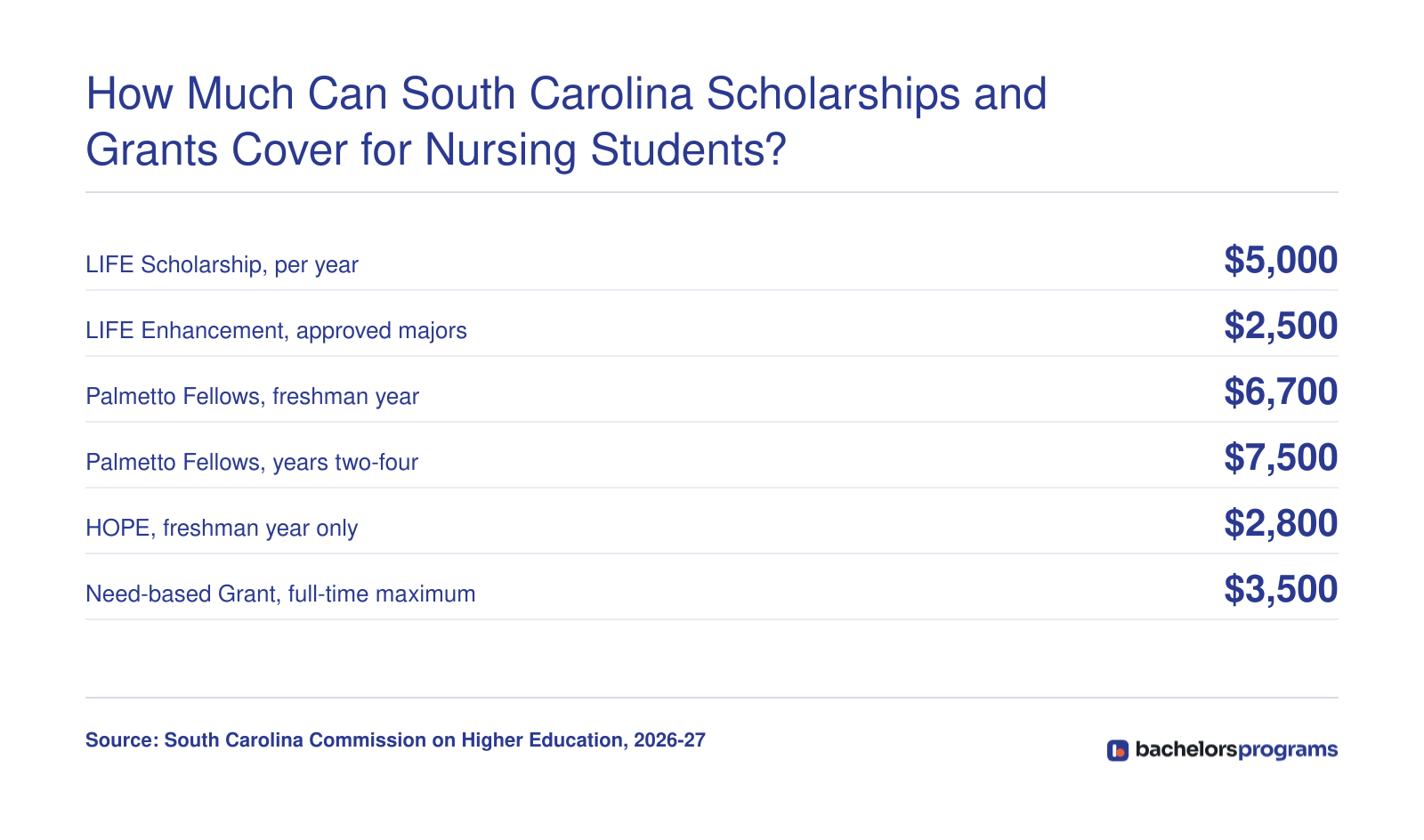
- SC Need-based Grant: up to $3,500 a year full time, $1,750 part time, with a 2.0 GPA and 24 credits a year to renew.
- LIFE Scholarship: $5,000 with a 3.0 GPA plus 1100 SAT or 22 ACT, and 30 credits to renew. Health science majors who complete 14 credits in math or science add $2,500, for a $7,500 maximum.
- Palmetto Fellows: $6,700 in the first year and $7,500 in upper years, with the same $2,500 enhancement and a $10,000 cap. Early awards go to students in the top 6 percent of their class.
- HOPE: a smaller merit award for students who fall short of the LIFE thresholds.
Nursing-Specific Help
The SC Nursing Faculty Loan Forgiveness Program, run by the South Carolina Student Loan Corporation, forgives $30,000 for every two years of service, up to $90,000 over six years, for nurses who teach at least 500 hours a year.1 It targets the faculty shortage rather than tuition, but it is the state's dedicated nursing incentive.
How Much Can South Carolina Scholarships and Grants Cover for Nursing Students?
For 2026-27, LIFE pays up to $5,000 a year at a four-year school if you meet two of three marks (3.0 GPA, 1100 SAT or 22 ACT, top 30% of your class). HOPE covers freshmen with a 3.0 GPA who miss LIFE, Palmetto Fellows rewards top merit students, the Need-based Grant requires the FAFSA and financial need, and $2,500 enhancements start in year two for approved majors with 14 approved credits completed before then. These awards stack with federal Pell Grants and school aid, but the Need-based Grant cannot be combined with LIFE, HOPE or Palmetto Fellows.
South Carolina Board of Nursing Approval, Accreditation, and NCLEX-RN Licensure
A South Carolina RN license starts with a $90 application fee to the Board of Nursing, and the NCLEX-RN registration is a separate payment to Pearson VUE. The two credentials behind that process, state approval and national accreditation, are not interchangeable.
State approval versus accreditation
The South Carolina Board of Nursing must approve a prelicensure program before its graduates can sit for the NCLEX-RN. The Board's approved-program list, updated in July 2026, is the controlling source for a school's program type and approval status. The list covers ADN, BSN, and AAS programs, so confirm you are reading the BSN entry. Initial approval runs until the first graduating class's NCLEX results are published and a Board survey is completed. Full approval reflects continued compliance with the Board's legal and educational requirements.
CCNE or ACEN accreditation is voluntary and separate from state approval. It matters for graduate school; many employers look for it, and federal aid eligibility can depend on it. South Carolina does not accredit BSN programs itself. National accreditation is granted program by program through CCNE or ACEN, and the ranking above shows which seal applies at each school. If you plan to pursue a graduate nursing degree, confirm the seal early, because graduate programs typically require it.
How to become an RN in South Carolina
- Graduate from a Board-approved nursing program.
- Apply to the Board and pay the $90 application fee, which is nonrefundable.
- Wait for the Board's instructions before you complete the required fingerprint-based criminal history check.
- Register for the NCLEX-RN with Pearson VUE. LLR has announced a $350 U.S. exam fee effective February 1, 2027.
- Pass the NCLEX-RN.
If you do not pass within three years of graduation, you must requalify through an approved program and show graduate-level knowledge, skills and abilities. South Carolina is a Nurse Licensure Compact state, but multistate privileges depend on your primary state of residence and license status, so verify eligibility before you accept a compact position.
South Carolina RN Licensure by Exam: The Short Version
Already an RN or Have a Bachelor's Degree? Other BSN Routes
The traditional BSN is not the only path to a bachelor's in nursing, and for two groups of students it is rarely the fastest. An RN license or a bachelor's degree in a non-nursing field usually points to a different route that saves time and tuition.
Licensed RNs: RN-to-BSN
Registered nurses who earned an associate degree in nursing (ADN) or a hospital diploma do not need to repeat pre-licensure coursework or retake the NCLEX-RN. An RN-to-BSN program builds on that license, adding upper-division courses in leadership, community health, and evidence-based practice. Our dedicated RN-to-BSN guide covers these programs separately.
Career Changers: Accelerated BSN
If you hold a non-nursing bachelor's degree, an accelerated BSN compresses nursing coursework and clinical rotations into a shorter, more intensive schedule, usually with science prerequisites completed before you start. Graduates sit for the NCLEX-RN just as traditional BSN students do. Our accelerated BSN page covers those options.
First-Time Students: Your Next Step
If you are starting college or have no prior degree, the traditional BSN rankings above are your list. Shortlist three schools, confirm whether each admits students directly into nursing or at the upper-division stage, then check your eligibility for South Carolina state aid before you apply.
Compare Bachelor of Science in Nursing (BSN) programs on the data that matters
Explore more Nursing majors or browse every field of study.
All Nursing programs Browse every field of study