Best Accelerated BSN (ABSN) Programs in South Carolina
Compare 5 accredited Accelerated BSN (ABSN) programs in South Carolina, with net price after aid, graduation rates, earnings and debt from IPEDS and the U.S. College Scorecard.
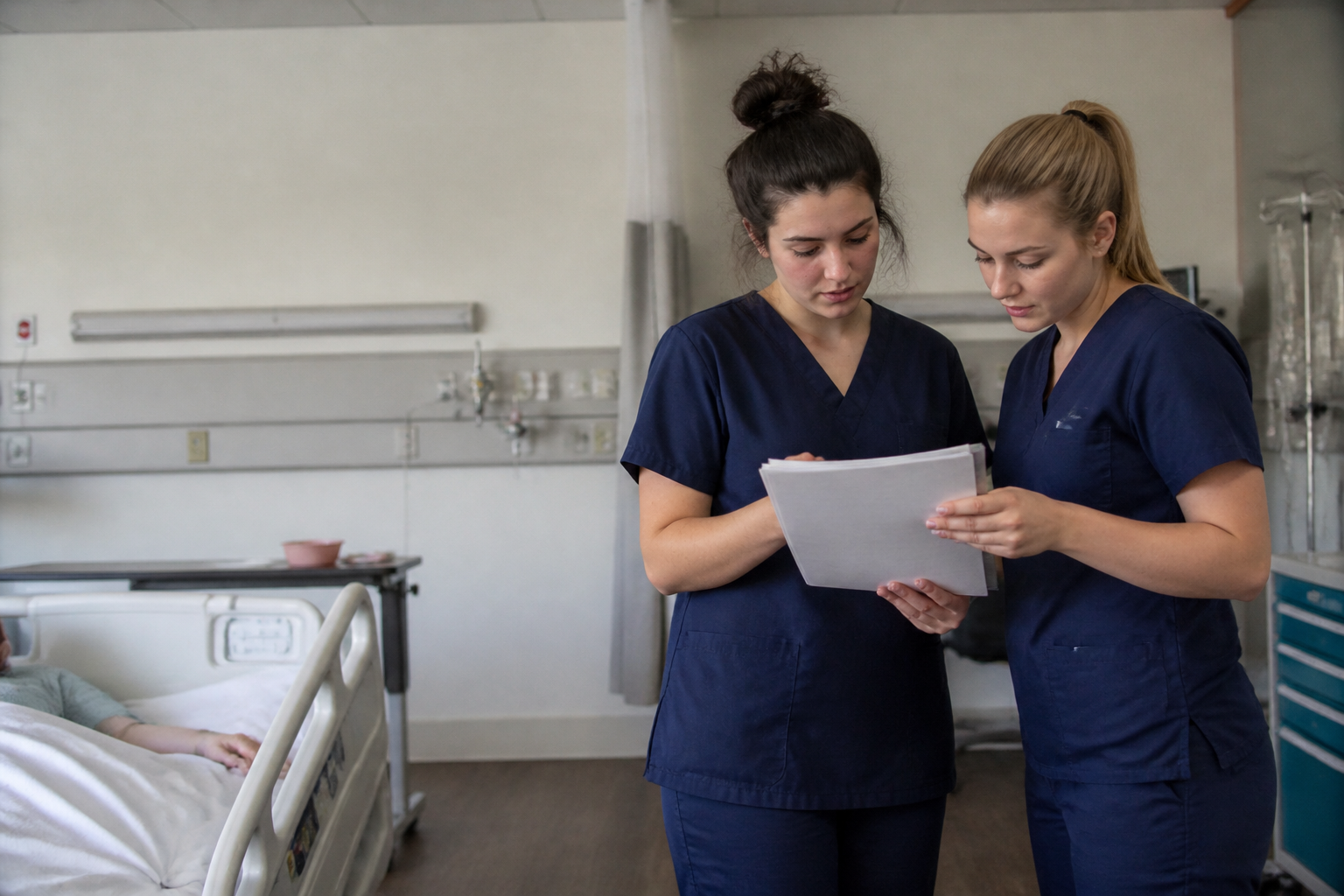
Anderson University's ABSN runs 15 months and asks for 59 transferable credit hours, the kind of transcript a biology, business or psychology graduate often already holds. That is the core appeal of second-degree nursing in South Carolina. Your first bachelor's covers general education, so the remaining time goes to nursing courses, labs and clinicals.
Program length varies more than the word "accelerated" suggests. The Medical University of South Carolina (MUSC) finishes in four semesters, Charleston Southern University in 18 months and Clemson University in five consecutive semesters.
The compressed schedule is the real constraint. MUSC does not allow part-time enrollment, and most programs here set a 3.0 GPA minimum, so holding a full-time job through an ABSN is rarely realistic.
Key Points
- Clemson University lists the lowest in-state tuition and fees: $15,554 a year.
- For lowest average net price, Bob Jones University leads at $16,641.
- Plan on 12 to 18 months of full-time study before NCLEX-RN eligibility.
Best Accelerated BSN Schools in South Carolina, Ranked
Clemson University
#1Clemson, SC · $20,000 – $25,000/yr (est.)
Clemson University's accelerated second degree nursing track is a full-time, five-semester bachelor's for students who already hold a degree, taught in the nursing building in Greenville with clinical rotations at area hospitals. The curriculum runs from health assessment and pathophysiology through medical-surgical, psychosocial, gerontology, mental health, pediatric, women's health and community nursing, plus leadership. Students at this school graduate at a rate of about 87%, the strongest finish rate on this list, and the published in-state tuition and fees are the lowest here for South Carolina residents. Applicants need a 3.0 GPA and the prerequisite science courses, and the program starts each summer.
- Five consecutive semesters of full-time study
- Starts each summer
- 3.0 GPA minimum
- Prerequisite courses required
- Clinicals at Greenville area hospitals
- Financial aid and scholarships available
- Prepares graduates for the NCLEX-RN
Bob Jones University
#2Greenville, SC · ~$17,000/yr (est.)
Best for: Faith-based campus learners who want structured sequencing
Bob Jones University runs a CCNE-accredited BSN Fast Track on its Greenville campus for students who come in with prior college work or a completed bachelor's in another field. The track is sequenced rather than self-paced: nursing courses run at least three years, science labs meet weekly in person, and admission to the clinical sequence requires a 2.75 GPA, the TEAS exam and an interview with the division chair. Published tuition and fees sit in the middle of this group, and the average net price after aid lands in the mid teens, making it one of the more affordable entries once grant aid is counted.
- 3 to 3.5 year track
- CCNE accredited
- TEAS entrance exam required
- 2.75 GPA minimum for clinical nursing courses
- Interview with the division chair required
- Weekly in-person science labs, online labs not accepted
- AP, CLEP and approved transfer credit accepted
- Candidacy requests due March 1 for fall, October 1 for spring
Anderson University
#3Anderson, SC · ~$24,000/yr (est.)
Best for: Upstate career-changers wanting a 15-month finish
Anderson University offers a CCNE-accredited accelerated BSN on its Anderson campus, a 15-month full-time track for students who hold a bachelor's in another field or at least 59 transferable credits. Students learn in a simulation center and cadaver lab and complete clinical placements across upstate South Carolina, in a Christ-centered program that requires 123 total credit hours and a 3.0 GPA for admission. Students at this school graduate at a rate of about 66%, and the average net price after aid is roughly $23,500. The shorter calendar and the Upstate clinical network make it a practical pick for readers who want to finish quickly without leaving the region.
- 15-month accelerated track for non-nursing bachelor's holders
- 123 total credit hours
- Starts fall
- 3.0 GPA minimum
- TEAS entrance exam required
- 59 transferable credit hours accepted
- Simulation center and cadaver lab
- Clinical placements across upstate South Carolina
Medical University of South Carolina
#4Charleston, SC
The Medical University of South Carolina in Charleston delivers a CCNE-accredited accelerated BSN as a 60-credit, four-semester program for students with a prior degree, with clinical rotations inside MUSC's 700-bed medical center and high-fidelity simulation labs. Coursework spans health assessment, pathophysiology, pharmacology, medical-surgical and psychiatric nursing, women's health and leadership, with an emphasis on clinical judgment and interprofessional practice. Published in-state tuition and fees are the lowest of any school here. Students who want an academic health center on their transcript and a Charleston clinical network should put this near the top of their list.
- Four semesters, 60 credit hours
- CCNE accredited
- 3.0 GPA minimum
- Prerequisite courses required
- At least three letters of recommendation
- Clinical rotations at the MUSC medical center
- High-fidelity simulation labs
- Priority admission and active-duty military early decision
Charleston Southern University
#5Charleston, SC · ~$22,000/yr (est.)
Charleston Southern University's ACEN-accredited accelerated BSN is an 18-month hybrid track built for working adults: classes run asynchronously online, labs meet on weekday evenings on the Charleston campus, and clinical rotations happen on weekends at Lowcountry hospitals. The 67-credit curriculum covers health assessment, pharmacology, adult health, mental health, maternal-child and community nursing, ending in a capstone and clinical immersion, with biblical studies woven into the faith-based mission. Students at this school graduate at a rate of about 47%, the lowest on this list, so readers should weigh the flexible schedule against the finish rate. Science and math prerequisites must be recent, with a 3.0 GPA in those courses.
- 18-month hybrid program
- 67 total credit hours
- Starts summer
- Asynchronous online classes
- Evening labs on campus, weekend clinical rotations
- Prerequisites must be within five years
- 3.0 GPA minimum in science and math prerequisites
- Capstone and clinical immersion required
Cost & outcomes by school
Federal data for the highest-earning Accelerated BSN (ABSN) programs, independent of the ranking above. Earnings are this field's bachelor's graduates four years after completing where the Scorecard reports them, else the school's undergraduate median.
| School | Net price / yr | Grad rate | Earnings | Debt | Grads/yr | Format |
|---|---|---|---|---|---|---|
| Medical University of South Carolina SC | — | — | $88,420 | $15,000 | 336 | Campus |
| Clemson University SC | $22,253 | 87% | $71,513 | $21,500 | 12,414 | Campus |
| Charleston Southern University SC | $21,666 | 47% | $45,898 | $26,471 | 1,130 | Hybrid |
| Bob Jones University SC | $16,641 | 65% | $44,354 | $16,585 | 912 | Campus |
| Anderson University SC | $23,544 | 66% | $42,101 | $26,700 | 1,562 | Campus |
Sources: U.S. Department of Education. Net price, graduation rate, earnings and debt: College Scorecard (earnings and debt for this field's bachelor's graduates where reported, else school-wide); graduates: IPEDS. A dash means no figure is reported.
Cost, debt & payoff
Median earnings of this field's bachelor's graduates (4 yrs after completing, else the school's undergraduate median) vs. their median federal loan debt · U.S. College Scorecard
Across these programs the median graduate earns about $45,898 and finishes with roughly $21,500 in debt — a ratio that clears a common rule of thumb (keep debt below first-year salary). Net price and debt vary widely school to school, so check the per-school figures in the table above before you shortlist.
Accelerated BSN Admission Requirements: Prior Degree, Science Prerequisites and GPA
South Carolina's ABSN programs admit students who already hold a degree in another field, but each school sets its own course list and GPA floor. The details below come from the published admissions pages at Clemson and MUSC. Requirements change by admissions cycle, so confirm them before you apply.
- Prior bachelor's degreeClemson requires a bachelor's from a regionally or nationally accredited school. You may apply, and be accepted, while still finishing that degree.
- Prerequisite credit hoursMUSC lists 60 prerequisite credit hours. Coursework can still be in progress when you apply if it is finished by initial enrollment.
- Science prerequisitesMUSC requires anatomy and physiology with lab, microbiology and lifespan human development. Clemson's list covers biology, chemistry, microbiology, nutrition and statistics.
- Course-specific rulesAt MUSC, comparative anatomy and physiology does not count. Development coursework must span birth through death, and three of four sciences must be done at application.
- Minimum course gradeBoth Clemson and MUSC require a C or better in prerequisite courses.
- GPAClemson sets a 3.0 cumulative or last-60-hours minimum. MUSC prefers 3.0, and its more selective criteria call for 3.5 overall and 3.8 in prerequisites.
- Tests, deadlines and experienceCheck entrance exam policy, application dates and any interview or healthcare-experience preference directly with Anderson, Bob Jones, Charleston Southern, Clemson and MUSC.
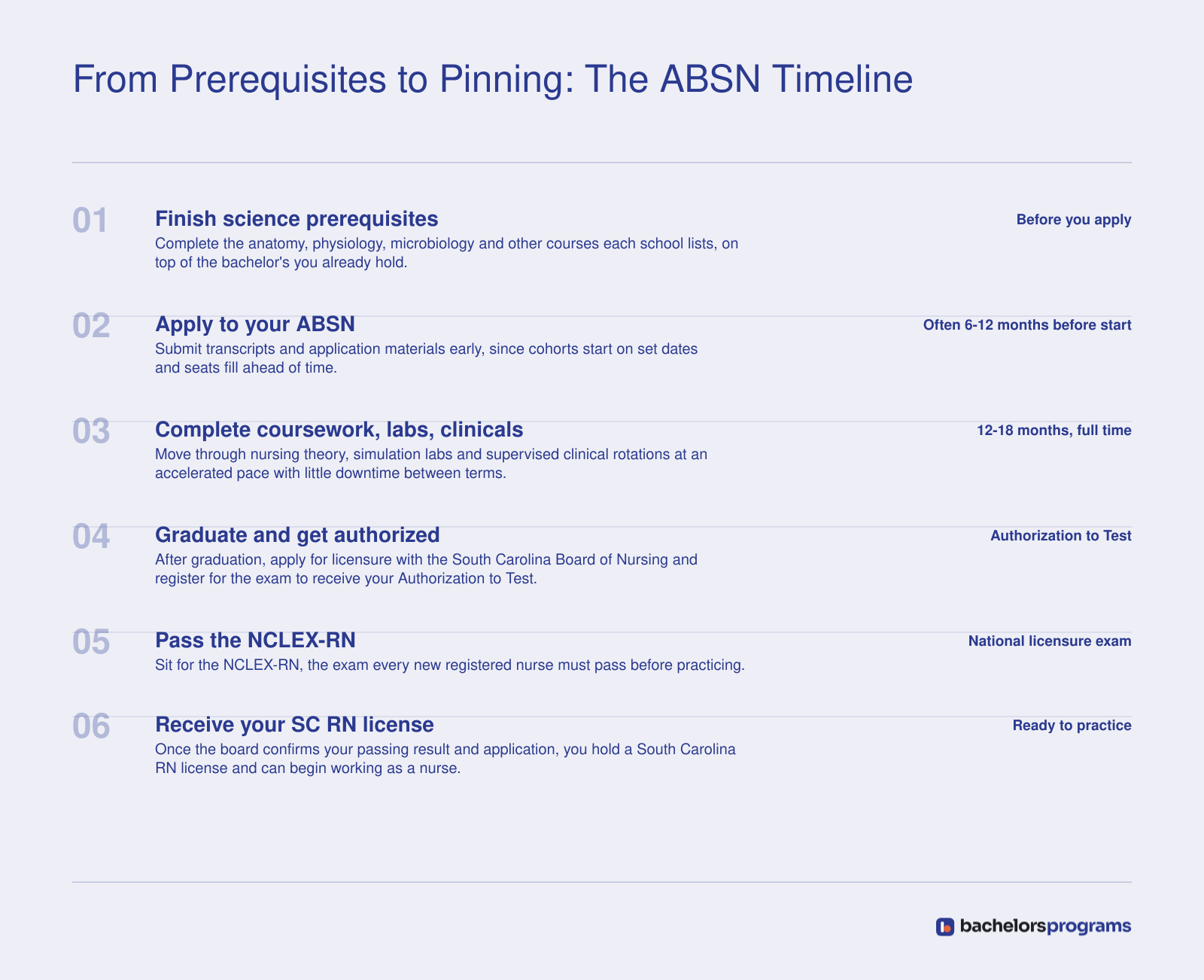
From Prerequisites to Pinning: The ABSN Timeline
An accelerated BSN compresses a full nursing curriculum into roughly 12 to 18 months of full-time study, so the path from your first prerequisite to your South Carolina RN license follows a tight sequence. Between classes, skills labs and clinical rotations, the weekly load runs like a demanding full-time job, which is why most ABSN students plan their finances so they can step away from work during the program.
ABSN Pace and Cost: Program Length, In-State Tuition and Financial Aid
A public university prices you by your address, while a private one charges every student the same rate. That split shapes the first number you see. Clemson University lists the lowest published tuition and fees here: $15,554 a year for South Carolina residents and $40,866 for out-of-state students. Bob Jones University ($24,470), Charleston Southern University ($32,520) and Anderson University ($34,970) charge one rate regardless of residency. These are published annual figures before aid.
What the Accelerated Track Actually Costs
Those annual figures describe each school as a whole, not the accelerated track. Program pricing is more precise. For 2026-27, Clemson's ABSN charges $7,560 per semester for residents and $21,551 for nonresidents. The Medical University of South Carolina quotes total program tuition and fees of $34,519 for residents and $61,335 for nonresidents over four semesters.
Tuition is not the all-in bill. Budget separately for:
- Textbooks
- Uniforms
- Lab and clinical fees
- Background checks and drug screens
- NCLEX registration and review materials
Request an itemized cost sheet from each school before you commit.
Average net price after aid offers another reference point: $16,641 at Bob Jones, $21,666 at Charleston Southern, $22,253 at Clemson and $23,544 at Anderson. These are institution-wide averages for undergraduates, not a guaranteed price for second-degree nursing students.
Financial Aid for Second-Degree Students
- Pell Grants: Because you already hold a bachelor's degree, you generally won't qualify.
- Federal loans: Direct Unsubsidized Loans are the main federal source, so file the FAFSA early.
- School scholarships: Clemson and Anderson note scholarships for their accelerated programs. Ask whether any are reserved for ABSN cohorts, and whether clinical partner hospitals offer tuition help in exchange for a work commitment.
- State programs: A 2025-2026 South Carolina bill would create a nursing scholarship and forgivable loan worth $10,000 per year for up to four years, with one year of service per funded year. It would not take effect until July 1, 2027, and undergraduate eligibility is unsettled.
- After graduation: Public Service Loan Forgiveness covers government and qualifying nonprofit employers. The HRSA Nurse Corps Loan Repayment Program targets critical-shortage facilities.
Plan Living Costs Around the Calendar
Pace sets your living budget. Anderson's track runs 15 months, Charleston Southern's 18 and Clemson's 20, and full-time clinical schedules leave little room for a paying job. Multiply your monthly rent, food, insurance and transportation by the program length, then add a cushion. Build that total into your loan plan alongside tuition.
Related Articles
South Carolina Board of Nursing Approval and NCLEX-RN Licensure
An accelerated BSN must be state-approved before you can sit for the NCLEX-RN. In South Carolina, the Board of Nursing, part of the Department of Labor, Licensing and Regulation (SC LLR), oversees initial licensure programs. Graduating from one of those programs is what makes you eligible to test. ABSN graduates take the same NCLEX-RN as traditional BSN graduates, and their results are counted in the same program totals.
Board Approval vs. National Accreditation
State approval and national accreditation are two separate things. Approval is the licensure gate. Accreditation from the Commission on Collegiate Nursing Education (CCNE) or the Accreditation Commission for Education in Nursing (ACEN) is voluntary, but many graduate nursing programs and some hospital employers expect it. Anderson University, Bob Jones University, Charleston Southern University and Clemson University all appear in the Board's 2025 baccalaureate NCLEX report. Confirm each school's current accreditor and status on its nursing page before you apply.
2025 First-Time Pass Rates
The Board reports results by baccalaureate program, not by track. These figures therefore blend accelerated and traditional students who tested for the first time in calendar year 2025:
- Anderson University: 100.00% (66 tested)
- Bob Jones University: 100.00% (28 tested)
- Medical University of South Carolina: 98.39% (124 tested), a reported figure you should confirm in the Board's report
- Clemson University: 97.18% (213 tested)
- Charleston Southern University: 94.67% (75 tested)
For context, South Carolina baccalaureate programs as a group posted a 91.63% first-time rate in 2025. These pass rates are separate from the ranking above.
How to Check Current Numbers
Pass rates shift every year, and small cohorts can swing sharply. Pull the latest SC LLR Board of Nursing NCLEX pass-rate report, then compare it with each school's outcomes page. Ask admissions whether ABSN results are tracked separately. A track-level figure tells you more about your own odds than a blended one.
Getting Your South Carolina RN License After an ABSN
Campus, Hybrid and Clinical Format Compared
No accelerated BSN in South Carolina is fully online, because labs, simulations and clinical rotations happen in person at every school. The real question is how much of your coursework you can do remotely.
Campus-Based or Hybrid
- Medical University of South Carolina: On-campus, about 16 months.
- Anderson University: On-campus, 15 months.
- Charleston Southern University: Hybrid, 18 months, with asynchronous online coursework, required on-campus days, and labs on weekday evenings.
- Clemson University: Fall start. Ask admissions whether coursework is fully on campus.
Start Terms and Deadlines
Most programs begin in fall. MUSC is the exception, with a Spring 2027 start. Its priority (September 1, 2026) and final (October 1, 2026) deadlines for that cohort have already passed. Its next cycle reportedly lists a January 31, 2027 priority date and a March 15, 2027 final date. Anderson starts one August cohort and reports a March 20 deadline. Charleston Southern's application closes March 1. Confirm the year on each date, since schools reset them every cycle. Clemson's deadline varies by year.
Seats are limited and competitive. Cohort sizes vary by school, so ask each admissions office directly and apply early rather than at the final deadline.
Where Clinicals Happen
MUSC students train at MUSC Medical Center and in inpatient, outpatient and community settings. Charleston Southern places students in Charleston-area hospitals, and its clinical shifts run Friday, Saturday and/or Sunday. Clemson's clinicals center on the Upstate and Greenville region.
If you need flexibility for work or family, ask each school about weekday, evening and weekend clinical scheduling before you apply. Charleston Southern's weekend clinicals and evening labs are the clearest fit for working students.
Questions to Ask Yourself
Can you go 12 to 18 months without a paycheck?
Are your anatomy, physiology and microbiology credits recent enough?
Would you relocate to Charleston, Columbia or the Upstate for a cohort start?
Is a lower in-state price worth waiting for a later start date?
How to Choose the Right Accelerated BSN School in South Carolina
Clemson University lists in-state tuition and fees of $15,554 a year, the lowest sticker price among the schools here. Bob Jones University shows the lowest average net price, $16,641. Your best fit depends on which constraint matters most to you.
Lowest Cost
Annual figures hide how long you will be enrolled. Clemson runs five consecutive semesters and Bob Jones runs three years, so the total bill can differ from the yearly number. Ask admissions: "What is the full program cost, including fees, and what does a typical aid package cover?" Medical University of South Carolina publishes a $34,519 total program tuition and fees, which makes it easy to compare.
Fastest Finish
Anderson University advertises a 15-month track and Charleston Southern University an 18-month track. Medical University of South Carolina runs four semesters. Ask: "When does the next cohort start, and can I take any remaining prerequisites before then?" A fast program only saves time if you can start soon.
No Prior Bachelor's
Bob Jones University's BSN Fast Track is the credit-based route here. It accepts AP and CLEP credit and transfer credit with approval. Clemson requires a previous bachelor's, and Anderson's accelerated track is built for non-nursing bachelor's holders. Ask Bob Jones: "How many of my existing credits will count toward the three years?"
Flexible or Hybrid Schedule
Charleston Southern offers asynchronous online classes, but it still requires on-campus days, weekday evening labs and weekend clinical rotations. Ask: "What does a typical week look like, and can I hold a job?"
Before You Pay a Deposit
Confirm that South Carolina Board of Nursing approval and national nursing accreditation are current, and ask for the latest NCLEX-RN results.
Your Next Step
Shortlist two or three schools. Compare your transcript against each school's prerequisite list, note the gaps, and write down every application deadline.
Second-Degree Nursing in South Carolina: Four Quick Answers
How many months does an accelerated BSN take in South Carolina?
Can I enter a South Carolina accelerated nursing program with a non-nursing bachelor's degree?
Which South Carolina ABSN has the lowest sticker price?
Do accelerated BSN graduates qualify for the NCLEX-RN in South Carolina?
Compare Accelerated BSN (ABSN) programs on the data that matters
Explore more Nursing majors or browse every field of study.
All Nursing programs Browse every field of study