Best Christian Studies Degree Programs
Compare 420+ accredited Christian Studies programs, with net price after aid, graduation rates, earnings and debt from IPEDS and the U.S. College Scorecard.

The field now splits between confessional colleges that teach from within one tradition and research universities that study Christianity as one religion among several. The top-ranked programs here lean toward the second group, and the price spread is wide: in-state tuition runs from $6,381 at the University of Florida to $70,662 at the University of Chicago.
Cost is only one variable. A student headed for pastoral ministry needs something different from one aiming at law school or a doctorate in religion, and format and theological emphasis follow from that goal.
Accreditation and denominational fit ultimately decide whether credits transfer to seminary and whether a church or ministry employer recognizes the degree.
Key Points
- Value comparisons rely on 2024 IPEDS and College Scorecard net price data.
- Low debt and recognized accreditation matter more than prestige in ministry fields.
- Many Christian studies graduates head to seminary, so transferable credits matter.
The 10 Best Christian Studies Degree Programs, Ranked
All ten programs here are campus-based, and the top three separate themselves on a mix of average net price after aid and required research work: two of the three post the lowest average prices in the group, and each expects a capstone, thesis, or advanced seminar before graduation. Below that, the differences come down to how much room a department gives you to build your own focus, whether through cross-registration, an interdisciplinary course list, or named Christian-studies tracks. Prices shown are averages after aid, not guaranteed rates.
Princeton University
#1Princeton, NJ · ~$6,000/yr (est.)
Best for: Aspiring academics who want a senior thesis
Princeton's religion department pairs broad study of Christianity, Judaism, Islam and Asian traditions with a genuine research apprenticeship: a junior colloquium and paper, a 70 to 90 page senior thesis, and an oral exam. Students choose among five concentration options or a thematic stream that crosses traditions, and biblical texts are read closely rather than surveyed. The average net price after aid is the lowest in this group, and the school's overall graduation rate is 98%.
- Five concentration options plus a thematic, cross-tradition stream
- 11 courses total, including a junior colloquium and paper
- Senior thesis of 70 to 90 pages with an oral examination
- Critical Approaches course required of all majors
- Traditions streams cover five religious traditions
University of Florida
#2Gainesville, FL · ~$7,000/yr (est.)
Best for: Florida students seeking a compact religion major
The University of Florida keeps the religion major compact: 10 courses (30 credits) inside a 120-credit degree, with required junior and senior seminars and no prerequisites for introductory courses. Coursework spans Asian, Islamic, Jewish and Christian traditions, and the department encourages study abroad and cross-listing with Jewish studies and sustainability. The average net price after aid is about $6,500, and the school's overall graduation rate is 91%.
- 120 total credit hours, with 10 courses (30 credits) in the major
- Required junior and senior seminars
- No prerequisites for 2000-level courses
- Electives in Asian, Islamic, Jewish and Christian traditions
- Study abroad encouraged; courses cross-list with Jewish studies
- Pairs with sustainability and other UF programs
University of California-Los Angeles
#3Los Angeles, CA · $13,000/yr (est. net price)
Best for: Field researchers drawn to urban religious communities
UCLA treats the study of religion as a capstone major, so every student finishes with an advanced seminar that carries a research, writing and presentation load. Courses pull from anthropology, history, philosophy and religious studies, and honors students can pursue an independent thesis with faculty mentoring. Field research in Los Angeles religious communities is part of the draw, and the school's overall graduation rate is 93%.
- 15 courses, capped by a required advanced seminar
- Designated capstone major at UCLA
- Honors program with independent thesis and faculty mentorship
- Field research in Los Angeles religious communities
- Courses drawn from anthropology, history, philosophy and religion
Rice University
#4Houston, TX · ~$13,000/yr (est.)
Rice offers the clearest Christian-studies tracks in this group: four concentration areas inside the religion major cover Global Christianity, Christianity and Popular Culture, Bible and Beyond, and New Testament and Early Christian Studies. Students can study biblical texts in their original languages and finish with a thesis or capstone seminar, and the school's overall graduation rate is 95%.
- 120 total credit hours
- Tracks include Global Christianity and Bible and Beyond
- Also New Testament and Early Christian Studies and Christianity and Popular Culture
- Biblical texts studied in original languages
- Thesis or capstone seminar required
- Departmental honors program and Saba Prize
- Transfer credit limited to 6 hours
University of North Carolina at Chapel Hill
#5Chapel Hill, NC · ~$12,000/yr (est.)
UNC's religious studies major runs nine courses (27 credit hours) and requires work in at least three of five subfields, from Ancient Mediterranean Religions to Religion in the Americas, so the degree stays broad rather than narrowly confessional. A capstone seminar is required, an honors thesis is optional, and study abroad courses count toward the major. The school's overall graduation rate is 91%.
- 27 credit hours across 9 courses
- Must take classes in at least three of five subfields
- Capstone seminar required
- Honors thesis option; study abroad counts toward the major
- Theta Alpha Kappa honor society chapter
- 2.0 GPA minimum for the major
- Summer research funding and department awards
University of Chicago
#6Chicago, IL · ~$15,000/yr (est.)
Chicago's religious studies program sits alongside its well-known Divinity School, and undergraduates study Buddhism, Christianity, Hinduism, Islam and Judaism through historical, ethical and comparative lenses. The major is open to students in any field and is often paired with history, philosophy, literature or economics, and it examines how religion intersects with politics, gender and race. The school's overall graduation rate is 96%.
- Study Buddhism, Christianity, Hinduism, Islam and Judaism
- Open to students majoring in any field
- Complements history, philosophy, literature and economics
- Examines religion and gender, race, politics and ethics
- Taught alongside the Divinity School
- Scholarships and financial aid available
University of California-San Diego
#7La Jolla, CA · $10,000 – $15,000/yr (est.)
UC San Diego runs its study of religion as a two-year major with an interdisciplinary course list that spans 11 departments, so students build a program around their own research interests. Core and affiliated faculty mentor work in critical analysis and cross-cultural interpretation. The school's overall graduation rate is 86%.
- Two-year major
- Interdisciplinary course list spans 11 departments
- Students pursue their own research interests
- Emphasis on critical thinking and cross-cultural interpretation
Pomona College
#8Claremont, CA · ~$19,000/yr (est.)
Pomona's religious studies major is a cooperative program with Claremont McKenna, Harvey Mudd, Pitzer and Scripps, which turns a small liberal arts department into a five-college course catalog. Students examine religion through geographical, philosophical, thematic and comparative approaches while focusing on at least one tradition, with faculty mentoring throughout. The school's overall graduation rate is 93%.
- Cooperative major with Claremont McKenna, Harvey Mudd, Pitzer and Scripps
- Geographical, philosophical, critical, thematic and comparative approaches
- Students focus on at least one religious tradition
- Prepares for graduate study in religion, law, medicine and business
- Dedicated faculty mentors
University of California-Davis
#9Davis, CA · $10,000 – $15,000/yr (est.)
UC Davis builds its religious studies degree around 60 credit hours of coursework in Judaism, Christianity, Islam and Hinduism, plus cross-cultural courses on symbols, myths and rituals and thematic courses on religion and science, ethics or violence. The major pairs well as a second degree, and an honors program and study abroad are available. The school's overall graduation rate is 86%.
- 60 credit hours in the major
- Courses in Judaism, Christianity, Islam and Hinduism
- Cross-cultural courses on symbols, myths and rituals
- Thematic courses on religion and science, ethics and violence
- Honors program available
- Works well as a second major
University of Washington-Seattle Campus
#10Seattle, WA · ~$14,000/yr (est.)
At the University of Washington, comparative religion sits inside the Jackson School of International Studies, which gives the major a global, policy-adjacent framing rather than a confessional one. Courses approach religion historically, textually, anthropologically, philosophically, psychologically and sociologically, drawing faculty from several departments. The school's overall graduation rate is 85%.
- Housed in the Jackson School of International Studies
- Historical, textual, anthropological and sociological approaches
- Faculty drawn from multiple departments
- International, trans-cultural curriculum
- Access to strong language and literature programs
Cost & outcomes by school
Federal data for the highest-earning Christian Studies programs, independent of the ranking above. Earnings are this field's bachelor's graduates four years after completing where the Scorecard reports them, else the school's undergraduate median.
| School | Net price / yr | Grad rate | Earnings | Debt | Grads/yr | Format |
|---|---|---|---|---|---|---|
| Princeton University NJ | $6,128 | 98% | $110,066 | $10,320 | 6 | Campus |
| Santa Clara University CA | $50,062 | 88% | $109,183 | $19,162 | 5 | Campus |
| Cornell University NY | $28,690 | 95% | $104,043 | $14,000 | 1 | Campus |
| Georgetown University DC | $40,815 | 95% | $103,494 | $15,500 | 8 | Campus |
| Yale University CT | $23,777 | 96% | $100,533 | $12,975 | 9 | Campus |
| Villanova University PA | $43,756 | 92% | $100,423 | $25,874 | — | Campus |
| Duke University NC | $29,612 | 97% | $97,800 | $13,000 | 5 | Campus |
| Washington and Lee University VA | $23,781 | 94% | $94,810 | $19,500 | 4 | Campus |
| Northeastern University MA | $30,915 | 91% | $92,538 | $24,250 | 1 | Campus |
| University of Chicago IL | $14,860 | 96% | $91,885 | $15,000 | 1 | Campus |
| Trinity College CT | $34,832 | 84% | $90,779 | $23,000 | 4 | Campus |
| Rice University TX | $13,370 | 95% | $89,718 | $11,000 | 8 | Campus |
Sources: U.S. Department of Education. Net price, graduation rate, earnings and debt: College Scorecard (earnings and debt for this field's bachelor's graduates where reported, else school-wide); graduates: IPEDS. A dash means no figure is reported.
Cost, debt & payoff
Median earnings of this field's bachelor's graduates (4 yrs after completing, else the school's undergraduate median) vs. their median federal loan debt · U.S. College Scorecard
Across these programs the median graduate earns about $57,116 and finishes with roughly $23,887 in debt — a ratio that clears a common rule of thumb (keep debt below first-year salary). Net price and debt vary widely school to school, so check the per-school figures in the table above before you shortlist.
How We Ranked These Christian Studies Programs
Sticker price tells you what a school charges. Net price tells you what students actually pay after grants and scholarships. We lean on the second number, because that is the one your budget will feel.
What Went Into the Rankings
Four inputs shaped the order of the programs below:
- Net price: The average cost after financial aid, not the published tuition rate.
- Graduation and retention: How many students finish at the school and how many return after the first year.
- Earnings and debt: Program-level figures from the U.S. Department of Education's College Scorecard, where they are available.
- Format flexibility: Whether a student can complete the degree online, on campus, or in a hybrid arrangement.
Schools did not pay for placement. The rankings use the latest Scorecard snapshot available in 2026.
Limits of the Data
Graduation and retention rates describe the whole institution, not the Christian studies major alone. A school with strong overall numbers may still have a small or newer program. Earnings and debt figures also go unpublished for some small programs, so certain cards show fewer statistics. We left those gaps empty instead of estimating.
What No Ranking Can Measure
Numbers cannot capture theological tradition, faculty fit, or campus culture. A Reformed, Wesleyan, Catholic, or nondenominational school can each rank well and still feel wrong for you. Those questions often matter more than a few points of net price.
Before you apply anywhere, check a school's accreditation and denominational affiliation: both affect whether credits transfer to seminary, how ordination paths work, and where graduate study is possible.
Which Christian Studies Programs Deliver the Best Value?
Based on 2024 U.S. Department of Education data from IPEDS and the College Scorecard, these schools pair low net prices and light borrowing with strong long-term outcomes. The debt and earnings figures are school-wide context covering all majors, not results for the religion programs themselves. Graduates who enter ministry, church staff, or nonprofit roles often earn well below school-wide medians, so keeping debt between $10,000 and $11,000, as these schools do, leaves room to afford seminary or a lower-paying calling without years of heavy loan payments.
| School | Program | Location | Average Annual Net Price | School-Wide Median Debt at Graduation (All Majors) | School-Wide Median Earnings, 10 Years After Enrollment (All Majors) |
|---|---|---|---|---|---|
| Princeton University | Religion (Bachelor's) | Princeton, NJ | $6,128 | $10,320 | $110,066 |
| Wellesley College | Religious Studies (Bachelor's) | Wellesley, MA | $25,496 | $10,000 | $84,803 |
| Rice University | BA with a Major in Religion | Houston, TX | $13,370 | $11,000 | $89,718 |
Online vs. Campus Christian Studies Degrees
The choice between online and campus Christian studies usually comes down to flexibility versus formation. Online formats let you keep a job, a ministry role, or a family routine; campus programs ask for relocation and a residential rhythm in exchange for daily community. Neither is automatically better, but they lead to different weekly lives.
Who Online Works For
Liberty University, Grand Canyon University, and Moody Bible Institute are among the schools here with online or hybrid routes. Liberty's online B.S. in Bible and B.S. in Religion are 100% online, use 8-week courses, and require no set login times or campus intensives. That structure suits working adults, bivocational ministers, and students who cannot relocate. Campus programs still have a case: chapel services, face-to-face mentoring, and supervised ministry practicums are harder to replicate at a distance. If formation through shared daily life matters to you, residential may be worth the cost.
Transfer Credit and Residency
Transfer policy varies enough to check before you apply. Liberty's online religion programs accept up to 75% of the degree in transfer credit, normally about 90 of 120 credits.1 Its 2026-2027 B.S. in Bible plan waives certain required religion courses for students who transfer 45 or more undergraduate credits, with additional waivers at 60 or more; a C minimum applies in upper-level major courses, and residency rules still require 25% of the major and 30 credits through Liberty.2 Moody's online B.S. in Integrated Ministry Studies allows up to 90 transfer credits. Grand Canyon evaluates transfer credit individually rather than publishing one universal maximum.3
Accelerated Routes to Seminary
Grand Canyon advertises accelerated B.A.-to-M.Div. pathways for Christian Ministry and Christian Studies: graduate courses count during the bachelor's, completion can take five years, and a Barnabas Scholarship is available3, all subject to graduation requirements. Liberty's online M.Div. in Biblical Studies is 72 credits4 and may accept up to 66.7% transfer from a master's-level religion program5, but that is graduate-to-graduate credit, not a documented BA-to-MDiv shortcut.
Related Articles
Christian Studies vs. Biblical Studies: Concentrations and Degree Types
Christian studies is a broad undergraduate major that examines the Christian faith through theology, church history, ethics, and culture, while biblical studies narrows in on Scripture itself: how it was written, how it is interpreted, and often the original languages behind it. Many schools blur the two, so read the course list rather than trusting the major title.
BA vs. BS
A BA usually adds foreign language and humanities requirements, which suits students headed to seminary or graduate study. A BS, where offered, tends to swap in applied coursework such as ministry leadership, counseling, or nonprofit management. The programs ranked here are mostly liberal arts degrees in religion or theology, though a few are BS tracks, so if a BS appeals to you, check the additional programs near the end of this page.
Concentrations and Where They Lead
Rice University's religion major shows how concentrations shape a degree. Its options include Global Christianity, Christianity and Popular Culture, Bible and Beyond, and New Testament and Early Christian Studies. Princeton and UNC Chapel Hill each offer five concentration options of their own. Here is how common tracks tend to map to careers:
- Bible and theology: Seminary, graduate study, or teaching.
- Youth ministry: Church staff roles and youth organizations.
- Missions and global Christianity: Cross-cultural and international service work.
- Apologetics and culture: Writing, teaching, or campus ministry.
The ranked programs are academic rather than confessional, so they work best for students who want a rigorous study of Christianity, not ministry formation.
Hebrew and Greek
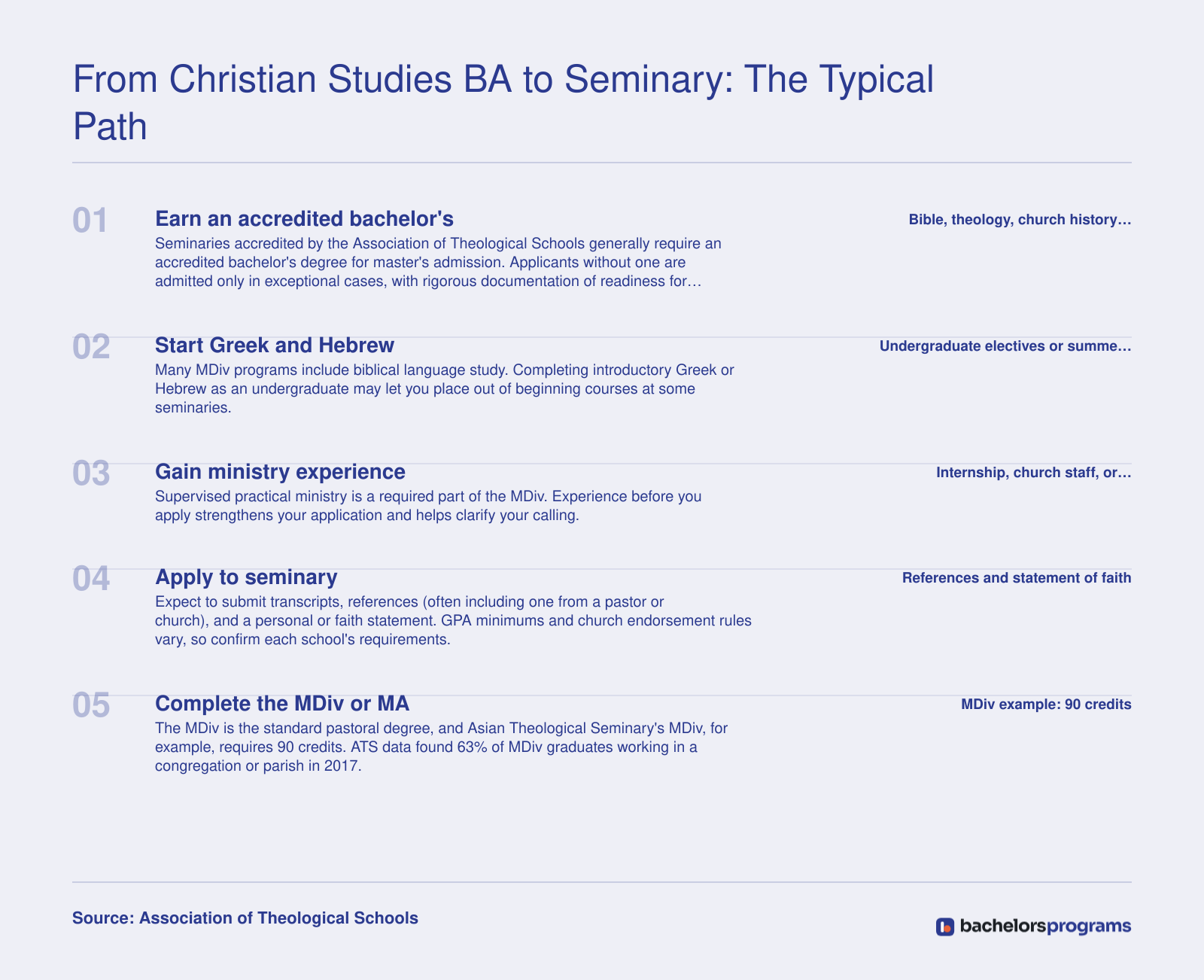
Many biblical studies BAs require at least one ancient language, while many Christian studies and ministry tracks make languages optional. Rice notes that students can learn religious texts in their original languages, an opportunity worth looking for at any school. If you plan to pursue a Master of Divinity, take Greek early. Seminaries often expect some preparation, and starting as a freshman spreads the workload across four years instead of cramming it into the last two. Hebrew can follow in your junior year if your schedule allows.
From Christian Studies BA to Seminary: The Typical Path
For many Christian studies majors, the bachelor's degree is a first step toward seminary rather than the finish line. Admission requirements vary by school, but most applicants follow a similar sequence. Plan for each stage early so your undergraduate years count toward your graduate goals.
Questions to Ask Yourself
Do you plan to attend seminary, and does this program build in Greek or Hebrew?
Can you study comfortably under the school's doctrinal statement?
Will you ever need to transfer these credits somewhere else?
Do you need fully online classes, or do you want campus mentorship and chapel?
In a ministry-oriented field, low debt and recognized accreditation matter more than prestige. Choose the program that keeps your loans manageable and your credits transferable to seminary or graduate study.
Christian Studies programs by state
Christian Studies Degree FAQs
These are the questions prospective students ask most often when comparing Christian studies programs. Each answer is short, and the sections above cover the details.
Is a Christian studies degree worth it?
Can you get a Christian studies degree online?
Do Christian studies programs require Hebrew or Greek?
Can a Christian studies degree lead to a counseling career?
Compare Christian Studies programs on the data that matters
Explore more Religion & Theology majors or browse every field of study.
All Religion & Theology programs Browse every field of study