Best Political Science Degree Programs
Compare 1,000+ accredited Political Science, Government programs, with net price after aid, graduation rates, earnings and debt from IPEDS and the U.S. College Scorecard.

A political science B.A. costs roughly the same to deliver at every tier. What students actually pay after grant aid varies far more. The University of Florida posts an average net price near $6,500. Princeton lands close to $6,100 for aided families, while Harvard's average sits above $19,000. Same major, different check written each year.
The choice is rarely campus versus online. Formats differ, but what a department's price buys is smaller seminars, a semester in Washington, placement in state legislative offices, and the early-career earnings its graduates report five years out.
Political science rewards proximity to power and patience with entry-level pay. Your decision comes down to where those two meet.
Key Points
- Yale political science graduates earn a $123,834 median five years out.
- Accreditation, not online or campus format, determines a degree's weight.
- Semester-in-DC programs like The Washington Center build résumés before graduation.
Top 10 Political Science Degree Programs for 2027
Low net price after grant aid, paired with published earnings for the political science major itself, is what separates the top of this list from the rest. Every card below shows the format, the net price students actually pay, the admission rate, and median earnings measured four years after finishing, alongside program-level federal debt and the monthly payment it implies over ten years. Graduation rates are institution-wide; earnings and debt figures refer to the political science major specifically.
University of California-Los Angeles
#1Los Angeles, CA · $13,000/yr (est. net price)
Best for: In-state Californians wanting research-scale access
UCLA combines a large research university's catalog with one of the biggest political science pipelines in the country, awarding roughly 675 bachelor's degrees in the field in a recent reporting year. Undergraduates finish at a 93% institution-wide rate, and the median political science graduate earned $74,202 four years after finishing, against $15,000 in program-level federal debt and a $159 monthly payment over ten years. Admission is highly selective at about 9%, so applicants need strong grades and a clear reason for the major.
- Bachelor of Arts in Political Science listed in the UCLA General Catalog
- Catalog published annually with course, requirement and fee updates
- Roughly 675 political science bachelor's degrees completed in the reporting year
Princeton University
#2Princeton, NJ · ~$6,000/yr (est.)
Best for: Thesis writers drawn to small seminars
Princeton's Politics department delivers a liberal arts style program inside a major research university, built around four concentrations and the small-group preceptorial system. Graduates of the major earned a median $88,576 four years after finishing, among the highest in this group, and the institution-wide graduation rate runs near 98%. Admission is extremely selective at about 5%, and a year-long senior thesis caps the degree.
- Four concentrations: American politics, comparative politics, international relations, political theory
- Preceptorial discussion groups paired with larger lectures
- Year-long senior thesis required for the major
- Coursework in quantitative social science and game theory
University of California-Berkeley
#3Berkeley, CA · ~$13,000/yr (est.)
Best for: Activist-minded students wanting a large public university
UC Berkeley's political science department is one of the largest in the country, and its structure reflects that scale: lower-division lectures of 250 to 300 students give way to seminars of about 18. The median graduate earned $75,128 four years after finishing, with $13,000 in program-level federal debt and a $138 monthly payment over ten years, and the institution-wide graduation rate is about 93%. Admission is competitive at roughly 11%, and the honors track is the clearest route into research work.
- Lectures of 250 to 300 students; seminars capped near 18
- Declaration requires eligibility courses plus an orientation session
- Upper-division courses restricted to declared majors
- Honors track: 3.5 major GPA, two-semester seminar, faculty-sponsored thesis
University of Florida
#4Gainesville, FL · ~$7,000/yr (est.)
Florida's flagship keeps the price of a political science degree unusually low and builds the major for students who want practical add-ons. The median political science graduate earned $70,434 four years after finishing, against $15,000 in program-level federal debt and a $159 monthly payment, and the institution-wide graduation rate is about 91%. The degree runs 120 total credits, 30 of them in political science, and admission sits near 24%.
- 120 total credit hours, including 30 in political science
- Certificate options in Political Campaigning and Public Affairs
- Combined BA/MA pathway available to strong undergraduates
- Core work in American government, comparative politics, international relations and theory
- Internships, overseas study and faculty-led research encouraged
University of North Carolina at Chapel Hill
#5Chapel Hill, NC · ~$12,000/yr (est.)
UNC's political science major is compact on paper, 27 credit hours across nine courses, but it spreads across five subfields and adds a Data in Politics track for students who want quantitative work. The median graduate earned $72,001 four years after finishing, with $14,569 in program-level federal debt and a $154 monthly payment over ten years. The institution-wide graduation rate is about 91%, admission runs near 15%, and both honors thesis and internship credit are on the table.
- 27 credit hours across nine courses
- Five subfields, including political methodology
- Data in Politics track for quantitative coursework
- Honors program with thesis; internship credit available
- Pi Sigma Alpha honor society chapter on campus
Florida State University
#6Tallahassee, FL · ~$11,000/yr (est.)
Florida State offers the political science major as a BA or BS, with a required research course and distribution across at least three of five subfields. The median graduate earned $68,059 four years after finishing, with $17,537 in program-level federal debt and an $186 monthly payment over ten years, the heaviest loan burden among the schools that publish a program figure here. The institution-wide graduation rate is about 86%, admission sits near 24%, and a pre-law track plus a required minor or second major shape the degree.
- BA or BS track with 30 political science credit hours
- Required research course plus work in three of five subfields
- Minor or second major required; 120 total credits
- Pre-law curriculum and oral communication competency built in
Harvard University
#7Cambridge, MA · $15,000 – $20,000/yr (est.)
Harvard files political science under its Government program, a concentration that leans on theory, institutional analysis and faculty-led research rather than vocational training. The median graduate earned $95,838 four years after finishing and $117,484 by year five, with an institution-wide graduation rate near 98%. Admission is extremely selective at roughly 4%, and the degree feeds directly into law school, diplomacy, policy work and academia.
- Concentration in political science within Harvard's Government program
- Study of power, governance and political behavior across theoretical perspectives
- Training in argumentation, data analysis and ethical reasoning
- Small classes and faculty-led research on the Cambridge campus
University of California-San Diego
#8La Jolla, CA · $10,000 – $15,000/yr (est.)
UC San Diego's general political science major is built for breadth: introductory work in American politics, comparative politics, international relations and theory, then twelve upper-division electives drawn from across the department. The median graduate earned $67,713 four years after finishing, with $15,000 in program-level federal debt and a $159 monthly payment over ten years. The institution-wide graduation rate is about 86% and admission runs near 27%, making it one of the more accessible UC entries for this major.
- Broad elective choice across the political science department
- Introductory work in American politics, comparative politics, international relations and theory
- Research methods course required of all majors
- Twelve upper-division electives in the department
- All major courses taken for letter grades
University of California-Irvine
#9Irvine, CA · $14,000/yr (est. net price)
UC Irvine structures the major around five upper-division modules and asks students to concentrate three courses in one area while sampling the rest. The median graduate earned $63,318 four years after finishing, with $16,000 in program-level federal debt and a $170 monthly payment over ten years. The institution-wide graduation rate is about 87%, admission sits near 29%, and the UCDC internship in Washington, D.C., gives students an out-of-classroom route into policy work.
- 12 courses (48 units) required for the major
- Five upper-division modules, with three courses concentrated in one
- UCDC Internship in Washington, D.C.
- Honors program with senior thesis
- Education Abroad and field study options
Stanford University
#10Stanford, CA · $10,000 – $15,000/yr (est.)
Stanford's political science major runs 70 units across a primary and a secondary track, with five tracks including Justice and Law, and Data Science. Graduates earned a median $59,297 one year after finishing and $73,221 by year five, with $11,705 in program-level federal debt and a $124 monthly payment over ten years. The institution-wide graduation rate is about 92%, admission is at roughly 4%, and every student completes a capstone through an honors thesis, project or policy practicum.
- 70 units, including a 5-unit introductory course and a methods course
- Five tracks, including Justice and Law, and Data Science
- Primary and secondary track structure of 25 and 15 units
- Capstone via honors thesis, project or policy practicum
- Research Honors Program requires a 3.5 GPA and a thesis graded B+ or higher
Cost & outcomes by school
Federal data for the highest-earning Political Science, Government programs, independent of the ranking above. Earnings are this field's bachelor's graduates four years after completing where the Scorecard reports them, else the school's undergraduate median.
| School | Net price / yr | Grad rate | Earnings | Debt | Grads/yr | Format |
|---|---|---|---|---|---|---|
| Massachusetts Institute of Technology MA | $20,111 | 96% | $143,372 | $14,768 | 6 | Campus |
| California Institute of Technology CA | $16,075 | 94% | $128,566 | — | — | Campus |
| Stanford University CA | $13,807 | 92% | $124,080 | $11,705 | 73 | Campus |
| Johns Hopkins University MD | $18,809 | 94% | $121,729 | $10,250 | 32 | Campus |
| Carnegie Mellon University PA | $31,944 | 94% | $114,862 | $21,750 | 2 | Campus |
| Dartmouth College NH | $29,519 | 96% | $106,153 | $17,500 | 177 | Campus |
| Vanderbilt University TN | $15,846 | 94% | $102,789 | $14,000 | 111 | Campus |
| Columbia University in the City of New York NY | $21,590 | 96% | $100,245 | $21,500 | 233 | Campus |
| Colby College ME | $17,180 | 89% | $96,621 | $27,000 | 61 | Campus |
| Harvard University MA | $19,066 | 98% | $95,838 | $14,000 | 181 | Campus |
| Cornell University NY | $28,690 | 95% | $95,391 | $14,400 | 148 | Campus |
| Washington and Lee University VA | $23,781 | 94% | $95,190 | $19,500 | 55 | Campus |
Sources: U.S. Department of Education. Net price, graduation rate, earnings and debt: College Scorecard (earnings and debt for this field's bachelor's graduates where reported, else school-wide); graduates: IPEDS. A dash means no figure is reported.
Cost, debt & payoff
Median earnings of this field's bachelor's graduates (4 yrs after completing, else the school's undergraduate median) vs. their median federal loan debt · U.S. College Scorecard
Across these programs the median graduate earns about $57,008 and finishes with roughly $23,000 in debt — a ratio that clears a common rule of thumb (keep debt below first-year salary). Net price and debt vary widely school to school, so check the per-school figures in the table above before you shortlist.
Our Scoring Formula: Cost, Earnings and Completion Data
Students comparing majors now lean on outcome data far more than brand names, and political science is no exception. Every school on this list had to prove its value with federal figures, not reputation surveys.
What Went Into the Rankings
The rankings cover bachelor's-level political science programs. For each one, we drew on College Scorecard program-level earnings and debt for political science completers, plus institution-level net price, graduation rate, and retention. Together those show what a degree costs, whether students stay and finish, and what graduates earn and owe afterward.
What the Numbers Can and Cannot Tell You
Read the figures with their limits in mind.
- Graduation and retention: These are school-wide averages, so they describe the whole campus, not only political science majors.
- Net price: Also an institution-wide figure. What you pay depends on your aid and your family's income.
- Earnings: Program earnings are medians for completers, measured over a set window after graduation. They reflect earlier graduating classes, not a promise for yours.
What We Left Out
Prestige surveys and faculty publication counts did not factor in. Both reward reputation and research output, neither of which says much about whether an undergraduate finishes on time, borrows a manageable amount, and finds work. Outcome data is measured the same way at public and private schools, and anyone can check it. A famous name can still be a fine choice, but it should earn its place on the numbers.
Where Political Science Graduates Earn the Most Early On
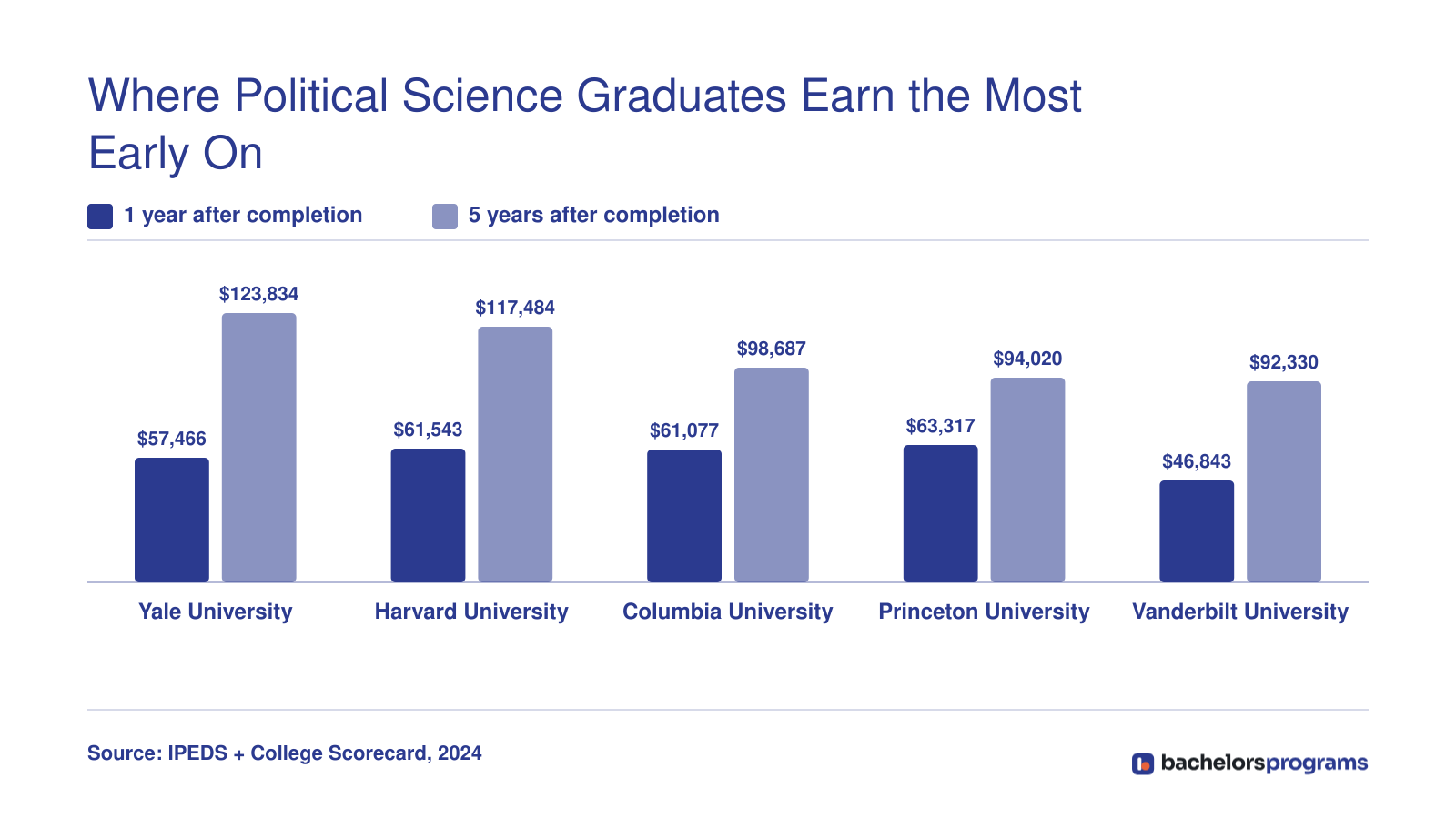
Yale leads with median earnings of $123,834 five years after completion, which is $31,504 more than Vanderbilt's $92,330. Every bar reflects program-level earnings measured 1 year and 5 years after completion, not school-wide 10-year figures. Higher pay does not always mean a higher price: Princeton graduates earn $94,020 at five years with an average net price of $6,128, the lowest of these schools, and Harvard out-earns Columbia while costing less ($19,066 versus $21,590).
Most Affordable Political Science Degree Programs
The net prices below are averages for undergraduates after grants and scholarships, drawn from 2024 U.S. Department of Education IPEDS and College Scorecard data, so your own quote will vary with family income and aid. Public CUNY Baruch College posts the lowest net price at $3,033 a year, while private Princeton University ($6,128) comes in just below the public University of Florida ($6,541) after grant aid, despite a $62,688 sticker price. All of these are campus-based programs, so online students should compare the online options elsewhere on this page. Don't judge on sticker price alone: weigh the monthly loan payment against early earnings, as Baruch graduates do with a median payment of about $125 a month against median first-year earnings of $31,005.
| School | State | Format | Sector | Avg. Net Price After Aid (per year) | Program Median Debt | Est. Monthly Loan Payment | Median Earnings 1 Year After Graduation |
|---|---|---|---|---|---|---|---|
| CUNY Bernard M Baruch College | NY | On-campus | Public | $3,033 | $11,744 | $125 | $31,005 |
| Princeton University | NJ | On-campus | Private nonprofit | $6,128 | N/A | N/A | $63,317 |
| University of Florida | FL | On-campus | Public | $6,541 | $15,000 | $159 | $31,574 |
Related Articles
Online and On-Campus Political Science Degrees: Accreditation and Credit Transfer
Accreditation, not delivery format, determines whether an online political science degree carries the same weight as a campus one. Because accreditation attaches to the institution, check that the school is accredited by an accreditor recognized by the U.S. Department of Education or listed with CHEA. The University of Oklahoma Online, for example, is accredited by the Higher Learning Commission and awards the same diploma as its campus program. Diplomas generally do not have to name the delivery format.
Which Format Fits
Every school in the top ranks here delivers its political science major on campus, so online seekers should look at the programs in the later listing or at online divisions such as Oklahoma, UW-Madison, and Kansas. Online suits working adults and part-time students who need flexible scheduling. Campus suits students who want in-person debate, Model UN, and a campus internship office down the hall.
Transfer Credit Basics
Community college transfers should start with articulation agreements, which spell out how courses move between institutions. Then confirm the rules that cap what counts:
- Total credits: A standard bachelor's commonly requires 120 credits, as UW-Madison Online lists.
- Transfer caps: General-practice reports put caps between 60 and 113 credits, with 90 the most common for online programs. Oklahoma allows up to 90.
- Eligibility floors and grades: Oklahoma and Kansas each use a 24-credit threshold, and Kansas also asks for a 2.5 GPA. Johns Hopkins requires a C or better.
- Residency: Residency means credits earned through the degree-granting school, not living nearby. Johns Hopkins requires 60 residency credits, while common patterns call for 30 credits or 25 to 30 percent of the degree.
Accepted credit does not always satisfy major, upper-division, or capstone requirements, so get a written evaluation before you enroll.
Political Science Internships in Washington, DC, and State Capitols
Semester internships are now a standard way political science majors build a résumé before graduation, and the programs behind them differ more than the brochures suggest.
Semester-in-DC Programs
The Washington Center (TWC) is a consortium-style provider that places students from many colleges. At the University of Memphis, the 2026 listing shows a $60 application fee, program fees of $7,500 to $9,700, and housing of $4,990 to $6,570.1 A $1,000 housing award applies only if you stay in TWC housing.1
University-run programs vary. William & Mary's D.C. Semester pairs a TWC-managed internship with W&M-taught accelerated courses for 12 credits. It charges regular tuition plus a $1,000 program fee, and optional housing runs $6,000 to $8,000. James Madison University's Washington Semester also totals 12 credits, with 6 of them for the internship. Students secure their own placement, work Monday through Thursday, and attend class Friday morning. JMU housing is about $5,500.
Placements span congressional offices, agencies, think tanks, and advocacy groups. None of these programs promises a paid placement, so budget for fees, housing, travel, and meals.
If You Cannot Relocate
State legislative programs are the strongest alternative, and many pay:
- Washington State: $2,400 per month in 2026 for 60 to 105 days, open to juniors and seniors.2
- Texas: $2,000 to $2,200 per month.3
- Arizona: a $6,000 stipend over 18 weeks, plus $1,000 in housing reimbursement. It requires a 3.0 GPA and 12 credits.4
- Massachusetts: unpaid, which suits students who live nearby and can absorb the cost.5
Remote federal internships can also work if you cannot move. Check each agency's posting for eligibility and credit rules before you count on one.
Timing Your Search
Deadlines arrive early. The New York State Assembly's undergraduate program closed on November 1, 2026, which is already behind us.6 Start two semesters ahead: in the spring before a fall placement, meet your campus internship adviser, confirm how credit transfers, and collect recommendation letters before applications open.
Questions to Ask Yourself
Is law school your likely next step?
Can you realistically spend a semester in DC?
Are you drawn to quantitative policy analysis or to theory and writing?
Will you need online or part-time scheduling to finish without extra debt?
A political science degree pays off when you pair the coursework with internships and practical skills, and choose a program whose cost fits the early earnings its graduates actually report.
Political Science, Government programs by state
Quick Answers on Choosing a Political Science Program
These answers cover the questions students ask most when comparing programs. Requirements vary by school, so treat each answer as a guide and confirm details in the program catalog.
Which ranked political science schools are in the South?
Should you choose a BA or a BS in political science?
How many credits does a political science bachelor's degree usually take, and how many count toward the major?
Compare Political Science, Government programs on the data that matters
Explore more Social Work & Social Sciences majors or browse every field of study.
All Social Work & Social Sciences programs Browse every field of study