Best Legal Studies Degree Programs
Compare 140+ accredited Legal Studies programs, with net price after aid, graduation rates, earnings and debt from IPEDS and the U.S. College Scorecard.

Which legal studies degree is worth the money, and what does it actually lead to? It depends on where you want to end up. Paralegal work, compliance roles, and law school each reward different programs, and a legal studies bachelor's neither requires nor guarantees any of them.
Price is the sharpest divider. Among the schools ranked here, average net price after aid runs from $9,597 a year at American Public University to $29,167 at Northwestern, and the list includes both online and campus formats.
Law schools do not require a particular undergraduate major, so the degree's value usually comes down to coursework, internships, and what you pay.
Key Points
- Humphreys University's average net price after aid is $5,524 a year.
- The ABA directory lists 220 approved paralegal programs, not legal studies degrees.
- Top-value programs keep median debt under $20,000 while earnings top $70,000.
The 10 Best Legal Studies Degree Programs for 2027
Ten legal studies programs made this year's list, spanning large public research universities, a small research-driven major at a private university, a service academy, and two fully online options. Each entry reflects the institution's overall profile as well as what the legal studies major itself offers, from required internships to concentration choices. Figures for net price, graduation rate, and admission rate describe the institution as a whole rather than the major alone.
University of California-Berkeley
#1Berkeley, CA · ~$13,000/yr (est.)
Best for: Pre-law students seeking interdisciplinary law and society study
UC Berkeley pairs one of the strongest public-university law and society traditions in the country with deep pre-law support, including the CLEO College Scholars pre-law program, Law Fellows, LSAT workshops, and public-service fellowships. The Legal Studies major is deliberately interdisciplinary, treating law as something shaped by politics, economics, and culture rather than a narrow technical skill set. It is a focused major with no minor offered, which suits students who want law at the center of their undergraduate work. The university graduates about 93% of students, and roughly 11% of applicants are admitted.
- 12 courses: 4 prerequisites plus 8 upper-division courses
- Interdisciplinary liberal arts major on law and society
- Coursework spans jurisprudence to empirical legal studies
- Pre-law support includes LSAT workshops and public-service fellowships
- No minor offered; focused, comprehensive major
University of Washington-Seattle Campus
#2Seattle, WA · ~$14,000/yr (est.)
Best for: Hands-on learners wanting a required legal internship
The University of Washington's Law, Societies, and Justice major treats law as a practice embedded in political and social life, and it is one of the few programs that requires every major to complete a for-credit internship with 100 hours of community service. Admission is capacity constrained, so students apply after clearing prerequisites rather than declaring on day one. A dedicated study abroad fund supports socio-legal research overseas, and honors work is available. The university graduates about 85% of students.
- 56 to 60 credits, including 20 core credits and LSJ 200
- 5-credit 400-level capstone seminar required
- Internship required for all majors: 100 hours of community service
- 2.50 GPA required for enrolled UW students to apply
- Admission is capacity constrained
- Stromberg Study Abroad Fund supports socio-legal study abroad
- Honors options available in the major
University of Central Florida
#3Orlando, FL · ~$10,000/yr (est.)
Best for: Working adults seeking fully online legal studies classes
UCF runs one of the largest legal studies programs in the country and backs it with real Orlando legal connections: mentoring through the Orange County Bar Association, pro bono events with local attorneys, courthouse visits, and a student group that organizes law school tours and admissions workshops. The degree is offered fully online, which makes it unusual among public Florida institutions, and five concentrations let students shape the curriculum. The university graduates about 78% of students, and average net price after aid lands near $10,400.
- 5 concentrations: Law and Policy, Advocacy, Technology and Business, Family Matters, International
- 120 total credit hours; $212 per credit
- Fully online option unique among Florida public institutions
- All faculty are graduates of ABA-approved law schools
- Mock Trial, Moot Court, and Mediation Team available
- Thesis or capstone option
- Undergraduate Law Journal
University of Wisconsin-Madison
#4Madison, WI · ~$17,000/yr (est.)
UW-Madison organizes its Legal Studies BA around five themes, from legal institutions to law and literature, and pulls coursework from sociology, political science, history, and philosophy. There is no application to declare, which makes it an accessible major for students who decide on law after arriving, and seniors can pursue a thesis or honors. Required work in global legal systems and race and justice keeps the degree from staying purely theoretical. The university graduates about 90% of students.
- 36 credits across 12 courses
- Five themes, from legal institutions to law and theory
- No application required to declare the major
- Senior thesis option and honors in the major
- Required coursework in global legal systems and race and justice
- Career advising through the college's SuccessWorks program
University of California-Santa Cruz
#5Santa Cruz, CA · $15,000 – $20,000/yr (est.)
UC Santa Cruz frames legal studies as an interdisciplinary liberal arts major drawing on more than a dozen departments, with thematic work in theory, public law and institutions, and law and society. Students can take specialized courses in environmental justice and human rights, and the program closes with a senior capstone or thesis. Internships, study abroad, a speakers series, and an honors program round out the experience. The university graduates about 75% of students.
- Three thematic areas: Theory, Public Law and Institutions, Law and Society
- Courses drawn from more than a dozen departments
- Senior capstone or thesis required
- Internship and study abroad opportunities
- Honors program and speakers series
Northwestern University
#6Evanston, IL · $29,000/yr (est. net price)
Northwestern's Legal Studies major is small by design: about 25 students are admitted each year through a competitive application, and every major completes a two-quarter advanced research seminar that produces an original thesis. The program is open to undergraduates from any Northwestern school and emphasizes socio-legal research over pre-professional training. Faculty mentorship is close, and the writing and analytical training travels well into law, policy, and academia. The university graduates about 95% of students, and roughly 8% of applicants are admitted.
- 12 courses; application required, winter quarter cycle
- Two-quarter Advanced Research Seminar with original thesis
- Capped at 25 majors per year
- Open to undergraduates in any Northwestern school
- No minimum GPA requirement
University at Buffalo
#7Buffalo, NY · $20,000 – $25,000/yr (est.)
The University at Buffalo offers a BA in Legal Studies through its social sciences interdisciplinary unit, combining philosophy, history, political science, and law. Prerequisite coursework in U.S. history and American politics grounds the major, and students can earn academic credit through an internship. It is a practical choice for future law students as well as for careers in law enforcement, public administration, and nonprofits. The university graduates about 75% of students, and average net price after aid is roughly $21,000.
- Prerequisite coursework in U.S. history and American politics
- Internship available for academic credit
- Explores philosophical, historical, social, and political foundations of law
- Prepares for law school, law enforcement, public administration, nonprofits
University of Massachusetts-Amherst
#8Amherst, MA · $20,000 – $25,000/yr (est.)
UMass Amherst claims the oldest undergraduate law and society program in the country, and its five Letters of Specialization let students build a focus in comparative and international law, conflict resolution, constitutional law, data analytics, or social justice. Internships place students in Massachusetts trial and appellate courts, district attorneys' offices, law firms, and public interest groups. Faculty expertise spans human trafficking, judicial decision-making, and immigration. The university graduates about 83% of students.
- Five Letters of Specialization, including conflict resolution and data analytics
- Oldest undergraduate law and society program in the country
- Internships in Massachusetts trial and appellate courts and district attorneys' offices
- Faculty expertise in human trafficking, judicial decision-making, and immigration
- Courses in globalization and the law, legal research and writing, civil liberties
American Public University System
#9Charles Town, WV · $5,000 – $10,000/yr (est.)
American Public University System is built for working adults, with a fully online BS in Legal Studies that covers the U.S. court system, civil and criminal procedure, legal ethics, and legal research and writing. Eight concentrations let students target criminal law support, legal communications, legal data analytics, and other specializations, and a capstone closes the degree. Tuition is low relative to most ranked programs, and the average net price after aid is roughly $9,600. The institution graduates about 57% of students.
- 8 concentration options
- 120 credit hours with a final capstone
- Covers U.S. court system, civil and criminal procedure, legal ethics
- Emphasis on legal writing, research, and technology skills
- Fully online format designed for working adults
United States Military Academy
#10West Point, NY
West Point's Law and Legal Studies major exists to prepare cadets for command, not for law school, and that framing shapes everything about it: required work in legal method, the law of war, and jurisprudence, plus specialty tracks in international law or American law and society. Electives reach into cyber law, environmental law, and national security law, and an honors track and summer enrichment programs are available. Admission is highly selective and the curriculum is inseparable from military training. The academy graduates about 87% of students.
- Not a pre-law program; built to prepare cadets for command
- Required courses in legal method, law of war, and jurisprudence
- Seven electives including cyber law, environmental law, national security law
- Two tracks: International Law and Legal Systems, or American Law and Society
- Honors track and summer AIAD enrichment
Cost & outcomes by school
Federal data for the highest-earning Legal Studies programs, independent of the ranking above. Earnings are this field's bachelor's graduates four years after completing where the Scorecard reports them, else the school's undergraduate median.
| School | Net price / yr | Grad rate | Earnings | Debt | Grads/yr | Format |
|---|---|---|---|---|---|---|
| Harvard University MA | $19,066 | 98% | $101,817 | $14,000 | — | Online |
| University of Miami FL | $37,244 | 84% | $99,836 | $15,565 | 91 | Campus |
| University of Southern California CA | $32,740 | 92% | $92,498 | $18,000 | — | Campus |
| Northwestern University IL | $29,167 | 95% | $89,363 | $15,000 | 25 | Campus |
| New Jersey Institute of Technology NJ | $16,504 | 73% | $84,276 | $21,000 | — | Campus |
| New York University NY | $37,050 | 88% | $82,509 | $20,500 | — | Campus |
| George Mason University VA | $17,915 | 68% | $76,343 | $19,500 | — | Campus |
| Brigham Young University UT | $15,564 | 81% | $75,790 | $11,069 | — | Campus |
| Rutgers University-Newark NJ | $19,703 | 64% | $74,479 | $21,500 | 5 | Hybrid |
| Drake University IA | $29,127 | 74% | $71,901 | $23,000 | 48 | Campus |
| University of Washington-Seattle Campus WA | $14,091 | 85% | $71,042 | $14,512 | 137 | Campus |
| University at Buffalo NY | $20,995 | 75% | $70,814 | $19,000 | 126 | Campus |
Sources: U.S. Department of Education. Net price, graduation rate, earnings and debt: College Scorecard (earnings and debt for this field's bachelor's graduates where reported, else school-wide); graduates: IPEDS. A dash means no figure is reported.
Cost, debt & payoff
Median earnings of this field's bachelor's graduates (4 yrs after completing, else the school's undergraduate median) vs. their median federal loan debt · U.S. College Scorecard
Across these programs the median graduate earns about $53,071 and finishes with roughly $23,000 in debt — a ratio that clears a common rule of thumb (keep debt below first-year salary). Net price and debt vary widely school to school, so check the per-school figures in the table above before you shortlist.
How We Ranked These Legal Studies Programs
The College Scorecard publishes earnings for legal studies graduates under a single federal program code, and coverage varies by campus.
What We Compared
Every program on this list is offered online, on campus, or both. For each one, we reviewed average net price, the school's overall graduation and retention rates, earnings after completion when the program reported them, median debt at completion, and the number of credentials awarded. Tuition figures came from federal IPEDS data; program-level outcomes came from College Scorecard snapshots for the legal studies classification. We did not treat ABA approval as a ranking input. It was verified separately so readers can see which programs carry it.
Where the Data Has Limits
Some numbers describe the whole institution, not the legal studies department. Graduation and retention rates describe the whole school, and net price averages students who receive federal aid, so an individual bill can look different. Earnings are reported at the program level only where the government publishes them; some programs do not have a usable figure. Debt is median borrowed at completion, not total cost of attendance.
How to Read the List
The order favors lower net prices and stronger completion outcomes, with earnings and debt shown alongside. A missing earnings figure did not count against a program; we used what was published rather than guessing. Treat the list as a starting point, then check ABA approval, location, and transfer policies on each school's site.
Which Ranked Legal Studies Programs Cost the Least After Aid?
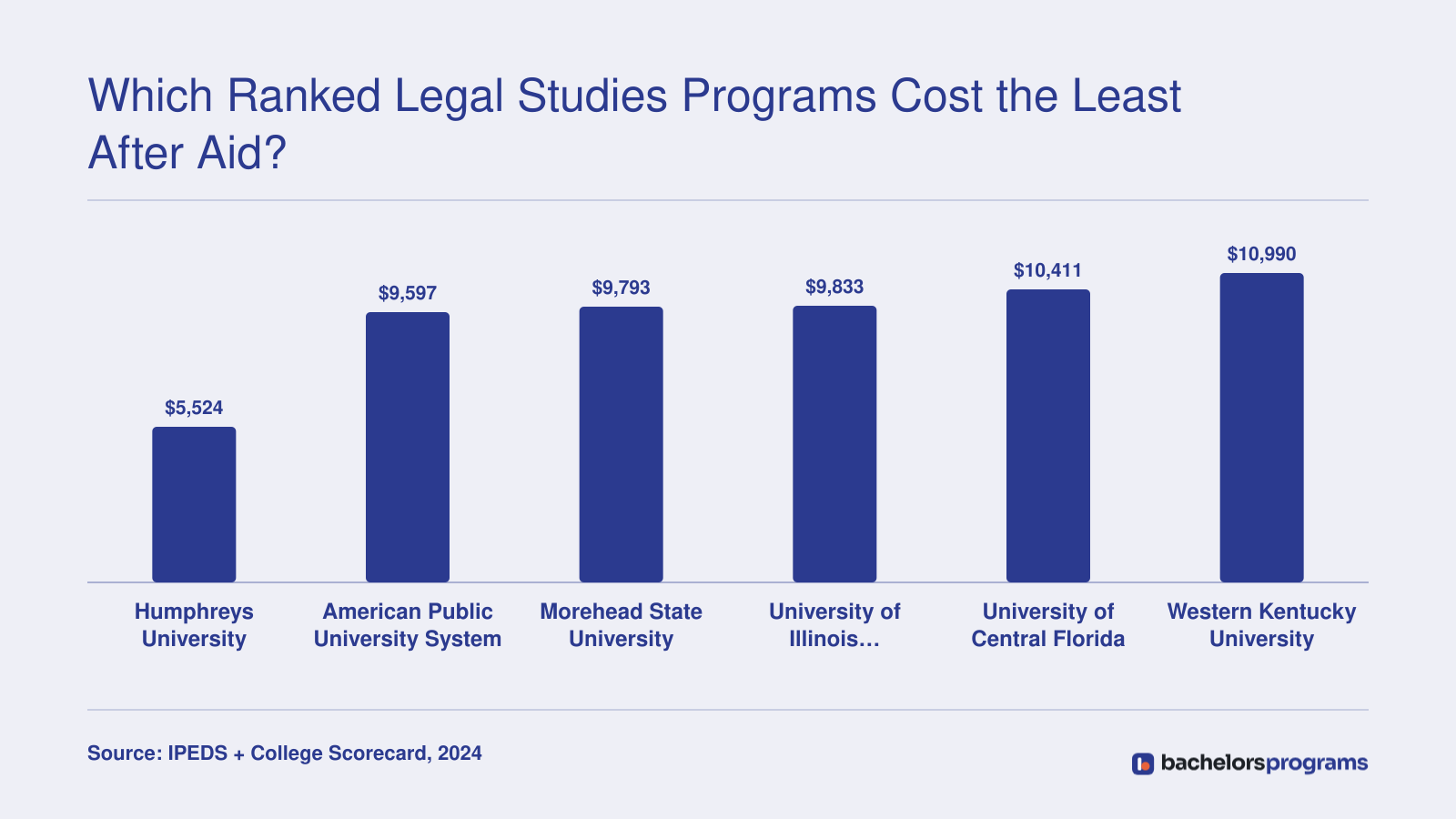
Among the most affordable schools ranked here, average net price after aid runs from $5,524 a year at Humphreys University to $10,990 at Western Kentucky University, a gap of about $5,466. All of these are bachelor's programs, so each bar shows average net price after grants and scholarships, not sticker tuition. Your own cost will depend on your family income and the aid you qualify for, so run each school's net price calculator before you compare.
Legal Studies Degree Cost, Debt, and Graduate Earnings
The strongest return in legal studies comes from programs where median debt stays under $20,000 while graduate earnings clear $70,000. A few schools here meet that bar, and the gap between them and the rest is wide.
Standout Returns
The University of Miami's Legal Studies BSBA posts the highest program-level earnings on this list: graduates earn a median of $99,836 four years after finishing. Median debt at completion is $15,565, which works out to about $165 a month over 10 years. Miami's sticker tuition is steep at $62,616, so check the net price before assuming that return applies to you.
UC Berkeley and the University of Washington-Seattle land close together. Berkeley graduates earn a median of $70,636 four years after finishing, against $13,000 in debt and a payment near $138 a month. Washington graduates earn $71,042 over the same window, with $14,512 in debt and a payment of about $154. Both pair low borrowing with solid pay.
Highest Earnings vs. Lowest Debt
Berkeley carries the lightest debt load of the schools with complete figures here, so it is the low-debt benchmark. Miami is the high-earnings benchmark. Choosing between them is a question of how much upside you want and what you can afford up front.
The weaker trade-offs sit further down. American Public University System has one of the lowest tuition rates listed at $8,400, yet its graduates carry $30,518 in median debt, the highest here, and earn $61,532 four years after finishing. The monthly payment is about $324. Morehead State University shows a similar squeeze: $24,383 in debt, about $259 a month, and median earnings of $40,990 four years out.
UMass Amherst, at $69,269 four years after finishing with $21,500 in debt, and UC Santa Cruz, at $66,244 with $17,883, sit in the middle. Both are workable returns, but neither matches the debt-to-pay ratio of the top three.
Use these figures as a starting point. Compare each school's net price and your expected borrowing, since program medians reflect past graduates, not a guarantee.
Online vs. Campus Legal Studies Degrees
Both formats lead to the same bachelor's degree, but they differ on flexibility, local access, and how generously they treat prior credits. Several of the schools ranked here offer both formats, so you can often compare options within a single institution. Transfer rules vary, so confirm the details with each admissions office before you commit.
| Factor | Online Legal Studies | Campus Legal Studies |
|---|---|---|
| Schedule flexibility | Coursework fits around jobs and family; best for working adults | Fixed class times; less room to work full time |
| Internship and courtroom access | Students usually arrange placements on their own near home | Easier access to nearby courts, firms, and school-coordinated internships |
| Networking with local firms | Mostly virtual; local connections depend on your own outreach | In-person events, faculty ties, and alumni in the local legal community |
| Total credits for the degree | 120 credit hours | Typically a full bachelor's credit load; an earned associate degree is applied as 60 credits |
| Residency requirement | 45 credit hours minimum to be completed at the school | 30 credit hours minimum, plus 50% of major courses |
| Legal-specialty transfer | Up to 42 credit hours, with a grade of C or higher | Up to 42 credit hours, with a grade of C or higher |
| Prior paralegal coursework | Up to 6 credit hours, and only from an ABA-approved program | Up to 9 upper-division semester units from an ABA-approved program, with a B or higher, a close course match, and completion within five years |
| Associate degree or prior credits | Accelerated option requires an associate degree or at least 60 prior credits | A qualifying A.A., A.S., or A.A.S. is accepted for the Paralegal Certificate pathway |
| Cost factors | Savings on commuting and housing; compare per-credit rates and fees | Tuition plus housing, transportation, and campus costs, offset by on-campus aid options |
Related Articles
ABA Approval: What It Means for Legal Studies Degrees
The ABA Standing Committee on Paralegals lists 220 approved paralegal programs in its directory, last updated in early November 2026.1 That figure covers paralegal education programs, not legal studies degrees as a field. The ABA approves programs, never individual graduates, and approval is voluntary, requested by the institution.2
Why Many Strong Programs Aren't Listed
Many respected legal studies BA and BS programs are interdisciplinary and built around law school preparation, policy, or government work. Most never seek ABA approval, and that is not a red flag. The directory mixes certificate, associate, and bachelor's-level programs and can be searched by degree type, so bachelor's programs are only a portion of the 220. For context, the ABA describes roughly 500 formal paralegal programs nationally, which means approved programs are a minority.3
When Approval Matters
- Employers: Legal employers recognize ABA-approved education as a quality signal, but there is no uniform hiring rule or proven salary premium.
- State rules: Paralegal regulations differ by state, and approval does not give you a nationwide right to work in any particular role. Check your state's requirements.
- Certifications: Some certification routes treat approved education favorably. No paralegal certification exam is mandatory anywhere in the U.S.2, and nobody can legitimately be called an "ABA-certified paralegal."
How to Verify a Program
To earn approval, a program must sit at an accredited institution, have operated for at least two academic years, submit a self-evaluation, and pass an on-site review by a two-person team.2 Approval typically lasts seven years, with a gradual shift toward a 10-year term beginning in 2027.4
The directory is updated every February and August, and any program not listed is not ABA-approved.5 Before enrolling, look up your specific program and degree level on the current directory. Do not assume any school ranked here appears there, since many of these are general legal studies majors rather than paralegal programs. If you want a paralegal-focused credential, confirm the listing first, then weigh it against the other factors covered here.
Paralegal Certification Paths With a Legal Studies Bachelor's
A legal studies bachelor's can shorten your route to paralegal certification, but only if the degree, or a component of it, counts as paralegal education. Use this checklist to see where you stand with each credential.
- NALA Certified Paralegal (CP): paralegal studies bachelor'sA bachelor's in paralegal studies that meets NALA's program criteria qualifies with no work experience required. A general legal studies degree qualifies on this route only if it meets those criteria.
- NALA CP: bachelor's in another fieldYou need either 15 semester hours (or the quarter-hour equivalent) of substantive paralegal courses or one year working as a paralegal. The experience route requires attestation from an attorney or employer.
- NFPA PACE (Registered Paralegal, RP)With a bachelor's in any field from an accredited school, you need three years of substantive paralegal experience. That drops to two years if the bachelor's includes a qualifying paralegal program from an institutionally accredited and/or ABA-approved school. An associate's in paralegal studies requires six years. Applicants cannot have a felony conviction or a suspended or revoked credential.
- NFPA PCCE (CRP designation)This is NFPA's education-focused exam, but it still requires work experience. NFPA says applicants without substantive paralegal work experience are not eligible for either of its exams. Full-time work counts only when paralegal duties fill at least 80 percent of the job, and each employer must verify this.
- State-specific rulesSome states set their own paralegal requirements, such as California's Business and Professions Code 6450. Check your state's rules before choosing a program.
Paralegal Median Pay at a Glance
For legal studies graduates heading into paralegal work, this is the national midpoint for pay.
Questions to Ask Yourself
Do you want to work as a paralegal right after graduating, or is law school the real goal?
Do you already have an associate degree or paralegal certificate that could transfer?
Is your interest courtroom-focused or policy- and business-focused?
Can you get local internship access through an online program, or do you need a campus near firms and courts?
Legal Studies programs by state
Compare Legal Studies programs on the data that matters
Explore more Criminal Justice & Law majors or browse every field of study.
All Criminal Justice & Law programs Browse every field of study