Best Criminal Justice Schools in New Mexico
Compare 5 accredited Criminal Justice programs in New Mexico at 4 colleges, with net price after aid, graduation rates, earnings and debt from IPEDS and the U.S. College Scorecard.
A bachelor's degree in criminal justice, most often a Bachelor of Science (B.S.) in Criminal Justice, is rarely a hard requirement for patrol work in New Mexico, yet it can shape which agencies, supervisory tracks and investigative roles you can reach later. The real tension is price against flexibility: tuition at the public universities here is close, but online access, internships and transfer pathways differ.
All of the programs here are bachelor's degrees at New Mexico schools, delivered on campus, online, or in both formats.
Because agency hiring still turns on state certification, the degree and the academy serve different purposes.
Key Points
- Eastern New Mexico University charges the lowest in-state tuition here, $7,194.
- Western New Mexico University graduates earn a $52,188 median five years out.
- New Mexico police certification under 10.8.2 NMAC requires a minimum age of 21.
Best Schools for a Bachelor's Degree in Criminal Justice in New Mexico
Four public universities in New Mexico award a bachelor's degree in criminal justice, and each one takes a noticeably different approach. Two run fully online options with asynchronous coursework, one requires an internship and leans on regional transfer agreements, and one pairs criminal justice with sociology and political science. The profiles below describe what each school is actually like for an undergraduate in the field.
New Mexico State University
#1Las Cruces, NM · $8,000 – $25,000/yr (est.)
Best for: Career changers curious about forensic technology
New Mexico State University in Las Cruces awards a Bachelor of Criminal Justice through its College of Arts and Sciences, with coursework in criminal law, criminological theory, ethics and research methods. Students can take the degree in person or 100% online with optional synchronous sessions, and the department grants degree credit for police academy training through its partnership with the New Mexico State Police. An online forensics course uses virtual-reality crime-scene simulations to teach investigative technique. Graduates move into law enforcement, corrections, victim advocacy and forensics.
- 120 total credit hours, including 48 upper-division credits
- Second language requirement for graduation
- Offered in person or 100% online, with optional live sessions
- Courses in criminal law, criminological theory, ethics and research methods
- Electives such as human trafficking, victimology and policing
- Credit for police academy training; New Mexico State Police partnership
- No fixed application deadlines
- New Mexico Opportunity Scholarship can cover up to 100% of tuition
Eastern New Mexico University
#2Portales, NM · ~$4,900/yr (est.)
Best for: Transfer students from regional community colleges
Eastern New Mexico University in Portales offers both a Bachelor of Science and a Bachelor of Arts in Criminal Justice, with three ways to take it: on campus, online, or a combination of the two. An internship is required, and sections run as recorded or live Panopto lectures or as fully online Canvas courses. The associate degree at ENMU-Roswell is built to transfer into the Portales bachelor's program under the state's southeastern two-plus-two agreement. The online application is free.
- Three delivery options: on campus, online, or a mix of both
- Fully online path depends on the minor chosen
- Internship required for graduation
- $0 application fee
- Recorded or live Panopto lectures; some fully online Canvas sections
- Finish in about four years
- Free job placement assistance and phone or email advising
- Military and veterans resources available
Western New Mexico University
#3Silver City, NM · ~$9,000/yr (est.)
Best for: Students aiming at corrections careers
Western New Mexico University in Silver City awards a Bachelor of Science in Criminal Justice with two concentrations, Corrections and Policing, and both can be completed entirely online through asynchronous courses. A full-time course sequence is laid out so students can graduate in four years. The department also runs a five-month Law Enforcement Training certificate and an associate option for students who have already finished the state law enforcement training program. Graduates work in law enforcement, corrections, courts, the military and civilian security contracting.
- One of two concentrations in the criminal justice major
- Fully online, asynchronous coursework
- Four-year course sequence for full-time students
- Prepares students for corrections and court careers
- Prepares students for law enforcement and security contracting
- Multidisciplinary study of crime and disorder
- Coursework supports military and civilian security careers
New Mexico Highlands University
#4Las Vegas, NM · $15,000/yr (est. net price)
New Mexico Highlands University in Las Vegas takes a multidisciplinary approach to criminal justice, with coursework drawn from sociology and political science and a strong emphasis on critical thinking and communication. Internships place students with state and local law enforcement agencies, adult and juvenile probation and corrections, and U.S. Fish and Wildlife. The degree is also structured to prepare students for law school or graduate study in sociology and criminal justice.
- Coursework draws on sociology and political science
- Internships with state and local law enforcement agencies
- Placements in adult and juvenile probation and corrections
- Internship option with U.S. Fish and Wildlife
- Preparation for law school and graduate study
- Focus on critical thinking and effective communication
Cost & outcomes by school
Federal data for the highest-earning Criminal Justice programs, independent of the ranking above. Earnings are this field's bachelor's graduates four years after completing where the Scorecard reports them, else the school's undergraduate median.
| School | Net price / yr | Grad rate | Earnings | Debt | Grads/yr | Format |
|---|---|---|---|---|---|---|
| Eastern New Mexico University NM | $4,904 | 45% | $56,614 | $17,375 | 21 | Online or campus |
| New Mexico State University NM | $8,889 | 55% | $49,834 | $20,250 | 143 | Online or campus |
| Western New Mexico University NM | $8,522 | 32% | $46,184 | $13,750 | 12 | Online |
| New Mexico Highlands University NM | $14,838 | 26% | $45,868 | $11,399 | 9 | Campus |
Sources: U.S. Department of Education. Net price, graduation rate, earnings and debt: College Scorecard (earnings and debt for this field's bachelor's graduates where reported, else school-wide); graduates: IPEDS. A dash means no figure is reported.
Cost, debt & payoff
Median earnings of this field's bachelor's graduates (4 yrs after completing, else the school's undergraduate median) vs. their median federal loan debt · U.S. College Scorecard
Across these programs the median graduate earns about $46,184 and finishes with roughly $13,750 in debt — a ratio that clears a common rule of thumb (keep debt below first-year salary). Net price and debt vary widely school to school, so check the per-school figures in the table above before you shortlist.
How We Ranked New Mexico Criminal Justice Schools
A short list is easy to skim and just as easy to misread, so know what sits behind it before you weigh one New Mexico school against another.
What Goes Into the Comparison
The figures here come from federal College Scorecard data on cost, completion, earnings and student debt, paired with each school's published criminal justice curriculum. Only bachelor's programs count. Graduate certificates and associate-level offerings are outside the scope, even when a school runs them well.
Two Numbers to Read Carefully
Graduation rate describes the whole institution, not the criminal justice department. A school with a strong overall completion rate may still run a small program with its own advising quirks, so treat the figure as context rather than a promise.
Net price is an average after grants and scholarships, not a quote. Your own aid offer, residency status and housing choice will move the number, sometimes by thousands of dollars a year.
Why the List Is Short
New Mexico is a small state with a limited pool of regionally accredited public universities offering a bachelor's in criminal justice, and the programs below meet that bar. Other rankings, Niche among them, blend associate degrees and branch-campus locations into the same table, which can make a field of study look deeper than it is. Fewer names, cleaner comparison.
Online and Hybrid Criminal Justice Bachelor's Options at New Mexico Schools
Can you earn a bachelor's degree in criminal justice online in New Mexico? Yes. Three of the schools here offer a fully online route, and a fourth is campus-based.
Who Offers What
- Western New Mexico University: The Bachelor of Science in Criminal Justice is fully online. The school says both of its bachelor's degrees in this area can be completed entirely online.1
- New Mexico State University: Offered in both formats. A fully online option sits alongside the Las Cruces campus program.
- Eastern New Mexico University: Also offered in both formats, with a fully online option for the B.S. and B.A. in Criminal Justice.
- New Mexico Highlands University: Criminal Justice Studies is delivered on campus in Las Vegas.
Synchronous or Asynchronous?
Synchronous classes meet at set times, good for live discussion but harder to fit around shift work. Asynchronous classes let you complete lectures and assignments on your own schedule within deadlines. WNMU's online courses are asynchronous, which suits working adults, including officers and corrections staff on rotating shifts. NMSU lists both synchronous and asynchronous options, so check the format of each course before you enroll.
Concentrations and Accreditation
WNMU offers two concentrations, Corrections and Policing, so you can aim your coursework at a specific career. The program pages for NMSU and ENMU do not list concentrations, though both point toward careers such as law enforcement and victim advocacy.
WNMU is accredited by the Higher Learning Commission, an institutional accreditor recognized by the U.S. Department of Education, and has held that status continuously since 1942. For the other schools, confirm accreditation on each school's own accreditation page before you apply. WNMU's pages also do not say whether internships or individual course sections require in-person attendance, so ask the department directly.
Admission Requirements for New Mexico Criminal Justice Bachelor's Programs
Admissions details for criminal justice bachelor's programs are scattered across catalogs and transfer pages. Here is what each school publishes. Confirm every point with an admissions or transfer advisor before you apply.
- New Mexico State UniversityThe Bachelor of Criminal Justice requires 120 credits, including 48 upper-division credits. The bachelor's catalog page does not list a minimum admission GPA or an SAT/ACT policy. The 2.0 GPA you may see cited applies to the associate degree, not bachelor's admission.
- Eastern New Mexico UniversityOffers both a B.S. and a B.A. in Criminal Justice. Its associate of arts in criminal justice is designed to transfer into those bachelor's degrees at the Portales campus. Students should confirm each course with an advisor at the receiving campus. No minimum GPA or test policy appeared in the materials reviewed.
- Western New Mexico UniversityOffers a B.S. in Criminal Justice. The ACCUPLACER requirement in its materials applies to police academy applicants, not to bachelor's admission. No minimum GPA or SAT/ACT policy for the bachelor's was found.
- New Mexico Highlands UniversityOffers Criminal Justice Studies. Its Bachelor of Applied Science accepts 30 career-technical credits and 31 general education credits from an associate degree. No minimum GPA or test policy for the program was found.
- Associate-to-bachelor's transferNMSU has the clearest published route: its 60-credit associate in criminal justice (2.0 GPA, ENGL 1110G, math and major courses) serves as the first two years of the bachelor's. Some New Mexico community college criminology associate degrees satisfy New Mexico general education and have pathways to NMHU and NMSU. Applied science routes to ENMU and NMHU may lead to an applied science bachelor's rather than a traditional criminal justice degree. No single statewide agreement guarantees identical credit at every school.
- Credit for academy trainingWNMU awards 16 credits toward its A.S. and B.A.S. for police academy graduates. For academies begun after July 1, 2002, it requires New Mexico DPS certification and a passing score on the law enforcement certification exam. ENMU's associate program maps police academy and correctional academy training to specific criminal justice courses. NMSU says academy training may earn degree credit but lists no amounts or eligibility rules.
What a Criminal Justice Bachelor's Degree Costs in New Mexico
Published in-state tuition and fees at these public universities fall in a narrow band, from $7,194 at Eastern New Mexico University to $8,183 at New Mexico State University, so the average net price after grants and scholarships is the better guide to what you will actually pay. Eastern New Mexico University has the lowest net price here at $4,904 a year, while New Mexico Highlands University has the highest at $14,838 despite its lower sticker price. Figures are annual amounts from the U.S. Department of Education's IPEDS and College Scorecard data (2024).
| School | City | In-State Tuition & Fees | Out-of-State Tuition & Fees | Average Net Price After Aid | Median Debt at Graduation (All Majors) |
|---|---|---|---|---|---|
| Eastern New Mexico University | Portales | $7,194 | $9,174 | $4,904 | $16,500 |
| Western New Mexico University | Silver City | $7,856 | $14,342 | $8,522 | $23,000 |
| New Mexico State University | Las Cruces | $8,183 | $25,307 | $8,889 | $17,095 |
| New Mexico Highlands University | Las Vegas | $7,416 | $12,336 | $14,838 | $11,399 |
New Mexico Scholarships and Grants That Lower the Price
Which New Mexico scholarships actually lower the price of a criminal justice bachelor's degree? For New Mexico residents at the public universities on this page, three state programs do most of the work.
The Main State Awards
- Opportunity Scholarship: Covers up to 100% of tuition and required fees for New Mexico residents enrolled at least half-time (6 credit hours) in a certificate, associate, or bachelor's program.1 Students generally need fewer than 90 credits toward an associate degree or fewer than 160 toward a bachelor's, with a 2.5 GPA for continuing eligibility.2 There is no separate application; the school's financial aid office awards it after you apply and enroll.1
- Lottery Success Scholarship: Covers up to 75% of tuition and fees for full-time students who enroll within 16 months of high school graduation or earning an equivalency credential, with a 2.5 college GPA and continuous enrollment.3 It can combine with the Opportunity Scholarship, which then covers fees.4
- College Affordability Grant: A separate state grant for New Mexico residents at public institutions; check the New Mexico Higher Education Department for current eligibility and award amounts.1
Residency and the Net Price
In-state tuition generally requires 12 months of New Mexico residency, financial independence, and classification at admission by the census date.5 That matters because the net price figures in the cost table assume resident tuition; the Opportunity Scholarship can bring tuition and fees close to zero for eligible students. Pell-eligible students benefit most, since federal aid can then cover books, housing, and transportation, and working adults can qualify at six credit hours.
Confirm Before You Apply
File the FAFSA every year and check the New Mexico Higher Education Department for current award amounts, credit caps, and renewal rules before you budget.1
Related Articles
New Mexico Law Enforcement Certification and Academy Pathways
Do you need a college degree to become a police officer in New Mexico? The state's basic certification rule, 10.8.2 NMAC,1 sets a minimum age of 21, proven with a government-issued ID, passport or certified birth certificate.2 Education standards beyond that sit largely with the hiring agency. The published state certification materials do not set a specific college-degree requirement, and departments can and do set their own. The administrative code also carries applicant eligibility and documentation provisions, and each agency runs its own background investigation and interviews. A bachelor's degree in criminal justice therefore widens the list of agencies you can apply to; it is not a statewide requirement.
How the Certification Path Runs
Hiring comes first. You apply to a municipal or county agency, clear its screening, and your agency sends you to Basic Police Officer Training at the New Mexico Law Enforcement Academy or a certified agency academy.4 The basic course runs more than 750 hours and covers domestic violence response, crisis intervention, mental and emotional health, criminal and juvenile law, evidence collection, surveillance, suspect identification and firearms.3 A separate 68-hour legal block covers constitutional law, authority and jurisdiction, laws of arrest, hate crimes and juvenile law.1 DPS notes that cadets and officers registering for that legal block enroll concurrently at a partner community college, with funding provided.5 Certification is issued by the Department of Public Safety under rules administered with the Law Enforcement Academy Board, after you finish the academy and meet the state's certification requirements.4
What a Bachelor's Degree Adds
A degree matters most for competitive hiring, promotion beyond patrol, probation and parole work, and federal positions, which generally require a bachelor's. Academy training is not documented as carrying a specific college-credit value, so confirm transfer credit with the school before you count on it.
Criminal Justice Careers in New Mexico: Salaries by Role
The fastest route to a job and the best-paying route are not always the same in criminal justice. New Mexico's wage data shows a wide spread between entry-level custody work and investigative roles. The figures below are the latest state estimates from the U.S. Bureau of Labor Statistics (May 2023).
Median Pay and Employment by Role
- Police and sheriff's patrol officers: $61,650 median annual wage, with 4,590 workers statewide.1
- Correctional officers and jailers: $42,660 median annual wage, with 3,230 workers.2
- Detectives and criminal investigators: $82,700 median annual wage, with 1,810 workers.1
Patrol is the largest of these groups and pays about $19,000 more than corrections at the median. Detectives and criminal investigators are the smallest group but earn the most, roughly $21,000 above patrol. These are statewide medians, so pay in a given city, county or agency will differ.
Where a Bachelor's Degree Matters Most
Correctional officer and many patrol openings do not always require a four-year degree, so the degree is often a promotion advantage rather than an entry ticket. Detective and investigator roles usually reward it more, since they tend to be filled by officers with experience, and federal investigative agencies commonly ask for a bachelor's. Probation and correctional treatment positions are the clearest case: they typically call for a bachelor's degree, and a criminal justice major fits well.
A B.S. in Criminal Justice from New Mexico State University, Eastern New Mexico University, Western New Mexico University or New Mexico Highlands University gives you a base for any of these tracks. Match the role you want to the credential it asks for before you plan your coursework.
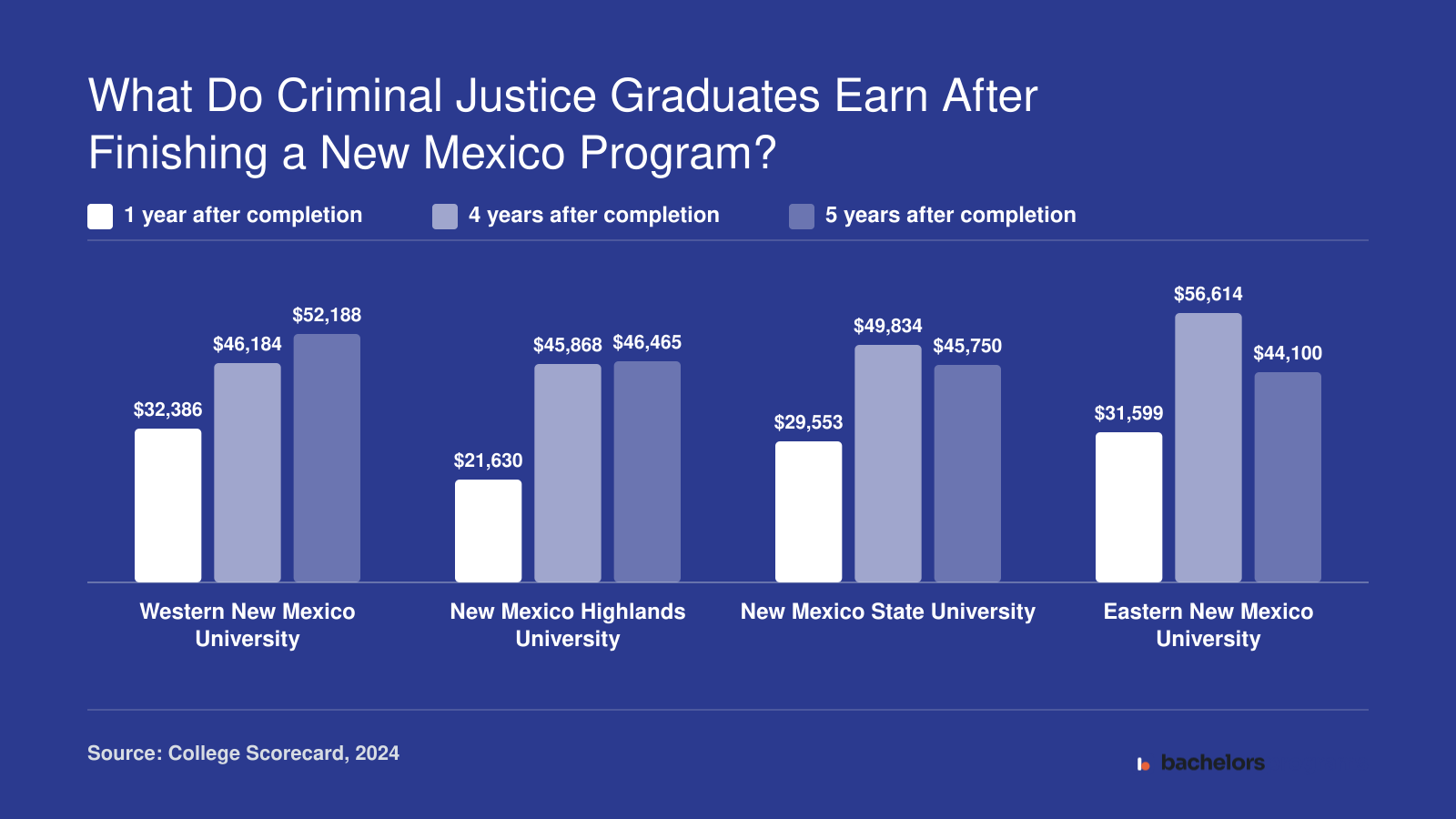
What Do Criminal Justice Graduates Earn After Finishing a New Mexico Program?
Federal data tracks the median earnings of each school's criminal justice bachelor's completers at set points after graduation. Western New Mexico University graduates post the highest median five years after completion at $52,188, while Eastern New Mexico University leads four years after completion at $56,614. Each time window follows a different group of graduates, so a school's figure can dip between the four-year and five-year marks.
Common Questions About Criminal Justice Degrees in New Mexico
These answers cover the questions prospective students ask most about a bachelor's degree in criminal justice in New Mexico. Requirements vary by agency and by school, so confirm details with the employer or program before you apply.
What is the best school for criminal justice in New Mexico?
What can you do with a bachelor's degree in criminal justice in New Mexico?
Are there affordable criminal justice colleges in New Mexico?
Do you need a degree to become a police officer in New Mexico?
How long does a bachelor's degree in criminal justice take?
Compare Criminal Justice programs on the data that matters
Explore more Criminal Justice & Law majors or browse every field of study.
All Criminal Justice & Law programs Browse every field of study