Best Information Technology Schools in New Mexico
Compare 3 accredited Information Technology programs in New Mexico, with net price after aid, graduation rates, earnings and debt from IPEDS and the U.S. College Scorecard.

IT hiring in New Mexico now tilts toward security and cloud operations, and the state's largest employers write their job postings around those skills. Sandia and Los Alamos national laboratories, Intel's Rio Rancho fabrication plant and state government agencies all recruit IT staff in the state.
The standard entry credential is a bachelor's degree, most often a Bachelor of Science (B.S.) in Information Technology. New Mexico Tech, New Mexico State University and Navajo Technical University each offer one, on campus or online.
What separates them is what each is built to produce: secure systems work, network operations, or data center and cloud infrastructure. A mismatch usually costs transfer credits, not a career.
Key Points
- New Mexico Tech ranks first, with a security-focused B.S. in IT.
- Navajo Technical University has the lowest average net price: $5,338 after aid.
- Graduates of New Mexico Tech earn a median $95,750 four years out.
Best Bachelor's Degree in Information Technology Programs in New Mexico
New Mexico Tech earns the top spot by pairing a security-focused Bachelor of Science in Information Technology with the strongest graduation rate on this list and a two-semester Senior Design clinic that puts students on real systems work before they finish. New Mexico State follows with the most flexible option in the state, a 120-credit information and communication technology degree that can be completed entirely online. Navajo Technical University rounds out the ranking with an ABET-accredited applied science degree built around cloud and high-performance computing.
New Mexico Institute of Mining and Technology
#1Socorro, NM · ~$10,000/yr (est.)
Best for: Security-focused students wanting hands-on design work
New Mexico Tech is a small public research institute in Socorro, and its information technology degree is taught jointly by the Computer Science and Management departments, so students get software and systems depth alongside project management. Security and information assurance run through the coursework and connect to the Institute for Complex Additive Systems Analysis, where IT students can find internships or work. The program closes with a two-semester Senior Design clinic plus 12 hours of technical electives. Roughly 57% of the institute's students graduate, the highest rate among the New Mexico schools in this ranking.
- Bachelor of Science in Information Technology, completed on campus in Socorro
- Taught jointly by the Computer Science and Management departments
- Focus on secure information systems and information assurance
- 12 hours of technical electives plus a required two-semester Senior Design clinic
- Internship and work opportunities through the ICASA research institute
- Training in software design, configuration, IT requirements analysis and project management
- Median earnings four years after finishing: about $95,750
New Mexico State University
#2Las Cruces, NM · $8,000 – $25,000/yr (est.)
Best for: Working adults finishing a degree online
New Mexico State University is the state's land-grant campus in Las Cruces, and its 120-credit Bachelor of Information and Communication Technology is built for students who want options: concentrations in Network Technologies, Cyber Defense and Software Development, all available fully online through the Global Campus with no campus visits required. Required courses fold in A+ and Network+ certification training, Security+ preparation, Linux system administration and ethical hacking, and the degree finishes with a senior project. A 2+2 completion pathway and accepted transfer credits make it a practical route for students arriving with prior college work. About 55% of NMSU students graduate, and graduates report median earnings near $94,000 four years after finishing.
- 120-credit Bachelor of Information and Communication Technology
- Three concentrations: Network Technologies, Cyber Defense and Software Development
- Available fully online through the Global Campus, no campus visits required
- 2+2 bachelor's completion pathway with transfer credit accepted
- A+ and Network+ certification training built into required courses
- Security+ prep, Linux system administration and ethical hacking coursework
- 48 credits must be at the 300 level or above; senior project required
- Median earnings four years after finishing: about $94,000
Navajo Technical University
#3Crownpoint, NM · $5,000 – $10,000/yr (est.)
Best for: Tribal community members seeking affordable local study
Navajo Technical University is a tribal institution in Crownpoint that awards a Bachelor of Applied Science in Information Technology accredited by the Computing Accreditation Commission of ABET. Students can attend in person or complete the degree online, and each student is assigned a program advisor. The curriculum ranges from programming and network operations to web and database design, computer security, data center and cluster maintenance, and distributed high-performance and cloud computing, with digital media work such as moviemaking, sound and graphics along the way. Students must hold a 2.50 GPA across core IT and general education courses in their first two years before moving into 300- and 400-level work.
- Bachelor of Applied Science in Information Technology accredited by ABET
- Study in person at Crownpoint or complete the degree fully online
- 2.50 GPA required in first two years of core and general education courses
- Coursework in data center and cluster design and maintenance
- Distributed high-performance and cloud computing focus
- Also covers programming, network operations, computer security, web and database design
- Digital media courses in moviemaking, digital sound and graphics
- Program advisor assigned to each student
Cost & outcomes by school
Federal data for the highest-earning Information Technology programs, independent of the ranking above. Earnings are this field's bachelor's graduates four years after completing where the Scorecard reports them, else the school's undergraduate median.
| School | Net price / yr | Grad rate | Earnings | Debt | Grads/yr | Format |
|---|---|---|---|---|---|---|
| New Mexico Institute of Mining and Technology NM | $9,873 | 57% | $95,750 | $16,918 | 3 | Campus |
| New Mexico State University NM | $8,889 | 55% | $94,024 | $19,508 | 173 | Online or campus |
| Navajo Technical University NM | $5,338 | 12% | $26,364 | — | 1 | Online or campus |
Sources: U.S. Department of Education. Net price, graduation rate, earnings and debt: College Scorecard (earnings and debt for this field's bachelor's graduates where reported, else school-wide); graduates: IPEDS. A dash means no figure is reported.
How We Ranked New Mexico Bachelor's in IT Programs
A ranking built on reputation asks you to trust a brochure. A ranking built on outcomes asks what graduates actually earned and owed. This one leans on the second.
What Goes Into the Order
We start with federal College Scorecard data for each New Mexico school, then compare:
- Net price: what students pay after grants and scholarships, not the sticker tuition.
- Graduation rate: the share of students who finish.
- Earnings: median pay for graduates in the years after they leave.
- Debt: typical borrowing at graduation.
- Completions: how many students actually finish the IT credential.
Schools that keep cost low, graduate most of their students and send them into decent-paying work rise. Schools with high prices and thin completion records fall, whatever their local reputation.
Where the Numbers Stop Being Precise
Two honest caveats. Graduation rate and net price are reported for the whole institution, so they describe the school, not the IT department specifically. Program-level earnings and debt are narrower but still blend graduates across several years. Treat net price as an estimate: your aid package, residency and transfer credits will move it.
Only bachelor's programs based in New Mexico count, on campus or online. New Mexico Tech in Socorro, New Mexico State in Las Cruces and Navajo Technical University in Crownpoint are measured on the same terms, so a small campus and a large university are judged against identical figures rather than against their own marketing.
Which New Mexico IT School Fits Your Goal? Networking, Cybersecurity or Cloud
A bachelor's degree in information technology teaches you to build, secure and run the networks, systems and software that organizations depend on. In New Mexico, the label on the diploma varies, so the name matters less than what the curriculum covers.
What Each School Calls Its Degree
New Mexico Tech offers one. Its Bachelor of Science in Information Technology is run jointly by Computer Science and Management and blends computing, business and engineering. It stresses secure information systems and information assurance, and it requires 12 credit hours of technical electives.
New Mexico State University calls its version the Bachelor of Information and Communication Technology (ICT). It takes 120 credits, 48 of them at the upper-division level, and can be completed on campus or fully online. Navajo Technical University lists an Information Technology program at its Crownpoint campus.
Decoding the Labels
- Information technology: Applied work such as networks, systems administration and security. It suits students who want to run and protect infrastructure.
- Computer science: Heavier on programming theory, algorithms and software design. It suits future software developers.
- Information systems: Focuses on how technology serves business needs, so it leans toward management.
- ICT at NMSU: Closest to IT, with a communications and networking emphasis.
Matching Your Goal to a School
- Networking: NMSU's ICT is the clearest fit, since the program is listed with a Network Technologies focus.
- Cybersecurity: NMSU offers a Cyber Defense concentration (ICT 360, 450, 457 and 439). New Mexico Tech's information assurance emphasis points the same way, with more of a computer science and management mix.
- Cloud: None of the program materials we reviewed names a cloud concentration. If cloud work is your target, ask each advisor which electives cover it.
Accreditation and Certifications
NMSU is accredited by the Higher Learning Commission, and its ICT program holds ABET Computing Accreditation Commission accreditation under the General and Information Technology criteria. ABET is a program-quality standard, not a professional certification.
New Mexico Tech's program pages do not establish program-level ABET status. Navajo Technical University's accreditation details are not covered in the sources used here, so confirm them with the school. None of the three publishes embedded CompTIA, Cisco or AWS certification alignment for its bachelor's program. If you want those credentials, plan to earn them separately and ask admissions how coursework prepares you.
Related Articles
Online and Hybrid Bachelor's in Information Technology Options at New Mexico Schools
Can you earn a bachelor's in information technology online from a New Mexico school? Yes. New Mexico State University offers the Bachelor of Information and Communication Technology (BICT) through NMSU Global, and Navajo Technical University lists its Information Technology bachelor's with an online option. New Mexico Tech's Bachelor of Science in Information Technology is campus-based.
How the NMSU Global BICT Works
The BICT is a 100% online degree-completion option for students who already hold college credit and want to finish. Concentrations include Cyber Defense, Network Technologies and Software Development.
- Transfer limit: Up to 90 credits or 75% of the degree.
- GPA: Transfer applicants need a 2.0 minimum cumulative GPA.
- Evaluation: A free unofficial review of U.S. transcripts generally takes 24 to 48 hours. Credits earned outside the U.S. require a Foreign Credential Evaluation report.
- Degree rules: At least 120 credits, including 48 at the upper level, with ICT requirements passed at C- or higher.
Transferring many credits does not guarantee they all land in the ICT major. NMSU's official evaluation decides whether a course counts toward the major or only as an elective. The roadmap also assumes placement into MATH 1220G or higher, and developmental coursework does not count toward the degree.
Fully Online, Hybrid and Campus Formats
New Mexico Tech's IT bachelor's is campus only. NMSU and Navajo Tech are both listed as campus and online. NMSU's Bachelor of Science in Cybersecurity is in person only, so it is not an online route. None of the program listings we reviewed describes a hybrid schedule, so ask each school's advisors whether one exists.
Technology Requirements for Online Students
NMSU Global publishes these minimums:
- High-speed Internet
- A sound card and a microphone/webcam
- At least 12 GB of RAM
- Microsoft operating system 8.1 or newer
- Microsoft Office
The published list does not say whether newer Windows versions, Macs, Chromebooks or mobile devices are supported, so confirm with NMSU before you buy equipment. Navajo Tech's online requirements were not available in the materials we reviewed, so ask the school directly.
Admissions: GPA, Test Policy and Transfer Credit for New Mexico IT Bachelor's Programs
Admission to a New Mexico IT bachelor's program usually comes down to three published numbers: a minimum grade point average, whether test scores are required, and how many credits a school will accept from your previous college. Each school sets those on its own, and the rules for a first-year applicant look nothing like the rules for someone arriving with an associate degree.
First-year applicants
New Mexico Tech sets the clearest bar. Its 2025-2026 catalog lists a 3.0 minimum GPA for first-time freshmen and a test-optional route that applies to freshmen only and is tied to that GPA. Scores are not pointless, though: Tech still asks for them when awarding scholarships, and every incoming student completes math placement before the first term. Plan on testing into pre-calculus if you want to start the computing sequence on schedule.
New Mexico State does not publish an IT-specific GPA floor for the Information and Communication Technology degree, and no general test-optional rule is established in its admissions materials, so treat the university's standard freshman requirements as your baseline and confirm with an admissions counselor. Navajo Technical University's published materials do not set out a minimum GPA or test-score requirement for its information technology program, so contact admissions directly rather than assuming you fall short.
Transferring in with college credit
New Mexico Tech counts you as a transfer applicant once you have 30 or more post-high-school credits, with a 2.0 cumulative GPA. Credit must come from a regionally accredited institution, carry a grade of C or better, and is reviewed course by course; placement into Math 1240 or higher applies. Below that credit threshold, including dual-credit hours earned in high school, freshman rules govern.
NMSU Global Campus also uses a 2.0 cumulative minimum for students arriving from another college or from an NMSU community college campus, and credit evaluations are free. Published limits reference both 90 credits and 75 percent of the bachelor's degree, with the applicable cap depending on the degree and the evaluation. Computer and technology associate programs at NMSU's community college campuses are described as articulated toward the ICT bachelor's in the Engineering Technology department, though the guidance stops short of naming which courses satisfy the major, which is why advising on both ends matters.
Before you apply
Gather sealed transcripts from every institution, syllabi or catalog descriptions for technical courses, your math placement results, and a target graduation plan. Request a credit evaluation before you commit, not after.
Cost of an IT Bachelor's Degree in New Mexico: Tuition and Net Price
Navajo Technical University is the most affordable option here, with an average net price of $5,338 after aid, while New Mexico Tech is the highest at $9,873. The gap comes mostly from sticker tuition, since Navajo Tech charges $4,346 a year regardless of residency. Net price is a school-wide average for aided undergraduates, not an IT-specific figure, so treat it as an approximation. If you are moving to New Mexico, expect out-of-state tuition of $25,307 at New Mexico State and $27,247 at New Mexico Tech, though New Mexico State offers reduced nonresident rates for some Arizona, Colorado, nearby Texas and Western Undergraduate Exchange students.
| School | Campus | In-state tuition and fees (per year) | Out-of-state tuition and fees (per year) | In-state per-credit rate (2026-2027) | Out-of-state per-credit rate (2026-2027) | Average net price after aid |
|---|---|---|---|---|---|---|
| Navajo Technical University | Crownpoint | $4,346 | $4,346 | N/A | N/A | $5,338 |
| New Mexico State University | Las Cruces | $8,183 | $25,307 | About $288 (estimated from a 15-credit semester budget), plus a $17.33 per-credit Las Cruces fee | About $899 (estimated from a 15-credit semester budget), plus a $17.33 per-credit Las Cruces fee | $8,889 |
| New Mexico Institute of Mining and Technology | Socorro | $9,476 | $27,247 | $299 (7 to 11 credits) | $1,069.38 (7 to 11 credits) | $9,873 |
New Mexico State Aid That Can Cut Your IT Degree Cost
New Mexico's state aid can lower the cost of an IT bachelor's at its public universities, but the awards come with credit and timing rules. Three programs matter most: the Opportunity Scholarship, the Lottery Success Scholarship and the College Affordability Scholarship.
How the Opportunity Scholarship Works
No separate application is required.1 Apply for admission, enroll in at least six credit hours toward a bachelor's, and let the financial aid office determine eligibility. Students generally need 12 months of established New Mexico residency, a high school diploma or equivalency, no prior bachelor's degree or higher, and a 2.5 cumulative GPA.2 The award covers up to 100% of eligible tuition and required fees after other state aid, with course fees generally capped at $50 per credit.3 It does not cover books, housing, food or transportation.
Lottery Success and the College Affordability Scholarship
The Lottery Success Scholarship targets recent New Mexico high school graduates who enroll within 16 months.2 You must complete 15 first-semester credits at a university (12 at a community or branch campus) with a 2.5 GPA.2 The award generally begins in your second semester and covers tuition, and there is no separate application. The College Affordability Scholarship is the state's other award. Its terms are set by the state, so confirm current eligibility and amounts with the financial aid office before you budget around it.
Rules and Paperwork That Trip Students Up
Watch the credit band (6 to 18 in fall and spring), the summer cap of 9 credits, and the overall limit of 160 attempted credits for a bachelor's. Falling below a 2.5 GPA can cost you the award. FAFSA is not required for the Opportunity or Lottery awards, but file it anyway to capture federal Pell Grants.3 At New Mexico State University, about 84 percent of undergraduates receive Pell; at New Mexico Tech, about 65 percent. Start with the FAFSA, then follow the New Mexico Higher Education Department's guidance and your school's financial aid checklist.
What IT Graduates From These Schools Earn and Owe
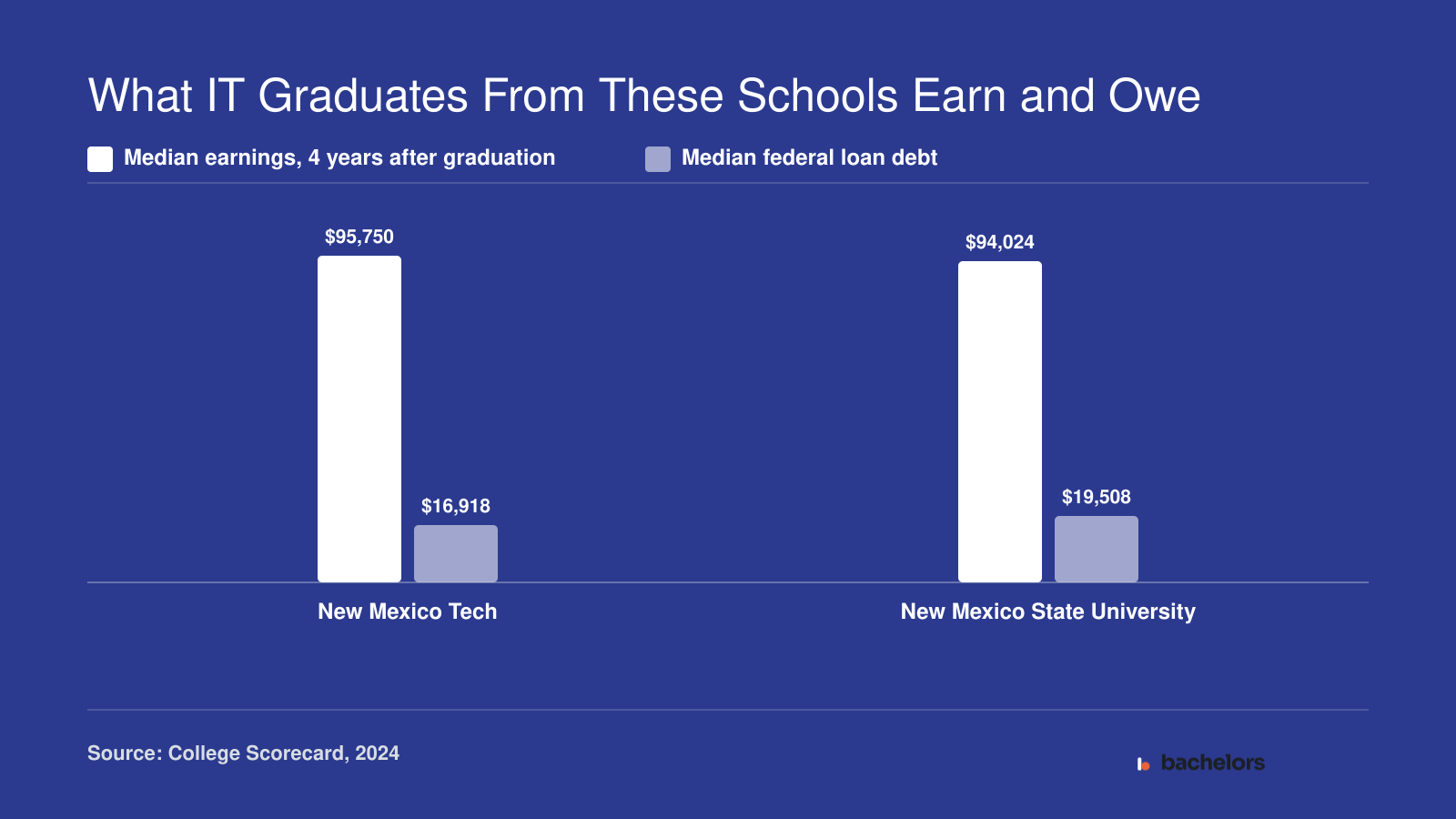
Four years after finishing a bachelor's in information technology, graduates of New Mexico Tech earn a median of $95,750 and NMSU graduates earn $94,024. Both figures are about five times the median federal loan debt these graduates carry ($16,918 at New Mexico Tech and $19,508 at NMSU), so on these numbers the degree looks well worth the borrowing. NMSU graduates already earn a median of $63,674 one year out, which suggests repayment can start early in a career.
IT Salaries in New Mexico: What Network, Support and Security Roles Pay
Security has become the best-paid lane on the infrastructure side of IT, well ahead of networking and help-desk work. The most recent federal wage survey, from May 2025, puts the national median for information security analysts at $129,180 a year.
National Medians, May 2025
The Bureau of Labor Statistics reports these national median annual wages for roles an IT bachelor's commonly leads to:
- Information security analysts: $129,180
- Network and computer systems administrators: $99,1302
- Computer network support specialists: $76,2203
- Computer user support specialists: $61,8603
These are national figures. Pay in New Mexico depends on employer and location, so treat them as a benchmark rather than a local promise.
The New Mexico Picture
The state's own detailed occupational breakdown was published by the New Mexico Department of Workforce Solutions in 2014 and reflects 2010 data.1 Its main value is showing where the jobs cluster.
- Computer user support specialists: 3,240 workers, $42,530 median
- Network and computer systems administrators: 1,400 workers, $64,670 median
- Computer network support specialists: 1,070 workers, $60,150 median
- Information security analysts: 340 workers, $76,600 median
- Web developers: 300 workers, $50,200 median
Those dollar amounts are more than 15 years old. Do not compare them with the 2025 national figures. The pattern is still useful. Support roles employed the most people, while security employed the fewest and paid the most. Before you weigh a job offer, check the latest state-level wage release for current local pay.
Occupational Wages vs. Graduate Earnings
The earnings figures for the schools above describe a narrow group: recent graduates of each program, measured a short time after they finish. The occupational medians here cover everyone in the role, from new hires to veterans with decades on the job. Your first salary will likely sit closer to the graduate figures. The occupational medians show where experience and added skills can take you.
Careers and Employers for IT Bachelor's Graduates in New Mexico
New Mexico's IT job market runs on a few large, stable employers, and a bachelor's degree gives you the best shot with them.
Major Employers Hiring IT Talent
Sandia National Laboratories, based in Albuquerque, says it recruits at colleges, universities and conferences.1 Its recent IT listings included software systems engineer, cloud solutions architect and systems architect roles. Not every Sandia position requires a bachelor's degree, so read each posting's qualifications.
State government is another steady source of work. The New Mexico Department of Information Technology has listed an IT Security Analyst, a Senior IT Network Analyst, a Unified Communications Administrator and a Senior IT Project Manager in Santa Fe, with closing dates between November 12 and 26, 2026.2 The Secretary of State's Office has also listed an IT Project Manager role.5
Los Alamos National Laboratory and Intel's Rio Rancho site are also major technology employers in the state. Check their career pages for current openings and requirements.
State requirements vary by role. The IT Security Analyst posting asked for a bachelor's degree in computer science, management information systems, information technology, engineering or a similar field, plus two years of experience, though education-and-experience combinations were allowed.3 A systems administrator listing accepted an associate degree plus two years of experience.4 A bachelor's from New Mexico Tech, New Mexico State or Navajo Technical University gives you a stronger starting position, though it is not the only route in.
Licensing and Certifications
IT is generally not a licensed field, and New Mexico does not require a state license for standard IT roles.2 Employers instead look for voluntary certifications, which you can often earn alongside your degree:
- Entry level: CompTIA A+, Network+ and Security+.
- Networking and cloud: Cisco CCNA, Microsoft Azure and AWS Cloud Practitioner or Solutions Architect.
- With experience: CISSP (cybersecurity), CISA (IT audit) and PMP (project management).
Is an IT Degree Worth It in New Mexico?
For most students, yes. The tuition and earnings figures above show a credential that is affordable in-state and leads to employers with real demand, especially if you add a certification and target a specific role such as network, security or cloud work. The degree pays off most for students who finish it and choose a program that matches the job they want.
Compare Information Technology programs on the data that matters
Explore more Computers & IT majors or browse every field of study.
All Computers & IT programs Browse every field of study