Best Finance Schools in New Mexico
Compare 8 accredited Finance programs in New Mexico at 5 colleges, with net price after aid, graduation rates, earnings and debt from IPEDS and the U.S. College Scorecard.

New Mexico's cheapest in-state finance tuition is $7,194 a year at Eastern New Mexico University; the University of New Mexico charges $10,140. Both lead to a Bachelor of Business Administration in finance; at some schools finance is the named major, at others a concentration inside the BBA.
Accreditation separates them more than price. Only the University of New Mexico and New Mexico State University hold AACSB business accreditation; the rest carry regional or program-level accreditation.
Finance hiring here runs through national lab contracts, state agencies and credit unions, and what you studied matters more than how the degree is titled.
Key Points
- Eastern New Mexico University charges $7,194 in-state, with $4,904 average net price.
- UNM Anderson and New Mexico State finance programs hold AACSB accreditation.
- University of the Southwest in Hobbs teaches its business degree entirely online.
Best Bachelor's Degree in Finance Programs in New Mexico, Ranked
Five New Mexico institutions award a bachelor's degree in finance, and they differ sharply in size, format and specialty, from a large public research campus in Las Cruces to a small private university in Hobbs that teaches entirely online. Each card names the exact program or concentration a student would enroll in, plus the format and the outcome data that matter when you compare them side by side.
New Mexico State University
#1Las Cruces, NM · $8,000 – $25,000/yr (est.)
Best for: Future analysts wanting hands-on portfolio experience
New Mexico State University runs its finance coursework through the Department of Finance on the Las Cruces campus, where undergraduates make real investment decisions through the Wetherbe Student-Managed Investment Fund and take internships with approved finance, insurance and banking employers. Students can steer electives toward corporate finance, investments, or risk management and insurance, and the department also offers real estate pre-licensing education. In 2026 NMSU joined the University of New Mexico and the New Mexico State Treasurer's Office in a program that connects students to state government finance leaders, agencies and internship openings.
- Wetherbe Student-Managed Investment Fund with real decisions
- Internships in finance, insurance and banking with approved employers
- Electives in corporate finance, investments, or risk management
- Coursework spans financial analysis, banking and real estate appraisal
- Median earnings of $68,890 four years after finishing
- Median earnings of $48,868 one year after finishing
- Financial Management Association student organization
- Gamma Iota Sigma risk and insurance student organization
- Curriculum built on math, statistics and economics
- Internships enhance the classroom curriculum
- Focus areas: corporate finance, investments, risk management
- AI applied in finance case analysis
- Built on math, statistics, economics and accounting
- Insurance internships in real workplaces
- Life, health and property insurance coverage
- Retirement plans and 401(k) topics
- Enterprise risk management training
- Derivatives and hedging strategies
- Fixed income and mortgage-backed securities
- Real estate appraisal field trips
University of New Mexico
#2Albuquerque, NM · ~$15,000/yr (est.)
Best for: Albuquerque students aiming at banking careers
The University of New Mexico's Anderson School of Management offers the finance concentration of its BBA in Albuquerque, built on required courses in financial management, advanced corporate finance and investment analysis, with separate Investment and Banking tracks. Anderson partnered with NMSU and the New Mexico State Treasurer's Office in 2026 to expose students to state budgeting, investment management and public finance internships, and the Nusenda Center for Financial Capability supports first-generation, Pell-eligible and low-income students. A faculty concentration advisor and a published degree planner help BBA students stay on sequence.
- Two tracks: Investment and Banking
- Core includes financial management and advanced corporate finance
- Investment track adds derivatives and securities analysis
- Banking track adds commercial banking and financial markets
- Electives in international and entrepreneurial finance
- Faculty concentration advisor and degree planner available
University of the Southwest
#3Hobbs, NM · ~$17,000/yr (est.)
Best for: Working adults needing fully online flexibility
The University of the Southwest in Hobbs delivers its BBA with a finance concentration entirely online, with an on-campus option and flexible scheduling built for working adults. Coursework covers financial markets, financial institutions, investment criteria and the quantitative tools behind sound financial decisions, preparing graduates for banking, corporate finance and investment analysis roles. The College of Business Administration holds IACBE accreditation, and the university is regionally accredited by the Higher Learning Commission.
- 100% online, with an on-campus option in Hobbs
- Custom scheduling designed for working adults
- Covers financial markets and financial institutions
- Emphasis on quantitative analysis tools
- Business college holds IACBE accreditation
- Prepares for banking and investment analysis roles
Eastern New Mexico University
#4Portales, NM · ~$4,900/yr (est.)
Eastern New Mexico University in Portales awards a BBA with an emphasis in economics and finance that can be completed fully online or on campus, starting with introductory finance, macroeconomics and microeconomics before moving into financial modeling, investments and international topics such as exchange rates and the balance of payments. The free application and modest tuition make it one of the state's most accessible entry points into the field. Graduates move into budget analysis, financial analysis, investment management, banking and economic development.
- Available fully online or on campus in Portales
- Free application with no fee
- 17:1 student-to-teacher ratio
- Financial modeling and investments coursework
- Covers exchange rates and balance of payments
- Military and veteran scholarships available
- Free job placement assistance
New Mexico Highlands University
#5Las Vegas, NM · $15,000/yr (est. net price)
New Mexico Highlands University in Las Vegas packs 24 credit hours of finance coursework into a 120 to 125 credit hour BBA, covering corporate finance, investments, financial markets, international finance and financial statement analysis alongside a broad business core. The program is ACBSP accredited and leans on small classes and a multicultural campus culture that stresses ethical, responsible leadership. Graduates head into banking, investment management, corporate financial planning and government finance.
- 24 credit hours of finance-specific coursework
- Degree totals 120 to 125 credit hours
- Covers corporate finance, investments, international finance
- ACBSP accredited business program
- One of seven BBA concentration options
- Emphasizes ethical and responsible decision making
Cost & outcomes by school
Federal data for the highest-earning Finance programs, independent of the ranking above. Earnings are this field's bachelor's graduates four years after completing where the Scorecard reports them, else the school's undergraduate median.
| School | Net price / yr | Grad rate | Earnings | Debt | Grads/yr | Format |
|---|---|---|---|---|---|---|
| New Mexico State University NM | $8,889 | 55% | $68,890 | $15,670 | 32 | Campus |
| New Mexico Highlands University NM | $14,838 | 26% | $45,937 | $11,399 | — | Campus |
| University of the Southwest NM | $16,927 | 17% | $45,389 | $21,303 | 1 | Online |
| University of New Mexico NM | $15,489 | 55% | $44,792 | $18,450 | — | Campus |
| Eastern New Mexico University NM | $4,904 | 45% | $38,550 | $16,500 | — | Online or campus |
Sources: U.S. Department of Education. Net price, graduation rate, earnings and debt: College Scorecard (earnings and debt for this field's bachelor's graduates where reported, else school-wide); graduates: IPEDS. A dash means no figure is reported.
Cost, debt & payoff
Median earnings of this field's bachelor's graduates (4 yrs after completing, else the school's undergraduate median) vs. their median federal loan debt · U.S. College Scorecard
Across these programs the median graduate earns about $57,414 and finishes with roughly $15,670 in debt — a ratio that clears a common rule of thumb (keep debt below first-year salary). Net price and debt vary widely school to school, so check the per-school figures in the table above before you shortlist.
How We Ranked New Mexico Finance Schools
What does a New Mexico finance degree actually cost after aid, and what do graduates earn?
The Inputs That Matter
The ranking rests on five things a prospective student can verify: outcomes from the federal College Scorecard (what graduates earn a few years out, and whether they are working or in graduate school), net price after grants and scholarships, graduation rate, how selective the school is, and how many students actually complete a finance program. Tuition stickers get less attention than net price, because the published price is rarely what a family ends up paying.
One Caution About the Figures
The completion rate and the average price after aid both describe the whole institution, not the finance major alone. A school with a strong overall completion rate may still run a small, selective finance program. Read those numbers as a measure of the school's overall health, then check the finance department's own pages for class sizes and course sequence.
Why This Ranking Is Independent
Search results for New Mexico finance programs are dominated by the schools' own marketing pages, which describe strengths but never compare. This ranking sets the same measures side by side across New Mexico institutions, so a lower net price or a stronger completion rate stands out. Every school here is based in New Mexico and offers a bachelor's degree in finance.
AACSB Accreditation at New Mexico Business Schools
Yes, New Mexico has AACSB-accredited finance options: the University of New Mexico's Anderson School of Management holds AACSB accreditation for both business and accounting, and New Mexico State University's Bachelor of Business Administration in Finance is AACSB accredited. AACSB is the business accreditor that many employers and graduate programs recognize, and it holds schools to standards for faculty qualifications and curriculum, though it does not guarantee a job offer or graduate admission. New Mexico Highlands University's BBA programs, including its finance concentration, carry ACBSP accreditation instead, so if AACSB status matters to you, ask Eastern New Mexico University and University of the Southwest directly about their business accreditation.
| School | Business College | AACSB Business Accreditation | Other Accreditation |
|---|---|---|---|
| University of New Mexico | Anderson School of Management | AACSB accredited (Business and Accounting) | N/A |
| New Mexico State University | College of Business | AACSB accredited | Higher Learning Commission (institutional) |
| New Mexico Highlands University | Department of Business Administration | Not confirmed | ACBSP accreditation for BBA degree programs |
Finance Majors vs. Concentrations vs. Emphases at New Mexico Schools
Three Ways Finance Shows Up on a Degree
A finance degree in New Mexico can mean three different things on paper. A stand-alone finance major puts "Finance" in the degree title and builds most upper-division coursework around investments, corporate finance and financial markets. A finance concentration sits inside a general Bachelor of Business Administration (BBA): you complete the full business core, then add a block of finance electives. An emphasis that pairs economics with finance blends the two fields, so you graduate with a broader, more analytical mix.
Where Each School Fits
- Stand-alone major: New Mexico State University offers a Finance degree with four tracks: Banking and Financial Planning, Financial Analyst, Risk Management and Insurance, and Entrepreneurial Finance.
- BBA with a finance concentration: The University of New Mexico runs finance as a concentration within its BBA. University of the Southwest offers a BBA with a finance focus, including a fully online option. New Mexico Highlands University lists finance as a concentration inside its Business Administration degree, and the concentration requires 24 credit hours.
- Economics and finance emphasis: Eastern New Mexico University's BBA carries an Emphasis in Economics and Finance. It starts with finance, macroeconomics and microeconomics, then moves into financial modeling and investments.
What to Check Before You Compare
Read each program's catalog page with these questions in mind:
- Degree title: Does the official degree name say finance, or only business administration?
- Finance course count: How many credit hours are finance-specific, and how many go to the general business core?
- Transcript notation: Will the concentration or emphasis appear on your official transcript?
Those answers let you compare like with like, which matters when an employer screens for finance coursework.
One caution: a minor in finance is a different thing. A minor adds a handful of finance courses to another major, but it does not count as a finance degree.
Related Articles
Online and Hybrid Bachelor's Finance Options at New Mexico Schools
Flexibility is easy to find in New Mexico, but a fully online finance degree is not. Which schools actually offer one matters more than which advertise "online."
Full Online Degrees
Two schools stand out. Eastern New Mexico University offers its Bachelor of Business Administration with an emphasis in Applied Economics and Finance both on campus and 100% online, and it is a complete bachelor's degree. University of the Southwest lists its BBA in Finance as a fully online option, with an on-site campus option in Hobbs as well.
Partial, Hybrid and Campus-Based Routes
New Mexico State University's BBA in Finance is delivered in person, and New Mexico Highlands University's business program is listed as campus-based. The University of New Mexico's Anderson School says its Department of Finance and Innovation offers online and in-person options, but we could not confirm that the Finance concentration can be finished entirely online. Treat UNM as partly online until an advisor confirms it.
We found no clearly described hybrid finance bachelor's at these schools. Watch for look-alikes too. ENMU's online Bachelor of Applied Arts and Sciences with a Business concentration is a full 120-credit degree, but its finance content is limited to courses such as Introduction to Finance, so it is not a finance concentration.
What to Verify Before Applying
- Tuition rate: Ask whether online courses are billed at the in-state or out-of-state rate. ENMU and USW publish different tuition figures, so confirm the online rate for your residency.
- Course availability: Ask whether upper-division finance courses, such as investments and financial modeling, run online every term or only in certain semesters.
- Degree scope: Confirm that the online option is the complete degree, not a minor or a partial sequence of courses.
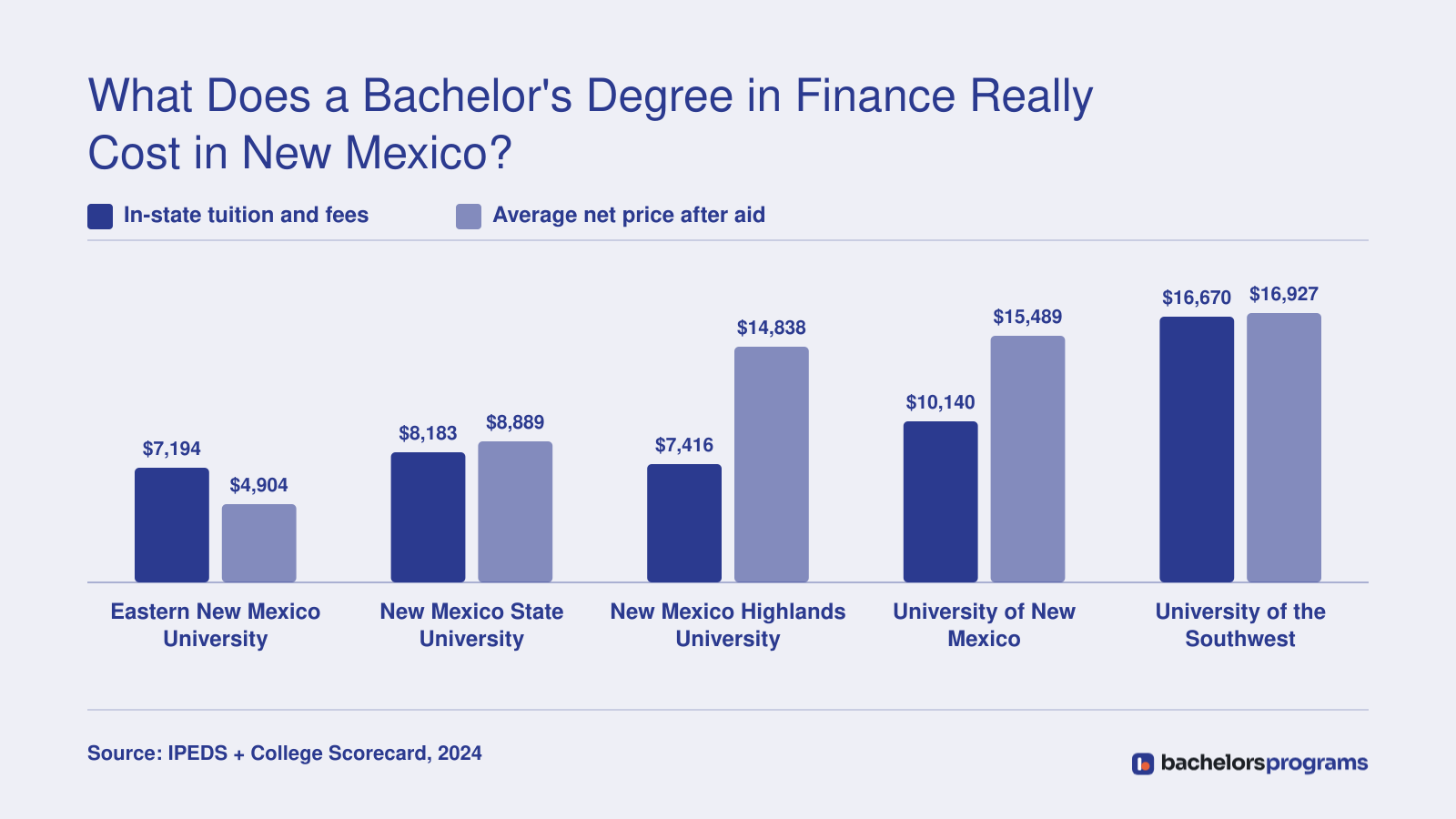
What Does a Bachelor's Degree in Finance Really Cost in New Mexico?
Eastern New Mexico University is the cheapest option here, with $7,194 in in-state tuition and fees and an average net price of $4,904 after aid. Net price runs above tuition at the other schools because it counts housing, books and living costs, not just tuition, minus grants and scholarships. It is an institution-wide average, not a finance-specific figure, and out-of-state tuition climbs to $25,307 at New Mexico State University and $33,060 at the University of New Mexico.
State Aid and Scholarships That Cut the Cost of a Finance Degree
In-state tuition and fees run from about $7,194 a year at Eastern New Mexico University to $10,140 at the University of New Mexico, with New Mexico State at $8,183 and New Mexico Highlands at $7,416.4 Over four years that is roughly $29,000 to $41,000 before aid. University of the Southwest, a private school, lists $16,670 a year, or about $66,700 over four years.
The State Programs
- Opportunity Scholarship: For New Mexico residents at public colleges taking at least 6 credit hours. Continuing students generally need a 2.5 GPA going forward. It covers up to 100% of tuition and required fees left after other aid, and there is no separate application.1 Your school's financial aid office awards it. Eligibility for four-year degrees has varied by student group, so confirm your status.
- Legislative Lottery Scholarship: A first-dollar award for recent high school graduates and honorably discharged veterans with a 2.5 GPA.3 The state's program matrix lists $4,582 at research institutions and $3,116 at comprehensive institutions, covering roughly 60 to 75% of tuition, with a 15-credit-hour requirement.2 Those amounts come from an older matrix, so verify current figures.
- Lottery Success Scholarship: Rules change, so get current eligibility and credit requirements from the Higher Education Department or your aid office.
Sticker Price vs. Net Price
Net price is what remains after grants. Federal net price figures often include housing and other costs, so they can exceed tuition alone. Eastern New Mexico reports about $4,904, New Mexico State $8,889. Pell share points to aid availability: roughly 81% to 86% of students at the public schools here receive Pell grants.
Practical Steps
- File the FAFSA as soon as it opens: it determines your federal grant eligibility and triggers state aid screening.
- Confirm with each school's aid office which state awards you qualify for.
- Stay on credit pace, because lottery-based awards depend on full-time enrollment.
Where New Mexico Finance Graduates Work: Banks, Labs, Government and Insurers
Finance employers in New Mexico cluster in four places: banks and credit unions, state government, the national laboratories, and insurers.
Banks, Credit Unions and Insurers
The state hosts 37 NCUA-insured credit unions with $20.8 billion in combined assets and about 1.16 million members.2 Nusenda ($5.0 billion) and Sunward ($4.6 billion) lead; Del Norte, U.S. Eagle, Sandia Area and State Employees follow. UNM Anderson's finance career guide names Enterprise Bank & Trust, Wells Fargo, Bank of America, Fidelity and Thornburg Investment Management as employers, plus New York Life for claims, underwriting, risk, sales and actuarial work. Hospital systems hire finance graduates into budgeting, reimbursement and revenue-cycle analysis.
Government and the Labs
State government employed roughly 31,100 people in FY2025 and the federal government about 28,900 in New Mexico, while Sandia (15,100) and Los Alamos (14,150) anchor the lab corridor.1 Those are total job counts, not finance openings, but the finance work is steady: budgeting, contracts, procurement, project controls and analysis. The Legislative Finance Committee, State Investment Council, PERA, Educational Retirement Board and New Mexico Finance Authority all staff finance and investment roles.
Pipelines From Campus
UNM Anderson recruits year-round, heaviest in fall and spring, through its Handshake portal. Its Ellis Facilitated Internship places a student in the State Treasurer's Office as an investments intern, and a 2026 government-finance event introduced students to PERA, the Educational Retirement Board, the New Mexico Finance Authority and the State Investment Council.
Credentials and Licensing
The CFA and CFP carry weight in investment management, trust and private wealth, and research, but most entry-level finance jobs require neither. Finance is largely unlicensed, so no New Mexico state license is needed for a typical analyst or banking role.
Your First Move
Target an internship in sophomore or junior year, not senior year. One supervised stint before your final semester is what turns a finance major into a candidate.
Choosing the Right New Mexico Finance School for You
Finance programs in New Mexico come in more shapes than a single campus major, so the order in which you weigh your options matters. Work through four filters in sequence: budget, format, accreditation and career goals.
Start With Budget, Then Format
Compare net price after aid, not sticker tuition. If you qualify for state aid such as the New Mexico Opportunity Scholarship or the Legislative Lottery Scholarship, the public universities here (New Mexico State University, the University of New Mexico, Eastern New Mexico University and New Mexico Highlands University) can cost far less than their published rates. Next, decide whether you need campus, hybrid or online coursework, and confirm which finance courses each school delivers in that format.
Match Your Profile
- Lowest-cost seeker: Lead with the price after aid and the state scholarships you qualify for, then compare the public options side by side.
- Working adult: Prioritize schools with online or evening delivery and clear transfer credit policies.
- AACSB-focused student: Check the accreditation table above first, since that credential carries weight with some employers.
- In-state career builder: Look at specialization. New Mexico State University offers finance tracks in banking and financial planning, financial analysis, and risk management and insurance, while the University of New Mexico places its finance concentration in Albuquerque, the state's largest city.
Your Next Three Steps
Shortlist two or three schools. Verify admissions requirements, deadlines and aid on each school's own pages, since policies change from year to year. Then contact the business advising office at each school and ask how the finance coursework fits your goals and how your existing credits will transfer. One focused conversation with an advisor will tell you more than any brochure.
Common Questions About Finance Degrees in New Mexico
These answers draw on the school profiles, admissions findings and career research earlier in the article. Requirements change, so confirm details with each school and employer before you commit.
Which New Mexico school is best for a bachelor's degree in finance?
Can you get a finance degree online from a New Mexico school?
Can I transfer community college credits toward a finance degree in New Mexico?
Do I need a CFA or CFP to work in finance in New Mexico?
Compare Finance programs on the data that matters
Explore more Business & Management majors or browse every field of study.
All Business & Management programs Browse every field of study