Best Public Health Degree Programs
Compare 590+ accredited Public Health programs, with net price after aid, graduation rates, earnings and debt from IPEDS and the U.S. College Scorecard.

Sticker tuition for a public health bachelor's runs from $6,381 a year in-state at the University of Florida to $65,230 at Johns Hopkins, yet most public health rankings never register that gap. They rate graduate schools by peer reputation, which says little about an undergraduate's cost or odds of finishing.
The ranking weighs cost, completion, and program-level earnings, and treats online, campus, and hybrid formats alike. Accreditation, net price, first-year earnings, and MPH plans separate otherwise similar programs, and each one weighs differently on your shortlist.
Many senior roles still expect a master's, so a bachelor's you can finish affordably often serves better than a famous one financed with loans.
Key Points
- Schools here rank on completion, net price, and earnings, not prestige.
- Brown University public health graduates earn the top first-year median pay here.
- Even online public health degrees rarely let you skip field experience.
The 10 Best Public Health Schools for Bachelor's Students in 2027
These ten schools earned their place on what happens after enrollment: whether students finish, what they pay, and what completers earn. All ten deliver the public health bachelor's on campus, four sit in California, and the list runs from a 6% admission rate to one that admits nearly half of its applicants.
University of Florida
#1Gainesville, FL · ~$7,000/yr (est.)
Best for: Florida residents aiming at graduate health study
The University of Florida builds its public health bachelor's around the five core disciplines, then adds a service learning practicum and a capstone exam. Students at this school graduate at 91%, and about 24% of applicants are admitted. Public health graduates report a median near $30,000 one year after finishing, climbing past $60,000 by the four-year mark.
- CEPH accredited
- 120 credit hours with a service learning practicum
- Capstone exam required before graduation
- Covers all five core public health areas
- 3.0 GPA minimum and prerequisite courses required
- AP, IB, and AICE credit accepted for prerequisites
- Combination-degree option fast-tracks graduate study
University of California-Berkeley
#2Berkeley, CA · ~$13,000/yr (est.)
Best for: Community health advocates seeking an accelerated MPH path
Berkeley treats public health as an Applied High Demand major, so applicants who name it on the UC application and complete the declaration requirements keep a guaranteed seat. Students at this school graduate at 93%, and roughly 11% of applicants are admitted. Options include an honors thesis, a 4+1 MPH track, and a summer global health certificate open to students from other schools. Public health graduates report a median near $48,000 one year after finishing.
- CEPH accredited
- Senior capstone required, with several capstone course options
- Undergraduate honors thesis option
- 4+1 MPH pathway
- Study abroad electives count toward the major
- Student-facilitated DeCal courses available
University of California-San Diego
#3La Jolla, CA · $10,000 – $15,000/yr (est.)
Best for: Pre-health students wanting an honors practicum
UC San Diego runs its public health bachelor's as the only undergraduate major inside Health Sciences, which keeps the degree population-focused and science-heavy at once. Students at this school graduate at 86%, and about 27% of applicants are admitted. Internships, research placements, study abroad, and an optional honors practicum give students portfolio material before they finish. Public health graduates report a median near $39,000 one year after finishing.
- Only undergraduate program in UC San Diego Health Sciences
- Internships, research, and study abroad built in
- Honors Practicum option
- Award-winning capstone and honors posters
- Quarterly course enrollment and offerings
University of California-Los Angeles
#4Los Angeles, CA · $13,000/yr (est. net price)
UCLA's Fielding School offers a four-year Bachelor of Science layered on a life sciences core, so students take real chemistry and biology alongside epidemiology and health policy. Students at this school graduate at 93%, and admission is the tightest on this list at about 9%. A cohort structure, a required community engagement course, and a two-quarter capstone keep the degree applied rather than abstract.
- CEPH accredited
- 180 total credit hours
- Cohort-based structure with onsite weekday classes
- Two-quarter capstone experience
- Required community engagement course
- Problem-based learning approach
- 2.0 GPA minimum plus prerequisites
University of North Carolina at Chapel Hill
#5Chapel Hill, NC · ~$12,000/yr (est.)
UNC-Chapel Hill admits students into Gillings School public health majors as sophomores, after prerequisites, then sequences them through small single-section courses. Students at this school graduate at 91%, and about 15% of applicants are admitted. Five majors run from biostatistics to nutrition, each pointing at a different career. Deadlines differ for high school applicants, current UNC students, and external transfers, so timing matters here.
- CEPH accredited
- Five majors including biostatistics, environmental health, and nutrition
- Students apply sophomore year and start coursework as juniors
- Small majors with one section per course
- Assured Enrollment pathway for Gillings School
- Minimum of two letters of recommendation
- Prerequisite coursework required before admission
University of California-Irvine
#6Irvine, CA · $14,000/yr (est. net price)
UC Irvine pairs a biological science foundation with epidemiology, biostatistics, and health policy, then sends students into a 100-hour community practicum at an agency, nonprofit, or laboratory. Students at this school graduate at 87%, and about 29% of applicants are admitted. First-year applicants need nothing beyond the university's own requirements, while transfers face prerequisite and GPA thresholds. Public health graduates report a median near $35,000 one year after finishing.
- CEPH accredited
- 100-hour community practicum required
- Premedical coursework can be built into the degree
- Honors research and student organizations available
- Peer academic advisors and Career Pathways advising
Johns Hopkins University
#7Baltimore, MD · $19,000/yr (est. net price)
Johns Hopkins splits its public health BA between the Homewood campus and the Bloomberg School, where seniors take fifteen credits of graduate-level coursework. Students at this school graduate at 94%, the highest figure here, and only about 6% of applicants are admitted. An 80-hour applied experience and six core courses carry the degree. Public health graduates report a median near $37,000 one year after finishing.
- CEPH accredited
- Six core courses in methods, biostatistics, epidemiology, policy, and environmental health
- Final year coursework at the Bloomberg School of Public Health
- Fifteen credits of advanced Bloomberg coursework
- 80-hour applied public health experience
- AP credit accepted for prerequisites
University of Michigan
#8Ann Arbor, MI · $18,000 – $61,000/yr (est.)
Michigan admits students into the School of Public Health as juniors, so the public health sciences BS sits on top of two years of foundational work. Students at this school graduate at 93%, and about 16% of applicants are admitted. A second route, the BA in Community and Global Public Health, suits students aimed at policy and community practice rather than laboratory science. Public health graduates report a median near $36,000 one year after finishing.
- CEPH accredited
- Upper-level program entered as a junior
- Science-based, clinical perspective on disease
- Training in surveillance, epidemiological investigation, and modeling
- Pre-health track for medicine, dentistry, nursing, and pharmacy
- Prevention, treatment, and eradication strategies covered
University of Washington-Seattle Campus
#9Seattle, WA · ~$14,000/yr (est.)
The University of Washington's Public Health-Global Health major is a school-wide liberal education degree that awards either a BA or a BS, with four concentration options. Students at this school graduate at 85%, and about 39% of applicants are admitted. Advising happens in person, and requirements were revised recently, so applicants should read the current catalog closely. Public health graduates report a median near $46,000 one year after finishing.
- CEPH accredited
- Awards either a Bachelor of Arts or a Bachelor of Science
- Four concentration options
- School-wide liberal education major
- New degree requirements effective autumn 2024
- In-person advising at HRC G120
University of Maryland-College Park
#10College Park, MD · $16,000/yr (est. net price)
Maryland's public health science BS is the largest undergraduate major in its School of Public Health, built on biology, chemistry, and calculus before the public health core. Students at this school graduate at 89%, and about 45% of applicants are admitted, the most open door on this list. Up to six internship credits and a required interdisciplinary capstone push students into practice. Public health graduates report a median near $38,000 one year after finishing.
- CEPH accredited
- 120 total credit hours
- Largest undergraduate major in the School of Public Health
- Interdisciplinary capstone required
- Up to 6 internship credits
- Core includes biostatistics, epidemiology, community, and environmental health
Cost & outcomes by school
Federal data for the highest-earning Public Health programs, independent of the ranking above. Earnings are this field's bachelor's graduates four years after completing where the Scorecard reports them, else the school's undergraduate median.
| School | Net price / yr | Grad rate | Earnings | Debt | Grads/yr | Format |
|---|---|---|---|---|---|---|
| University of Health Sciences and Pharmacy in St. Louis MO | $31,817 | 62% | $137,047 | $17,755 | 2 | Campus |
| Albany College of Pharmacy and Health Sciences NY | $29,882 | 68% | $131,426 | $25,500 | 9 | Campus |
| University of Pennsylvania PA | $28,699 | 97% | $111,371 | $15,715 | — | Campus |
| Lehigh University PA | $36,931 | 88% | $105,584 | $21,960 | 58 | Campus |
| Cornell University NY | $28,690 | 95% | $104,043 | $12,133 | 27 | Campus |
| Boston College MA | $41,704 | 91% | $103,937 | $19,000 | 17 | Campus |
| Georgetown University DC | $40,815 | 95% | $103,494 | $12,000 | 16 | Campus |
| Columbia University in the City of New York NY | $21,590 | 96% | $102,491 | $21,500 | — | Campus |
| Utah State University UT | $14,936 | 59% | $93,161 | $14,340 | 14 | Campus |
| Northeastern University MA | $30,915 | 91% | $92,538 | $24,250 | 33 | Campus |
| California Polytechnic State University-San Luis Obispo CA | $16,665 | 86% | $90,768 | $18,500 | 55 | Campus |
| Northwestern University IL | $29,167 | 95% | $89,363 | $14,684 | 86 | Online |
Sources: U.S. Department of Education. Net price, graduation rate, earnings and debt: College Scorecard (earnings and debt for this field's bachelor's graduates where reported, else school-wide); graduates: IPEDS. A dash means no figure is reported.
Cost, debt & payoff
Median earnings of this field's bachelor's graduates (4 yrs after completing, else the school's undergraduate median) vs. their median federal loan debt · U.S. College Scorecard
Across these programs the median graduate earns about $56,469 and finishes with roughly $23,275 in debt — a ratio that clears a common rule of thumb (keep debt below first-year salary). Net price and debt vary widely school to school, so check the per-school figures in the table above before you shortlist.
Why Outcomes, Not Reputation, Drive This List
Prestige is the easiest thing to shop for and the least useful. A famous name usually reflects a strong graduate school; your bachelor's experience depends more on class size, field placement, cost, and whether graduates land jobs within a year.
- Cost after aid: the average net price a first-year student actually pays once grants and scholarships are applied.
- Completion and retention: school-wide rates showing whether students stay enrolled and finish.
- Earnings and debt: median pay and typical borrowing for graduates of the program, drawn from federal College Scorecard figures.
- Admission selectivity: how competitive the entering class is, which shapes the pace and the peer group.
U.S. News-style surveys, by contrast, poll deans and faculty about graduate schools of public health. They say little about what happens to a bachelor's graduate looking for a first job.
Treat each number as a signal, not a promise. Net price averages across all students, completion rates describe the whole institution rather than one major, and some smaller programs report no earnings at all.
Use the list as a shortlist to visit, compare, and question, then let your own priorities decide. It is a starting point, not a verdict.
Campus, Online, or Hybrid: Where Public Health Programs Still Expect You On-Site
Campus delivery means showing up for class. Online delivery rarely means skipping the field. That split matters when you compare formats.
What the ranked schools offer
Every school in the ranked list delivers its public health bachelor's on campus, and none is flagged as online. UCLA, for example, lists onsite weekday classes. If you need remote coursework, look at the online programs in the additional listing further down and judge them on their own terms.
The catch with online programs
Online coursework often ends with supervised, in-person field work. Abilene Christian's 100% online BS requires a practicum of at least 120 field hours under a preceptor at an agency, hospital, nonprofit, or research setting.1 Delaware State's online BS lists 460 field-service hours, including an off-campus component of at least 60 hours at an agency you choose.2 National University spreads its practicum over eight weeks and asks for at least 20 approved hours; current-employer experience counts only if the duties differ from your regular job.3 South University's online program says field experience is required but does not state hours in its published material.4
Those figures may describe different components, so do not treat them as equivalent.
Placements and working adults
University of Cincinnati is the clearest case for flexibility: online students can intern from nearly anywhere, including near home, at health departments, hospitals, and community or nonprofit partners.5 Elsewhere, local placement tends to depend on faculty approval rather than a stated guarantee. For working adults, that can mean arranging daytime availability at an agency, so plan for it early.
What to ask before you apply
Ask each program how placements are arranged, who approves the site, and how many hours are required. Also ask when those hours can begin and whether your current workplace can ever count.
Related Articles
CEPH Accreditation for Undergraduate Public Health: What the Seal Actually Covers
Does CEPH accredit bachelor's degrees in public health, or only graduate programs?
Three Layers, One Degree
Institutional accreditation is the baseline every legitimate university holds. CEPH, the Council on Education for Public Health, sits above it and recognizes 274 units: 68 schools of public health, 175 public health programs, and 31 standalone baccalaureate programs (SBPs). Only the SBP category exists for undergraduates alone. An SBP may cover only baccalaureate public health degrees, cannot include graduate public health degrees or an MPH, and must include every BPH, BSPH, BS, or BA public health degree in that unit. A bachelor's inside an accredited school of public health is covered only where CEPH approved that scope, so it is not automatic.
What the Record Confirms
- Standalone baccalaureate programs: University of Miami (through December 2030), Ball State (July 2027), Western Washington (December 2033), and Albany College of Pharmacy and Health Sciences (December 2033).
- Approved undergraduate scope: University of San Francisco added its bachelor's in December 2022 through December 2026, housed in the School of Nursing and Health Professions rather than a school of public health.1
- School-level only: Boston University and Drexel hold accreditation through July 2026 and July 2029, but their listings do not separately confirm undergraduate coverage.
- Applicants: Appalachian State has a site visit set for April 2027 and Chicago State's application was accepted in 2026. Neither is accredited yet.
Why the Seal Matters
Health departments and nonprofits screen applicants for it, MPH admissions committees read it as evidence of preparation, and CHES exam eligibility depends on your specific degree and coursework, so ask each program how its curriculum maps.
Best-Value Picks: Lowest Net Price Among Ranked Public Health Schools
If you are searching for affordable public health degree programs, the schools below post the lowest average net price after aid among those ranked here, based on 2024 IPEDS and College Scorecard data. Treat each figure as an approximate yearly average across aided students, not a price quote. The two public universities land within about $15 of each other, near $6,550, while private BYU-Idaho runs roughly $1,700 higher at $8,221. Public health graduates at all three carry median debt of about $12,500 to $15,500, or roughly $132 to $164 a month in loan payments. The key lesson is that BYU-Idaho has the lowest sticker tuition here at $4,800 yet the highest net price, so compare what you will actually pay and borrow rather than the published rate.
| School | Location | Sector | Average Net Price After Aid (approx.) | In-State Tuition and Fees | Program Median Debt | Est. Monthly Loan Payment |
|---|---|---|---|---|---|---|
| University of Florida | Gainesville, FL | Public | $6,541 | $6,381 | $15,454 | $164 |
| California State University-Fullerton | Fullerton, CA | Public | $6,555 | $7,470 | $12,489 | $132 |
| Brigham Young University-Idaho | Rexburg, ID | Private nonprofit | $8,221 | $4,800 | $13,043 | $138 |
Top First-Year Earnings Among Ranked Programs
Among the schools ranked here, Brown University's public health graduates post the highest first-year median pay.
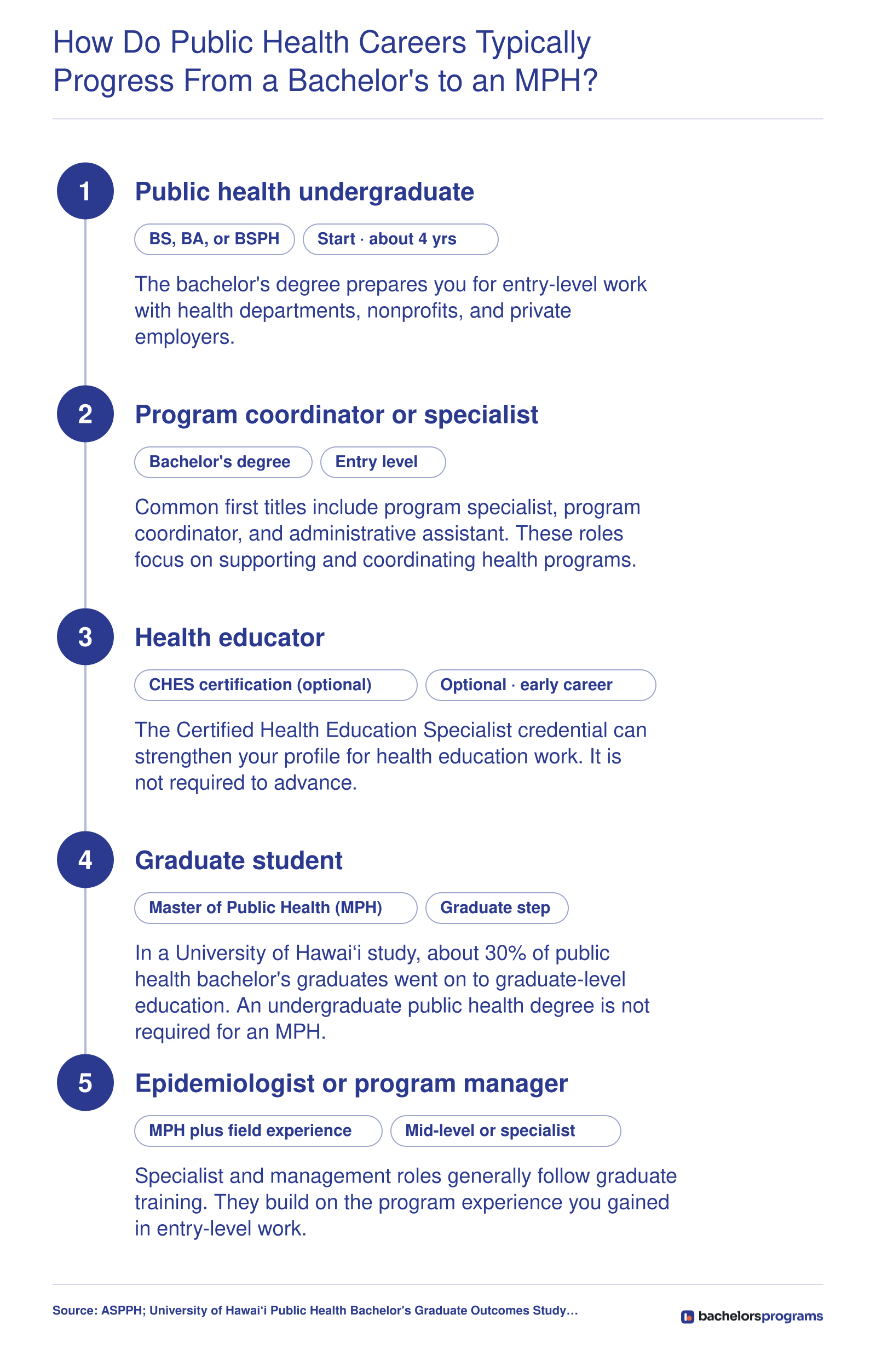
How Do Public Health Careers Typically Progress From a Bachelor's to an MPH?
Most public health careers start with a bachelor's degree and an entry-level coordination role, and many professionals later add a credential or a Master of Public Health. Immediate graduate study is the less common path. Among more than 1,300 bachelor's graduates from ASPPH member schools in 2014-2015, over 75% were employed and 12% were pursuing further education of any kind.
Questions to Ask Yourself
Do you want to start community work now, or build toward research and epidemiology?
Is the program housed in a CEPH-accredited school of public health, and does that affect your MPH plans?
If you study online, can you secure a field placement near home?
Would an accelerated BS/MPH save you a year of tuition?
Public Health programs by state
Quick Answers: What Students Ask Before Choosing a Public Health Program
These are the questions prospective students ask most often before they apply. Each answer is a short summary, and the sections around this one go deeper on cost, accreditation, format, and earnings.
Which US schools have the strongest public health bachelor's outcomes?
How do I confirm a public health bachelor's program is CEPH accredited?
Can I finish a public health degree entirely online, including the field experience?
Which entry-level roles hire people with only a public health bachelor's?
What do public health graduates typically earn in their first few years?
Does a public health bachelor's pay off if I never pursue an MPH?
Will my community college or transfer credits count toward a public health bachelor's, and what do top programs require for admission?
Compare Public Health programs on the data that matters
Explore more Healthcare majors or browse every field of study.
All Healthcare programs Browse every field of study