Best Finance Schools in Delaware
Compare 6 accredited Finance programs in Delaware at 5 colleges, with net price after aid, graduation rates, earnings and debt from IPEDS and the U.S. College Scorecard.

Studying finance in Delaware carries a real advantage: Wilmington's banking and financial-services cluster, home to card issuers, trust companies and corporate service firms that hire analysts, credit specialists and compliance staff. The Bachelor of Science (B.S.) in Finance is the common credential, though Strayer University-Delaware awards a Bachelor of Business Administration in Finance.
Every program ranked here is a bachelor's, campus-based or online, at a school in Delaware. Those programs split on cost, admissions, online access and career payoff.
Proximity to the same employers does not produce the same pay. Four years out, University of Delaware finance graduates earned a median of $101,605, while Goldey-Beacom College graduates earned $58,992.
Key Points
- University of Delaware finance graduates earned a $101,605 median four years out.
- Delaware State University is the value pick, at $13,910 average net price.
- Delaware licenses few entry-level finance roles, but Series 7 needs firm sponsorship.
Best Schools for a Bachelor's Degree in Finance in Delaware
The University of Delaware is the strongest overall choice for a bachelor's degree in finance in Delaware, pairing an AACSB-accredited business school with the highest published earnings in the group. Delaware State University is the value pick, carrying the same AACSB accreditation at the lowest net price after aid of the five schools here. Schools offering this program report graduation rates from 19.8% to 80.6%, so completion support deserves as much attention as price.
University of Delaware
#1Newark, DE · $15,000 – $20,000/yr (est.)
Best for: Full-time undergrads wanting a research university
The University of Delaware's Alfred Lerner College of Business and Economics runs a Bachelor of Science in Finance built on AACSB-guided learning goals, from time value of money to capital structure and dividend policy. Students take three upper-level finance electives plus professional electives in accounting, business, entrepreneurship or management information systems, and every major course requires at least a C-. About 80.6% of the university's students graduate, the highest completion rate among the Delaware schools here, and finance graduates reported median earnings of $66,889 one year after completion and $101,605 four years out.
- AACSB-accredited Lerner College of Business and Economics
- Three upper-level finance electives plus professional electives
- C- minimum grade required in every major course
- Calculus I, statistics and business analytics required
- Public speaking or executive presentations course required
- Twelve credits of creative arts, humanities or foreign language
- Professional electives from accounting, business, finance or MIS
- Science breadth includes one lab credit
Goldey-Beacom College
#2Wilmington, DE · $15,000 – $20,000/yr (est.)
Best for: Students who want small finance classes
Goldey-Beacom College is a small private business-focused campus in Wilmington where finance majors work in classes of roughly 20 to 30 students and get close faculty attention. The 120-credit Bachelor of Science in Finance is ACBSP-accredited and covers accounting, economics, financial management, business law and portfolio management, with a five-year path that adds a master's in finance in one extra year. The college graduates 57.4% of its students, and finance graduates reported median earnings of $58,992 four years after completing.
- ACBSP-accredited business program
- 120 total credit hours
- Five-year bachelor's to master's in finance option
- Classes of roughly 20 to 30 students
- Coursework in portfolio management and business law
- Emphasis on risk analysis and mitigation
- Prepares for investment banking and financial advisor roles
Delaware State University
#3Dover, DE · $10,000 – $15,000/yr (est.)
Best for: In-state students seeking the lowest net price
Delaware State University's College of Business holds AACSB accreditation and offers a finance Bachelor of Science with tracks in Finance and Banking or Financial Economics. Students can pair the major with a CFP Board-registered financial planning minor, and the department helps place interns with firms including JPMorgan Chase, DuPont and WSFS Bank. The university graduates 39.1% of its students overall, and it is the lowest net price option among the five schools in this ranking.
- AACSB-accredited College of Business
- Two concentration options within the major
- CFP Board-registered Financial Planning minor available
- Recent internship placements at JPMorgan Chase, DuPont, WSFS
- Networking events with working professionals
- State-of-the-art finance facilities and equipment
- Concentration aimed at bank and financial institution careers
- Prepares for financial analyst and investment consultant roles
- Paid or unpaid internship assistance
Wilmington University
#4New Castle, DE · ~$16,000/yr (est.)
Wilmington University's 120-credit Bachelor of Science in Finance blends financial theory with investments, risk management and financial modeling, then adds data analytics and global derivatives so graduates can handle modern markets. Classes are taught by working practitioners, start every eight weeks, and the program includes internships and cooperative learning placements. The IACBE-accredited degree also lets students fold master's-level coursework into the bachelor's at no extra cost. The university graduates 19.8% of its students, and finance graduates reported median earnings of $49,275 one year after completion and $68,627 four years out.
- IACBE-accredited business program
- 120 credits across 40 courses
- New classes start every eight weeks
- Faculty are active practitioners
- Internships and cooperative learning experiences
- Covers investments, risk management and financial modeling
- Includes data analytics and global derivatives coursework
- Master's-level coursework can be added at no extra cost
Strayer University-Delaware
#5Wilmington, DE · ~$23,000/yr (est.)
Strayer University's Bachelor of Business Administration in Finance is a 40-course degree with a finance concentration covering money and banking, investments, financial markets and institutions, risk analysis and advanced financial management. Business programs hold ACBSP programmatic accreditation, and the degree is built for working adults, with employer tuition reimbursement support, scholarships and transfer credit for up to 28 classes. The Wilmington campus serves students across the state, and free general education courses are available through Sophia Learning.
- ACBSP-accredited business programs
- 40 courses delivered in 11-week terms
- Concentration in money and banking, investments, risk analysis
- Transfer up to 28 classes
- Employer tuition reimbursement supported
- No-cost general education courses via Sophia Learning
- Scholarships and financial aid available
Cost & outcomes by school
Federal data for the highest-earning Finance programs, independent of the ranking above. Earnings are this field's bachelor's graduates four years after completing where the Scorecard reports them, else the school's undergraduate median.
| School | Net price / yr | Grad rate | Earnings | Debt | Grads/yr | Format |
|---|---|---|---|---|---|---|
| University of Delaware DE | $17,799 | 81% | $101,605 | $23,495 | 387 | Campus |
| Wilmington University DE | $15,644 | 20% | $68,627 | $17,831 | 46 | Online |
| Goldey-Beacom College DE | $15,554 | 57% | $58,992 | $18,900 | 13 | Campus |
| Delaware State University DE | $13,910 | 39% | $49,307 | $26,000 | 14 | Campus |
| Strayer University-Delaware DE | $22,593 | — | $40,092 | $40,621 | — | Online or campus |
Sources: U.S. Department of Education. Net price, graduation rate, earnings and debt: College Scorecard (earnings and debt for this field's bachelor's graduates where reported, else school-wide); graduates: IPEDS. A dash means no figure is reported.
Cost, debt & payoff
Median earnings of this field's bachelor's graduates (4 yrs after completing, else the school's undergraduate median) vs. their median federal loan debt · U.S. College Scorecard
Across these programs the median graduate earns about $54,150 and finishes with roughly $24,748 in debt — a ratio that clears a common rule of thumb (keep debt below first-year salary). Net price and debt vary widely school to school, so check the per-school figures in the table above before you shortlist.
How We Ranked Delaware Bachelor's in Finance Programs
Anyone weighing a bachelor's degree in finance in Delaware should start with two questions: what the degree costs, and what graduates of that school tend to earn. Every measure comes from the latest federal College Scorecard release and is compared school by school, so the differences reflect the institutions themselves rather than a scoring formula.
What We Compare
- Earnings after graduation: median pay for former students a decade after they first enrolled, a sign of whether graduates gain ground in the labor market.
- Graduation rate: the share of first-time, full-time students who finish their program.
- Net price: average yearly cost after federal, state and institutional aid, for students who receive it.
- Debt and selectivity: typical borrowing among graduates and how choosy the admissions office is.
- Delivery format: whether finance coursework runs on campus, online, or both.
Reading the Numbers Carefully
Graduation rate, net price and 10-year earnings describe the whole institution, not its finance department, so read them as context rather than a finance-specific forecast. Net price is a sector-based average; your own bill moves with merit aid, residency, housing and transfer credits.
What's on the List
Every school here is based in Delaware and confers a bachelor's degree in finance: University of Delaware, Goldey-Beacom College, Delaware State University, Wilmington University and Strayer University-Delaware. Programs built for working adults, like those at Wilmington and Strayer, sit alongside traditional residential options; delivery format is what separates them.
Online and Hybrid Bachelor's in Finance Options at Delaware Schools
On-campus finance study in Delaware still dominates, but a working adult who needs evening or asynchronous coursework has real options here. The split is clean: some programs meet only in a classroom, while others publish a fully online path to the same degree.
Which Delaware programs run online
Wilmington University is the clearest online route. Its B.S. in Finance is listed for both New Castle and online delivery, and the university states the degree can be completed 100% online or face to face.1 The program runs 120 credits across 40 courses, with new classes starting every eight weeks, so a student who stops out for a term does not wait a full semester to restart.4 Wilmington lists the same dual delivery for its B.S. in Accounting and Finance, which suits students who want the accounting coursework alongside finance.2 The finance program itself is published as classroom or online rather than as a formal hybrid track, though the university offers hybrid courses more broadly.3
Strayer University-Delaware, based in Wilmington, carries its Bachelor of Business Administration in Finance in both campus and fully online formats. Strayer runs 11-week terms, accepts transfer credit for up to 28 prior courses, and supports employer tuition reimbursement, all of which matter to someone already working full time.
Campus-based programs
The University of Delaware's Finance (BS) in Newark is a campus program. The school does not publish an online or hybrid version of the finance major, so students pursuing the UD finance major should plan on attending in person. Goldey-Beacom College in Wilmington and Delaware State University in Dover likewise list their finance bachelor's degrees as campus-based.
Who should choose online
Online study pays off most for students already employed in the Wilmington corridor's banking, trust, and credit-card sector, where an employer may cover part of the cost and a short course term fits around shift work. If you want on-campus recruiting events, internship pipelines, and a trading room, the in-person programs in Newark, Dover, and Wilmington serve that better.
Admission Requirements for Delaware Finance Bachelor's Programs
What GPA and test scores do you need to get into a finance program in Delaware? It depends on the school, and most do not publish a hard minimum.
GPA and Test Policies
University of Delaware reports an average admitted GPA of about 3.9 for 2026 and no official minimum. It is test-optional for 2026-2027, and not sending scores does not count against you. Delaware State University reports an average admitted GPA of roughly 3.2 (3.16 for 2025-26), which is an average, not a cutoff. Its reported SAT range is 830 to 1060 and its ACT range is 20 to 24, but we could not confirm whether scores are optional or required this year.
For Goldey-Beacom College, Wilmington University and Strayer University-Delaware, we found no published GPA minimum or test policy. Ask each admissions office directly before you apply.
Acceptance Rates
Overall admission rates in our data are 73 percent at University of Delaware, 84.5 percent at Goldey-Beacom and 46.6 percent at Delaware State. No rate is reported for Wilmington University or Strayer. These are university-wide figures. None of the schools publishes a separate acceptance rate for finance.
Separate Business-Major Step
University of Delaware is the one school here with a clear second hurdle. Entering the finance major requires:
- Courses: ECON 101 plus one of MATH 115, 221, 232 or 241, each with a C- or better.
- Credits: 12 credits completed at UD.
- GPA: A 3.0 cumulative GPA, with applicants below 3.0 reviewed case by case.
We found no separate business-school entry requirement at Delaware State.
Transfer Credit
UD's business college accepts AACSB-accredited 300-level business courses, and students transferring under an articulation agreement receive all of their credits. We did not find a general UD credit cap or a rule for community college courses outside those agreements, so confirm course equivalencies before you enroll elsewhere first. Strayer says students can transfer up to 28 classes toward its 40-course degree. We found no published transfer rules for the other schools.
A Timeline Tip
At UD, expect to be admitted to the university first and to the finance major afterward. Because the major requires 12 credits and specific prerequisites, most students declare after their first year. Plan ECON 101 and your math course for freshman year, and keep your GPA at or above 3.0 so the declaration is routine.
Related Articles
Cost of a Bachelor's Degree in Finance in Delaware
Delaware State University is the most affordable option here, with in-state tuition and fees of $10,670 and an average net price of $13,910 after grants and scholarships, according to federal IPEDS and College Scorecard data. The Pell share and median debt figures below describe each school's full undergraduate population, not finance majors alone. State aid can lower costs further. Per the State of Delaware's announcement, the Inspire Scholarship covers full in-state tuition at Delaware State University for up to eight semesters for Delaware residents who meet all of these conditions: - graduated from a Delaware high school with at least a 2.75 GPA (or an 80 percent average) - have no felony conviction - enroll full time the fall after high school graduation - accept all non-loan aid first The University of Delaware's SEED page describes the SEED Scholarship for Delaware residents and Delaware high school graduates with at least a 2.5 GPA who start in UD's Associate in Arts program. Once Pell is applied, it covers the remaining tuition for that associate degree plus up to two semesters toward a bachelor's, so an eligible student pays tuition for only one year. The Delaware Higher Education Office also lists the Scholarship Incentive Program (ScIP), a $1,000 grant with a May 15, 2026 deadline in its 2026 listing.
| School | Sector | In-State Tuition and Fees | Average Net Price After Aid | Pell Grant Recipients (Institution-Wide) | Median Debt at Graduation (Institution-Wide) |
|---|---|---|---|---|---|
| Delaware State University | Public | $10,670 | $13,910 | 68.6% | $26,000 |
| Goldey-Beacom College | Private nonprofit | $14,940 | $15,554 | 67.6% | $18,900 |
| Wilmington University | Private nonprofit | $12,630 | $15,644 | 70.4% | $20,000 |
| University of Delaware | Public | $16,810 | $17,799 | 28.1% | $24,572 |
| Strayer University-Delaware | Private for-profit | $13,920 | $22,593 | 86.3% | $40,621 |
Finance Careers and Salaries in Delaware
A bachelor's degree in finance is the typical entry credential for financial and investment analysts and personal financial advisors, two common paths for graduates of the programs ranked here, and the table below shows the most recent median pay in our research for each role. For current Delaware numbers, open the Delaware page and the Wilmington metro tables in the BLS Occupational Employment and Wage Statistics (OEWS) program, search occupation codes 13-2051, 13-2052, and 13-2072, and note the release date and area definition, since BLS data can lag and metro boundaries do not match city limits. Then cross-check Delaware Department of Labor labor market information and the career-outcome pages at the University of Delaware and Delaware State University, and build your own employer list from LinkedIn, company career pages, the Delaware State Chamber of Commerce, and local business journals, starting with financial-services employers the Delaware Prosperity Partnership names, such as JPMorgan Chase, Bank of America, Capital One, WSFS, M&T Bank, PayPal, and SoFi.
| Occupation | Median Annual Wage (Delaware) | Employment (Delaware) | Typical Entry Education |
|---|---|---|---|
| Financial and Investment Analysts (13-2051) | $102,740 (U.S. median, May 2025) | N/A | Bachelor's degree |
| Personal Financial Advisors (13-2052) | $134,970 (Philadelphia-Camden-Wilmington metro, May 2021) | N/A | Bachelor's degree |
| Loan Officers (13-2072) | $84,440 (Philadelphia-Camden-Wilmington metro, May 2021) | N/A | N/A |
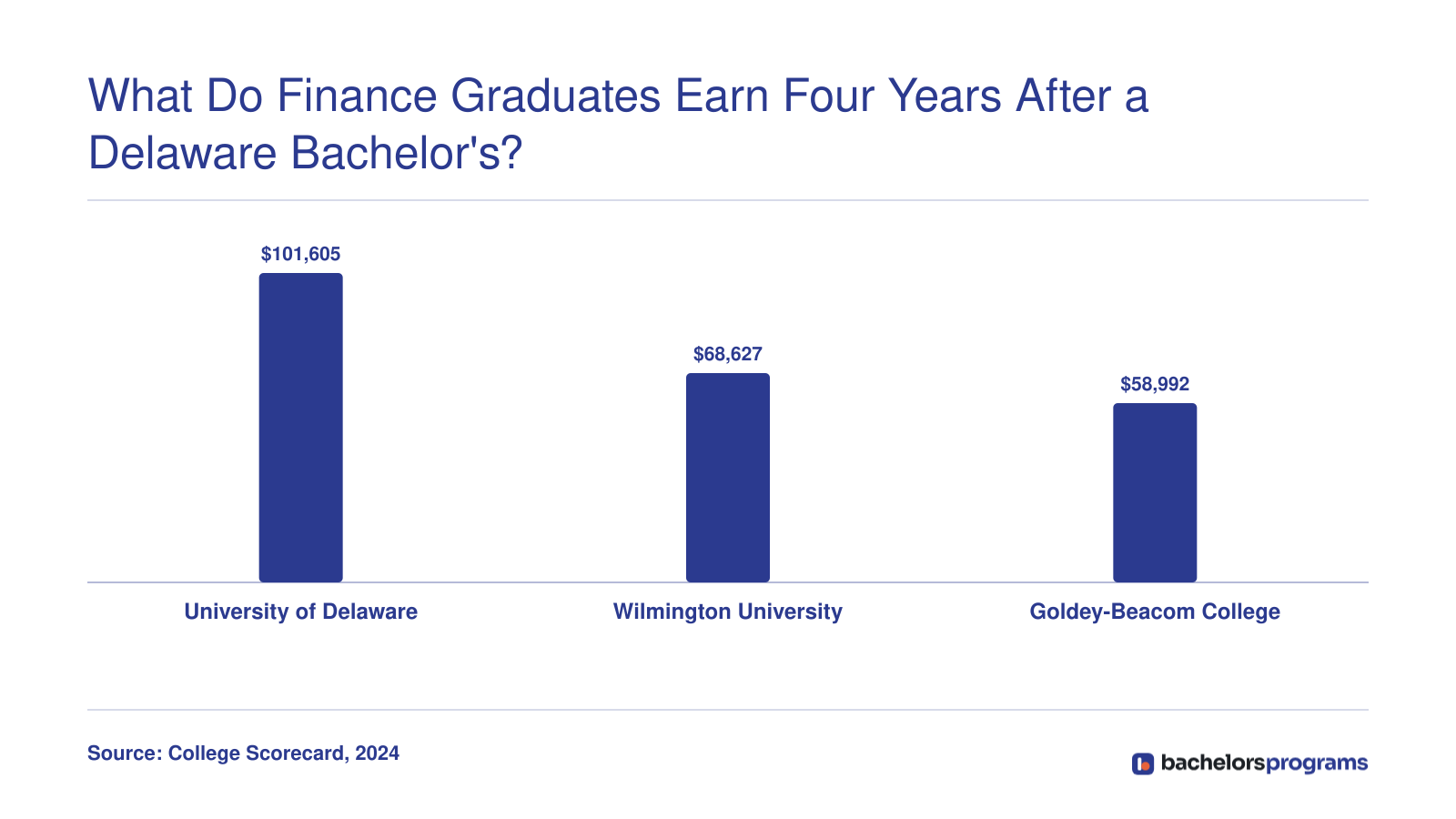
What Do Finance Graduates Earn Four Years After a Delaware Bachelor's?
Four years after finishing the bachelor's degree in finance, University of Delaware graduates earned a median of $101,605, compared with $68,627 at Wilmington University and $58,992 at Goldey-Beacom College. These College Scorecard medians cover everyone who completed each program, including graduates working outside Delaware, so they reflect regional and national job markets as well as local ones.
Delaware Licensure and Registration for Finance Careers
Delaware Finance Bachelor's Degree FAQs
These answers draw on published admissions and transfer information from the University of Delaware and on the Delaware schools ranked above. Policies and figures change, so confirm details with each school's admissions office before you apply.
What is the University of Delaware business school acceptance rate?
Can you earn a bachelor's degree in finance online from a Delaware school?
What is the starting salary for a finance graduate in Delaware?
Do I need a Series 7 license to start a finance career in Delaware?
Can community college credits transfer toward a Delaware finance bachelor's?
Compare Finance programs on the data that matters
Explore more Business & Management majors or browse every field of study.
All Business & Management programs Browse every field of study