Best Accounting Schools in Delaware
Compare 5 accredited Accounting programs in Delaware, with net price after aid, graduation rates, earnings and debt from IPEDS and the U.S. College Scorecard.

An accounting bachelor's degree is the four-year credential behind staff accountant and audit jobs, and the starting point for a Delaware CPA license. Most schools award it as a Bachelor of Science (B.S.) in Accounting of about 120 semester credits.
Delaware schools offer the degree on campus, online or both. They differ on accreditation, admissions and price: annual in-state tuition and fees run from $10,670 at Delaware State University to $16,810 at the University of Delaware.
The tighter constraint is licensure. Delaware requires 150 credit hours to become a CPA, so a standard bachelor's leaves graduates roughly 30 credits short.
Key Points
- Delaware State's 100% online accounting B.S. runs $446 to $504 per credit.
- Transfer credit, not admission, usually decides how long your degree takes.
- Delaware employed 6,570 accountants and auditors, per the state's 2025 labor data.
Best Accounting Schools in Delaware: Ranked Bachelor's Degree in Accounting Programs
Delaware's bachelor's degree in accounting field is small, which makes comparing schools straightforward: five institutions in the state offer the degree, and they differ sharply on accreditation, delivery and price. Two hold AACSB business accreditation, one is built around a tri-state CPA track, and two are designed around working adults and online study. Each profile below covers what the program requires, what graduates earn, and who the school fits best.
University of Delaware
#1Newark, DE · $15,000 – $20,000/yr (est.)
Best for: Traditional students wanting a full campus experience
Delaware's flagship public research university, in Newark, and the strongest accounting option in the state on accreditation alone: the Alfred Lerner College of Business and Economics holds AACSB business accreditation plus the separate AACSB accounting accreditation awarded in 1984, which the college notes fewer than 200 schools maintain. Undergraduates work through Intermediate Accounting I and II, cost accounting, taxation, auditing and big data coursework, and 300-level transfer credit is accepted only from AACSB-accredited institutions. An accelerated route lets students finish a bachelor's and master's in five years or less. Program graduates reported median earnings of about $71,500 one year after completion and about $105,400 four years out, with median debt near $26,200.
- Separate AACSB accounting accreditation, held since 1984
- Required sequence includes Intermediate Accounting I and II, Cost, Auditing and Tax
- Nine credits of 300-level or higher accounting, finance or MIS electives
- 300-level transfer credit accepted only from AACSB-accredited institutions
- ACCT 425 must be completed at Delaware
- Data analytics coursework covers Big Data Technologies and accounting information systems
- Minimum grade of C- required in every required course
- Accelerated pathway completes the bachelor's and master's in five years or less
Goldey-Beacom College
#2Wilmington, DE · $15,000 – $20,000/yr (est.)
Best for: CPA-track students in the tri-state area
A private college in Wilmington with a compact, career-focused 120-credit Bachelor of Science in Accounting: 36 general education credits, 30 accounting major credits and 39 business credits. The program is built around CPA eligibility and is designed to meet the education requirements in Delaware, Maryland and Pennsylvania, with a Master of Science in Taxation covering the extra credits the 150-hour rule requires. Coursework leans practical, adding applied statistics, database applications and FASB standards to accounting theory. Median earnings were about $57,500 one year after graduation and about $70,800 four years out, with median debt around $17,700.
- 120-credit degree: 36 general education, 30 accounting major, 39 business credits
- Meets CPA education requirements in Delaware, Maryland and Pennsylvania
- 150-credit CPA requirement can be met through the M.S. in Taxation
- Coursework covers auditing standards, cost accounting, business law and applied statistics
- Emphasizes database applications and computer skills alongside accounting theory
- Includes accounting theory built around FASB standards
Delaware State University
#3Dover, DE · $10,000 – $15,000/yr (est.)
Best for: Students seeking a public HBCU option
Delaware's public land-grant institution in Dover and an HBCU, offering a Bachelor of Science in Accounting that adds 33 credit hours beyond the general management degree. Students prepare for the CPA, CMA and CIA credentials, intern with accounting firms, government agencies and corporations, and can extend into a five-year bachelor's-to-MBA pathway. The Accounting and Finance Club and a NABA chapter run networking events and job fairs, and recent graduates have landed at Deloitte, KPMG and Mastercard. Median earnings reached about $72,500 four years after completion, with median debt around $25,000.
- Accounting major is 33 credit hours beyond the general management degree
- Prepares students for the CPA, CMA and CIA credentials
- Five-year pathway pairs the bachelor's degree with an MBA
- Internships with accounting firms, government agencies and corporations
- Active Accounting and Finance Club and a NABA student chapter
- Recent graduates placed at Deloitte, KPMG and Mastercard
- Scholarships available to accounting majors
Wilmington University
#4New Castle, DE · ~$16,000/yr (est.)
A private university in New Castle built around working adults, with a 120-credit, 40-course Bachelor of Science in Accounting offered on campus, fully online or in a mix of both, with classes starting every eight weeks. The business program lists IACBE accreditation, and a CPA review certificate supplies 120 hours toward the 150-hour requirement. Electives can double as a related certificate or master's-level coursework at no extra tuition. Median earnings were about $47,000 one year after graduation and about $60,000 four years out, with median debt around $22,200.
- 120 credits across 40 courses, available on campus, fully online or blended
- Classes start every eight weeks
- CPA review certificate provides 120 hours toward the 150-hour requirement
- CPA review course offered only in Delaware
- Electives can count toward a related certificate or master's at no extra tuition
- Coursework covers GAAP plus Advanced Accounting I and II
Strayer University-Delaware
#5Wilmington, DE · ~$23,000/yr (est.)
A for-profit university whose Wilmington campus serves working adults, with a Bachelor of Science in Accounting delivered online across 180 quarter credits, 81 of them in the major. The catalog lists ACBSP accreditation and a curriculum spanning federal taxation, auditing, government and not-for-profit accounting, data analytics for accounting, and a capstone. Micro-credentials can be stacked along the way, and the university notes that the degree alone does not qualify holders for professional licensing exams. Median earnings were about $52,400 one year after completion and about $66,100 four years out, with median debt near $55,000.
- 180 quarter credits, with 81 in the accounting major
- Major includes Auditing, Government and Not-for-Profit Accounting and a capstone
- Coursework covers data analytics for accounting and accounting information systems
- Micro-credentials can be earned alongside the degree
- Associate in Arts in Accounting and M.S. in Accounting also available
- Degree does not automatically qualify holders for licensing examinations
Cost & outcomes by school
Federal data for the highest-earning Accounting programs, independent of the ranking above. Earnings are this field's bachelor's graduates four years after completing where the Scorecard reports them, else the school's undergraduate median.
| School | Net price / yr | Grad rate | Earnings | Debt | Grads/yr | Format |
|---|---|---|---|---|---|---|
| University of Delaware DE | $17,799 | 81% | $105,425 | $26,301 | 79 | Campus |
| Delaware State University DE | $13,910 | 39% | $72,522 | $25,000 | 15 | Campus |
| Goldey-Beacom College DE | $15,554 | 57% | $70,765 | $15,000 | 11 | Campus |
| Strayer University-Delaware DE | $22,593 | — | $66,108 | $41,625 | — | Online |
| Wilmington University DE | $15,644 | 20% | $59,954 | $20,271 | 79 | Hybrid |
Sources: U.S. Department of Education. Net price, graduation rate, earnings and debt: College Scorecard (earnings and debt for this field's bachelor's graduates where reported, else school-wide); graduates: IPEDS. A dash means no figure is reported.
Cost, debt & payoff
Median earnings of this field's bachelor's graduates (4 yrs after completing, else the school's undergraduate median) vs. their median federal loan debt · U.S. College Scorecard
Across these programs the median graduate earns about $70,765 and finishes with roughly $25,000 in debt — a ratio that clears a common rule of thumb (keep debt below first-year salary). Net price and debt vary widely school to school, so check the per-school figures in the table above before you shortlist.
How We Ranked Delaware Bachelor's in Accounting Schools
The order answers a practical question: which Delaware bachelor's in accounting programs offer the strongest mix of earnings, affordability and completion?
The measures that matter
The comparison uses five reader-facing measures: earnings for graduates, net price, completion rate, median debt, and accreditation. Earnings and median debt are program-level figures, reported for the accounting program itself. Net price and completion rate are institution-wide, so they describe the whole school rather than the accounting department. Accreditation applies to the business school or the accounting program, depending on the school, and it signals an external review rather than a marketing claim.
Why the order holds up
The figures come from the latest federal College Scorecard release. Every program included is a Delaware-based bachelor's program, whether it is delivered on campus, online, or in a hybrid format. The measures are read side by side rather than blended into one score, which keeps the trade-offs visible: a lower net price with modest accounting earnings is a different value than a higher price with stronger earnings. That transparency makes the order a comparison tool rather than a single verdict. Use it as a starting point, then check the program details that matter to you.
AACSB vs. ACBSP vs. IACBE: What Accounting Accreditation Means for You
All three groups accredit business schools, and AACSB is generally the most selective and the one large firms most often recognize. That does not make the other two a red flag. State CPA boards, including Delaware's, focus on the institution's regional accreditation and the accounting coursework you complete, not on which business accreditor a school holds. To see which accreditation each Delaware school carries, check the ranking above, then confirm it in the accreditor's own directory.
| Factor | AACSB | ACBSP | IACBE |
|---|---|---|---|
| Typical school profile | Generally larger schools with a wider range of degrees | Generally smaller schools with a narrower range of degrees | Generally smaller schools with a narrower range of degrees |
| Scale of accreditation | More than 700 accredited programs in the U.S. (2024) | Almost 3,000 programs at more than 430 campuses worldwide (2024) | More than 170 programs worldwide (2024) |
| Share of schools accredited by the three groups | 58% | 26% | 16% |
| Rigor and selectivity | Generally the most selective of the three; its schools pay the highest faculty salaries | Falls between the other two on faculty pay, much closer to IACBE | Its schools pay the lowest faculty salaries of the three |
| Employer recognition | Employers familiar with AACSB tend to view a graduate of an accredited program as a plus; one study found no entry-level wage premium after controlling for GPA and test scores | No comparable employer finding in the research reviewed | No comparable employer finding in the research reviewed |
| Where to verify a school | AACSB's online directory of accredited schools | ACBSP's online directory of accredited schools | IACBE's online directory of accredited schools |
Online and Hybrid Bachelor's in Accounting Options at Delaware Schools
Delaware State University lists its Bachelor of Science in Accounting as 100% online: 121 credits over a typical four years, at $446 to $504 per credit.1 That makes it the clearest fully online route among the Delaware schools here.
Sorting the Schools by Format
- Online: Delaware State University and Strayer University-Delaware, which is categorized as an online provider.
- Campus plus online or hybrid: Wilmington University, which lists traditional classroom and online formats, with in-person, 100% online or combined delivery from New Castle.
- Campus-based: University of Delaware and Goldey-Beacom College. UD's program page does not describe an online, hybrid or evening track, though an accreditor listing mentions face-to-face delivery with some hybrid modality information.2
No school program page we reviewed describes an evening or weekend accounting bachelor's track. If you need night classes, ask each admissions office directly. Wilmington's online and combined formats are the most likely fit for working adults.
What Online Means for Residents and Out-of-State Students
An online degree from a Delaware-based school does not require you to live in Delaware. For Delaware residents, it can mean keeping a job near home while still enrolling at an in-state school. Out-of-state students get the same flexibility, but should confirm which rate applies to them.
One Practical Tip on Tuition
Ask the bursar's office in writing whether online students pay the same per-credit rate as on-campus students, and whether residency changes it. On-campus, Delaware State lists $10,670 in-state against $20,634 out-of-state, so a gap is possible. Online rates may differ, and so can technology or other fees. Request the total cost per credit and the full fee schedule before you compare schools.
Related Articles
Admissions for Delaware Accounting Bachelor's Programs: GPA, Test Policy and Transfer Credit
Admission to most accounting bachelor's programs in Delaware is closer to a formality than a hurdle, so transfer credit, not the acceptance letter, is what actually determines how long a degree takes.
University of Delaware: No Stated GPA, Tests Optional
Delaware's flagship publishes no minimum GPA and does not require SAT or ACT scores from any applicant, including homeschooled and non-traditional students. Scores that are submitted are superscored on the SAT and read at the highest ACT composite. About 71% of applicants are admitted, so coursework and the application itself carry more weight than a test score.3
Delaware State and Goldey-Beacom: Ask Directly
Delaware State University admits roughly 47% of applicants and Goldey-Beacom College about 85%, a wide gap in selectivity between two of the state's accounting options. Neither school publishes a stated minimum GPA or a clear test-optional statement on its undergraduate admissions pages, so confirm both with an admissions counselor before applying. A missing policy is not the same as a flexible one.
Wilmington University does not report an admissions rate, and its accounting program runs on eight-week terms with frequent start dates, which suits transfer students who want to begin mid-year. Strayer University-Delaware likewise publishes no admission rate.
Transfer Credit: Where Degrees Get Won or Lost
- University of Delaware: accepts up to 90 transfer credits, requires a C or better in non-remedial college work, does not take pass/fail credit, and requires the final 30 credits in residence.
- Community college pathway: guaranteed-admission agreements exist between the state's two-year campuses and several four-year partners, but they are program-to-program and the receiving university makes the final credit decision.1 Get the evaluation in writing.
- Goldey-Beacom: has no published course-by-course transfer matrix, so expect individual transcript review rather than a pre-approved list.2
- Delaware State, Wilmington, Strayer: ask each registrar for a written cap on transfer credits and any residency minimum before you enroll.
Cost of an Accounting Bachelor's Degree in Delaware
Delaware State University is the most affordable accounting option here, and state aid can lower its price further. Every figure below is annual, not the total for a degree.
Annual tuition versus net price
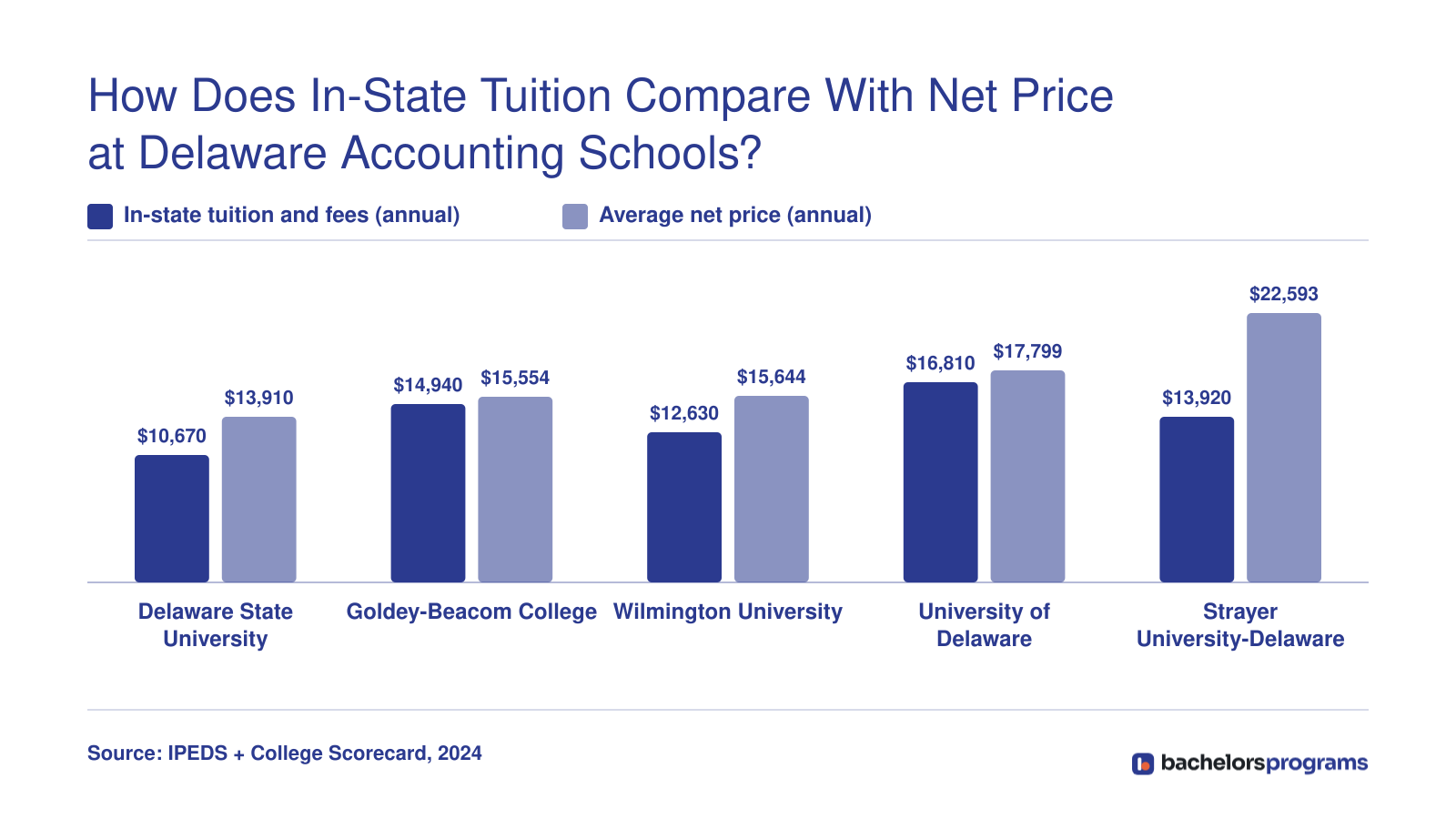
Annual in-state tuition and fees run from $10,670 at Delaware State University to $16,810 at the University of Delaware. Wilmington University charges $12,630, Strayer University-Delaware $13,920 and Goldey-Beacom College $14,940. Average annual net price after aid, an approximate figure, tells a different story:
- Delaware State University: $13,910
- Goldey-Beacom College: $15,554
- Wilmington University: $15,644
- University of Delaware: $17,799
- Strayer University-Delaware: $22,593
The public and private gap is narrower than sticker prices suggest, because private schools discount more heavily. Strayer is the exception, with the highest net price of the group. University of Delaware's out-of-state tuition is $41,400, so residency matters there.
Delaware state aid
The Inspire Scholarship is the most relevant award for accounting majors at Delaware State University. It pays full in-state tuition for generally up to eight semesters.1 Applicants must be Delaware residents and Delaware high school graduates with at least an 80 average or 2.75 GPA.1 They must attend full-time, have no felony conviction, and accept all other aid except loans.
The DHEO Scholarship Incentive Program (ScIP) is open to full-time Delaware undergraduates at accredited Delaware institutions. The listed 2026 award was $1,000 with a May 15, 2026 deadline.2 Amounts vary each year, awards are need-based, and a student can receive no more than five annual awards.3
SEED covers tuition for associate-level study, so it does not fund a bachelor's degree in accounting directly.4
A reality check on debt
Median program debt for accounting graduates is lowest at Goldey-Beacom College ($15,000), followed by Wilmington University ($20,271). Delaware State University graduates borrow a median of $25,000, and University of Delaware graduates $26,301. Strayer University-Delaware graduates borrow the most, at $41,625. The lowest net price does not always mean the least debt, so compare both.
How Does In-State Tuition Compare With Net Price at Delaware Accounting Schools?
Both figures are annual. Tuition and fees is the published in-state sticker price. Average net price is what students paid in a year after grants and scholarships, and it also includes housing, books and other living costs, so it can run higher than tuition. The gap between the two is the number that matters: at Goldey-Beacom College net price sits just $614 above tuition, while at Strayer University-Delaware it runs $8,673 above.
Accounting Careers in Delaware: Employers, Job Paths and Earnings
Delaware has a substantial accounting job market, and finance drives much of it. The Delaware Department of Labor counts 6,570 accountants and auditors statewide in its 2025 edition.1
Where Graduates Work
Most bachelor's graduates land in one of four tracks:
- Public accounting: audit, tax and advisory work at CPA firms.
- Corporate finance: accounting roles at banks and financial firms, concentrated around Wilmington.
- Government: state and local agencies, a path Delaware State University highlights for its program.
- Nonprofit: finance and compliance roles at charities and health and education organizations.
No verified ranking of Delaware's largest accounting employers is available, so check current openings directly rather than relying on a list.
Wages and Outlook
The state wage tables do not clearly identify a statewide median for accountants, so treat any single figure with caution and check the Delaware Department of Labor's tables for the current number.1 On demand, the state's finance-sector projections show replacement openings outnumbering growth openings by roughly two to one.2 That means most openings come from retirements and turnover, not from new positions.
What Graduates Earn After Finishing
College Scorecard figures measure something different from occupational wages. They are median earnings for graduates of each program, five years after completion:
- University of Delaware: $106,304
- Delaware State University: $71,308
- Goldey-Beacom College: $65,020
- Wilmington University: $63,650
- Strayer University-Delaware: $59,529
The gap is meaningful at the top. University of Delaware graduates report earnings well above the others, which sit within roughly $12,000 of one another. These are medians from modest graduate cohorts, so use them as a rough guide, not a promise.
What Accounting Graduates Earn After Finishing
Program-level earnings show what accounting bachelor's graduates from these Delaware schools actually make.
Questions to Ask Yourself
Will you sit for the CPA exam, and do you want a school that builds the 150-credit plan into its program?
Do you need evening or online classes while working, or can you attend on campus?
Is a Wilmington-area firm internship pipeline worth a higher net price to you?
Compare Accounting programs on the data that matters
Explore more Business & Management majors or browse every field of study.
All Business & Management programs Browse every field of study