Best Public Health Schools in Delaware
Compare 3 accredited Public Health programs in Delaware, with net price after aid, graduation rates, earnings and debt from IPEDS and the U.S. College Scorecard.

Delaware has no state license for public health practice, so employers lean on the degree and on national credentials such as CHES, an exam many graduates can take soon after earning a bachelor's degree in public health. The usual credential is the Bachelor of Science (B.S.) in Public Health, offered on campus at the University of Delaware in Newark and fully online by Delaware State University in Dover.
Strayer University-Delaware in Wilmington offers a related health services administration degree with more flexible scheduling.
Every school here is Delaware-based, campus or online. Check CEPH status early. On cost, sticker tuition understates the real bill, since net price after aid also counts housing and books.
Key Points
- University of Delaware and Delaware State University both offer public health majors.
- At every school here, net price tops tuition because it includes housing.
- No Delaware license exists for public health; CHES welcomes many new graduates.
Best Public Health Schools in Delaware: Ranked
Three Delaware schools offer a bachelor's degree in public health or a closely related public health pathway, and all three pair a foundation in epidemiology and community health with some form of applied practice. Two are traditional campus programs in Newark and Dover; the third is a fully online health services administration degree with a public health concentration, based in Wilmington. The order below reflects the program records and outcomes data used for this list.
University of Delaware
#1Newark, DE · $15,000 – $20,000/yr (est.)
Best for: Research-minded students in community health
The University of Delaware is the state's largest research university and the anchor for public health education in Newark, with a program that draws on multiple departments and colleges. Its Partnership for Healthy Communities connects coursework to real projects in New Castle, Dover, and Seaford, and the university has worked with the Delaware Division of Public Health on a statewide health improvement strategy. Students who want research experience alongside community practice get both here, and the public health bachelor's holds accreditation from the Council on Education for Public Health.
- Accredited by the Council on Education for Public Health
- Interdisciplinary curriculum spanning multiple colleges
- Builds skills in public health research and community engagement
- Partnership for Healthy Communities links students to state projects
- Focus on health disparities in resource-constrained communities
- Prepares for applied public health roles and graduate study
Delaware State University
#2Dover, DE · $10,000 – $15,000/yr (est.)
Best for: Hands-on learners seeking a senior practicum
Delaware State University is a public land-grant institution in Dover and the state's only historically Black university, and its public health bachelor's leans heavily on practice. The curriculum spans health education and policy, informatics, chronic disease management, nutrition, environmental health, and epidemiology, and every student finishes a twelve-credit senior capstone practicum with an extensive report and oral presentation. The Dover location puts students near state agencies and community organizations, and graduates move into public health agencies, nonprofits, worksite wellness, and HIV prevention work.
- Twelve-credit senior capstone practicum with field experience
- Coursework in epidemiology, informatics, and environmental health
- Training in needs assessment, program planning, and evaluation
- Covers health education, policy, nutrition, and substance use
- Example roles: immunization coordinator, food inspector, wellness coordinator
- Builds a foundation for graduate study in public health and epidemiology
Strayer University-Delaware
#3Wilmington, DE · ~$23,000/yr (est.)
Best for: Working adults needing fully online study
Strayer University-Delaware is a Wilmington campus of a national online institution, and its public health offering is a concentration inside the Bachelor of Science in Health Services Administration rather than a standalone public health major. The degree runs 40 courses fully online, with academic coaches and advisors assigned to each student, and transfer credit can cover up to 28 classes. It fits adults who need to keep working while they finish a bachelor's, and it points toward community health education, public health agencies, and emergency preparedness roles.
- Fully online, 40-course degree
- Public health concentration within health services administration
- Coursework in biostatistics, epidemiology, and emergency management
- Learn to investigate outbreaks and interpret public health data
- Transfer up to 28 classes, with no-cost general education courses
- One-on-one academic coaches and advisors; Middle States accredited
Cost & outcomes by school
Federal data for the highest-earning Public Health programs, independent of the ranking above. Earnings are this field's bachelor's graduates four years after completing where the Scorecard reports them, else the school's undergraduate median.
| School | Net price / yr | Grad rate | Earnings | Debt | Grads/yr | Format |
|---|---|---|---|---|---|---|
| University of Delaware DE | $17,799 | 81% | $70,793 | $24,336 | 138 | Campus |
| Delaware State University DE | $13,910 | 39% | $49,307 | $25,872 | 47 | Campus |
| Strayer University-Delaware DE | $22,593 | — | $40,092 | $40,621 | — | Online |
Sources: U.S. Department of Education. Net price, graduation rate, earnings and debt: College Scorecard (earnings and debt for this field's bachelor's graduates where reported, else school-wide); graduates: IPEDS. A dash means no figure is reported.
Cost, debt & payoff
Median earnings of this field's bachelor's graduates (4 yrs after completing, else the school's undergraduate median) vs. their median federal loan debt · U.S. College Scorecard
Across these programs the median graduate earns about $49,307 and finishes with roughly $25,872 in debt — a ratio that clears a common rule of thumb (keep debt below first-year salary). Net price and debt vary widely school to school, so check the per-school figures in the table above before you shortlist.
How We Ranked Delaware's Bachelor's Programs in Public Health
The cheapest school is not always the one with the strongest outcomes, and the ranking reflects that tradeoff. Four College Scorecard measures set the order: net price (what students pay after grants), graduation rate, earnings ten years after enrollment, and typical debt at graduation.
What the Numbers Mean
Graduation rate, net price, and 10-year earnings are institution-wide. They describe everyone at the school, not only public health majors. Treat them as a read on the campus, not a promise about this degree.
The gaps are still useful:
- University of Delaware: about 81% of students graduate, net price is $17,799, and median earnings reach $72,950.
- Delaware State University: net price is lower at $13,910, with a 39% graduation rate and median earnings of $49,307.
- Strayer University-Delaware: net price is $22,593, median earnings are $40,092, and typical debt is $40,621. No graduation rate is reported.
So, What Is the Best Public Health School in Delaware?
There is no single answer. The best fit depends on your budget, whether you need an on-campus or online format, and your goals. Students planning graduate study or a research-heavy path may weigh the University of Delaware's accredited program differently from someone who wants a lower sticker price at Delaware State or a fully online route at Strayer. Use the order as a starting point, then compare the schools against your own priorities.
Earning a Bachelor's Degree in Public Health in Delaware: Who Offers It and CEPH Status
Which Delaware colleges actually award a bachelor's degree in public health, and do any carry CEPH accreditation? The University of Delaware and Delaware State University both offer an undergraduate public health major. Strayer University-Delaware offers a related health administration degree.
Who Offers the Degree
- University of Delaware (Newark): Bachelor of Science in Public Health, 121 credits.
- Delaware State University (Dover): B.S. in Public Health. The program is undergraduate, so DSU is not limited to graduate study in this field. Ask the department for its current curriculum sheet and practicum details.
- Strayer University-Delaware (Wilmington): Bachelor of Science in Health Services Administration. This fits students drawn to running health organizations rather than studying population health.
CEPH Status
UD states that its public health curriculum follows standards set by the Council on Education for Public Health (CEPH). Following those standards is not the same as holding a separate accreditation for the undergraduate degree. UD's program materials do not show the bachelor's carrying its own CEPH accreditation. Delaware State's accreditation status should be confirmed directly with its department. If CEPH status matters to your plans, ask each admissions office to state it in writing.
What You Study
UD's core covers population health, epidemiology, biostatistics, and health policy. The degree requires a capstone and supervised experiential learning.
One route is HBNS 464, a Health Behavior Science internship worth 6 to 9 credits. It is graded pass/not-pass and requires faculty advisement and instructor permission. The catalog describes it as a capstone and professional practicum. Not every major necessarily takes that exact course, so map out your plan with an advisor early.
Credentials After Graduation
Delaware does not license public health practice. No state board stands between graduation and your first job. Voluntary national credentials fill that role instead.
UD says its bachelor's positions graduates for the Certified Health Education Specialist (CHES) credential. CHES is a common choice for health education and community outreach roles. Being positioned for the credential is not the same as guaranteed eligibility. Compare the credentialing body's coursework requirements against your transcript before you register for the exam.
The Certified in Public Health (CPH) credential is another option. It is often pursued later in a career, so read its eligibility rules before counting on it right after graduation.
Related Articles
Online and Hybrid Public Health Bachelor's Options at Delaware Schools
An online public health bachelor's covers the same coursework as a campus degree through web-based classes, so you can study without relocating or keeping a fixed class schedule. Among the schools here, the formats split clearly.
Campus, online, or both
- University of Delaware: The B.S. in Public Health (121 credits) is a campus program in Newark. Its program pages describe no online or hybrid track.
- Delaware State University: The B.S. in Public Health is listed as 100% online, with a four-year, 122-credit structure. Tuition runs roughly $446 to $504 per credit hour, and separate registration, technology, distance-education, and textbook-access fees apply.
- Strayer University-Delaware: Its Bachelor of Science in Health Services Administration, with a public health concentration, is offered fully online. It is not a standalone public health major, but it is the closest alternative if you want a health-focused degree with a public health emphasis.
None of the program pages for these schools describe a hybrid format. If you want a blend of online and in-person learning, ask each admissions office directly what it can arrange.
Who benefits most
Online study suits working adults who need to keep a job or manage family responsibilities while earning a degree. Transfer students often benefit too. Strayer states that you can transfer up to 28 classes, which can shorten the path considerably. If you are coming straight from high school and want labs, in-person advising, and campus life, University of Delaware's on-campus format fits better. Before you enroll in any online option, confirm the current per-credit rate and fee schedule, since the total depends on how many credits you take each semester.
Admissions for Public Health Bachelor's Programs in Delaware
What GPA and test scores do you need to get into a public health program in Delaware? The answer differs by school, and some schools publish very little. Here is what each admissions page shows.
School-by-School Requirements
- University of Delaware: No single overall GPA is published. A 3.2 applies to transfers into Human Physiology, with a B or higher in college biology and chemistry labs. SAT/ACT scores are not required, and students who skip them remain scholarship-eligible. The Early Action and Honors deadline is November 1. Transfer deadlines are suggested for November 1 (spring) and June 1 (fall). Transfer credit acceptance varies by program. Students with 24 or more earned credits need only college transcripts.
- Delaware State University: The minimum GPA is 2.0. Testing is optional until further notice, and applications get a holistic review. Deadlines listed for 2027 are Fall Early Action on November 2, Fall Regular on April 15, and Spring Regular on October 5. First-year applicants need 19 course units with a C or better, including four in English and three each in math and lab science. Transfer credit policy: No published policy.
- Strayer University-Delaware: GPA: No published policy. Tests: No published policy. Deadlines: No published policy. Transfer credit: No published policy.
Declaring the Major
At the University of Delaware and Delaware State University, the admissions pages do not lay out separate steps for declaring public health as a major or minor. The usual route is to apply to the university, then meet with an academic advisor to confirm the program and any course prerequisites. Transfer students should ask for a credit evaluation before they commit, since credit acceptance is decided program by program at Delaware.
Admissions requirements, deadlines, and test policies change from year to year. Treat the details above as a starting point and confirm them on each school's current admissions page, or with an admissions counselor, before you apply.
Cost of a Public Health Bachelor's Degree in Delaware
The cheapest sticker price is not always the cheapest bill, and in Delaware the gap depends heavily on whether you qualify for state aid. Here is how the three schools compare, using approximate federal Scorecard figures.
Tuition, fees and net price
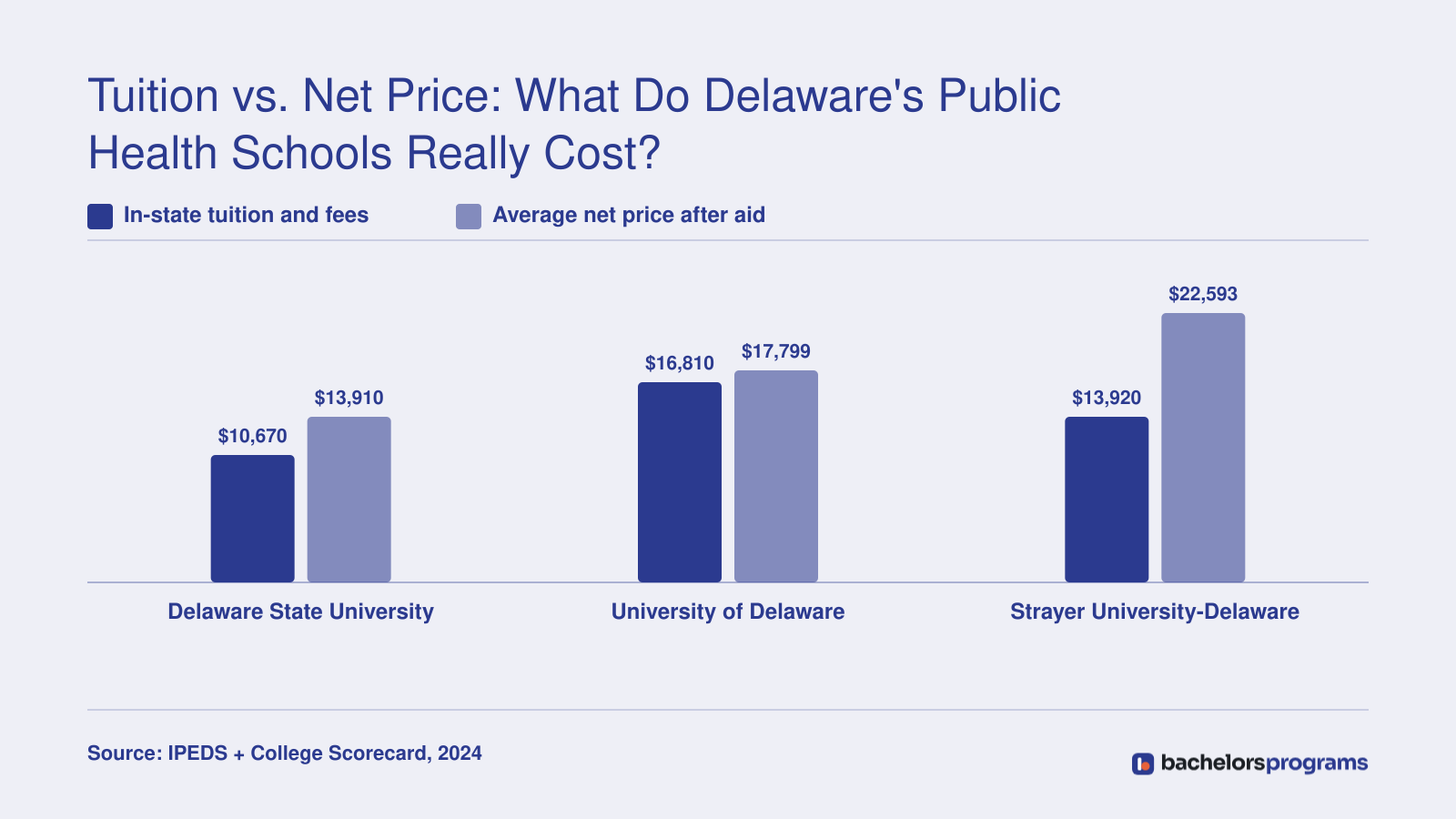
- Delaware State University: In-state tuition and fees run $10,670, against $20,634 out of state. The average net price after aid is $13,910.
- University of Delaware: In-state tuition and fees are $16,810, and out-of-state is $41,400. The average net price is $17,799.
- Strayer University-Delaware: Tuition and fees are $13,920 for everyone, in-state or not. The average net price is $22,593.
Net price is an institution-wide average across all undergraduates, not a figure for public health majors, so your own number will vary with income and aid.
Median debt
Median debt for graduates is about $26,000 at Delaware State, $24,572 at the University of Delaware and $40,621 at Strayer. Treat these as approximate. They reflect past cohorts and the whole institution, not one program.
Delaware aid programs
Two state programs matter most, and they work very differently.
- Inspire: This is a full four-year tuition scholarship at Delaware State University. The award equals full in-state tuition. You must be a Delaware resident, enroll full time in a degree program, and have no felony conviction.2 You also need a Delaware high school diploma with a cumulative average of at least 80 out of 100 (2.75 on a 4.0 scale). Awards depend on annual state appropriations.2 If eligible applicants outnumber funds, the university can prioritize by financial need and academic achievement. The sources reviewed do not say whether it covers mandatory fees, housing, or books, so budget for those.
- SEED: This program makes tuition free for Delaware residents, but it applies to associate-level study, including the University of Delaware's Associate in Arts Program.1 It is not a scholarship for the bachelor's public health degree itself, though it can shorten the cost of a path that transfers into one.
The Delaware Higher Education Office, part of the state Department of Education, lists both programs and also administers the Scholarship Incentive Program.1 Check its current pages for eligibility and award details before you apply, since funding is set each year.
The bottom line
For an in-state student who meets the Inspire requirements, Delaware State University is the most affordable route, with the lowest sticker price and a tuition scholarship on top.
Tuition vs. Net Price: What Do Delaware's Public Health Schools Really Cost?
Sticker tuition tells only part of the story. At every school here, the average net price runs higher than tuition because net price covers the full cost of attendance (tuition, fees, housing, books and other expenses) after grants and scholarships. It is also an institution-wide average for aided students, not a figure for public health majors alone. Delaware State University has the lowest tuition and net price, while Strayer University-Delaware shows the widest gap between tuition and net price.
Public Health Careers and Credentials in Delaware
Two credentials dominate public health hiring, and they sit at very different points in a career. CHES is open to many bachelor's graduates right after graduation. CPH usually comes later. Delaware has no state license for public health practice, so both are voluntary professional credentials.
Where Bachelor's Graduates Work
Entry-level roles generally fall into four settings: state and county health agencies, hospital and health-system community programs, nonprofits, and local health departments. Delaware State University's public health program points to agency careers, community health work, and roles such as HIV prevention specialist, diabetes prevention specialist, and employee wellness coordinator. Strayer University-Delaware's online health services administration degree, with a public health concentration, emphasizes health education materials and outbreak investigation skills.
Pay for Health Education Roles
A Delaware wage document for health education specialists (SOC 21-1091) lists an hourly figure of $31.98, with a range running from $21.09 to $37.43. It does not clearly label which percentile each number represents, so treat these as a rough guide rather than a precise median. For a national comparison, check the Bureau of Labor Statistics for the latest U.S. figure.
What Graduates Actually Earn
College Scorecard reports earnings for the public health program itself, not the whole university. Five years after completion, University of Delaware public health graduates had median earnings of $63,636, and Delaware State University graduates had $55,503. Strayer's program does not have program-level earnings reported. Cohorts are small and reflect older graduating classes, so use these as context, not a promise.
CHES and CPH Explained
- CHES: Run by NCHEC, it requires a bachelor's degree or higher from an accredited institution. You qualify with a major in a field such as health education, community health education, or public health education. Alternatively, you need at least 25 semester credits (37 quarter hours) of coursework, grade C or better, tied to the Nine Areas of Responsibility for health education specialists. At least 12 semester credits must be process courses. The exam tests those same areas.
- CPH: Run by NBPHE, it is open with a bachelor's degree plus five years of public health work experience. A graduate-degree pathway needs three years, but it does not apply to bachelor's-only candidates.
If you want a credential soon after graduating, plan your electives around the CHES coursework rules and confirm with your advisor how your transcript maps to them.
Questions to Ask Yourself
Will you live on campus, or do you need online or hybrid study because you work?
Are you an in-state student who can use Delaware aid, or paying out-of-state rates?
Do you need CEPH accreditation or CHES-aligned coursework for your target job or graduate plans?
Are you starting fresh, or transferring credits from a Delaware community college?
Choosing the Right Delaware Public Health School for Your Situation
The choice usually comes down to a tradeoff: the lowest cost and the most convenient format, or the strongest fit with the public health career you actually want. Settle it by comparing a short list of specifics rather than general impressions.
Start With the Job, Then Work Backward
Before comparing schools, look up your target occupation on BLS.gov, where the Occupational Outlook Handbook lists typical duties, pay, and projected demand for roles such as health education specialist, community health worker, and epidemiologist. Then check professional associations such as the American Public Health Association (APHA) and the Society for Public Health Education (SOPHE) for career guidance and credential information, including the certified health education specialist pathway. That picture tells you which concentration, fieldwork, and credential support matter most.
Compare Programs on the Details That Change Outcomes
Go to each school's program and admissions pages and ask directly about:
- Accreditation: which accreditations apply to the specific bachelor's program, and whether the public health degree sits within a CEPH-accredited school or program. For a health services administration degree, ask which programmatic or business accreditation applies.
- Curriculum and concentration: required courses, electives, and whether the degree leans toward population health, policy, or administration.
- Fieldwork: where recent students completed practicums and internships, and whether placements are arranged in Delaware organizations such as county health departments, hospitals, and nonprofits.
- Cost: in-state tuition at Delaware's public universities, published net price after aid, and which Delaware grant and scholarship programs apply.
- Format: part-time, evening, and online options, and how long each route takes to finish.
Questions to Verify Yourself
Ask each school where graduates have been hired in Delaware, what career services they offer, and how alumni connections work in the state. Request a written estimate of total cost for your situation, not a sticker price. Then compare your notes side by side: the program that answers these questions clearly and matches your career target is usually the right one.
Compare Public Health programs on the data that matters
Explore more Healthcare majors or browse every field of study.
All Healthcare programs Browse every field of study