Best Communications Degree Programs in Delaware
Compare 10 accredited Communications programs in Delaware at 4 colleges, with net price after aid, graduation rates, earnings and debt from IPEDS and the U.S. College Scorecard.

Delaware's communications options divide along a familiar line: a public flagship with research faculty in Newark, and smaller private colleges where evening and online sections serve working adults. Most schools here award the Bachelor of Arts (B.A.) in Communications, though some title it mass communications or communication and media. A bachelor's degree in communications in this state runs anywhere from roughly $12,000 to $41,000 a year in tuition, depending on residency and sector.
That spread, not the diploma wording, is the real decision.
What separates graduates in Wilmington and Dover is less the degree's name than the internship clips and portfolio work behind it.
Key Points
- University of Delaware communication graduates earned a $70,414 median four years out.
- Wilmington University's B.S. in Communication can be completed fully online.
- At Delaware State University, mass communications graduates' one-year median was $30,098.
Best Bachelor's Degree in Communications Schools in Delaware, Ranked
Delaware is a small state with a short list of communications bachelor's degree options, and they differ sharply in size, price and format. The four schools below range from a flagship public research university to a small private college, a historically Black land-grant university in Dover and a test-optional university built for working adults. Each entry describes the school as a whole, then the specific communications programs and concentrations a student can actually enroll in.
University of Delaware
#1Newark, DE · $15,000 – $20,000/yr (est.)
Best for: Students seeking multiple concentration options
Delaware's flagship public university in Newark awards more communications bachelor's degrees than any other school in the state, and its B.A. in Communication carries three concentration options spanning interpersonal, media and public relations study. Students can earn academic credit through internships, independent study and research projects with faculty mentors, and eligible juniors can begin graduate coursework in strategic communication through a 4+1 pathway. The department's roughly 188 bachelor's degrees a year make it the largest program in Delaware.
- Bachelor of Arts in Communication with three concentration options
- Tracks: Interpersonal Communication, Media Communication, Public Relations
- 2.5 minimum GPA to change into the major
- C- minimum grade required in communication courses
- Internships, independent study and faculty research carry academic credit
- Eligible juniors can start graduate study in strategic communication
- Honors program and multiple minor options available
- Writing Center and Student Success Center support on campus
Goldey-Beacom College
#2Wilmington, DE · $15,000 – $20,000/yr (est.)
Best for: Aspiring social media and brand strategists
A small private college in Wilmington, Goldey-Beacom pairs its communications offerings with a formal partnership with Pennsylvania College of Art & Design, so students can take creative design courses covering layout, visual organization and industry-standard technology alongside media coursework. Lightning Studio projects supply video and social media production experience, and an industry network supports internships and mentorships. The college also publishes employer-specific tuition discounts for workers at some Delaware companies, including a 10% discount for eligible staff at participating organizations.
- 120 credit hours to graduate
- Partnership with Pennsylvania College of Art & Design for design coursework
- Lightning Studio projects in video and social media
- Internships and mentorships through an industry network
- Theory blended with hands-on projects across the curriculum
Delaware State University
#3Dover, DE · $10,000 – $15,000/yr (est.)
Best for: Hands-on learners wanting campus newsrooms
Delaware State University in Dover, the state's historically Black land-grant institution, builds its Mass Communications bachelor's degree around three concentrations and two required off-campus internships. Students work in student-run television and radio stations and modern broadcast facilities, and the campus hosts chapters of the National Association of Black Journalists and the Public Relations Student Society of America. Faculty bring journalism, public relations and broadcasting experience, and research support runs through the McNair Program and honors presentations.
- Bachelor of Arts in Mass Communications
- Tracks: Convergence Journalism, Public Relations and Advertising, Digital Media Production
- Two required off-campus internships
- Student-run TV and radio stations plus studio and live event production
- Campus chapters of NABJ and PRSSA
- Faculty with journalism, PR and broadcasting industry experience
- McNair Program research and honors presentation opportunities
- News writing, video and audio production, media law and ethics coursework
Wilmington University
#4New Castle, DE · ~$16,000/yr (est.)
Wilmington University in New Castle offers a bachelor's degree in communications with a fully online option that requires no campus attendance, which makes it the most flexible of the four programs. Admission is test optional and calls for no entrance exam, out-of-state students pay the in-state tuition rate, and the Brandywine site is set up for working adults with extended hours and 150-plus programs under one roof. The location across from Concord Mall serves Chester, Delaware and northern New Castle counties.
- Bachelor of Science in Communication available 100% online
- Test optional admission with no entrance exam required
- Out-of-state students pay the in-state tuition rate
- Designed for working adults, with extended Wednesday hours
- 150+ career-building programs at the Brandywine site
- Student Success Center, library, labs and campus store on site
Cost & outcomes by school
Federal data for the highest-earning Communications programs, independent of the ranking above. Earnings are this field's bachelor's graduates four years after completing where the Scorecard reports them, else the school's undergraduate median.
| School | Net price / yr | Grad rate | Earnings | Debt | Grads/yr | Format |
|---|---|---|---|---|---|---|
| University of Delaware DE | $17,799 | 81% | $70,414 | $24,296 | 262 | Campus |
| Goldey-Beacom College DE | $15,554 | 57% | $59,892 | $18,900 | 1 | Campus |
| Wilmington University DE | $15,644 | 20% | $53,844 | $20,000 | — | Hybrid |
| Delaware State University DE | $13,910 | 39% | $46,440 | $25,000 | 26 | Campus |
Sources: U.S. Department of Education. Net price, graduation rate, earnings and debt: College Scorecard (earnings and debt for this field's bachelor's graduates where reported, else school-wide); graduates: IPEDS. A dash means no figure is reported.
Cost, debt & payoff
Median earnings of this field's bachelor's graduates (4 yrs after completing, else the school's undergraduate median) vs. their median federal loan debt · U.S. College Scorecard
Across these programs the median graduate earns about $56,868 and finishes with roughly $24,296 in debt — a ratio that clears a common rule of thumb (keep debt below first-year salary). Net price and debt vary widely school to school, so check the per-school figures in the table above before you shortlist.
Communications Concentrations Compared: Media, Public Relations and Interpersonal Leadership
Employers expect communicators to handle content creation and people-facing work alike, so your concentration decides which one you practice first.
Concentrations and Entry-Level Jobs
The University of Delaware publishes two concentrations in its Communication B.A.
- Media Communication: Social media coordinator, content specialist, communications assistant.
- Interpersonal Communication: Client relations representative, training coordinator, human resources assistant.
Public relations roles, such as a PR assistant or communications coordinator, generally draw on the media-focused coursework. Goldey-Beacom College's Communication and Media program and Delaware State University's Mass Communications program lean toward that media side. Wilmington University offers a BS in Communication. Confirm each school's current concentration list in its catalog before you apply.
How the Degrees Differ
Communication is the broadest of these degrees. It covers how messages work in organizations, relationships and media. Journalism narrows to reporting, sourcing and news ethics. Media Studies is more analytical: you study and critique media rather than produce it. A Visual Communications B.F.A. is a studio degree built around design and a portfolio. Choose it if you want to make visual work for a living, not manage messaging.
Credits, Internship and Capstone
The University of Delaware's Communication B.A. requires a minimum of 124 credits and a Capstone Experience. An internship is optional. COMM 364 can count for 3 credits toward the 12 credits of restricted COMM electives. It is open to juniors and seniors with at least a 2.75 GPA in communication courses. Seats are limited and not guaranteed, and the course runs in fall, spring and summer. If COMM 364 is full, students can register for UNIV 364 through the Career Center. For the other schools here, check the official program catalog for credit totals and any capstone or internship requirement, which vary by school.
A Rule of Thumb
Pick Media Communication if you want to produce content, and Interpersonal Communication if you want to lead, persuade or train people.
Online and Hybrid Bachelor's in Communications Options at Delaware Schools
Wilmington University is the only Delaware-based school whose communications bachelor's program can be completed online, and for working adults in the state that settles the format question.
Fully Online Versus Campus
Wilmington's B.S. in Communication carries both an online and an on-campus format.2 The degree runs 120 credits across 40 courses, with concentrations that include Digital Journalism, and it is built around working adults rather than traditional full-time students. Online students outside Delaware should note that out-of-state students pay the in-state rate here, so distance does not carry a tuition penalty.
University of Delaware, Goldey-Beacom College and Delaware State University list their communications bachelor's as campus programs. Delaware's flagship program in Newark centers on Communication with an Interpersonal Communication concentration. Goldey-Beacom's Communication and Media major sits in Wilmington, and Delaware State's Mass Communications degree is based in Dover. A student who wants any of those three should plan on attending in person.
Before You Commit to an Online Seat
Wilmington's program materials confirm an online option but do not spell out, course by course, whether every requirement can be met remotely. Ask an advisor which courses carry on-site or location-based components, and get the answer before you register rather than in your final term.
Transfer students bringing credit from a two-year school should request a written credit evaluation early. With 40 required courses,1 a handful of credits applied to the wrong category can push a graduation date back a full term.
Admission Requirements for Delaware Communications Bachelor's Programs: GPA, Test Policy and Transfer Credit
The GPA figures below are reported averages for enrolled freshmen drawn from third-party college profiles, so read them as a rough sense of each school's typical student rather than as hard cutoffs. Delaware State University's reported average of about 3.16 and Goldey-Beacom College's reported average near 3.2 suggest accessible entry for solid B students, and the University of Delaware publishes the most detailed testing and credit rules of the schools ranked here. Confirm current requirements with each admissions office before you apply, because policies change from year to year.
| School | GPA Expectation | Test Policy | Transfer Credit Policy |
|---|---|---|---|
| University of Delaware | No policy published | Test-optional: submit SAT or ACT scores or choose the Test Optional Program | AP, IB and comparable exam scores may earn credit; applicants with fewer than 24 transferable college credits must also send a final high school transcript and official test scores (per the university catalog) |
| Delaware State University | 3.16 average for enrolled freshmen (third-party profile) | Test-optional for students starting in fall 2027; submitted scores are considered | No policy published |
| Goldey-Beacom College | 3.2 average (college listing) | No policy published | No policy published |
| Wilmington University | No policy published | No policy published | No policy published |
Related Articles
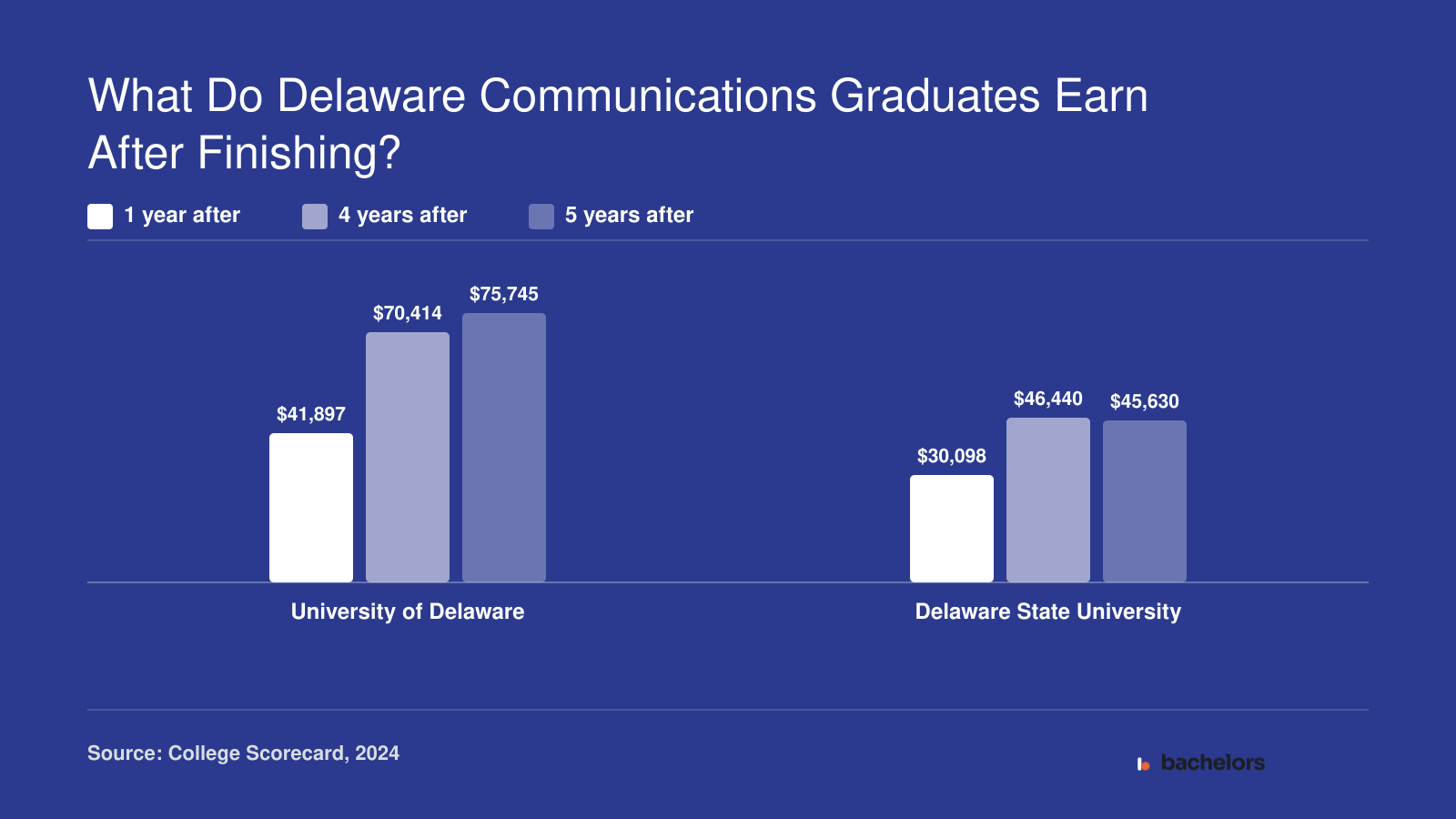
What Do Delaware Communications Graduates Earn After Finishing?
University of Delaware communication graduates earned a median of $41,897 one year after finishing their bachelor's, $70,414 at four years and $75,745 at five years. Delaware State University mass communications graduates earned $30,098 at one year, $46,440 at four years and $45,630 at five years. The chart covers only these two programs because Goldey-Beacom College and Wilmington University have no program-level earnings figures reported. Campus-wide salary figures are left out so the comparison stays focused on communications graduates.
Communications Careers and Salaries in Delaware
Communications hiring in Delaware increasingly rewards people who can pair clean writing with data, and the state's wage figures show what that combination pays.
What the State's Wages Look Like
The U.S. Bureau of Labor Statistics publishes May 2023 estimates for Delaware occupations that communications graduates commonly enter:
- Public relations specialists: 960 jobs, median annual wage of $74,6201
- Editors: 180 jobs, median annual wage of $77,6501
- Technical writers: 110 jobs, median annual wage of $106,4001
Those are occupational estimates covering everyone working in the state, not a measurement of what graduates of any one program earn. A new graduate usually starts below the median and moves up as clips, campaigns, and client work accumulate. Public relations is the largest of the three by a wide margin, which matters if you want to stay in state rather than commute into Philadelphia or remote roles elsewhere.
Where Graduates Actually Land
Titles vary more than the wage table suggests. Communications graduates from the schools on this page move into marketing and social media coordination, internal and employee communications, development and alumni relations, human resources, and newsroom or production work. Employers range from state agencies and hospital systems to banks and the small agencies clustered around Wilmington.
No License Required
Delaware does not license communications professionals. Communications professionals need no state exam, no supervised hours and no credential to renew. Your portfolio does the work a license does in other fields: published clips, campaign results, analytics reports, and internship references.
Delaware Communications Degree FAQs
These answers cover the questions Delaware students ask most about a bachelor's degree in communications. Program details can change, so confirm specifics with each school's admissions office before you apply.
Which Delaware school has the best bachelor's degree in communications?
Can you get a bachelor's degree in communications online from a Delaware school?
Can I transfer community college credits into a communications bachelor's program in Delaware?
What is the difference between communication, journalism and media studies degrees?
Compare Communications programs on the data that matters
Explore more Communications & Media majors or browse every field of study.
All Communications & Media programs Browse every field of study