Best Communications Degree Programs in Louisiana
Compare 29 accredited Communications programs in Louisiana at 15 colleges, with net price after aid, graduation rates, earnings and debt from IPEDS and the U.S. College Scorecard.
A bachelor's degree in communications is offered on Louisiana campuses from Baton Rouge to Shreveport, and by Louisiana-based schools that deliver coursework online. Most schools award the Bachelor of Arts (B.A.), though some label the degree communication studies, mass communication, or strategic communication.
The real decision is not whether to study communications but which version fits your budget and your first job. Net price swings widely between public universities and private ones in New Orleans, and a narrow mass communication track builds a different portfolio than a broad studies degree.
In a state where newsrooms are small and public relations work clusters around a few metro areas, that portfolio often counts for more than the program's name.
Key Points
- LSU Shreveport has the lowest average net price here, at $7,022.
- Southeastern charges $8,373 in-state tuition and fees; UL Lafayette charges $10,418.
- Median graduate debt spans $18,135 (LSU Shreveport) to $22,250 (McNeese State).
Best Schools for a Bachelor's Degree in Communications in Louisiana
Louisiana's communications programs run from a flagship research campus in Baton Rouge to small liberal arts departments in New Orleans and regional universities across the northern half of the state. Every school below awards a bachelor's degree in communications, and most offer more than one track, so the fit usually comes down to how much hands-on production you want and what you can afford after aid.
Louisiana State University and Agricultural & Mechanical College
#1Baton Rouge, LA · $15,000 – $20,000/yr (est.)
Best for: In-state students wanting a flagship research campus
Louisiana's flagship campus in Baton Rouge, where communication studies sits inside a large research university with deep media resources. Undergraduates work through a theory-and-practice core covering rhetoric, organizational communication, and conflict resolution, with room for electives at the upper division. LSU's Manship School also introduced a $50,000 advertising scholarship, which matters to students leaning toward strategic communication. A separate online track in communication in human relationships lets working students earn the same credential remotely.
- 120 total credit hours, including 12 core communication courses
- 24 hours of communication electives, at least 12 at upper division
- Maximum of 37 communication hours counted toward the degree
- Computer literacy requirement plus a lab-based science sequence
- Coursework in rhetoric, organizational communication, and conflict resolution
- Campus program in Baton Rouge
- $340 per credit hour in the online format
- 120 total credit hours: 18 core, 18 concentration, 39 general education
- Minimum 2.0 high school GPA and ACT composite of 20
- Up to 75% of credits may transfer
- Concentration courses in interpersonal, small group, intercultural, and nonverbal communication
- Live video sessions and dedicated student support coaches
Tulane University of Louisiana
#2New Orleans, LA · ~$40,000/yr (est.)
Best for: Private-university seekers drawn to media theory
A private research university in New Orleans with a small communication major built on seminars and close reading rather than production drills. The curriculum is organized around texts and representation, identities and relationships, and the political and economic structures that shape media, with social justice as a recurring theme. Honors students can take a graduate seminar and write a thesis. It suits students who want a critical, theory-heavy foundation and can absorb private tuition.
- Coursework grouped into texts and representation, identities and relationships, and structures and institutions
- Emphasis on social inequality, power, and media's role in society
- Close textual analysis of written, visual, and nonverbal communication
- Honors option includes a graduate seminar and a thesis
- Campus program in New Orleans
Louisiana Tech University
#3Ruston, LA · ~$12,000/yr (est.)
Best for: Community college transfers eyeing North Louisiana
A public university in Ruston whose communication degree shares a common core across concentrations and closes with a senior capstone. The coursework pairs contemporary communication theory and research methods with practical electives, and the catalog points graduates toward public relations, corporate consulting, advertising, and digital design. Louisiana Tech also signed a transfer pathway agreement with Bossier Parish Community College, which helps North Louisiana students plan a four-year route early.
- 15-hour shared core across all concentrations
- 39 hours in concentration courses, including 9 hours of directed electives
- 21 elective hours built into the curriculum
- Capstone seminar required in the senior year
- Coursework in contemporary communication theory, research methods, and media literacy
- Catalog names public relations, corporate consulting, advertising, and web design as outcomes
University of Louisiana at Monroe
#4Monroe, LA · ~$13,000/yr (est.)
A regional public university in Monroe whose communication major splits into three distinct tracks: communication studies, film and media arts, and integrated media. The communication studies track takes a pragmatic, cultural approach to how messages shape relationships and identity, while integrated media students work with the student-operated radio station. Class sizes are modest and the price point is among the lower ones in the state.
- Pragmatic, skills-based curriculum focused on communication in cultural contexts
- Prepares graduates for public relations, corporate communication, and media roles
- Emphasis on ethical strategy and adapting to diverse audiences
- Coursework in motion graphics and film editing
- Financial aid and scholarships available to majors
- Skills framed around a competitive media job market
- Training for roles as the public face of an organization
- Student-operated radio station KXUL on campus
- Coursework in cultivating ethical professional relationships
University of Louisiana at Lafayette
#5Lafayette, LA · $10,000 – $15,000/yr (est.)
A public university in Lafayette with a mass communication program that emphasizes doing the work rather than only studying it. Journalism and broadcasting students build portfolios, complete a senior internship, and finish with a capstone often produced for an off-campus client. A separate strategic communication track in advertising rounds out the offerings, and every major adds a minor outside the department.
- Tracks in journalism and broadcasting
- Senior-year internship required
- Capstone project, often produced for an off-campus client
- Minor required outside the department
- All majors study media design, communication law, and ethics
- Portfolio built across the degree
- Advertising concentration
- Internship required in the senior year
- Capstone course included
- Minor required outside communication
- Courses in communication law and ethics
Southeastern Louisiana University
#6Hammond, LA · ~$13,000/yr (est.)
A public university in Hammond with a flexible Bachelor of Arts in Communication that lets students weight coursework toward media strategy, content creation, or communication theory. The degree requires 39 hours of general education alongside a substantial block of major electives, and 15 of the elective hours must be upper division. Students drawn to organizational communication, multimedia journalism, sports communication, or corporate training can shape the major around those areas, and an 18-hour communication minor is available.
- 39 hours of general education, 33 supporting, 27 major electives, 18 concentration hours
- COMM 1510 core requirement, passed with a C or better
- 15 elective hours must sit at the 3000 or 4000 level
- Study areas include organizational communication, multimedia journalism, and sports communication
- Honors diploma available in the discipline
- 18-hour communication minor available
McNeese State University
#7Lake Charles, LA · $10,000 – $15,000/yr (est.)
A public university in Lake Charles offering a Bachelor of Science in Mass Communication with an unusually hands-on structure. Every student completes an internship and works on client-based projects, and four tracks let students specialize in journalism, public relations, integrated digital media, or sports and entertainment communication. The Poke Press publication, the speech and debate team, and PRSSA and SPJ connections give students outlets and professional contacts before graduation.
- 120 credit hours over four years, delivered in person
- Internship required before graduation
- Client-based projects and service-learning classes
- Tracks in journalism, public relations, integrated digital media, and sports and entertainment communication
- Student work through the Poke Press online publication
- Speech and debate team plus PRSSA and SPJ conference access
Xavier University of Louisiana
#8New Orleans, LA · $17,000/yr (est. net price)
A private university in New Orleans and one of the nation's historically Black Catholic institutions, with a communication studies degree rooted in applied communication, culture, and performance. Service-learning courses and a capstone are required, and the department encourages double concentrations, study abroad, and faculty-student research collaboration. A separate mass communication track adds multimedia and strategic communication options, supported by student-run XUTV and XRadio.
- Coursework in applied communication, communication and culture, and performance studies
- Service-learning courses and a capstone required
- Double concentrations and study abroad encouraged
- Students attend national conferences and collaborate with faculty on research
- Honors distinction available
- Tracks in multimedia and strategic communication/public relations
- Student-run media outlets including XUTV and XRadio
- Internship program available to majors
- PRSSA student association on campus
- Health communication certificate option
- Mass communication minor available
Loyola University New Orleans
#9New Orleans, LA · ~$24,000/yr (est.)
A private Jesuit university in New Orleans with a mass communication degree that leans on professional practice. Students choose journalism, advertising, or public relations and produce work in the Multimedia Center, the Digital Communications Hub, and The Maroon, the campus outlet where Hearst Award-winning student work has appeared. A Degree in Three option and a fully online Bachelor of Arts in Communication give students faster or more flexible routes to the credential.
- Tracks in journalism, advertising, and public relations
- Multimedia Center and Digital Communications Hub access
- Student work published through The Maroon
- Degree in Three option to finish in three years
- Center for Environmental Communication on campus
- Faculty bring professional media experience
Northwestern State University of Louisiana
#10Natchitoches, LA · $10,000 – $15,000/yr (est.)
A public university in Natchitoches with a communication degree organized around three academic maps: journalism, sports media, and strategic communication. Students produce content in campus studios, publications, and media labs, and an internship builds the portfolio employers ask for. Faculty include former media professionals, and students can work on ESPN+ productions, the student newspaper, and the campus radio station.
- Tracks in strategic communication, journalism and broadcast, and sports media
- Content work in NSU studios, publications, and media labs
- Internship experience builds a portfolio
- NSU TV, KNWD 91.7 FM, and The Current Sauce newspaper
- ESPN+ production opportunities
- Faculty include former media professionals
Cost & outcomes by school
Federal data for the highest-earning Communications programs, independent of the ranking above. Earnings are this field's bachelor's graduates four years after completing where the Scorecard reports them, else the school's undergraduate median.
| School | Net price / yr | Grad rate | Earnings | Debt | Grads/yr | Format |
|---|---|---|---|---|---|---|
| Tulane University of Louisiana LA | $39,949 | 86% | $76,945 | $23,082 | 180 | Campus |
| Louisiana State University and Agricultural & Mechanical College LA | $19,151 | 69% | $55,245 | $21,500 | 381 | Campus |
| Loyola University New Orleans LA | $23,696 | 59% | $52,927 | $26,000 | 4 | Campus |
| Louisiana Tech University LA | $11,864 | 64% | $52,279 | $22,135 | — | Campus |
| Xavier University of Louisiana LA | $17,127 | 49% | $52,184 | $24,053 | 32 | Campus |
| Louisiana Christian University LA | $13,113 | 44% | $51,700 | $21,875 | — | Campus |
| Dillard University LA | $22,094 | 43% | $49,103 | $34,500 | 13 | Campus |
| Southern University and A & M College LA | $20,077 | 27% | $48,264 | $27,000 | 28 | Campus |
| Louisiana State University-Shreveport LA | $7,022 | 38% | $47,477 | $18,135 | 8 | Online |
| McNeese State University LA | $12,493 | 47% | $47,166 | $22,250 | 20 | Campus |
| Southeastern Louisiana University LA | $13,154 | 45% | $46,051 | $20,700 | 48 | Campus |
| University of Louisiana at Lafayette LA | $13,530 | 53% | $44,432 | $27,000 | 14 | Campus |
Sources: U.S. Department of Education. Net price, graduation rate, earnings and debt: College Scorecard (earnings and debt for this field's bachelor's graduates where reported, else school-wide); graduates: IPEDS. A dash means no figure is reported.
Cost, debt & payoff
Median earnings of this field's bachelor's graduates (4 yrs after completing, else the school's undergraduate median) vs. their median federal loan debt · U.S. College Scorecard
Across these programs the median graduate earns about $47,166 and finishes with roughly $22,250 in debt — a ratio that clears a common rule of thumb (keep debt below first-year salary). Net price and debt vary widely school to school, so check the per-school figures in the table above before you shortlist.
Most Affordable Communications Bachelor's Programs in Louisiana
The schools below are ordered by average annual net price, which is what students actually pay after grants and scholarships, based on 2024 federal IPEDS and College Scorecard data. Louisiana State University-Shreveport has the lowest net price at $7,022 and delivers its Mass Communication program online, with Louisiana State University at Alexandria close behind at $7,065. Louisiana Christian University is private, so its $20,266 sticker price drops to a $13,113 net price after aid. Compare net price, not tuition alone, when weighing affordable communications degree programs in Louisiana.
| School | City | Program | Format | In-State Tuition and Fees | Average Net Price | Graduation Rate |
|---|---|---|---|---|---|---|
| Louisiana State University-Shreveport | Shreveport | Mass Communication | Online | $7,518 | $7,022 | 37.5% |
| Louisiana State University at Alexandria | Alexandria | Communication Studies, BA | Campus | $7,050 | $7,065 | 34.2% |
| Louisiana Tech University | Ruston | Communication | Campus | $10,125 | $11,864 | 63.8% |
| McNeese State University | Lake Charles | Mass Communication | Campus | $8,489 | $12,493 | 47.0% |
| Louisiana Christian University | Pineville | Bachelor of Arts in Communication Studies | Campus | $20,266 | $13,113 | 43.9% |
Online and Hybrid Communications Bachelor's Programs at Louisiana Schools
Both campus study and online study can lead to a Louisiana communications degree, but the two are not equally available. Most programs here are built around in-person classes, studios, and student media, while a smaller group adds a fully online route.
How the Schools Sort by Format
- Campus-based: LSU in Baton Rouge, Tulane, Louisiana Tech, ULM, UL Lafayette, Southeastern Louisiana University, McNeese State, Xavier, and Northwestern State deliver their communications bachelor's programs primarily on campus.
- Online option: Loyola University New Orleans offers its Mass Communication program on campus and also online.
- Partly online: Campus programs often run some general education and core courses online, so a mixed schedule may be possible even when the full degree is not offered remotely.
The plain answer: yes, you can earn a communications bachelor's online from a Louisiana school. LSU Online and LSU Alexandria run the full degree remotely, and Loyola offers its Mass Communication program online as well.
What Online Study Costs
Loyola is private and charges one tuition rate to all students, listed at $49,440 a year. In-state tuition at the public universities runs far lower: Southeastern lists $8,373 and McNeese lists $8,489. Online rates are often billed per credit and can carry distance-learning fees, so ask each admissions office for its current per-credit online rate and any added fees. Multiply that rate by the credits you still need, then compare the total with a year of in-state campus tuition.
Which Concentrations Work Online
Writing-heavy and strategy-focused tracks, such as communication studies, public relations, and strategic communication, tend to adapt well to online delivery. Production-heavy tracks are harder to move off campus. Northwestern State's journalism, sports media, and strategic communication plans include work in studios, publications, and media labs. UL Lafayette requires a senior-year internship and a client capstone, and McNeese requires an internship before graduation. Internships can sometimes be completed near home, but studio and lab courses usually cannot. Before you commit, ask each program which concentration courses run online and which require you to be on campus.
Related Articles
Admission Requirements: GPA, Test Policy, and Transfer Credit
Admission is one hurdle; credit transfer is the other. The school that accepts you may not count your community-college hours toward a bachelor's degree in communications, so compare both policies before you apply.
Freshman GPA and Test Scores
LSU's assured-admission standard is a 3.0 core GPA plus a 22 ACT or 1100 SAT. Louisiana Tech asks for a 2.0 cumulative GPA, a 2.5 core GPA, and a 23 ACT or 1130 SAT; applicants near the line can use an alternative pathway with at least 17 Core 4 credits. UL Lafayette sets a 2.0 cumulative and 2.5 core GPA, with 19 ACT math and 18 ACT English. The Board of Regents' 2026 minimums are 3.0 core GPA and 25 ACT for flagship admission, 2.5 and 23 for statewide schools, and 2.0 and 20 for HBCU categories, but campuses may set stricter rules.1 None of these schools is test-blind; each publishes ACT or SAT thresholds for freshman admission. Where no comparable freshman index is published, ask admissions directly.
Transfer Credit Rules
LSU transfer applicants need a 2.50 overall college GPA and a C or better in college-level English and math. Credit is evaluated after you apply and submit transcripts, and lower-division 1000- and 2000-level coursework cannot satisfy upper-level requirements. Louisiana Tech requires a 2.25 GPA for transfers with 24 or more hours, plus college English and math; under 24 hours, you also must meet freshman standards. UL Lafayette uses the same 2.25 threshold for 24-plus hours, excluding remedial work, with a C or better in freshman English and college math. UL Lafayette accepts only regionally accredited credit and caps community-college work at 60 semester hours or half the degree. Louisiana Tech caps it at 68 semester hours, typically freshman and sophomore courses. LSU accepts academic credit from regionally accredited two-year institutions but publishes no separate community-college articulation agreement or maximum.
Easiest Transfer Paths
UL Lafayette guarantees admission to associate-degree holders, the cleanest landing spot for a community-college graduate. Louisiana Tech also accepts an associate degree and has the most generous published credit cap. On admission rates, Tulane is the most selective school here at about 14%, while Southeastern admits nearly everyone at about 99%. Pick the transfer policy before prestige, and get any credit evaluation in writing.
Cost of a Communications Degree in Louisiana: Tuition, Net Price, and State Aid
Sticker price and net price diverge sharply in Louisiana. Public in-state tuition and fees range from $8,373 at Southeastern Louisiana University to $10,418 at the University of Louisiana at Lafayette. Average net price, which adds housing, books and living costs and then subtracts grants, is higher still: $11,864 at Louisiana Tech University and $13,606 at Northwestern State University of Louisiana. Private Xavier University of Louisiana flips that pattern, with $28,733 in tuition and fees but a $17,127 net price after aid.
Treat net price as approximate. It is an average across all undergraduates at a school, not a figure for communications majors, and your own aid package can land above or below it.
TOPS and the GO Grant
TOPS is Louisiana's merit scholarship for residents, and it applies to a communications major the same way it applies to any other field. The Opportunity award requires an ACT composite at least equal to the prior year's state average (rounded), never below 201, plus the TOPS core curriculum and a qualifying GPA.
- Opportunity: Covers tuition at eligible schools, plus $600 per year for books and materials.
- Performance: Tuition plus $400 per year.2
- Honors: Tuition plus $800 per year.
- Excellence: The lesser of tuition or $12,000 per year.
Awards last up to eight semesters, with 12 credit hours as the full-time standard.3 Payments depend on yearly legislative funding, and you must keep steady enrollment and a minimum GPA to renew. For 2026 high school graduates, the FAFSA must reach the federal processor by July 1, 2027 for full funding.4
The Louisiana GO Grant is separate from TOPS. It is need-based, aimed at low- and moderate-income and nontraditional students, and pays $225 to $1,000 per year.5
Four-Year Cost Range
Multiplying net price by four gives a rough total of about $47,500 at Louisiana Tech and about $68,500 at Xavier. Louisiana State University-Shreveport and Louisiana State University at Alexandria, both in our directory, list net prices near $7,000 a year, or roughly $28,000 over four years.
One Practical Way to Spend Less
File the FAFSA as soon as it opens each year. It doubles as your TOPS application, and need-based aid like the GO Grant is limited, so early filers stand a better chance of receiving the full package a school can offer.
How Much Do Communications Graduates at Louisiana Schools Borrow?
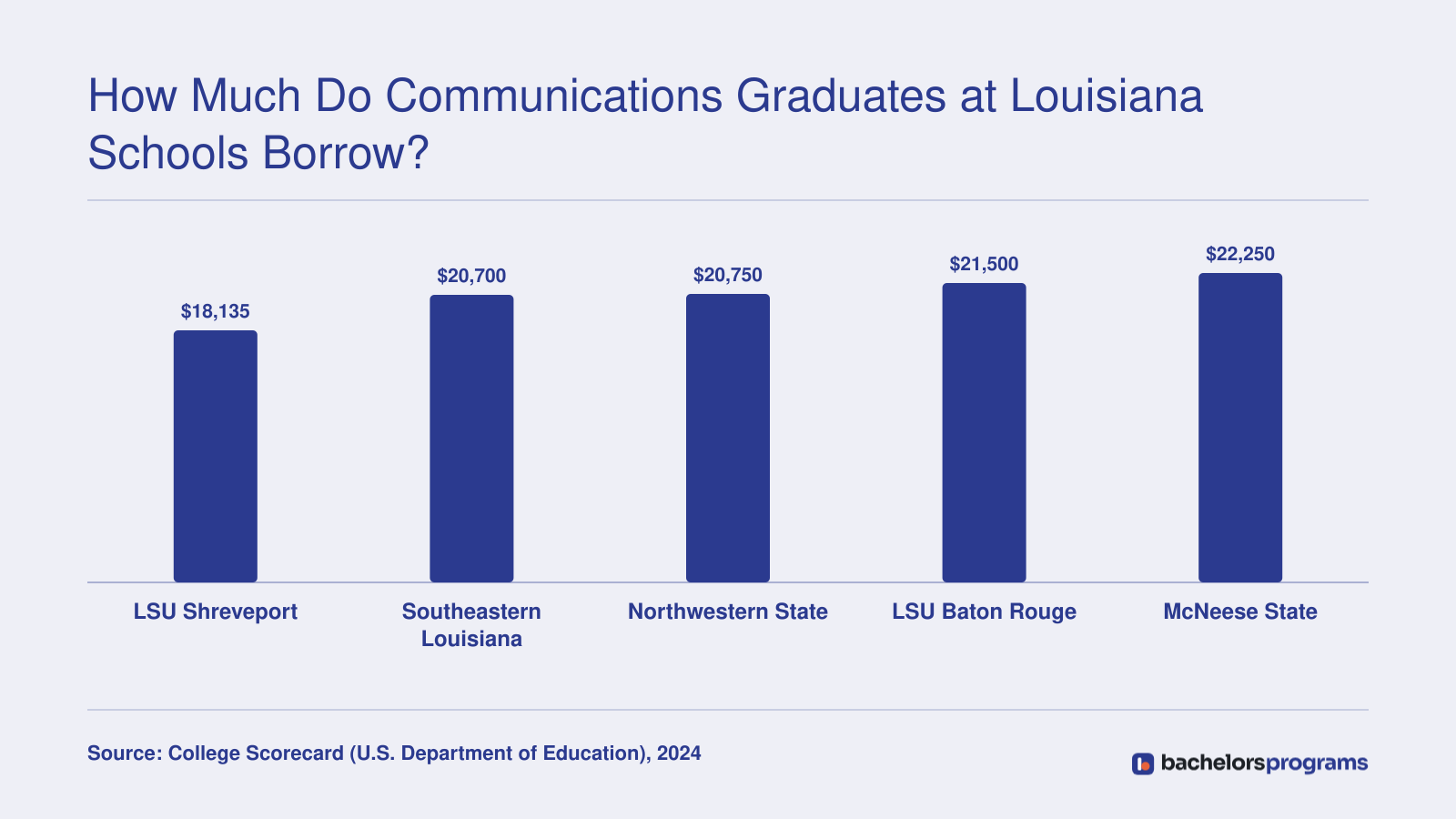
Median federal debt at completion for communications bachelor's graduates runs from $18,135 at LSU Shreveport to $22,250 at McNeese State, with Southeastern, Northwestern State and LSU in between. On a standard 10-year plan, that works out to roughly $192-$236 a month. Read these figures alongside the first-year earnings in the table above: a lower balance matters most when early pay is modest. The figures are program-level medians from College Scorecard, and not every school reports them.
Communications Concentrations: Journalism, Public Relations, Mass Communication, and More
The label on a bachelor's degree in communications matters less than the track inside it: communication studies buys flexibility, while a named mass communication or journalism concentration buys a clearer portfolio and a narrower set of first jobs.
Two families of degrees
Communication studies is the liberal arts version. It leans on rhetoric, interpersonal communication, and social analysis, which suits students aiming at law, HR, sales, or graduate school. Mass communication is applied media training: broadcasting, advertising, public relations, and journalism. Journalism focuses on reporting and storytelling; public relations and strategic communication focus on reputation, campaigns, and persuasion, with strategic communication often serving as the umbrella term.
Where the tracks show up
LSU's Manship School organizes mass communication into digital advertising, journalism, political communication, and public relations. UL Lafayette lists broadcasting and journalism concentrations and requires a senior internship plus an 18-hour minor outside communication. Northwestern State's communication degree names journalism, sports media, and strategic communication plans. Tulane's communication major reads more like social and cultural analysis than production training. McNeese's mass communication program requires an internship and points students to Poke Press, PRSSA, and SPJ.
Accreditation and experience checks
SACSCOC accredits the university, not the major. LSU A&M's institutional accreditation was reaffirmed in 2024. ACEJMC is the program-level stamp; LSU Manship was reaccredited in 20231, and Loyola New Orleans appears on ACEJMC's list.2 Ask each department which body accredits the specific communications program.
Internships vary. LSU's PR track encourages multiple internships and treats Public Relations Campaigns as a capstone, but that does not mean every concentration requires one. Louisiana Tech and Xavier list capstones. UL Lafayette names a student newspaper, Channel 1 News, and KRVS. PRSSA at LSU is a student organization, not the professional PRSA chapter, so ask what professional chapter access a program actually offers.
Questions to Ask Yourself
Do you want a hands-on journalism or broadcast track with student media, or a broader communication studies degree?
Will you stay in Louisiana after graduating, and does the school's internship network reach New Orleans, Baton Rouge, or Shreveport?
Do you need an online or hybrid format, or can you relocate to campus?
Will TOPS cover enough of the cost to make a higher-priced school worth it?
Careers in Louisiana With a Bachelor's Degree in Communications
National medians describe a communications salary in the abstract; Louisiana data shows what the work pays where you plan to live. Check the local numbers yourself before you commit to a path.
Start With BLS and O*NET
On BLS.gov, open the Occupational Employment and Wage Statistics tool and filter to Louisiana, then to the New Orleans, Baton Rouge, and Lafayette metro areas. Search by occupation title: public relations specialists, news analysts, reporters, and journalists, market research analysts, and the advertising and promotions roles. For scale, the May 2025 national medians were $74,750 for public relations specialists, $62,200 for reporters and journalists, and $78,760 for market research analysts, against $50,980 for all occupations.1 Those are U.S. numbers, not Louisiana ones.
The Occupational Outlook Handbook and O*NET help you compare duties, typical education, job outlook, and wage ranges across these roles. Then cross-check with Louisiana Workforce Commission labor market information. For general context, BLS reported Louisiana employment of 1,917,200 in March 2026, down 0.5 percent from a year earlier, with average weekly wages up 4.0 percent to $1,274.2 That covers the whole economy, not communications jobs specifically.
Use School Career Services
Program and career services pages at LSU, the University of Louisiana at Lafayette, Tulane, and Loyola New Orleans are where to look for internship pipelines, employer recruiting lists, alumni outcomes, and communications-specific job postings. Ask each office which employers hire its communications graduates and where those graduates end up.
Build Local Connections
Professional groups often show demand better than any national table:
- PRSA: Chapter events and job boards for public relations work.
- Louisiana Press Association: Newsroom openings and a window into the state's journalism market.
- American Marketing Association: Local chapters for marketing and research roles.
- Metro industry groups: Check New Orleans, Baton Rouge, and Lafayette networks for events where you can meet working professionals.
Student memberships are often cheaper, and attending a meeting or two before graduation can reveal which metro area fits your goals.
Common Questions About Communications Degrees in Louisiana
These answers draw on figures published by the schools themselves. Costs vary by school, residency, transfer credits, and fees, so confirm current numbers with each program before you apply.
What is the best communications college in Louisiana?
How much does a bachelor's degree in communications cost in Louisiana?
Can you earn a communications degree online from a Louisiana school?
What is the difference between communication studies and mass communication?
What jobs can you get with a bachelor's degree in communications in Louisiana?
Compare Communications programs on the data that matters
Explore more Communications & Media majors or browse every field of study.
All Communications & Media programs Browse every field of study